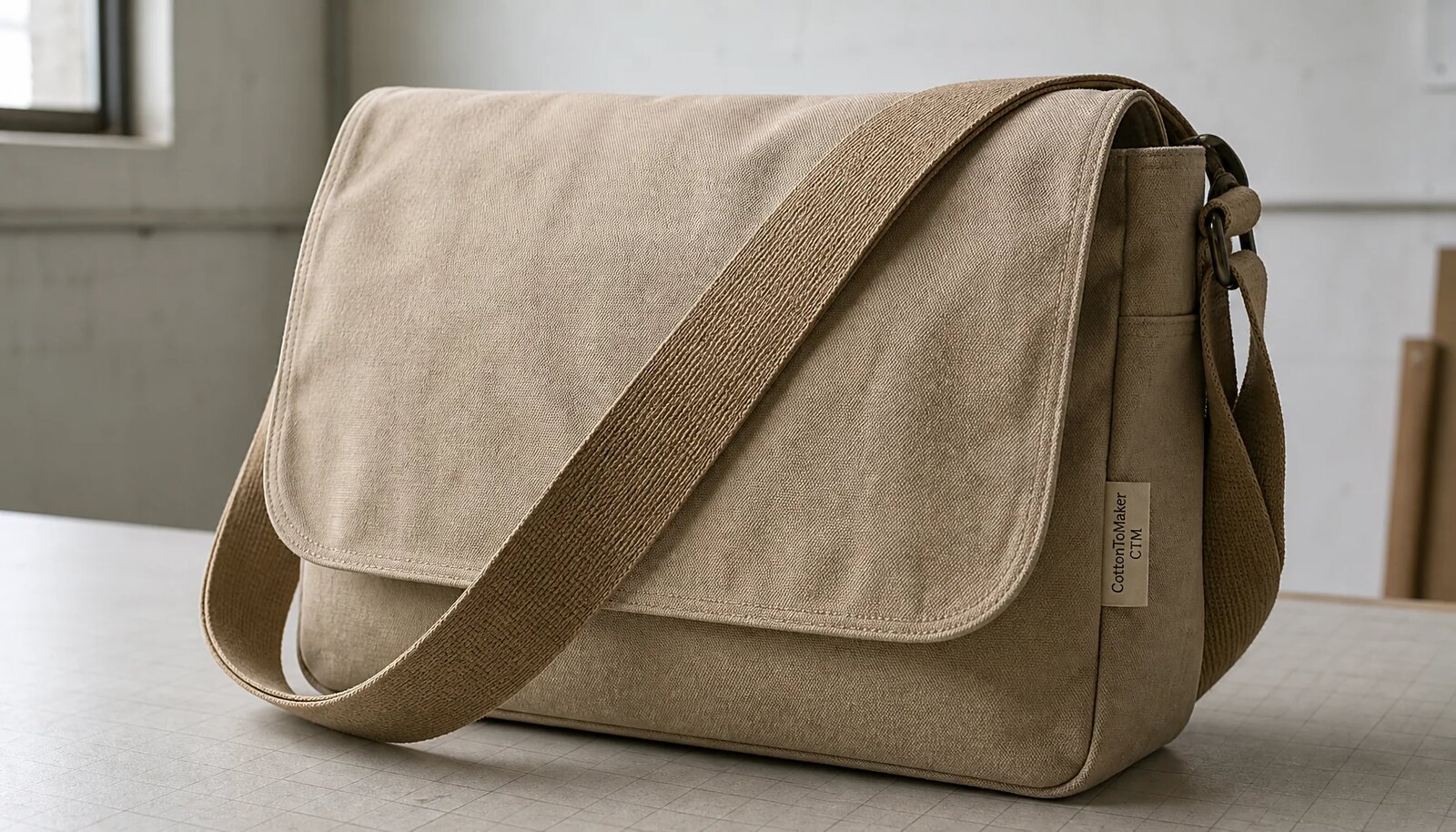
Treat Packing as Part of the Product
For wholesale canvas messenger bags used in corporate gifting, carton packing is not a warehouse detail to solve after production. It affects logo appearance, shape recovery, receiving speed, freight cube, destination sorting, and rework risk. A good sample can still become a poor shipment if the bags are folded differently in bulk, stacked too tightly, or packed under carton marks that do not match the distribution file.
Procurement should include the carton packing plan in the RFQ. State the final use, expected presentation level, shipment route, and whether the bags will be handed out empty or filled later with documents, electronics, samples, or onboarding materials. The supplier can then quote real labor, packing materials, carton size, and carton count instead of making quiet assumptions.
The most useful brief is specific enough for production, inspection, forwarding, and receiving teams to read the same way. It should show the folding sequence, strap tuck, flap direction, logo protection, inner pack rule, pieces per carton, carton dimensions, carton marks, and label fields. This is also where the long SEO phrase becomes practical: buyers sourcing wholesale canvas messenger bags for corporate gifting need a carton packing plan before the final price is meaningful.
- Define use case: event handout, employee kit, client gift, sales sample bag, or internal equipment bag.
- State presentation level: economical bulk pack, clean event-ready pack, or premium gift pack with shape support.
- Require actual packed-sample dimensions before fixing carton count.
- Put carton marks and destination labels into the RFQ, not only the shipping email.
Build the Spec Around Real Contents
Outside dimensions are not enough for a messenger bag. A bag listed as 38 cm wide may not accept a 38 cm folder once seams, lining, zipper openings, flap curve, and gusset shape are included. If the bag will carry a laptop sleeve, tablet, notebook, bottle, catalogue, charger, or welcome kit, measure those contents first and state the minimum usable internal dimensions.
Use tolerances by part. A sewn canvas body may reasonably need a wider tolerance than a printed logo position. For example, a buyer may approve body width at 38 cm plus or minus 1 cm, height at 28 cm plus or minus 1 cm, gusset at 8 cm plus or minus 0.5 cm, and logo placement within a 5 mm to 8 mm box, subject to factory confirmation. Strap length usually needs its own range because webbing and sliders behave differently from cut fabric panels.
Construction should reflect the load. Light event documents may only need clean seams and stable stitching. Laptop-oriented bags or sales kits need better stress-point control at strap anchors, zipper ends, flap corners, and bottom gussets. Ask for stitch density, bartack positions, seam allowance, webbing width, and reinforcement layers before approving the sample.
- List intended contents with dimensions and approximate filled weight.
- Specify both finished outer size and minimum usable internal size.
- Set separate tolerances for body, flap, gusset, pocket, strap, and logo position.
- Test the closure with the real contents inside, not only on an empty sample.
Choose Canvas Weight With Evidence
Canvas descriptions vary by supplier, so the quote should state ounce weight and GSM where possible. For many corporate gifting messenger bags, 10 oz to 12 oz canvas, often about 280 to 380 gsm depending on weave and finish, is a practical starting range. It gives a more substantial feel than a light tote while usually keeping sewing difficulty, folded thickness, and carton cube under control.
Heavier canvas can be right when the program needs a premium hand feel, a sharper silhouette, or stronger daily-use positioning. A 14 oz to 16 oz canvas may look more structured, but it can also resist folding, raise carton weight, and reduce pieces per carton. That tradeoff should be visible in the quote comparison.
Ask how the fabric weight is measured. Washed canvas may soften and shrink. Natural canvas may show seed flecks and shade variation. Dark dyed canvas may show lint, chalk marks, or contrast thread more clearly. Approve a physical swatch for color, weave, hand feel, and surface character, then tie the bulk order to that swatch with an agreed tolerance.
- Request GSM or ounce weight, weave, finish, and practical tolerance.
- Confirm whether weight is measured before or after washing.
- Approve a physical swatch, not only a color name such as black, navy, grey, or natural.
- Check whether heavier canvas changes folded dimensions and pieces per carton.
Decide Structure Before Pricing
Lining, interfacing, boards, and padding change both the bag and the carton plan. Polyester lining can make the product feel more finished, but it can reduce usable internal space and add sewing defects if caught poorly in seams. Interfacing can help a flap lie flatter. A bottom board can improve shape when the bag is filled, but it adds thickness in the packed state. Foam padding can support electronics but may force a lower carton count.
Do not let these choices hide inside one unit price. Ask suppliers to quote the base bag, lined version, reinforced flap, bottom board, tissue pack, individual polybag, and printed master carton as separate options. That makes it easier to see whether a feature improves recipient experience or mainly increases freight cube.
Reinforcement should be targeted. More canvas everywhere is not always better than bartacks at strap anchors, clean binding at flap edges, and secure zipper ends. For procurement, the question is not only whether the bag feels strong in the hand. It is whether the approved construction survives packing, storage, redistribution, and normal first use.
- Quote lining, interfacing, baseboard, foam, and packing materials as separate line items.
- Check folded thickness after each structure option is added.
- Use reinforcement at stress points before upgrading every panel.
- Keep the approved sample and bill of materials aligned.
Place the Logo for Transit, Not Just Approval
Logo approval should include the packed condition. Screen printing is often efficient for simple solid corporate logos, especially on a stable canvas panel. The buyer still needs controls for ink coverage, curing, registration, color match, and placement away from hard fold lines. Heat transfer can handle detail or multiple colors, but edge adhesion and heat marks must be checked on the selected canvas. Embroidery, woven labels, and patches can lift perceived value, while adding thickness and possible stacking pressure.
Placement should be reviewed with seam lines, fold lines, snaps, buckles, sliders, and zipper pulls visible. A logo that looks centered on an open flap may crease sharply in the carton. A patch near a seam may tilt after sewing. A print may rub against hardware if the strap is tucked inconsistently.
Turn brand standards into measurable instructions. Provide logo width, height, color reference, distance from edges or seams, and placement tolerance. Define whether slight canvas texture through ink is acceptable, and classify crooked logos, color mismatch, lifting edges, thread tails, or patch tilt as defects before bulk starts.
- Show logo placement on an artwork proof with fold lines and hardware positions.
- Keep printed logos away from hard creases unless the sample proves the position works.
- Specify Pantone, thread, woven-label, or patch references as applicable.
- Inspect the logo flat, folded, and after short carton-style compression.
Make the Carton Plan Checkable
A packing plan should be easy to inspect. It should state how each bag is folded, where the strap sits, whether the flap faces up or down, whether hardware is isolated from the logo, whether paper or tissue is used, and how many units belong in each inner pack and master carton. If the instructions are vague, packing will vary by line, shift, or carton closer.
Carton count should balance protection and freight efficiency. Too many bags can crush flaps, bend boards, cause bulging cartons, or make cartons too heavy to handle cleanly. Too few bags waste cube. The right count depends on finished size, canvas weight, lining, insert board, logo protection, and shipping mode. Ask the factory to test the approved folded bag and provide open-carton photos, sealed-carton photos, carton dimensions, net weight, and gross weight.
Use a simple packing matrix when there are multiple colors, logos, destinations, or kit versions. Useful fields include SKU, color, logo version, destination, pieces per inner pack, pieces per master carton, carton dimensions, carton mark, carton number sequence, barcode, country-of-origin label, pallet rule, and special notes. This matrix prevents warehouse improvisation after production is already complete.
- Approve folding sequence, strap tuck, flap direction, and logo protection.
- Record pieces per inner bundle, bundles per carton, and total pieces per carton.
- Require carton length, width, height, net weight, gross weight, and bulge limit.
- Use one packing matrix for all colors, logos, and destinations.
Use Carton Marks That Receiving Can Trust
Carton marks are procurement controls. They help receiving teams count, sort, store, and distribute bags before anyone opens the carton. A weak mark such as 'canvas bag' may be enough for a single small shipment, but it is risky for a multi-destination corporate gifting program. The mark should match the purchase order and shipping documents exactly.
A practical carton mark can include buyer name or code, PO number, SKU, item description, color, logo version, destination, quantity per carton, carton number sequence, gross weight, net weight, carton dimensions, country of origin, and barcode if required. Example: PO CTM-2406, SKU MSB-NVY-A, Navy Canvas Messenger Bag, Logo A, 25 pcs, Carton 001 of 080, Destination Chicago Office, Made in China. The exact copy should be approved before cartons are printed.
Label placement matters too. If cartons will be palletized, marks should remain visible after stacking and stretch wrapping. If cartons will be split by a fulfillment center, barcode labels should be scannable without opening cartons. If country-of-origin or compliance labels are needed, confirm whether they belong on the product, polybag, carton, or all three.
- Approve carton mark copy before carton printing starts.
- Use carton number sequences that match the packing list.
- Keep destination labels visible after palletization.
- Check barcode size, placement, and scan quality if barcodes are required.
Normalize Quotes Before Comparing Price
Messenger bag quotes often look comparable until the assumptions are separated. One supplier may include lining, screen print, polybag, printed carton, and inspection support. Another may quote an unlined bag in a plain export carton and exclude setup charges. A third may use a lower canvas weight or a carton count that has not been tested with the actual folded bag.
Normalize every quote around the same specification: canvas GSM, lining, hardware, logo method, sample basis, folding method, packing materials, pieces per carton, carton dimensions, carton mark, and Incoterm. EXW, FOB, CIF, and DDP assign costs and risks differently. Even when freight is not in the factory quote, carton size still affects landed cost.
MOQ should be checked by component. Minimums may apply by fabric color, logo version, hardware finish, lining color, label type, destination mark, or packing method. A 5,000-piece order can become several small production lots if departments, event dates, countries, or recipient groups require different marks. Ask for tiered pricing and a variation matrix so the quote reflects the real order.
- Compare quotes using the same canvas weight, logo method, and packing plan.
- Separate sample, setup, carton printing, labeling, palletizing, and inspection support costs.
- Confirm MOQ by color, logo, hardware, lining, label, and carton configuration.
- Use actual carton dimensions when estimating landed cost.
Approve Samples as Production Evidence
A pre-production sample should prove the full order, not only the sewing. It should use production-equivalent canvas, lining, hardware, thread, logo method, folding method, and packing materials. A loose table sample cannot prove that the logo will avoid rubbing, the strap will unpack cleanly, or the carton count will protect the bottom layer.
Review the sample in stages. Measure body width, height, gusset, flap depth, pocket opening, strap width, strap length, logo position, and folded dimensions. Open and close zippers, snaps, buckles, and magnetic closures several times. Fill the bag with intended contents if it is part of a kit. Then fold and stack it according to the proposed carton plan and inspect the logo face, flap shape, and hardware contact points again.
Keep the approval record written and visual. Retained samples should show fabric, logo, hardware, lining, fold state, inner pack, and carton mark. Photograph the bag open, filled if relevant, folded, inside the master carton, and with the sealed carton mark visible. Any later change to fabric lot, logo process, folding method, carton count, or label copy should trigger written approval.
- Approve the sample open, filled if relevant, folded, and packed.
- Record actual measurements against the spec sheet.
- Keep retained samples with the buyer and supplier when possible.
- Treat material, logo, fold, carton count, or label changes as revised approvals.
Set QC and Rework Rules Early
Quality control should be agreed before cutting and branding begin. Phrases such as good workmanship are not enough for a branded corporate gift. The inspection brief should cover dimensions, fabric appearance, shade, sewing, logo quality, hardware function, lining cleanliness, packing method, carton count, carton marks, and destination labels. If AQL is used, state the sampling level and acceptable quality limits in the purchase order or inspection instruction.
Defect categories should reflect business impact. Critical defects may include contamination or safety concerns. Major defects may include wrong logo color, broken zipper, missing snap, loose strap anchor, severely crooked logo, wrong carton count, mixed SKU, missing destination label, or carton marks that conflict with documents. Minor defects may include a small loose thread, slight internal lining wrinkle, or a fabric slub inside the approved canvas character.
Rework responsibility should be clear before inspection. State who pays for sorting, opening cartons, re-packing, re-labeling, replacing units, and re-inspection if the order fails agreed checks. Also define the triggers: for example, any mixed-SKU carton, wrong destination mark, failed logo rub check, carton count shortage, or strap-anchor failure may require containment before shipment. Clear triggers prevent rushed negotiation when the delivery date is already close.
- Define critical, major, and minor defects before bulk production.
- Inspect random sealed cartons as well as loose finished bags.
- Require photos of selected units, open cartons, sealed cartons, labels, dimensions, and defects.
- Agree who handles sorting, rework, relabeling, repacking, replacement, and re-inspection costs.
Specification comparison for buyers
| Specification choice | Carton packing impact | Best fit | Procurement check |
|---|---|---|---|
| 10 oz to 12 oz canvas, about 280 to 380 gsm depending on weave | Moderate folded thickness, usually easier to hold shape without wasting carton cube | Cost-balanced corporate gifts, conferences, onboarding kits, and general branded programs | Confirm GSM tolerance, whether weight is before or after washing, and folded sample dimensions before fixing pieces per carton |
| 14 oz to 16 oz canvas or reinforced canvas body | Thicker folds, higher carton weight, and possible reduction in pieces per carton | Premium gifts, laptop-oriented bags, sales kits, or programs where structure matters | Ask for carton test photos and compare landed cost using actual carton dimensions, not only unit price |
| Unlined bag with bound seams | Lower bulk and simpler folding; presentation depends heavily on clean seam finishing | Budget events, short-use giveaways, or bags for light documents | Check loose threads, seam allowance, and whether raw canvas dust transfers during packing |
| Polyester lining or internal sleeve | Adds finish and function but can reduce usable internal space and increase fold thickness | Client gifts, employee kits, laptop sleeves, or bags carrying mixed contents | Measure usable internal dimensions after lining is installed and confirm carton count with the lined sample |
| Screen print on flap or front body | Efficient packing if the print avoids hard folds and hardware contact | Simple corporate logos, solid-color artwork, and high-volume orders | Define cure standard, rub check, placement box, and whether tissue is needed between printed faces |
| Embroidery, woven label, or patch | Adds raised thickness and may require altered stacking or logo protection | Premium branding, textured logos, or longer-use gifts | Check backing, edge security, tilt tolerance, and whether raised branding marks the adjacent bag in carton |
| Individual polybag | Improves cleanliness and receiving count but adds material, handling, and disposal considerations | Multi-destination shipments, dusty routes, warehouse storage, or gift-kit assembly | Confirm bag size, warning text if needed, barcode placement, and whether air is pressed out before carton sealing |
| Tissue wrap or paper interleaf without polybag | Protects logo face with less plastic but requires consistent packing labor | Event-ready presentation where light surface protection is enough | Approve paper size, wrap position, and whether it prevents logo-to-hardware abrasion during compression |
| Printed master carton with SKU and PO marks | Speeds receiving, sorting, and destination control; reduces relabeling work | Corporate rollouts with multiple offices, departments, events, or fulfillment centers | Approve carton mark copy, carton number sequence, country-of-origin text, and barcode field before cartons are printed |
Buyer checklist before sampling
- Finished bag width, height, gusset, flap depth, pocket opening, strap width, adjustable strap length, and tolerance for each point.
- Minimum usable internal dimensions for laptop sleeve, tablet, folder, notebook, welcome-kit contents, or buyer-supplied inserts.
- Canvas ounce weight or GSM, weave type, color standard, finish, shrinkage expectation, shade tolerance, and whether fabric is washed, dyed, or pre-shrunk.
- Lining, interfacing, baseboard, flap reinforcement, edge binding, foam, padding, or internal sleeve included in the quoted unit price.
- Thread color, stitch density, seam allowance, bartack locations, strap-anchor reinforcement, and acceptable loose-thread standard.
- Logo method, logo size, placement box, color reference, setup charge, placement tolerance, and confirmation that the logo avoids hard fold lines unless approved.
- Closure type, zipper gauge, zipper puller, snap strength, buckle finish, slider finish, strap webbing width, and corrosion or colorfastness expectations if relevant.
- Approved folding sequence, strap tuck method, flap direction, hardware protection, tissue or paper wrap choice, individual polybag rule, and inner pack count.
- Master carton dimensions, pieces per carton, net weight, gross weight, carton board strength if specified, sealing method, and maximum acceptable carton bulge.
- Carton mark content, SKU code, PO number, destination, carton number sequence, country-of-origin label, barcode label if needed, and pallet requirements.
Factory quote questions to send
- What exact canvas ounce weight or GSM, weave, color standard, and finish are included in this price? What tolerance applies to GSM and shade?
- Is the quote based on production fabric, production hardware, production lining, and the same logo method planned for bulk? If anything differs, what changes?
- What finished measurement tolerances do you propose for body width, height, gusset, flap depth, strap length, logo position, folded dimensions, and carton size?
- Can you quote the same bag with no insert, tissue interleaf, bottom board, individual polybag, and printed master carton so we can compare landed cost?
- What are the open bag dimensions, usable internal dimensions, folded bag dimensions, packed carton size, net weight, gross weight, and pieces per carton?
- Which logo method is included in the unit price, what setup charge applies, and how will curing, rub resistance, alignment, adhesion, or embroidery security be checked?
- What is the MOQ per fabric color, logo version, hardware finish, lining color, label type, destination mark, and packing configuration?
- How many days are required for artwork proof, material sourcing, pre-production sample, sample revision, bulk cutting, sewing, logo application, packing, inspection, and shipment handoff?
- What AQL level or internal inspection method do you use for dimensions, stitching, logo quality, hardware function, fabric appearance, carton count, and carton marking?
- Which costs are excluded, including label printing, carton printing, hangtags, desiccants, palletizing, export documents, bank fees, inspection support, or rework labor?
Quality-control points to confirm
- Finished dimensions should be checked against buyer-approved tolerances, with separate rules for body width, height, gusset, flap depth, pocket opening, strap width, and strap length.
- Canvas weight, color, hand feel, and surface character should match the approved swatch, allowing normal canvas texture but rejecting obvious shade bands, oil marks, dye stains, holes, weak areas, or excessive slubs beyond the approved standard.
- Logo placement should remain inside the approved placement box and should not cross a seam ridge, snap, buckle, flap crease, or hard fold line unless the approved sample proves that location works.
- Screen print should be fully cured, evenly covered, correctly registered, and resistant to dry rubbing; heat transfer should show no lifting edge; embroidery should have clean borders, secure backing, and no visible thread tails on the presentation face.
- Stitching at strap anchors, handle joins, flap corners, pocket openings, zipper ends, and gusset stress points should have no skipped stitches, loose seams, broken threads, uneven bartacks, or twisting that changes the bag shape.
- Hardware, zippers, sliders, buckles, snaps, and magnetic closures should operate smoothly without snagging lining, scraping printed areas, discoloring adjacent fabric, or distorting the bag mouth.
- Lining should be clean, correctly caught in seams, free from punctures or trapped threads, and should not reduce the usable internal dimension below the agreed requirement.
- Packed bags should follow the approved folding sequence, with straps tucked consistently, hardware isolated from logo surfaces, and any tissue, paper wrap, board, or polybag applied as specified.
- Carton count should be exact, with no mixed SKUs, missing units, unapproved substitutions, or cartons that are bulging, crushed, wet, weak at the corners, or sealed with insufficient tape.
- Carton marks, PO numbers, SKU codes, destination labels, carton number sequences, barcode labels, and country-of-origin details should match the purchase order and shipping document set.