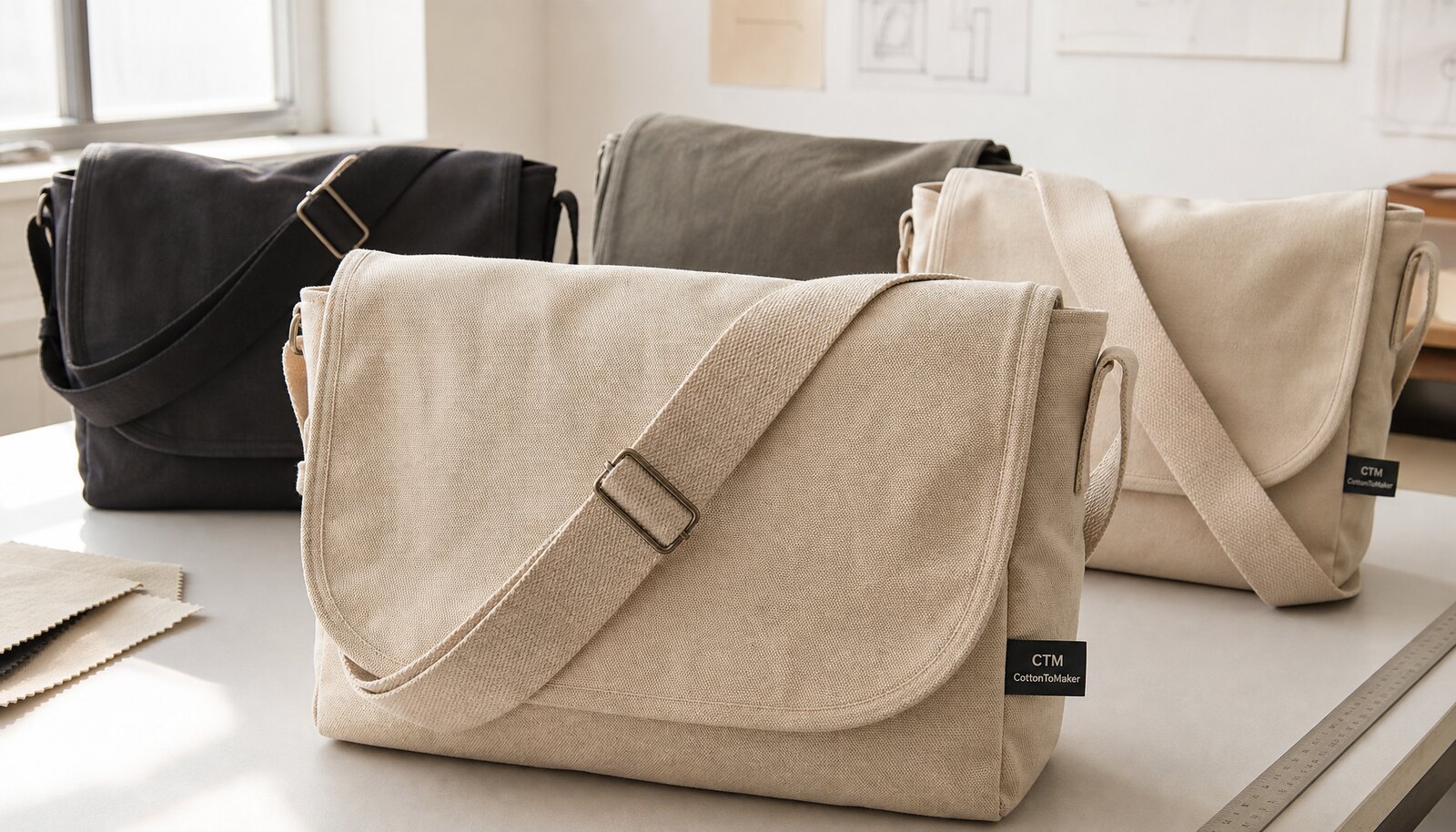
What corporate gifting buyers should optimize first
The first mistake in sourcing wholesale canvas messenger bags for corporate gifting is treating them like generic promo bags. For a gifting program, the bag has to carry more than a logo. It has to look substantial in hand, hold a useful load, and survive the first few months of daily use without frayed seams or crooked print. That means the buyer should optimize for fabric weight, structure, closure, and branding method before discussing decorative details.
A clean sourcing brief starts with the use case. An employee onboarding kit usually needs a laptop pocket and a secure top closure. A conference giveaway may prioritize low weight, lower MOQ, and fast production. A distributor order for retail resale needs stronger packaging discipline, more consistent sizing, and a sample that reflects the final carton pack. Once the use case is fixed, the rest of the quote becomes easier to compare.
- Define whether the bag is for daily commute, event gifting, retail resale, or internal company distribution.
- Set the minimum acceptable look and feel in hand, not just the printed artwork.
- Separate must-have features from nice-to-have add-ons before asking for quotes.
Canvas weight, finish, and structure
For most corporate gifting programs, 12 oz to 16 oz canvas is the practical range. Below that, the bag can feel too soft, lose shape, and telegraph low value once the logo is printed. Above that, the bag becomes heavier, more expensive to sew, and less comfortable for recipients who will carry it every day. The right point depends on whether the bag is meant to feel rugged, polished, or budget-conscious.
Ask the supplier whether the quoted weight is raw fabric weight or finished weight after washing and dyeing. That distinction matters because washing can change hand feel, shrinkage, and color consistency. If the bag needs a crisp structure, request an internal lining or stiffener panel only where needed, such as the base or front body. Avoid overbuilding the entire bag unless the use case justifies it.
- 12 oz canvas: balanced for most gifting and commuter use.
- 14 oz canvas: stronger hand feel and better shape retention.
- 16 oz canvas: suitable for higher perceived value or heavier contents.
- Washed canvas: softer appearance, but check shrinkage and color variation.
Closure, strap, and internal layout choices
The closure design drives both user experience and cost. An open-top messenger bag is cheaper and easier to sew, but it is weak on security and less suitable for documents, electronics, or premium welcome kits. A zipper closure improves protection and makes the bag feel more complete as a gift item, though it adds hardware cost and sewing time. A flap with buckle gives a more classic messenger look, but the closure should not make packing too slow on the factory line.
Strap construction is another place where quote comparisons can be misleading. A bag with a thin decorative strap and a bag with a load-bearing cotton webbing strap are not equivalent, even if the outside dimensions are identical. For corporate gifting, specify the strap width, adjuster type, reinforcement stitching, and target strap drop. If the bag is meant to carry a laptop or sample pack, ask for bar-tack reinforcement at the stress points and inspect the strap anchor in the physical sample.
- Choose zipper top when security and gift presentation matter.
- Choose flap closure when the brand wants a classic messenger style.
- Specify strap width and shoulder comfort if the bag will be used daily.
- Require reinforcement at every major load point, not only at the strap end.
Print method and logo placement that survive production
Logo decoration should be selected by artwork complexity and order volume, not by habit. Screen print is usually the best fit for one- or two-color corporate logos because it scales well and keeps unit cost under control. If the artwork has multiple colors, small text, or fine gradients, direct screen print may lose sharpness. In those cases, a woven label, embroidery patch, or heat transfer can preserve detail better, but each option changes the perceived quality and the production flow.
Do not approve logo placement from a flat artwork file alone. Ask for a production-size mockup that shows exact distance from edge, seam, and pocket line. On canvas messenger bags, print distortion often appears where the fabric folds around a seam or where the bag body is slightly curved during sewing. The buyer should insist on a physical sample with the actual logo size and the same fabric color, because a logo that looks fine on a PDF can look off-center once sewn.
- Use screen print for simple, bold branding on large order volumes.
- Use embroidery patch or woven label for finer detail or a more premium feel.
- Avoid placing small text too close to seams or stitch lines.
- Ask for artwork in the same scale as final production, not reduced concept art.
MOQ logic and how it changes your unit price
MOQ is not only a factory policy. It is the point where setup, fabric cutting, print registration, and packing labor become efficient enough to quote competitively. If you split an order across too many colors, logo placements, or packaging styles, you usually force the supplier to run multiple small lots and the unit price rises quickly. For corporate gifting, it is often smarter to standardize the bag body and vary only the insert card or outer carton label by program.
When comparing quotes, separate the true product MOQ from the order-size threshold that triggers better pricing. A factory might accept a small sample run, but the quote for 300 pieces can be much higher than the quote for 1,000 because setup labor is spread over fewer units. Ask for the price break at 500, 1,000, and 3,000 pieces if your procurement team expects repeat demand. That gives a more realistic view of landed cost and helps justify the best production lot size.
- Standardize color and logo position to reduce setup cost.
- Ask for price breaks at realistic reorder volumes.
- Treat multiple packing variants as a cost driver, not a minor detail.
- Use the same bag base across programs when possible.
A practical supplier comparison for this product
The best supplier route depends on how much control your team needs. A direct factory is usually better when you care about sample accuracy, stitching details, and packaging discipline. A trading company can be useful if you need broader sourcing support, but it may hide the real production source and make QC follow-up slower. For a branded gifting bag, the cheapest quote is often the least useful if it cannot prove fabric spec, print control, and carton accuracy.
Compare suppliers on evidence, not presentation. A serious factory can normally show previous sample photos, a measured spec sheet, print method guidance, and a packing plan. If they only answer with a unit price and a lead time, the quote is incomplete. Use the table below as a sourcing filter and remove any supplier that cannot support the spec in writing.
- Prefer direct factory sourcing when branding and sample accuracy matter.
- Use a trading route only if it adds verified sourcing value.
- Ask for measured samples and written packing data before shortlisting.
Sample approval should test the real failure points
A sample is not approved just because the logo looks correct. For canvas messenger bags, the sample needs to prove the fabric weight, the strap comfort, the zipper or buckle function, and the sewing quality at the load points. If the sample has a lining, pocket, or gusset, inspect how the fabric turns at the corners and whether the inner seams are neat enough for a gift item. A rough interior can still be acceptable for low-cost campaign bags, but it should be a conscious decision, not an accident.
Set acceptance criteria before the supplier starts production. For example, the bag should meet finished size within an agreed tolerance, the logo should align to the same reference point on each sample, and the stitch line should not wander near the top edge. If your team needs a pre-production sample, make sure it uses production fabric, production thread, and the intended packaging. A showroom sample that does not match the real line is not a reliable approval basis.
- Measure finished size, strap length, and pocket dimensions on the actual sample.
- Open and close the bag repeatedly to test hardware and seam stress.
- Inspect the interior for loose threads, exposed seams, and weak corners.
- Approve only after the sample matches the real production method.
Packing, carton planning, and warehouse impact
Packing affects freight cost more than many buyers expect. A messenger bag packed flat with a simple polybag can achieve efficient carton loading and lower carton volume. Add rigid inserts, heavy retail headers, or oversized tissue and the carton size grows fast. For a corporate gifting program, the right answer is usually the simplest pack that still protects the bag and keeps the presentation clean when opened by the recipient.
Ask the supplier to quote the pack configuration separately from the bag itself. That lets you compare bulk pack, individual polybag, barcode sticker, and retail insert as separate cost items. Also ask how many pieces fit per carton and whether the cartons are designed for export stacking. Weak cartons, poor inner packing, or inconsistent fold direction can create warehouse damage even if the bag itself is well made.
- Keep pack style simple unless the gift presentation requires more.
- Confirm carton count, carton size, and gross weight before booking freight.
- Use the same fold method in every carton to avoid warehouse variation.
- Separate product cost from packaging cost in the quote.
Lead time, risk points, and landed-cost comparison
Lead time for wholesale canvas messenger bags is usually driven by fabric readiness, print queue, and packing workload, not by sewing alone. If the supplier needs to source custom-dyed canvas or new hardware, the schedule stretches. If the logo has multiple colors or several placement points, printing becomes the bottleneck. Buyers should plan for sample approval, material booking, production, and carton inspection as separate milestones rather than assuming the date on the quote is fixed.
For landed-cost comparison, the real question is not which supplier gives the lowest ex-works price. It is which one delivers a bag that clears your internal QC, arrives in the right pack, and avoids rework at destination. A slightly higher unit price can be cheaper overall if it reduces defect sorting, repacking, or urgent air freight. The goal is to compare the total path from approved sample to usable inventory.
- Identify whether fabric, printing, or packing is the schedule bottleneck.
- Ask for milestone dates, not only a single delivery promise.
- Compare ex-works price against freight, duty, repacking, and reject risk.
- Plan a time buffer if the order includes custom fabric or multi-color branding.
Specification comparison for buyers
| Spec decision | Recommended option | When it fits | Buyer risk to check |
|---|---|---|---|
| Fabric weight | 12 oz to 16 oz washed or dyed canvas for a structured retail feel | Corporate gifting programs where the bag must look substantial and hold a laptop, files, or promotional kits | Thin 8 oz cloth can look cheap, collapse in transit, and show print distortion after sewing |
| Supplier route | Direct factory with print and assembly in one place | You need control over sample timing, branding placement, and packing details | Trading layers can hide real fabric source, add margin, and weaken accountability if print or stitching fails |
| Print method | Screen print for 1 to 2 colors, heat transfer or embroidery patch for complex branding | Simple corporate logos, branch campaigns, or budget-conscious bulk orders | Fine lines, gradients, or small text may blur; insist on a production-size artwork proof |
| Closure | Zipper top or flap with buckle depending on use case | Laptop carry, travel kits, and high-value welcome packs | Open-top bags are cheaper but less secure; buckle flaps can slow packing and increase labor |
| Strap construction | Cotton webbing strap with bar-tack reinforcement at stress points | Daily commuter use or heavier internal loads | Weak strap attachment is a common failure point; require load-bearing stitch details in the sample |
| Interior build | Simple lining with one sleeve pocket or unlined body for lower-cost campaigns | Need a cleaner internal finish or a better presentation when opened by recipients | Too many pockets increase sewing time, MOQ pressure, and QC defects around seam alignment |
| MOQ logic | Standardize one body color and one logo placement to reduce setup cost | B2B buyers comparing multiple recipient groups or regional programs | Changing fabric color, print position, and packaging in one order raises cost faster than most buyers expect |
| Packing route | Bulk polybag with carton label for price-sensitive programs; individual retail-style insert only if required | Distributor orders, event kits, and warehouse-forward fulfillment | Overpacking can raise carton size, freight cost, and repacking labor at destination |
Buyer checklist before sampling
- Confirm the end use: welcome kit, conference giveaway, employee gift, or customer loyalty pack.
- Lock fabric weight, color, and finish before asking for quotes.
- Specify print size, logo placement, number of colors, and whether the artwork must wrap across seams.
- Ask for a measurement sheet with finished size, strap length, handle drop, and pocket dimensions.
- Request a sewn pre-production sample, not only a printed artwork proof.
- Set acceptance criteria for stitch density, print registration, and strap pull strength.
- Define packing method, carton count, and carton gross weight target before production starts.
- Compare landed cost, not only ex-works price, when deciding between suppliers.
Factory quote questions to send
- What exact canvas weight do you quote, and is it finished weight before or after washing?
- What print method do you recommend for this logo, and what is the setup cost per color or location?
- What is your MOQ for one color, one logo position, and one packing style?
- Can you show a pre-production sample with the same fabric, strap, zipper, and lining structure?
- What tolerance do you allow on finished size, strap length, and print placement?
- How many bags fit per carton, and what carton size and gross weight should I use for freight planning?
- What production lead time applies after sample approval, and what events usually delay it?
- Which parts of the quote are optional, such as inner pouch, dust bag, retail insert, or barcode label?
Quality-control points to confirm
- Fabric weight should match the agreed spec within a practical supplier tolerance; do not accept an unverified lighter cloth.
- Stitching at strap anchors, side seams, and pocket corners should show even tension with no skipped stitches or loose thread tails.
- Logo position should stay within the agreed measurement from top edge and side seam on both front and back where applicable.
- Zippers, buckles, and snaps should cycle smoothly and stay aligned after repeated opening and closing.
- Finished size should be consistent across cartons, especially when the bag is intended to fit a laptop sleeve or document folder.
- Carton count and pack method should match the packing list exactly to avoid warehouse recounts and retail shortfalls.
- Sample approval should be signed only after the physical sample matches artwork, size, material, and packaging intent.