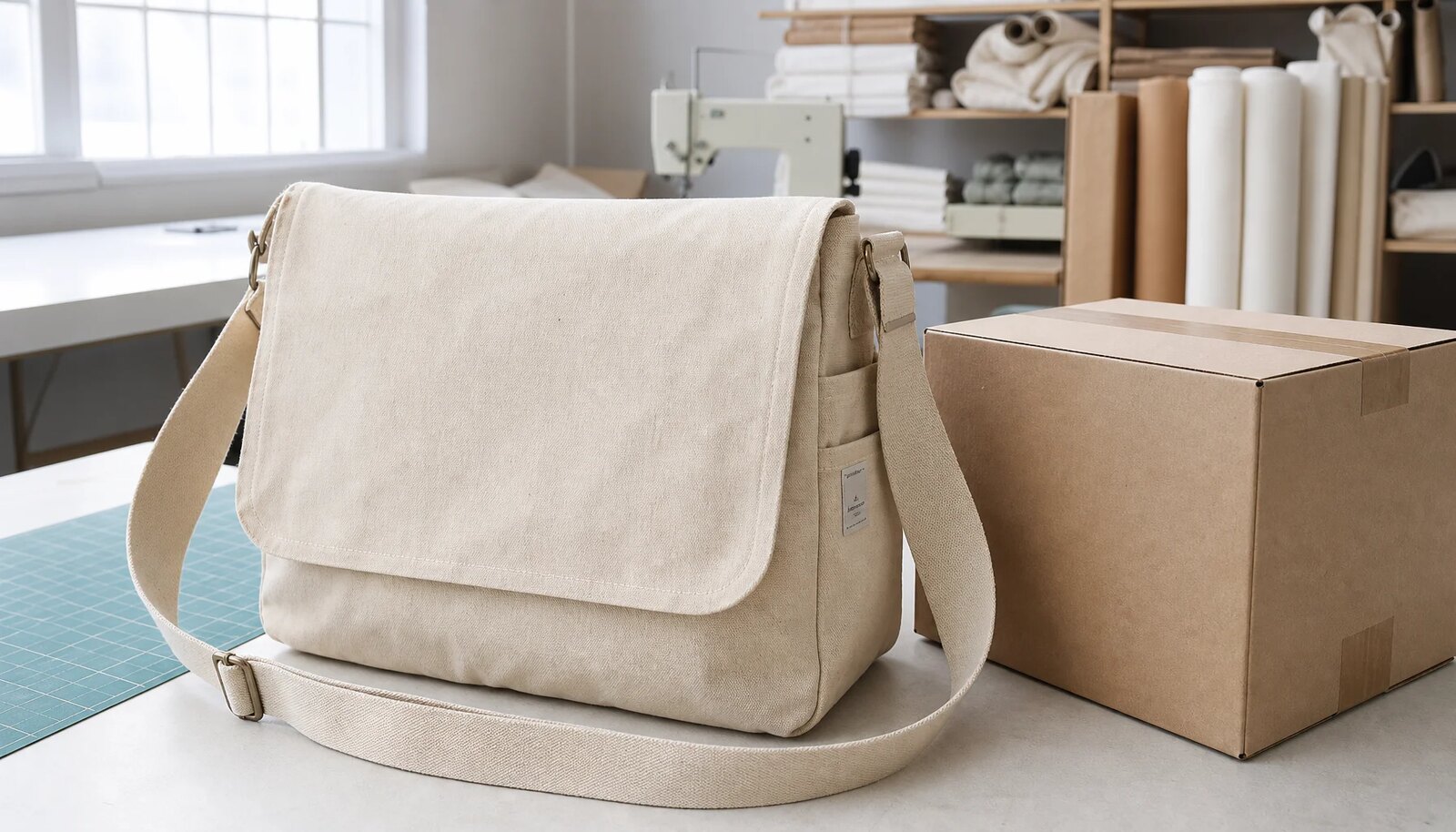
Start With the Movement Path
For procurement teams buying canvas messenger bags for farmers market programs, the product is only half the purchase. The other half is how the bags travel: from factory line to master carton, from carton to pallet, from pallet to warehouse, and finally to a vendor booth, store display, or event table. A bag that looks strong in a sample room can still become expensive if it ships in oversized cartons, arrives creased across the logo, or takes too much labor to count and split by market location.
Use the RFQ to describe the movement path before asking for the final unit price. Are cartons going to a central warehouse for seasonal allocation? Will a market association divide cartons among dozens of weekend vendors? Will the bags be resold from a booth display, handed out as sponsor kits, or used by staff carrying POS devices and receipts? Those answers change pack count, labeling, carton strength, and the acceptable level of presentation packing.
This is why wholesale canvas messenger bags for farmers market vendors shipping carton planning should read like a logistics spec as much as a product spec. The phrase is long, but the buying problem is practical: every carton choice affects landed cost, receiving time, vendor handling, and the condition of the bag at the moment it reaches a customer or staff member.
- Map the route: factory, forwarder, port or airport, warehouse, distributor, store, event site, or individual market booth.
- Identify who opens the carton first: warehouse receiver, market manager, resale staff, vendor, or end customer.
- Decide whether the carton must optimize freight cube, retail presentation, light lifting, or simple location-by-location allocation.
- Quote all suppliers on the same movement path so bag cost and carton cost can be compared honestly.
Build the Bag Around Vendor Use
Farmers market vendors usually need a messenger bag for mixed, low-weight but high-touch items. The bag may carry a receipt book, a mobile POS reader, spare labels, price cards, a cash pouch, a water bottle, sampling supplies, vendor permits, loyalty cards, or small packaged goods. If the program is resale-focused, the bag also needs to look appealing on a table without being hand-shaped every time a customer picks it up.
That use case is different from a student bag or a generic promotional tote. Messenger bags for vendors often benefit from a flap that closes cleanly, a strap that adjusts across outerwear, at least one accessible pocket for paperwork or a phone, and enough gusset depth to hold market-day items without bulging. A very soft bag may pack efficiently but collapse on display. A very structured bag may display better but reduce carton density and increase freight cost.
For resale, ask how the bag will be presented. Will it hang from a peg, lie flat in a stack, sit upright on a shelf, or be folded inside a branded carton? Booth handling matters because weekend setups are fast, surfaces are crowded, and merchandise may share space with produce, jars, flowers, baked goods, or checkout equipment. A buyer who defines the display method early can avoid paying for features that do not help the vendor and avoid cartons that create extra prep work.
- For staff carry: prioritize strap comfort, pocket access, closure security, and easy cleaning instructions.
- For resale: prioritize shape recovery after unpacking, clean logo placement, compact display stack, and consistent individual presentation.
- For event kits: prioritize fast carton opening, accurate count, and low rework at the staging table.
- For seasonal replenishment: prioritize repeatable SKU labeling, carton count consistency, and price breaks at realistic reorder volumes.
Specify Fabric Without Overclaiming
Canvas weight is a useful buying language, but it should not be treated as a universal quality guarantee. A 14 oz canvas from one mill can feel different from another if the yarn, weave, finishing, dyeing, or washing process changes. For procurement, the better approach is to state both oz and GSM where possible, define a tolerance, approve a physical swatch or sample, and inspect bulk against that agreed standard.
A lighter canvas can be appropriate for promotional or event use when the bag is not expected to carry much. A mid-weight canvas is often a practical starting point for commercial messenger bags because it balances structure, sewing cost, folded thickness, and freight. A heavier canvas can support a more premium feel, but it can also make each folded bag thicker, push carton gross weight upward, and reduce units per carton. None of these choices is automatically correct; the right answer depends on the program's expected load, price point, display method, and shipping route.
Buyers should also separate fabric weight from reinforcement. A bag made with a reasonable canvas weight but poor strap anchoring can fail faster than a slightly lighter bag with well-placed bar-tacks and clean seams. If the vendor use includes carrying POS equipment, change floats, or packaged goods, reinforce stress points instead of relying on fabric weight alone to solve the durability problem.
- Ask for actual oz and GSM, plus the allowed production tolerance used by the supplier.
- Approve fabric hand-feel, shade, weave appearance, and finishing on a physical sample before bulk production.
- Specify reinforcement at strap anchors, pocket corners, flap corners, and bottom seams where the bag will carry daily vendor items.
- Avoid buying only by a weight label; inspect dimensions, stitching, reinforcement, print, and packed condition as a complete product.
Choose Branding for Handling, Not Just Artwork
Farmers market branding often uses natural colors, sponsor marks, produce motifs, or simple market association logos. The artwork may look uncomplicated, but the production choice still matters. Screen print can be efficient for bulk orders when artwork is flat, colors are limited, and the print area does not cross seams or hard fold lines. Woven labels and sewn patches can reduce ink-related risk and work well for repeat programs with small brand marks. Embroidery can look premium, but it needs sample approval because stitch density can pull on canvas and change the way a flap or pocket lies.
Avoid broad claims such as one print method always lasts longer. Durability depends on ink system, curing, fabric finish, artwork coverage, stitch density, and use conditions. Instead, define the inspection basis. Ask the supplier to show a production-representative print on the actual fabric and agree on a simple rub, scratch, tape-pull, or wash-related check if that matters to the end channel. The method should be practical and repeatable, not just a verbal promise.
Brand placement also affects carton planning. If the main logo sits across a fold, the packed bag may arrive with a line through the artwork. If a patch is thick, it can leave pressure marks on the adjacent bag in a compressed carton. If a hangtag is attached for resale, it may tangle or bend unless the inner pack is adjusted. These are small details in design review and expensive nuisances after shipment.
- Keep logos away from hard fold lines unless the packed sample proves the fold is acceptable.
- Ask for print placement tolerance in millimeters, not only a visual mockup.
- Test branding after folding, stacking, and reopening, because market teams often sell or distribute directly from cartons.
- For sponsor-funded programs, confirm whether every artwork version has its own MOQ, setup charge, carton label, and inspection sample.
Make Carton Planning Concrete
The carton plan should be quoted before bulk production starts, not guessed at the packing table. For canvas messenger bags, the best carton count depends on finished size, gusset, fabric weight, hardware, lining, print sensitivity, and whether each unit is flat-packed, tissue-wrapped, or individually polybagged. A useful RFQ asks the factory to propose at least two carton plans and to show units per carton, carton dimensions, gross weight, net weight, and any inner packing.
A practical target for hand-lifted export cartons is often somewhere around 10-18 kg gross weight, but the correct limit depends on the buyer's warehouse rules, parcel carrier limits, and destination handling. Do not treat that range as a standard. Treat it as a starting point for discussion. A small replenishment carton may intentionally stay under 10-12 kg because a market manager will move it alone. A dense warehouse carton may run heavier if the destination accepts it and the carton structure can handle stacking.
Dimensional weight can overturn a simple actual-weight comparison. For example, a carton measuring 60 x 45 x 40 cm has a volume of 108,000 cubic centimeters. If a parcel or air carrier uses a divisor of 5,000, the dimensional weight is 21.6 kg. If the actual gross weight is 15 kg, the shipment may still be charged at 21.6 kg. With a divisor of 6,000, the dimensional weight is 18 kg. The exact divisor depends on the carrier and route, so the buyer should request the calculation basis, not assume actual weight will control freight.
Pallet planning matters for larger orders. If cartons are 60 x 45 cm on the base, they may fit a pallet differently than cartons at 55 x 42 cm. A slightly smaller carton may allow cleaner layers, less overhang, and better stack stability, even if it carries fewer units. Ask the supplier or forwarder for a pallet pattern using the destination pallet size, cartons per layer, layers per pallet, pallet height, and total units per pallet. That information turns a bag quote into a distribution quote.
- Quote a cube-efficient carton and a retail-clean carton for the same bag spec.
- Set a gross weight cap that matches the destination handling environment, not only the factory's preference.
- Request dimensional-weight examples for air, parcel, and urgent replenishment shipments.
- Ask for pallet pattern details when ordering seasonal inventory or multi-location allocations.
- Approve one packed carton sample or at least packing photos before full order release when presentation matters.
Compare Cost by Carton, Not Only Unit
Two suppliers can quote nearly identical bag prices and still deliver very different landed costs. Supplier A may pack 50 units in a compact carton with a lower cube, while Supplier B may pack 35 units with cleaner presentation but more cartons. Neither choice is automatically better. The right one depends on whether the buyer values freight efficiency, booth-ready presentation, warehouse labor, or reduced damage risk.
Build a comparison sheet with four lines for each supplier: unit product cost, packing cost, freight cost per carton, and landed cost per sellable unit. Then add non-price notes such as carton gross weight, cartons per pallet, count accuracy, packaging waste, and whether the packed bag needs steaming or reshaping before resale. This reveals the tradeoff between a neat carton and a cheap carton.
For farmers market programs, seasonal timing makes this especially important. A spring launch order may ship ocean or truck freight with pallet efficiency as the main concern. A mid-season reorder may ship by parcel or air to cover a weekend event, making dimensional weight and smaller carton handling more important. Buyers who establish both an opening-order carton plan and a replenishment carton plan can respond to demand without rebuilding the spec under pressure.
- Opening order: optimize pallet cube, carton consistency, and clean warehouse receiving.
- Mid-season reorder: optimize carton weight, direct allocation, and faster count verification.
- Retail resale: optimize individual presentation, logo protection, and low rework after unpacking.
- Sponsor or event kit: optimize carton marks, location labels, and exact allocation by market date.
Write RFQs That Suppliers Can Price Accurately
A strong RFQ does not need to be long, but it must remove the guessing. Give the supplier the finished bag sketch or reference sample, dimensions, fabric target, branding method, artwork size, quantity, colorway, packing expectation, carton target, inspection requirement, and delivery term. If you are still open to options, ask for clearly named alternatives instead of letting each supplier choose a different assumption.
The most common quote problem is that every supplier prices a different product. One supplier assumes 12 oz canvas and a bulk carton. Another assumes 14 oz canvas with individual polybags. A third uses a stock pattern with a shorter strap and a different fold. The unit prices then look comparable in a spreadsheet, but the physical bags, carton counts, and receiving labor are not comparable at all.
Use controlled alternatives. For example, ask every supplier to quote Option 1 as 14 oz natural canvas, one-color screen print, flat-packed 50 per carton, target gross weight under 18 kg. Ask Option 2 as the same bag, individually polybagged, 35 per carton, target gross weight under 16 kg. If heavier canvas or a sewn patch is being considered, make it Option 3. This keeps creativity inside a structure procurement can compare.
- Separate must-have requirements from alternates so suppliers know what cannot change.
- Ask for cost impact by fabric weight, branding method, inner pack, and carton count.
- Require carton dimensions and gross weight in the first quote, not after supplier selection.
- State the inspection plan and defect categories before the factory confirms final price.
- Ask suppliers to identify assumptions and exclusions in writing.
Approve Samples as Packed Products
A messenger bag sample approved loose on a table is not enough for a carton-driven program. The buyer should review the bag as a finished product and as a packed unit. First check the usual product details: dimensions, flap coverage, strap adjustment, pocket access, stitching, reinforcement, closure alignment, hardware finish, label placement, and print appearance. Then fold the bag the way production will fold it and inspect what happens to the logo, flap, corners, and pockets.
A packed sample is especially helpful when bags will be resold at a market booth. The team opening the carton may not have time to steam, reshape, or retag every unit. If a bag needs manual shaping to look acceptable, that should be known before the PO is released. The supplier can adjust the fold, add tissue, reduce units per carton, change the layer pattern, or use a different inner pack, but those decisions are cheaper before bulk packing begins.
For repeat programs, keep the approved sample and a packed production reference. Label it with PO number, supplier, fabric lot if known, artwork version, carton plan, and approval date. This physical reference is valuable when the next order is placed six months later and everyone remembers the same bag slightly differently.
- Review one loose sample, one folded unit, one layered stack, and one production-style packed unit when timing allows.
- Check whether print, patch, or label placement survives the approved fold without objectionable creasing or pressure marks.
- Approve the strap folding method so buckles or metal sliders do not rub printed surfaces.
- Keep a retained standard for repeat orders and for resolving disputes after delivery.
Inspect Production and Cartons Together
Quality control should cover the bag and the carton as one shipment. A normal product inspection may catch stitching defects, missing hardware, or logo placement issues, but it can miss carton-level problems such as mixed SKUs, wrong carton marks, overweight boxes, weak cartons, or pack counts that do not match the packing list. For procurement buyers, carton accuracy is not clerical detail; it controls receiving, allocation, invoicing, and customer service.
Define inspection levels before production. Many buyers use an AQL-based approach such as general inspection Level II, but the exact level, sample size, and acceptance limits should be agreed in the PO or inspection booking. Critical defects might include unsafe hardware, mildew, wrong logo, or wrong SKU. Major defects might include open seams, badly misaligned print, failed closure, incorrect dimensions outside tolerance, or cartons packed with the wrong count. Minor defects might include small thread tails or slight cosmetic variation within the approved standard.
Carton checks should include count verification, carton dimension measurement, gross weight measurement, barcode or carton mark review, and a look at stacking condition. If goods will move through parcel networks or be stacked for weeks before market season, ask whether the supplier can perform a simple carton drop, edge check, or stack check to an agreed internal method. Moisture deserves attention too: canvas packed damp or stored in humid conditions can develop odor or mildew risk, so cartons should be dry, clean, and suitable for the route.
Inspection should end with traceability. The factory should provide a final packing list, carton sequence, production photos if requested, and retained sample details. If an issue appears at receipt, procurement can then identify whether it is a product defect, packing defect, freight damage, or receiving mismatch.
- Inspect product workmanship and packed-carton accuracy in the same pre-shipment review.
- Verify carton marks and barcodes against PO, SKU, artwork version, color, quantity, and destination.
- Measure carton dimensions and gross weight against the approved carton plan.
- Open cartons from different stack positions to check whether top, middle, and bottom layers look consistent.
- Document retained samples and shipment photos before release.
Plan Replenishment Before Launch
Farmers market demand often moves with weather, tourist season, harvest calendars, sponsor campaigns, and local event schedules. A bag that sells slowly in February may move quickly during spring opening weekends or holiday markets. Procurement should treat replenishment as part of the first order plan rather than a separate scramble after inventory runs low.
Ask suppliers for realistic repeat-order MOQs and lead times at the same time as the opening quote. If the first order uses custom-dyed canvas, a special patch, or a unique strap color, a small reorder may not be economical. If the supplier can hold stock fabric or repeat a standard color, the replenishment path may be easier. The buyer should also ask whether the same carton plan can be maintained at smaller quantities, because a reduced reorder sometimes changes packing efficiency and carton marks.
For multi-location market programs, consider location allocation early. A central warehouse may prefer large dense cartons, but a market manager may prefer cartons packed by site, week, or vendor group. Splitting cartons at origin can cost more in packing labor, but it can reduce domestic handling and mistakes. The right answer depends on how many locations are involved, how often cartons are opened, and who pays for the final sorting work.
The final step is to keep the spec stable enough for repeat buying. When the approved bag, carton, label, and inspection plan are documented, the next order becomes a controlled replenishment instead of a new sourcing project. That saves time and reduces the chance that a small supplier assumption changes the bag customers already recognize.
- Request opening-order and replenishment pricing in the same RFQ.
- Confirm whether smaller repeat orders keep the same fabric, trim, print, and carton plan.
- Use site-specific carton labels when the shipment will be split across several market locations.
- Track sell-through by season so the next PO quantity is based on demand, not guesswork.
- Keep a spec sheet with bag details, carton plan, inspection notes, and approved samples for every reorder.
Specification comparison for buyers
| Carton plan scenario | Typical carton target to quote | Commercial upside | Tradeoff or control point |
|---|---|---|---|
| Flat-packed, bulk lined master carton | 40-60 bags per carton, about 55 x 42 x 35 cm, target gross weight 13-18 kg depending on fabric and hardware | Best cube efficiency for warehouse receiving, distributor staging, and seasonal replenishment orders | Confirm fold line does not cross the printed logo; inspect top and bottom layers for pressure marks after packing |
| Flat-packed with individual polybags | 30-45 bags per carton, about 58 x 45 x 38 cm, target gross weight 12-17 kg | Cleaner handling for retail resale, multi-location allocation, and cartons opened at market booths | Adds material and labor cost; verify suffocation warnings or recycling marks if required by your destination channel |
| Tissue-wrapped retail presentation pack | 25-35 bags per carton, about 60 x 46 x 40 cm, target gross weight 11-16 kg | Better first impression when vendors resell bags from a display table or shelf | Lower carton density; tissue can shift unless the fold and layer pattern are documented in the packing instruction |
| Structured bag with base board or padded pocket | 20-30 bags per carton, about 62 x 48 x 42 cm, target gross weight 12-18 kg | Protects shape for premium merchandise and better table display at markets | Higher cube; carton compression can deform pockets unless stack height and top clearance are tested |
| Small replenishment carton for direct-to-booth allocation | 10-20 bags per carton, about 45 x 35 x 30 cm, target gross weight under 10-12 kg | Easier for market managers or vendor teams to lift, count, and split by location | More cartons per order and more carton labels to manage; use only when handling labor matters more than freight cube |
| Heavy canvas or hardware-rich build | 20-35 bags per carton with gross weight capped before final dimension is chosen | Protects warehouse teams from overweight cartons and reduces split seams caused by overpacking | May increase dimensional weight; ask supplier to quote both weight-limited and cube-limited carton options |
| Parcel or air shipment trial order | Keep gross weight commonly under 15 kg and request dimensional-weight estimate using carrier formula | Useful for urgent launch samples, pre-season pilots, or split replenishment | Dimensional weight may exceed actual weight; compare packed carton size before approving air or parcel routing |
| Palletized ocean or truck shipment | Design cartons to stack cleanly on the destination pallet size, with consistent height layers | Improves pallet utilization, count accuracy, and warehouse receiving speed | Ask for pallet pattern, cartons per layer, layers per pallet, and any overhang or compression risk |
Buyer checklist before sampling
- Define the buyer role for the bag: vendor staff carry bag, resale merchandise, market welcome kit, loyalty promotion, or sponsor-branded event item.
- List the real carry contents: receipt book, small POS terminal, cash pouch, phone, water bottle, seed packets, produce samples, vendor paperwork, or light personal items.
- Lock finished dimensions, gusset depth, strap range, flap closure, pocket layout, and whether the bag must sit upright on a display table.
- State fabric weight in oz and GSM with an acceptable production tolerance instead of relying only on a sales label such as heavy canvas.
- Choose natural, bleached, dyed, washed, or recycled-content canvas and ask whether shade variation will be controlled by lot approval.
- Specify print method, artwork size, number of colors, Pantone or approved color target, placement window, and whether print may cross folds or seams.
- Request two packing quotes: one cube-efficient warehouse pack and one retail-clean pack, using the same bag spec and same order quantity.
- Set carton targets: units per carton, maximum gross weight, sample carton dimensions, inner pack style, carton board strength if relevant, and barcode or carton mark format.
- Ask for a dimensional-weight example when shipping by air, parcel, or mixed freight so the freight quote is not based on actual weight alone.
- Confirm whether cartons will be palletized, floor-loaded, or sent as parcel cartons because each route changes the best pack count.
Factory quote questions to send
- What is the actual canvas weight in oz and GSM, and what production tolerance do you use when inspecting fabric lots?
- Is the quoted canvas natural, bleached, dyed, washed, or finished in another way, and will bulk shade be matched to an approved swatch?
- What are the finished bag dimensions, gusset depth, flap size, strap width, strap adjustment range, and pocket measurements on the approved sample?
- Which reinforcement is included at the strap anchors, flap stress points, pocket corners, and bottom seams?
- Which print or branding method is quoted, how many colors are included, and what artwork size or placement changes would affect price?
- What color matching basis do you use for print approval, and what tolerance do you apply for normal production variation?
- Can you quote the same bag in two carton plans: bulk flat pack and individual polybag or retail-clean pack?
- For each carton plan, what are the units per carton, carton dimensions, estimated gross weight, net weight, and carton material specification?
- If the order ships by air or parcel, what dimensional-weight calculation should we expect using the proposed carton dimensions?
- How many cartons fit per pallet using our destination pallet size, and what are the cartons-per-layer and layers-per-pallet assumptions?
Quality-control points to confirm
- Fabric weight is checked against the agreed oz and GSM tolerance, using the approved production standard rather than a vague hand-feel description.
- Bulk fabric shade, weave appearance, slub level, and shrinkage risk are reviewed against the approved swatch or sample lot.
- Finished dimensions, gusset depth, flap coverage, pocket size, and strap adjustment range are measured against the approved spec with stated tolerances.
- Main seams, pocket edges, flap seams, and strap anchors show even stitch density, no skipped stitches, no open seams, no loose thread clusters, and no exposed raw edges unless intentionally specified.
- Bar-tacks or reinforcement stitching at stress points fully catch the required fabric layers and do not cut into the canvas or webbing.
- Hardware, snaps, magnets, buckles, sliders, zippers, and rivets operate smoothly and are correctly aligned before packing.
- Print or label placement sits within the approved position window, and color density is visually consistent across sampled units under the agreed inspection basis.
- Printed areas pass the buyer's agreed rub, scratch, or tape-pull check without obvious peeling, cracking, or heavy transfer, with the method documented before production.
- AQL inspection level is agreed in advance, commonly using general inspection Level II with buyer-defined critical, major, and minor defects unless the PO states another plan.
- Carton count matches the packing list, with no mixed artwork, mixed SKU, mixed color, or mixed packing style unless the PO specifically allows it.