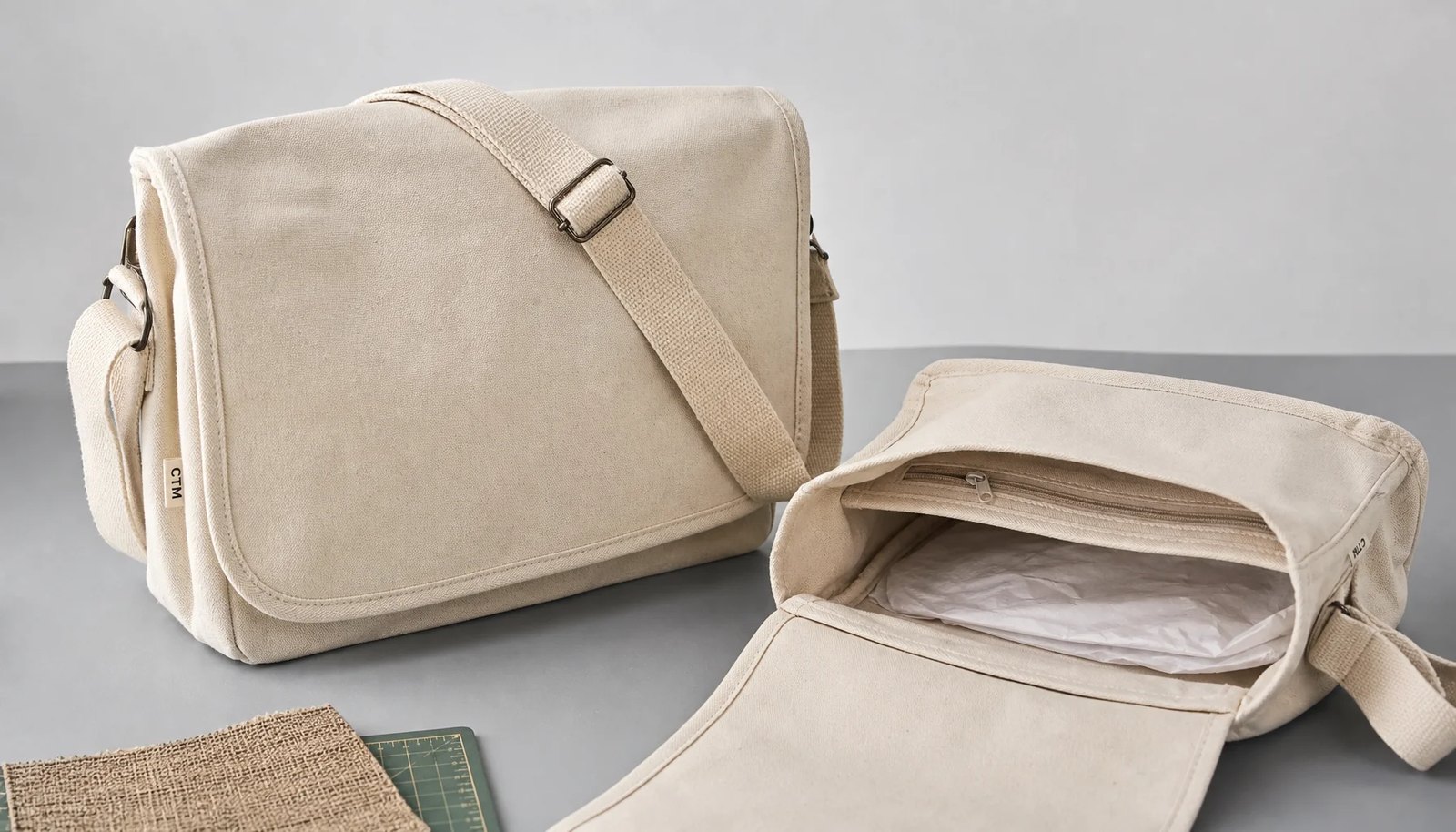
Plan Cartons Before Comparing Unit Price
A canvas messenger bag is not a flat tote. The flap, gusset, strap, reinforced anchor, closure, pocket, and printed front panel all change folded thickness. If one supplier quotes 40 pieces per carton with a tight fold and another quotes 25 pieces with tissue protection, the FOB unit prices are not directly comparable. The packing method is part of the product specification, not a logistics detail to settle after sampling.
For university bookstores, carton planning affects landed cost, receiving labor, product condition, and launch timing. Goods may move from a main receiving dock to a campus shop, satellite store, orientation tent, alumni event, department office, or campus van. A carton that saves CBM can still be the wrong choice if it is too heavy for staff, crushes flap corners, presses hardware into the canvas, or causes ink transfer on a school logo.
Build carton fields into the first RFQ. Require pieces per carton, carton dimensions, net weight, gross weight, carton count, total CBM, carton material, sealing method, carton marks, and packing method for each quantity tier. Ask for folded-unit photos and carton-loading photos before bulk approval so the quoted cube matches the bag being purchased.
- Make pieces per carton, carton size, gross weight, and total CBM mandatory quote fields.
- Compare unit price with carton count, freight cube, packing labor, and rework risk.
- Set a maximum carton gross weight if campus staff will handle cartons manually.
- Confirm whether the quote is export-ready, store-ready, or display-ready.
- Do not approve mass packing until the folding method is documented.
Define the Bookstore Use Case First
The same messenger bag silhouette can serve very different campus programs. A premium retail bag needs cleaner stitching, better shelf presentation, stronger strap anchors, and controlled logo placement. An orientation giveaway may prioritize cost, fast unpacking, and efficient cartons. A course-material bundle may need a deeper gusset and higher load confidence. The intended use should come before fabric weight, logo method, or carton quantity.
Write dimensions in measurable terms. Avoid descriptions such as standard, medium, or laptop size unless they are backed by width, height, gusset depth, flap length, pocket size, strap width, and strap length range. A common retail messenger reference might be about 36-40 cm wide, 28-32 cm high, and 8-10 cm deep, but the right size depends on what the bag must carry and how it will be displayed.
Small design changes can alter the shipping plan. A 2 cm deeper gusset improves capacity but increases folded bulk. A longer flap may look better on shelf yet require a different fold. Wider cotton webbing feels more comfortable but adds weight and can tangle unless packed consistently. Ask for both open finished dimensions and folded unit dimensions before locking carton assumptions.
- Identify the product role: retail, giveaway, alumni, department, event, or course bundle.
- State expected contents, such as tablet, notebooks, light books, apparel, or gifts.
- Use written tolerances; +/-1 cm on main sewn dimensions is a common example.
- Request folded unit dimensions before approving carton assumptions.
- Avoid adding pockets or hardware unless they support the retail price point.
Specify Canvas Weight and Finish Clearly
Canvas terms create quote errors. Some suppliers quote ounces, others quote GSM, and many use loose words such as heavy or premium. Require both ounces and GSM, while treating ranges as supplier-confirmed examples rather than universal standards. A mill might describe 10 oz cotton canvas as roughly 320-360 GSM and 12 oz as roughly 380-420 GSM, but weave, finish, and internal standards can change the number. The approved swatch should control the order.
For wholesale canvas messenger bags for university bookstores, 12 oz cotton canvas is often a practical retail option because it gives structure without making the bag unnecessarily heavy. A 10 oz canvas may fit promotional or price-sensitive programs. A 14 oz canvas can support a premium look, but it may raise sewing difficulty, unit weight, needle and thread requirements, and carton gross weight. Heavier is not automatically better.
Finish affects both appearance and packing. Natural canvas gives a classic campus look but may show seed flecks, slubs, and shade variation. Dyed canvas can support brand-color goals but may require shade-lot approval. Washed canvas feels softer but can wrinkle and pack less crisply. Bleached canvas gives a cleaner print base but may show dirt during handling. State the finish and acceptance limits before sampling.
- Require ounces and GSM, plus weave, finish, color reference, and swatch ID.
- Confirm whether fabric is stock, dyed to order, washed, bleached, or natural unfinished.
- State whether seed flecks, slubs, shade variation, or yarn irregularities are acceptable.
- Match fabric weight to load, retail price, logo method, and carton gross weight.
- Use the approved swatch, not a generic fabric description, as the control sample.
Engineer Stress Points Before Sampling
Messenger bag construction needs more detail than a flat tote specification. The flap is the main display panel. The side seams and bottom gusset carry weight. Strap anchors take repeated stress when a student swings the bag onto a shoulder. If the RFQ does not define these areas, suppliers will make different assumptions and the quotes will not match.
A practical bookstore messenger bag often includes a full front flap, one inner slip pocket, cotton webbing shoulder strap, adjustable slider, reinforced strap anchors, and either a simple closure or no closure. Magnetic snaps, buckles, zippers, padded sleeves, and dividers can add value, but they also add sewing steps, inspection points, sourcing risk, weight, and carton thickness.
Strap details deserve direct specification. A fixed strap is simpler; an adjustable strap fits more customers. For bags intended to carry notebooks or light books, a 1.25-1.5 inch cotton webbing strap is often more comfortable than a narrow strap. State strap width, length range, slider material, hardware color, stitch pattern, and reinforcement method. Then test whether the strap packs cleanly without knotting or pressing into the logo area.
- Define strap anchors as bartacks, box-X stitching, or another approved reinforcement.
- Specify stitch type, seam allowance expectation, thread color, and stitch density if required.
- State closure type: none, magnetic snap, hook-and-loop, buckle, button, or zipper.
- Check flap alignment, gusset corners, pocket openings, and load-bearing seams during sampling.
- Confirm hardware does not create pressure marks in the packed carton.
Protect Licensed Logos From Print to Carton
Most university bookstore messenger bags use screen printing because it is efficient for simple one- to three-color artwork. Water-based ink can give a softer hand on natural canvas, while other ink systems may improve opacity on darker fabrics. Heat transfer may suit detailed graphics, and embroidery can look premium, but each method brings different adhesion, handfeel, puckering, and packing risks.
Logo placement should work for retail display and carton loading. A large flap print is visible on shelf, but it is exposed to fold lines, stacking pressure, tissue decisions, and ink-transfer risk. A woven side label or hangtag may add retail detail without increasing printed surface area. For licensed marks, send vector artwork, Pantone references, print dimensions, placement from seams or flap edge, and the required approval workflow.
Print QC should match the ink system. Ask for a strike-off on the actual production fabric, not unrelated cotton. Check color, opacity, edge sharpness, registration, placement, pinholes, smearing, cracking, adhesion, and rub performance. If printed surfaces touch in the carton, require tissue or interleaving and review a packed sample after compression.
- Use screen print for simple campus artwork where cost and repeatability matter.
- Require vector files, Pantone targets, approved print size, and placement measurements.
- Avoid putting critical artwork across fold lines or hardware pressure points.
- Approve strike-offs on the actual fabric used for production.
- Confirm curing time before folding and carton loading.
Plan MOQ Around Real SKU Splits
MOQ is rarely one clean number. It may be driven by fabric availability, dye-lot minimums, cutting efficiency, logo screens, hardware color, woven labels, hangtags, barcodes, carton marks, and packing method. Natural stock canvas may support a lower minimum than custom-dyed canvas. A single one-color campus logo is easier than separate alumni, athletics, department, and event versions.
Bookstore buyers often need multiple versions for good reasons, but splits should be disclosed in the first RFQ. If extra logos or destination cartons are added after price negotiation, the supplier may need new screens, revised approvals, separate packing lists, additional carton labels, and more packing time. The order may still be workable, but the original quote is no longer accurate.
Ask for tiered pricing at 500, 1,000, 3,000, and 5,000 pieces using the same Incoterm, currency, payment terms, logo method, and packing assumption. Then ask for added cost and minimums for each extra logo, fabric color, hardware color, hangtag, barcode, and carton-mark version. For a first order, fewer splits reduce mixed-carton and label errors.
- Separate MOQ by fabric color, logo artwork, ink set, hardware, label, hangtag, and barcode.
- Ask for setup charges per logo color and repeat-run costs for reorders.
- Confirm whether cartons are single-SKU, mixed-assortment, or store-allocation cartons.
- Avoid late small splits unless revised cost and lead time are approved.
- Use barcode scans or label checks for every SKU version during final inspection.
Compare Cartons With a CBM Model
A useful carton comparison shows more than pieces per carton. It should show carton dimensions, gross weight, carton count, total CBM, packing risk, and receiving impact. The following model is only a planning example; actual values depend on bag size, canvas weight, folding method, strap, closure, polybag, and carton material. It shows why a lower unit price can lose value if packing creates damage or freight waste.
Example order: 1,000 canvas messenger bags, about 38 x 30 x 9 cm finished size, 12 oz cotton canvas, front flap screen print, cotton webbing strap, and no rigid padding. Option A packs 40 pieces per carton with a tight folded-only method in a 60 x 45 x 38 cm carton. That creates 25 cartons. Each carton is 0.1026 CBM, so total volume is about 2.57 CBM. If gross weight reaches 18-20 kg per carton, receiving may be manageable but compression risk should be reviewed.
Option B packs 25 pieces per carton with tissue at the printed flap and a looser fold in a 58 x 42 x 34 cm carton. That creates 40 cartons. Each carton is 0.0828 CBM, so total volume is about 3.31 CBM. Freight cube rises about 0.74 CBM, but carton weight drops and print or flap protection may improve. Option C uses 30 pieces per carton with individual polybags in a 60 x 45 x 36 cm carton, creating 34 cartons and about 3.30 CBM. This may help barcode receiving but adds material and unpacking waste.
- Calculate CBM as carton length x width x height in meters x carton count.
- Compare carton count and total CBM, not pieces per carton alone.
- Check gross weight against bookstore receiving limits and domestic handling rules.
- Test compression risk when packing more than 35-40 messenger bags per carton.
- Ask suppliers to show carton options when the order has premium retail presentation needs.
Choose Packing for Store-Ready Arrival
Unit packing determines how bags look when staff open the carton. A tight fold can reduce freight cube but crease the flap, distort the gusset, create strap impressions, or press hardware into the canvas. A looser fold protects appearance but increases volume. Individual polybags reduce dirt and handling marks and make barcode labeling easier, but they add cost, labor, material, and campus waste.
Decide whether the order needs export-ready, store-ready, or display-ready packing. Export-ready focuses on safe movement and efficient cartons. Store-ready may include barcode stickers, hangtags, price stickers, consistent fold orientation, and SKU separation. Display-ready should allow staff to place bags on shelves or fixtures with minimal reshaping. The more retail-ready the packing, the more detailed the quote must be.
Packing instructions should be visual. Include a reference photo or diagram showing flap position, strap fold, tissue placement, hangtag point, barcode location, polybag direction, and whether the printed surface faces inward or outward. If polybags are required, specify size, thickness if known, open or sealed format, barcode adhesion, and any warning text needed for the market.
- Choose folded-only, tissue-protected, polybagged, hangtagged, or barcode-ready packing before price comparison.
- Define barcode, hangtag, and price-sticker placement for receiving efficiency.
- Do not fold through a large print unless a packed sample proves the crease is acceptable.
- Use photos as the packing standard for bulk production and inspection.
- Confirm packing materials and labor are included in the quoted unit price.
Approve Samples and QC Standards Together
A loose sample proves only part of the order. It lets the buyer review fabric, size, stitching, print color, hardware, strap, pocket, and general appearance. It does not prove how the product will arrive after folding, compression, export handling, and domestic redistribution. For canvas messenger bags, a packed sample or carton trial is a practical requirement.
Use a staged approval path. First, approve the fabric swatch for weight, GSM, color, finish, handfeel, and surface character. Second, approve the artwork proof and strike-off on production fabric. Third, approve the pre-production sample with correct strap, hardware, label, closure, seams, and dimensions. Fourth, approve packed-unit photos or a carton trial showing fold, tissue, polybag if used, barcode, hangtag, and pieces per carton.
QC should cover incoming materials, in-line sewing, decoration, packing, and final carton checks. Fabric should be checked before cutting for stains, holes, shade bands, skewing, and weaving defects. Strap anchors, bottom gussets, flap edges, and pocket openings should be checked during production because clean repair is difficult after final assembly. Final inspection should verify measurements, print quality, closure function, barcode scans, carton marks, carton count, gross weight spot checks, and packing-list accuracy.
- Approve swatch, strike-off, pre-production sample, and packed sample before mass production.
- Keep one control sample with the factory and one with the buyer or inspection team.
- Classify defects before inspection: minor, major, and critical.
- Check print transfer after folding or compression, not only on a flat panel.
- Verify carton labels against SKU, logo version, barcode version, and allocation list.
Write the PO Around Landed-Cost Controls
The purchase order should translate the approved quote into enforceable production instructions. Include the same Incoterm, currency, payment terms, artwork revision, fabric swatch ID, sample approval reference, packing method, carton specification, and carton marks used during quotation. If these details stay only in emails, they are easier to miss during production and inspection.
For logistics planning, require the supplier to update carton data after the pre-production sample and before final booking. Actual folded thickness can differ from the early estimate, especially when canvas weight, strap width, hardware, or packing method changes. A small carton dimension change can affect LCL cost, air dimensional weight, pallet layout, and campus receiving plans.
Before shipment, reconcile the commercial invoice, packing list, carton labels, SKU list, and inspection report. The bookstore team should know carton count, total pieces, pieces per carton, gross weight range, CBM, and any mixed-carton details before goods arrive. Clear carton planning reduces receiving surprises and gives the buyer a stronger basis for reorder quotes.
- Put fabric, construction, logo, packing, and carton data directly into the PO.
- Require final carton dimensions, carton count, gross weight, and CBM before freight booking.
- Confirm carton marks include PO, SKU, logo version, quantity, carton number, weights, and dimensions.
- Match invoice, packing list, barcode file, and allocation list before shipment.
- Use the first shipment’s actual carton data to improve reorder planning.
Specification comparison for buyers
| Packing method | Typical carton impact | Best fit for bookstore orders | Tradeoff to verify before PO |
|---|---|---|---|
| Folded-only bulk pack | Usually lowest packing cost and smallest cube; may fit about 35-45 pcs per export carton depending on bag size, fabric weight, strap, and closure | Orientation giveaways, simple one-color logos, or orders where staff can reshape bags before display | Check flap creases, strap tangles, hardware pressure marks, ink transfer, and whether staff can unpack quickly |
| Tissue-protected folded pack | Adds material and labor; carton quantity may stay similar or drop slightly if tissue changes folded thickness | Retail bookstore bags with printed flaps where individual polybags are not preferred | Confirm tissue placement, print-facing direction, compression test result, and whether tissue is included in the unit price |
| Individual polybag with barcode | Often reduces pieces per carton because trapped air and stiffer packed units increase volume; adds unit packing cost | Store-ready receiving, barcode scanning, multi-SKU orders, or goods passing through several handling points | Specify polybag size, sealed or open format, warning text if required, barcode location, and campus waste preference |
| Hangtagged bulk pack | Small cube increase if tags are protected well; packing labor rises because tag placement must be consistent | Retail programs where price, story, or licensing information must be visible at receiving or on shelf | Confirm hangtag attachment point, tag protection from crushing, barcode scanability, and whether tags snag straps during unpacking |
| Looser protected packing | Fewer pieces per carton and higher CBM, but less compression on flap corners, embroidery, closures, and structured gussets | Premium bookstore merchandise, alumni shop items, embroidery, buckles, magnetic snaps, or large flap prints | Compare extra freight against lower rework, cleaner shelf presentation, and fewer crushed or marked bags |
| Inner cartons or bundles | Improves counting and allocation but may raise total cube and material cost | Department allocations, event kits, satellite stores, or orders needing controlled internal distribution | Define pieces per inner bundle, mixed-SKU rules, inner labels, and whether inner cartons fit campus storage |
| Store-allocation cartons | Can increase carton versions and packing time; total CBM may rise if small allocations create partly filled cartons | Orders split between main store, satellite shop, athletics, alumni office, event team, or departments | Require allocation list, carton marks, mixed-SKU label format, barcode verification, and pack-list match before shipment |
| Pallet-ready export cartons | May not change unit packing but affects carton grade, stacking, moisture protection, and domestic handling | LCL or warehouse receiving where cartons will be stacked, cross-docked, or stored before campus distribution | Confirm carton strength, gross weight, pallet pattern, moisture protection, and whether pallet dimensions suit the destination |
Buyer checklist before sampling
- Define the selling role first: everyday student bag, orientation giveaway, alumni merchandise, department program, athletics item, bookstore premium product, or course-material bundle.
- State finished width, height, gusset depth, flap length, pocket dimensions, strap width, strap material, adjustable strap range, and accepted tolerance for each measured point.
- Specify canvas in ounces and GSM, plus weave, finish, color reference, shade tolerance, approved swatch ID, and whether natural cotton flecks or slubs are acceptable.
- Confirm expected contents: tablet, 13 inch laptop in separate sleeve, notebooks, light textbooks, apparel, gift items, or lightweight promotional materials only.
- List strap anchor construction, reinforcement location, seam allowance expectation, stitch density target if required, and whether bartacks or box-X stitching are mandatory.
- Provide vector artwork, Pantone or brand color references, print size, placement from seams or flap edge, licensing approval workflow, and whether the mark may be folded during packing.
- Choose decoration before RFQ comparison: screen print, water-based ink, plastisol ink, heat transfer, embroidery, woven label, printed label, patch, or hangtag-only branding.
- Select packing style before comparing prices: folded-only, tissue at printed flap, individual polybag, hangtag, barcode sticker, price ticket, inner carton, store-allocation carton, or export carton only.
- Require carton dimensions in centimeters, pieces per carton, net weight, gross weight, total carton count, total CBM, carton grade, sealing method, palletization advice, and carton-mark layout.
- Ask suppliers to quote 500, 1,000, 3,000, and 5,000 pieces using the same Incoterm, currency, payment terms, logo assumptions, sample charges, and packing assumptions.
Factory quote questions to send
- What canvas weight are you quoting in ounces and GSM, and is the fabric stock, greige, dyed to order, bleached, washed, enzyme-washed, or natural unfinished cotton?
- What finished dimensions, gusset depth, flap length, pocket size, strap width, and adjustable strap length range are included, and what tolerances are assumed?
- Which construction details are included at strap anchors, flap corners, pocket openings, side seams, bottom gusset corners, and stress points?
- What stitch type, stitch density range, seam allowance, thread type, and reinforcement method are assumed for load-bearing seams?
- Which logo method is included, what is the maximum artwork size, how many print colors are included, and what are the screen, setup, strike-off, or repeat-run charges?
- Will the print strike-off be made on the actual production fabric, and what curing, dry-rub, tape-adhesion, or transfer checks will you perform before packing?
- Does the price include artwork positioning proof, pre-production sample, packed sample photos, physical sample courier cost, or a carton packing trial?
- How many pieces fit in one export carton for this exact bag size, canvas weight, folding method, closure hardware, strap placement, and retail packing style?
- What are the estimated carton dimensions, net weight, gross weight, total carton count, and total CBM for 500, 1,000, 3,000, and 5,000 pieces?
- What carton material, ply count, bursting strength or edge crush test specification if available, sealing method, moisture protection, and palletization recommendation are you assuming?
Quality-control points to confirm
- Finished bag dimensions should be checked against the approved specification for width, height, gusset, flap length, pocket size, print placement, label placement, and strap length range; +/-1 cm is a common example for main sewn body dimensions unless the buyer agrees a tighter tolerance.
- Canvas GSM, weave, color, handfeel, surface appearance, and finish should match the approved swatch; natural cotton flecks, slubs, or shade variation are acceptable only if approved before production.
- Incoming fabric panels should be inspected before sewing for stains, oil marks, holes, skewing, visible weaving defects, shade bands, excessive slubs, and cutting errors because many defects cannot be repaired after assembly.
- Printed logos should match approved artwork size, Pantone target or agreed color range, placement from seams, edge sharpness, opacity, and registration, with no obvious pinholes, smearing, ghosting, cracking, or off-center placement.
- Printed areas should pass the agreed checks for the ink system, such as dry rub, tape adhesion, cure verification, and transfer review after folding or stacking pressure before cartons are sealed.
- Strap attachment points should use the approved reinforcement method, such as box-X stitching or bartacks, with no skipped stitches, broken threads, loose thread nests, weak seam margins, or uneven strap alignment.
- Flap alignment should be centered and repeatable when the bag is closed; visible twisting, uneven flap corners, or inconsistent flap length should be classified before inspection as minor, major, or critical depending on severity.
- Closures, sliders, buckles, snaps, magnetic buttons, and zippers should be checked for smooth function, rust, sharp edges, plating consistency, pull security, and correct hardware color.
- Inner pockets, woven labels, care labels, hangtags, barcodes, price stickers, and warning labels should be verified against the buyer purchase order and packing instruction, not only against the factory worksheet.
- Packed bags should not show permanent fold marks across the logo, crushed flap corners, strap tangles, hardware pressure marks, ink transfer, moisture marks, mildew odor, or compression damage after a packing trial.