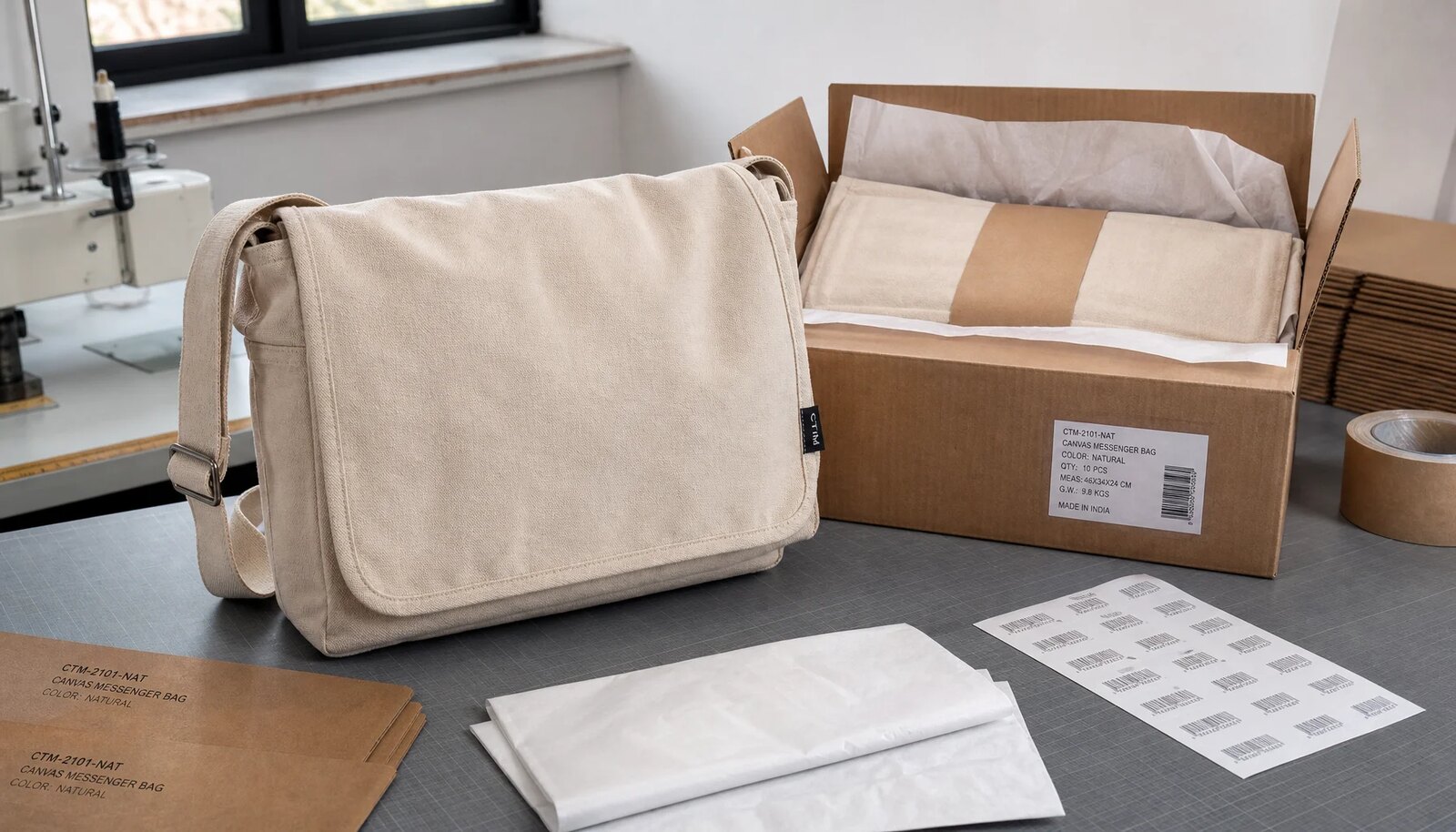
Why carton packing belongs in the product specification
A carton packing plan is not a warehouse footnote. For wholesale canvas messenger bags for eco apparel brands, it affects freight cube, landed cost, receiving speed, product presentation, and the chance of avoidable defects. A bag can pass sewing inspection and still arrive with a crushed flap, a creased logo, a bent slider, dusty canvas, or a carton label that does not match the purchase order.
Canvas has its own behavior in transit. It can hold fold lines, absorb odor, pick up dust, and show rub marks, especially on natural, black, navy, olive, washed, or pigment-dyed finishes. Messenger bags also have more moving parts than a flat tote: flap closures, adjustable straps, sliders, buckles, zippers, pockets, padded panels, and sometimes handles. If those parts are packed differently from carton to carton, the first sample carton may look fine while bulk cartons bulge or mark the product.
For procurement teams, the goal is predictability. Predictable carton dimensions let the forwarder calculate CBM with fewer surprises. Predictable pack counts help the 3PL receive goods without opening every box. Predictable folding protects front panels, logo areas, and hardware. The packing plan should be quoted, sampled, approved, inspected, and documented with the same seriousness as fabric weight or logo placement.
- Treat fold method, inner packing, carton count, carton dimensions, and carton marks as approved product specifications.
- Compare supplier quotes by landed-cost inputs, not only by bag unit price.
- Confirm whether the logo face may be folded or whether it requires a flat panel and interleaf protection.
- Require carton marks to match the PO, SKU list, packing list, destination, and barcode rules.
Start the RFQ with measurable bag construction
A reliable carton plan starts with a clear bag spec. A 12oz unlined canvas messenger bag can usually fold flatter than a 16oz lined style with a zipper, flap, buckle hardware, and internal pocket. Both may be sold as canvas messenger bags, but they are not the same sourcing item, and they should not be packed or costed as if they are.
Your RFQ should name every finished dimension and the exact measurement point. Include body width, body height, gusset depth, flap length, strap width, adjustable strap range, handle drop if used, pocket dimensions, and logo area. If the bag must carry a laptop, notebook, folded apparel, trade-show materials, or retail samples, say so. Intended contents influence fabric weight, reinforcement, lining, and hardware. Those choices then influence carton count and gross carton weight.
Canvas weight should be specified in oz and, where available, GSM. As a practical B2B range, 10oz can work for lower-cost promotional orders, 12oz is a common retail baseline, and 14oz to 16oz gives a firmer premium hand. Heavier is not automatically better; it raises material cost, sewing effort, needle stress, folded bulk, and freight weight. Lighter canvas is not automatically wrong either, but buyers should expect a softer look and more visible wrinkling.
Finish language also needs to be precise. Natural or unbleached canvas can support a low-dye, eco-positioned look, but seed flecks, slubs, and shade variation may be visible. Dyed canvas gives better color merchandising but requires shade-lot and colorfastness control. Washed or pigment-dyed canvas can feel more developed, yet it may create more variation in hand feel and finished measurements. If a water-repellent finish is requested, ask the supplier to state the finish type and any printing or care limitations.
- Quote by finished measurement and construction details, not only by reference photo.
- Include gusset, flap, closure, strap, lining, pockets, binding, labels, and hardware before asking for final price.
- Ask for fabric weight tolerance, not just a phrase such as 'heavy canvas'.
- Confirm whether bulk dimensions are measured before or after washing, dyeing, or finishing.
Specify tolerances before suppliers quote
Procurement teams often ask for better quality but leave the factory to define what that means. That is risky. For canvas messenger bags, quality should be translated into measurable limits: finished size, fabric weight, logo placement, stitch density, strap length, hardware function, carton weight, and carton dimensions.
Finished size tolerance should be realistic for sewn cotton canvas. For many messenger styles, body width and height are commonly controlled around ±1 cm for compact bags and ±1.5 cm for larger bags unless the buyer requires a tighter standard. Gusset depth, pocket size, and flap alignment need their own checks because they affect both appearance and packed shape. Strap length tolerance should be set by function; even when a strap is adjustable, the minimum and maximum usable range still matter.
Logo placement deserves separate attention. A print drifting 15 mm might be acceptable on a casual giveaway tote, but it can look wrong on a centered messenger flap. State the distance from the top edge, side seam, flap edge, or pocket line. Use ruler photos for sample approval and inspection. Decoration tolerances should also cover multi-color registration, edge sharpness, color density, embroidery puckering, and label angle.
Carton tolerances are just as important. The approved carton size should not change without buyer approval because freight quotations may depend on it. Gross carton weight should stay inside the agreed range, especially if the buyer's warehouse or 3PL has manual handling limits. If the approved carton count is 20 pieces, inspection must verify 20 pieces, not simply confirm that the carton looks full.
- Write tolerances into the PO, tech pack, or inspection checklist before bulk cutting.
- Use ruler photos for measurement points and logo placement approval.
- Set maximum gross weight per carton and require carton dimensions on the packing list.
- Do not accept carton count changes unless the SKU, carton number, and reason are documented.
Match logo method to artwork, handling, and reorders
Decoration is one of the fastest ways for canvas messenger bag quotes to become hard to compare. Screen printing, heat transfer, embroidery, woven labels, and sewn patches can all work, but they do not carry the same setup cost, production speed, defect risk, or packing requirement. A factory quoting a one-color screen print is not quoting the same product as a supplier quoting a full-color transfer or embroidery.
Screen printing is often efficient for simple repeat artwork, bold brand marks, and one- to three-color graphics. Buyers should specify print size, color references, location, placement tolerance from seams, and whether the print sits on the flap, front panel, side panel, or pocket. Poor curing can cause tackiness, cracking, or color transfer, so print dryness and rub resistance should be checked before bags are packed.
Heat transfer can make sense for short runs, gradients, or multi-color artwork. Still, buyers should ask about hand feel, edge finish, adhesion, and fold performance. Transfers placed across a hard fold line may crack or lift if carton pressure is high. Embroidery gives a premium look and strong durability, but it adds needle holes, thread bulk, and possible puckering on lighter canvas. Woven labels and sewn patches are often practical for eco apparel brands because they keep branding consistent with less surface ink.
Decoration should influence the packing plan. Logo-to-logo stacking can scuff some prints. Hardware pressing against a printed flap can leave dents or rub marks. Embroidery creates raised areas that may need looser packing. For repeat private-label SKUs, choose a method that can be reproduced across future orders with the same placement, color, and protection standard.
- Screen print: best for simple repeat logos; confirm curing, opacity, registration, and rub resistance.
- Heat transfer: useful for complex artwork; confirm fold resistance and edge adhesion.
- Embroidery: premium appearance; check puckering, backing, thread trimming, and added bulk.
- Woven label or patch: good for consistent branding; control label position and stitch neatness.
Approve the packing format with the pre-production sample
Do not approve a loose sample and leave packing for later. That sequence invites trouble. The factory may choose a fold that saves labor but creases the logo, overfill cartons to meet a low freight estimate, or bulk pack unprotected canvas that rubs during transit. A complete pre-production approval should include the finished bag, inner packing, fold direction, carton count, master carton dimensions, and carton mark layout.
Common inner packing formats include individual polybag, reduced polybag, paper band, tissue wrap, and bulk pack. Individual polybags improve dust protection, barcode control, and 3PL receiving, but they add material and may conflict with reduced-plastic goals. Paper bands and tissue can align better with eco apparel positioning, but they provide less moisture protection and may not control loose straps. Bulk packing reduces packaging material, yet it requires clean cartons, careful folding, and a receiving team that can process units without individual barcodes.
The fold method should protect the most visible panel. If the logo is on the flap, avoid a hard fold through the artwork. If sliders, D-rings, buckles, or zipper pulls are present, place them away from the decorated face. Define whether the shoulder strap is shortened, laid flat, tucked inside, wrapped in tissue, or secured with a paper band. These small decisions determine whether cartons look consistent when production scales.
A useful packing trial uses final or near-final materials. The factory should pack the proposed quantity into the proposed carton, close it, weigh it, measure it, photograph the layers, and then reopen the carton to check creasing and pressure marks. For ocean shipments, carton strength, moisture exposure, and long compression time deserve more attention. For air or courier, dimensional weight and gross carton weight may drive the cost comparison.
- Approve the sample only after reviewing fold direction and packed-carton condition.
- Choose polybag, reduced polybag, paper band, tissue, or bulk pack based on channel requirements and risk.
- Keep hardware away from the logo face and front flap during stacking.
- Require photos of open carton layers, closed carton marks, dimensions, and gross weight.
Set carton pack count from real folded dimensions
There is no universal carton count for canvas messenger bags. A compact unlined bag may fit 30 or 40 pieces in a master carton. A larger lined style with hardware may need 10 to 20 pieces to avoid compression damage. The correct count depends on finished size, fabric weight, gusset, lining, closure, strap bulk, individual packing, carton strength, and the buyer's maximum carton weight.
The supplier's recommended count should be tested against three limits: fit, strength, and warehouse usability. Fit means bags sit cleanly without forced closure, bulging panels, crushed flap corners, or bent hardware. Strength means the carton can survive stacking and normal handling without collapsing. Warehouse usability means the carton count is easy to receive, scan, store, and allocate. A carton that saves cube but is too heavy, too mixed, or too difficult to identify is not automatically better.
Pack count changes how quotes should be compared. Supplier A may quote 40 pieces per carton and look freight-efficient. If those cartons are overstuffed, the buyer may later pay through rework, steaming, repacking, or customer complaints. Supplier B may quote 20 pieces per carton and protect the product better, but create more cartons and handling cost. Procurement should ask for carton dimensions, net weight, gross weight, and CBM per carton before deciding.
SKU complexity also shapes carton planning. One body color and one logo version can use simple single-SKU cartons. A program with four colors, two print versions, and multiple destinations needs stricter labeling and may need separate carton counts by SKU. If mixed cartons are unavoidable, the exact SKU breakdown should appear on the carton label and packing list.
- Measure the actual folded bag with strap, lining, labels, and hardware included.
- Ask for carton dimensions, gross weight, net weight, CBM per carton, and carton count in every serious quote.
- Keep gross carton weight within buyer or 3PL handling limits, often around 15-20 kg unless otherwise approved.
- Avoid mixed-SKU cartons unless the receiving warehouse has approved the exact breakdown format.
Use MOQ logic to avoid hidden setup charges
MOQ is not only a sales threshold. It reflects fabric sourcing, dye lot, cutting efficiency, decoration setup, trim purchasing, hardware minimums, line changeover, label printing, and packing organization. A factory may accept a total order of 1,000 units, but the economics change quickly if that order is split into five body colors, three logo versions, two strap colors, and two destinations.
Ask for MOQ by variable. Fabric color may require a minimum dye lot. Screen printing usually has setup by artwork and color. Hardware finish may have minimum purchase quantities. Lining, zipper tape, woven labels, hangtags, unit barcodes, and custom carton marks can each create separate work. If a quote only says 'MOQ 500 pcs' without explaining the variables, it may not protect the buyer from later charges.
A strong RFQ includes a SKU matrix. Each line should show style number, body color, fabric weight, finish, logo method, logo colors, trim color, lining, target quantity, destination, and packing format. Ask the supplier which SKUs can share fabric, trims, labels, screens, or cartons. Then procurement can decide whether to simplify the program, increase one color, combine destinations, or stage the order.
MOQ also affects QC risk. Fragmented orders create more opportunities for wrong labels, mixed colors, print placement drift, missing barcode stickers, and carton mark errors. If merchandising requires several colorways, compensate with clearer carton labels, separate production records, and inspection sampling from each SKU rather than only from the total order.
- Request MOQ by fabric color, print version, trim color, lining, hardware finish, and packing style.
- Separate setup charges from unit cost so reorders can be forecast accurately.
- Provide a SKU matrix instead of one total quantity.
- Simplify small color or artwork splits when they add more risk than commercial value.
Compare supplier routes by control and documentation
The sourcing route affects how much control the buyer has over materials, sewing, decoration, inspection, and carton packing. Direct factory sourcing is often strongest for repeat private-label canvas messenger bags because the specification can be locked at the production source. This route is useful when fabric weight, stitch reinforcement, logo placement, carton count, and reorder consistency matter.
A trading company can help when the buyer needs several bag types, mixed accessories, or category consolidation. Traders may support communication, documentation, and supplier coordination. The tradeoff is reduced direct visibility into the production floor. Buyers should ask whether the trader can provide factory-level inspection photos, identify where the goods are made, and keep approved samples at the actual sewing and packing site.
A stockist or local distributor can solve urgent replenishment needs. Delivery may be faster and planning may be simpler, but the spec is usually limited to available stock colors, standard sizes, and standard decoration methods. Carton packing may already be fixed. That can be acceptable for small urgent orders, but it is limiting for retail-ready programs that need consistent carton marks, unit barcodes, or exact pack counts.
When comparing routes, ask who owns the carton decision. If the sales contact cannot answer how many pieces fit per carton, what the gross weight is, what carton dimensions are used, or how the front flap is folded, the quotation is incomplete. A B2B supplier should be able to explain the operational logic behind packing, inspection, documentation, and shipment readiness.
- Use direct factories when repeat consistency and packing control matter most.
- Use traders when consolidation and coordination across products are more important than deep factory control.
- Use stockists for urgent or small replenishment where standard specs and packing are acceptable.
- Require every route to document carton size, count, weight, inner packing, and inspection responsibility.
Lock inspection standards before bulk cutting
Quality control works best before bulk cutting begins. Once fabric is cut, printed, and sewn, defects are harder and more expensive to correct. For canvas messenger bags, inspection standards should cover fabric weight, shade, shrinkage, finished measurements, stitch quality, strap strength, logo placement, hardware function, odor, cleanliness, barcode accuracy, carton marks, and carton condition.
Classify defects as critical, major, and minor. Critical defects usually include broken straps, unsafe hardware, missing closures, wrong logo, wrong SKU, unreadable barcode, severe odor, mildew, or missing carton marks. Major defects include obvious measurement drift, weak seams, poor print coverage, heavy logo creasing, damaged cartons, or hardware that does not function smoothly. Minor defects may include isolated loose threads, minor canvas slubs within the approved standard, or small alignment variation inside tolerance.
Inspection should happen in stages. Fabric inspection before cutting checks weight, shade, stains, and finish. In-line sewing inspection checks strap points, flap alignment, pocket attachment, seam allowance, and stitch density. Decoration inspection checks logo position, color, curing, registration, and cleanliness before packing hides the panel. Final inspection checks finished measurements, function, labeling, carton count, carton marks, and packed condition.
For higher-value programs, add simple repeatable performance checks. A strap load check can expose weak bartacks. A zipper cycle check can identify rough sliders. A snap pull check can reveal loose magnetic closures. A print rub check can show poor curing or transfer adhesion. A packed-carton compression review can reveal whether fold lines, hardware ridges, or overfilled cartons will create receiving complaints.
- Define critical, major, and minor defects in writing before production starts.
- Inspect fabric before cutting, decoration before packing, and cartons after final packing.
- Sample from different production times and SKUs, not only the first finished pieces.
- Document defects with photos showing scale, measurement point, SKU, and carton number.
Design carton marks for receiving accuracy
Carton marks look simple, but they carry a lot of operational weight. If marks are unclear, missing, or inconsistent with the packing list, the warehouse may need to open cartons to confirm contents. That slows receiving, increases handling, and can disturb the approved fold presentation. For procurement buyers, carton marking should be controlled as carefully as hangtags, care labels, and barcodes.
A practical master carton mark should include buyer name or code, PO number, style number, SKU, color, quantity, carton number, total cartons, gross weight, net weight, carton dimensions, destination, and country of origin if required. If the buyer uses barcodes, confirm barcode type, scan size, label position, and whether the unit, inner pack, and master carton each require separate labels.
Avoid vague descriptions such as 'assorted canvas bags' unless the warehouse has approved that format. If cartons are single-SKU, make the SKU visible. If mixed cartons are unavoidable, print or attach a clear breakdown showing exact quantity by SKU, color, and logo version. The more information a carton provides without opening, the lower the inbound error risk.
Carton marks should match export and receiving documents. The SKU description on the carton, packing list, commercial invoice, and buyer PO should use the same naming. Differences such as natural versus beige, black strap versus black body, or large versus standard can create avoidable confusion. Approve the carton mark layout before bulk packing so the factory is not inventing a format at shipment deadline.
- Include PO, style, SKU, color, quantity, carton number, weights, dimensions, and destination where required.
- Confirm unit barcode, inner pack barcode, and master carton barcode requirements separately.
- Use mixed cartons only with written SKU breakdown and warehouse approval.
- Compare carton marks against the packing list before shipment release.
Specification comparison for buyers
| Spec decision | Recommended option | When it fits | Buyer risk to check |
|---|---|---|---|
| Canvas weight | 10oz for low-cost promotional use; 12oz as a retail baseline; 14oz-16oz for firmer premium messenger bags | Use 12oz when the buyer needs structure, print stability, and manageable carton weight; move heavier only when the target retail price supports it | Confirm fabric weight before cutting by swatch or roll record. Do not rely on finished bag weight because lining, hardware, straps, and packing distort the number |
| Fabric weight tolerance | Ask supplier to state tolerance in oz or GSM, commonly ±5% for greige or finished canvas unless a tighter standard is agreed | Useful when comparing quotes from multiple factories that may use different mills or finishing routes | A quote for '12oz canvas' without tolerance can hide downgraded cloth, shrinkage after washing, or substitution during reorder |
| Canvas finish | Natural/unbleached for low-dye positioning; dyed canvas for color merchandising; washed canvas for softer hand feel; water-repellent finish only when needed | Choose based on brand positioning, color program, care claim, and expected use | Natural canvas has seed specks and shade variation; dyed and washed canvas require shade-lot control, shrinkage review, and colorfastness checks |
| Finished size and gusset | Specify body width, height, gusset depth, flap length, pocket size, and strap range with measurement points | Required for all B2B RFQs because carton cube depends on real folded dimensions | Loose dimensions cause wrong carton count, poor fit, inconsistent folding, and disputes during final inspection |
| Closure system | Zipper or flap with magnetic snap for commuter use; buckle straps for heritage styling; open top only for budget or event programs | Match closure to security need, labor budget, and retail promise | Closures add failure points. Check zipper smoothness, snap pull-out risk, buckle plating, and pressure marks inside the carton |
| Strap construction | 38-50 mm cotton webbing or canvas strap with box-X stitching and bartacks at load points; adjustable slider for daily-use SKUs | Best for work, campus, travel, and apparel brand merchandise intended for repeated use | Thin webbing, weak bartacks, poor strap angle, and inadequate seam allowance can create early returns |
| Logo method | Screen print for simple repeat artwork; heat transfer for short runs or multi-color graphics; embroidery or woven label for premium branding | Select by order volume, artwork complexity, surface hand feel, and reorder plan | Check curing, rub resistance, registration, embroidery puckering, label placement, and whether the logo face may be folded |
| Lining and pockets | Unlined for value orders; cotton twill or polyester lining with inside pocket for retail programs; padded pocket only if specified | Use lining when inside finish, small-item organization, or product tier requires it | Lining increases sewing time, inspection points, folded bulk, and may reduce pieces per carton |
| Individual packing | Paper band or tissue for reduced-plastic programs; reduced polybag or full polybag when barcode control, dust protection, or 3PL receiving requires it | Choose according to warehouse receiving rules, sustainability policy, moisture risk, and channel requirements | Minimal packing can expose canvas to dust and moisture; polybagging may conflict with packaging goals and adds cost |
Buyer checklist before sampling
- Confirm finished bag size with measurement points: body width, body height, gusset depth, flap length, pocket dimensions, handle drop if any, strap width, and adjustable strap range.
- Specify canvas weight in oz and, if available, GSM equivalent; require the supplier to state fabric weight tolerance, shrinkage expectation after finishing, and whether weight is measured before or after washing.
- Define fabric status clearly: greige, natural/unbleached, bleached, yarn-dyed, piece-dyed, washed, enzyme-washed, pigment-dyed, or water-repellent finished.
- State all construction details before quoting: flap shape, closure type, zipper length and tape color, magnetic snap size, buckle type, D-ring size, slider finish, binding, lining, inside pocket, padding, labels, and hangtags.
- Provide logo artwork with print size, color references, placement distance from seams, orientation, color count, artwork repeat requirements, and whether the decorated panel is allowed to fold during packing.
- Share target order quantity by SKU, body color, logo version, trim color, destination, and packing format so MOQ is calculated by real production variable rather than averaged across the total order.
- Ask suppliers to quote bag unit cost, decoration cost, trim upgrades, individual packing cost, master carton cost, sample cost, mold or screen setup, barcode label cost, and any repacking charge as separate line items.
- Specify target carton pack count, acceptable master carton dimension range, maximum gross weight per carton, carton board requirement, carton mark format, palletization need, and whether mixed-SKU cartons are allowed.
- Request one pre-production sample made with final fabric, final logo method, final trims, final label placement, and a packing trial using the proposed fold direction, inner packing, and carton count.
- Set written acceptance criteria for measurements, stitch density, seam strength, strap load, print placement, print curing, hardware function, odor, cleanliness, barcode accuracy, carton marks, and visible crease marks.
Factory quote questions to send
- What exact canvas weight are you quoting in oz and GSM, and what tolerance do you control before cutting and after finishing?
- Is the quoted fabric stock fabric, greige fabric for dyeing, or custom finished fabric, and can all units in one SKU be cut from the same shade lot where practical?
- What shrinkage, shade variation, and hand-feel change should we expect if the canvas is washed, pigment-dyed, or enzyme-treated?
- Does your quotation include screen setup, artwork adjustment, color matching, one pre-production sample, and one carton packing trial? If not, list each charge separately.
- Which logo method is included in the quote, and what checks do you perform for print curing, adhesion, rub resistance, registration, embroidery puckering, or label placement?
- What MOQ applies by fabric color, print version, trim color, hardware finish, lining option, and packing configuration?
- What is your recommended carton pack count for this exact bag size, and what folded bag dimensions did you use to calculate it?
- What master carton dimensions, carton board type or strength, net weight, gross weight, and estimated CBM per carton are you quoting?
- Can you quote one product-protection pack option and one freight-optimized pack option so we can compare landed cost and receiving risk?
- Will each bag be polybagged, reduced-polybagged, paper banded, tissue wrapped, or bulk packed, and how will the logo face be protected from scuffing and hardware pressure?
Quality-control points to confirm
- Finished measurement tolerance: body width and height should normally stay within ±1 cm for compact messenger bags and ±1.5 cm for larger styles unless the buyer specification is tighter; gusset depth, flap length, and pocket size need separate tolerances.
- Fabric weight verification: record canvas weight before cutting by swatch or roll sample. Finished bag weight is not a valid substitute because lining, hardware, straps, and packing change the result.
- Shade and finish control: compare bulk fabric to the approved swatch under consistent lighting; check natural, black, navy, olive, washed, and pigment-dyed shades carefully because lot variation is common.
- Shrinkage review: for washed or dyed canvas, confirm whether dimensions are measured after finishing and whether the approved sample reflects the final process.
- Stitching quality: inspect seam density, skipped stitches, broken threads, bartacks, box-X reinforcement, loose threads, edge binding, folded seam allowance, and strap attachment at stress points.
- Strap and hardware function: cycle zippers, snaps, buckles, sliders, D-rings, and adjustable straps on representative samples from the batch; check burrs, plating scratches, pull-out risk, and rough slider movement.
- Print and label placement: verify logo centering, color density, edge sharpness, curing, registration, embroidery puckering, woven label position, distance from seams, and whether bulk placement matches the approved sample.
- Load check: test representative pieces with a defined weight and time period agreed in the buyer spec; document strap stitching, seam distortion, and hardware performance after loading.
- Carton compression review: open test cartons after packed storage or simulated pressure and confirm folded bags do not create hard ridges through the front panel, logo area, zipper teeth, flap edge, or bag corners.
- Odor and cleanliness: check for solvent smell, mildew odor, oil stains, cutting dust, chalk marks, metal burrs, thread piles, dirty tissue, and contaminated cartons before shipment.