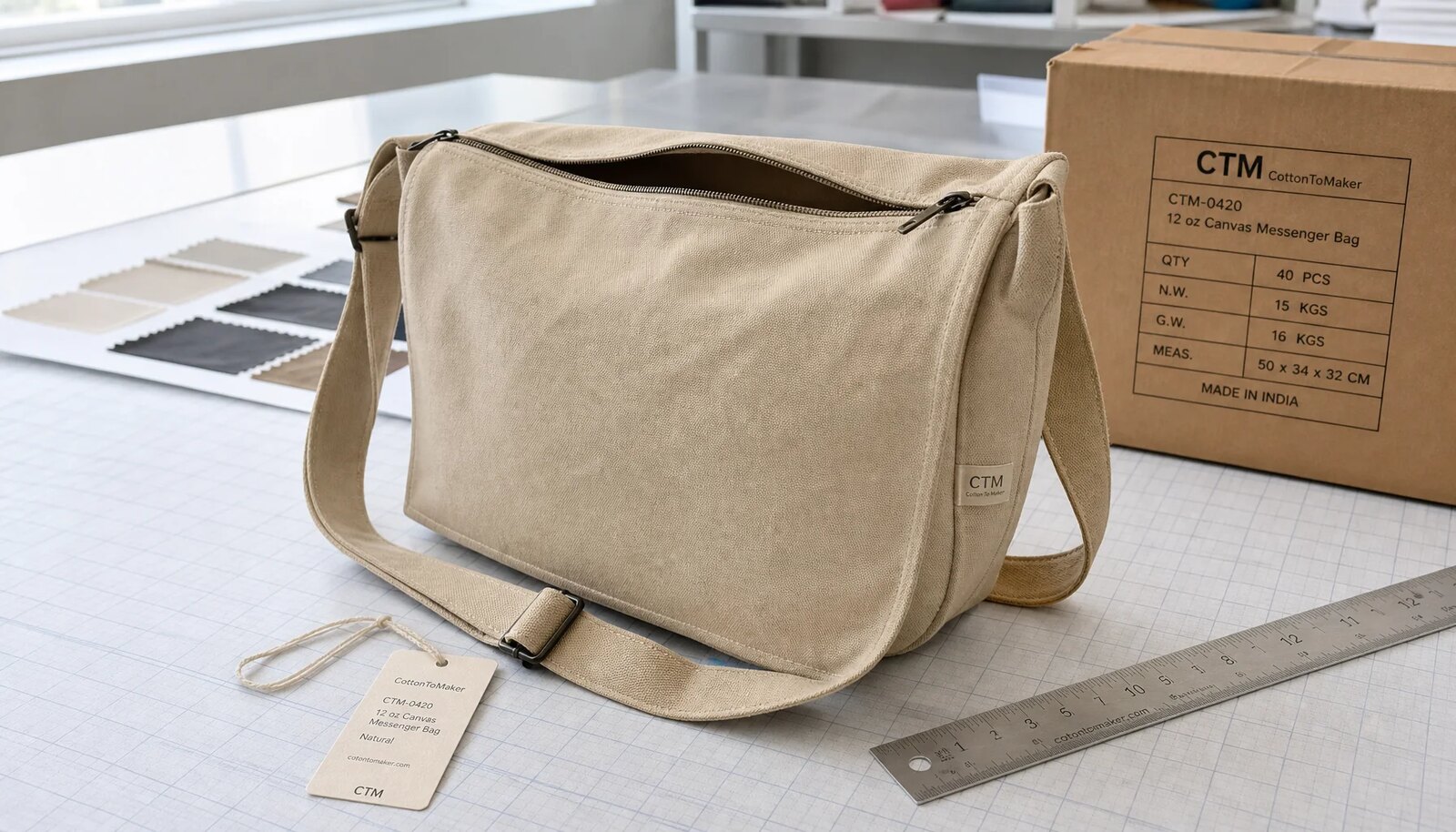
Start with the delivery problem, not the product photo
For event planners, wholesale canvas messenger bags are dated inventory. They have to arrive before registration opens, before sponsor kits are built, and before a venue team has run out of receiving time. A sample photo can look perfectly acceptable while the order itself creates problems: mixed carton counts, weak outer cartons, crushed flaps, scuffed logos, unclear marks, or a packing list that does not match what the warehouse receives.
Messenger bags need more packing discipline than flat totes. A typical style may include a flap, gusset, zipper, shoulder strap, buckle, D-ring, inside pocket, lining, and decoration on a front panel that takes pressure during shipment. If the carton is too tight, zipper teeth can press into canvas, metal hardware can mark the logo area, and straps can create uneven creases. Those defects are especially visible when bags are handed out at a conference desk or placed inside premium sponsor kits.
The carton packing plan belongs in the RFQ. It should not wait until the supplier is ready to ship. Units per carton, carton dimensions, gross weight, fold direction, logo protection, and outer marks affect freight cost, receiving labor, and event readiness. When a supplier prices a generic export pack and the buyer later asks for individual polybags, destination sorting, or retail-like presentation, the cost and volume can both change.
- State the handling route: factory to warehouse, factory to venue, factory to distributor, or factory to multiple destinations.
- Identify who opens cartons: warehouse staff, venue staff, volunteers, sponsor teams, retail buyers, or end customers.
- Define whether bags should arrive flat, folded, individually packed, barcode-labeled, tissue-protected, or bulk-packed.
- Treat carton quantity, carton dimensions, and gross weight as procurement specifications, not shipping afterthoughts.
- Ask the supplier to quote the exact packing method, including any polybag, insert, carton liner, or destination sorting labor.
Write the bag specification in measurable terms
A useful quote starts with a bag spec that can be measured. Fabric weight matters, but it is only one part of the product. An 8oz to 10oz canvas can work for light handouts such as badges, brochures, notebooks, and small giveaways. A 12oz to 14oz canvas is a stronger starting point for reusable event kits with catalogs, product samples, tablets, or bottles. Heavy 16oz canvas may feel more premium, but it can add sewing difficulty, folding bulk, carton volume, and freight cost.
Ask suppliers to state canvas weight in both oz/yd2 and GSM. A practical conversion is 1 oz/yd2 equals about 33.9 GSM, so 10oz canvas is roughly 339 GSM and 12oz canvas is roughly 407 GSM. The number may be measured before finishing, while washing, dyeing, coating, or lamination can change shrinkage, stiffness, and how the bag behaves in a carton. Natural canvas may show cottonseed flecks and shade variation; dyed canvas needs a color standard and an agreed shade band.
Avoid shorthand such as A4 size, laptop bag, or standard messenger. Specify finished width, height, gusset depth, flap length, strap width, adjustable strap range, zipper opening, pocket size, lining, and closure type. Tolerances should be realistic enough for sewn cotton goods and clear enough for inspection: plus or minus 1 cm for main dimensions is a common starting point, while pocket placement or logo placement may need tighter control. Reinforcement also needs to be named, such as bartack at strap anchors, box stitch at webbing joins, extra panel patch, bound seam, or double stitching.
- Specify canvas as oz/yd2 and GSM, plus natural, bleached, dyed, washed, coated, laminated, or recycled blend if applicable.
- Use 8oz to 10oz for light handouts, 12oz to 14oz for reusable event kits, and heavier fabric only when structure justifies the added bulk.
- Define finished width, height, gusset, flap, closure, strap width, strap range, lining, pockets, and hardware in the RFQ.
- Set tolerances before sampling, such as plus or minus 1 cm for main dimensions and an agreed tolerance for logo placement.
- Name reinforcement methods at strap anchors, pocket openings, zipper ends, bottom corners, and flap corners.
- Provide expected load weight so the supplier can design seam strength and run a relevant test.
Choose decoration with packing pressure in mind
Decoration should be selected for the artwork, the event use, and the way the bags will be packed. Screen print is usually efficient for simple logos, solid colors, and medium-to-large runs. It performs best on a flat panel and away from zipper tape, thick seams, flap folds, and strap anchors. For gradients, photographic artwork, or many colors, heat transfer or digital print may be more practical, but the buyer should verify adhesion, edge sharpness, curing, and behavior after folding.
Embroidery, woven patches, leather patches, and sewn labels create a different buyer impression. They can feel more substantial than a large print, but they introduce their own controls. Embroidery may pucker lighter canvas unless backing, stitch density, thread, and fabric weight are suitable. A woven patch can keep brand color consistent, but tooling, cutting, sewing, and placement still need inspection. Leather or PU patches should be checked for color transfer, cracking, sharp corners, and any buyer-specific material restrictions.
Do not approve branding from a digital mockup alone. Require a decorated sample on actual production fabric with the final thread, webbing, zipper, ink, transfer, patch, or label. Placement should be measured from fixed references: left edge, bottom seam, flap seam, zipper line, or side seam. On messenger bags, the logo may sit on the flap, below the flap, on a side label, on the strap, or inside the bag. Each position changes visibility, abrasion risk, and the type of protection needed inside the carton.
- Use screen print for simple spot-color artwork and clear event branding at volume.
- Use heat transfer or digital print for complex graphics only after rub, fold, cure, and pack testing.
- Use embroidery on canvas heavy enough to resist puckering, with backing and stitch density approved on a real sample.
- Use woven patch or sewn label for repeat programs where controlled logo appearance matters more than large print area.
- Keep artwork away from zipper teeth, seam intersections, flap folds, strap stitching, and heavy pressure points.
- Measure logo placement from fixed edges and approve a tolerance such as plus or minus 5 mm to 10 mm.
Use MOQ and sample stages to expose hidden limits
MOQ is rarely one simple number. It is often a bundle of component minimums. A supplier may accept a low MOQ for stock natural canvas, standard black webbing, a standard zipper, and one-color print. The same messenger bag with custom dyed canvas, matching lining, woven labels, special hardware, branded inserts, or printed cartons may require a higher quantity because each component has its own purchase threshold.
Quote tiers should match real buying decisions, not random round numbers. Asking for 300, 500, 1,000, 2,500, and 5,000 pieces can reveal where cutting efficiency, print setup, carton purchase, and labor allocation change. Require the same specification and same packing method at every tier. Also separate one-time charges from repeat unit cost: screen setup, embroidery digitizing, patch molds, label tooling, sample fees, sample freight, barcode setup, and carton printing should be visible if the program may reorder.
Sampling should move in stages. A blank construction sample checks size, pocket layout, strap comfort, hardware, and reinforcement before decoration money is spent. A decorated sample checks logo position, print color, opacity, embroidery density, patch placement, or label sewing. A pre-production sample confirms final fabric, trim, labels, decoration, and hardware before bulk cutting. A carton-packed sample confirms fold direction, units per carton, carton size, gross weight, and product condition after compression. For event buyers, that last sample often prevents the most expensive surprises.
- Ask for MOQ by fabric color, trim color, zipper, hardware, lining, label, decoration method, and packing method.
- Request realistic quote tiers and require the same spec at every tier.
- Separate setup fees from repeat unit cost so future events can be budgeted accurately.
- Approve blank construction before decoration when the bag shape, strap, or reinforcement is custom.
- Approve decorated sample before bulk printing or embroidery, especially for brand colors and fine artwork.
- Approve a carton-packed sample when carton count, freight volume, venue receiving, or presentation condition matters.
Build the carton packing plan from a real pack test
Carton packing should protect the bag and give logistics a dependable freight number. A flat unlined messenger bag may fit about 15 to 20 pieces per export carton. A lined, gusseted, padded, hardware-heavy, or retail-packed messenger bag may need about 8 to 12 pieces. These are planning ranges, not rules. The correct count depends on finished dimensions, canvas weight, flap stiffness, strap bulk, hardware, zipper thickness, polybag use, and whether the bag must arrive ready for presentation.
The supplier should run a physical pack test. Pack the proposed carton, seal it, record length, width, height, net weight, gross weight, wall type, and units per carton, then reopen it after at least 24 hours. Look for flap creases, crushed gussets, zipper impressions, hardware dents, print abrasion, color transfer, carton dust, damp odor, and carton bulging. If the carton has to be forced closed, the count is too high. If the logo faces rough carton board or another bag's hardware, change the fold direction, add tissue, use a carton liner, or separate layers.
Gross weight matters almost as much as volume. Many receiving teams prefer cartons that can be handled manually without special equipment. A practical target is often under 18 kg to 20 kg gross weight per carton, subject to warehouse rules and local handling requirements. For sea freight, double-wall export cartons are usually more suitable than thin domestic cartons, especially for natural cotton canvas that can pick up damp odor if stored poorly. If palletized, confirm pallet dimensions, cartons per pallet, pallet height, stretch wrap, and whether carton labels remain visible.
- Confirm units per carton by physical pack test, not only by calculating flat bag dimensions.
- Record carton length, width, height, net weight, gross weight, wall type, and total carton count before freight booking.
- Use tissue, polybag, layer sheet, carton liner, or reversed stacking when the logo area touches hardware or carton board.
- Reduce units per carton for thick canvas, padded panels, lined construction, metal hardware, retail packing, or bulky straps.
- Avoid forced carton closure because it creates flap creases, zipper impressions, and weak carton corners.
- Keep approved packing photos for warehouse receiving, freight claims, and reorder consistency.
Make carton marks useful for event operations
Carton marks are small details until a venue team is standing beside a loading dock with a tight schedule. Generic marks such as canvas bag or promo bag are not enough for event distribution. The outer carton should show the PO number, style number, color, quantity, carton sequence, destination code, event date when needed, and country of origin when required. If cartons are split by sponsor, kit type, or venue, the code should be large and consistent on the carton face most likely to be seen after delivery.
Carton numbering should match the packing list. A simple format such as 1 of 48, 2 of 48, and so on lets receiving staff spot missing cartons quickly. For split shipments, number by destination group rather than only by total shipment if the warehouse will forward cartons to different venues. If barcodes are required, confirm barcode type, label size, label position, scan direction, and whether the barcode goes on the individual bag, polybag, inner pack, master carton, or pallet.
Ask for packing photos before shipment, especially for multi-venue or sponsor-sensitive orders. Photos should show the bag fold, logo protection, individual packing if used, carton filling, carton marks, carton number, and sealed carton condition. These images help the buyer train receiving teams, resolve short-count disputes, and repeat the same packing method on the next order. They also force assumptions into the open before the goods leave the factory.
- Show PO number, style, color, quantity, carton sequence, destination code, and required origin text on the carton mark.
- Use large, consistent destination codes when cartons are sorted by venue, sponsor, event date, or kit type.
- Match carton numbering to the packing list and shipping documents.
- Confirm barcode type, placement, and scan requirements before labels are printed.
- Keep carton marks away from strap marks, tape seams, and freight labels where possible.
- Request packing photos of open cartons and sealed cartons before release.
Use QC tolerances an inspector can apply
Quality control needs numbers and pass/fail language. Words such as clean, centered, strong, and good are too loose for bulk inspection. The inspection sheet should define finished size tolerance, logo position tolerance, fabric defect limits, stitch quality, zipper function, reinforcement, color standard, packing method, and carton count accuracy. If AQL is used, define major and minor defects before production starts so disagreements do not begin after the bags are finished.
Incoming material inspection should check canvas weight, shade, weave consistency, holes, oil marks, dye streaks, dampness, odor, and excessive slubs. Natural canvas may include small cotton flecks, but stains, mildew odor, weak weave lines, and panel-to-panel shade mismatch should be controlled. Cutting should follow grain direction to avoid twisting. During sewing, inspectors should check stitch length, seam allowance, back-tacking, bartacks, strap anchor strength, flap alignment, pocket placement, zipper setting, and loose thread trimming.
Final inspection should include unit-level and carton-level checks. Unit checks catch broken zippers, open seams, skipped stitches, dirty marks, wrong labels, loose threads, crooked patches, and incorrect logo placement. Carton checks catch short counts, mixed colors, wrong marks, missing polybags, damp cartons, weak cartons, and packing damage. Major defects normally include broken zipper, open strap seam, wrong artwork, wrong color, missing component, mold odor, and incorrect carton quantity because they affect use, brand appearance, or fulfillment.
- Set main dimension tolerance, such as plus or minus 1 cm for width, height, gusset, and flap unless the product requires tighter control.
- Set logo placement tolerance from fixed references, commonly plus or minus 5 mm to 10 mm depending on artwork and construction.
- Define major defects: broken zipper, open seam, wrong logo, wrong color, stain, mildew odor, missing strap, sharp hardware, or incorrect carton count.
- Define minor defects: trimmed thread issue, slight wrinkle, acceptable natural slub, or small non-facing mark within the approved limit.
- Run a hang-load test using the expected event load, with stated test weight, hold time, and pass/fail criteria.
- Open finished cartons during inspection to verify count, marks, packing method, and product condition after compression.
Ask for load testing that matches the event kit
Messenger bags usually fail at stress points, not in the middle of a fabric panel. Strap anchors, webbing joins, D-ring loops, zipper ends, flap corners, pocket openings, and bottom seams deserve more attention than decorative areas. If the event kit includes catalogs, water bottles, electronics, samples, or sponsor inserts, tell the supplier the expected loaded weight before confirming fabric, webbing, and reinforcement.
A useful load test should be simple enough to repeat. For example, load the bag with 1.5 times the expected use weight, hang it from the strap for an agreed hold time, then inspect for seam opening, stitch breakage, fabric tearing, anchor distortion, hardware deformation, and zipper stress. If the buyer expects a 3 kg event kit, the test may use 4.5 kg for a controlled hold period agreed with the supplier. The exact method can vary, but the test weight, time, sample quantity, and pass/fail criteria should be written down.
Load testing does not replace normal sewing inspection. A bag can pass one hanging test while the bulk run still has missing bartacks, short seam allowance, or uneven reinforcement. Ask the supplier to document tested samples with photos and include the same stress points in the final inspection checklist. For heavier kits, reduce carton compression so buckles, straps, and reinforced panels are not bent or stressed before the bags reach the event team.
- Tell the supplier the expected contents and loaded weight, not just the bag size.
- Require reinforcement at strap anchors, webbing loops, D-rings, zipper ends, flap corners, and pocket openings.
- Use a load test based on event use, such as 1.5 times expected load for an agreed hold time.
- Inspect after testing for seam opening, stitch breakage, fabric tearing, anchor distortion, and hardware deformation.
- Check that reinforcement is consistent across bulk production, not only on the approved sample.
- Use lower carton compression for heavy-duty bags with thick straps, buckles, or reinforced panels.
Plan the schedule backward from the in-hand date
Event procurement has very little recovery time. Start with the in-hand date and work backward through venue receiving, warehouse sorting, domestic delivery, customs clearance, international freight, export documents, final inspection, packing, decoration, sewing, material preparation, and sample approval. The factory ship date is not the same as readiness. The bags must be available where the event team can actually use them.
Delays often sit in materials and approvals. Stock natural canvas and standard trims can move faster than custom dyed canvas, special webbing, custom lining, nonstandard hardware, woven labels, printed inserts, or branded cartons. Decoration can also hold the schedule when vector artwork is missing, Pantone references are unclear, print size changes, or the buyer approves the bag shape without approving logo location. The sample calendar should include production time, sample freight, buyer review, revision, and final sign-off.
Final inspection should happen before the freight booking cutoff. If goods fail inspection after a vessel or air booking is fixed, the buyer may have to choose between shipping with defects, rushing rework, upgrading freight, or splitting delivery. Build in time for reinspection and warehouse receiving checks. For multi-venue programs, add time to sort by destination and verify carton sequence before goods move to event sites.
- Work backward from the in-hand date, not the ex-factory date.
- Reserve time for blank sample, decorated sample, pre-production sample, carton-packed sample, and buyer comments.
- Ask which components are long-lead items: canvas, dyed fabric, zipper, buckle, label, patch, insert, carton, or print material.
- Schedule final inspection before freight cutoff so rework can happen without missing the event.
- Plan receiving time for carton count, damage check, destination sorting, and kit assembly.
- Keep approved samples, artwork, swatches, carton plan, and packing photos in one shared procurement file.
Compare quotes by landed cost, not just unit price
The lowest unit price is not always the lowest event cost. A quote that excludes individual packing, carton upgrades, inland freight, palletization, inspection support, sample revisions, or repacking labor can look attractive until freight and warehouse costs are added. Compare suppliers on the same basis: same finished size, same fabric weight, same decoration, same quantity tier, same packing method, same incoterm, same destination, and same inspection requirement.
Sourcing route affects control. A direct factory can be strong when cutting, sewing, decoration, and packing are coordinated under one production plan. A trading company can help with lower quantities, mixed product programs, or supplier coordination, but the buyer should ask who owns QC if sewing, printing, and packing happen at different sites. A local stock importer can reduce lead time, but may limit control over fabric weight, shade, trim, and repeat consistency. The right route depends on customization, deadline, order size, and risk tolerance.
Landed cost should include product price, setup charges, sample fees, sample freight, inspection cost, inland freight, export documents, international freight, duties, destination handling, pallet cost, warehouse receiving labor, relabeling, and repacking if needed. Carton data is essential because freight uses volume and weight, not how good the bag looks in a sample room. Ask for carton dimensions and gross weight at each quote tier, especially when changing from bulk pack to individual polybag or from loose cartons to pallets.
- Compare quotes using the same incoterm, such as EXW, FOB, CIF, DAP, or DDP, before judging price.
- Request separate lines for bag body, decoration, polybag, insert, master carton, pallet, inland freight, setup charges, and inspection support.
- Use carton dimensions and gross weight to estimate freight instead of relying only on unit price.
- Confirm production city and export port because inland freight and lead time can vary.
- Ask whether decoration and packing are done in the same facility or moved to subcontractors.
- Check reorder controls: retained swatches, trim cards, artwork files, print screens, sample references, and packing photos.
Specification comparison for buyers
| Procurement situation | Best sourcing route | Carton packing requirement | Buyer risk to verify |
|---|---|---|---|
| Conference kit order with a fixed venue date | Direct factory or exporter controlling cutting, sewing, decoration, inspection, and export packing | Approved units per carton, carton dimensions, gross weight, outer marks, carton numbering, and packing photos before shipment | Late discovery that cartons are oversized, overweight, weak, or unsuitable for venue receiving |
| Rush order using simple one-color artwork | Stock blank supplier or local importer with in-house decoration | Supplier must confirm whether blanks are repacked after printing, aired after curing, and shipped in original or new cartons | Original stock cartons may not protect fresh print, may mix batches, or may have weak carton walls |
| Premium sponsor gift with retail-like presentation | Factory able to sew, decorate, fold, polybag, insert, label, and carton pack in one controlled process | Individual polybag or tissue sheet, controlled fold direction, barcode or label placement, carton liner, and lower compression | Retail packing can increase carton volume by 15% to 35% if not tested and quoted separately |
| Pilot order below normal factory MOQ | Trading company or factory using stock fabric, standard trim, and existing carton sizes | Carton count and carton size must be confirmed because small runs are often packed manually in available cartons | Fabric shade, zipper color, webbing width, or carton dimensions may change on reorder |
| Annual multi-event program with repeat artwork | Factory with retained fabric swatches, trim cards, print screens, artwork files, and packing standards | Same carton dimensions, same units per carton, same outer mark layout, retained packed sample photos, and reorder reference number | Shade drift, trim substitution, or carton density change can disrupt warehouse receiving and sponsor consistency |
| Sea freight shipment to a central warehouse | Direct factory or exporter experienced with export cartons and pallet or loose-carton loading | Double-wall export carton, moisture control, carton drop resistance, gross weight limit, and clear carton sequence marks | Overweight cartons, damp storage, weak liners, or loose straps can cause crushed panels, mildew odor, or print abrasion |
| Order split across multiple venues or sponsors | Supplier that can pack and mark cartons by destination code, event date, color, sponsor, or kit type | Carton marks must show PO number, style, color, quantity, destination code, carton sequence, and country of origin when required | Venue teams may open the wrong cartons if marks are generic, inconsistent, or hidden by freight labels |
| Order requiring exact landed-cost comparison | Factory quoting bag body, decoration, individual packing, master carton, pallet, inland freight, and export fees separately | Carton dimensions and gross weight must be listed for every quantity tier and packing option | An all-in unit price can hide carton upgrades, pallet cost, inspection support, or repacking labor |
| Order carrying heavy contents such as catalogs, samples, or bottles | Factory with reinforced strap anchors, heavier webbing, bartack capability, and load-test process | Lower units per carton, no forced compression, protected hardware, and stress-point inspection before packing | Seams may look acceptable but fail when bags are loaded at registration or during attendee use |
Buyer checklist before sampling
- Define the event use case: registration handout, sponsor kit, resale item, staff bag, VIP gift, or multi-venue distribution pack.
- List expected contents and loaded weight, such as 1.5 kg paper kit or 3 kg catalog-and-sample kit, before asking the supplier to recommend reinforcement.
- Specify finished width, height, gusset depth, flap length, pocket layout, strap width, adjustable strap range, closure type, and reinforcement points.
- Confirm canvas weight in both oz/yd2 and GSM, and state whether the fabric is natural, bleached, dyed, washed, laminated, waxed, or water-repellent finished.
- Set target construction tolerances, such as plus or minus 1 cm for finished size and plus or minus 5 mm to 10 mm for logo placement, subject to sample approval.
- Send vector artwork, Pantone or brand color references, print size, logo placement diagram, and acceptable color variation method.
- Choose the decoration method before comparing quotes: screen print, heat transfer, digital print, embroidery, woven patch, leather patch, or sewn label.
- Request quote tiers at real decision points, such as 300, 500, 1,000, 2,500, and 5,000 pieces, with the same spec and packing method for each tier.
- Separate one-time charges from repeat unit cost, including screen setup, embroidery digitizing, label tooling, sample fees, carton printing, and barcode setup.
- Ask for sample stages: blank construction sample, decorated sample, pre-production sample, and carton-packed sample when freight planning or venue receiving matters.
Factory quote questions to send
- What is the exact canvas weight in oz/yd2 and GSM, and is that weight measured before or after washing, coating, or finishing?
- Is the canvas stock fabric, custom dyed fabric, natural cotton canvas, bleached canvas, recycled cotton blend, or polyester-cotton canvas, and what shade variation should we expect between lots?
- What are the finished bag dimensions, gusset width, flap length, strap width, adjustable strap range, zipper gauge, lining material, pocket layout, and closure type included in this quote?
- What dimensional tolerance is included for width, height, gusset, flap, pocket, and strap length, and how will measurements be taken during inspection?
- Which stress points are reinforced with bartack, cross-stitch, box stitch, extra seam allowance, binding, or patch reinforcement?
- Can you run a hang-load test using our expected event kit weight, and can you state test weight, hold time, and pass/fail criteria?
- What decoration method is quoted, how many colors are included, what print size is assumed, and what setup charge applies per screen, transfer, embroidery design, label, or patch?
- Can you provide a decorated sample using actual production fabric, thread, zipper, webbing, print ink or transfer, and logo color rather than a substitute blank?
- What is the MOQ by fabric color, trim color, decoration method, label, hardware, lining, and carton packing method?
- Can you quote blank bag, decoration, individual packing, insert, master carton, pallet, inspection support, inland freight, and export documents as separate lines?
Quality-control points to confirm
- Canvas weight is checked against the approved target in oz/yd2 or GSM, with no weak weave lines, holes, heavy slubs outside the approved limit, oil marks, dye streaks, dampness, or mildew odor.
- Fabric shade is compared against the approved swatch under consistent lighting, with natural canvas variation documented before bulk cutting and mixed-shade panels rejected when outside the agreed tolerance.
- Finished width, height, gusset width, flap coverage, strap width, strap length, pocket size, and lining fit match the specification within the agreed tolerance.
- Logo placement is measured from fixed bag edges or seam lines, not judged by eye, and registration stays within the approved placement tolerance.
- Print color, opacity, edge sharpness, curing, and adhesion are checked against the signed sample, with no pinholes, bleeding, cracking, tackiness, scorching, ghosting, or transfer marks.
- Embroidery, woven patches, leather patches, or sewn labels sit flat without puckering, loose threads, skipped stitches, crooked attachment, exposed backing, or sharp patch corners.
- Main seams, flap seams, strap anchors, zipper seams, pocket seams, and bottom corners have even stitch length, secure back-tacking or bartack reinforcement, correct seam allowance, and trimmed thread ends.
- Handles and shoulder straps pass the agreed hang-load test, with no seam opening, fabric tearing, anchor distortion, stitch breakage, or hardware deformation.
- Zippers open and close smoothly from end to end, with no missing teeth, bent sliders, rough stops, loose pullers, fabric caught in the track, or wavy zipper setting.
- Hardware, buckles, sliders, snaps, D-rings, magnetic closures, and metal eyelets are clean, correctly finished, secure, and free from sharp edges, rust marks, plating bubbles, or stains on the canvas.