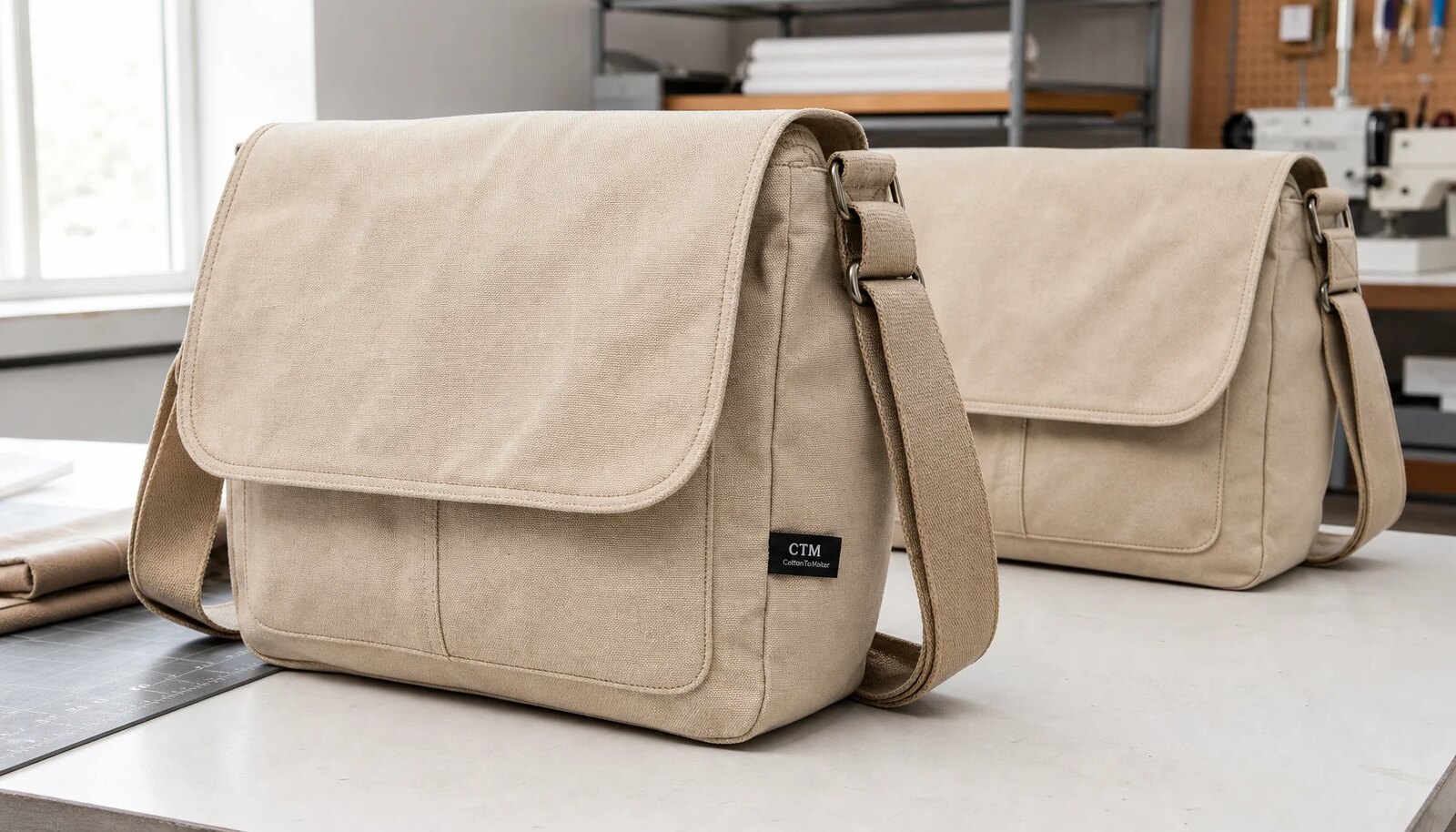
1. Start with the buying job, not the bag photo
A messenger bag photo is not enough information for a wholesale quote. The same image can be produced as a lightweight event giveaway, a mid-range retail accessory, or a more structured daily carry bag. Each version uses different canvas, reinforcement, pocket logic, strap hardware, logo method, and packing. For eco apparel brands, the buying job matters even more because the product has to support the brand story without becoming overbuilt, overpriced, or hard to document.
Begin the RFQ with the commercial use. State whether the bag will be sold as an accessory, bundled with apparel, used for an event, offered as staff merchandise, or delivered to a retailer with barcode and hangtag requirements. Then state the expected carry load: phone and notebook, folded apparel, books, tablet, or 13-inch laptop. A supplier can only recommend the right gusset, strap width, flap length, and reinforcement when the load and channel are clear.
This also prevents false price comparisons. A supplier quoting a flat, unlined 8 oz promo bag is not competing with a supplier quoting a lined 12 oz gusseted bag with reinforced strap anchors. Both may call the item a canvas messenger bag, but procurement is not buying the same product.
- Retail accessory: prioritize shape, finish, clean stitching, consistent logo placement, and packaging presentation.
- Daily carry: prioritize strap comfort, reinforced anchors, secure closure, pocket utility, and load testing.
- Event or promotional use: prioritize logo clarity, simple construction, fast production, and responsible material choices that still feel durable.
- E-commerce bundle: prioritize flat packing, barcode accuracy, carton efficiency, and protection from moisture or abrasion.
2. Choose canvas material with proof behind the eco claim
Canvas weight is only one part of the material decision. Fabric weight, weave density, fiber content, finish, shrinkage, and dye process all affect performance and cost. For many wholesale canvas messenger bags, 10 oz to 12 oz finished canvas is a practical center because it balances structure, printability, sewing efficiency, and carton volume. Lighter canvas can work for promotional use. Heavier 14 oz canvas can support a premium daily-carry product, but it may increase sewing difficulty, freight volume, and lead time.
Eco apparel brands should separate aesthetic language from documented claims. Natural cotton canvas, organic cotton canvas, recycled cotton canvas, and undyed canvas are not interchangeable. Natural canvas may simply mean unbleached conventional cotton. Organic cotton requires documentation at the level being claimed. Recycled cotton content should be stated by percentage and supported by supplier documents. If the bag includes polyester thread, plastic Velcro, metal hardware, coated backing, or synthetic labels, avoid implying the entire bag is natural or plastic-free.
Dyeing and finishing need the same discipline. Natural or undyed canvas can reduce color-process complexity, but it may show seed flecks, slubs, and shade variation. Custom dyed canvas gives stronger brand control but requires lab dips, shade approval, and often higher MOQ. Washed or enzyme finishes can improve hand feel yet change dimensions, shade, and print absorbency. Ask for finished-fabric weight after treatment, not only greige or pre-finish weight.
- Request fiber content by percentage, not broad descriptions such as eco cotton or sustainable canvas.
- Ask whether certification applies to fiber, fabric, processing, or finished product labeling.
- Confirm restricted substances expectations for dyes, inks, adhesives, trims, and metal finishes.
- Define acceptable natural-canvas variation: flecks, slub, shade range, and minor weave irregularity.
- Avoid greenwashing by matching marketing copy to supplier documentation.
3. Specify the construction that protects the product in use
The durability of a canvas messenger bag is usually decided by small construction choices. Strap anchors, flap corners, pocket openings, side seams, bottom edges, and closure points take the most stress. If those areas are not defined in the spec, they may be simplified in production to meet a target price. The sample may look acceptable when empty, but the bag can fail after regular use.
Start with the body. A flat body packs efficiently and costs less, but it carries less volume. A gusseted body adds usable space and improves daily function, but it increases cutting and sewing time. A lined interior looks cleaner and can support pockets, yet it adds material, labor, and another possible source of shrinkage or color transfer. A bottom board or base reinforcement can improve structure, but buyers should confirm material type, recyclability claims, and whether it matches the brand position.
The flap needs specific measurements. Define flap length, width, corner shape, closure placement, and reinforcement. Velcro is simple and common, but alignment must be accurate and the hook side can catch fibers. Magnetic snaps look cleaner, but the snap area should be reinforced. Zippers add security but also add cost, inspection points, and potential lead-time issues. The right closure is the one that fits the channel, price point, and use case.
- Body: flat, gusseted, boxed bottom, lined, unlined, padded, or reinforced.
- Strap: material, width, length range, adjuster type, anchor position, and bar-tack size.
- Pockets: external pocket, internal slip pocket, zipper pocket, laptop divider, pen slot, or no pocket.
- Closure: Velcro, magnetic snap, zipper, buckle, button, or open flap with defined risk acceptance.
- Reinforcement: strap anchors, side seams, pocket openings, flap corners, bottom edge, and hardware points.
4. Compare suppliers by route, capability, and transparency
Unit price matters, but the route behind the quote matters too. A direct factory can give strong control over construction, sample corrections, production timing, and defect feedback. That route works well when the bag is custom, repeated seasonally, or tied closely to brand standards. It also requires the buyer to provide a clearer spec and manage approvals carefully.
A trading company or sourcing office can be useful for mixed-category programs, smaller seasonal buys, or brands that need one contact for apparel, bags, packaging, and labels. The tradeoff is visibility. If dyeing, printing, embroidery, or sewing is subcontracted, the buyer needs to know who controls materials, who approves bulk, and who is accountable for rework.
For eco apparel brands, transparency is a commercial requirement, not a nice extra. Ask who buys the cotton canvas, where decoration is done, whether trims are stock or custom, and what documentation can be passed through. If a supplier cannot explain material origin, dye process, trim content, or inspection method, keep the claim language conservative and compare that risk against the price.
- Use direct factory sourcing for custom construction, repeat orders, tighter QC, and clearer technical feedback.
- Use a trading company when consolidation, mixed products, and lower internal coordination are more important.
- Ask which processes are in-house: cutting, sewing, printing, embroidery, washing, packing, and inspection.
- Request the production factory name when audit, compliance, or repeatability matters.
- Score communication quality: strong suppliers identify construction, MOQ, or documentation risks before sampling.
5. Normalize quotes so the lowest price is actually comparable
Many quote problems start with an incomplete RFQ. If the buyer sends only a photo, logo file, and quantity, each supplier fills in the blanks differently. One may quote 8 oz stock canvas, another 12 oz dyed canvas. One may include screen setup, another may exclude it. One may assume bulk pack, another retail-ready polybag and barcode. The lowest number may simply be the least complete quote.
Build a one-page specification table and require every supplier to price the same version. Include finished dimensions, canvas weight, fiber content, finish, lining, strap, closure, pocket, reinforcement, logo method, label, hangtag, packing, carton count, MOQ, sample stages, inspection requirement, Incoterm, currency, and quote validity. Ask suppliers to mark each item as included, excluded, or optional.
Separate one-time charges from unit costs. Screen setup, embroidery digitizing, sample fees, courier cost, lab dips, testing, custom labels, and packing development can distort the first order. For landed-cost comparison, add carton dimensions, gross weight, freight mode, inland handling, duty assumptions, and inspection cost. Procurement should compare the delivered program, not only ex-factory unit price.
- Require price breaks at practical quantities such as 300, 500, 1,000, and 2,000 pieces.
- Ask for MOQ by style, color, artwork, fabric, webbing, label, and hardware.
- Confirm whether sample cost is refundable, credited, or separate from bulk production.
- Request carton dimensions early because bulky packing can erase unit-price savings.
- Keep a quote comparison sheet with identical rows for every supplier.
6. Match decoration to canvas texture and brand position
Logo decoration should be chosen around artwork, fabric texture, durability expectations, and order size. Screen printing is often the best balance for canvas messenger bags with bold logos, flat panels, and wholesale quantities. It can look clean on natural canvas when the artwork is prepared for the weave. The risk is fine detail: small type, thin lines, and delicate curves may break on textured canvas.
Embroidery creates a premium signal for small marks, monograms, and patches, but it is not automatically better. Dense stitching can pucker lighter canvas or make a flap hang unevenly. Large embroidery can become expensive and stiff. A woven patch may be more stable if the brand wants a textured label look without direct embroidery stress on the panel.
Heat transfer can help with complex artwork, gradients, or smaller runs, but eco apparel brands should check hand feel carefully. A glossy or plastic-heavy transfer may conflict with the natural canvas story. Whatever method is chosen, approve it on the real fabric, not only on a digital mockup. The strike-off or pre-production sample should be rubbed, bent, and viewed at normal distance.
- Screen print: best for bold one- to three-color logos on flat panels.
- Embroidery: best for small premium marks, but check puckering and readability.
- Woven patch: useful for subtle branding and repeat retail lines.
- Heat transfer: useful for complex art, but test adhesion, edge lift, and hand feel.
- Placement rule: measure from fixed edges or centerlines, not by eye.
7. Use staged sampling to catch mistakes before bulk sewing
A messenger bag sample should prove more than appearance. It should confirm proportion, carry comfort, closure function, decoration quality, construction strength, and packing effect. The first prototype may use substitute material if the goal is pattern and size, but bulk should not be approved from a prototype alone.
The pre-production sample should use final canvas, final color, final logo method, final trims, final closure, final labels, final reinforcement, and final sewing standard. This is the sample that shows whether the supplier can make the approved product under real production conditions. If any key item changes after approval, request a revised sample or written change approval before cutting bulk fabric.
The golden sample is the inspection reference. Sign and date it, photograph it, and keep one with the buyer and one with the factory when possible. If the product is retail-ready, approve a packing sample too. Folding can affect creasing, print abrasion, barcode placement, carton volume, and how the bag looks when unpacked.
- Prototype: checks size, silhouette, flap, pocket logic, and general construction.
- Pre-production sample: checks final material, trim, decoration, label, closure, and reinforcement.
- Golden sample: locks the approved standard for bulk inspection.
- Packing sample: confirms fold, inner pack, hangtag, barcode, carton count, and moisture protection.
- Sample review: load the bag, wear it, measure it, open closures, pull strap anchors, rub the print, and record comments clearly.
8. Define QC with AQL, defect classes, and functional checks
Quality control should be written before production begins. Canvas can have natural variation, but inspection still needs rules. Define whether the order will use AQL inspection, what inspection level applies, when inspection happens, and which defects are critical, major, or minor. For many consumer bag orders, buyers use a third-party or internal final random inspection after goods are at least mostly packed, but the exact plan should match order size, buyer risk, and retailer requirements.
Defect classification keeps decisions consistent. Critical defects make the bag unsafe or unusable: sharp hardware, broken strap anchors, mold, severe odor, missing closures, or contamination. Major defects affect saleability or function: wrong logo color, crooked flap, nonfunctioning zipper, weak stitching, serious stains, wrong measurement, or visible shade mismatch. Minor defects are small workmanship issues not obvious in normal use.
Functional checks matter because many defects do not show in a flat photo. Load the bag to the agreed test weight and check strap anchors, side seams, flap closure, and adjuster slip. Perform rub checks on printed areas and dyed straps to catch crocking risk. Check colorfastness expectations when dark canvas or dark webbing may contact light apparel. Measure logo placement from fixed reference points. Inspect multiple cartons, not only the cleanest top units.
- Set inspection timing: inline check if needed, final inspection before shipment, and reinspection after rework.
- Use defect classes: critical, major, and minor, with examples approved before production.
- Check seam strength at strap anchors, pocket openings, flap corners, side seams, and bottom edge.
- Check decoration for placement, curing, adhesion, cracking, pinholes, ghosting, and rub resistance.
- Check cartons for dry condition, correct marks, barcode accuracy, pack count, and crush damage.
9. Align packaging, lead time, and purchase order controls
Packaging affects cost, sustainability messaging, freight volume, and retail handling. A flat bulk pack may be best for low-waste programs and efficient freight. Individual polybags protect against moisture and handling marks but add plastic and labor. Paper belly bands, hangtags, barcode stickers, retail sleeves, or inner cartons can help stores and warehouses, but they must be quoted and sampled.
Eco apparel brands should be precise with packaging claims. If using recycled paper, recycled polybags, compostable bags, or FSC paper, ask what documentation is available and whether the claim applies in the destination market. Avoid adding packaging only to make the product look premium if it creates waste that conflicts with the brand position. At the same time, do not remove all protection if the route has moisture risk; mold or odor is worse than a carefully justified protective pack.
Lead time should be broken into stages: artwork approval, lab dip or material approval, sample making, sample revision, fabric booking, cutting, decoration, sewing, finishing, inspection, packing, and shipping handover. Custom dye, organic or recycled material documentation, custom webbing, and retail labeling can all add time. Put the approved spec, sample reference, QC requirement, Incoterm, delivery date, payment terms, and packing method into the purchase order. That is what turns a good sourcing conversation into a controllable order.
- Packaging: bulk pack, individual pack, hangtag, barcode, retail sleeve, carton strength, carton marks, and moisture control.
- Lead time: separate sample time, material booking, bulk production, inspection, rework buffer, and shipping booking.
- Landed cost: include unit price, setup, samples, testing, inspection, cartons, inland handling, freight, duty, and rework risk.
- PO controls: attach final spec sheet, approved sample reference, quantity by color, packing method, delivery terms, and inspection standard.
- Change control: require written price and timing approval for logo, pocket, trim, closure, material, or packing changes.
Specification comparison for buyers
| Sourcing route or build choice | Best fit | Cost and lead-time tradeoff | Procurement risk to control |
|---|---|---|---|
| Stock canvas, standard trim build | First wholesale test orders, event merchandise, simple retail add-ons, and programs that need faster sampling | Usually lower MOQ and faster material booking because canvas, webbing, closures, and labels are already available | Confirm the exact fabric weight, shade range, trim quality, and whether repeat orders can use the same material source |
| Custom dyed or custom finished canvas | Eco apparel brands with a defined seasonal color palette or retail line that must match apparel drops | Higher MOQ and longer lead time due to lab dips, dye lots, shade approval, and possible fabric finishing minimums | Require lab dip approval, bulk shade tolerance, shrinkage data, and a plan for shade continuity on reorders |
| Organic or recycled cotton canvas | Brands making material-led claims and selling through sustainability-conscious retail or DTC channels | Can cost more and require longer sourcing time, especially if documentation or certified chain-of-custody is needed | Ask which certificate applies to the fiber, fabric, dyeing, and finished product; do not market claims that the supplier cannot document |
| Screen printed logo | Bold artwork, larger front panels, wholesale quantities, and natural canvas looks | Efficient at scale, but each color or location can add setup cost and approval time | Approve a strike-off on the actual canvas and check curing, rub resistance, registration, and edge clarity |
| Embroidery or woven patch | Small premium marks, heritage styling, or subtle branding on higher-price bags | Higher unit cost than simple print and slower production when stitch count or patch MOQ is high | Check puckering, backing, thread color, small-text readability, and whether the panel stays flat |
| Retail-ready packing | Bags sold as finished accessories, marketplace orders, retailer deliveries, or barcode-controlled fulfillment | Adds labor, label management, carton planning, and sometimes material cost, but can reduce warehouse handling later | Confirm barcode position, hangtag, folding method, carton count, carton strength, moisture protection, and retailer compliance |
Buyer checklist before sampling
- Define the bag use case: retail accessory, commuter bag, apparel bundle, event merchandise, or corporate gifting program.
- Confirm finished dimensions, usable gusset depth, flap length, pocket sizes, strap width, strap length range, and measurement tolerance.
- Specify finished fabric weight in oz or GSM, weave type, color state, finish process, shrinkage allowance, and whether fabric is stock or custom made.
- For eco claims, request documentation for organic cotton, recycled cotton, recycled polyester trims, dye standard, restricted substances, and packaging material claims.
- Define construction: lined or unlined, seam binding, bottom reinforcement, internal pocket, laptop divider, flap reinforcement, and bar-tack locations.
- Approve logo method against artwork complexity, canvas texture, line thickness, logo size, placement, Pantone target, and decoration sample.
- Confirm trims: webbing material and width, zipper grade, snap type, Velcro grade, buckle finish, metal color, label material, hangtag, and care label.
- Set sample stages: prototype, revised sample if needed, pre-production sample with final materials, golden sample, and packing sample.
- State QC requirements: inspection timing, AQL level if used, defect classes, measurement points, load check, rub test, colorfastness check, and carton inspection.
- Request quote line items separately for fabric, dyeing, printing, embroidery, trims, sewing, packaging, testing, inspection support, inland handling, and cartons.
Factory quote questions to send
- What exact fabric weight, weave type, yarn construction, color state, finishing process, and shrinkage allowance are included in the quoted price?
- Is the canvas conventional cotton, organic cotton, recycled cotton, blended cotton, or another material, and what documentation can you provide for that claim?
- Is the fabric stock or custom produced, and can you keep the same source, shade standard, and hand feel for repeat orders?
- Are dyes, inks, adhesives, and trims compliant with any restricted substance list or retailer requirement we need to provide?
- Is the logo price based on one color, one side, and one location, or does it include screens, artwork separation, Pantone matching, and strike-off approval?
- What is the MOQ by style, color, artwork, fabric, webbing, lining, label, and hardware if we choose custom materials?
- Which sample is included in the sample fee: prototype, revised sample, pre-production sample, courier sample, or packing sample?
- What stitch count, seam allowance, thread type, bar-tack length, and reinforcement method do you use at strap anchors and pocket openings?
- What carton pack count, inner packing method, master carton dimensions, gross weight, and carton material are assumed in the quotation?
- What inspection standard do you work to for AQL, defect classification, size tolerance, color variance, print defects, stitching defects, stains, odor, hardware function, and carton damage?
Quality-control points to confirm
- Use a written inspection plan before production starts, including sampling quantity, inspection timing, AQL level if required, and critical, major, and minor defect definitions.
- Fabric weight, weave density, shade, hand feel, and stiffness should match the approved swatch or golden sample, with separate approval for natural, dyed, washed, or recycled canvas.
- Finished width, height, gusset, flap length, pocket depth, strap width, strap length, and logo placement should be checked from fixed reference points.
- For many canvas messenger bags, practical size tolerance is about +/-0.5 cm on small details and about +/-1.0 cm on larger body measurements unless the spec requires tighter control.
- Cut panels should be square so the flap closes evenly, side seams do not twist, the bag sits flat, and the gusset remains usable.
- Classify sharp hardware, broken strap anchors, mold, severe odor, missing closure, or unsafe metal edges as critical defects.
- Classify wrong logo color, weak stitching, crooked flap, severe stains, nonfunctioning snap or zipper, and size outside tolerance as major defects.
- Check seam strength at strap anchors, side seams, pocket openings, flap corners, closure attachments, and bottom edges; use pull or load checks agreed before production.
- Check print or transfer quality for placement, curing, adhesion, cracking, ghosting, pinholes, color match, and dry or wet rub resistance where relevant.
- Check colorfastness and crocking risk on dyed canvas or dark straps, especially where the bag may rub against light apparel.