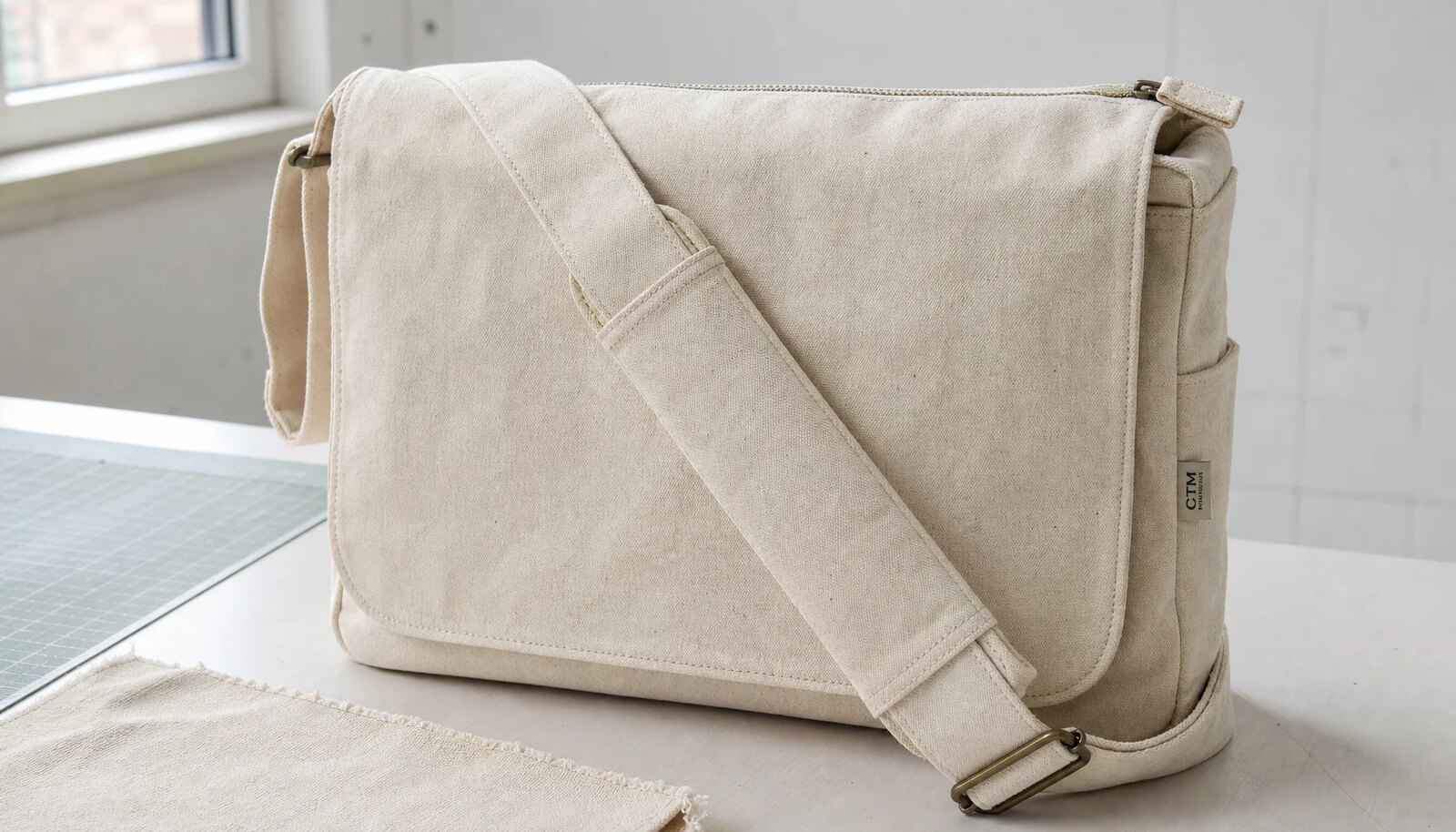
Start with one quote-ready product definition
A canvas messenger bag is too broad to price well until the buyer narrows the use case. A factory can quote a soft promotional shoulder bag, a structured commuter bag, a retail messenger with lining and hardware, or a minimal tote-style hybrid. Those are different constructions, different labor profiles, and different landed costs. The first procurement task is not comparing suppliers. It is defining one bag that every supplier prices from the same basis.
For eco apparel brands, the bag also carries brand meaning. If the line positions itself around organic cotton, recycled fiber, or lower-impact packaging, the messenger bag needs the same discipline as the apparel assortment. That means deciding what the bag is made from, how it closes, how it is branded, how it packs, and which claims can be documented. Buyers who lock that brief early spend less time reconciling quotes later.
The main sourcing mistake is comparing different products as if they were the same. An unlined 12 oz canvas bag with one-color print is not comparable to a fully lined 16 oz messenger with zipper, adjustable strap, internal pocket, woven patch, and branded carton. A usable bulk pricing plan starts when the spec is fixed and the quote variables are isolated.
- Write one RFQ that every factory can price against without interpreting the product differently.
- Treat sustainability language as part of the product definition, not as a marketing note added after quoting.
- Keep the first round narrow: one size, one body color, one closure, one branding method, one pack-out.
Lock dimensions, materials, and tolerances before you compare quotes
A production spec should describe the bag in measurable terms. At minimum, define width at the opening, width at the base if the bag tapers, height, gusset depth, flap length, strap width, strap adjustment range, pocket dimensions, and logo placement. If the bag includes a tablet sleeve or laptop compartment, state the usable internal dimensions, not just the approximate device size it may hold. Even a simple messenger bag can drift in production if the measurement points are unclear.
Tolerances matter because sewn goods are not machined parts. After cutting, sewing, pressing, and packing, a few millimeters of variation is normal. The useful standard is a toleranced spec sheet tied to the approved sample, not a vague promise of consistency. For many canvas bags, buyers work with tighter limits for print placement and small trims, and slightly wider limits for overall body dimensions and strap length. What matters is consistency between the sample, the purchase order, and the inspection sheet.
Fabric detail needs to go beyond the phrase natural canvas. State fiber content, weave type, canvas weight in oz and GSM, finish, color, and whether the material is unwashed, washed, dyed, bleached, unbleached, organic, recycled, or blended. If the bag is intended to feel more premium, the buyer may also need to define hand feel, visual texture, and how much natural slub or seed fleck is acceptable. That level of detail keeps the supplier from pricing a lighter or rougher cloth that does not match the retail expectation.
- Approve a fabric swatch for weight, shade, hand feel, texture, and visible natural-fiber characteristics.
- State whether measurements are before or after washing, dyeing, pressing, and packing.
- Measure logo placement from fixed seams or panel edges, not from a generic center line only.
Match canvas weight and construction to the selling channel
The weight choice drives cost, sewability, and how the bag feels in hand. Lightweight 10-12 oz canvas, often around 280-380 GSM depending on weave and finish, works for promotional, event, or lower-load bags. For retail messenger bags that need to carry apparel, books, daily items, or a tablet sleeve, 14-16 oz canvas, roughly 400-550 GSM, is often the more balanced choice. It usually gives enough body for clean decoration without turning the bag into a bulky sewing job.
Heavier is not automatically better. At 18 oz and above, the bag can look substantial, but seams become thicker, corners are harder to finish cleanly, and strap anchors need more reinforcement. The factory may need more time, stronger needles, and more careful handling. That raises cost in ways that are easy to miss if the buyer only looks at the unit price. A heavier cloth can also increase carton weight and freight spend. If the product is meant to feel rugged or workwear-inspired, sample it first and check how it behaves once loaded.
Construction follows the same logic. Full lining improves presentation, helps hide raw edges, and supports internal pockets, but it adds material and labor. Bound seams or clean overlock finishing can control loose fibers on unlined styles without the full cost of lining. The right build depends on the channel. A wholesale program sold through eco apparel boutiques may justify cleaner finishing and more protective packing than a giveaway bag for an event launch.
- Ask whether the quoted fabric weight is greige, dyed, washed, or finished weight.
- For dyed canvas, approve lab dips under consistent lighting and confirm shade control across rolls.
- For washed canvas, require the supplier to state shrinkage expectations and the final measurement basis.
Turn sustainability claims into evidence, not decoration
Eco apparel buyers often source for more than appearance. The bag may need to support claims such as organic cotton, recycled cotton, undyed canvas, low-impact printing, reduced plastic packing, or restricted-substance compliance. Each claim changes procurement risk. If the label, hangtag, or wholesale line sheet will mention a material or process claim, the supplier needs to produce documentation that matches that exact claim. Otherwise the bag may be sellable, but not marketable in the way the brand intended.
The documentation should fit the claim and the market. For organic or recycled cotton, a buyer may need certificate scope details and transaction certificates when applicable, not just a generic supplier statement. For fiber content, a composition report can be useful. For chemical compliance, request restricted-substance testing or declarations covering fabric, dyes, print inks, hardware coatings, and trims where relevant. For packaging, keep recycled-content statements or paper sourcing documents on file if the brand will reference them publicly.
Region-specific compliance changes what belongs in the file. The EU often requires a careful RSL or chemical compliance review, and some retail customers will ask for their own declarations in addition to general test reports. The UK may ask for similar buyer-specific documentation. In the U.S., California distribution can raise Prop 65 questions depending on materials and finishes, and packaging rules can differ by state or customer. None of this means the product is difficult to source. It means the compliance pack should be built for the destination, not for a generic global market. One document set rarely satisfies every channel.
- Separate mandatory claim requirements from preferred upgrades that are not marketed.
- Match certificates, test reports, and wording to the exact claim and destination market.
- Keep approved claim language with the purchase order so sales and sourcing use the same wording.
Choose the supplier model with the least hidden risk
Direct cut-and-sew factories are usually the best starting point for a repeat messenger bag program. They give the buyer a clearer view of labor, materials, and sample revision control. Agents can still make sense when the brand needs to consolidate several categories, manage multiple countries, or work through a supplier network that already has the needed certifications. The choice is less about ideology and more about who can control the spec, answer technical questions, and keep the order aligned from sample to shipment.
A useful supplier review looks past the price line. Buyers need to know whether the factory actually sews the product in-house, subcontracts part of the work, or buys in a semi-finished shell and finishes it elsewhere. Ask for the production flow: cutting, sewing, printing or embroidery, trimming, QC, packing, and carton close. Look for evidence that the supplier can control fabric traceability, handle trim variation, and hold a consistent QC standard across repeat runs. A low quote can be attractive and still be the wrong factory if the line is set up for simple promo bags rather than retail-grade accessories.
For sourcing audits, the most useful checks are practical. Review machine capability for heavy canvas and reinforced seams, inspect the handling of bulk fabric rolls, ask where rejected pieces are stored, and see how the factory tracks color lots, trim lots, and sample revisions. A strong supplier can explain how it manages material substitutions, what it does when fabric shade drifts, and who signs off on a deviation. Social compliance and environmental certificates matter too, but only when they are current and relevant to the buyer's market. A certificate without operational discipline does not reduce production risk by itself.
- Verify whether the factory is truly cut-and-sew or acting as a trading layer with outsourced sewing.
- Inspect traceability for fabric lots, trim lots, sample revisions, and deviation approvals.
- Use the audit to see how the factory reacts to defects, not only whether it has certificates on the wall.
Build the bulk pricing plan around comparable tiers and landed cost
A pricing plan becomes useful when every tier uses the same spec. Ask for the same canvas messenger bag at 300, 500, 1,000, and 2,000 pieces, or the actual forecast tiers you plan to buy. The construction, fabric, branding method, packing, and Incoterm must stay constant. If a supplier quietly changes the fabric weight, swaps a trim, or removes a packaging step at the higher tier, the quote is not comparable and the price ladder is misleading.
The math should separate factory cost from project cost. A quote may look competitive at the unit level and still lose on setup, samples, freight, or carton efficiency. Consider a simple example. If the FOB unit price is $9.80 at 300 pieces, $8.90 at 500, $7.95 at 1,000, and $7.60 at 2,000, the slope is meaningful but only if the setup charge and freight scale sensibly. If screens, labels, or embroidery digitizing add a one-time charge of $320, that adds $1.07 per bag at 300 pieces but only $0.32 per bag at 1,000. That can justify a larger run only when sell-through confidence is real.
Landed cost is the number that matters for margin. A factory with a slightly higher FOB can still win if it packs more efficiently, charges less for setup, or ships a more stable carton size. A buyer should compare the received cost, not the factory quote. That means adding setup amortization, sample cost, inspection, inland transport, international freight, duty or tax estimate, warehouse receiving, and an allowance for defects or rework. The cheapest quote on paper is not always the cheapest received unit.
- Use one spreadsheet for FOB, setup, sample, freight, duty, inspection, and defect allowance.
- Separate one-time charges from repeat charges so reorders can be modeled correctly.
- Tie the first run to sell-through confidence, not to the lowest cost at the highest tier.
Control MOQ by variable, not only by total pieces
MOQ problems often come from too many variables, not from the total quantity alone. A factory may accept 500 pieces if the order uses one body color, one lining color, one print version, one zipper tape color, one hardware finish, and one carton mark. Split that same order into two body colors, multiple logo placements, or separate retailer labels, and the factory may treat it as multiple mini-runs with separate minimums. The buyer sees one order; production sees several setups.
The cleanest first run is narrow. One size, one canvas color, one lining color, one strap color, one branding method, and one pack-out are easier to cost, inspect, and repeat. Narrowing the launch does not block future variation. It gives the brand a baseline for fit, decoration, and retail feedback before colorways or special packs are added. For some programs, the right path is a core black or natural style first, then a second run with seasonal color or upgraded label once the supplier has proven the base build.
Low MOQ offers can be valid when the factory is using stock canvas and standard trims. They become risky when a supplier claims low MOQ for many custom variables without explaining where the savings come from. That usually means the quote assumes stock materials, slower lead times, simpler packing, or higher rework risk later. The buyer does not need the lowest MOQ in isolation. The buyer needs a MOQ that matches the brand's launch plan and the factory's actual setup logic.
- Request MOQ by style, body color, print version, fabric lot, lining color, zipper color, hardware finish, label, hangtag, and carton mark.
- Ask whether reorders will keep the same MOQ once screens, labels, or patches already exist.
- Keep the first launch tight enough to establish a QC baseline before expanding colorways or account-specific labels.
Send an RFQ that produces comparable supplier quotes
An RFQ should read like a short production brief rather than a casual inquiry. Include reference photos or sketches, finished measurements, fabric specification, construction requirements, lining and pocket layout, closure type, strap details, hardware finish, branding artwork, label and hangtag instructions, packing requirements, order tiers, Incoterm, destination country, and target approval timeline. When the brief is tight, the quote is easier to compare and the supplier is less likely to assume its own defaults.
The quote itself should show what is included and what is not. A line that says canvas messenger bag, MOQ 500, does not help procurement. The response should identify whether the unit price includes zipper top, full lining, internal pocket, laptop sleeve, adjustable strap, metal hardware, print, labels, hangtags, cartons, and export packing. It should also list sample cost, setup cost, bulk lead time, payment terms, quote validity, port, carton quantity, carton dimensions, gross weight, and estimated CBM. Without that detail, the buyer cannot compare suppliers on equivalent terms.
A simple quote matrix is often enough. Columns can cover unit price by tier, MOQ by variable, material basis, sustainability proof, branding method, setup charges, sample details, lead time, carton data, Incoterm, payment terms, exclusions, and unresolved questions. The value of the matrix is not formality. It keeps the supplier from looking cheaper simply because it omitted packaging, freight assumptions, or finishing labor from the price line.
- Mark every line item as included, excluded, optional, or pending confirmation.
- Reject comparisons that change fabric weight, closure type, pack-out, or Incoterm.
- Ask suppliers to state their assumptions in plain language, especially stock materials, print area, carton pack-out, and lead-time start date.
Use samples as production controls, not as visual mockups
Sampling should reduce ambiguity, not create it. A prototype can use available materials to validate shape. A sales sample can support merchandising. The pre-production sample is the one that matters for bulk approval, and it should use final bulk canvas, final lining, final zipper or closure, final strap webbing, final hardware, final labels, final branding method, and representative packing. That sample becomes the benchmark for the order.
Inspect the sample as a functional object. Put the expected contents inside it, adjust the strap, open and close the zipper repeatedly, test snap or magnet engagement, and look for balance when the bag is carried. Then measure width, height, gusset, flap depth, strap range, pocket size, label position, and logo placement against the tolerance sheet. The buyer needs both the visual and operational check. A messenger bag that photographs well but twists under load is still a failed sample.
Revision notes work best when they are specific and measurable. Comments like improve quality do not help production. Better comments are move print 1.5 cm up from the bottom seam, add bar-tack reinforcement at both strap anchors, change zipper tape to natural, increase pocket depth to 18 cm, or reduce flap length by 2 cm. Keep one approved sample with the factory and one with the buyer or inspector. That avoids arguments about which version was actually approved.
- Separate prototype, revised sample, and pre-production sample in the approval record.
- Do not release bulk cutting if the sample uses substitute materials for critical components.
- Keep marked photos, measurements, revision notes, and final approval date with the PO.
Set QC rules for fabric, sewing, branding, packing, and shipment
Quality control should be written before production starts. Define critical, major, and minor defects, inspection timing, measurement tolerances, and rework responsibility. Critical issues include mold, contamination, unsafe sharp hardware, wrong product, or severe odor. Major defects include broken zippers, open seams, missing labels, wrong print, wrong size outside tolerance, severe stain, weak strap anchors, or wrong packing. Minor defects may include small thread ends or slight non-prominent creasing if retail presentation is not affected.
Use staged inspection rather than relying only on final inspection. Material inspection checks fabric weight, shade, stains, holes, and trim availability before cutting. In-line inspection catches early sewing problems before they spread across the batch. Final inspection verifies finished goods against the approved sample, PO, tolerance sheet, and packing instructions. For new styles, high-value orders, or orders tied to a retailer program, a third-party inspection or a documented factory QC report with photos is often worth the cost because it finds issues before shipment.
Load-bearing points deserve extra attention. Strap anchors, side seams, bottom corners, flap joins, pocket stress points, and zipper ends should have the specified reinforcement. Bar-tacks or box-X stitching are common at strap anchors. Branding also needs a QC standard. Screen prints need clean edges and proper curing; embroidery and patches should not pucker the canvas or leave rough backing in customer-facing areas. A bag that passes color approval but fails on strap comfort or zipper function still creates customer complaints.
- Define defect categories and repair or replacement responsibility in the purchase order.
- Use in-line inspection for first production runs; final inspection alone may find systematic defects too late.
- Check appearance and function together: measurements, seam strength, zipper operation, strap adjustment, print quality, odor, and packing accuracy.
Specification comparison for buyers
| Spec or pricing decision | B2B recommended option | Procurement use case | Quote or QC risk to control |
|---|---|---|---|
| Factory channel | Direct cut-and-sew factory for repeat messenger bag programs; agent only when consolidating several categories or regions | Best when the buyer can issue a tech pack, compare samples, and keep one spec across reorders | Confirm who owns sample revisions, material substitutions, carton data, production photos, and document control |
| Canvas weight | 14-16 oz cotton canvas, often about 400-550 GSM depending on weave and finish | Retail messenger bags carrying apparel, books, daily items, or a small tablet sleeve | State oz and GSM, define whether weight is greige, dyed, washed, or finished, and agree a fabric-weight tolerance such as +/-5% |
| Lower-cost canvas option | 10-12 oz canvas, often about 280-380 GSM | Promotional, event, or entry-price bags where cost and lighter feel matter more than structure | Can sag under load, wrinkle more, show print-through, and feel less retail-grade; load test before approval |
| Premium/heavy option | 18 oz+ canvas or localized reinforcement panels only where load and brand position justify it | Rugged workwear-style accessory or premium commuter bag | Adds seam bulk, needle wear, sewing time, carton weight, and freight cost; test strap anchors and corners |
| Construction | Full lining for premium retail; bound internal seams for cost-controlled unlined styles | Lining improves presentation and pocket function; bound seams reduce loose fibers without full lining cost | Lining adds material and labor; unlined raw edges can shed; confirm shrinkage compatibility between shell and lining |
| Closure and hardware | Zipper top for security; flap with snap or magnet for casual styling; 38-50 mm adjustable webbing strap | Useful for retail, commuter, campus, and apparel bundle programs | Define zipper size, slider and puller style, snap strength, magnet polarity, finish color, sharp-edge standard, and strap reinforcement |
| Branding method | Screen print for simple artwork; woven patch, woven label, or embroidery for premium branding; heat transfer only after flex testing | Match artwork detail, order volume, abrasion exposure, and eco positioning | Specify Pantone colors, ink type, curing, embroidery density, patch edge finish, placement tolerance, and abrasion expectation |
| Sustainability proof | Claim-specific documents: organic/recycled cotton certificates where applicable, transaction certificates when required, restricted substance tests, and packaging paper claims | Needed when the brand markets organic cotton, recycled cotton, low-impact dyeing, reduced plastic, or restricted-substance compliance | Do not market claims the supplier cannot substantiate; certification scope must cover material, facility, product, or transaction as applicable |
| Region-specific compliance | EU REACH and buyer RSLs, UK buyer requirements, U.S. state chemical rules where applicable, textile labeling, origin marking, and packaging EPR rules by market | Important when bags ship into multiple regions with different retail, customs, or packaging requirements | Do not assume one compliance pack fits every market; verify what the destination and customer require |
Buyer checklist before sampling
- Define finished measurements: width at top/opening, width at base if tapered, height, gusset, flap depth, strap width, strap adjustable range, handle drop if used, pocket dimensions, and logo placement points.
- State canvas in both oz and GSM where possible, and clarify whether the weight is measured before or after dyeing, washing, coating, or finishing.
- Identify mandatory sustainability requirements before RFQ: organic cotton, recycled cotton blend, undyed/unbleached canvas, restricted-substance compliance, recycled paper hangtags, reduced plastic packing, or water-based ink preference.
- List acceptable proof for claims: supplier certificate scope, material certificate, transaction certificate where relevant, fiber composition report, restricted substance testing, and packaging paper certification or recycled-content statement.
- Lock construction: full lining, partial lining, bound seams, internal pocket count, laptop/tablet sleeve size, zipper top, flap closure, snap/magnet type, and bottom reinforcement.
- Specify trim: zipper size and tape color, slider and puller type, strap webbing width, D-ring or rectangle ring size, adjuster finish, snap finish, rivet use, and label placement.
- Provide vector artwork and specify branding method, print size, Pantone colors, placement tolerance, ink type preference, curing requirement, and abrasion expectation.
- Request a line-by-line quote separating base bag, canvas, lining, zipper, strap, hardware, print or patch, labels, hangtags, packing, cartons, samples, setup, and courier cost.
- Ask for price tiers at the exact same specification, such as 300, 500, 1,000, and 2,000 pieces, and require the supplier to state if any tier assumes different materials or pack-out.
- Build a landed-cost worksheet with unit price, setup amortization, sample charges, inspection, inland transport, international freight, duty or tax estimate, warehousing, and expected defect allowance.
Factory quote questions to send
- What exact canvas are you quoting: fiber content, weave, oz, GSM, yarn-dyed or piece-dyed, washed or unwashed, and finished or unfinished weight?
- Is the canvas conventional cotton, certified organic cotton, recycled cotton blend, cotton/poly blend, or another material, and what documentation can be provided if we market that claim?
- If organic or recycled cotton is quoted, can you provide certificate scope details and transaction certificates where applicable, or only a general supplier certificate?
- Can you provide restricted-substance testing or material safety documentation for fabric, dyes, inks, hardware coatings, and trims if required by our market or retailer?
- What fabric-weight tolerance, shade tolerance, and shrinkage range do you normally control for this canvas, and can you test bulk rolls before cutting?
- Does the unit price include full lining or bound seams, zipper top, flap, snaps or magnets, inside pocket, laptop sleeve, strap webbing, adjuster, D-rings, labels, hangtags, and export cartons?
- Which items are excluded or optional, including screens, embroidery digitizing, woven patch tooling, barcode labels, retail packaging, inspection support, and sample courier fees?
- What MOQ applies by style, body color, print version, lining color, zipper color, hardware finish, label type, and carton mark?
- Please quote the same specification at 300, 500, 1,000, and 2,000 pieces, and state Incoterm, port, quote validity, payment terms, carton quantity, carton size, gross weight, and CBM for each tier.
- Will the pre-production sample be made from final bulk canvas, final lining, final zipper, final strap webbing, final hardware, final label, final branding method, and representative packing?
Quality-control points to confirm
- Fabric weight should match the approved specification within the agreed tolerance, commonly around +/-5% unless the buyer sets a tighter standard with the supplier.
- Bulk fabric shade should match the approved swatch or lab dip; natural canvas flecks and slubs must stay within the approved appearance standard and should not create obvious panel mismatch on one bag.
- Fabric should be checked for stains, holes, oil marks, yarn defects, mildew odor, excessive creasing, color banding, and unacceptable roll-end variation before cutting.
- Cut panels should follow grain direction and pattern alignment so the bag does not twist, skew, or collapse unevenly after sewing.
- Critical measurements should be checked against the approved sample and tolerance sheet: width, height, gusset, flap depth, strap length range, pocket size, logo placement, and label position.
- Main seams, bottom corners, flap joins, strap anchors, pocket edges, and zipper ends should have consistent stitch density, secured backstitching, and bar-tack or box-X reinforcement where specified.
- Stitching should be even without skipped stitches, broken threads, thread loops, needle cuts, seam puckering, open seams, or visible thread color mismatch unless approved.
- Raw seam allowances should be bound, overlocked, folded, or cleanly secured according to the approved sample; loose fibers inside the bag should not be excessive.
- Zippers should open and close smoothly without catching, split teeth, wavy tape, crooked ends, loose sliders, broken pullers, or unfinished tape edges.
- Snaps, magnets, D-rings, sliders, buckles, and rivets should be securely attached, aligned, free from sharp edges, and consistent in finish color.