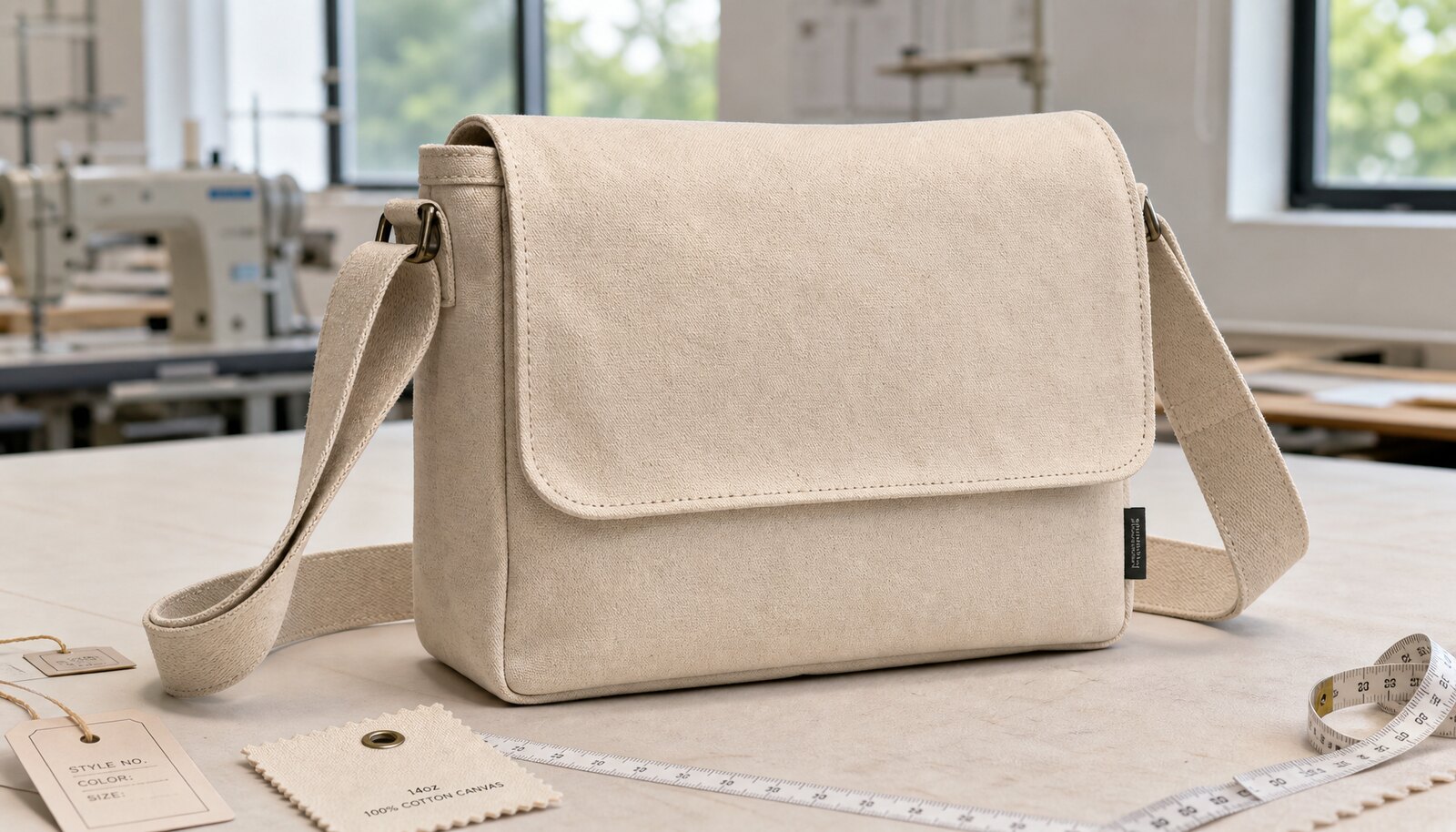
Why Fabric Weight Decides The Whole Quote
For wholesale canvas messenger bags for boutique wineries, fabric weight is not a cosmetic detail. It affects how the bag hangs on the shelf, how it survives repeated handling in a tasting room, and how much the supplier can charge once sewing labor, packing volume, and freight are added. A buyer who only asks for a canvas messenger bag without defining the weight usually gets quotes that are impossible to compare. One supplier may quote a loose 12 oz cloth, another a dense 16 oz canvas, and both will claim the bag is premium.
The right starting point is the end use. If the bag is for menus, event inserts, or branded retail carry, 12 oz to 14 oz can be enough. If it needs to support heavier merchandise, a notebook, a bottle, or a more structured retail feel, move to 14 oz to 16 oz. Once you push to 18 oz, the bag becomes stiffer and more expensive to cut and sew, and the freight cost starts to matter because the bag occupies more carton space.
- 12 oz is a lighter retail option, not a universal standard.
- 14 oz to 16 oz is the most common buying band for winery-branded messenger bags.
- 18 oz makes sense when shelf structure and premium hand feel matter more than unit cost.
Which Canvas Weight Fits Which Winery Use
Buyers often treat GSM and ounce weight as interchangeable marketing terms, but the factory needs a clear target. A useful conversion range is 12 oz at about 407 gsm, 14 oz at about 475 gsm, 16 oz at about 542 gsm, and 18 oz at about 610 gsm. Those numbers are not a substitute for an actual swatch, because weave density, yarn thickness, and finishing change the feel. Still, they are enough to stop vague quotes and force suppliers to name the real construction.
For boutique wineries, the best all-round choice is usually 14 oz to 16 oz plain weave canvas. It gives enough body for a structured messenger profile, can take print well, and does not collapse when a bag is carried around the tasting room all day. If the bag includes a lining, inner pocket, or flap closure, you can sometimes stay in the lower part of that band without losing the premium look. If the bag is unlined and expected to hold a heavier load, staying too light is a mistake that shows up quickly in corner wear and flap sag.
- Use 12 oz for lightweight promotional carry and simpler construction.
- Use 14 oz to 16 oz for retail resale, premium tasting-room merch, or mixed-use bags.
- Use 18 oz only when the buyer wants a rigid silhouette and accepts higher freight.
How Structure Changes Cost And Shelf Feel
Two bags can use the same fabric weight and still quote very differently. The difference usually comes from structure. A lined bag with a clean flap, zipper pocket, and reinforced strap anchors can look more premium than a heavier unlined bag, but it takes more sewing operations. That is why the correct RFQ should not stop at fabric weight. It should define lining, interlining, closure style, strap width, and reinforcement points. Otherwise the factory may quote a basic shell and treat the rest as extras.
For boutique winery buyers, structure also changes perceived value. A messenger bag that opens flat, stays square, and holds printed collateral neatly will sell better in retail than a floppy carry bag with the same logo. If the bag is meant for brand merchandise, think about how it will sit on a shelf, not only how it will look in a photo. A slightly heavier canvas can reduce the need for extra reinforcement, but the tradeoff is higher cost and more carton volume. The buying decision should balance fabric weight against sewing complexity, not treat them separately.
- Lining can improve body, but it adds labor and inspection points.
- Strap reinforcement matters more than raw fabric weight once the bag is used daily.
- A structured silhouette can justify a higher quote if the retail channel supports it.
Supplier Routes And Why Quote Spreads Happen
The same bag specification can produce very different quotes depending on the supplier route. A direct cut-and-sew factory with in-house printing is usually the cleanest option when the buyer wants controlled samples, stable repeat orders, and clear accountability on seams, print placement, and packing. A trading company can be useful when the program is broad or the buyer needs speed, but the material source and workmanship may vary by subcontractor. That means the first sample can look acceptable while bulk quality drifts later.
For wholesale canvas messenger bags for boutique wineries, the best supplier is not automatically the cheapest. Compare how the supplier handles material sourcing, cutting, printing, stitching, and carton work. If the quote is low because the fabric is thinner, the zipper is lighter, or the packing is loose, the landed cost can still go up through damage, returns, or rework. Ask each supplier to quote the same material, same print method, same reinforcement, and same packing format. Without that discipline, quote spread is just noise.
- Direct factory sourcing is better for repeatability and clearer defect ownership.
- Trading routes are useful when the buyer needs speed or mixed SKUs, but traceability is weaker.
- The cheapest quote often leaves out one of the real cost items, such as packing or print setup.
Printing And Branding That Hold Up In Retail
Canvas takes branding well, but not every method performs the same on a messenger bag. Screen print is usually the right choice for one or two colors because it gives strong coverage and is cost-effective at volume. It also keeps repeat orders stable when the art file does not change. If the logo uses fine lines or a small wordmark, the buyer should ask the factory to show the screen count, ink type, and curing method, because textured canvas can break up small details. For heavier canvas, the print can look bold, but the actual edge quality still depends on the mesh and registration.
Embroidery, woven labels, and sewn patches give a more premium feel, especially for boutique winery retail, but they need a different review process. Embroidery can distort lighter fabric if the stitch density is too high, while a woven patch can fray if the edge finishing is weak. A debossed or embossed badge can look refined, but only if the bag construction supports it. The safest rule is to choose the branding method after the weight band is set, not before. That avoids a common mistake where a buyer commits to an elegant logo treatment on a fabric that cannot support the result cleanly.
- Screen print fits repeat orders and simple artwork.
- Embroidery and patches fit premium positioning, but they need stronger sample review.
- Small type and fine lines are the first things to fail on textured canvas.
Sample Approval And QC Thresholds Before Bulk
A sample is only useful if the buyer defines what must match. The first sample should be judged on fabric weight, shade, dimensions, strap feel, print sharpness, and seam finish. If the supplier sends a nice-looking sample but it is made from a different fabric batch or a different print process, it should not be approved as the production standard. The best practice is to approve one physical gold sample and one written spec sheet, then tie both to the PO. That gives procurement a reference point when the factory tries to substitute a lighter fabric or a faster print method later.
For bulk approval, use acceptance criteria that are simple and enforceable. Check the bag flat, then filled to intended use weight. Open and close the flap, inspect the stress points, and review the print after handling. If your winery brand is selling the bag at retail, the buyer should care about the first customer touch, not only carton delivery. A bag that is technically within size tolerance but looks wrinkled, misaligned, or over-folded will still create a quality issue on the shelf.
- Approve one gold sample and one written spec sheet together.
- Reject any sample that changes fabric weight, print method, or strap construction without notice.
- Test the bag in the way it will actually be used, not just as a flat piece.
Packing Details That Protect Retail Value
Packing is where many canvas bag orders lose value without anyone noticing. A messenger bag can be fully correct on material and still arrive looking poor if it is over-folded, crushed in an oversized carton, or packed without a stable inner stack. For a retail program, ask the factory to define the folded dimensions, units per inner pack, master carton count, and carton gross weight. That matters for warehouse handling and for container loading. If the bag is bulky, a lower bag count per carton can actually save damage and reduce the chance of carton failure.
The better packing plan is the one that matches the channel. Export cartons for distributor stock should be labeled clearly and packed to a controlled weight. Retail units may need tissue, barcode stickers, or a hangtag that does not scratch the canvas. If the winery is selling through a tasting room, presentation matters, but it should not create extra handling loss. Make the factory show the final folded bag size and carton configuration before bulk. That step often reveals whether the quoted weight band will stay commercially viable once packed.
- Define folded size, not just bag size.
- Control carton weight and carton marks for warehouse receiving.
- Protect the surface finish so retail units do not arrive creased or marked.
Lead Time Risks You Can Actually Control
The longest delays on a custom canvas messenger bag order usually happen before bulk sewing starts. The hidden schedule risks are fabric confirmation, logo approval, and sample revision. A simple bag may move from sample approval to bulk in about 25 to 35 days, but custom dyeing, embroidery, extra pockets, or special hardware can add time. If the buyer wants a wine-season launch, the schedule should include a cushion for artwork fixes and a first inspection round. The most common mistake is to count only the sewing time and ignore sample iteration.
You can reduce schedule risk by asking the supplier to separate the timeline into material booking, sample, bulk production, packing, and shipment handoff. That forces the factory to reveal where delays tend to occur. If the supplier cannot identify the critical path, the quote is not fully mature. For procurement, the real question is not only when the first carton leaves the factory, but whether the production plan has enough time to recover from one rejected sample or one late fabric shipment. That is the difference between a managed order and a rushed order.
- Break the schedule into sample, bulk, packing, and shipment steps.
- Add time for logo approval and one revision cycle.
- Treat custom dye, embroidery, and hardware as timeline risks, not small add-ons.
How To Compare Quotes On Landed Cost, Not Unit Price
A useful quote comparison starts with the same bag specification and the same destination term. Once those are aligned, compare fabric weight, print method, reinforcement, packing, and sample support. Then ask what is excluded. A supplier may give a lower unit price because the bag is packed loosely, the print is a cheaper transfer, or the master cartons are not export-ready. Those shortcuts usually show up later as damaged goods, slower receiving, or extra warehouse handling. The best quote is the one that reduces total cost of ownership, not the one that wins the spreadsheet by a small margin.
For a boutique winery buyer, landed cost should include freight, carton efficiency, sample rounds, and the chance of a rework. If a slightly heavier canvas increases unit cost but reduces returns and creates a stronger retail impression, it may still be the better buy. This is especially true when the bag is part of a premium brand program or a winery gift bundle. Compare supplier options by their ability to hold the approved spec, not by the first number on the page. That is the only way to avoid being pulled into a cheap quote that turns expensive after production starts.
- Normalize all quotes to the same spec before comparing price.
- Look for exclusions in packing, printing, and sample support.
- Judge the quote on landed cost and defect risk, not on unit price alone.
Specification comparison for buyers
| Spec decision | Recommended option | When it fits | Buyer risk to check |
|---|---|---|---|
| Fabric weight target | 12 oz / about 407 gsm | Light retail use, brochure kits, tasting-room carry, lower freight sensitivity | Too soft for heavy inserts, weak seam recovery, and faster corner wear |
| Fabric weight target | 14 oz to 16 oz / about 475 to 542 gsm | Best all-round range for boutique winery retail bags and branded resale | If the supplier quotes a light weave, the bag may look thick on paper but feel flimsy in hand |
| Fabric weight target | 18 oz / about 610 gsm | Premium structured look, higher perceived value, bags that must stand up better on shelf | Higher sewing difficulty, bulkier packing, and more shipping volume |
| Supplier route | Direct cut-and-sew factory with in-house printing | Best when the bag is custom and the buyer needs tighter control of samples, seams, and packing | Factory may still outsource embroidery, zippers, or labels, so confirm what is truly in-house |
| Supplier route | Trading company or multi-factory sourcing partner | Useful when the buyer needs a fast quote or mixed product families in one order | Workmanship can vary by subcontractor and corrective action is slower |
| Branding method | 1 to 2 color screen print | Best for logos, tasting-room resale, and repeat orders with clean artwork | Textured canvas can blur thin lines or small type if ink and mesh are not matched |
| Branding method | Woven label, sewn patch, or debossed badge | Best for a premium minimalist look and less logo wear in retail handling | Label placement, stitch quality, and edge fray can become visible defects |
| Packing route | Flat-packed with controlled carton count and master carton marks | Best for export shipments, warehouse receiving, and retail distribution | If the bag is bulky or over-folded, creasing and carton overfill can hurt appearance and freight cost |
Buyer checklist before sampling
- Lock the finished bag size, usable depth, and whether the structure should stay soft or stand upright.
- Specify canvas weight in oz and gsm, plus a tolerance band if your buyer team needs consistency across reorders.
- State the use case clearly, such as brochure carry, tasting-room retail, or premium gift kit, because that changes the right weight band.
- Provide artwork in vector format and note the print method you want, including one-color, two-color, screen print, embroidery, or label.
- Define strap length, strap width, bar-tack points, and whether the bag needs lining or bottom reinforcement.
- Set the packaging format, including polybag, tissue, carton count, master carton marks, and barcode label requirements.
- Give the target MOQ by color and logo version, not just total quantity, so the factory can price setup correctly.
- Ask for a pre-production sample or gold sample approval before bulk cutting starts.
- Confirm the delivery term, destination port or warehouse, and whether the quote includes inland freight and export carton work.
- Request the supplier's lead time broken out by sample, bulk production, and shipment booking, not just one total number.
Factory quote questions to send
- What exact fabric weight, weave density, and finish are you quoting, and what tolerance do you allow?
- Is the canvas pre-shrunk, washed, or untreated, and how will that affect final size after production?
- Which print method is included in the quote, and what is the setup charge for each color or placement?
- What reinforcement do you include at the strap anchors, side seams, and bottom panel?
- Is the zipper, flap closure, lining, and inner pocket included or treated as an add-on?
- What is the MOQ by color, artwork, and material combination, and what changes would trigger a new MOQ?
- What are the sample stages, who approves them, and how many rounds are included before bulk starts?
- What packing spec, carton size, and gross weight are you quoting, and what is excluded from the price?
Quality-control points to confirm
- Verify fabric weight against the approved spec, not just the supplier's catalog name.
- Inspect shade consistency across rolls and compare against the approved master swatch under neutral light.
- Measure seam allowance, strap symmetry, and strap placement before the bag goes to final packing.
- Check bar-tack density and stitch alignment at all stress points, especially strap ends and flap corners.
- Test print opacity, edge sharpness, and rub resistance after curing or heat setting.
- Confirm the bag opens and closes cleanly, with hardware that does not snag lining or edge tape.
- Measure final dimensions and fold size against the approved sample and carton plan.
- Run a practical load test at the intended use weight and reject any bag that distorts, tears, or shifts excessively.