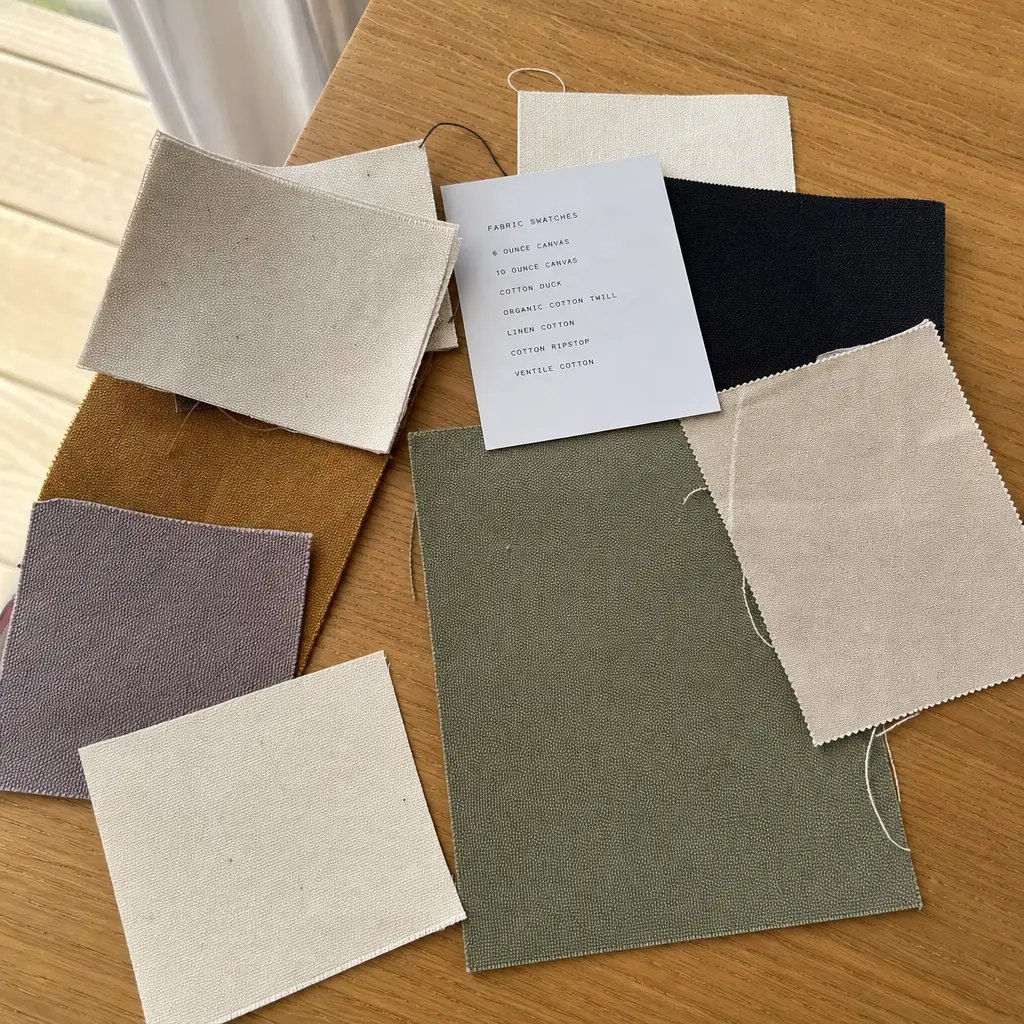
Procurement Context: Bakery Bags Are Not Basic Totes
Wholesale canvas messenger bags for artisan bakeries sit in a tougher category than simple cotton totes. A tote may only travel from counter to car. A messenger bag gets worn across the shoulder, opened and closed all day, loaded unevenly, dropped onto café chairs, taken to markets, and reused long after the first pastry purchase. The durability question therefore moves beyond the fabric panel. The strap anchor, flap fold, bottom seam, closure, and logo surface all need to survive real handling.
The biggest sourcing risk is quote confusion. Several suppliers can look at the same reference photo and price very different bags. One may assume 10 oz canvas, a flat bottom, and a narrow strap. Another may quote 16 oz canvas, boxed corners, reinforcement patches, magnetic snaps, and bar-tacked webbing. Both descriptions may say “canvas messenger bag,” yet the cost, feel, freight weight, and failure risk are not comparable. A useful RFQ removes that ambiguity before the buyer compares unit prices.
Bakery branding adds another layer. Natural canvas, off-white cotton, kraft paper, and muted ink colors often suit artisan bakeries well. They also show stains, creases, ink transfer, and hardware pressure marks more quickly than darker synthetic bags. If the bag will be sold as merchandise, the inspection standard must protect both function and shelf appearance. A strong bag that arrives with flap dents or scuffed print can still be a commercial problem.
- Define whether the bag is for retail sale, staff use, market events, loyalty gifts, distributor resale, or premium takeaway packaging.
- Normalize quotes by fabric GSM, finished size, strap width, closure, reinforcement, logo method, and packing.
- Treat strap anchors, bottom corners, flap fold, closure backing, and print adhesion as primary risk areas.
- Do not approve bulk production from a photo reference without a written spec sheet and physical sample.
- Separate natural canvas character, such as seed flecks and slubs, from workmanship defects such as stains, open seams, and weak stitching.
Build the Spec Around Real Bakery Loads
Start the specification with what the bag must carry. A bakery messenger bag for staff uniforms has different needs from one designed for retail customers buying coffee, bread sleeves, and boxed pastries. Common finished sizes run about 32–38 cm wide, 26–32 cm high, and 8–12 cm deep, but those numbers only matter if they match the intended contents. A beautiful slim bag can disappoint quickly if the gusset is too shallow for pastry boxes or the flap will not close when loaded.
Write finished measurements into the purchase order, not only cutting measurements or a style name. Cotton canvas moves during sewing, washing, and pressing. Suppliers may also measure differently unless told otherwise. State that the bag is measured flat on a table without stretching, then list width, height, gusset, flap drop, strap width, minimum strap length, maximum strap length, and pocket dimensions if used. For many soft cotton bags, practical tolerance is ±5 mm on key smaller measurements or ±2% on larger dimensions.
Capacity is not just volume. Construction decides how the load sits. A flat unboxed bag may look similar in a front-view photo, but it bulges when a dense coffee bag or small jar pushes against one side. Boxed corners and a reinforced base seam distribute weight more evenly and help the bag keep a cleaner shape. If the bakery wants the bag to stand partly open for display, review that behavior on the sample with the real target load inside.
- Specify finished size, not only cutting size, because washing and sewing can change dimensions.
- Measure width, height, gusset, flap drop, strap width, and strap length range separately.
- Test the sample with bakery-relevant contents: pastry box, coffee bag, apron, notebook, water bottle, or small tablet.
- Confirm whether the flap must close when the bag is loaded to expected capacity.
- Set logo and label placement tolerance, commonly ±3–5 mm for visible retail branding.
Canvas Weight, Finish, and Hand Feel
For wholesale canvas messenger bags for artisan bakeries, a practical main-fabric range is 12 oz to 16 oz cotton canvas. In metric terms, 12 oz per square yard is roughly 407 GSM, 14 oz is about 475 GSM, and 16 oz is about 542 GSM before finishing differences are considered. These conversions help buyers compare offers, but they should not replace actual bulk checks. Dyeing, washing, calendaring, coating, and shrinkage can all change measured GSM, stiffness, and print behavior.
A 10 oz canvas may work for a light promotional item, but it can collapse on the shelf and show strain sooner at strap joints. A reinforced 12 oz canvas is often a good middle ground for cost-controlled retail programs. A 14 oz or 16 oz canvas usually gives stronger perceived value and better shape retention, though it may add sewing difficulty, needle marking, carton weight, and freight cost. Heavier is not always better. An 18 oz bag may become stiff, expensive, hard to fold, and more likely to show permanent creases if packed tightly.
Finish should be discussed early. Natural or greige canvas often fits bakery aesthetics and avoids the extra approval cycle of dyed fabric. Dyed canvas supports brand colors and seasonal retail collections, but it needs lab dips, shade bands, colorfastness review, and lot control in cutting. Washed canvas feels softer and more casual, yet the buyer must confirm shrinkage before final size approval. Coated or laminated canvas can improve moisture resistance, but it may change sewing behavior, recyclability, print adhesion, and the natural touch many bakery brands want.
- Require both oz per square yard and GSM in every supplier quote.
- Ask whether GSM is measured before or after dyeing, washing, coating, or softening.
- Use 12 oz canvas for cost-controlled programs when reinforcement is properly specified.
- Use 14 oz to 16 oz canvas when structure, premium feel, and reuse value are priorities.
- Approve dyed canvas by lab dip and define shade limits before bulk fabric is purchased.
- Confirm shrinkage for washed canvas before approving final dimensions.
Construction Details That Prevent Load Failure
Most canvas messenger bags do not fail in the center of the fabric panel. They fail where the work is concentrated: strap seams, bottom corners, flap edges, closure points, and seam allowances. Bakery loads can be awkward. A coffee bag, jar, or water bottle may pull to one side while a pastry box pushes the flap outward. That uneven pressure makes strap anchor design and bottom construction more important than a fabric swatch strength test alone.
A stronger build usually includes boxed corners, reinforced strap attachment points, secured seam allowance, and bar-tacks or box-X stitching at load-bearing joints. Stitch density should suit heavy canvas. A common target is 7–9 stitches per inch, but sample review matters because too many stitches can perforate thick cotton while too few reduce seam strength. Look for even tension, secure back-tacks, clean seam allowance, and no needle cutting around high-stress areas.
Lined bags need a sharper inspection routine. A lining can make the product look more finished, but it can also hide weak seams and missing reinforcement. Ask for production photos before the lining is closed, or request one duplicate cut-open sample for evaluation. If the bag is unlined, the inside becomes part of the customer experience. Seam binding, overlock quality, thread trimming, and raw-edge control should be included in the cosmetic standard.
- Specify strap width, strap material, strap length range, and exact reinforcement method.
- Require bar-tacks, box-X stitching, or reinforced patches at shoulder strap anchors.
- Check that boxed corners and bottom seams remain stable under realistic bakery load.
- Reject samples with skipped stitches, loose tension, frayed seam allowance, or needle-cut fabric at stress points.
- Ask for inside construction photos when lining hides reinforcement.
- Confirm whether rivets are functional reinforcement or decorative; rivets alone should not replace sound stitching.
Closures, Hardware, and Strap Components
Closure choice changes both durability and brand feel. Magnetic snaps create a clean retail look and are common under messenger flaps, but they need proper backing so the canvas does not tear. Metal snaps can feel secure yet leave pressure rings on natural fabric when cartons are compressed. Buckles bring a rugged craft-market style and add labor time. Hook-and-loop tape is economical and easy to operate, but it collects lint, makes noise, and may feel too promotional for a premium bakery merchandise item.
Hardware descriptions should be specific. “Metal accessories” does not tell a buyer enough. Ask whether sliders, D-rings, snaps, rivets, and magnetic closures are iron, brass, zinc alloy, stainless steel, or another material. Clarify plating, anti-rust expectations, and edge finishing. Natural canvas will reveal rust marks, burr scratches, and black residue quickly, especially after humid storage or ocean transit.
Straps deserve the same attention as the body fabric. Cotton webbing matches the artisan look, but its shrinkage and stretch depend on weave and finish. Polyester webbing may be more dimensionally stable, though it can feel less natural. Canvas self-fabric straps look cohesive but may twist if they are too narrow or poorly constructed. For a messenger-bag feel, 38–50 mm width is usually more suitable than narrow tote handles. Test the adjustable range over normal clothing and, for staff or outdoor market use, over a coat.
- Define closure type, size, finish, and backing reinforcement in the RFQ.
- Check magnetic snaps for holding force, alignment, and fabric tearing after repeated opening.
- Inspect hardware for rust, sharp edges, plating scratches, loose prongs, and pressure marks.
- Require strap sliders and rings that match the strap width without slipping or twisting.
- Test dark straps against natural canvas for staining during compressed packing.
- Include spare hardware or replacement options in the quote if the component is custom or seasonal.
Logo Durability on Natural and Dyed Canvas
Bakery graphics often work beautifully on canvas: wheat line art, simple wordmarks, round seals, small slogans, and one- or two-color icons. Screen printing is usually the practical choice for wholesale canvas messenger bags when the artwork is clean and the quantity supports setup. Water-based or pigment screen print can keep a softer hand on natural cotton. Plastisol may offer stronger opacity, but it can feel heavier. Embroidery feels premium on small marks, provided backing and stitch density are controlled. Woven labels are durable for compact branding and reduce the risk of ink abrasion.
Placement is a durability decision, not only a design choice. A logo printed across the flap fold may crack sooner because the flap bends every time the bag opens. A large lower-front print may rub against clothing, counters, or café furniture. Fine text printed across slubs, seams, or heavy canvas texture can lose clarity. Define print size, color reference, placement, placement tolerance, curing requirement, and acceptable hand feel before the supplier prices production.
Approve the print on the actual bulk fabric color and finish. A strike-off on smooth white cotton does not prove performance on natural 14 oz canvas or dyed washed canvas. Ask the supplier to show whether the ink cures properly, whether color shifts on natural cotton, whether the logo cracks when the flap bends, and whether dark ink transfers during packing. For brand-critical color, review a physical strike-off rather than relying on a digital mockup.
- Use screen print for simple bakery logos, short slogans, and repeatable one- or two-color artwork.
- Use woven labels for small premium branding where abrasion resistance matters more than large visual impact.
- Avoid placing fine text over flap folds, seam transitions, or heavy slub areas.
- Define logo placement tolerance, commonly ±3–5 mm depending on panel size and retail needs.
- Require dry rub, wet rub, tape pull, and bend checks on production fabric.
- Confirm whether setup charges, screen charges, embroidery tape charges, or label mold charges are included.
Sample Approval and Practical Durability Tests
A pre-production sample should prove more than appearance. It should confirm fabric weight, hand feel, finished size, construction method, strap security, logo result, closure function, and packing recovery. The most useful test is simple: load the bag like a bakery customer would, carry it on the shoulder, open and close the flap, place it on a table, and inspect what changed. Photo approval alone can hide weak reinforcement and poor inside construction.
Not every order needs a full laboratory program, but every order needs written pass/fail checks. For bakery lifestyle use, many buyers screen samples with a defined load around 5–8 kg, then inspect strap anchors, seams, bottom corners, closure backing, and flap alignment. If the bag is marketed for heavier daily carry, set a higher test weight and consider third-party lab testing. The important part is to write down the load, duration, handling method, and failure criteria. “Strong enough” cannot be inspected consistently.
Make sure the approved sample represents the quoted bulk product. A sample made in 16 oz canvas does not prove performance if the quote is for 12 oz bulk fabric. A print strike-off on a different finish does not prove adhesion. Buyer and factory should each keep a sealed approved sample, plus fabric swatch, hardware sample, print strike-off, and packing photo. Those references become the standard for in-line and final inspection.
- Verify sample fabric weight by supplier test report, internal GSM check, or mill lot documentation.
- Measure finished dimensions flat: width, height, gusset, flap drop, strap width, and strap length range.
- Load the sample with a defined weight such as 5–8 kg for typical bakery lifestyle use, then inspect seams and strap anchors.
- Open and close the flap and closure at least 50–100 cycles for screening before approving the pre-production sample.
- Check print by dry rub, damp rub, tape pull, and repeated bending at the actual flap movement area.
- Photograph strap anchors, bottom corners, inside seams, closure backing, logo placement, and packing method.
- Seal one approved sample at the buyer side and one at the factory side before bulk cutting.
Bulk QC Plan and Defect Classification
Bulk quality control should turn the approved sample into measurable inspection points. Many bag orders use a sampling plan such as general inspection level II with AQL 0 for critical defects, 2.5 for major defects, and 4.0 for minor defects. The final plan should match the buyer’s quality policy, shipment value, and market risk. What matters most is timing. Define the inspection standard before production starts, not when packed goods are waiting for vessel cutoff.
Defect classification should separate safety, function, and appearance. Critical defects may include sharp hardware, exposed broken metal, mold contamination, or severe chemical odor. Major defects may include open seams, broken straps, wrong fabric, wrong size beyond tolerance, missing closure, major print cracking, severe stains, rust transfer, or incorrect logo placement. Minor defects may include small thread ends, slight natural slub variation, minor shade variation within the approved range, or wrinkles that recover after unpacking.
In-line inspection is especially useful for messenger bags. Strap attachment, seam allowance, closure backing, and print curing are easier to correct before final packing. Final inspection should include packed-carton review as well as loose-piece review. A bag that looks fine on the sewing table can still arrive with permanent flap creases, hardware dents, scuffed ink, or barcode problems if export packing is weak.
- Use the approved sample, fabric swatch, print strike-off, and packing sample as inspection references.
- Classify sharp hardware, mold, severe odor, and unsafe broken parts as critical defects.
- Classify strap failure, open seams, wrong fabric GSM, wrong dimensions, severe stains, and failed closure as major defects.
- Classify trim thread ends, minor wrinkles, and acceptable natural cotton flecks as minor defects when they do not affect use.
- Check a packed carton during inspection, not only loose pieces from the sewing line.
- Record inspection results by defect type, location, quantity checked, quantity failed, and photo evidence.
Packing, Moisture Control, and Carton Design
A well-made messenger bag can still arrive unsellable if packing is treated as an afterthought. Heavy canvas flaps can hold hard creases when folded under pressure. Magnetic snaps, buckles, and rivets can leave circular pressure marks on natural fabric. Dark straps can transfer color to light canvas when humidity and compression combine. Screen prints can block, scuff, or pick up lint if stacked before full cure. Packing is part of the durability plan.
Choose packing around the sales channel. Individual polybags improve cleanliness, counting, and barcode control, but they add cost and may conflict with sustainability goals. Paper belly bands or kraft sleeves fit an artisan bakery look, though they provide less moisture protection. Bulk packing reduces material use and cost, but it raises the risk of abrasion, mixed folding, and handling marks. State whether the goods must be retail-ready, warehouse-ready, or distributor bulk-packed.
Carton data affects landed cost and warehouse handling. Ask for pieces per carton, carton dimensions, net weight, gross weight, carton material, and shipping mark format before confirming the purchase order. Many buyers prefer carton gross weight below 15–18 kg for manual handling, but the correct limit depends on warehouse rules. For humid routes or sea freight, review desiccant and moisture-barrier practices. Desiccant should not touch the printed logo or visible canvas directly.
- Protect flaps from hard fold lines by using light folding, tissue, or a defined packing board when needed.
- Place paper or tissue between hardware and visible canvas to reduce pressure marks.
- Confirm that prints are fully cured before stacking to avoid blocking or ink transfer.
- Use desiccant for humid transit routes, but keep it separated from visible fabric and print surfaces.
- Set carton gross weight, carton strength, shipping marks, barcode placement, and packing orientation in the PO.
- Inspect packed samples after compression before approving final export packing.
MOQ, Lead Time, and Quote Comparison
MOQ is not just a number the supplier prefers. It is driven by body fabric sourcing, dye-lot size, cutting efficiency, webbing availability, lining material, hardware purchasing, print setup, sewing-line changeover, and packing requirements. A natural canvas bag using stock fabric and standard webbing may support a lower MOQ than a dyed bag with custom webbing, custom lining, branded hardware, and several logo placements. Ask suppliers to break MOQ down by component so the buyer can see what is fixed and what is negotiable.
Lead time should be broken into stages. “35 days production” may not include prototype sampling, buyer approval time, lab dips, print strike-offs, material preparation, packing approval, final inspection, export documents, or vessel booking. Natural canvas with standard webbing usually reduces approval risk. Dyed canvas adds lab dip and shade-correction time. Custom hardware can add uncertainty if plating, mold work, or component stock changes. Large screen prints may need extra curing space and careful handling.
When comparing quotes, look past FOB unit price. One supplier may include 14 oz canvas, reinforced strap anchors, individual packing, barcode labels, and support for final inspection. Another may quote 10 oz canvas, a narrow strap, bulk pack, and no clear inspection standard. The cheaper line item can become the more expensive order after sample revisions, packing upgrades, failed inspection, or customer complaints. A reliable quote sheet should include spec version, incoterm, payment terms, sample cost, setup charges, production timeline, carton data, and quote validity.
- Request MOQ separately for natural canvas, dyed canvas, custom webbing, custom lining, hardware finish, and logo method.
- Ask whether the quote uses one continuous fabric lot or mixed stock fabric lots.
- Break lead time into sample, lab dip, strike-off, material preparation, cutting, sewing, printing, finishing, inspection, and packing.
- Compare quotes by total landed cost, including freight volume, inspection, labels, cartons, duties, and warehouse handling.
- Require quote validity and component-substitution approval so the supplier cannot change fabric, hardware, or packing without written consent.
- For a first order, reduce risk by launching one proven base specification before expanding colorways or custom components.
Specification comparison for buyers
| Spec decision | Recommended option | When it fits | Buyer risk to check |
|---|---|---|---|
| Main fabric weight | 12 oz to 16 oz cotton canvas, approximately 407 to 542 GSM before finishing; confirm actual tested GSM after dyeing, washing, or coating | Retail bakery merchandise, staff bags, loyalty gifts, market bags, and premium takeaway packaging that must hold shape | Quotes that say only “canvas” may compare 8 oz promotional fabric with 14 oz messenger-bag fabric; require oz per square yard and GSM |
| Finished size | Common bakery messenger range: 32–38 cm width, 26–32 cm height, 8–12 cm gusset; set tolerance at ±5 mm for key panels or ±2% for larger dimensions | Fits pastry boxes, bread sleeves, coffee bags, aprons, POS materials, notebooks, or small tablets | A photo reference does not control capacity; undersized gussets cause bulging, flap misalignment, and poor retail appearance |
| Bag structure | Flap messenger with boxed bottom, reinforced base seam, and defined flap drop | Useful when the customer may carry dense bakery items such as coffee, jars, packaged granola, or merch with bread | Flat unboxed construction lowers sewing cost but concentrates load at the lower seam and reduces usable capacity |
| Strap construction | 38 mm to 50 mm cotton webbing, canvas webbing, or heavy cotton tape with box-X stitching or bar-tacks at load points | Best for repeated shoulder use and a product positioned above a basic tote | Narrow straps twist, dig into the shoulder, and may fail before the body fabric; specify strap length and adjustment range |
| Stitching standard | Typical heavy-canvas target: 7–9 stitches per inch, lockstitch, secured back-tacks, clean seam allowance, no skipped stitches at stress points | Works for unlined and lined messenger bags if the sewing line uses suitable needle size and thread | Too many stitches can perforate heavy canvas; too few stitches reduce seam strength; approve by sample and pull test |
| Closure method | Magnetic snap, metal snap, buckle, or hook-and-loop under flap depending on price point and brand feel | Magnetic snap gives a clean retail look; buckle feels rugged; hook-and-loop is cost-effective for promotions | Hardware can mark natural canvas, rust, tear the flap, or print through the carton if not protected during packing |
| Logo method | Water-based screen print, pigment screen print, embroidery, or woven label depending on artwork size and abrasion exposure | Simple artisan bakery marks, wheat icons, wordmarks, and one- or two-color graphics usually work well by screen print | Large prints across the flap fold can crack or abrade; require cure checks, rub testing, and placement tolerance |
| Color route | Natural greige canvas for fastest approval; reactive or pigment dyed canvas when brand color control is required | Natural canvas suits bakery aesthetics and reduces lab-dip work; dyed canvas supports seasonal retail collections | Dyed fabric needs lab dip approval, shade band limits, colorfastness review, and lot separation in cutting |
| MOQ logic | Separate MOQ by body fabric, dyed color, custom webbing, lining, hardware, logo method, and carton packing | Helps importers decide whether to launch one universal bakery bag or several bakery-specific colorways | Low MOQ quotes may use stock fabric, substitute hardware, mixed fabric lots, or simplified reinforcement unless the PO controls it |
Buyer checklist before sampling
- Define the real bakery use case before quoting: retail merchandise, staff bag, loyalty gift, market delivery bag, distributor resale item, or premium takeaway packaging.
- Specify finished dimensions in centimeters or inches, including width, height, gusset, flap drop, strap width, strap length range, and pocket dimensions if included.
- State fabric weight as oz per square yard and GSM, and identify whether the canvas is natural, bleached, dyed, washed, enzyme softened, laminated, or coated.
- Require every supplier to quote the same construction: boxed bottom or flat bottom, lined or unlined body, seam allowance, reinforcement patches, and strap attachment method.
- Set practical tolerances in the PO: fabric GSM usually ±5%, finished size commonly ±5 mm or ±2%, print placement ±3–5 mm, and shade within the approved lab dip range.
- Ask for stitch density, thread type, needle suitability, seam allowance, and exact bar-tack or box-X locations on the technical sample or construction sheet.
- Choose the logo method by artwork size, fabric color, wash expectation, hand feel, abrasion area, and whether the print crosses a flap fold or seam.
- Approve lab dips for dyed canvas and a physical print strike-off on the actual bulk fabric color before bulk cutting or full production printing.
- Run sample durability checks with realistic bakery loads such as boxed pastries, packaged coffee, an apron, small notebook, water bottle, or tablet-sized item.
- Confirm carton quantity, carton size, gross weight, packing orientation, moisture control, flap protection, barcode labels, and whether hardware is isolated from visible panels.
Factory quote questions to send
- What exact canvas weight are you quoting in oz per square yard and GSM, and is the GSM measured before or after dyeing, washing, or coating?
- Is the body fabric stock, greige, natural, bleached, dyed to order, washed after sewing, or finished with any coating or softener?
- What are the quoted finished dimensions for width, height, gusset, flap drop, strap width, strap length, and any pockets, and what tolerances will you apply?
- Which seams are lockstitched, which are overlocked or bound, what seam allowance is used, and what stitch density is planned for heavy canvas areas?
- Where exactly will bar-tacks, box-X stitches, reinforcement patches, rivets, or extra fabric layers be placed at the strap anchors and bottom corners?
- What strap material is included in the price: cotton webbing, polyester webbing, canvas self-fabric strap, or blended tape, and what is the minimum breaking strength if known?
- What closure is included: magnetic snap, spring snap, hook-and-loop, buckle, or no closure, and what plating or anti-rust requirement is included for metal parts?
- What logo method is included in the quote, how many colors are included, what is the maximum printable area, and what setup or screen charges are excluded?
- Will the logo be printed and cured on the same fabric color and finish used in bulk production, and can you perform dry rub, wet rub, tape pull, and bend checks?
- What is the MOQ for natural canvas, dyed canvas, custom webbing color, custom lining, custom hardware finish, embroidery, woven labels, and each additional colorway?
Quality-control points to confirm
- Fabric weight should be verified against the approved specification; for heavy cotton canvas, many buyers use a ±5% GSM tolerance unless a tighter tolerance is written into the contract.
- Finished dimensions should be measured flat without stretching, with width, height, gusset, flap drop, strap width, and maximum and minimum strap length recorded separately.
- Sample load screening should use a buyer-defined weight, commonly 5–8 kg for bakery lifestyle use and higher only when the bag is marketed for heavier daily carry.
- Strap attachment should be visually checked and pull-tested; reject open seams, cracked bar-tacks, needle-cut fabric, loose reinforcement patches, or thread breakage at load points.
- Stitching should be checked for skipped stitches, uneven tension, unsecured back-tacks, excessive needle holes, fraying seam allowance, and loose thread ends longer than the approved limit.
- Print adhesion should be checked on the actual production fabric by dry rub, wet rub, tape pull, and bend testing, especially if the logo sits on the flap or near the lower front panel.
- Colorfastness should be reviewed when dark straps, dyed canvas, or printed panels touch natural canvas under pressure during shipment.
- Flap alignment should be checked both empty and loaded because a twisted flap is a visible retail defect and often indicates uneven sewing or strap tension.
- Metal hardware should be checked for rust marks, sharp edges, weak magnetic force, plating scratches, burrs, broken prongs, and fabric staining after compression.
- Carton review should include crease marks, odor, moisture risk, desiccant placement, carton burst strength, gross weight, shipping marks, barcode readability, and packing orientation.