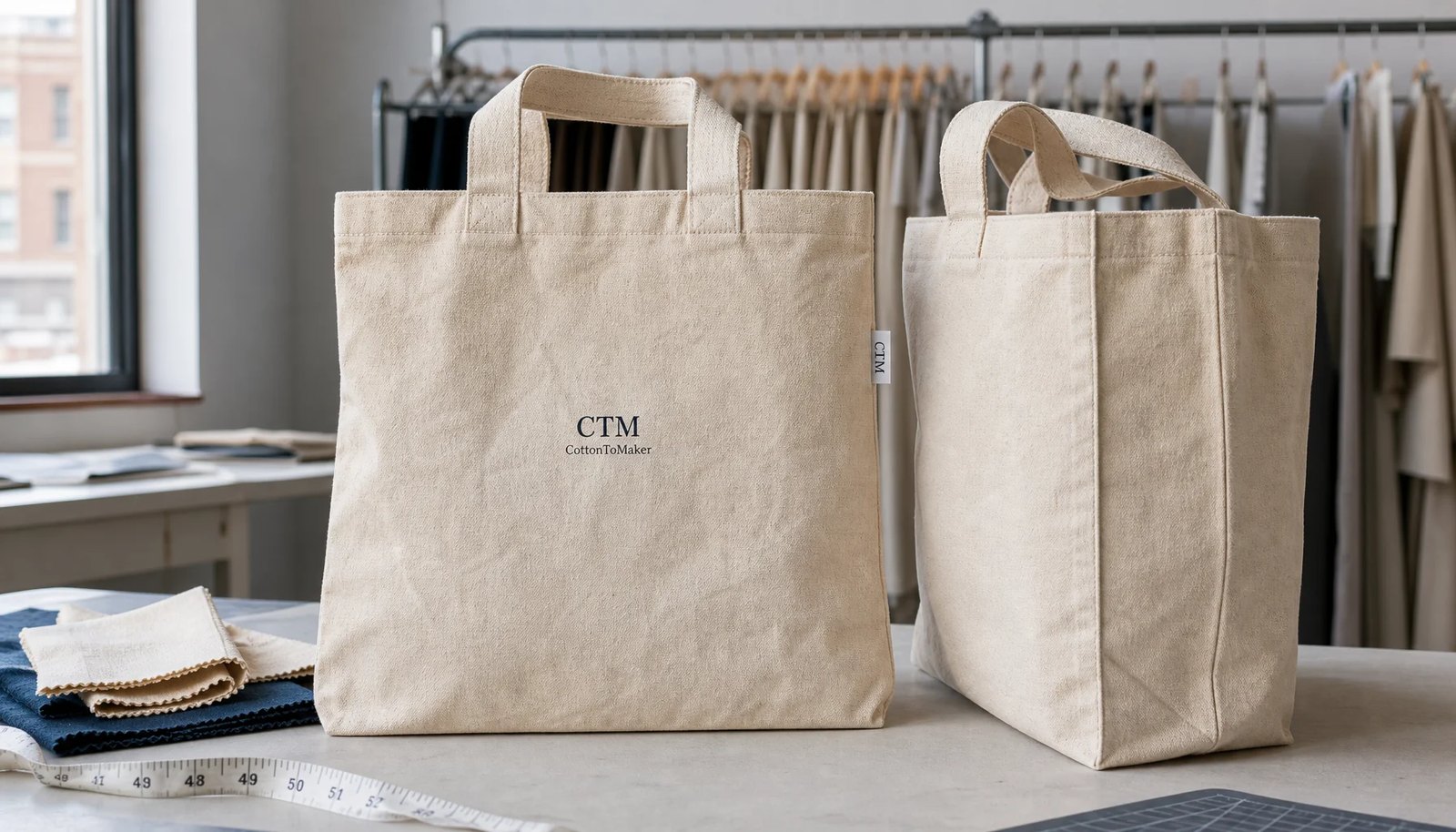
Begin With the Bookstore Use Case
A useful RFQ for wholesale canvas grocery totes for university bookstores starts with the program, not with a pretty product image. The same canvas tote can serve very different jobs on campus. It may be sold as licensed merchandise, offered as a checkout grocery bag, packed with orientation materials, given to alumni, used by a department, or included with online orders. Those uses do not need the same fabric weight, print detail, packing, or approval path.
A resale tote has to feel worth the retail price. It should fold neatly, carry the licensed mark cleanly, and look consistent on a shelf or peg. A checkout tote needs capacity, fast handling at the register, and enough strength for books, snacks, bottled drinks, and apparel. A one-day giveaway may lean more heavily toward budget and delivery date. If the supplier does not know the use case, the quote often defaults to a generic open tote that is easy to price but not necessarily right for the bookstore.
Tell suppliers how the tote will move through your operation. Will it arrive at a central university warehouse, a bookstore stockroom, a distributor, or directly to a campus event? Will staff need barcode labels, hangtags, price stickers, department codes, carton sequence numbers, or SKU separation? Small operational details can change cost and lead time. They also affect receiving labor, which is easy to overlook when comparing only unit price.
Date discipline matters. University demand clusters around move-in, orientation, semester openings, homecoming, graduation, alumni weekend, and athletic events. Ask for the required in-store date, then work backward through artwork approval, sample approval, production, inspection, export, transit, customs clearance if applicable, and final receiving. A tote that lands two weeks late may be perfect on paper and still fail the program.
- State the program type: resale, checkout grocery bag, welcome kit, alumni event, department merchandise, online insert, or staff gift.
- List expected contents by category, such as textbooks, apparel, snacks, bottled drinks, binders, folders, or mixed retail goods.
- Define how the tote should merchandise: folded at cash wrap, hung on a peg, stacked on a table, packed in kits, or shipped in ecommerce parcels.
- Identify licensing, barcode, hangtag, price label, distributor routing, carton marking, and campus receiving requirements.
- Provide the required in-store date and the latest acceptable delivery date to the bookstore, warehouse, or event location.
Make Fabric Weight Comparable
Canvas weight is one of the fastest ways quotes drift out of alignment. A buyer may ask for an 8 oz, 10 oz, or 12 oz canvas tote and receive prices that appear comparable. Often they are not. Suppliers may report ounce per square yard, GSM, greige fabric weight, dyed fabric weight, washed fabric weight, or finished-goods weight. A procurement-ready RFQ asks for both ounce and GSM, then asks when and how that weight is measured.
For many university bookstore grocery tote programs, 10 oz to 12 oz cotton canvas, roughly 340-410 GSM, is a practical middle range. It gives the bag enough body for books, apparel, snacks, and bottled drinks without making the tote overly stiff or the cartons unnecessarily heavy. Lighter 8 oz canvas can work for budget giveaways or inserts, but it may feel thin for resale. Heavier 14 oz canvas may support premium positioning, but it can raise fabric cost, sewing effort, needle wear, carton weight, and freight exposure.
Composition should be stated plainly. If the buyer wants 100% cotton, say so. If a cotton blend is acceptable, define the blend or ask the factory to disclose it. The RFQ should also ask for weave or yarn description when available, fabric finish, color, and expected shrinkage or dimensional change if the tote is marketed as washable. Do not rely on broad claims such as heavy duty, premium, sustainable, or eco-friendly unless the supplier explains the material basis and provides any documentation the buyer requires.
Color deserves the same care as weight. Natural canvas is usually easier to source and repeat than custom dyed canvas. Bleached, black, navy, or custom campus-color canvas can affect MOQ, shade tolerance, print opacity, and lead time. For dyed canvas, request lab dips before bulk fabric approval. For natural or unbleached canvas, define the acceptable range for slubs, cotton seed flecks, and shade variation against the approved sample.
- Request both ounce per square yard and GSM; do not use ounce-only quotes for final supplier comparison.
- State fabric composition, such as 100% cotton canvas or a disclosed cotton blend.
- Define finish: natural, bleached, dyed, washed, softened, coated, unwashed, or preshrunk if offered.
- Ask whether fabric weight is measured before dyeing, after dyeing, after washing, or on finished sewn goods.
- For dyed canvas, require lab dips, shade tolerance, and print-opacity confirmation on the selected color.
Specify Capacity, Not Just Size
A grocery tote is more than a front panel with handles. Capacity comes from the side gusset, bottom gusset, fabric behavior, and how the bag opens under real use. A common bookstore tote may sit around 14-16 inches wide, 15-17 inches high, and 4-6 inches deep, but the final size should follow the merchandise mix. Textbooks need a stable bottom and strong seams. Apparel needs volume. Convenience-store goods need a gusset that opens easily at checkout. Orientation kits may need to hold folders, brochures, water bottles, and small giveaways without bulging.
Use a dimensioned specification table rather than a photo with approximate measurements. Include finished width, finished height, side gusset, bottom gusset, handle length, handle width, and handle drop if shoulder comfort matters. Add tolerance for each dimension. This is not paperwork for its own sake. A supplier quoting a slightly smaller tote saves fabric and may look cheaper, while the bookstore receives a bag that carries less.
The RFQ should also identify structural choices before pricing. A snap closure, inside pocket, bottom board, woven side label, printed care label, hang loop, reinforced bottom panel, or special retail fold changes cost and inspection scope. For most grocery-style bookstore totes, an open top with reinforced handles and secure internal seams is the cleanest starting point. Add features only when they improve resale value, merchandising, or a specific campus use.
A physical blank sample is worth more than a perfect mockup. Load it with the expected contents: two textbooks, a sweatshirt, a water bottle, snacks, binders, or whatever the program actually requires. Check whether it stands, folds, carries, and opens the way staff and customers need. Make adjustments before bulk cutting, not after cartons arrive.
- Specify body width, body height, side gusset, bottom gusset, handle length, handle width, and handle drop.
- Use a 4-6 inch gusset when the tote must carry bulky items, books, apparel, groceries, or mixed checkout goods.
- Require finished-size tolerance for every measured dimension, not only the front panel.
- Identify closures, pockets, bottom inserts, labels, hang loops, and retail trim as included or optional.
- Approve a loaded physical size sample before bulk cutting for custom bookstore programs.
Treat Handles as a Performance Spec
Handle design is where a low-cost tote often starts to feel cheap. Students, staff, parents, and alumni may carry the bag from the bookstore to dorms, offices, parking lots, buses, tailgate areas, or event venues. A shoulder-carry handle is usually more useful than a short hand-carry loop for that kind of movement. A 22-24 inch handle length is a common target, but the RFQ must define how the length is measured.
Measurement language can cause real disputes. Some factories measure the strip before sewing. Others measure finished end-to-end length. Buyers may mean handle drop. Those are different numbers. If shoulder comfort is important, ask for finished drop and finished end-to-end length. For a grocery tote expected to carry books or bottled drinks, handle width also matters. A 1.25-1.5 inch width is a practical range for many canvas programs because it spreads weight better than a narrow strip.
Self-fabric handles give a unified retail look. Cotton webbing handles may feel firmer and can be efficient in production. Neither choice is automatically better. Approve the handle material with the final body fabric, especially on natural or dyed campus colors where shade mismatch can be visible. If webbing is used, confirm width, thickness, texture, shrinkage behavior, and color tolerance.
The attachment point is the stress point. The RFQ should call for a reinforced box stitch, cross stitch, or another approved pattern, with placement tolerance. Ask how the supplier checks handle strength during production. A simple in-line load simulation using a defined weight or expected merchandise mix can catch weak back-tacking, skipped stitches, and seam tearing before packing. If the buyer requires formal testing, state that separately.
- Set handle length for actual shoulder carry, not only material efficiency.
- Specify whether handle measurement means pre-sewing strip length, finished end-to-end length, or finished handle drop.
- Require handle width, reinforcement pattern, attachment spacing, and placement tolerance.
- Approve self-fabric or webbing handles with the final body fabric to confirm shade and hand feel.
- Ask for an in-line load check focused on handle attachment, side seams, bottom seam, and gusset seams.
Match Decoration to Licensed Artwork
University bookstore artwork can be more demanding than a standard promotional logo. It may include official wordmarks, seals, mascots, department marks, class-year graphics, athletic references, legal text, and trademark details. These marks need clean reproduction and, in many cases, formal approval before production. For most wholesale canvas grocery totes, screen printing is the most controlled option for one to three spot colors at bulk quantities.
Canvas has texture, so not every detail prints well at small size. Fine mascot lines, seal text, distressed effects, small legal copy, tight two-color registration, and large solid ink blocks should be reviewed before screens are made. Dark or dyed canvas may need an underbase for opacity. That can raise cost, thicken the print hand, and add production time. Large ink areas can also make the tote feel stiff if the ink system and curing are not suited to the fabric.
The RFQ should not simply ask, Can you print this? Better questions produce better quotes. Ask the supplier to identify minimum line thickness, minimum text height, registration tolerance, maximum recommended ink coverage, underbase requirements, curing method, and placement tolerance. If the mark is licensed, the printed strike-off should be treated as a control sample, not a casual preview.
Transfers, DTG, digital print, and embroidery can be useful in specific cases, but each should be tested on the actual canvas weight and color. Transfers require adhesion and edge-durability review. DTG and digital methods require color and wash-behavior checks if washability is claimed. Embroidery can work for a small premium mark, but large embroidery may pucker canvas and add thread cost. Choose the method because it fits the artwork and order, not because it sounds more advanced.
- Use screen print for simple campus logos, slogans, seals, and mascot art with limited spot colors.
- Provide vector files, Pantone targets, print dimensions, clear-space rules, approved logo versions, and placement reference points.
- Ask for minimum line thickness, minimum text height, registration tolerance, curing needs, and maximum recommended ink coverage.
- Confirm whether dark or dyed canvas needs an underbase, and include that in pricing and sample approval.
- Require a printed strike-off on the final canvas color and weight before bulk printing.
Use MOQ Tiers to Reveal Cost Drivers
A one-quantity RFQ hides too much. Ask suppliers to quote 500, 1,000, 2,500, and 5,000 pieces using the same tote specification and packing method. This shows where the real price breaks come from: fabric purchasing, cutting yield, screen setup allocation, trim buying, sewing-line planning, and carton utilization. If the supplier changes the canvas, handle, print method, label, fold, or packing between tiers, the tier comparison is no longer clean.
MOQ is often tied to one production input rather than the sewing operation itself. Natural canvas may be available in smaller quantities. Custom dyed canvas may require a minimum fabric commitment. Woven labels, hangtags, barcode stickers, special cartons, individual polybags, and custom trims can each have separate MOQs. Ask which factor sets the minimum: fabric, dyeing, printing, labels, packing material, or scheduling. The answer helps procurement decide which features are required now and which can wait for a larger repeat order.
Price breaks should be weighed against inventory risk. A 5,000-piece order may lower unit cost, but it also increases storage needs, cash tied in inventory, and exposure to artwork changes, licensing updates, department rebrands, class-year graphics, or event-date changes. A 1,000- or 2,500-piece order may be smarter for seasonal designs, graduation programs, alumni events, or a new design being market-tested. Stable core bookstore artwork can be sourced differently from temporary event graphics.
Keep optional upgrades visible. If the bookstore is considering a hangtag, woven side label, retail fold, barcode sticker, paper band, or individual bag, ask for each as a separate line item. That makes the cost of presentation clear and prevents a supplier from embedding assumptions that another supplier excludes.
- Request 500, 1,000, 2,500, and 5,000 piece tiers using the same spec and packing.
- Ask which feature drives MOQ: canvas availability, dyeing, print setup, trim, packing, or line scheduling.
- Separate required specifications from optional upgrades so cost impact is visible.
- Do not compare a natural canvas one-color quote with a dyed canvas multi-color quote as equivalent.
- Balance unit price against storage space, inventory turn, licensing changes, and seasonal artwork risk.
Turn the RFQ Into a Quote Sheet
Procurement teams compare suppliers faster when each quote returns the same fields. A canvas grocery tote RFQ should read like a data sheet, not a loose email asking for best price. Required fields should include item name, quantity tier, unit price, canvas weight in ounce and GSM, finished size, gusset depth, handle specification, seam construction, reinforcement method, print method, print size, number of colors, sample charges, setup charges, packing method, carton count, carton dimensions, gross weight, lead time, payment term, Incoterm, quote validity, and excluded costs.
This structure prevents false low pricing. One supplier may quote FOB with no sample courier, no screen setup, no hangtag, no barcode sticker, no retail folding, and no testing. Another may include delivered cost, hangtags, barcode labeling, and carton marks. Those quotes are not equivalent. If the buyer compares only the unit price, the apparent winner may become more expensive after artwork approval or sample signoff.
A good quote sheet also helps internal review. Licensing can check artwork and strike-off requirements. Merchandising can judge retail presentation. Finance can compare terms and landed cost. Receiving can review carton weight, carton count, and SKU separation. The best supplier is not always the cheapest on the first line. It is the supplier whose assumptions are clear enough for procurement to control the outcome.
Ask suppliers to list exclusions. Exclusions are not a problem by themselves; hidden exclusions are. If testing, duties, destination handling, pallets, hangtags, or courier fees are outside the unit price, the buyer should know before issuing the purchase order. Quote validity should also be stated, especially when cotton cost, exchange rate, or freight rates may move.
- Require unit price by tier plus setup, sampling, courier, testing, label, hangtag, and packing charges.
- State Incoterm clearly: EXW, FOB, CIF, DDP, or domestic delivered.
- Ask for carton dimensions and gross weight early so freight, storage, and receiving labor can be estimated.
- Require quote validity and identify assumptions that can change price, such as cotton, exchange rate, and freight.
- Create one comparison sheet so procurement, licensing, merchandising, finance, and receiving review the same assumptions.
Approve Samples in Controlled Stages
Sampling should reduce risk step by step. Start with fabric. For a custom university bookstore grocery tote, the first approval may be a swatch or lab dip. This confirms canvas weight, color, texture, and shade expectation before time is spent on a full sample. For natural canvas, the swatch should show the acceptable range of cotton flecks, slubs, and shade variation. For dyed canvas, lab dip approval should include lighting conditions and a practical tolerance.
Next comes the blank size sample. This is where the buyer checks body dimensions, gusset shape, handle length, handle width, handle drop, seam construction, reinforcement pattern, and overall hand feel. A blank sample can expose problems early: the tote is too shallow for books, the gusset does not open well, the handle digs into the shoulder, or the fabric feels lighter than the quote implied. Load the sample with real bookstore merchandise and record required changes clearly.
The printed strike-off should be produced on the actual canvas color and weight or on an approved production-equivalent fabric. It checks print color, line detail, opacity, registration, placement, ink hand, and artwork accuracy. This stage is especially important for university seals, mascot details, legal trademark text, and multi-color marks. The strike-off should be signed or otherwise formally approved before bulk printing.
The final pre-production sample should combine all approved elements: fabric, sewing, print, labels, hangtags, barcode, folding, packing, and carton mark when relevant. Keep one signed sample with the buyer and one sealed control sample with the factory. If production is inspected later, the inspector needs a physical standard rather than a chain of email images.
- Approve a fabric swatch or lab dip before committing to dyed or nonstandard canvas.
- Approve a blank size sample before bulk cutting when the tote structure is custom.
- Approve a print strike-off before bulk printing, especially for licensed marks or dark canvas.
- Approve a final pre-production sample including labels, tags, folding, and packing.
- Record who approved the sample, approval date, artwork version, Pantone targets, and agreed tolerances.
Set QC Rules Before Cutting Starts
Quality control belongs in the RFQ and purchase order, not only in a final inspection email. Canvas grocery tote inspection should cover fabric cleanliness, shade consistency, measurements, handle attachment, seam construction, stitch density, loose threads, print accuracy, label placement, folding, carton count, and SKU separation. Common defects include oil marks, dirt, mildew odor, uneven natural canvas shade, holes, broken stitches, skipped stitches, crooked handles, print smears, pinholes, registration shifts, wrong print placement, mixed cartons, and short counts.
Defect classification reduces arguments. A critical defect may include unsafe contamination, wrong licensed logo, wrong university mark, or construction failure that makes the tote unusable. A major defect may include visible print smearing, size outside tolerance, broken handle stitch, incorrect carton count, wrong SKU label, or severe shade mismatch. A minor defect may include a loose thread that can be trimmed without affecting use. Write these examples into the inspection plan so the supplier knows what will be judged.
Many buyers use an AQL-based sampling plan or another agreed random sampling method for soft goods, but the RFQ should define the actual acceptance standard instead of assuming the factory uses the buyer's preference. State how many pieces will be checked, which cartons will be opened, what measurements will be recorded, and what triggers rework or rejection. Pull samples from multiple cartons, operators, and production times rather than from a supplier-selected stack.
Licensed merchandise needs extra attention at inspection. A small print defect on a generic promo bag may be tolerable; the same defect across a university seal or legal mark may create approval and resale problems. Check spelling, logo version, trademark text, color, placement, hangtag, barcode, and SKU against the final approved file. The signed strike-off should be on hand during review.
- Set critical, major, and minor defect definitions in the purchase order or inspection plan.
- Measure random pieces from multiple cartons, operators, and production times.
- Inspect handle stitching under tension because handle failure is a primary complaint risk.
- Check print color, placement, opacity, line detail, and visible defects against the signed strike-off.
- Verify carton count, carton marks, SKU separation, labels, folding, and packing before final shipment release.
Plan Packing, Timeline, and Landed Cost Together
Packing is a procurement decision. A common wholesale format for canvas grocery totes is flat packing in export cartons, often around 40-60 pieces per carton depending on canvas weight, gusset depth, fold method, tags, and carton weight limits. The RFQ should state a maximum gross weight that campus receiving or distributor teams can handle safely. Heavy cartons slow stockroom work. Variable counts slow receiving. Poor carton marks force staff to open boxes just to identify SKUs.
Individual polybags can protect premium retail merchandise, but they add cost, plastic waste, and unpacking labor. Bulk packing, paper bands, or clean inner bundles may be enough for many bookstore programs. If the tote needs a barcode, hangtag, ecommerce presentation, or shelf-ready condition, individual packing or paper bands may be justified. Define fold method, inner bundle count, carton marks, PO number, SKU, item description, color, quantity, carton sequence, and any routing rules from the bookstore, distributor, or central university warehouse.
Lead time should be broken into milestones. Ask suppliers to separate artwork review, sample making, sample approval, fabric purchase, dyeing if applicable, printing, sewing, finishing, inspection, packing, export handover, transit, customs clearance, and final delivery. A quote that says 30 days after deposit may exclude artwork revisions, license approval, sample courier time, holiday closures, freight booking, or customs delays. For orientation, homecoming, graduation, and semester openings, that gap matters.
Landed cost includes more than the factory unit price. Buyers should include setup charges, samples, sample courier, testing if required, packing upgrades, hangtags, barcode stickers, freight, insurance if applicable, duties, customs clearance, destination handling, pallets, and final delivery to the bookstore or warehouse. A lower FOB price may not be the lowest landed cost if cartons are inefficient, gross weight is high, or receiving labor increases. Ask for carton dimensions and estimated gross weight at quote stage so logistics can model cost before the purchase order is finalized.
- Set pieces per carton and maximum gross weight based on campus receiving or distributor limits.
- Define whether totes are flat packed, half folded, retail folded, paper banded, bundled, or individually packed.
- Require carton marks with PO number, SKU, item description, color, quantity, gross weight, and carton sequence.
- Split lead time into approval, material, production, inspection, packing, export, transit, and delivery milestones.
- Compare landed cost, receiving labor, schedule risk, and defect exposure rather than factory unit price alone.
Specification comparison for buyers
| RFQ decision | Procurement-ready specification | Best fit for university bookstores | Quote and QC risk to control |
|---|---|---|---|
| Sourcing route | Factory-direct custom production for repeat bulk orders; domestic distributor decoration for urgent stock-tote needs. | Factory-direct works best for 500-10,000 pieces when buyers need control over canvas weight, gusset, handle reinforcement, licensed artwork, packing, and repeat consistency. A distributor is useful for rush orders, small tests, or 50-500 piece stock programs. | Compare the same finished size, GSM, handle, print count, packing, freight term, and included charges. A low local MOQ may rely on stock blanks with less control over fabric shade, sewing quality, and repeat-order consistency. |
| Canvas weight | 10 oz to 12 oz cotton canvas, approximately 340-410 GSM, with both units stated in the quote. | A practical range for resale totes, grocery checkout, textbooks, apparel, bottled drinks, convenience items, and reusable retail programs. | Do not compare ounce-only quotes. Require GSM, composition, weave or yarn description when available, finish, shrinkage statement, and whether weight is measured on greige, dyed, washed, or finished fabric. |
| Bag body size | Gusseted open-top tote, often 14-16 in W x 15-17 in H x 4-6 in D, adjusted to the bookstore merchandise mix. | Works for books, sweatshirts, snacks, convenience-store goods, and counter checkout where usable volume matters more than a flat promotional silhouette. | A flat tote may look cheaper because it uses less fabric. Require side and bottom gusset dimensions, finished-size tolerance, and a loaded physical sample before production approval. |
| Handle specification | 22-24 in self-fabric or cotton webbing handles, 1.25-1.5 in wide, reinforced at attachment points. | Shoulder carry for students, staff, alumni, parents, and visitors walking between bookstore, dorms, parking, transit, and campus events. | Confirm whether length is measured before sewing, finished end-to-end, or as handle drop. Narrow or short handles reduce cost but also reduce comfort and perceived retail value. |
| Seam construction | Overlocked internal seams for standard programs; bound internal seams for premium retail finish. | Overlock is suitable for most wholesale canvas grocery totes. Bound seams fit higher-ticket licensed merchandise, heavier canvas, or premium alumni programs. | Ask for stitch density target, thread type, reinforcement pattern, trimming standard, and defect classifications for skipped stitches, broken stitches, fraying, seam twisting, and loose threads. |
| Print method | Screen print for 1-3 spot colors; test transfer, DTG, digital, or embroidery only when artwork requires it. | Screen printing is usually the most controlled method for campus wordmarks, seals, mascot outlines, slogans, department marks, and bookstore logos at wholesale quantities. | Fine mascot detail, small trademark text, tight registration, dark canvas, and large ink blocks require strike-off approval. Confirm opacity, underbase need, hand feel, cracking risk, curing, and placement tolerance. |
| MOQ and tiers | Quote 500, 1,000, 2,500, and 5,000 pieces using identical specs and packing. | Lets procurement see real price breaks from fabric purchasing, cutting yield, screen setup allocation, sewing-line planning, trim buying, and carton utilization. | If fabric color, handle, print method, label, fold, or packing changes by tier, the ladder is not comparable. Ask which input sets MOQ: fabric, dyeing, print, trim, packing, or scheduling. |
| Sampling plan | Fabric swatch or lab dip, blank size sample, printed strike-off, pre-production sample, and retained shipping sample. | Gives procurement, licensing, merchandising, and receiving teams a shared approval standard before bulk cutting, printing, and packing. | Photo approvals miss handle comfort, canvas hand, print texture, and loaded behavior. Define approval owner, sample quantity, revision charges, courier cost, and the tolerance represented by the approved sample. |
| Packing format | Flat packed in clean export cartons, commonly 40-60 pieces per carton depending on weight and fold, with maximum gross weight stated. | Supports campus receiving, stockroom handling, shelf replenishment, SKU count, and freight planning without unnecessary overpacking. | Overpacking raises cost and waste; vague carton specs can lead to crushed, damp, overweight, or poorly marked cartons. Require carton size, gross weight, carton marks, SKU separation, and moisture-control expectations. |
Buyer checklist before sampling
- Define finished tote dimensions: width, height, side gusset, bottom gusset, handle length, handle width, handle drop if needed, and measurement tolerance for each dimension.
- Specify canvas as cotton or cotton blend with ounce per square yard, GSM, composition, weave description if available, finish, color, and whether weight is measured before dyeing, after dyeing, after washing, or on finished goods.
- State the bookstore program clearly: retail resale, checkout grocery bag, student welcome kit, orientation giveaway, alumni event, department merchandise, staff gift, online order insert, or licensed campus product.
- List expected contents and load assumptions, such as two textbooks, apparel, water bottles, snacks, binders, lab supplies, electronics accessories, or mixed convenience-store merchandise.
- Provide vector artwork with approved logo version, Pantone targets, minimum clear space, print size, placement reference points, number of colors, and whether one side, two sides, gussets, labels, or hangtags are decorated.
- Ask suppliers to confirm the recommended decoration method and artwork limits for line thickness, minimum text size, registration tolerance, ink coverage, opacity, cracking, curing, and hand feel on the selected canvas.
- Request MOQ price tiers at 500, 1,000, 2,500, and 5,000 pieces using the same specification, and ask the supplier to identify which cost driver sets the MOQ.
- Separate mandatory specifications from optional add-ons such as hangtags, woven labels, barcode stickers, price labels, individual polybags, paper bands, retail folds, pallets, and custom export cartons.
- Require a staged sample plan: fabric swatch or lab dip, blank size sample, printed strike-off, pre-production sample, and retained shipping sample for final inspection comparison.
- Define seam construction, handle reinforcement pattern, stitch density target, thread color, trim standard, label placement, and whether inside seams are overlocked, bound, or otherwise finished.
Factory quote questions to send
- What exact canvas weight will be used in ounce per square yard and GSM, and is that measured on greige fabric, after dyeing, after washing, or on the finished sewn tote?
- What is the fabric composition, weave or yarn description if available, finish, color standard, shade tolerance, and expected dimensional change if the tote is marketed as washable or likely to be washed?
- Can you quote 500, 1,000, 2,500, and 5,000 pieces without changing fabric, handle, print method, sewing construction, label, folding, carton count, or packing material?
- What are the finished-size tolerances for body width, body height, side gusset, bottom gusset, handle length, handle width, handle drop, and print placement?
- Which decoration method do you recommend for our artwork, and what minimum line thickness, minimum text height, color count, registration tolerance, and maximum ink coverage should we follow?
- If printing on dark or dyed canvas, is an underbase required for opacity, and how will that affect price, hand feel, print thickness, curing, and production time?
- Can you produce a printed strike-off on the exact canvas color and weight before bulk printing, and how many artwork or color revisions are included before extra charges apply?
- What seam construction will be used inside the tote, what stitch density is typical per inch or centimeter, what thread will be used, and how will the handle attachment be reinforced?
- What sample types are included or charged separately: fabric swatch, lab dip for dyed canvas, blank size sample, printed strike-off, pre-production sample, and final shipping sample?
- What simple load simulation or in-line strength check can you perform for handle attachment, side seams, bottom seams, and gusset seams before packing?
Quality-control points to confirm
- Finished size should stay within the agreed tolerance, commonly plus or minus 1 cm for bag body dimensions and plus or minus 0.5 cm for smaller dimensions such as handle width or print reference points unless the buyer approves another standard.
- Canvas fabric should be clean, dry, evenly finished, free from oil marks, mildew odor, heavy shade bands, obvious contamination, holes, torn yarns, and weaving faults outside the approved sample range.
- Natural canvas slubs, cotton seed flecks, and shade variation should be judged against the signed sample. Define before production which natural markings are acceptable and which are major visual defects.
- Handle length, width, attachment position, and handle drop should be measured on finished pieces. Handles should not be twisted, uneven, noticeably crooked, or inconsistent between left and right attachment points.
- Handle attachment should use the approved box stitch, cross stitch, or reinforcement method with no skipped stitches, broken stitches, loose thread loops, seam tearing, or weak back-tacking under the agreed load simulation.
- Side seams, bottom seams, and gusset seams should be secure, aligned, and trimmed. Inside seams should be overlocked, bound, or finished as specified so raw edges do not fray during normal retail use.
- Stitch density should match the approved standard, with consistent thread tension and no long untrimmed threads visible at retail viewing distance.
- Print color should match the approved Pantone target or signed strike-off under consistent lighting, with no major pinholes, smearing, registration shift, ink bleed, ghosting, cracking, poor opacity, or screen marks.
- Print placement should be measured from agreed reference points, not judged by eye only. Front and back prints should not be rotated, off-center, or too close to seams unless approved.
- Licensed logos, wordmarks, legal text, mascot details, hangtags, labels, and barcode stickers should match the final approval file, including spelling, SKU, trademark details, and placement.