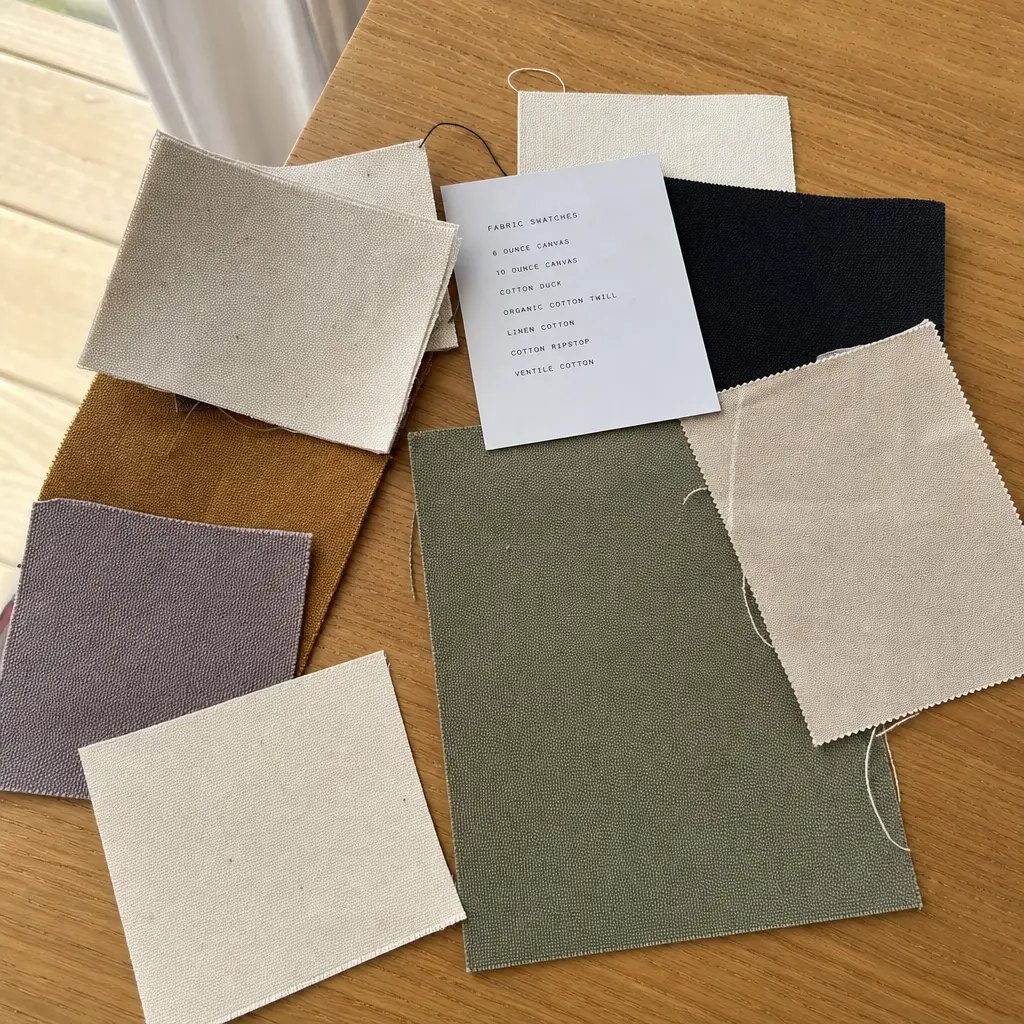
Start with the receiving date
For wholesale canvas grocery totes for trade show exhibitors, the real deadline is not the morning the show opens. Procurement needs the bags received, counted, inspected, allocated, and moved into booth freight, registration kits, sales rep kits, or a decorator's advance warehouse before the event team is already under pressure. A shipment that reaches the dock during booth build may look acceptable on a supplier's delivery report, but it often creates expensive work for the buyer.
Work backward from the required receiving date at the warehouse, 3PL, hotel, convention center dock, or show decorator. Then place every decision on the calendar: artwork freeze, sample approval, fabric booking, cutting, sewing, printing, curing, final inspection, packing, freight pickup, transit, customs if applicable, receiving, and allocation. This turns the schedule into something procurement can manage rather than something everyone hopes will hold.
Trade show freight adds its own rules. Advance warehouses usually publish receiving windows, carton labeling requirements, and penalties for late or noncompliant freight. If the tote program has multiple sponsor logos, regional allocations, or exhibitor kit splits, count verification and carton sorting may take several business days by themselves. Put those days in the plan early, when the calendar can still absorb them.
- Set a required receiving date several business days before internal kit assembly, booth freight cutoff, or advance warehouse close.
- Keep buyer approval time separate from supplier production time so late artwork is not hidden inside a factory lead time.
- Assign one owner and due date for artwork approval, sample approval, carton marks, ship-to details, and inspection release.
- Use the show open date as the final constraint, but manage daily decisions against the receiving and allocation date.
Write a comparable RFQ
The phrase canvas grocery tote sounds clear until three suppliers quote three different bags. One may price an 8 oz flat tote. Another may quote a 10 oz gusseted shopper. A third may include reinforced handles, individual packing, and printed carton labels. The lowest unit cost may simply be the least complete product.
A strong RFQ describes the finished bag, not just the category. Include width, height, gusset depth, handle length, handle drop, fabric weight, fabric color, top hem, seam construction, handle reinforcement, print method, print size, print side, placement, print colors, packing method, carton quantity, and delivery term. Write size as width x height x gusset, and state whether the measurement is taken flat or formed. Handle drop deserves its own line because it controls whether the tote works as a hand-carry bag, shoulder tote, or grocery-style carrier.
The intended contents should shape the specification. Paper literature does not stress a tote the same way as bottled samples, boxed products, or a mixed giveaway kit. A buyer who names the load profile helps the factory choose fabric weight, gusset depth, handle reinforcement, and stitching that match the field use. The spec also gives the inspection team something concrete to check later.
- Write dimensions in inches or centimeters and ask each supplier to restate them on the quotation.
- Specify handle drop separately from handle length because sewn-in length and finished carry height are different controls.
- Describe the expected contents, such as three catalogs plus two boxed samples, instead of using only vague terms like heavy duty.
- Define measurable requirements for fabric, stitching, decoration, packing, and tolerances before comparing unit prices.
Choose canvas weight by use
Canvas weight is often quoted in ounces, while mills and factories may also use GSM. A common working range is 8 oz near 270 GSM, 10 oz near 340 GSM, and 12 oz near 400 GSM, depending on weave and finish. Treat these as verification points, not marketing labels. Ask for the quoted weight, tolerance, construction, and confirmation that the approved sample and bulk production will use the same fabric route.
An 8 oz canvas tote can work for high-volume light giveaways where the bag mainly carries flyers, light brochures, or simple event materials. It keeps material cost and carton weight lower. The tradeoff is less structure, more wrinkling, more print show-through, and less confidence if attendees add catalogs or samples. For many exhibitor grocery-style totes, 10 oz is the middle ground: enough body for a useful bag without the full cost and shipping weight of heavier fabric.
A 12 oz tote feels more substantial and can make sense for reusable grocery programs, premium launches, retail-style gifts, or heavier booth materials. It also brings practical considerations. Heavier fabric can require more careful needle selection, stronger machines, more attention at bulky seams, and a folding method that does not create a poor presentation in the carton.
Color and finish affect timing too. Natural canvas may be faster when stock fabric is available, but shade can vary between lots. Bleached canvas gives a cleaner print ground for some artwork but may show dirt more easily. Custom dyed or piece-dyed canvas adds lab dip review, dyeing time, shade approval, and often higher minimums. If shade matters, make it part of the lead time plan, not a late aesthetic decision.
- Ask for canvas weight in both oz and GSM, plus the supplier's accepted tolerance before cutting.
- Use 8 oz for light giveaway loads, 10 oz for balanced trade show grocery totes, and 12 oz for heavier reusable or retail-style programs.
- Confirm whether handles use the same canvas as the bag body, a different webbing, or folded fabric construction.
- Require shade approval for dyed fabric and state whether normal natural canvas variation is acceptable.
Control the construction details
Tote performance is not decided by fabric weight alone. Handle attachment, seam allowance, stitch density, gusset construction, thread quality, and sewing consistency all matter. A grocery-style tote sees stress at the handle anchor points and bottom corners because users load it with dimensional items. The RFQ should say whether the handles use box stitch, box stitch with cross, bartack, or another reinforcement method.
The approved sample should show the exact construction. A supplier can describe reinforcement in general terms, but the inspection team needs to know what the finished stitch pattern should look like. If the tote uses a top hem, bottom gusset, side binding, or folded corners, those details should be visible in the sample photos and physical approval.
Stitch density should suit the fabric. Too few stitches can weaken a seam. Too many can perforate cotton canvas and create tearing risk, especially in high-stress areas. Skipped stitches, puckering, loose threads, and open seam ends may appear cosmetic at first glance, but they often point to weak process control.
Soft goods are not machined parts, so some variation is normal. Still, buyers should define acceptable tolerances for finished width, height, gusset, handle drop, and print placement. A one inch handle drop difference may not sound large on paper, but it can change carry comfort and make a batch look inconsistent when bags are lined up at a booth.
- Specify the handle reinforcement type and require it to match the approved sample.
- Ask how the factory controls stitch security on canvas totes, especially at handles, top hems, and gusset corners.
- Define tolerances for finished size, handle drop, print size, and print placement before mass production starts.
- Include skipped stitches, open seams, loose threads, fraying, and seam puckering in the inspection checklist.
Match decoration to artwork
Screen printing remains a common choice for canvas trade show totes because it is efficient for solid logos, event marks, sponsor branding, and medium-to-large quantities. It works best with vector artwork, clear shapes, and one or two colors. Give the supplier Pantone targets, print dimensions, print side, and placement measured from a stable reference such as the top hem, side seam, or center line.
Decoration risk changes with the artwork. Fine type can fill in on textured canvas. Large ink coverage can make the bag feel stiff and can highlight wrinkles. Multi-color designs need registration control. Every added color may add setup cost, approval time, and a new failure point. A clean one-color mark is often easier to produce consistently than a crowded block of sponsor logos.
Digital print or heat transfer may fit short runs, gradients, many-color artwork, or variable logo batches where screens become inefficient. Test the method on the actual canvas before committing. A transfer that looks sharp on a smooth proof may feel heavy on cotton, show edge lift, or crack under folding. A digital print may handle color range well but still needs checks for hand feel, odor, curing, and abrasion.
For brand-sensitive orders, ask for a print strike-off. It is especially useful when the tote color is natural canvas, because the fabric ground can shift the visual color. For repeat orders, confirm whether screens are reused, artwork is re-output, or color standards have changed since the previous production run.
- Supply vector artwork and identify Pantone targets, print size, print side, and placement in millimeters.
- Use screen print for simple solid artwork at larger quantities, and evaluate digital print or transfer for short-run or complex artwork.
- Approve a strike-off or production sample when brand color, fine type, or registration is important.
- Quote setup charges per color and per artwork so sponsor or regional variants are visible cost drivers.
Break MOQ into components
MOQ is rarely one simple number. It can be driven by fabric purchase minimums, dyeing, cutting efficiency, sewing setup, decoration setup, trim sourcing, label minimums, packing labor, and waste allowance. A supplier may support a low MOQ for a stock natural canvas blank but require a higher minimum for custom dyed fabric, woven labels, hangtags, or a multi-color print.
Ask for price breaks at realistic order quantities such as 500, 1,000, 2,500, and 5,000 units if those volumes fit the program. The pattern of the price breaks tells procurement something useful. A sharp drop after the first tier may point to setup and sampling costs. A gradual drop may mean material and labor are the main drivers. If freight becomes more efficient at higher quantities, combining needs across multiple shows may be better than placing repeated rush orders.
Variant logic is where many trade show tote budgets change. A 2,000-unit order split across four sponsor logos may be treated as four 500-unit print runs. A tote with the same body but different inserts, barcode labels, or carton allocations may also require extra handling. Clarify whether minimums apply per design, per fabric shade, per size, per destination, or per total PO.
This is not only a cost discussion. MOQ affects the production calendar. More variants mean more artwork approvals, more screens or print files, more carton sorting, and more chances to mix goods. Put the real program structure in the RFQ so suppliers quote the work that will actually happen.
- Ask for MOQ by blank tote, decorated tote, fabric shade, handle type, label, hangtag, insert, barcode label, polybag, and carton allocation.
- Request price breaks at multiple quantities and require setup charges to be shown per artwork or per color.
- Clarify whether minimums apply per logo, per size, per fabric color, per destination, or per total order.
- Use MOQ findings to decide whether to consolidate variants or standardize the tote body across events.
Use samples as controls
A digital mockup is useful for layout discussion. It does not prove the bag will sew correctly, carry comfortably, fold neatly, or print cleanly. A physical sample confirms fabric body, handle feel, seam quality, gusset shape, print scale, print position, and presentation after packing. For a trade show order tied to a fixed date, sampling should answer production questions before the factory cuts bulk fabric.
The approval record should be measured and specific. Include finished width, height, gusset, handle length, handle drop, fabric weight, print size, print placement, seam details, and any approved deviations. Photos help, but a retained physical sample is stronger. It becomes the standard for inspection and gives procurement, sales, marketing, and the supplier one shared reference.
Ask whether the sample is made from bulk fabric or sample-room fabric. If the print is produced on a sample press, ask whether mass production will use the same ink, screen mesh, curing method, and placement jig. These questions may sound detailed, but they prevent the familiar problem where the sample looks good and the production run behaves differently.
A simple load check is worth doing before approval. Put the expected show contents inside the tote: brochures, catalogs, packaged samples, apparel, or whatever the event team will hand out. Carry it by hand and shoulder if relevant. Watch the handles, seams, gusset corners, and print area. The test does not replace lab testing, but it quickly shows whether the bag feels right for the actual event.
- Approve the artwork layout first, then approve a measured physical sample or pre-production sample.
- Record width, height, gusset, handle length, handle drop, print size, and print placement on the approval sheet.
- Test the sample with realistic contents rather than judging the empty bag only.
- Keep the approved sample and measurement record linked to the PO, inspection checklist, and shipment release.
Build QC into the PO
Quality control is much easier when it is written before production starts. The PO should reference the final specification, artwork, approved sample, fabric weight, print standard, tolerances, packing method, carton marks, and inspection method. If these items are missing, inspection becomes subjective and the supplier may default to its own internal standard.
For canvas grocery totes, QC should cover measurements, workmanship, function, decoration, and packing. Measured checks include finished width, height, gusset, handle drop, print size, and print placement. Visual checks include shade, stains, slubs in prominent print areas, sewing defects, loose threads, print clarity, registration, and odor. Functional checks include handle attachment, seam security, and basic load performance.
Define serious defects clearly. Wrong logo, wrong print color, open seam, failed handle attachment, uncured ink, mixed variants, or incorrect carton labels can disrupt an event even when most units look acceptable. These issues affect brand presentation, booth operations, and allocation accuracy, so they need more weight than minor cosmetic variation.
If the supplier performs factory QC, request a photo report that shows measurement points, handle reinforcement, print close-ups, carton labels, and packed cartons. If a third-party inspection is required, schedule it before freight pickup. A failed inspection after the goods are already in transit leaves few good options.
- Attach the final spec sheet, artwork, approved sample record, and packing instructions to the PO.
- Define tolerances for dimensions, handle drop, print placement, carton count, and variant mix.
- Classify wrong logo, open seams, failed handle attachment, uncured print, and incorrect carton labels as serious defects.
- Schedule inspection early enough that rework does not automatically become rush freight.
Plan packing for event logistics
Packing is where a good tote order can become a hard shipment to use. Bulk carton packing is efficient for a single-variant order, but trade show programs often need more control. Bags may be allocated by booth, sponsor, sales region, retail kit, registration counter, or destination. The factory needs those rules before final packing, because reopening cartons later adds cost, time, and error risk.
Specify quantity per carton, inner packing, polybag use, insert placement, barcode labels, carton dimensions, gross weight, net weight, carton marks, and pallet requirements. Carton marks should include PO number, item number, logo or variant code, quantity, carton sequence, destination, and any 3PL or show decorator routing information.
If goods are going to an advance warehouse, follow its receiving instructions exactly. A correct tote in a mislabeled carton can still miss the receiving window or create extra handling fees. If carton labels must face a certain direction on pallets, or if the decorator requires specific shipment paperwork, send those rules before packing begins.
Do not overpack cartons to save a small amount on carton count. Canvas totes are bulky. Bulging or overly heavy cartons are more likely to split, crush, arrive distorted, or be rejected by a receiving team. For multi-variant orders, carton-level separation and a carton-by-carton packing list make allocation and shortage claims much easier.
- Use bulk pack for simple single-variant orders and carton-level allocation for sponsor, exhibitor, or destination splits.
- Confirm carton quantity, carton dimensions, gross weight, net weight, and palletization before shipment.
- Use carton marks that match warehouse, 3PL, or decorator receiving requirements.
- Require the packing list to show variant and quantity by carton when the order has multiple logos or destinations.
Compare true landed cost
The lowest unit price is not always the lowest procurement cost. Quotes for wholesale canvas grocery totes should be compared on the same specification, quantity, artwork count, packing method, delivery term, inspection requirement, and receiving date. Otherwise, procurement may be comparing a blank stock tote against a custom decorated tote, or an ex-factory price against a delivered warehouse price.
Landed cost should include the tote, decoration, setup, samples, strike-offs, packing labor, labels, cartons, inland freight, export freight or domestic freight, duty if applicable, brokerage, destination handling, warehouse receiving, rework, and rush fees. For a fixed trade show date, also consider schedule risk. A custom offshore route may be the best value when the calendar is healthy. A domestic stock route may be the better decision when sampling, production, transit, and customs cannot fit the remaining timeline.
Accountability matters as much as arithmetic. Ask who controls sewing, printing, packing, inspection, and freight handoff. Subcontracting is common and can work well, but the buyer needs one commercial owner for corrective action. If a print subcontractor misses registration or a packing team mixes sponsor variants, the PO should already make clear who fixes it, who pays, and how the schedule is protected.
A strong supplier quote should make the production path visible. It should show what is included, what is excluded, which approvals start the clock, and where the calendar has risk. That level of clarity is often more valuable than a small unit-price difference that disappears once rush freight or rework enters the order.
- Normalize EXW, FOB, CIF, DDP, and delivered warehouse quotes before comparing totals.
- Separate unit cost, setup, sample, packing, freight, duty, inspection, and rework exposure in the quote comparison.
- Ask which steps are in-house and which are subcontracted before accepting the production calendar.
- Choose the supplier that can explain schedule gates, QC controls, and carton handling clearly, not only the lowest first quote.
Specification comparison for buyers
| Spec decision | Recommended option | When it fits | Buyer risk to check |
|---|---|---|---|
| Source route | Direct factory with sewing and decoration managed under one PO | Best for custom size, steady quantity, overseas production, or a program that needs one calendar for fabric, cutting, sewing, printing, inspection, packing, and freight handoff | Confirm which steps are in-house and which are subcontracted. Ask who approves print strike-offs, who owns rework, and whether quoted lead time includes decoration and packing, not only sewing. |
| Source route | Stock blank tote from domestic distributor plus local decoration | Useful for smaller quantities, urgent replenishment, late artwork, or a show date too close for custom offshore production | Check blank inventory by lot, fabric shade, size variation, carton condition, decorator capacity, print cure time, and whether carton marks can meet 3PL or show-service requirements. |
| Source route | Trading company coordinating factory, printer, trim, and packing | Useful when the order has several variants, labels, inserts, split shipments, or multiple factories feeding one program | Clarify commercial accountability before PO release. If a subcontracted print, label, or packing step fails inspection, the buyer needs one responsible party and a written corrective action path. |
| Fabric weight | 8 oz canvas, commonly around 270 GSM depending on weave and finish | Cost-sensitive giveaways, light brochures, simple one-day events, or high-volume distribution where carton weight and unit price matter most | Expect lower body, more wrinkling, more show-through, weaker perceived value, and higher risk of seam distortion under heavier catalog or sample loads. |
| Fabric weight | 10 oz canvas, commonly around 340 GSM depending on construction | Balanced trade show grocery tote for brochures, samples, apparel, light grocery items, and reusable brand value | Verify fabric weight tolerance, actual hand feel, shrinkage risk, shade consistency, and whether the approved sample fabric matches bulk production fabric. |
| Fabric weight | 12 oz canvas, commonly around 400 GSM depending on construction | Reusable grocery-style tote, retail-quality giveaway, heavier samples, product kits, or premium exhibitor programs | Plan for higher material cost, heavier cartons, possible longer sourcing time, and more attention to needle size, seam bulk, print hand feel, and folding method. |
| Print method | 1-color or 2-color screen print | Most simple trade show logos, sponsor marks, event branding, and medium-to-large runs with solid vector artwork | Confirm Pantone targets, registration tolerance, curing method, rub resistance, and whether fine type or large ink coverage has been tested on the actual canvas. |
| Print method | Heat transfer or digital print | Short runs, urgent samples, many-color art, gradients, or variable logo batches where screens are inefficient | Check edge lift, cracking, hand feel, odor, wash or rub behavior if relevant, and whether the transfer finish is acceptable on a textured cotton surface. |
| Approval stage | Measured pre-production sample plus print strike-off when decoration is critical | Custom dimensions, custom handle drop, placement-sensitive artwork, multiple variants, or buyer-owned brand standards | Digital mockups do not confirm fabric, stitch, scale, print coverage, or handle comfort. Require measured photos and keep one approved sample as the inspection standard. |
Buyer checklist before sampling
- Set the required receiving date before the show open date, allowing time for warehouse check-in, count verification, allocation, booth kit assembly, rep kit packing, or transfer to an advance warehouse.
- Confirm finished tote width, height, gusset, handle length, handle drop, top hem, seam type, handle reinforcement, fabric color, and fabric weight in oz and/or GSM before requesting pricing.
- State the intended contents: brochures, catalogs, apparel, boxed samples, bottled products, grocery items, or mixed booth materials. Use this to decide fabric weight, gusset depth, and handle reinforcement.
- Request production-ready artwork in vector format and specify Pantone targets, number of print colors, print size, print side, placement from top edge or seam, and registration requirements.
- Ask suppliers to quote bag, decoration, setup charges, sample, inner packing, carton, labeling, inspection, inland freight, and export or domestic freight assumptions as separate lines.
- Request MOQ and price breaks by component: blank tote, printed tote, custom fabric shade, custom handle, woven label, hangtag, barcode label, insert, polybag, and carton allocation.
- Build the lead time backward from warehouse receipt and include artwork freeze, sample or strike-off approval, fabric booking, cutting, sewing, print curing, final inspection, packing, pickup, transit, customs if applicable, and receiving.
- Ask for a sewn pre-production sample or production-ready sample with measured dimensions, not only a digital proof. Include the acceptable tolerance range on the approval record.
- Define carton quantity, individual polybag rules, insert placement, barcode labels, carton marks, pallet requirements, routing guide, and variant separation before the PO is released.
- Confirm factory QC checks for fabric weight, shade, shrinkage risk, handle attachment, seam security, stitch density, skipped stitches, loose threads, print placement, ink curing, rub resistance, odor, carton count, and carton condition.
Factory quote questions to send
- What finished width, height, gusset depth, handle length, handle drop, top hem, seam construction, and handle reinforcement are included in this quote?
- What canvas weight is quoted in oz and GSM, what tolerance do you apply, and how do you verify fabric weight before cutting?
- Is the canvas natural, greige, bleached, dyed, piece-dyed, or custom dyed, and is the fabric available now for the required production window?
- What is the MOQ for blank totes, printed totes, custom fabric color, custom handles, woven labels, hangtags, inserts, barcode labels, polybags, and special carton packing?
- Which print method will you use for the supplied artwork, and what setup, screen, plate, strike-off, sample, or color-matching charges apply?
- Can you confirm print size and placement in millimeters from the top hem, side seam, or center line, with acceptable tolerance for production?
- Will you provide a sewn pre-production sample, print strike-off, size set, or production sample before mass production, and how many working days are needed after artwork approval?
- What are your normal tolerances for finished dimensions, handle drop, print placement, stitch density, fabric shade, and carton quantity?
- What quality checks do you perform for handle pull strength, box stitch or bartack security, seam slippage, skipped stitches, loose threads, print curing, registration, rub-off, and odor?
- What is your standard carton quantity, carton dimensions, gross weight, net weight, and maximum stack height, and can cartons be palletized or labeled for a 3PL or show decorator?
Quality-control points to confirm
- Finished width, height, gusset depth, handle length, and handle drop are measured after sewing and pressing, with tolerance agreed in the PO or approved sample record.
- Canvas weight and hand feel match the approved sample, with no unauthorized substitution to a lighter fabric and no obvious shade shift between lots, panels, handles, or cartons.
- Cut panels are square enough for the tote to stand and fold correctly, with no severe twisting, skewed gussets, uneven top hems, or visible fabric defects in the print area.
- Handle attachment points use the specified box stitch, cross stitch, or bartack reinforcement, with no skipped stitches, broken threads, open ends, or loose thread tails that affect appearance or strength.
- Top hem, side seams, bottom seam, gusset corners, and binding are straight, secure, and free from fraying, needle damage, seam puckering, open seams, or uneven trimming.
- Print placement, size, centering, level alignment, registration, and side selection match the approved layout within the stated tolerance across the order.
- Ink or transfer is cured properly, with no tackiness, smearing, blocking, cracking, edge lift, heavy odor, or unacceptable color transfer after normal handling and stacking.
- Print color is checked against the approved Pantone target, strike-off, or signed sample under consistent lighting, especially when the same brand color appears on booth graphics or printed collateral.
- Random load checks use a realistic weight and content profile for the event, confirming no handle tear-out, seam splitting, severe distortion, or failure at gusset corners.
- Carton quantity, variant mix, inner packing, polybag use, labels, inserts, carton marks, and carton sequence match the purchase order, packing list, and routing instructions.