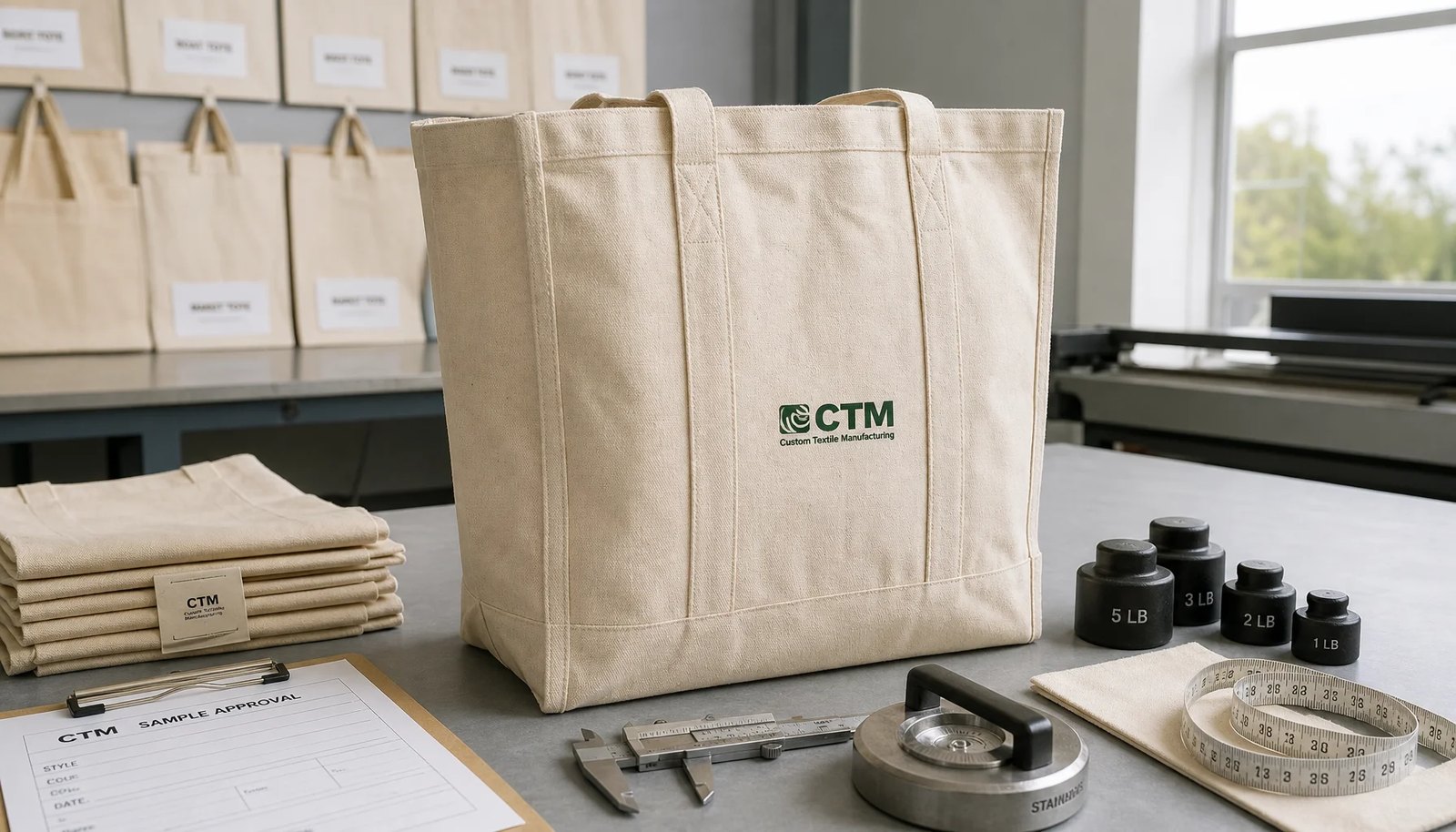
Why Trade Show Totes Need a Real Specification
Wholesale canvas grocery totes for trade show exhibitors sit in a tougher environment than many promotional bags. One bag may carry catalogs, bottled samples, cosmetics, snacks, chargers, apparel, notebooks, and personal items for hours. It may be handed out at a crowded booth, packed inside a sponsor kit, shipped through an event warehouse, stacked on a pallet, then photographed with the exhibitor logo facing forward. Strength, presentation, and packing are not separate issues. They meet in the same product.
Most tote problems begin before production. An RFQ that says natural canvas tote, 15 x 16 inches, one-color logo, best price gives the factory too much room to decide. Fabric weight, weave density, handle width, insertion depth, seam finish, reinforcement pattern, print ink, folding style, and carton strength may all change from one quote to the next. Two suppliers can appear to quote the same bag while one is pricing a 12 oz boxed-bottom tote with reinforced webbing and the other is pricing lighter fabric with narrow handles and basic seams.
A better brief turns the tote into an inspectable sewn item. Procurement teams should define the expected load, finished dimensions, tolerances, handle construction, seam method, print method, sample sequence, and packing rules. The objective is not to overbuild a simple giveaway. It is to remove ambiguity before the event deadline makes replacement impossible.
- Define expected carrying load before selecting fabric weight or handle style.
- Separate appearance approval from durability approval; both matter.
- Treat handle bases, gusset corners, seam finishing, and print adhesion as high-risk points.
- Compare supplier quotes against the same written specification, not product names or photos.
- Match the tote to the workflow: booth handout, sponsor kit, retail resale, or warehouse-delivered event pack.
Fabric Weight, Composition, and Canvas Terms
For grocery-style trade show use, many buyers land in the 10 oz to 12 oz canvas range, often around 280 to 360 GSM depending on weave and finish. That range usually gives a practical balance between load capacity, hand feel, and freight cost. An 8 oz to 10 oz canvas can work for lighter brochure bags or short event use, especially when the budget or freight weight is tight. At 14 oz and above, the bag feels more substantial and structured, but sewing, folding, print cracking risk, carton weight, and shipping CBM all increase.
Do not compare quotes by the word canvas alone. One supplier may mean cotton duck. Another may mean a looser cotton fabric, recycled cotton blend, cotton-poly blend, or fabric sold under a canvas description because of its look rather than its performance. A tight 10 oz fabric can outperform a loose heavier one. Composition also affects shrinkage, hand feel, surface texture, ink absorption, and whether the product can carry a sustainability or material claim.
Ask when the fabric weight is measured. Greige fabric, dyed fabric, washed fabric, finished fabric, and pressed fabric can differ. If production uses a different lot from the showroom sample, the bulk tote may feel softer, shade differently, print less sharply, or shrink more than expected. When time allows, request a blank prototype or at least a bulk-source swatch before approving the printed sample.
- Economy option: 8 oz to 10 oz for light giveaways and lower freight weight.
- Recommended option: 10 oz to 12 oz for better load capacity, shape retention, and perceived value.
- Premium option: 14 oz and above for resale, VIP gifting, or heavier sponsor kits.
- RFQ wording: state composition, GSM or oz, color, finish, washing, and shrinkage expectation.
- Quote control: require the supplier to state whether weight is greige, dyed, finished, washed, or post-treatment.
Dimensions, Capacity, and Tolerances
Canvas grocery totes are sewn products, so some variation is normal. The trouble starts when no one defines how much variation is acceptable. A factory may view a 1.5 cm difference as reasonable while the buyer expects the bag to match a mockup closely. For many canvas totes, plus or minus 0.5 to 1.0 cm is a practical tolerance range, depending on the dimension and construction. Handle drop deserves its own tolerance because a small difference can change comfort quickly.
The specification should list finished width, finished height, gusset depth, bottom width, handle length, handle drop, top hem depth, print size, and print placement from top and side edges. If the bag must hold boxed samples, catalog stacks, retail inserts, or a pre-packed event kit, flat dimensions are not enough. Use inside usable dimensions or test the actual contents in the blank sample. A 10 cm boxed gusset can make the tote much more useful, but it also changes folding, carton quantity, and how the printed panel behaves under compression.
Decoration needs tolerances too. Print placement is commonly controlled within plus or minus 0.5 cm to 1.0 cm, depending on artwork size and sewing variation. Pantone matching should be treated as a target on natural canvas unless the buyer has approved lab dips, ink drawdowns, or a physical printed sample. Natural cotton shade variation, slubs, and canvas texture should be accepted or rejected in writing before production starts.
- Measure finished bag size after sewing and pressing, not from cut panels.
- State flat dimensions and usable capacity when totes carry boxed goods or kits.
- Use separate tolerances for body size, gusset depth, handle drop, and print placement.
- Define whether natural shade variation, slubs, and texture show-through are acceptable.
- Use the sealed sample as the visual reference and the written tolerance as the inspection rule.
Handle Strength: The First Failure Point
Handles are where many strong-looking canvas grocery totes fail. The fabric body may be adequate, but narrow webbing, short insertion, low stitch density, missing reinforcement, or a weak top hem can pull apart during normal use. For a hand-carry tote, a handle drop around 10 to 15 cm may be suitable. For a shoulder-carry grocery tote, a drop around 23 to 28 cm is more common. If attendees are expected to carry the bag around a hall for several hours, comfort and symmetry matter nearly as much as break strength.
The reinforcement pattern should be visible and measurable. Box-X stitching, bar tacks, and double-row reinforcement give inspectors something clear to check. If the handle is self-fabric, confirm whether it is folded canvas, lined, or simply stitched from body fabric. If the handle is cotton webbing, check width, thickness or weight where available, color, edge quality, and shrinkage behavior if the tote will be washed, steamed, or pressed.
Ask exactly where the handle is anchored. Some factories stitch handles only through the folded top hem. Others extend the handle deeper into the body panel or into a reinforced zone. For higher working loads, deeper insertion and a stronger stitch pattern reduce pull-out risk. Avoid vague wording such as reinforced handles unless the supplier also confirms handle width, insertion depth, stitch pattern, and load test criteria.
- Specify handle material, width, length, drop, insertion depth, and reinforcement size.
- Use box-X, bar tack, or double-row reinforcement for more than light brochure use.
- Reject samples with skipped stitches, loose thread, puckering, or distortion at handle bases.
- Run both static hanging and repeated lifting tests because attendees carry bags dynamically.
- Test comfort with the tote filled; a strong handle can still feel poor in the hand or on the shoulder.
Seams, Gussets, and Bottom Construction
The logo sits on the panel, but the load travels through the seams. For grocery-style trade show totes, a boxed bottom with an 8 to 12 cm gusset is usually more useful than a flat tote. It holds bottles, folded literature, boxed samples, apparel, and mixed giveaways more naturally, and it helps the tote stand on counters or booth tables. The trade-off is stress at the gusset corners. If seam allowance is inconsistent or the corner is poorly finished, the bottom can split while the main fabric still looks intact.
A good seam specification names both the sewing method and the inside finish. A common production-friendly choice is lockstitch sewing with inside overlock and a folded top hem. French seams, bound seams, or taped seams can improve appearance and fray control, but they add cost and sewing time. If the tote is unlined, raw-edge control matters. Fraying edges can shed fibers, look cheap when the attendee opens the bag, or weaken after handling.
Bottom construction should be understood before comparing prices. A one-piece body folded into a boxed bottom has different stress points from a separate bottom panel or multi-piece gusset. Procurement teams do not need to demand the most complex method. They need the method named, sampled, tested, and repeated. After load testing, inspect the handle bases, side seams, top hem, bottom corners, and the transition from gusset to body.
- Choose boxed bottoms when capacity and counter presentation matter.
- Require overlock, binding, French seam, or another named inner finishing method.
- Inspect gusset corners after load testing, not only before testing.
- Check seam allowance consistency near handles, bottom corners, and gusset transitions.
- Confirm whether the bottom is folded from one body piece or made with joined panels.
Print Method and Decoration Durability
Screen printing is still the practical default for many wholesale canvas grocery totes. It is economical at volume and dependable for one to three solid logo colors. The buyer should specify artwork size, placement, Pantone or color target, ink type if relevant, and whether the print must remain flexible after folding. Large solid prints on textured canvas need extra review because pinholes, uneven ink deposit, and cracking can appear after carton compression.
Heat transfer, digital print, embroidery, and woven labels can also work, but each changes the risk profile. Heat transfer can reproduce gradients and complex artwork, yet it needs edge-lift, peel, flex, and rub testing. Digital print can handle detailed graphics but depends heavily on fabric pretreatment and surface consistency. Embroidery can look premium, though it may pucker thinner canvas and create rough backing inside the bag. Woven labels are subtle and durable when sewn well, but label placement and seam capture must be controlled.
Test decoration on the actual tote, not only a flat swatch. Fold the printed area the way it will be folded in the carton. Rub the logo with a dry cloth and a lightly damp cloth. Inspect for color transfer, cracking, flaking, ink dust, edge lifting, and color migration. If the logo uses dark ink on natural cotton, check opacity without excessive stiffness. If light ink is printed on dyed canvas, confirm coverage and curing.
- Screen print: best for spot-color logos, sponsor marks, and repeatable volume programs.
- Heat transfer: useful for gradients, but test edge lift, cracking, adhesion, and flex resistance.
- Digital print: suitable for detail, but approve a physical sample on the intended canvas.
- Embroidery: premium look, but control puckering, backing, stitch density, and needle damage.
- Woven label: good for subtle branding, but confirm size, fold behavior, seam capture, and placement tolerance.
Durability Testing Checklist for Pre-Production Samples
A useful durability test should mirror trade show use and be simple enough to repeat. Start with a target working load. Many buyers evaluate canvas grocery totes at 5 kg to 8 kg, depending on tote size, expected contents, and attendee behavior. Heavier programs can set a higher internal requirement, but the important step is to define the load before quoting. Then the factory can test the correct construction instead of guessing.
Use more than one test. A static hanging test catches weak handles, poor seam balance, and obvious tearing. The supplier can load the sample to the agreed weight and hold it for a defined period such as 30 minutes or 1 hour. A repeated lift test catches different issues because attendees move, swing, set down, and pick up bags repeatedly. Fill the tote to the target load, lift by the handles, hold briefly, set down, and repeat for the agreed count. Keep the method the same across supplier samples.
After testing, inspect rather than simply asking whether the sample passed. Look at handle bases, top hem distortion, stitch breakage, side seams, gusset corners, bottom seam, and fabric tearing around needle holes. Decoration needs a separate check: dry rub, damp rub, fold cracking, color transfer, transfer edge lifting, and color migration. This is not a substitute for a formal lab standard when one is required, but it is a practical procurement screen before bulk release.
- Static load test: state target load, hold time, sample quantity, and pass or fail criteria.
- Repeated lift test: simulate attendee handling instead of relying only on a hanging sample.
- Post-test seam check: inspect handles, top hem, side seams, gusset corners, and bottom.
- Print rub test: check dry rub, damp rub, fold cracking, transfer edge lift, and migration.
- Failure definition: broken stitches, seam opening, tearing, excessive distortion, print cracking, or open raw edges.
Sample Approval Sequence Before Bulk Cutting
A good sample process protects buyers from approving a nice-looking but weak tote. Start with a blank construction prototype when size, gusset, handle drop, fabric weight, or sewing method is still open. This sample lets the buyer check capacity, hand feel, folding, carrying comfort, and seam construction without waiting for artwork setup. Once the body is correct, move to a printed pre-production sample using the intended bulk fabric, trim, handle material, sewing method, print process, and packing style.
Showroom samples should be handled carefully. They can show workmanship, but they may not match the quoted fabric lot, price level, handle webbing, thread, or printing method. If a supplier sends an existing sample, mark it as reference only unless the factory confirms that every major component matches the order. The sealed approval sample should include the tote, fabric swatch if available, artwork version, color target, thread color, label, folding method, inner packing, and carton mark.
For trade show orders, split approval into three gates: construction, decoration, and packing. Construction approval covers size, handles, seams, gusset, and load performance. Decoration approval covers artwork, color, placement, and print durability. Packing approval covers fold style, individual polybag if required, pieces per carton, carton mark, and carton strength. This sequence reduces the chance that production passes a photo review but fails at inspection or warehouse delivery.
- Blank sample approval: size, gusset, handle drop, hand feel, sewing, and load behavior.
- Printed sample approval: artwork, color target, print size, placement, rub resistance, and fold behavior.
- Packing sample approval: folding, polybag decision, carton quantity, carton marks, and label placement.
- Approval records: keep dated photos and sealed physical samples until final acceptance.
- Change control: document any change to fabric lot, thread, handle webbing, print ink, packing, or carton specification.
MOQ, Cost Drivers, and Quote Comparability
MOQ for canvas grocery totes is shaped by fabric availability, fabric minimums, dyeing or finishing, cutting efficiency, print setup, sewing line setup, and packing labor. Natural canvas in a common weight may support a lower MOQ because stock fabric is easier to source. Custom dyed canvas, unusual GSM, special webbing, recycled-content claims, private-label packaging, multiple artwork versions, and retail barcodes can increase both MOQ and lead time.
Ask for the same specification at several quantity breaks, such as 500, 1,000, 3,000, 5,000, and 10,000 pieces. A lower unit price may reflect real efficiency, but it can also hide a construction change. The supplier may reduce fabric weight, use narrower handles, shorten insertion depth, remove reinforcement, simplify seams, reduce print area, pack too many pieces per carton, or exclude setup charges. A line-by-line quote helps reveal what is included.
For trade shows, the hidden cost of failure is high. A weak tote can trigger complaints, brand damage, emergency replacements, rework, and freight upgrades. A small saving per bag disappears quickly if the shipment arrives late, creased, misprinted, or structurally weak. The procurement question is not only which tote is cheapest. It is which tote is economical enough to buy and strong enough to survive the event.
- Fabric cost rises with higher GSM, tighter weave, custom dyeing, finishing, and documented composition claims.
- Print cost changes with color count, artwork versions, print size, curing time, and setup charges.
- Sewing cost rises with gussets, reinforcement, labels, pockets, binding, and stricter trimming rules.
- Packing cost rises with polybags, hangtags, barcode labels, inner packs, and event-specific carton marks.
- Freight cost rises with heavier fabric, larger gussets, lower carton compression, and rigid presentation packing.
Packing, Cartons, and Event Warehouse Controls
Packing can turn a well-made tote into a commercial problem. Printed panels should be folded consistently so the main logo is not crushed under an unapproved hard crease. If the ink is thick or the printed area is large, the factory should allow enough curing time before packing. Export cartons need to survive handling, especially when goods move by LCL, courier, or through multiple warehouse transfers before the show.
Packing data belongs in the RFQ because it affects freight and event operations. A 12 oz gusseted canvas grocery tote takes more space than a flat lightweight cotton tote. Individual polybags can protect against dust and simplify kitting or retail distribution, but they add labor, plastic, carton volume, and unpacking time. Bulk packing may be fine for booth handouts if the carton protects the bags from dirt, moisture, and excessive compression.
Event warehouses may require carton labels, appointment data, SKU codes, booth numbers, pallet rules, or barcode scanning. These details should not be added after production if they can be avoided. If the tote is part of a sponsor kit, inner pack sequence may affect kitting labor and schedule. Before freight is booked, review carton dimensions, pieces per carton, gross weight, net weight, CBM, pallet pattern, and carton mark format.
- Confirm pieces per carton, carton size, gross weight, net weight, CBM, and pallet estimate.
- Avoid over-compression that creates permanent creases across logos or distorts gussets.
- Use clean, dry packing and moisture control when natural canvas ships through humid conditions.
- State carton mark format, SKU label, barcode label, event warehouse rule, and booth delivery requirement.
- Decide early whether polybags, bulk packs, inner bundles, hangtags, or barcode stickers are required.
- Check carton stacking risk so printed panels and top hems are not crushed in transit or storage.
Specification comparison for buyers
| Spec decision | Recommended option | When it fits | Buyer risk to check |
|---|---|---|---|
| Fabric weight for trade show grocery use | 10 oz to 12 oz canvas, typically about 280 to 360 GSM depending on weave and finish | Best balance for booth giveaways that must carry brochures, bottles, samples, retail packs, and personal items without excessive freight cost | Suppliers may quote lighter cotton sheeting, loose duck, or blended fabric as canvas; require composition, GSM or oz basis, finished fabric weight, and tolerance |
| Lightweight alternative | 8 oz to 10 oz cotton canvas or duck, about 230 to 300 GSM | Lower-cost brochure bags, short event use, or programs where freight weight is the main constraint | May feel too soft for grocery-style use; handle and seam testing becomes more important than the fabric label |
| Premium alternative | 14 oz canvas and above, often 400 GSM plus depending on construction | Retail resale, VIP sponsor kits, premium exhibitor bags, or programs where structure and hand feel are part of the value | Higher fabric weight increases sewing difficulty, print cracking risk on folds, carton weight, and shipping CBM |
| Handle construction | 1.0 to 1.5 inch cotton webbing or folded self-fabric handles with box-X, bar tack, or double-row reinforcement | Required when attendees carry the tote for several hours or when the bag may hold 5 kg to 8 kg working load | Narrow webbing, short insertion depth, low stitch density, or stitching only through a weak top hem can fail even when body fabric is strong |
| Handle drop | Hand carry: about 10 to 15 cm; shoulder carry: about 23 to 28 cm | Choose by booth use: handout counter bags, walking show-floor bags, or reusable grocery-style bags | A short drop may pass strength tests but feel inconvenient; an overly long drop can drag when the bag is filled |
| Main seam method | Inside overlock plus folded top hem for standard production; French seam or bound seam for premium programs | Open grocery totes where clean finishing, fray control, and consistent sewing cost all matter | Single lockstitch with raw trimmed edges may pass photos but fray, split, or shed lint after load handling |
| Bottom structure | Boxed bottom with 8 to 12 cm gusset and reinforced corner stress points | Useful when totes must stand on counters and hold catalogs, bottles, apparel, cosmetics, or boxed samples | Flat totes cost less but do not behave like grocery bags; weak gusset corners are a frequent failure point |
| Print method | Screen print for 1 to 3 spot colors; heat transfer or digital print only after adhesion, rub, and fold testing | Screen print fits most exhibitor logos and sponsor graphics at volume with stable setup economics | Thick ink can crack on heavy canvas folds; transfer films may peel if press temperature, pressure, and dwell time are not controlled |
| Sampling route | Blank construction prototype, then printed pre-production sample using intended bulk fabric, trims, sewing, and packing | Best for importers, distributors, and exhibitors who must lock construction before artwork and mass production | Sales samples and showroom bags often use different fabric lots, handle webbing, print ink, or carton packing than bulk production |
Buyer checklist before sampling
- Define the expected working load in kilograms before selecting fabric weight; for many trade show grocery totes, buyers evaluate 5 kg to 8 kg depending on size and use.
- State finished dimensions with tolerances: width, height, gusset depth, handle length, handle drop, top hem depth, print area, and print placement from edges.
- Specify fabric composition and weight: 100 percent cotton, recycled cotton blend, cotton-poly blend, or other; quote GSM or oz and state whether measured greige, finished, washed, or dyed.
- Require a fabric weight tolerance, commonly plus or minus 5 percent, and a finished dimension tolerance, commonly plus or minus 0.5 to 1.0 cm depending on the dimension.
- Approve handle material, width, thickness or GSM where applicable, color, insertion depth, stitch density, reinforcement pattern, and whether the handle passes through the top hem only or extends into the body panel.
- Specify seam construction: side seam type, bottom seam or boxed bottom method, gusset construction, inner edge finishing, top hem fold, stitch type, and thread color.
- Require load testing on the pre-production sample: static hanging load, repeated lift simulation, and post-test inspection of handles, top hem, side seams, gusset corners, and bottom.
- Test decoration on the actual tote, not only on a fabric swatch: dry rub, damp rub, fold cracking, color transfer, edge lifting for transfers, and print position after packing.
- Lock artwork file version, Pantone or color target, print size, print placement tolerance, maximum acceptable pinholes, and whether slight canvas texture show-through is acceptable.
- Confirm sample approval sequence: blank prototype, printed pre-production sample, and packing sample before bulk cutting or before full line release.
Factory quote questions to send
- What exact fabric are you quoting: composition, weave description, yarn or construction if available, GSM and oz, and is the weight measured before or after dyeing, washing, or finishing?
- What fabric weight tolerance and color tolerance can you maintain in bulk production, and how will you verify them before cutting?
- Is the quoted canvas 100 percent cotton, recycled cotton blend, polyester-cotton blend, organic cotton, or another composition, and what documentation can be provided if claims appear on the product or packaging?
- What is the minimum fabric order quantity for this color, width, and weight, and what fabric source will be used if our order quantity is below that level?
- What are the finished bag dimensions, allowed sewing tolerances, and shrinkage expectation if steaming, washing, or pressing is included?
- Which handle material is included: self-fabric, cotton webbing, recycled cotton webbing, or blended webbing; what is the handle width, drop, insertion depth, and reinforcement pattern?
- Which seam construction is included for side seams, top hem, bottom gusset, and inner edge finishing, and what stitch density range will production follow?
- What load test can you perform in-house: target load, hold time, sample quantity, repeated lift count, and pass or fail criteria?
- Which print method is included, how many colors are included, what ink or transfer type is planned, what is the maximum printable area, and what curing or pressing controls are used?
- Are screen charges, sample charges, artwork adjustment, printing setup, labels, hangtags, inner packing, carton marking, export cartons, and QC reports included or charged separately?
Quality-control points to confirm
- Fabric GSM should stay within the agreed tolerance, commonly plus or minus 5 percent unless the buyer specifies a tighter retail requirement; measure from bulk fabric, not only the approval swatch.
- Finished width, height, gusset, handle drop, top hem depth, and print position should match the approved sample within written sewing tolerance, usually plus or minus 0.5 to 1.0 cm depending on the dimension.
- Fabric composition, color, hand feel, weave density, odor, stains, slubs beyond approved character, and shade variation should be checked before cutting and again during final inspection.
- Handle attachment should pass the agreed static load and repeated lift test without broken stitches, fabric tearing, seam opening, excessive handle elongation, or visible top hem distortion.
- Handle width, insertion depth, reinforcement size, stitch density, thread color, and symmetry should be measured on production pieces, not judged only by appearance.
- Top hem, side seams, bottom seams, and gusset corners should show even stitching, no skipped stitches, no open seams, no loose threads longer than the agreed trimming standard, and no raw-edge fraying outside the approved finish.
- Printed logos should meet approved color target, position, size, edge sharpness, opacity, rub resistance, fold resistance, and curing quality; check the print after packing-style folding when applicable.
- Heat transfers should be checked for edge lifting, bubbling, adhesive bleed, color migration, and cracking after flexing; embroidery should be checked for puckering, loose threads, and clean backing.
- If washing, steaming, pressing, or pre-shrinking is part of the specification, confirm shrinkage, skew, odor, print stability, and handle shape after the finishing process.
- First production output should be inspected before full production release for bag size, handle symmetry, gusset alignment, seam finish, print placement, and carton packing method.