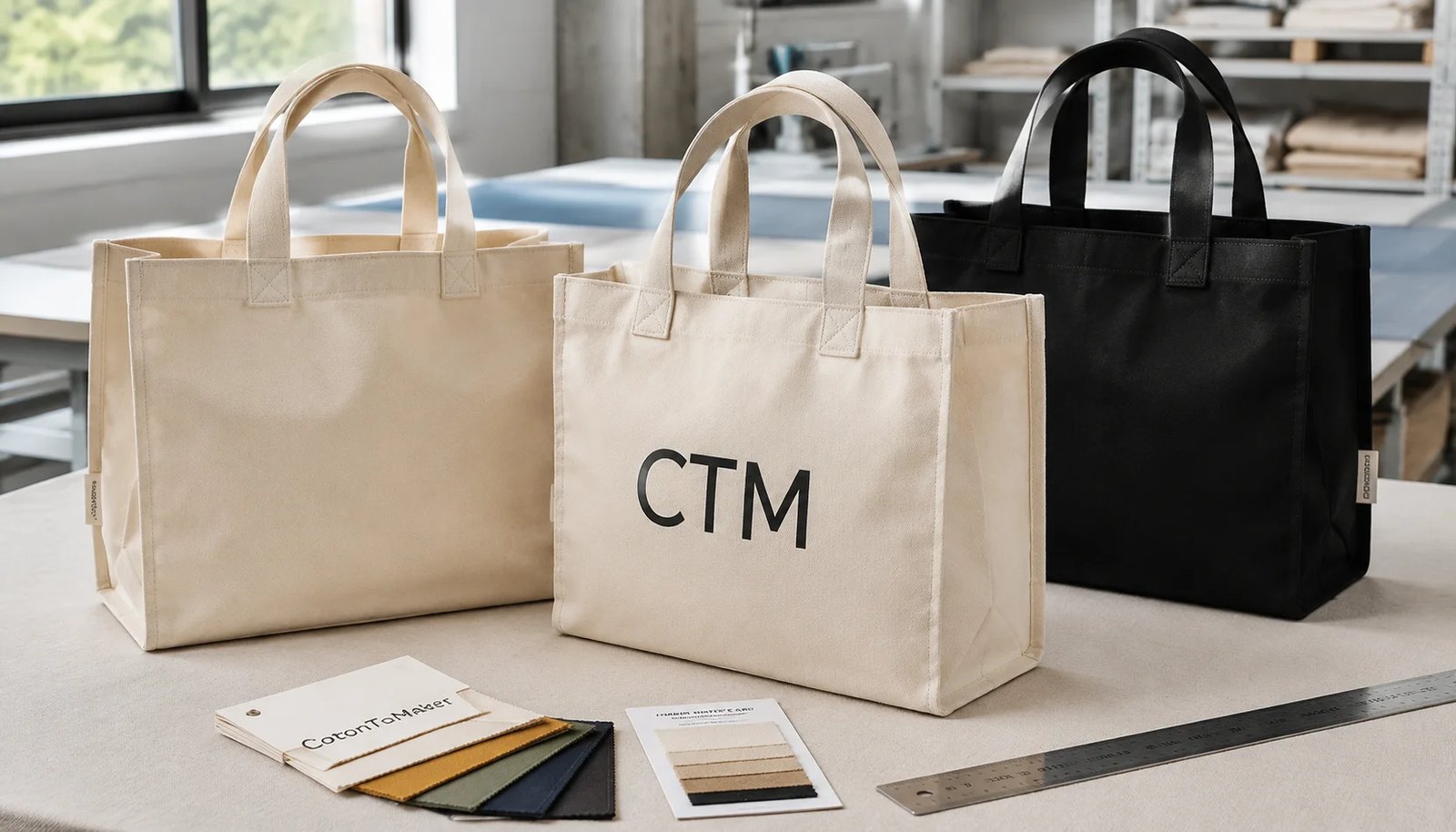
Why skincare totes need stricter inspection than ordinary promo bags
Wholesale canvas grocery totes for skincare brands sit between packaging, retail presentation, and promotional merchandise. They may carry glass bottles, boxed routines, refill pouches, jars, tissue, inserts, and samples. A weak tote can fail physically, but the more common problem is brand damage: a crooked logo, oil mark, rough seam, or sagging bottom makes a premium skincare set feel less controlled.
Procurement teams should therefore treat the tote as a branded packaging component, not a generic giveaway. The RFQ needs enough detail for suppliers to quote the same construction, and the quality inspection checklist needs measurable tolerances. Without that, the lowest price often reflects a thinner fabric, lighter handle reinforcement, larger print tolerance, or cheaper packing method that only becomes obvious after bulk production.
- Main commercial risks: sagging bottom, handle pull-out, skewed logo, visible stains, fabric shade variation, rough finishing, and carton count errors
- Most common skincare uses: gift-with-purchase tote, retail checkout bag, launch event bag, distributor kit, subscription insert, and holiday gift-set carrier
- Best procurement standard: define load, appearance, packing, and inspection requirements before requesting final supplier pricing
Build the RFQ around the actual skincare packout
Start with what the tote must carry. A reference photo or supplier catalog size is not enough. List the largest box dimensions, bottle height, expected quantity, target filled weight, and whether the pack should stand upright for retail filling. A flat tote may look clean in a mockup but can be unstable when loaded with pumps or glass jars. A bottom gusset is usually the better default for skincare sets because it creates a more usable base.
For compact sample programs, a smaller bag such as 30 x 35 x 8-10 cm may be sufficient. A common medium retail tote is around 35 x 38 x 10-12 cm. Larger launch or holiday sets may need 38 x 40 x 12-15 cm. These are starting points, not rules. Confirm by loading a sample with actual products or weighted substitutes before approving the size.
- Light sample route: flat or small gusset, 260-280 GSM, load usually below 1.5 kg
- Standard retail set route: bottom gusset, 280-320 GSM, load usually up to about 3 kg
- Glass-heavy or larger gift route: full gusset, 320-380 GSM, reinforced handles, load target up to about 5 kg
- RFQ must include finished size, tolerance, target load, product packout, print area, and packing method
Match fabric weight and construction to load tier
The broad 280-340 GSM range is useful only after you connect it to bag size and load. For many skincare buyers, 300 GSM natural cotton canvas is a practical middle point: it feels more substantial than thin promo cotton, still folds and packs efficiently, and handles a typical boxed retail set when construction is correct. If the tote is very small and only carries samples, a lighter fabric may be adequate. If it carries several glass items, the fabric and handle attachment both need upgrading.
Construction is just as important as GSM. A 340 GSM tote with poor handle stitching can fail before a 300 GSM tote with good reinforcement. Specify whether handles are self-fabric or cotton webbing, the handle width, the handle drop, and the reinforcement method. For hand-and-shoulder carry, a handle drop around 25-30 cm is often more useful than a short promotional handle. If you prefer to specify total handle length, 60-70 cm is common for medium totes, but test it on the actual bag height.
- Typical handle width: 25-30 mm for skincare grocery totes
- Typical handle drop: 25-30 cm for shoulder-friendly medium totes; shorter for hand-carry gift bags if intentional
- Preferred reinforcement: X-box stitch, bartack, or equivalent reinforced pattern at each handle end
- Inside finishing options: overlock for standard value, turned seam for cleaner finish, binding for higher-end presentation
Control print quality before it becomes a bulk defect
Most skincare tote artwork is simple: a front logo, brand message, ingredient statement, or small side label. Screen printing is usually the most cost-effective choice for one to three solid colors. It works well on natural or black canvas when the ink opacity, registration, and curing are controlled. Heat transfer can handle gradients, small details, and multicolor artwork, but it needs adhesion and rub testing on the exact canvas surface. Woven labels create a subtle premium mark, but sewing placement must be controlled like any other logo.
Natural canvas affects artwork. Small cotton specks, slub, and shade variation are normal, but they can interfere with fine type or pale ink. Ask for a production-like printed sample and inspect it under the same expectations as bulk goods. Specify logo size, distance from the top edge, horizontal center, Pantone target, and acceptable tolerance. If the tote will be folded for packing, tell the supplier whether a crease may cross the logo; for most retail skincare uses, it should not.
- Screen print: best for clean solid logos and repeat orders
- Heat transfer: useful for gradients or high-detail artwork but requires adhesion/rub checks
- Woven label: good for minimal branding, side seam marks, or premium subtlety
- Numeric print tolerance: placement ±5 mm from approved position, rotation not more than 3 degrees, no ghosting or unreadable type
Choose MOQ and customization level deliberately
Quote confusion often comes from mixing a stock-fabric route with a custom route. A supplier quoting natural stock canvas with one-color screen print and bulk packing is not equivalent to a supplier quoting custom dyed canvas, transfer print, individual polybags, and a sewn label. Both may be valid, but they solve different procurement problems.
For pilots, regional launches, and distributor programs, stock natural or black canvas usually gives better speed and cleaner repeat ordering. Custom dyeing, special linings, inside pockets, branded inserts, and multiple print locations make more sense when the tote is central to the retail campaign and order volume supports added approvals. Each custom step adds a new risk point: lab dip approval, shade tolerance, trim sourcing, setup cost, or longer sampling.
- Lower-MOQ path: stock fabric, one-color print, standard handles, counted bulk packing
- Mid-custom path: woven label, larger print area, custom carton marks, individual polybag if needed
- High-custom path: dyed fabric, special trims, multiple logo positions, premium seam finishing, retail-ready packaging
- Comparison rule: normalize spec first, then compare price; otherwise the cheapest quote may simply be a different product
Approve samples as production controls, not marketing mockups
A blank sample checks size and feel, but it does not prove the finished tote. The pre-production sample should use the intended fabric weight, print method, thread color, handle reinforcement, and packing fold. This is the sample your inspector and factory should use as the physical reference during bulk production.
Run a simple packout test before approval. Load the tote with actual skincare products or equivalent weights. Check whether bottles stand upright, whether the bottom sags, whether the mouth opens easily for retail filling, and whether handles feel comfortable. Hang the loaded tote for a short period and inspect handle joins and seam stress. Photograph the approved sample with a ruler showing logo placement, handle drop, gusset depth, and fold direction. These photos reduce arguments later if bulk goods drift.
- Approve: fabric handfeel, GSM, shade, size, gusset shape, handle drop, stitch pattern, print placement, and packing fold
- Reject sample if: logo sits too close to fold/gusset, handles twist, bottom collapses under target load, or print opacity is weak
- Record all approvals in one spec sheet; do not rely on email comments spread across marketing and sourcing teams
- Keep one signed sample with the buyer or QC team and one with the factory production team
Inspection-ready QC checklist with AQL classifications
The final inspection plan should separate critical, major, and minor defects. Critical defects are safety or severe contamination issues and should have zero tolerance. Major defects affect function, retail appearance, SKU accuracy, or customer usability. Minor defects are small workmanship issues that do not affect saleability or normal use. This classification prevents over-rejecting normal textile variation while still protecting the skincare brand.
Use numeric tolerances wherever possible. For a medium canvas grocery tote, common tolerances are width and height ±10 mm, gusset ±7 mm, handle drop ±10 mm, handle placement ±5 mm from side seams, and logo placement ±5 mm. Stitch density should be checked on both body seams and handle reinforcement; 7-9 stitches per inch on main seams and 8-10 on reinforcement is a practical target unless your supplier’s approved construction differs. For load testing, test at least 1.5 times the rated carrying load: a 3 kg intended load should be checked at 4.5 kg, and a 5 kg intended load at 7.5 kg.
- Recommended AQL: Critical 0.0, Major 2.5, Minor 4.0 unless your brand requires tighter limits
- Critical examples: needle/metal contamination, mildew odor, severe chemical odor, unsafe handle failure, wrong artwork/SKU
- Major examples: open seam, handle detachment, print badly misplaced, visible front stain, size outside tolerance, wrong carton quantity
- Minor examples: small thread ends, slight natural cotton slub, minor inside mark, small crease away from logo
- Inspection tools: approved sample, tape measure, scale, grey card or shade reference, rub cloth, load weights, carton checklist, camera
Packing decisions change freight, warehouse labor, and retail readiness
Packing is not just an afterthought. Bulk packing in counted bundles is usually best when the totes will be repacked into skincare kits at destination. It reduces material cost and speeds unpacking if bundle counts are clear. Individual polybags may be justified when totes ship directly to stores, must stay dust-free, or have transfer prints that need scuff protection. Avoid adding polybags automatically if your warehouse will remove them immediately.
Carton planning belongs in the quote. Canvas totes are bulky, and a small change in fabric weight, fold method, or polybag use can increase CBM. Set a carton gross weight your warehouse can handle safely, often below 15-18 kg for manual handling unless your operation allows more. Require carton marks by SKU, color, quantity, PO number, and destination if relevant. For multi-version skincare programs, inner bundle labels prevent receiving errors.
- Specify bundle size: commonly 25 or 50 pieces per bundle for receiving control
- Define fold direction so the logo is not sharply creased unless approved
- Require carton dimensions, units per carton, gross weight, net weight, and total CBM in every quote
- Inspect cartons for moisture, crushing, wrong marks, wrong quantity, and mixed SKU errors
Compare suppliers by landed value, not FOB price alone
A true supplier comparison includes unit price, setup fees, sample fees, carton cube, freight impact, payment terms, lead time, and QC risk. A supplier with a slightly higher FOB price may still be better if the carton plan is efficient, the sample is closer to production, and the factory can show stronger process controls. Conversely, a cheaper quote may become expensive if it requires extra inspection, rework, late air freight, or replacement units.
Use a simple landed-cost calculation during quote review. For example, on a 3,000-piece order, Supplier A quotes US$1.85 FOB, US$145 in setup/sample charges, and 2.21 CBM. If estimated freight is US$180/CBM, the pre-duty landed estimate is US$5,550 + US$145 + US$398 = US$6,093, or about US$2.03 per piece. Supplier B quotes US$2.18 FOB, US$230 in setup/sample charges, and 3.76 CBM. The estimate is US$6,540 + US$230 + US$677 = US$7,447, or about US$2.48 per piece. Add your actual duty, brokerage, insurance, and inland delivery, but the principle is the same: carton data and setup costs matter.
- Normalize specs before comparison: same size, GSM, gusset, handle, print method, logo size, and packing
- Ask each supplier for carton dimensions and units per carton before awarding the PO
- Compare repeat-order cost separately from first-order cost because screens, samples, and setup may not repeat
- Include inspection confidence: clear tolerances and factory QC evidence are part of landed value
Lead time control: approvals cause more delays than sewing
For standard canvas grocery totes, the sewing line is rarely the biggest schedule risk. Delays usually come from late artwork, unclear Pantone targets, sample revisions, custom dye approvals, carton mark changes, and undecided packing. Skincare launches often involve marketing, product, procurement, and logistics teams, so one missing approval can hold the full order.
Control the calendar by locking the critical path before PO release. Decide who approves artwork, who approves the physical sample, who confirms carton marks, and who books freight. If timing is tight, reduce variables: use stock canvas, one-color screen print, standard handles, and bulk packing. If the brand needs custom dyed canvas or special packaging, build in extra approval time and avoid changing artwork after the printed sample is approved.
- Fastest route: stock natural or black canvas, one print location, standard carton, approved artwork at PO stage
- Highest delay risk: custom dyeing, recycled-blend shade approval, multiple print locations, retail polybag labels, late compliance testing
- Require supplier timeline by stage: sample, material purchase, cutting, printing, sewing, packing, final inspection, shipment
- Do not pay balance before final inspection if the tote is tied to a fixed launch date
Specification comparison for buyers
| Quote item | Supplier A: stock canvas route | Supplier B: heavier custom route | Procurement check |
|---|---|---|---|
| Base spec quoted | 35 x 38 x 12 cm tote, 300 GSM natural canvas, 2.5 cm self-fabric handles, one-color screen print | 35 x 38 x 12 cm tote, 340 GSM dyed canvas, 3 cm handles, heat transfer logo, individual polybag | Confirm both suppliers quote the same finished size, gusset, handle drop, reinforcement, and print area before comparing price |
| FOB unit price example | US$1.85 per piece | US$2.18 per piece | A higher unit price may be justified only if the heavier fabric, dyeing, or packing improves the retail program |
| One-time charges | Screen setup US$85; printed pre-production sample US$60 | Transfer setup US$120; lab dip and printed sample US$110 | Separate one-time charges from repeat-order cost; do not hide them in unit price |
| Carton plan | 100 pcs/carton; carton 50 x 42 x 35 cm; about 0.0735 CBM/carton | 80 pcs/carton; carton 55 x 45 x 40 cm; about 0.099 CBM/carton | Calculate total CBM. Heavier fabric and individual polybags often increase freight cube |
| Example order: 3,000 pcs | 30 cartons; total about 2.21 CBM | 38 cartons; total about 3.76 CBM | If ocean freight is estimated at US$180/CBM, freight impact is about US$398 for A versus US$677 for B |
| Simple landed-cost view | FOB US$5,550 + setup/sample US$145 + freight US$398 = about US$2.03 per piece before duty/local costs | FOB US$6,540 + setup/sample US$230 + freight US$677 = about US$2.48 per piece before duty/local costs | Use your actual freight, duty, brokerage, and inland costs; this example shows why carton data belongs in the RFQ |
| Lead time assumption | Shorter if natural stock canvas and standard ink are available | Longer if lab dip, dye lot, transfer testing, or polybag artwork approval is needed | Ask for lead time by stage: sample, material booking, bulk production, final inspection, and shipment |
| Risk profile | Lower customization risk; natural shade variation still needs approval | More brand control but higher shade, adhesion, and schedule risk | Choose based on channel need: distributor gift bag, retail gift set, ecommerce insert, or premium launch |
Buyer checklist before sampling
- Confirm the actual skincare packout before setting bag size: product dimensions, bottle count, box sizes, target loaded weight, and whether items must stand upright.
- Select the bag structure by use: flat tote for light inserts, bottom gusset for small sets, full side-and-bottom gusset for heavier gift packs or retail filling.
- Tie fabric GSM to load tier: 260-280 GSM for light samples under 1.5 kg, 280-320 GSM for most retail sets up to 3 kg, and 320-380 GSM for heavier glass-heavy packs up to about 5 kg with reinforced handles.
- Specify finished dimensions and tolerances: width and height ±10 mm, gusset ±7 mm, handle drop ±10 mm, handle placement from side seams ±5 mm unless your QC standard differs.
- Define handle construction: width, total length or drop, same-fabric or webbing, X-box or bartack reinforcement, stitch density, thread color, and acceptable pair-length difference.
- Provide print-ready artwork with Pantone targets, print size, placement from top edge and center line, allowed placement tolerance, and whether print may cross a fold line.
- Approve one production-like pre-production sample using the final fabric weight, handle build, print method, thread color, and packing fold; do not approve from a digital mockup only.
- Set packing rules: bulk or individual polybag, units per bundle, units per carton, maximum carton gross weight, carton marks, SKU labels, barcode placement, and fold direction to protect the logo.
- Require inspection before final payment: sample reference, AQL level, defect classification, dimensional checks, print rub check, handle pull/load test, odor/stain review, and carton count verification.
- Compare suppliers by landed value: FOB price, setup/sample fees, MOQ, carton CBM, freight impact, lead time, payment terms, rework risk, and repeat-order costs.
Factory quote questions to send
- What exact fabric composition, yarn type if known, canvas weave, and GSM tolerance are included in this quote?
- Is the fabric stock natural/black, stock dyed, or custom dyed? What MOQ and lead time apply to each color route?
- What finished size tolerance can you hold for width, height, gusset, handle drop, and handle placement in bulk production?
- What load weight is your quoted handle construction designed for, and can you show photos of the handle reinforcement from similar totes?
- What stitch density do you use on side seams, bottom seams, and handle attachment, and what seam finishing is included inside the bag?
- Which print method is quoted? What are the charges for extra colors, larger print area, inside print, label attachment, or revised artwork?
- Can you make the pre-production sample with the final fabric, print method, thread color, handle reinforcement, and packing fold?
- How many pieces per carton are planned, what are the carton dimensions and gross weight, and how many cartons/CBM for our order quantity?
- What is your normal lead time from artwork approval, sample approval, material booking, bulk sewing, final inspection, and shipment booking?
- What AQL standard do you use for final inspection, and how do you classify critical, major, and minor defects for canvas tote bags?
Quality-control points to confirm
- AQL recommendation for final inspection: Critical 0.0, Major 2.5, Minor 4.0 under ANSI/ASQ Z1.4 or ISO 2859-1 unless your company standard requires tighter limits.
- Critical defects: broken needle or metal contamination, mildew or strong chemical odor, unsafe handle failure during load test, wrong SKU/artwork, severe contamination, or any issue that makes the tote unsafe for retail use.
- Major defects: body size outside tolerance, handle attachment insecure, print unreadable or badly misplaced, open seams, stains on visible panels, severe shade mixing, wrong packing quantity, or carton damage affecting goods.
- Minor defects: small thread ends, slight natural slub within approved standard, minor crease not through the logo, slight stitch waviness, or small inside-panel marks not visible in normal use.
- Finished body size tolerance: width and height ±10 mm; bottom/side gusset ±7 mm; diagonal skew difference should not exceed 15 mm on a medium tote unless separately approved.
- Handle tolerance: handle drop ±10 mm; left/right handle placement from side seam ±5 mm; pair length difference not more than 8 mm; handle width ±2 mm.
- Print placement tolerance: logo center line ±5 mm, distance from top edge ±5 mm, rotation/skew not more than 3 degrees, and no print placed across a fold line unless approved.
- Stitch density target: main seams 7-9 stitches per inch, handle reinforcement 8-10 stitches per inch, with no skipped stitch run longer than 10 mm and no seam opening over 5 mm.
- Load and pull test: for totes intended up to 3 kg, hang with 1.5x rated load for 30 minutes and check handle/seam damage; for 5 kg programs, test at 7.5 kg or buyer-approved equivalent.
- Print durability check: dry rub 10 cycles with no heavy ink transfer; tape adhesion or wash/rub testing should be added when heat transfer or high-friction retail use is expected.