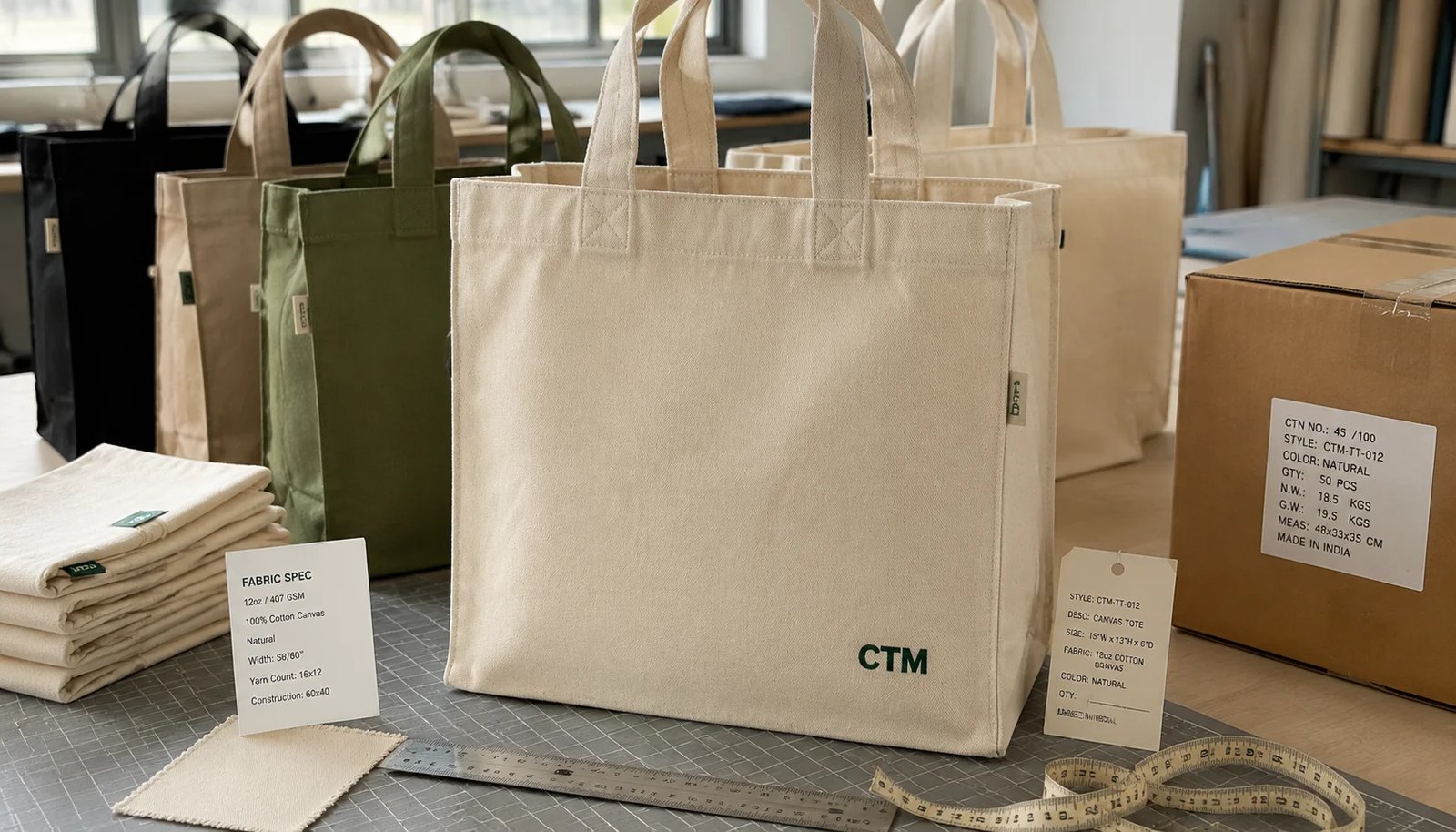
Start with the buying brief, not the logo file
Many sourcing problems in wholesale canvas grocery totes for skincare brands begin with an incomplete RFQ. A buyer sends approximate dimensions and artwork, then each supplier fills the blanks in a different way. One factory quotes 280 GSM natural canvas, another assumes a heavier 340 GSM body, and a third prices a flatter construction with lighter handles and no real reinforcement. The quotations look comparable on paper, but they are not for the same product.
That mismatch is especially common in skincare. The tote may serve as a gift-with-purchase bag, a premium event giveaway, a reusable checkout bag, or part of a retail set. Those uses sound similar, yet they place different demands on structure, print quality, packing, and price. A bag carrying sheet masks and brochures does not need the same build as one carrying glass bottles, jars, or boxed skincare sets.
A stronger brief keeps the project grounded. It does not need to be a long technical package, but it should define the end use, target fabric range, finished dimensions, gusset style, handle specification, print assumption, and packing basis. When those points are fixed early, suppliers quote from the same baseline and procurement can compare cost with fewer hidden gaps.
This is also where internal alignment matters. Before asking for prices, confirm what merchandising wants, what logistics can handle, and what the commercial team is willing to pay for. A tote meant to support a launch should be treated as part of the customer experience, not as a last-minute promo add-on.
- State the use case before requesting price
- Describe the heaviest or largest skincare set the tote must carry
- Define whether appearance, durability, or cost is the top priority
- Send one quote template to all suppliers to reduce assumption gaps
Choose fabric specs that translate cleanly into purchasing and QC
In B2B buying, the word canvas is only a starting point. Procurement should specify fiber content, target fabric weight, color status, and any content claim that affects sourcing. For many skincare tote programs, 100% cotton canvas in the 280-340 GSM range works well for everyday retail, giveaway, or checkout use. For a more structured retail presentation or heavier product bundles, 340-400 GSM is often more suitable.
Buyers often use ounce language because the market does, but GSM is usually the clearer control point. It is easier to compare and easier to inspect. If a supplier quotes only 10 oz or 12 oz without clarifying the tested basis, ask for the GSM target and tolerance in writing. This reduces disputes later when the bulk goods feel lighter or softer than expected.
Natural canvas is usually the cleanest quote basis for a bulk pricing plan. It tends to be easier for MOQ, easier for repeat sourcing, and less vulnerable to shade variation than custom-dyed options. Bleached or dyed canvas can support a brighter look or stronger brand alignment, but they introduce additional approval steps. Once color enters the program, shade control becomes a procurement issue, not just a design issue.
Handle material also deserves separate attention. Some quote sheets mention body fabric only, even though handles may be folded from lighter material, cut differently, or built with less structure than the buyer expects. On a grocery-style tote, handle comfort and strength affect real-world usability. If you need self-fabric handles, write the required width and total length. If you need webbing, specify material, width, and color as separate items.
If recycled cotton, organic cotton, or another declared content requirement matters for your market or compliance flow, put it into the first RFQ round. Changing that requirement after price selection usually changes available mills, MOQ, cost, and timing.
- Everyday working range: about 280-340 GSM
- Structured premium range: about 340-400 GSM
- Use GSM as the control point even if suppliers also speak in oz
- Natural stock canvas usually gives the lowest sourcing complexity
- Specify handle material separately from body fabric
Construction choices drive both durability and quote accuracy
For skincare brands, a gusseted canvas grocery tote is usually more practical than a flat tote. It handles boxed sets more neatly, stands better at retail, and creates usable capacity without excessive strain on the seams. Common finished sizes vary, but many programs land around 35-38 cm width, 35-40 cm height, and 10-15 cm gusset depth. The right dimensions should come from the intended pack-out, not from a visual reference alone.
Procurement should ask one simple question internally: what is the largest product grouping this bag must hold comfortably? Once that is known, the buyer can add realistic clearance for opening, carrying, and folding. That is a more reliable method than choosing a popular tote size and hoping it works for every market kit.
Small construction details often explain major price differences. A double-turned top hem, proper seam allowance, balanced stitching, and box-X handle reinforcement all add labor and control. If a quotation is materially lower than the rest, check whether one of those features has been simplified or removed. The low price may come from a shallower hem, narrow handles, a reduced gusset, or straight stitching where reinforcement was assumed.
Handle specification deserves its own line item in the buying brief. For many shoulder-carry grocery-style totes, 60-70 cm total handle length and 25-30 mm width are practical starting points. Heavier skincare bundles may justify wider handles for comfort, but that affects material use and visual proportion. The decision should be deliberate because it changes both customer experience and cost.
Artwork placement also interacts with construction. If the logo sits too close to side seams, bottom folds, or gusset breaks, print distortion becomes more likely after sewing and packing. It is better to discuss that at sampling stage than to discover in bulk that the clean logo area was too tight.
- Specify gusset type clearly: side, bottom, or both
- Write finished outside dimensions and tolerance
- Define handle width and total length, not just long handles
- Call for box-X or equivalent handle reinforcement
- Flag artwork that sits near folds or seam lines
Select print methods by artwork needs, reorder pattern, and handfeel
For most logo-driven skincare tote programs, screen printing remains the practical bulk choice. It is efficient on repeat orders, familiar to most tote factories, and usually gives a cleaner cost structure when artwork is simple. Buyers should still define the basics: number of colors, print size in centimeters, print location, and whether the print is one side or both sides. Without those points, quote comparisons become loose very quickly.
Water-based printing is often favored when a softer handfeel matters, especially on natural cotton canvas where the brand wants a more understated look. Plastisol may offer stronger opacity depending on the artwork and factory process. Procurement does not need to dictate chemistry unless there is a specific compliance or tactile requirement, but it should ask what print system the supplier is pricing and request a real sample on the actual fabric weight.
Heat transfer or DTF can be useful when the artwork includes fine lines, gradients, or multiple colors that are inefficient for standard screens. That can make sense for campaign graphics or lower-volume promotional runs. However, transfer-based methods can change the surface feel of the bag and may behave differently under folding, rubbing, or repeated use. For a premium skincare brand, that visual and tactile effect should be reviewed deliberately, not accepted as a hidden substitute.
The safest buying habit is simple: approve what will actually be made. A digital mockup can show scale, but it cannot show print edge quality, opacity, registration, texture interaction, or how the logo sits once the bag is sewn. A production-size printed panel or final sample is much more useful for commercial approval.
- Screen print is often the best value for repeat logo programs
- Define print colors, size, and location in the RFQ
- Ask what exact print process is included in the quote
- Review real printed fabric, not only digital artwork
Build the bulk pricing plan around what can stay standard
The strongest bulk pricing plan for wholesale canvas grocery totes for skincare brands is usually built around one approved base body. Keep the same fabric, dimensions, handle spec, and core construction whenever possible. Then vary the artwork, barcode, or hangtag only where the sales channel requires it. This helps factories optimize fabric usage, reduce setup changes, and schedule production more efficiently.
MOQ is rarely one simple number. There may be a style MOQ, a color MOQ, a print setup threshold per artwork, and extra cost for custom trims or store-level assortment packing. A buyer may think 5,000 pcs should achieve strong pricing, but if the order is divided into several body colors, multiple print versions, and mixed labels, the commercial picture changes. Good procurement makes that split visible before the PO is placed.
One practical method is to request price breaks at fixed levels such as 1,000, 3,000, 5,000, and 10,000 pcs on one unchanged specification. Then ask for adders if artwork, color, or packing is split. This makes supplier pricing logic easier to read. You can see whether cost movement is coming from fabric purchasing, print setup, labor efficiency, or carton planning.
Landed cost matters more than headline ex-works price. A slightly heavier canvas, added polybagging, or poor carton efficiency can wipe out a modest unit-price advantage. For imported programs, ask for estimated carton dimensions and gross weight during quotation so logistics can evaluate freight impact early. That makes the bulk pricing plan more realistic and less reactive.
If the brand expects repeat orders, build that into negotiations. A factory is more likely to support a competitive quote when it sees a standardized program rather than a one-off, highly fragmented order with moving details.
- Standardize the bag body before customizing SKUs
- Separate total MOQ from per-color and per-artwork MOQ
- Request quantity breaks on one unchanged specification
- Compare landed cost, not just FOB or EXW unit price
- Limit late assortment changes if cost stability matters
Compare supplier quotes line by line before negotiating price
A serious tote quotation should identify fabric specification, finished dimensions, gusset depth, handle construction, print method, print area, packing basis, sample charges, and lead time assumptions. If several of those items are missing, the quote is still useful as a rough benchmark, but it is not yet ready for final comparison.
The biggest price differences usually come from a handful of hidden variables: lighter fabric, reduced print area, less reinforcement, simpler packing, lower inspection coverage, or different trade terms. Procurement can avoid most confusion by requiring the same quote structure from every shortlisted supplier. Even if factories do not reveal full costing, they can still confirm what is included and what is excluded.
Measurement language deserves careful attention. Confirm whether dimensions are finished outside measurements after sewing, whether handle length means total end-to-end or drop length, and whether the quoted GSM is nominal or tested target. Those points sound minor, but they can produce visible differences in the delivered bags.
If one supplier comes in far below the others, resist the instinct to negotiate everyone down immediately. First ask what assumptions drove that price. Lower quotes often hide omitted reinforcement, lighter fabric, a smaller print size, or bulk packing that does not match channel needs. In tote sourcing, the cheapest line on a spreadsheet is often the most expensive correction later.
A structured quote review also helps with future repeats. Once procurement knows which specifications move cost the most, it can make smarter trade-offs on later orders without reopening the entire development process.
- Use one RFQ and one quote template across suppliers
- Confirm trade term basis such as EXW or FOB
- Check all dimension definitions in writing
- Ask suppliers to list assumptions explicitly
- Treat very low quotes as a spec-audit signal
Use sampling to test function, not just appearance
Sampling works best when each stage answers a different question. A blank proto helps confirm rough size and silhouette. A printed panel or print strike-off helps assess artwork scale, color, and coverage. A full PPS sample should combine the final fabric, final handle build, final print process, labels, and intended packing method. That is the sample that tells procurement what bulk production is likely to look like.
For skincare brands, functional review matters as much as visual review. The tote may need to fit a boxed set cleanly, fold into an ecommerce parcel, or sit neatly at the checkout counter. If the sample looks attractive when empty but becomes awkward once filled, the issue should be corrected before production approval. Common failures include a gusset that is too narrow for the intended gift set, handles that feel short after loading, or a print that creases badly when folded.
If the body fabric is dyed, include shade approval in the sample flow. If artwork sits near seams or folds, ask for the final placement on a sewn sample, not just a flat panel. If there are market-specific barcodes or hangtags, include them in the PPS review so warehouse and retail teams can confirm the assembly logic.
One useful discipline is to retain a sealed, approved reference sample. That sample should be identified clearly and held for in-line review, final inspection, and any post-shipment discussion. It gives everyone one physical standard rather than relying on memory or emailed images.
- Proto sample checks size and silhouette
- Printed panel checks artwork realism on actual fabric
- PPS sample checks the full production combination
- Test the tote with real skincare pack-out during review
- Keep one approved reference sample for inspection
Set QC rules that are measurable and realistic for sewn textile goods
Canvas totes are sewn products, so some variation is normal. Good QC does not try to eliminate all variation; it defines which variation is acceptable and which is not. For most skincare tote programs, the critical checks are fabric weight, finished size, gusset consistency, handle balance, seam security, print position, print quality, and visible cleanliness on the front-facing surfaces.
Fabric should be checked against the agreed GSM target and tolerance using a consistent method. If laboratory testing is required, state that in the purchase order. If field checks are acceptable, align the basis in advance so the supplier, buyer, and inspector are not using different approaches. Ambiguous fabric checking is a common source of disagreement because canvas weight influences both feel and perceived value.
Measurements should come from fixed methods, not casual judgment. Width, height, gusset, and handle length need to be measured the same way every time. Print position should be measured from reference points such as the top hem and side seam, not by eye alone. This is especially important when the logo is small or sits near a lower corner, where even a modest shift becomes obvious in retail display.
Visual QC deserves equal attention. A bag can meet size tolerance and still fail brand expectations if it has crooked artwork, dirty panels, severe slubs in the logo area, mildew odor, oil stains, broken stitches, or panel shade mismatch. For skincare, the tote often acts as a presentation item as well as a carrier, so appearance defects should be written into the inspection standard rather than treated informally.
Buyers should also remember pack-out safety. If the bags will hold skincare products directly, the packed goods should be free from loose staples, sharp fragments, or contamination risks inside the tote.
- Agree fabric GSM tolerance before production starts
- Use one measurement method for dimensions and handles
- Measure print position from fixed reference points
- Separate functional defects from appearance defects
- Check inside-bag cleanliness if the tote will carry products directly
Packing and carton planning affect freight, handling, and print protection
Packing is often treated as a routine final step, but for canvas totes it can materially change landed cost. Thick canvas takes space, and long handles add bulk. Individual polybags may improve cleanliness control, yet they also add cost and carton volume. For some skincare channels, that trade-off is justified. For others, folded bulk packing in master cartons is enough if the bags are protected and handled properly.
The right answer depends on channel use. Gift-with-purchase or ecommerce programs may need cleaner unit presentation. Store-distribution programs may prioritize freight efficiency and faster unpacking. Procurement should decide that early, because a factory cannot plan efficient folding, bundling, and carton loading if packing requirements are still moving near shipment.
Carton planning should start during quotation. Ask for proposed carton dimensions, quantity per carton, and estimated gross weight based on the intended folded method. This lets logistics compare container use, warehouse handling, and possible carton damage risk. A carton packed too tightly may scuff the print or distort the bags. A carton packed too loosely may waste freight and create unstable stacking.
Mixed-SKU or store-assorted programs need even more detail. Inner bundle quantity, barcode label position, shipping marks, and assortment logic should be fixed before bulk packing begins. Last-minute changes in these items are a common reason for shipping delays and pick-pack errors.
It is also worth reviewing the folded bag itself. Some print methods show pressure marks, cracking, or offset more easily once the tote is folded and compressed. A complete PPS approval should include the shipped fold state, not only the open bag.
- Choose packing based on channel, not habit
- Confirm polybag use only where it adds real value
- Request carton dimensions and gross weight before PO issue
- Lock barcode and shipping-mark details before packing
- Review print condition after folding, not only when open
Manage lead time through approvals and change control
Canvas tote sewing is relatively straightforward, but tote schedules still slip regularly because approvals are late or specs change midstream. In skincare programs, delays often come from revised artwork, late barcode confirmation, changed handle length, newly added packing instructions, or delayed color approval. In other words, the risk usually sits in decision-making rather than in sewing itself.
A practical timeline should include RFQ alignment, sampling, fabric booking, print strike-off or printed sample approval where needed, PPS approval, bulk production, final inspection, and packing completion. Lead time should be counted from the last complete approval point defined in the order, not from an early inquiry date or a partial deposit if key details are still unsettled.
Natural stock canvas usually carries lower schedule risk than custom-dyed fabric. Repeat body styles usually move faster than first developments. But even repeat programs can slow down if the print changes, carton marks arrive late, or market allocations are revised after cutting starts. Procurement should therefore treat the tote as a controlled packaging component rather than a simple promotional extra.
One useful habit is to create approval gates that trigger the next factory step. For example: no bulk fabric booking until body fabric and color status are approved; no print setup until final artwork and size are signed off; no packing start until shipping marks and assortment list are frozen. That keeps responsibilities clear and makes schedule risk easier to track.
For launch-driven skincare programs, the tote should be managed on the same critical path as labels, cartons, inserts, and gift boxes. If the tote is part of the retail experience, it deserves the same discipline.
- Count lead time from complete approval, not from early discussion
- Use approval gates to control production start points
- Expect dyed fabric and new artwork to add risk
- Freeze barcode and assortment details before packing
- Track the tote as part of the launch critical path
Specification comparison for buyers
| Spec decision | Recommended option | When it fits | Buyer risk to check |
|---|---|---|---|
| Sourcing route for 3,000-10,000 pcs repeat program | Direct factory with in-house cutting and sewing; printing may be in-house or approved subcontract | Best when the skincare brand wants stable repeats, controlled construction, and fewer handoff errors | Ask for process flow, cutting capacity, sewing lines, and who controls print strike-off and final inspection |
| Sourcing route for mixed-SKU pilot order | Merchandising supplier coordinating approved factory plus print/packing control | Useful when order volume is split across several artworks, store packs, or launch markets | Consistency can drift across factories; lock one approved tech pack, one PPS standard, and one final inspection method |
| Body fabric for everyday giveaway or checkout tote | 10 oz to 12 oz canvas, typically about 280-340 GSM | Good for skincare kits, brochures, testers, and light grocery reuse without excess freight | Do not accept only nominal oz wording; require tested GSM and tolerance on bulk fabric |
| Body fabric for premium retail or gift-with-purchase tote | 12 oz to 14 oz canvas, typically about 340-400 GSM | Fits structured presentation and heavier boxed sets | Heavier fabric increases sewing labor, carton cube, and print distortion risk near folds |
| Construction for grocery-style use | Gusseted body, double-turned top hem, self-fabric handles 25-30 mm wide, box-X reinforcement | Best balance of usable capacity, retail appearance, and durability | Some low quotes omit gusset depth, hem depth, or reinforcement detail; compare full construction not just dimensions |
| Logo method for 1-2 color brand marks | Screen print, usually water-based or plastisol depending artwork and handfeel target | Best value on repeat bulk orders with simple clean graphics | Print sharpness, opacity, and rub resistance vary; define print area and acceptable edge quality |
| Artwork method for fine detail or gradient | Heat transfer or DTF only when image detail is more important than soft handfeel | Works for short campaigns or multi-color art with low setup efficiency for screens | Surface feel, cracking resistance, and adhesion can differ widely; request actual durability sample |
| Packing route for retail distribution | Folded in bundles or bulk in master carton; individual polybag only if channel requires it | Best when cost and freight efficiency matter more than unit presentation | Overpacking raises landed cost and carton cube; underpacking can scuff print or create dirt complaints |
| MOQ strategy for best bulk pricing plan | One approved base body, shared fabric and handle spec, with print/artwork split by SKU | Improves cutting yield, line efficiency, and quote leverage across multiple store programs | Late artwork, barcode, or assortment changes can break print planning and carton efficiency |
Buyer checklist before sampling
- Define end use in one sentence: paid retail tote, gift-with-purchase, event giveaway, checkout bag, or reusable grocery bag for store programs
- Specify body fabric by composition and tested target GSM or oz, and note whether fabric is natural, bleached, dyed, recycled, or organic
- Write finished dimensions for width, height, gusset, handle width, and total handle length, with tolerances for sewn goods
- State whether dimensions are finished outside measurements and whether gusset is side gusset, bottom gusset, or both
- List print method preference, artwork size, print colors, print locations, and whether artwork crosses seams, folds, or gussets
- Clarify MOQ by total order, by color, and by artwork so all suppliers quote on the same volume logic
- Request a pre-production sample that combines final fabric, final stitching, final print process, labels, and packing method
- Set carton quantity, carton size target, maximum gross weight, shipping mark format, barcode label position, and any store-level assortment
- Include acceptance rules for GSM tolerance, size tolerance, handle symmetry, print position, color shade variation, dirt marks, seam security, and carton count accuracy
- Ask suppliers to separate price lines for bag body, print, packing extras, sample fees, testing, and any compliance documents
Factory quote questions to send
- What exact fabric composition are you quoting for the body and handles, and what is the target GSM with tolerance?
- Is the fabric stock natural canvas, bleached canvas, yarn-dyed, piece-dyed, or custom Pantone dyed?
- What is your MOQ by total style, by body color, and by print artwork or SKU?
- What finished dimensions are included in your price, and are these outside bag measurements after sewing?
- Which handle construction is included: self-fabric or webbing, width in mm, total length in cm, and reinforcement stitch type?
- Which print method is included, what print area in cm, and how many colors or layers does the price assume?
- What sample stages do you provide: digital layout, blank proto, printed sample, strike-off, and PPS sample?
- What are your standard tolerances for fabric GSM, finished size, handle pair difference, and print position?
- What packing is included in the quote: loose bulk, inner bundle, individual polybag, tissue, hangtag attachment, barcode, and export carton?
- What carton size, packed quantity per carton, and estimated gross weight per carton are you planning for this tote specification?
Quality-control points to confirm
- Confirm bulk fabric GSM against approved spec using a consistent test basis; if third-party lab testing is not used, weigh conditioned cut panels from bulk rolls and compare to agreed tolerance
- Check finished width, height, and gusset on laid-flat bags against approved tolerances, using the same measurement method stated in the tech pack
- Measure handle total length and pair difference; uneven handles are a common usability defect on shoulder-carry tote programs
- Verify handle attachment reinforcement is complete, centered, and free from skipped stitches, loose thread tails, or broken needle traces
- Inspect seam construction, stitch density consistency, top hem depth, and seam allowance appearance on front-facing panels
- Check print position from fixed reference points such as top edge and side seam; do not inspect only by eye
- Review print edge sharpness, color consistency, opacity, curing or adhesion result, and surface cleanliness after folding
- Reject obvious oil marks, mildew odor, severe slubs on front panels, yarn contamination, panel shade mismatch, or deep crease damage across print areas
- Confirm carton count, inner bundle quantity, barcode labels, shipping marks, and mixed-SKU assortment match the approved packing list
- If the tote is sold with skincare products, confirm no exposed metal fragments, loose staples, or contamination risks remain inside packed bags