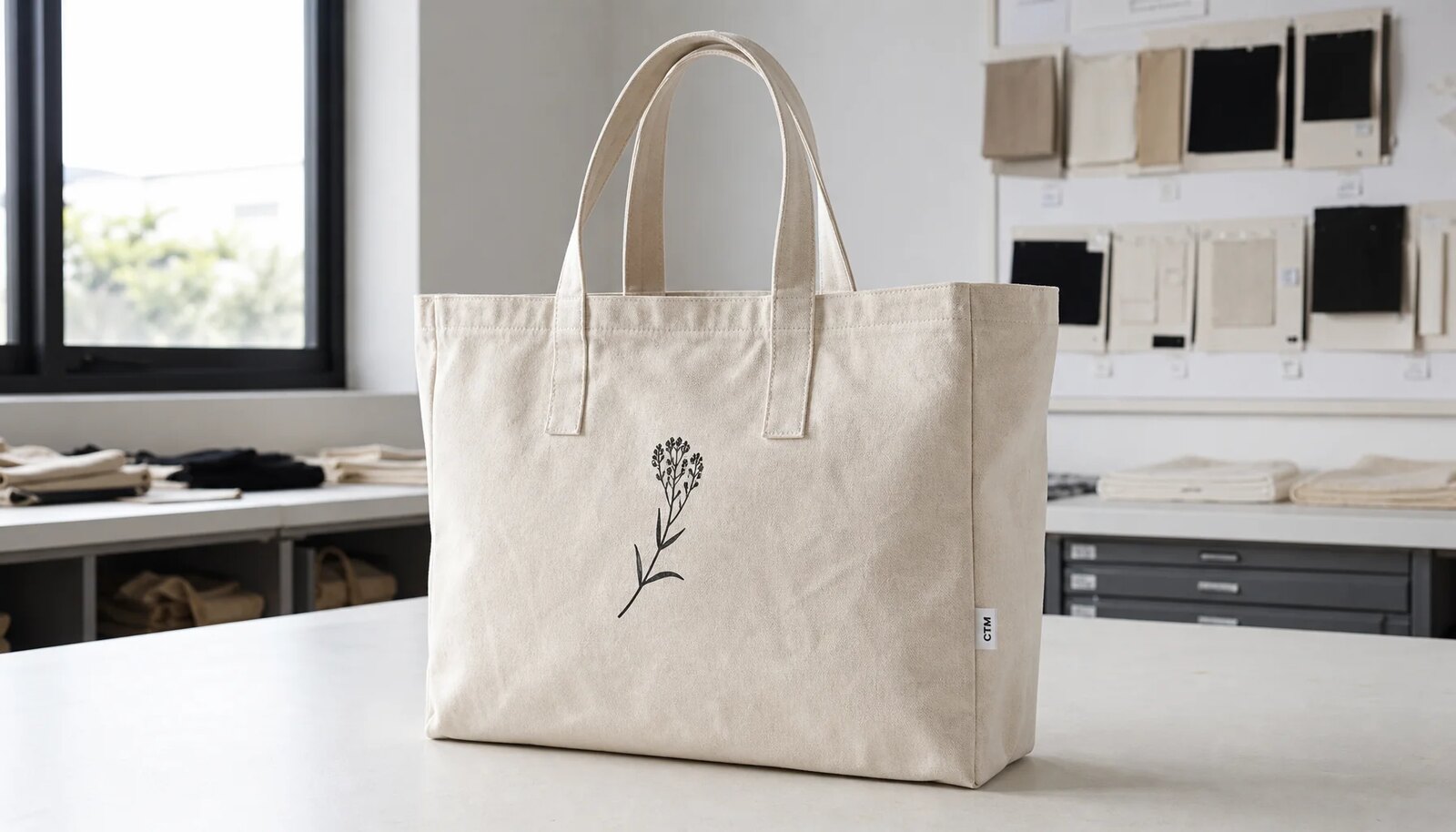
Why Event Tote Orders Fail
Wholesale canvas grocery totes look straightforward until they are distributed at scale. In a sample room, a tote may look acceptable because only the front print is being judged. At registration, a weak handle, uneven fold, crooked sponsor logo, or stained panel becomes visible in hundreds or thousands of hands. For event planners and procurement teams, the tote is not just a blank bag with a logo. It is a delivery vehicle for catalogs, samples, retail purchases, badges, meal kits, and sponsor visibility.
The most common failure is approving the artwork before approving the product. A digital mockup can confirm layout, but it cannot prove that the fabric has enough body, the bottom gusset sits flat, the handles are comfortable, or the decoration survives folding. Grocery-style totes are often expected to carry more than a standard giveaway bag. If the buyer does not define load, construction, and inspection rules before production, the factory may quote a lighter build that meets the artwork request but misses the actual event use case.
Event pressure also changes the risk profile. A retail buyer may have time to sort, rework, or delay stock. Event planners usually do not. Once the shipment arrives at the venue or fulfillment center, the receiving team needs cartons that are easy to count, bags that are clean and folded consistently, and quality that does not require emergency sorting. That is why a useful quality inspection checklist for wholesale canvas grocery totes must include fabric, sewing, print, packing, and schedule controls together.
- Do not treat the tote as only a printed item; inspect it as a sewn product under expected use.
- Most avoidable complaints come from weak handles, uneven sewing, poor print cure, incorrect counts, and packing damage.
- The inspection checklist should reflect the real event load: brochures, bottles, samples, apparel, groceries, or retail merchandise.
- A sample that looks good on a desk can still fail when stacked in cartons, carried across a venue, or distributed by temporary staff.
Define The Use Case Before The Spec
The strongest tote specification starts with a plain statement of use. A bag for light registration materials does not need the same build as a tote meant to carry beverage bottles, product samples, or grocery-weight loads. A tote used once at a conference can have a different balance of cost and durability than a branded bag intended for reuse after the event. Before asking suppliers for prices, procurement should define the target load, the handout environment, and the intended life of the bag.
For event planners, handle comfort and bag shape often matter as much as material weight. A short handle drop may look neat in photography but can frustrate attendees if the bag cannot sit over the shoulder. A deep gusset helps a grocery tote stand upright and carry volume, but it can also make folding and carton packing bulkier. A wide bag may show a large logo well, while a narrower bag may be easier to carry through aisles. These decisions affect cost, production time, and quality control, so they should be settled before the quote stage.
The use case should also identify who handles the tote after delivery. If the bags go to a venue, carton labels and count accuracy are critical. If they go to a kitting center, inner packs and barcode rules matter. If they go to retail resale, fold consistency, label placement, and cosmetic defects need tighter control. A single sentence such as "conference giveaway" is not enough for a factory to make the right production choices.
- State the expected contents and approximate load weight in the RFQ.
- Define whether the tote is hand-carry, shoulder-carry, or both.
- Specify whether the bag must stand upright, fold flat, or fit inside a kit carton.
- Identify the final receiving point: venue, warehouse, kitting center, retail stockroom, or direct mail operation.
Set The Tote Specification Before Quoting
For wholesale canvas grocery totes, fabric weight is the anchor specification. An 8 oz canvas, roughly 270 gsm, can work for light inserts, low-cost promotions, and short-use handouts. A 10 oz canvas, roughly 340 gsm, is the practical default for many event bags because it offers better body, cleaner print support, and more confidence under normal carry loads. A 12 oz or 400+ gsm canvas is appropriate when the tote needs a more structured retail feel or must carry heavier samples, bottles, books, or grocery items.
Weight alone is not the full story. Ask whether the quoted weight is measured before or after finishing, because washing, bleaching, dyeing, or coating can change the final hand feel and weight. Natural canvas is usually faster and more cost stable than dyed canvas. Bleached canvas offers a cleaner print background but may reveal dirt more easily. Dyed canvas can support brand colors, but it requires lab dip approval and closer shade control. If the event has multiple delivery waves, ask whether all units will be cut from one material lot or whether shade variation may occur between batches.
Construction details should be written as dimensions, not assumptions. Include finished width and height, gusset depth, bottom construction, seam allowance, handle width, and handle drop. If the tote must carry heavier contents, specify box-X stitching, bar-tacks, or reinforced cross stitching at the handle root. If the bag has a bottom gusset, define whether the bottom seam should be inside bound, folded, or otherwise reinforced. These details prevent suppliers from quoting different bags under the same product name.
- Use 8 oz / about 270 gsm only for light event inserts or short-use budget programs.
- Use 10 oz / about 340 gsm for general event handout bags and reusable grocery-style totes.
- Use 12 oz / 400+ gsm when load, structure, or premium presentation is more important than the lowest unit cost.
- List finished size, gusset depth, handle drop, handle width, seam allowance, and reinforcement method in the RFQ.
- For dyed canvas, require a lab dip and define shade tolerance before bulk material is cut.
Compare Supplier Routes With Process Visibility
The best sourcing route depends on time, customization, and risk tolerance. A direct factory is often the strongest choice for repeat programs or custom builds because the buyer can specify fabric, dimensions, sewing, printing, and packing in one controlled process. A stock tote wholesaler can be useful when the event date is close and a standard bag size is acceptable. A trading company or sourcing agent can simplify multi-category procurement, but the buyer should understand who is actually cutting, sewing, printing, and packing the totes.
Price differences often come from process differences. One supplier may quote a custom 10 oz canvas tote with reinforced handles, one-color screen print, inner packs, and export cartons. Another may quote a lighter stock tote with basic logo application and loose bulk packing. On paper, both may be described as wholesale canvas grocery totes. In reality, they are not the same product. Procurement should ask suppliers to disclose the fabric source, production location, decoration method, and packing process so the quote can be evaluated on equal terms.
Visibility matters most when something changes. If artwork is revised, an in-house print team can usually answer quickly about registration, screen size, and cure. If printing is outsourced, every question may require another step. If sewing is subcontracted, quality issues can become harder to trace. Subcontracting is not automatically a problem, but hidden subcontracting is. The purchase order should state which supplier is responsible for final quality and rework if any subcontracted step fails inspection.
- Ask for production photos of similar tote construction, not only finished beauty shots.
- Request the actual factory name, city, and process ownership for cutting, sewing, printing, and packing.
- Have the supplier state which processes are in-house and which are subcontracted.
- Check whether the supplier can support third-party inspection and provide carton-level packing information.
- Treat vague answers about production ownership as a cost and schedule risk, even when the unit price is attractive.
Build An RFQ That Produces Comparable Quotes
A useful RFQ removes guesswork. It should include the finished bag dimensions after sewing, canvas weight in oz and gsm, fabric color, handle dimensions, gusset depth, print size, print position, artwork file type, quantity by version, and packing format. If the artwork must sit a certain distance from the top edge or side seam, provide exact measurements. If the tote has multiple sponsors, state whether each sponsor version is a separate print run. Factories price setup, labor, and material based on these details.
Commercial terms belong in the RFQ as well. State the desired Incoterm, destination port or address, target in-hand date, sample requirement, inspection requirement, and whether the quote should include export cartons, labels, barcodes, palletizing, or testing. Without this information, suppliers may quote a basic ex-works bag while the buyer is comparing against a delivered, inspected, packed-for-event program. That makes price comparison unreliable.
Version control is another common source of errors. Events often involve different sponsor logos, different fabric colors, or separate carton marks for different locations. Each version should have its own quantity, artwork code, sample approval, and packing instruction. If there are multiple delivery locations, the RFQ should show the split clearly. This helps the supplier price correctly and reduces the chance that cartons are mixed or labels are applied to the wrong version.
- Attach vector artwork and provide Pantone or brand color references for every print color.
- Show print placement with measurements from finished edges, not only a visual mockup.
- List quantity by bag color, print version, packing version, and delivery location.
- State whether samples, screens, labels, cartons, inspection support, and freight should be included or listed separately.
- Ask suppliers to quote against your specification line by line so substitutions are visible.
Control Decoration Before Bulk Production
Screen printing is usually the most reliable decoration choice for simple logos and high-volume canvas tote orders. It offers good opacity on natural canvas, is easy to inspect against a strike-off, and works well for one-color or two-color event branding. The buyer should still confirm ink type, screen setup, print size limits, and curing method. Canvas texture can soften fine details, and large solid areas can show uneven ink if the setup is weak. A print that looks sharp on a digital proof may not behave the same way on woven fabric.
Heat transfer, embroidery, woven labels, and hangtags each have a place, but they should be chosen for the right reason. Heat transfer can support detailed artwork or shorter runs, but it must be checked for lifting, cracking, and fold marks. Embroidery can create a premium look, but it adds cost and may pucker lighter canvas if stitch density is too high. Woven labels are useful for a subtle brand mark and can reduce front-panel print complexity, but label placement and seam attachment must be inspected. Hangtags can support retail or sponsor messaging, but they add packing labor and can be damaged in loose cartons.
The safest approval path is a physical strike-off on the actual canvas base. Check color, opacity, edge clarity, registration, and hand feel. Then fold and rub the printed area in the way the bag will be packed and handled. For multi-sponsor or multi-color artwork, approve every version that will go into production. The approved strike-off should be kept with the golden sample so inspectors can compare bulk output against a real standard, not against a screen image.
- Approve decoration on the actual canvas, not only on paper, PDF, or a digital mockup.
- Check fine text, sponsor marks, QR codes, and thin lines at true production size.
- For screen print, inspect opacity, registration, edge clarity, cure, rub resistance, and placement.
- For heat transfer, inspect adhesion, cracking, lifting, and fold resistance.
- For embroidery, check puckering, thread color, backing, and whether the panel remains flat.
Use Practical Factory QC Thresholds
A quality inspection checklist works only when the thresholds are clear. Procurement should define critical, major, and minor defects before production starts. Critical defects include issues that make the bag unsafe, unusable, or unacceptable for distribution, such as broken handles, open seams, mold, strong odor, or incorrect artwork. Major defects include problems that affect appearance or function, such as crooked printing, visible stains, weak stitching, wrong dimensions, or mixed versions. Minor defects may include small loose threads or slight fold variation if they do not affect use or presentation.
Many buyers use AQL-style inspection for bulk orders, often with zero tolerance for critical defects and defined limits for major and minor defects. The exact standard should be agreed in the purchase order. For event planners, the key is not to overcomplicate the inspection but to measure the right things. Inspectors should check cartons from different stack positions, open inner packs, measure multiple bags, review front and back panels, and test handle attachment on a sample set. A tote shipment can pass a quick top-carton visual check and still contain hidden packing or sewing problems.
Measurement tolerances should be realistic for sewn cotton products. A small variation in finished width, height, or handle drop may be acceptable, but it needs a defined range. Print placement should also have a tolerance, especially when logos are centered on a panel. For grocery totes, handle strength and seam integrity deserve special attention because attendees may load the bag more heavily than expected. A simple pull check or agreed load test on sampled units can catch weak handle construction before the bags reach the venue.
- Set zero tolerance for mold, severe odor, wrong logo, broken handles, open seams, and unsafe hardware if any is used.
- Classify visible stains, print shift, wrong dimensions, weak reinforcement, and mixed carton contents as major defects.
- Measure width, height, gusset, handle drop, and print placement on multiple units from different cartons.
- Inspect both cosmetic quality and functional strength; a clean-looking tote with a weak handle still fails the purpose.
- Require inspection photos that document acceptable units and defects, not only a pass/fail statement.
Approve Samples In The Right Order
A disciplined sample process prevents expensive surprises. Start with an artwork proof to confirm logo size, placement, and version coding. Then approve a print strike-off on the selected canvas. After that, request a pre-production sample made with the actual fabric, handle construction, sewing method, decoration, labels, and intended packing. Only after those items are correct should the buyer approve a sealed golden sample for bulk production. Each step answers a different question, so skipping one usually shifts risk into the bulk order.
The pre-production sample should be reviewed like a production unit, not a presentation mockup. Measure the finished size, check the gusset, carry the bag with a realistic load, fold it as it will be packed, and inspect the print after handling. Confirm whether the sample includes the same thread color, handle reinforcement, label position, hangtag, and carton packing that will be used in bulk. If the supplier sends a sample with substitute fabric or temporary print, label it clearly as a reference sample only and do not treat it as bulk approval.
The golden sample should be sealed, dated, and tied to the purchase order version. If there are different fabric colors, artwork versions, or packing methods, keep a reference for each. This is especially important in event procurement because orders often involve multiple stakeholders: marketing approves the look, procurement approves cost, operations receives cartons, and venue teams distribute bags. The golden sample gives everyone a single physical standard for what was approved.
- Do not approve bulk production from artwork alone.
- Require a pre-production sample that uses actual materials, actual sewing, actual decoration, and intended packing.
- Label samples with date, supplier, PO number, artwork version, fabric color, and approval status.
- Keep one sealed golden sample for each version that will be inspected or distributed separately.
- Record sample revisions in writing so a corrected detail does not disappear in later production.
Pack For Venue Handout And Receiving
Packing should be designed around the final handoff, not only the export shipment. If totes are going directly to a venue, the receiving team needs cartons that are easy to count, easy to move, and clearly marked by version. Flat-folded bags in consistent inner packs reduce counting errors and make distribution faster. Individual polybags can protect against dust and print scuffing, but they add cost, handling time, and waste. Paper bands or counted inner bundles may be a better fit when the bags will be unpacked immediately at registration.
Carton specifications affect both quality and logistics. Overpacked cartons can crush folds, distort handles, and cause print transfer if bags are not fully cured. Weak cartons can collapse during transit or absorb moisture in storage. Natural canvas can pick up odor or mildew if packed damp or stored in humid conditions. For sea freight, long warehouse dwell time, or rainy-season routing, moisture protection should be discussed before packing begins. At minimum, the supplier should confirm that bags are dry before carton sealing and that cartons are stored off wet floors.
Carton marks should be treated as part of the order specification. Include PO number, product description, artwork version, quantity per carton, carton sequence, destination code, and handling marks where needed. If the event has multiple locations or sponsor versions, clear carton labeling prevents last-minute sorting under pressure. For retail or paid merchandise, barcode accuracy, hangtag condition, and fold alignment may need a tighter standard than for a simple giveaway.
- Specify individual polybag, paper band, inner stack, or loose bulk packing based on the distribution workflow.
- Define inner pack count and carton count so receiving teams can audit quickly.
- Require carton marks that identify version, quantity, PO number, and destination.
- Check cartons for moisture, crushing, scuffed print faces, mixed versions, and count errors during inspection.
- For multi-location events, ask for a packing list that matches carton sequence to destination.
Protect The Schedule From Avoidable Delays
Most tote delays are caused by unclear approvals, late changes, or material assumptions that were never confirmed. A reliable production calendar should include artwork finalization, material booking, strike-off approval, pre-production sample approval, cutting, sewing, printing, packing, inspection, and cargo-ready date. Each step should have an owner and a deadline. When the event date is fixed, the buyer should work backward from the in-hand date and leave room for sample revision, inspection, and freight variability.
Artwork changes are one of the easiest ways to lose time. Changing logo size after screens are made can trigger new setup. Changing fabric color after a lab dip can restart material sourcing. Changing packing after cartons are ordered can add labor and delay. The purchase order should define a lock date for artwork, materials, and packing. After that date, changes should be treated as schedule-impacting revisions, not casual updates.
Capacity should be confirmed before the deposit or purchase order is released. Ask when the factory will buy fabric, when it will reserve sewing lines, and whether printing capacity is shared with other programs. During peak seasons, a factory may accept the order but still place it behind larger retail production. A supplier that explains bottlenecks early is easier to manage than one that promises every date without showing the production path.
- Build the calendar from the required in-hand date, not from the factory's best-case sewing time.
- Reserve time for one sample revision and one inspection window.
- Freeze artwork before screens, transfers, labels, or embroidery files are finalized.
- Confirm material booking date, sewing start date, print date, packing date, inspection date, and cargo-ready date.
- Ask what changes would reset the schedule before approving the purchase order.
Specification comparison for buyers
| Spec decision | Recommended option | When it fits | Buyer risk to check |
|---|---|---|---|
| Source route | Direct factory with in-house cutting, sewing, and printing | Repeat event programs, custom dimensions, controlled branding, and buyer-specified packing | Undisclosed subcontracting, unclear line capacity, or a sales office that cannot confirm production ownership |
| Source route | Stock tote wholesaler with logo add-on service | Urgent event orders, simpler artwork, and acceptable stock sizes | Mixed shade lots, limited seam specification, weaker handle reinforcement, and less control over packing |
| Source route | Trading company or sourcing agent | Multi-category procurement when one contact must coordinate several event items | Margin stacking, slower answers, and limited visibility into the actual tote maker |
| Fabric weight | 10 oz / about 340 gsm for general event use; 12 oz / 400+ gsm for heavier grocery loads | Welcome kits, registration bags, sponsor giveaways, retail-style merch, and reusable grocery totes | Too-light fabric that collapses or tears; too-heavy fabric that increases freight, sewing difficulty, and unit cost |
| Fabric color | Natural canvas for speed and cost control; dyed canvas only with lab dip approval | Programs where shade accuracy, brand color, or retail presentation matters | Shade variation, dye lot mismatch, crocking risk, and longer material lead time |
| Handle construction | Self-fabric or webbing handles with box-X, bar-tack, or reinforced cross stitching | Bags carried across venues, loaded with catalogs, bottles, samples, or grocery-weight inserts | Single-row attachment, twisted handle placement, weak seam allowance, and handle pull-out |
| Print method | One- or two-color screen print with strike-off approval on the actual canvas | High-volume logos, sponsor marks, registration bags, and simple branded totes | Poor ink cure, cracked print, low opacity, registration drift, and edge bleeding on rough canvas |
| Sample route | Artwork proof, print strike-off, pre-production sample, then sealed golden sample | Any custom size, decoration, packing, or multi-version event order | Approving only a digital mockup and discovering construction or print issues after bulk starts |
| Packing route | Flat-folded inner packs, controlled carton counts, carton marks, and moisture protection | Venue handout, multi-location distribution, retail replenishment, or staged event delivery | Mixed counts, print scuffing, humidity odor, crushed cartons, and slow receiving at the venue |
Buyer checklist before sampling
- Define the finished tote size, gusset depth, handle width, handle drop, and acceptable measurement tolerance before requesting prices.
- Choose the fabric base up front: natural, bleached, dyed, organic, recycled, or conventional cotton canvas.
- State the target fabric weight in oz and gsm, and ask the supplier to confirm whether weight is measured before or after finishing.
- Provide vector artwork, Pantone or brand color references, print size, placement distance from seams, and whether the print is one side or two sides.
- Decide whether the decoration should be screen print, heat transfer, embroidery, woven label, hangtag, or a combined finish.
- Write handle reinforcement into the purchase order, including stitch type, stitch count target, and whether a pull test is required.
- Set acceptable tolerances for size, fabric shade, print registration, print color, stitch defects, and carton count accuracy.
- Require a pre-production sample made with the actual fabric, actual decoration, actual handle construction, and intended packing method.
- Keep a sealed golden sample for each colorway, print version, or packing version, and use it as the bulk inspection reference.
- Define inner pack quantity, carton quantity, carton dimensions, carton marks, barcode rules, pallet rules, and moisture protection.
Factory quote questions to send
- What exact canvas weight, yarn construction, weave, and fabric finish are you quoting, and is the material natural, bleached, dyed, organic, recycled, or conventional cotton?
- Is the quoted fabric weight measured before washing, after washing, or after finishing, and what tolerance do you allow across the lot?
- Are the handles self-fabric or webbing, what is the handle width and drop, and what reinforcement stitch pattern do you use at the stress point?
- What load check or handle pull test can you perform on production samples, and what result do you consider acceptable?
- What decoration method do you recommend for this artwork, how many print colors are included, and what setup charges are excluded from the unit price?
- Can you provide a print strike-off on the actual canvas base, and how do you verify ink cure, rub resistance, opacity, and registration?
- What is the MOQ by fabric color, print version, bag size, decoration method, and packaging version?
- Which samples will you provide before bulk production, what is the sample lead time, and what is the revision charge if the first sample misses the approved specification?
- What are your standard carton pack, inner pack, polybag, paper band, barcode, hangtag, and carton mark options?
- What inspection standard do you use, can we define critical, major, and minor defects in the purchase order, and can a third-party inspector access the factory?
Quality-control points to confirm
- Fabric weight, width, weave appearance, shrinkage behavior, and shade match the approved sample within the agreed tolerance.
- No holes, slubs that weaken the fabric, oil marks, water stains, mildew, odor, shade bands, or visible contamination on outer panels.
- Cut dimensions, panel symmetry, gusset depth, bottom width, handle width, and handle drop stay within the buyer-approved measurement range.
- Stitch count, seam allowance, backstitching, edge folding, and reinforcement stitches are consistent across the inspected lot.
- Handle attachment passes the agreed pull or load check on sampled units and shows no seam opening, stitch popping, or fabric tearing.
- Print alignment, placement, opacity, edge clarity, ink cure, color match, rub resistance, and crease behavior meet the approved strike-off standard.
- No loose threads, skipped stitches, needle holes, broken stitches, seam puckering, twisted handles, uneven top hems, or exposed raw edges beyond tolerance.
- Labels, hangtags, barcodes, care tags, and woven marks match the purchase order and are attached in the correct position.
- Carton count, inner pack count, carton marks, barcode labels, assortment by version, and packing configuration match the purchase order exactly.
- Bags are dry, clean, flat-folded as approved, and protected from scuffing, humidity, odor, and severe compression before shipment.