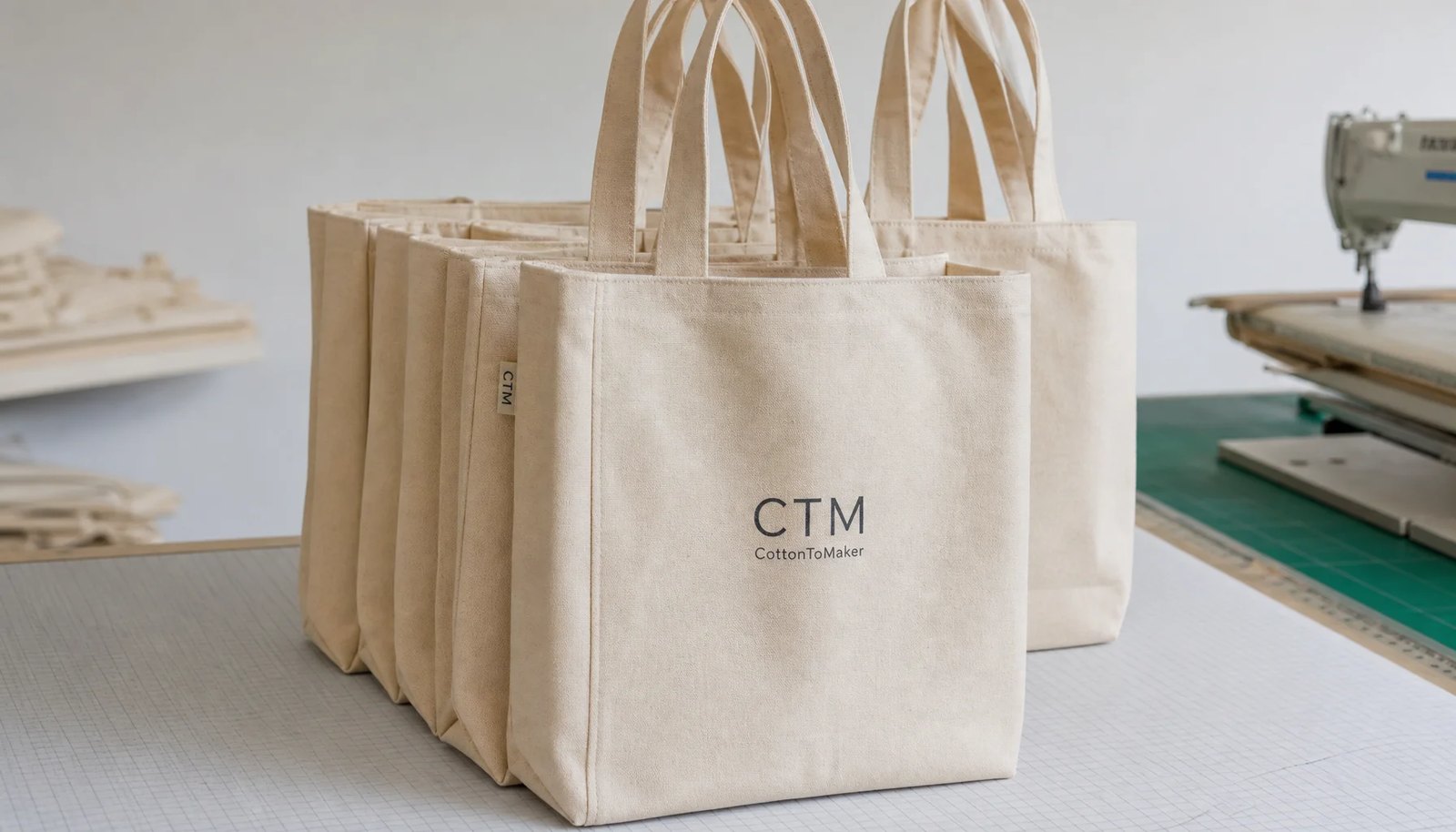
Why MOQ Is Different for Exhibitor Tote Orders
Trade show exhibitors buy under a different kind of pressure than ordinary retail tote buyers. The quantity is tied to booth traffic forecasts, VIP kits, sales team needs, dealer meetings, and event warehouse cutoffs. A buyer may need 400, 750, or 1,200 canvas grocery totes, while a supplier defaults to 1,000 or 2,000 pieces because that is the quantity where fabric purchasing, cutting, sewing, printing, and packing run efficiently.
Good MOQ negotiation starts by separating the supplier's habit from the true production constraint. A factory may say the MOQ is 1,000 pieces because that is the normal line setup, but the real limiter could be one fabric roll, one dye lot, minimum screen print labor, or the cost of packing a small export shipment. If the buyer asks only for a lower price, the supplier may lower the spec. If the buyer asks which input drives the MOQ, the supplier can suggest a cleaner alternative.
For procurement teams, the goal is not simply to force the smallest number. The goal is to order the right event quantity without weakening the tote, risking late delivery, or accepting hidden charges that make the smaller run more expensive than expected. The best RFQ makes the tote measurable: fabric weight, finished size, gusset, handle, print, packing, carton data, and approval schedule.
- Weak MOQ request: 'Can you do 300 pieces cheaper?'
- Stronger MOQ request: 'At 300, 500, and 1,000 pieces, what cost changes come from fabric, print setup, cutting loss, sewing setup, or packing labor?'
- Best starting position: stock natural canvas, factory standard grocery tote pattern, one-color print, bulk export packing, and fast written sample approval.
- Procurement rule: compare landed cost per usable bag, not only quoted unit price.
Build the RFQ Around a Standard Grocery Tote Spec
A wholesale canvas grocery tote for a trade show should be practical before it is decorative. It needs to hold catalogs, sample cartons, apparel, drinkware, and small purchases without looking overloaded. Common working sizes are 38 x 35 x 10 cm and 40 x 38 x 12 cm, stated as width x height x gusset. These are not universal standards, but they give suppliers a clear target and keep quotes comparable.
The bottom gusset is often worth protecting in negotiation. A flat tote can be cheaper, but it carries rectangular materials poorly and may not stand neatly on a booth counter. A boxed bottom or full bottom gusset improves usable capacity and presentation. For exhibitors, that can matter as much as the front logo because the bag is seen in aisles, lounges, and hotel lobbies after it leaves the booth.
Fabric should be stated in both ounces and GSM. Canvas ounce labels can vary by convention and may be used loosely in sales conversations, while GSM gives a measurable mass per square meter. For many exhibitor grocery totes, 10 oz to 12 oz cotton canvas, roughly 300-400 GSM depending on weave and finishing, is a practical balance. An 8 oz canvas can work for lighter giveaways, but it may feel thin beside premium catalogs. A 14 oz canvas can look substantial, but it raises sewing difficulty, carton weight, and freight cost.
- Budget event tote: 8 oz canvas, flat or small gusset, one-color print, bulk packed.
- Balanced exhibitor tote: 10 oz or 12 oz canvas, boxed bottom gusset, reinforced shoulder handles, one-side or two-side screen print.
- Premium retail-style tote: 12 oz to 14 oz canvas, cleaner seam finishing, stronger structure, optional inside pocket or label if lead time allows.
- RFQ wording: 'Natural cotton canvas grocery tote, 40 x 38 x 12 cm, 12 oz approximate 380 GSM, open top, boxed bottom gusset, self-fabric handles, box-X reinforcement, one-color screen print.'
Fabric Choices That Move MOQ Up or Down
Fabric is often the largest MOQ driver because the factory may need to buy full rolls or commit to a dye lot. Natural cotton canvas in a common weight is usually easier to source for smaller wholesale orders than custom dyed canvas, washed canvas, yarn-dyed stripe fabric, certified organic cotton, or unusual blends. For a fixed event deadline, stock natural canvas or stock black canvas usually carries less schedule risk than a custom Pantone fabric.
Ask the factory what stock fabric is available before changing the tote design. A small adjustment in finished width or gusset can improve cutting yield from the available roll width. For example, a 39 cm body width may cut better than 42 cm after seam allowance and gusset panels are considered. The buyer may not know the factory's cutting marker, but the factory can tell you whether your requested size wastes fabric.
Be careful with sustainability or certification language in the quote. If the order requires organic cotton, recycled cotton, GOTS, OEKO-TEX, or other documentation, the MOQ and lead time can change because the supplier must maintain chain-of-custody documents or source from a narrower fabric pool. Do not treat certified fabric as a simple material substitution unless the supplier confirms certificate scope, validity, and whether it applies to fabric, dyeing, printing, or finished goods.
- Lower MOQ fabric path: natural cotton canvas, stock GSM, no special wash, standard roll width, no contrast dyed handles.
- Higher MOQ fabric path: custom dyed canvas, garment wash, organic certification, recycled fiber claim, yarn-dyed pattern, special lining, contrast binding.
- Quote detail to require: composition, oz, GSM, color, roll width if relevant, stock or made-to-order status, GSM tolerance, and available quantity.
- Risk control: approve a physical fabric swatch or pre-production sample before bulk cutting, especially when hand feel and color matter.
Handle and Construction Specs Buyers Should Not Leave Vague
Handle failure is one of the most public defects on a trade show tote. A bag can look acceptable in a carton and still fail when loaded with catalogs and samples. Procurement should specify handle material, total handle length, handle width, handle drop, reinforcement style, and thread color when visible. For shoulder carry, 55-65 cm total handle length often works better than short hand-carry handles, but the ideal length depends on bag height and target use.
Handle width matters because narrow handles can dig into the user's shoulder, while very wide handles can cost more and look bulky. A 2.5-3.5 cm self-fabric handle is common for canvas grocery totes, but buyers should confirm whether the handle is made from the same canvas, cotton webbing, or another tape. Self-fabric handles can match the body nicely; webbing handles may improve consistency and production speed if the color and hand feel are acceptable.
Seam construction should also be stated. Open seams, poor overlocking, loose thread ends, and inconsistent stitch density can make a canvas tote feel cheap even if the fabric is adequate. For higher visibility events, ask the supplier to describe the seam finish at side seams, bottom gusset, and handle attachment. If the tote will carry heavier sample kits, ask for a practical load test using the expected contents or an agreed weight rather than relying on a generic strength claim.
- Specify handle length as total handle length or handle drop, and make clear which measurement is used.
- Ask for reinforcement method: box-X stitch, cross-stitch, bartack, or other approved construction.
- Define visible thread color: tone-on-tone, natural, black, or contrast, depending on brand requirements.
- Check sample under load: fill with expected booth materials and carry by handle for a realistic review.
- Avoid vague phrases: replace 'strong handles' with handle width, length, stitching method, and defect tolerance.
Print Method, Artwork Detail, and MOQ Tradeoffs
For wholesale canvas grocery totes for trade show exhibitors, screen printing remains a practical default for one to three solid colors. It gives a direct ink feel on canvas, good opacity when executed well, and efficient unit cost as quantity increases. The MOQ challenge is setup: each color adds screen preparation, registration time, ink control, and inspection complexity. A five-color logo at 500 pieces may be technically possible but commercially inefficient.
Heat transfer can be useful for small quantities, gradients, photo-like graphics, or sponsor blocks with many colors. It can also create buyer-side issues: a heavy film feel, glossy edge, cracking after folding, or poor adhesion if temperature and pressure are not controlled. Direct digital printing may work in some supply chains, but canvas texture can reduce edge sharpness and color saturation. Any method used for QR codes or fine text should be approved on actual canvas, not only as a digital proof.
Print position should be measurable. State the print size, side, distance from top edge, centerline alignment, and whether the bag will be printed before or after sewing. Printing after sewing may create uneven contact near seams and gussets; printing before sewing can improve flatness but requires tighter cutting and sewing alignment. Neither method is automatically better. The important point is to understand the supplier's process and set tolerances that match it.
- Best for screen print: bold logo, solid colors, repeat orders, larger front-panel artwork, strong opacity needs.
- Best for heat transfer: low quantity, multi-color sponsor art, gradients, urgent setup, or artwork that cannot be separated cleanly.
- QC watchpoints: ink opacity, edge clarity, registration, hand feel, cracking after folding, rub resistance, and QR scan performance.
- RFQ wording: 'One-color screen print, 28 x 24 cm, front side, centered, Pantone reference supplied, placement tolerance plus or minus 1 cm unless otherwise approved.'
MOQ Negotiation Levers That Preserve the Bag
The easiest ways to reduce MOQ are often the worst ones: thinner canvas, smaller handles, no gusset, cheaper print, or weaker seam finishing. Those changes can create a lower quote but also produce a tote that looks limp, carries poorly, or fails during the event. A buyer should protect functional requirements first: fabric weight, handle reinforcement, gusset construction, and print durability.
Better MOQ levers reduce variation rather than strength. Use a factory standard body pattern instead of a custom size. Choose stock canvas instead of dyed fabric. Reduce print colors or approve an event version of the logo. Use bulk packing instead of individual polybags. Accept a practical carton quantity that fits the factory's packing workflow. Approve artwork and samples quickly so the supplier can place the order into a normal production window.
When the supplier cannot meet the target MOQ, ask for a stepped quote with unchanged specs. This prevents quote comparisons from becoming distorted. A 500-piece quote for 10 oz canvas and a 1,000-piece quote for 12 oz canvas are not price breaks; they are different products. Procurement should ask the supplier to show exactly what surcharge applies below the normal MOQ and whether it is a fabric surcharge, setup surcharge, labor surcharge, or freight effect.
- Protect first: fabric GSM, handle reinforcement, gusset structure, seam quality, and approved print method.
- Flexible variables: exact body dimension, print color count, carton quantity, individual packing, inside label, and nonessential trims.
- Ask for price breaks at 300, 500, 1,000, 2,500, and 5,000 pieces using the same construction.
- Commercial test: compare the cost of a 500-piece setup surcharge against the cost of buying 1,000 pieces and storing unused inventory.
- Negotiation phrase: 'Please show the lowest quantity without changing fabric, handle construction, print method, or packing unless noted separately.'
Quote Tables That Make Supplier Offers Comparable
A procurement quote for canvas grocery totes should read like a product and logistics data sheet, not only a unit price. Without full data, one supplier may look cheaper because setup, cartons, sample freight, or inspection time are missing. Another may quote '12 oz canvas' without confirming GSM. A third may use a different tote size or handle length. The buyer's RFQ should force alignment before price comparison.
The most useful comparison is landed cost per usable bag. That includes product cost, print charge, setup charge, sample charge, packing, inland freight, export handling, international freight, duty, customs brokerage, inspection, and a realistic defect allowance. For trade show exhibitors, it should also include late-delivery risk. A cheap order that misses the advance warehouse deadline can create air freight, show-site drayage issues, or last-minute domestic rework.
Use a small quote matrix when comparing suppliers. It does not need to be elaborate, but it should separate product specifications from commercial terms and logistics data. This helps procurement spot hidden differences early, while there is still time to clarify or revise the specification.
- Product fields: finished size, fabric composition, oz, GSM, gusset depth, handle length, handle width, seam finish, print method, print size, print side.
- Commercial fields: MOQ, price breaks, setup charge, sample charge, repeat order setup, payment terms, validity period, incoterm.
- Logistics fields: pieces per carton, carton size, gross weight, net weight, CBM, port or airport, ready date, transit estimate.
- Approval fields: sample date, artwork cutoff, production days after approval, inspection window, latest ship date.
- Supplier clarification: 'Confirm that all quoted quantities use the same tote construction and print specification.'
Sample Approval and Tolerances Before Bulk Production
A sample can protect the buyer only if it represents bulk production. A showroom sample made from different canvas or printed by a different process is useful for general styling, but it is not enough for event-ready approval. For first orders, new suppliers, new artwork, direct-to-event shipments, or major spec changes, request a pre-production sample using actual fabric, final handle construction, actual print method, and the intended packing fold.
Approval should be measurable. Measure body width, body height, gusset depth, handle total length, handle drop, handle width, and print placement. Review whether the canvas stands well, whether the bag mouth opens easily, and whether the gusset sits square. Load the bag with expected show materials or equivalent weight. Scan printed QR codes from several angles and distances. Fold the printed panel as it will be packed and check whether ink or transfer film cracks, lifts, or marks the opposite panel.
Write tolerances before production starts. For many standard sewn canvas totes, plus or minus 1 cm on body width and height is a practical starting point, with tighter or looser tolerances depending on design and order value. Print placement tolerance may be plus or minus 1 cm for simple centered logos, but detailed layouts may need tighter control. GSM tolerance is often around plus or minus 5 percent, but the buyer should state the agreed number rather than assume it.
- Measure on sample: width, height, gusset, handle length, handle drop, handle width, print size, and print position.
- Review by function: load capacity, shoulder comfort, opening size, standing shape, seam quality, and folded carton fit.
- Review by brand: color, opacity, logo edge, placement, QR scan, sponsor text, and visible stains or slubs.
- Approval record: dated photos, signed spec sheet, artwork file version, Pantone references, sample comments, and accepted tolerances.
- Do not approve only with 'looks good'; convert approval into measurable acceptance criteria.
Packing, Cartons, and Event Warehouse Handling
Packing choices affect cost, freight, labor, and event execution. Canvas grocery totes are bulky when folded. Individual polybags can make each bag cleaner and easier to distribute into VIP kits, but they also add labor, plastic material, carton volume, and disposal work at the booth. For general booth giveaways, bulk packing is often faster and more economical.
Typical bulk packing may be 50-100 pieces per export carton, depending on fabric weight, folded size, and carton strength. Heavier canvas or large gussets can lower the pieces per carton because overpacked cartons split during handling. Underfilled cartons can crush and create poor presentation. Ask for carton dimensions, gross weight, net weight, and total CBM before shipment planning. For air freight, volume weight can matter as much as actual weight.
Trade show shipments also need clean identification. Carton marks should follow event instructions and may need event name, booth number, company name, PO number, SKU, quantity per carton, carton sequence, and destination label. If a decorator or advance warehouse has pallet, label, or receiving rules, provide those to the supplier early. A well-made tote does not help if cartons cannot be located or released on time at the venue.
- Bulk giveaway pack: 50-100 pieces per carton, flat folded, no individual polybag unless needed.
- Kit packing: individual polybag, belly band, insert card, or barcode label only when distribution requires it.
- Carton data to require: pieces per carton, carton dimensions, gross weight, net weight, total cartons, total CBM.
- Carton mark data: event name, booth number, PO, SKU, item description, quantity, carton number, and destination.
- Compliance note: individual plastic bags may trigger thickness, warning label, recycling, or retailer requirements depending on market and use.
Lead Time Is Mostly an Approval Discipline Problem
Suppliers can quote production lead time neatly, but event orders often fail because approvals drift. Artwork is revised after screens are prepared. Pantone colors are debated without a physical reference. The sample ships to the wrong person. The buyer changes from one-side print to two-side print after the production slot is reserved. A procurement calendar should control these decisions before they become emergency freight costs.
For standard stock canvas grocery totes with screen print, a realistic planning range may include 5-10 working days for sample making, 18-30 working days for bulk production after written approval, plus time for inspection, export paperwork, and freight. Custom dyed fabric, certified material, multi-color printing, retail packaging, or large quantities can extend that schedule. Air freight can rescue some delays, but canvas totes can be bulky, so freight cost may rise quickly by volume weight.
The PO should state the latest artwork approval date, sample approval date, production start condition, inspection date, and latest ship date. It should also state that specification changes after approval may reset lead time. This is not just supplier protection; it gives the buyer internal leverage to stop late design changes that jeopardize the show.
- Schedule anchors: event date, advance warehouse deadline, latest receiving date, latest ship date, inspection date.
- Approval anchors: final artwork, Pantone or color standard, sample approval, carton mark approval, packing approval.
- Factory anchors: fabric booking, cutting start, print start, sewing start, packing start, inspection-ready date.
- Risk buffers: courier delays, sample revisions, reprint decisions, customs clearance, weather delays, and exhibition warehouse cutoff rules.
- PO language: 'Production lead time starts after written approval of sample, artwork, packing instructions, and carton marks.'
Specification comparison for buyers
| Spec decision | Recommended option | When it fits | Buyer risk to check |
|---|---|---|---|
| Canvas weight | 10 oz to 12 oz cotton canvas, normally about 300-400 GSM depending on weave and finishing | Most exhibitor grocery totes carrying catalogs, sample boxes, drinkware, apparel, and booth giveaways | Quote must state both oz and GSM with tolerance; sales terms like 'heavy canvas' or 'thick cotton' are not enough |
| Finished size | 38 x 35 x 10 cm or 40 x 38 x 12 cm with boxed bottom gusset | General trade show distribution where the tote must stand on counters and hold rectangular materials | Oversized bags increase CBM and freight; undersized gussets reduce usable capacity even when the flat dimensions look acceptable |
| Handle construction | Self-fabric handles, 2.5-3.5 cm wide, 55-65 cm total length for shoulder carry, reinforced with cross-stitch or box-X stitching | Exhibitor totes expected to be carried all day through a hall | Short handles limit use; weak bartacks or skipped stitches at handle bases are among the most visible field failures |
| Print method | Screen print for 1-3 solid colors; heat transfer or digital only when artwork detail or low quantity justifies it | Corporate logos, booth campaigns, QR codes, sponsor blocks, and clean brand marks | Transfer can reduce MOQ but may feel plasticky, show edge film, or crack if curing and folding are poor |
| MOQ negotiation lever | Use stock natural canvas, factory standard body pattern, common handle tape width, and bulk packing | Orders around 300-1,000 pieces where event need is below the factory's default quote quantity | Supplier may reduce sewing MOQ but add fabric surcharge, screen setup, or longer lead time if the real constraint is not identified |
| Sample approval route | Pre-production sample using actual fabric weight, actual print method, final print size, handle reinforcement, and packing fold | New artwork, first order with supplier, direct shipment to event warehouse, or any change in size/fabric/print/pacing | Photo approval cannot verify hand feel, handle drop, print opacity, QR scan, seam strength, carton volume, or odor |
| Packing format | Bulk pack 50-100 pieces per export carton, flat folded, with individual polybag only when distribution requires it | Booth giveaways, dealer meetings, and sales team events where quick unpacking matters | Individual polybags add labor, plastic compliance review, carton volume, disposal work at booth, and possible receiving restrictions |
| Lead time buffer | Sample 5-10 working days, bulk 18-30 working days after written approval for standard natural canvas, plus inspection and freight buffer | Standard stock canvas with one-side screen print and no dyeing, washing, labeling complexity, or retail packout | Approval delays reset the schedule; PO should define artwork cutoff, sample approval date, inspection date, and latest ship date |
| Quote comparison basis | Compare landed cost per usable bag including setup, samples, cartons, CBM, freight, duty, inspection, and defect allowance | Importers, distributors, promotional product buyers, and exhibitors comparing factory-direct, trader, and domestic decorator quotes | Lowest unit price can lose after air freight, carton oversize, rework, late sample approval, or missing compliance documents |
Buyer checklist before sampling
- Confirm the event date, advance warehouse deadline, latest receiving date, delivery address type, and whether shipment goes to office, 3PL, hotel, show decorator, or exhibition warehouse.
- Lock a standard grocery tote size before collecting quotes, such as 38 x 35 x 10 cm or 40 x 38 x 12 cm, and state whether dimensions are width x height x gusset.
- Specify fabric as cotton canvas or cotton blend, with both oz and GSM, color, weave expectation, and acceptable GSM tolerance, commonly plus or minus 5 percent unless otherwise agreed.
- Define handle length, handle drop, handle width, material, and reinforcement method; for shoulder carry, 55-65 cm total handle length is usually safer than short hand-carry handles.
- State seam construction, bottom gusset type, whether seams are bound or overlocked, stitch density expectation, and thread color if brand appearance matters.
- Send vector artwork with Pantone references, final print dimensions, print position from top edge and side seams, and whether artwork prints on one side, two sides, or gussets.
- Confirm whether QR codes, sponsor logos, fine text, or compliance marks must remain readable or scannable after printing on textured canvas.
- Ask for a pre-production sample using actual material and actual print method when changing supplier, fabric weight, size, handle construction, artwork, or packing fold.
- Request quote line items for bag unit cost, print cost, screen or setup charge, sample charge, packing surcharge, export carton cost if separate, inland freight, and international freight estimate if required.
- Require packing details: pieces per carton, folded size if available, carton dimensions, gross weight, net weight, CBM, carton marks, palletization, and any event warehouse labeling rules.
Factory quote questions to send
- What is the lowest MOQ for this exact fabric weight, finished size, gusset, handle construction, print method, and packing method?
- Which part drives the MOQ: fabric roll purchase, dye lot, cutting table efficiency, sewing line setup, screen print setup, transfer sheet size, carton packing, or export handling?
- Can you quote 300, 500, 1,000, 2,500, and 5,000 pieces using the same specification so we can see real price breaks instead of changed specs?
- What stock canvas is available now by color, oz, GSM, roll width, composition, and approximate available quantity?
- What GSM tolerance do you apply to this fabric, and how will bulk fabric weight be checked before cutting?
- Will the pre-production sample use the same fabric lot, ink, print process, handle reinforcement, and packing fold as bulk production?
- What finished size tolerance, handle length tolerance, and print placement tolerance do you recommend for sewn canvas grocery totes?
- What is the maximum reliable print area on this bag size without distortion over seams, folds, gusset transitions, or uneven canvas texture?
- For QR codes or fine text, what minimum line weight and code size do you recommend after printing on canvas?
- How many pieces fit per export carton, what are the carton dimensions, gross weight, net weight, and total CBM at each quoted quantity?
Quality-control points to confirm
- Bulk fabric weight should be checked from actual fabric before cutting and kept within the agreed GSM tolerance, commonly plus or minus 5 percent unless a tighter standard is written.
- Finished body dimensions should follow written tolerance, often plus or minus 1 cm for width and height and plus or minus 0.5-1 cm for gusset depth on standard sewn canvas totes.
- Handle total length, handle drop, and handle width should be measured because small changes affect whether the tote works as a shoulder bag or only a hand-carry bag.
- Handle bases must be reinforced consistently with box-X, cross-stitch, bartack, or agreed method, with no skipped stitches, loose thread nests, broken thread, or open seams at stress points.
- Stitch density and seam finishing should be consistent across panels; raw edges, seam slippage, and unraveling threads should be classified before inspection starts.
- Print placement should remain within the approved tolerance from top edge, side seam, and handle centerline, especially when bags are folded before printing.
- Ink opacity should be checked on natural canvas under normal light because fabric flecks, slubs, and weave texture can lower contrast, especially with white or light inks.
- QR codes and small sponsor marks should be scan-tested from printed bulk pieces, not only checked on digital artwork or a smooth paper proof.
- Color should be compared against approved Pantone or physical standard with a practical tolerance; canvas texture can make a perfect coated-paper match unrealistic.
- Reject oil marks, mildew odor, water stains, heavy shade panels, sharp foreign matter, wrong artwork, wrong quantity, and broken handles as serious defects.