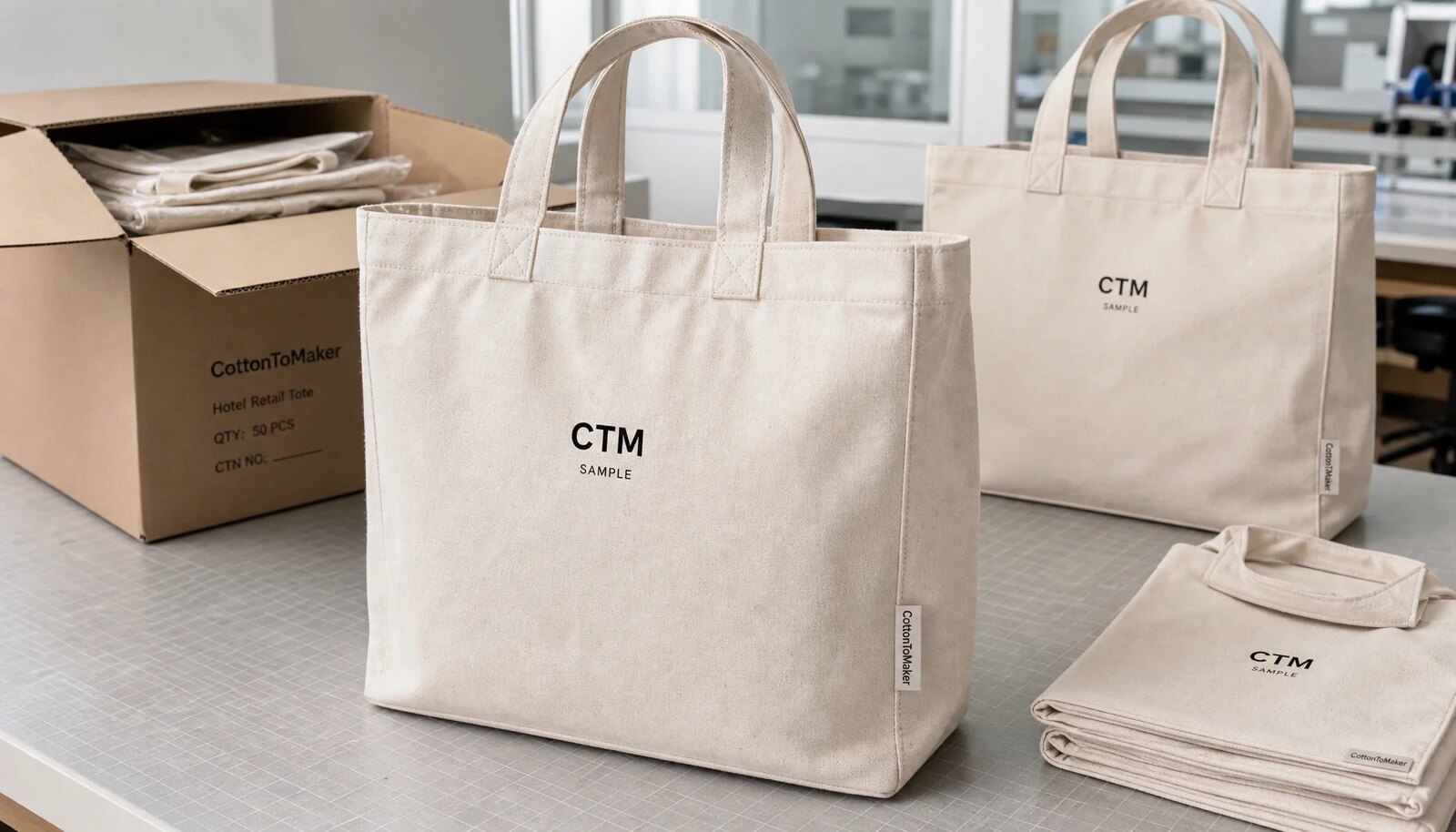
Start With the Carton, Then Judge the Tote
For wholesale canvas grocery totes in hotel retail, carton planning is not an afterthought. It belongs in the product brief. A sample can look perfect on a table and still create problems if it packs poorly, weighs too much per carton, arrives with hard creases across the print, or mixes property-specific SKUs without clear marks.
Hotel retail stock may move through an importer warehouse, a hotel group distribution center, a distributor, or direct-to-property shipments. The same tote might be sold in a gift shop, resort market, spa retail area, lobby pantry, beach store, or destination boutique. That route changes what matters. Carton count, carton size, carton strength, SKU labeling, and packing-list accuracy become part of the sellable unit.
A grocery-style tote also uses more material than a flat convention tote. It has a gusset, more volume, wider handles, and usually heavier canvas. Those choices help guests carry drinks, snacks, towels, books, spa products, local food, and gifts. They also add CBM and gross weight. A 12 oz canvas bag may feel more retail-ready than a 10 oz version, but it can lower pieces per carton and raise freight cost.
The stronger RFQ asks the factory to quote the tote and the shipping unit together: finished size, canvas weight, print, labels, folding method, pieces per carton, carton dimensions, gross weight, net weight, carton CBM, and carton marks. If the carton is too large for a back office, too heavy for property teams, or too unclear for receiving, the savings disappear after the PO is placed.
- Define the selling location: gift shop, resort market, spa retail, destination store, amenity resale, or grocery checkout.
- Set a carton handling target early; many programs work better below roughly 15-22 kg gross weight per carton, subject to buyer policy.
- Request packed-carton dimensions, gross weight, and CBM with the first quotation.
- Compare FOB price together with CBM per 1,000 pieces and estimated freight per sellable bag.
- Ask whether carton data comes from a real packed sample, a prior similar order, or a theoretical estimate.
Turn Retail Intent Into Factory Language
Hotel teams often brief a tote with words like premium, coastal, natural, reusable, boutique, or market-style. Those words help the creative direction, but they do not help a factory cut fabric or an inspector measure output. Procurement needs to translate the idea into finished body width, finished height, gusset depth, handle drop, handle width, fabric GSM, fabric color, print method, print size, print position, label position, folding method, carton count, and carton mark format.
The selling use should be stated plainly. A paid resort market grocery tote needs to carry real merchandise and look credible at checkout. A gift-with-purchase bag may prioritize cost and carton efficiency. A boutique hotel tote may need cleaner internal seams, a woven side label, a hangtag, and tighter print placement. A conference or seasonal retail program may favor shorter lead time and simpler artwork. The use case affects fabric, reinforcement, print, labels, packing, and inspection.
Measurement rules should be written before sampling. Finished dimensions should be measured after sewing and finishing, not estimated from the cutting pattern. Handle drop should be measured from the top edge of the bag to the highest point of the lifted handle. Gusset depth should use the agreed flat or opened method. Print placement should be measured from fixed points, such as the top edge, side seam, bottom fold, or centerline.
Without those definitions, two suppliers can quote two different products while appearing to answer the same RFQ. One may use lighter finished fabric, narrower handles, shallow insertion, or a basic carton. Another may include labels, reinforced handles, and carton marks. The buyer only has a fair comparison when the product, retail presentation, and carton plan are aligned.
- Use finished dimensions, not cutting dimensions, for quote comparison.
- Specify whether measurements are taken flat, opened, or under light tension.
- State the load expectation if the tote must carry bottles, groceries, towels, books, or spa products.
- Confirm whether the retail team wants a soft natural feel, structured shelf presence, or premium heavy canvas.
- Put tolerances in the PO so QC has an objective acceptance basis.
Choose Canvas Weight by GSM and Finish
Canvas grocery totes are often quoted in ounces, but B2B buyers should request GSM too. Ounce weight can mean different things if the supplier refers to greige fabric, finished fabric, dyed fabric, washed fabric, or coated fabric. For hotel retail, a practical range is often 10 oz to 12 oz cotton canvas, approximately 340-410 GSM depending on mill construction and finishing. It gives the tote enough body for paid retail without creating unnecessary freight pressure.
Lighter 8 oz canvas can work for promotional hotel programs, event bags, or short-life retail concepts where cost and shipping efficiency matter more than structure. It may not stand upright well and can feel light for a paid grocery tote unless the brand intentionally wants a relaxed look. A 10 oz tote is often a solid entry retail choice when it has reinforced handles, a clean print, and controlled packing. A 12 oz tote gives stronger handfeel and better structure for resort markets and destination graphics.
Heavier 14 oz or 16 oz canvas can look premium, but it changes the whole order. The buyer should recalculate unit cost, sewing time, needle breakage risk, carton quantity, gross weight, and landed cost before approving it. A heavier sample that photographs beautifully may be less practical once 2,500 pieces need to be stored, shipped, and distributed across multiple properties.
Color also needs discipline. Natural unbleached canvas can include small cotton specks, which are normal for the material, but visible panel-to-panel mismatch can hurt retail presentation. Dyed canvas needs closer control because navy, black, cream, and custom brand colors can shift under different light. Buyers should approve a fabric swatch before the pre-production sample and request a bulk cutting swatch before mass cutting for color-sensitive programs.
If sustainability language will appear on a hangtag or retail sign, match it to documentation. Do not call a tote organic, recycled, undyed, fair trade, or certified unless the supplier provides valid certificates and the PO requires that material. For standard cotton canvas grocery totes, the safer specification is composition, weight, color, and finish.
- Ask for both oz and GSM, with GSM measured on finished fabric unless agreed otherwise.
- Use 8 oz mainly for lighter promotional programs or intentionally casual retail looks.
- Use 10 oz when balancing retail appearance, MOQ flexibility, and freight efficiency.
- Use 12 oz when the hotel retail team wants more structure and stronger handfeel.
- Review carton count and gross weight carefully before approving 14 oz or heavier canvas.
Engineer Size, Gusset, and Handles for Use
A grocery tote is not just a larger flat tote. The gusset creates usable volume, and that volume is the reason guests can carry packaged snacks, drinks, folded apparel, beach items, books, and local food products. A common starting point is about 38 x 40 cm with a 10-12 cm gusset, then adjusted for the hotel’s shelf space, checkout counter, display basket, and merchandise mix.
Small size changes matter more than they seem. A tote that is 2 cm wider, 2 cm taller, and 2 cm deeper may look almost identical in a rendering. In production, it uses more fabric, folds thicker, and may reduce pieces per carton. In 12 oz canvas, those changes can move landed cost. Ask for carton data for the exact finished size, not for a similar bag from a previous order.
Handle design deserves equal attention. Guests may carry the tote by hand, over the shoulder, through an airport, across a resort property, or from a market back to the room. Narrow promotional handles can feel cheap and uncomfortable when the bag is full. For grocery use, 3.5-4 cm self-fabric handles are generally more comfortable than thin tape. The finished handle drop should match the carry style; shoulder carry usually needs a longer drop than hand carry.
The hidden weakness is often handle insertion. A handle caught only in the top hem, with shallow insertion, can look fine in a photo and fail under load. The RFQ should state total handle length, finished handle drop, handle width, insertion depth, reinforcement style, and stitch density target. Box-X stitching, cross-stitch reinforcement, or bar tacks can all work when they are matched to fabric thickness and expected use.
- Quote body size as finished width, height, and gusset depth with stated tolerance.
- Specify handle drop separately from total handle length because measurement habits vary by factory.
- Use 3.5-4 cm handle width for comfortable grocery use unless a narrower design is intentional.
- Define reinforcement as box-X, cross stitch, or bar tack at all four handle points.
- Inspect side gusset and bottom corner construction because those areas carry load when the bag is full.
Lock Print, Labels, and Branding Early
Most hotel retail canvas grocery totes use screen printing because it works well for logos, icons, resort names, destination graphics, and simple retail artwork. Water-based screen print is often a good fit on natural canvas because it keeps a softer handfeel. Heavier ink systems may improve opacity on dark fabric, but large ink areas can stiffen the panel. Heat transfer can handle gradients or photographic artwork, but buyers should approve handfeel, edge appearance, wash expectation, and rub performance before using it for a paid retail tote.
Artwork should be production-ready, not just attractive. Thin lines, small type, large solid blocks, and artwork close to seams increase manufacturing risk. For screen print, send vector files with Pantone or approved color references, final print size, and measured placement. Instead of writing “center front logo,” state the distance from the top edge, side seam, or centerline. A placement tolerance such as +/-0.5 cm gives the inspector something measurable.
Ask the factory to confirm minimum line width and registration tolerance on the actual canvas. Texture can break fine details, especially on natural slub or heavier weave fabrics. As a practical starting point, lines below about 0.3 mm should be reviewed carefully, and small reversed-out type should be tested before bulk printing. Multi-color prints need registration checks on canvas, not only on paper artwork.
Branding components beyond the main print also affect pricing and packing. A woven side label can raise perceived retail value, but it has its own MOQ, fold type, seam location, and orientation. A hangtag can carry barcode and story copy, but it adds labor and can bend in tight cartons. A belly band can improve shelf presentation but increases packed volume and may cover artwork if sized poorly. Price and sample these components with the tote, not after production.
- Use vector artwork for screen printing and list each Pantone or approved color standard.
- Confirm minimum line width, registration tolerance, and print placement tolerance before strike-off approval.
- Avoid large heavy ink blocks unless the buyer approves a stiffer print panel.
- Approve a strike-off or printed panel before bulk production, especially for dark canvas or multi-color artwork.
- Specify woven label size, fold type, seam location, orientation, and distance from the top or side seam.
Build MOQ Around Real Cost Drivers
MOQ for wholesale canvas grocery totes is not one universal number. It depends on fabric availability, dye batch minimums, cutting efficiency, print setup, label production, retail packing labor, and carton efficiency. Natural canvas usually gives more flexibility because standard fabric may already be available. Custom dyed canvas, woven labels, multi-color printing, belly bands, and property-specific packing usually push MOQ and setup cost higher.
Buyers should ask for tiered pricing instead of one MOQ. Practical tiers might be 500, 1,000, 2,500, and 5,000 pieces using the same specification. The supplier should separate fixed setup charges from unit price so procurement can see what improves with volume. Sometimes the lower price simply spreads screen charges, sample costs, or label setup over more units; sometimes it reflects better cutting and carton efficiency.
Carton logic should be included at each tier. A trial order may create partial cartons or awkward property allocations. A larger run may allow full-carton distribution by hotel, which reduces counting and repacking. If a carton holds 80 pieces and each property needs 160 pieces, allocation is clean. If each property needs 125 pieces, the warehouse must split cartons unless the order quantity or carton count changes.
Low MOQ is useful when testing a hotel retail line, but it can hide risk. A supplier may use available fabric that is close but not identical to the approved canvas, combine fabric lots, substitute a label, or pack odd quantities. Procurement should weigh MOQ against sell-through forecast, replenishment plan, property allocation, and the supplier’s ability to repeat the same specification later.
- Ask for tiered prices at practical quantities instead of accepting one MOQ and one unit price.
- Separate screen setup, sample fee, label fee, hangtag fee, barcode labor, and carton cost from the base bag cost.
- Confirm whether fabric comes from stock, a new mill run, or a dye batch made for the order.
- Check whether lower MOQ changes fabric shade, label type, print method, or packing format.
- Align order quantity with property allocations so hotels receive full cartons whenever possible.
Compare Quotes by Landed Sellable Cost
A low FOB price can be misleading for canvas grocery totes. These bags are bulky compared with many textile accessories, so carton efficiency has a real effect on landed cost. If one supplier packs 80 pieces per carton and another packs 50, the second offer may cost more to ship, store, and handle even when the FOB unit price looks similar. Ask for carton dimensions, gross weight, net weight, and CBM per carton, then calculate CBM per 1,000 pieces.
Every quote should state what is included. Some suppliers include export cartons but exclude hangtags, barcode stickers, individual polybags, property allocation labels, or special carton marks. Others quote basic folded bulk packing and add charges later for belly bands, recycled paper wraps, carton label printing, or repacking labor. These costs matter when an order is divided among several hotel properties.
A strong comparison sheet records the assumptions behind each price: canvas weight, finished size, gusset, handle construction, print colors, print area, labels, packing method, carton quantity, sample requirements, lead time, payment terms, inspection access, and inland freight. Without those assumptions, a cheaper quote may simply be a different tote.
Procurement should also be clear about the unit being compared. The factory unit is the sewn bag. The retail unit may include a hangtag, barcode, belly band, folded presentation, and SKU label. The landed sellable unit includes freight, duty, clearance, inland delivery, inspection, and any relabeling or repacking. For hotel retail buying, the landed sellable bag is the number that matters.
- Calculate landed cost per sellable bag instead of comparing FOB unit price only.
- Use pieces per carton, carton CBM, and gross weight to estimate freight and handling impact.
- Include retail finishing cost for hangtags, barcode stickers, woven labels, belly bands, polybags, and carton labels.
- Confirm whether carton marks, SKU labels, PO numbers, and property allocation labels are included.
- Reject quote comparisons where suppliers are not pricing the same GSM, size, reinforcement, print, and packing method.
Approve Samples as Evidence, Not Decoration
A pre-production sample is necessary, but it should not be treated as a photo prop. For hotel retail shipping carton planning, buyers need to approve the tote, the print, the label set, and the folded packing method. A canvas grocery tote can be folded several ways, and the fold affects carton height, print creasing, hangtag visibility, barcode access, and how staff removes the bag for display.
A practical approval set includes a fabric swatch, print strike-off, finished tote sample, label sample, folded packing sample, and carton mark artwork. If timing allows, request a first-carton photo or a small carton trial before mass packing. The photo should show bag orientation, quantity per carton, label direction, carton sealing, and whether carton marks match the PO.
Sample approval should be measurable. Check finished width, height, gusset depth, handle drop, handle width, print size, print placement, top hem width, label position, and folded dimensions. Weigh the sample. Compare handfeel against the approved swatch. Check odor, loose threads, seam finish, handle reinforcement, and print cure before the bags are folded tightly.
Keep physical references for inspection. One sealed approved production sample, one fabric swatch, one print strike-off, one label set, and one folded packing sample should be retained. If the factory, buyer, and inspector work from different references, disputes become harder to solve. The approved sample is a production control tool, not just a design signoff.
- Approve fabric swatch before sample sewing when color, GSM, or handfeel matters.
- Approve print strike-off before mass printing when color, line width, opacity, or registration is critical.
- Approve finished tote sample for size, handle construction, seam finish, print placement, and retail appearance.
- Approve folded packing sample so carton count, crease position, and label visibility are controlled.
- Approve carton mark and retail label files before bulk packing starts.
Set Packing Rules for Hotel Distribution
Hotel retail distribution often has more than one receiving point. Goods may move through an importer warehouse, hotel group distribution center, distributor facility, or direct-to-property route. Each path needs clear carton marks and predictable quantities. Bulk folded packing may work when staff will store totes under a counter or in a back room. Shelf display may require hangtags, barcode stickers, belly bands, or a retail-facing fold.
Export cartons should protect the bags without wasting freight. If packed too tightly, canvas totes may arrive with deep creases, distorted handles, or ink blocking when prints press together before fully cured. If packed too loosely, cartons waste CBM and may crush. For many grocery-style canvas totes, 50-100 pieces per export carton can be realistic depending on fabric weight, size, gusset depth, individual packing, and carton strength. The final number should come from a real packed sample or production trial.
Carton gross weight should be controlled. Very heavy cartons increase damage risk and make receiving harder for property teams. Many buyers prefer a manageable range such as 15-22 kg gross weight, but the correct limit depends on warehouse policy, destination rules, and handling method. If a 12 oz or 14 oz tote pushes cartons above the target, the supplier may need fewer pieces per carton, stronger cartons, or a revised tote specification.
For multi-property orders, the packing plan should state whether cartons are packed by SKU, by property allocation, or as one master shipment for later distribution. Mixed prints or mixed property labels inside one carton can create receiving errors. Full-carton allocation is usually cleaner, but it only works when order quantities match carton counts.
- Use one approved folding direction so print panels, labels, and hangtags face the intended way when unpacked.
- Set maximum carton gross weight based on warehouse and property handling requirements.
- Confirm carton ply, carton dimensions, moisture protection, sealing method, and strap requirements if used.
- Define carton marks with item code, SKU, quantity, color, PO number, destination, gross weight, net weight, and carton number.
- For multi-property orders, decide whether cartons are single-SKU, property-specific, or mixed only with a clear packing list.
Write QC Standards Inspectors Can Use
Quality control for canvas grocery totes should be written in inspection language. “Good stitching” is not enough. The PO or inspection file should state finished size tolerance, stitch density target, handle reinforcement method, print placement tolerance, label position tolerance, acceptable thread trimming, carton count, carton mark requirements, and defect classification. Inspectors need objective checkpoints that match the approved sample.
The most common failures are predictable. Handles may be twisted, uneven, shallowly inserted, or under-reinforced. Gusset corners may have skipped stitches where several fabric layers meet. Prints may drift if panels are not aligned before printing. Barcode labels may be crooked, placed over artwork, or mixed between SKUs. These issues are easier to correct during production than after all goods are packed.
The inspection plan should define critical, major, and minor defects before the inspector arrives. Critical defects may include safety hazards, contamination, mold, or wrong material where compliance is affected. Major defects may include wrong size outside tolerance, weak handle reinforcement, incorrect print color, poor ink adhesion, wrong SKU label, missing barcode, or incorrect carton quantity. Minor defects may include small loose threads or slight cosmetic variation within the approved range.
Final inspection should include packed cartons, not only loose sewing-line samples. Random cartons should be opened to verify count, folding direction, moisture condition, odor, print blocking, retail label placement, barcode accuracy, and carton marks. For hotel retail, a bag that is sewn correctly but packed under the wrong SKU or property label is still a commercial defect.
- Measure finished width, height, gusset, handle drop, handle width, print size, and print position against the approved sample.
- Inspect handle reinforcement for skipped stitches, loose threads, short insertion, broken thread, needle damage, and inconsistent placement.
- Check print adhesion with dry rub, hand-scratch, and visual transfer checks before goods are packed.
- Open random cartons to confirm quantity, folding direction, SKU, barcode, hangtag, carton mark, odor, and moisture condition.
- Classify critical, major, and minor defects before inspection so supplier and buyer share the same acceptance logic.
Specification comparison for buyers
| Spec decision | Recommended option | When it fits | Buyer risk to check |
|---|---|---|---|
| Canvas weight | 10 oz to 12 oz cotton canvas, approximately 340-410 GSM, confirmed on finished fabric swatch | Paid hotel gift shop totes, resort market grocery bags, boutique retail programs, and reusable guest purchase bags needing structure without excessive freight | Quotes that list only oz, omit GSM, or do not state whether weight is greige, finished, dyed, washed, or coated fabric |
| Finished bag size | Grocery format around 38 x 40 x 12 cm gusset, with buyer-approved tolerance of +/-1 cm on body and +/-0.5 cm on gusset where practical | Checkout retail bags for snacks, beverages, towels, books, spa products, local food, or destination merchandise | Oversized samples that photograph well but reduce carton count, increase CBM, and create storage problems at hotel properties |
| Handle construction | Self-fabric handles 3.5-4 cm wide, defined handle drop, 3-5 cm insertion depth, and box-X, cross-stitch, or bar-tack reinforcement | Reusable grocery loading, airport carry, resort market purchases, and guest room carryout where comfort and failure prevention matter | Thin promotional handles, shallow insertion, weak tack stitches, inconsistent stitch density, or handles captured only in the top hem |
| Stitching and seams | Overlocked inner seams, folded top hem, 7-9 stitches per inch as a typical target, and reinforced high-stress gusset corners | Standard hotel retail totes requiring durability, consistent appearance, and reasonable production cost | Raw seam edges, skipped stitches at thick intersections, loose thread nests, uneven top hem width, or seam puckering after folding |
| Print method | Water-based screen print for 1-3 solid colors; plastisol or discharge only if approved; heat transfer for gradients or photographic artwork after durability review | Hotel logos, resort icons, destination graphics, market branding, and simple retail artwork on natural or dyed canvas | Fine lines below factory capability, poor opacity on dark fabric, stiff ink coverage, weak rub resistance, or placement checked visually instead of measured |
| Retail labeling | Barcode sticker, hangtag, belly band, woven label, care label, or bulk-only packing locked before pre-production sample | POS scanning, property-specific SKUs, gift shop display, multi-location allocation, and repeat hotel retail replenishment | Late label changes that trigger repacking, cover artwork, change carton volume, confuse SKU receiving, or require unplanned labor |
| Packing method | Flat folded in one approved direction, usually 50-100 pieces per export carton depending on GSM, gusset, label format, and carton strength | Hotel retail replenishment where cartons must be countable, stackable, scannable, and easy for property teams to receive | Carton plans based on theoretical counts instead of real packed dimensions, gross weight, compression, crease position, and label visibility |
| Carton specification | 5-ply export carton where needed, defined inner protection, carton marks, carton number, quantity, net weight, gross weight, and CBM per carton | Importer warehouse receiving, hotel group distribution centers, distributor fulfillment, and direct-to-property shipments | Weak cartons, missing carton marks, excessive gross weight, mixed SKUs without packing list, or carton labels not matching purchase order data |
| MOQ and tier pricing | MOQ tied to fabric availability, dye batch, print setup, label components, packing labor, and full-carton allocation | Buyers testing a hotel retail line before committing to repeat multi-property replenishment | Low MOQ quotes that hide substituted fabric, mixed lots, higher setup cost, odd carton quantities, or unapproved packaging simplification |
Buyer checklist before sampling
- Define finished bag width, height, gusset depth, handle drop, handle width, canvas GSM, fabric color, print method, label format, and carton target before comparing supplier quotations.
- State the selling use clearly: paid hotel retail, resort market grocery tote, guest amenity resale, conference retail item, gift-with-purchase, or property-specific merchandise.
- Request the same tote quoted in at least two fabric weights, such as 10 oz and 12 oz, with carton dimensions, pieces per carton, gross weight, and CBM for each option.
- Use finished fabric GSM and approved swatches, not only supplier-stated ounce weight, because fabric finishing, dyeing, and washing can change weight and handfeel.
- Set measurable tolerances: typical starting points are +/-1 cm for body width and height, +/-0.5 cm for gusset and handle width, and +/-0.5 cm for print placement unless the design needs tighter control.
- Send vector artwork with Pantone or approved color references, print size, print position from fixed seams or top edge, color count, and minimum line-width requirements.
- Require handle construction details: total handle length, finished drop, insertion depth, reinforcement style, stitch density target, thread type, and acceptable load or pull test method.
- Confirm whether each bag needs a barcode sticker, hangtag, belly band, woven label, care label, inner polybag, recycled paper wrap, or only folded bulk packing.
- Request a packed-carton proposal showing pieces per carton, carton length, width, height, net weight, gross weight, carton ply, carton mark layout, and estimated CBM per 1,000 pieces.
- Compare supplier offers using landed cost per sellable bag, including print setup, labels, packing labor, carton CBM, freight, duty, inspection, inland transport, and repacking risk.
Factory quote questions to send
- What is the exact canvas weight in oz and GSM, and is the GSM measured on greige fabric, finished fabric, dyed fabric, washed fabric, or coated fabric?
- What fabric composition, weave, yarn count if available, fabric width, shrinkage allowance, and cutting loss are included in the quoted price for this gusseted grocery tote?
- Can you quote the same finished tote in 10 oz, 12 oz, and 14 oz canvas, including pieces per carton, carton dimensions, gross weight, net weight, and CBM for each option?
- What is the minimum order quantity for natural canvas, dyed canvas, printed panels, woven labels, hangtags, barcode labels, belly bands, and any custom retail packaging components?
- Which print method do you recommend for our artwork, and what are your minimum line width, registration tolerance, Pantone tolerance, dry rub, wet rub, and hand-scratch acceptance limits?
- How will the handles be reinforced, what is the handle insertion depth, what stitch type is used, and what pull or load test can your factory perform before shipment?
- What stitch density, seam type, thread type, top hem width, gusset corner treatment, and inner seam finishing will be used for the production version?
- How many pieces will be packed per export carton, and what are the estimated carton size, carton ply, net weight, gross weight, carton CBM, and CBM per 1,000 pieces?
- Is your carton plan based on a real packed sample, a previous similar production run, or a theoretical estimate from unfolded product dimensions?
- Can you provide a pre-production sample, fabric swatch, print strike-off, label sample, folded packing sample, carton mark proof, and photo of the first packed export carton?
Quality-control points to confirm
- Finished size tolerance should be stated in the purchase order; a practical starting point is +/-1 cm for body width and height, +/-0.5 cm for gusset depth, and +/-0.5 cm for handle width unless the design requires tighter control.
- Canvas GSM should be checked against the approved finished material sample because major variation changes stiffness, sewing performance, carton count, gross weight, and perceived retail value.
- Fabric shade should be compared to the approved swatch under consistent light; natural canvas can contain cotton specks, but visible panel-to-panel mismatch or mixed fabric lots should be classified before production.
- Handle attachment should match the approved reinforcement method with no skipped stitches, loose threads, short insertion, needle cuts, twisted handles, or unequal handle drops.
- Stitch density, seam allowance, top hem width, inner overlock, and gusset corner construction should be checked at sewing-line stage before all goods are packed.
- Print placement should be measured from fixed points such as the top edge, side seam, bottom fold, or centerline, not judged only by visual centering.
- Ink adhesion should pass dry rub, hand-scratch, and transfer checks before bulk packing, especially on dark dyed canvas, high-coverage artwork, or heat transfer prints.
- Seams around gusset corners should be inspected carefully because grocery tote failures often begin where side panel, bottom panel, and gusset layers meet under load.
- Barcode labels, hangtags, woven labels, care labels, and belly bands should match the approved SKU file and should not cover artwork, legal information, or important branding.
- Carton count should be verified by opening random packed cartons; quantity errors, mixed SKUs, wrong carton marks, and missing labels are commercial defects for hotel retail distribution.