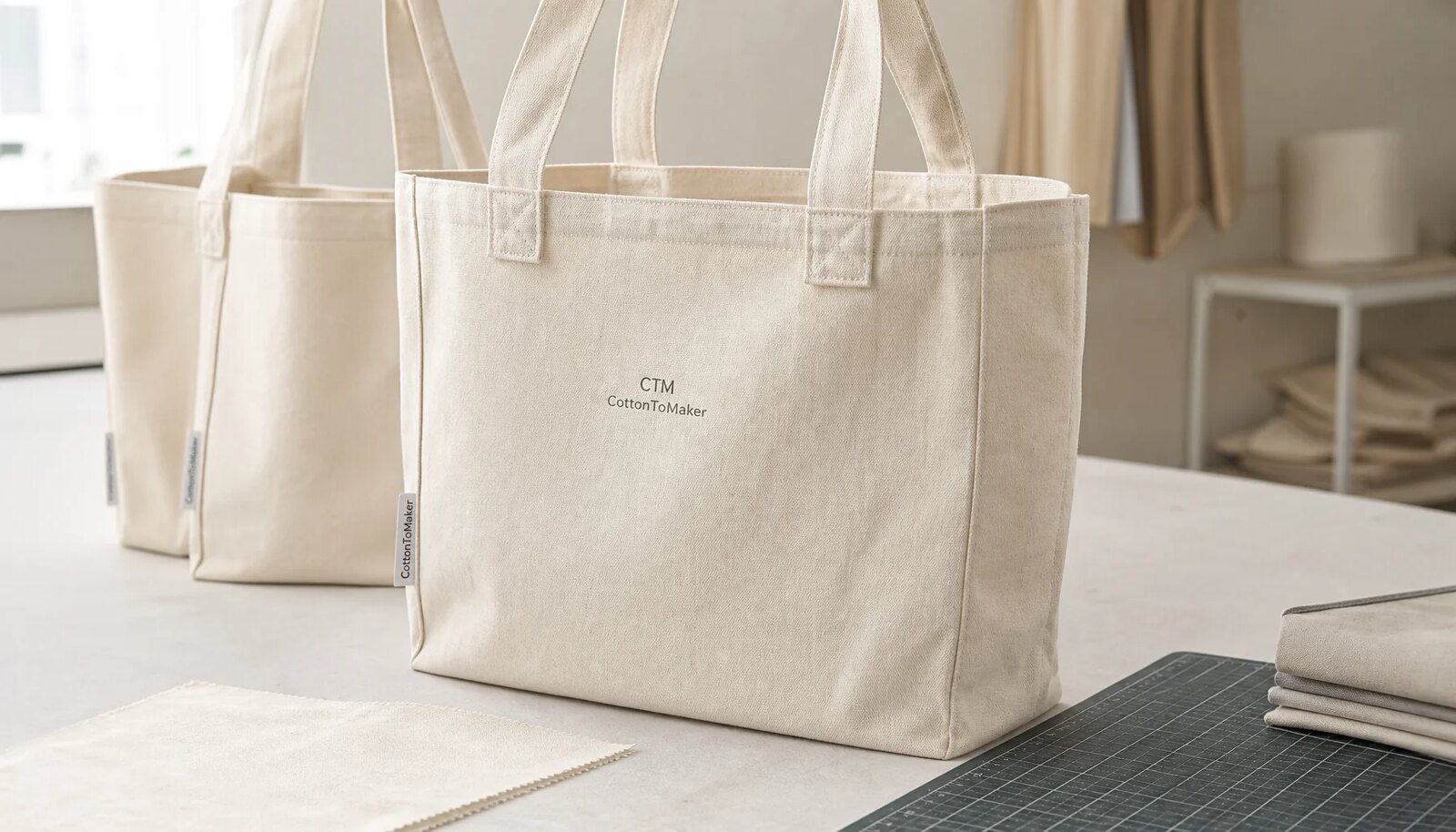
Start With the Retail Job, Not the Catalog Style
Wholesale canvas grocery totes for hotel retail usually fail at the specification stage, not at the sewing line. A tote sold in a lobby market, resort boutique, spa shop, or destination gift store has to do more than carry groceries. It must look structured on a shelf, feel strong in the guest's hand, print the hotel identity cleanly, and survive real use after checkout. A catalog photo cannot tell the factory how much weight the bag should carry, how stiff the fabric should feel, or how the bottom should stand when packed.
Before sending an RFQ, define the selling situation. A tote sold as a premium souvenir can justify heavier canvas, a woven side label, and a cleaner finish. A tote bundled with amenities may need tighter cost control, simpler printing, and compact carton packing. A distributor shipping to multiple hotel properties may need SKU separation, carton marks, and barcode handling. These decisions change the quote more than most buyers expect.
- For resale shelves, prioritize structured gusset, clean print, and consistent folding.
- For amenity giveaways, prioritize price stability, fast packing, and simple artwork.
- For resort grocery use, prioritize handle strength, bottom capacity, and stain control.
- For multi-property distribution, prioritize carton labeling, SKU separation, and repeatable specs.
Choose Canvas Weight by Performance and Margin
Canvas grocery totes are commonly quoted in ounces, but many factories also work internally by GSM. For hotel retail, 10 oz to 12 oz cotton canvas, roughly 340 to 407 GSM, is a practical range for a sturdy reusable grocery tote. An 8 oz canvas can work for light shopping or promotional retail, but it may feel thin when guests compare it with a paid merchandise item. A 14 oz canvas gives a premium hand feel, but it increases unit cost, carton weight, sewing difficulty, and sometimes print stiffness.
The key is to quote fabric weight with tolerance and construction together. A 10 oz canvas with boxed bottom, reinforced top hem, and good handle stitching can perform better than a heavier flat tote with weak seams. Natural cotton canvas is normally more economical than dyed canvas, but natural shade variation is real. If the hotel brand requires a precise cream, black, navy, or custom color, custom dyeing can raise MOQ and lead time.
- Use 8 oz canvas for budget retail or light amenity bags where load is limited.
- Use 10 oz to 12 oz canvas for most hotel grocery totes sold as reusable retail items.
- Use 14 oz canvas only when premium feel is worth higher cost and freight weight.
- Specify GSM tolerance, fabric color, shrinkage expectations, and approved swatch reference.
Lock the Bag Shape Before Comparing Prices
Two suppliers can quote the same nominal size and still deliver very different bags. A 38 x 40 cm flat tote is not the same product as a 38 x 35 x 12 cm grocery tote with boxed bottom. The gusset increases fabric consumption, sewing time, carton volume, and usable capacity. For hotel retail, the gusset is often what makes the bag feel like a grocery tote instead of a basic conference bag.
Dimensions should be written as finished size, not cutting size. Include width, height, gusset depth, handle drop, handle width, and top hem depth. If the bag needs to hold folded towels, packaged snacks, wine bottles, spa products, or guidebooks, test the sample with those items. A tote that photographs well may still tip over, drag on the floor, or pull the handles into an uncomfortable position when filled.
- Common retail size: about 38 cm wide x 35-40 cm high x 10-12 cm gusset.
- Handle drop of 25-30 cm usually works for shoulder carry, depending on market preference.
- Top hem reinforcement improves the bag mouth shape and reduces edge distortion.
- Boxed corners improve capacity but need clean sewing to avoid twisted bottoms.
Match Print Method to Hotel Artwork
Most hotel retail canvas grocery totes use screen printing because it is cost-effective, durable, and clean for simple logos, destination names, maps, and line artwork. Water-based screen print gives a softer hand feel than heavy plastisol-style ink and is suitable for natural canvas when the artwork is not too detailed. For large solid coverage, the print can stiffen the fabric, so the strike-off should be judged for both appearance and hand feel.
Heat transfer may be useful for full-color artwork, gradients, or photographic designs, but it changes the surface feel and must be tested for edge lifting, cracking, and wash or rub resistance. Embroidery is less common for grocery totes because it adds cost and may pucker on lighter canvas, but it can work for a small premium logo. Woven side labels are a good option when the hotel wants branding without a large front print.
- Screen print fits 1-3 color logos, clean typography, and repeat resort graphics.
- Heat transfer fits detailed full-color artwork but needs adhesion and rub testing.
- Embroidery fits small premium marks, not large grocery tote graphics.
- Woven labels add retail finish and help when the main bag print changes seasonally.
Understand MOQ Logic Before Negotiating
MOQ for canvas grocery totes is not a single number. It depends on fabric availability, color, bag size, print setup, sewing line efficiency, and packing requirements. A factory may accept 300 pieces for a simple natural canvas tote using stock fabric, but custom dyed canvas, mixed sizes, multiple print designs, or special labels can push the practical MOQ higher. If the buyer only negotiates the headline MOQ, the final quote may come back with hidden setup charges or limited options.
For hotel retail, it is often better to build MOQ scenarios. Quote 500, 1,000, and 3,000 pieces with the same specification and artwork. Then quote the same quantity with two fabric colors or two print designs if needed. This exposes the real cost drivers. A small order with one print color may be economical, while the same quantity split across four hotel properties can become inefficient because each SKU needs separate setup, counting, packing, and inspection.
- Separate total order MOQ from per-color, per-size, and per-design MOQ.
- Ask whether stock natural canvas reduces MOQ compared with dyed canvas.
- Clarify if repeat orders can use stored screens or require new setup charges.
- Avoid splitting a small first order into too many property-specific designs.
Use Samples to Prevent Bulk Production Errors
A proper sampling sequence saves money. Start with fabric swatches if color, GSM, or hand feel matters. Then review a blank sample for size, construction, gusset, handle, and sewing quality. After that, approve a print strike-off or logo panel to judge color, edge sharpness, ink coverage, and print hand feel. The final pre-production sample should combine the approved fabric, construction, print, label, and packing details.
Do not approve a photo-only sample for hotel retail unless the order is very simple and risk is low. Photos can hide fabric thinness, handle comfort, print stiffness, odor, and sewing distortion. If the tote will be sold, the sample should be handled like a customer would handle it: fill it, carry it, fold it, place it on a shelf, and compare it against the target retail price. Keep one signed sample with the buyer and one with the factory.
- Swatch approval controls fabric shade, GSM, weave, and finishing feel.
- Blank sample approval controls size, gusset, handles, stitching, and capacity.
- Print strike-off controls logo color, ink coverage, edge clarity, and hand feel.
- Pre-production sample approval becomes the standard for bulk inspection.
Define QC Thresholds in Buyer Language
Canvas totes are simple products, but inspection disputes happen when defects are not defined. For hotel retail, major defects should include open seams, broken handle stitches, severe stains, wrong fabric shade, incorrect dimensions beyond tolerance, misprinted logos, sharp objects, mildew odor, and carton mix-ups. Minor defects may include small loose threads, slight creasing, or small slubs within the approved fabric character. Natural canvas can have small cotton seed specks, so decide early whether they are acceptable.
AQL 2.5 for major defects and 4.0 for minor defects is a common practical starting point, but the inspection checklist must match the product. Include measurement points, print position tolerance, acceptable shade variation, seam strength expectations, and packing checks. A load test should be realistic. If the tote is expected to carry groceries and retail goods, define a test weight and duration that the factory can repeat before shipment.
- Classify wrong logo, wrong size, broken handle, and heavy stain as major defects.
- Set print position tolerance, for example plus or minus 5 mm from approved placement.
- Use an agreed load test, such as a defined weight held for a defined time.
- Include carton count, SKU separation, and retail label checks in final inspection.
Control Packing Before It Changes Landed Cost
Packing is often treated as an afterthought, but it affects cost, freight, warehouse handling, and retail readiness. Flat bulk packing is economical and works well for many hotel retail totes, especially if the warehouse will add hangtags or allocate goods to properties. Individual polybags protect the bag from dirt but add material cost, labor, plastic compliance questions, and extra unpacking time. For some markets, a paper belly band or hangtag may be more suitable than a polybag.
Carton size and packing density should be included in the quote. Heavier canvas and boxed bottoms increase carton volume. If cartons are overpacked, the totes may arrive with hard creases, distorted gussets, or print transfer. If cartons are underpacked, freight cost per piece rises. Buyers should request pieces per carton, carton dimensions, gross weight, net weight, and estimated CBM per 1,000 pieces before comparing supplier prices.
- Use flat bulk packing when cost and warehouse efficiency matter most.
- Use individual polybags only when cleanliness, retail handling, or distributor rules require it.
- Add hangtags, barcodes, or belly bands only after confirming labor and packing impact.
- Require carton marks showing PO, SKU, color, quantity, gross weight, and destination if needed.
Build Lead Time Around Approval Gates
A realistic schedule starts after artwork, fabric, and construction are approved, not when the first inquiry is sent. For a repeat natural canvas tote with simple screen print, production can be much faster than a custom dyed, multi-SKU program with labels and retail packaging. The risk points are usually artwork revision, fabric procurement, sample courier time, print strike-off approval, bulk cutting, and final inspection booking.
Hotel retail buyers should map the schedule backward from the in-store date. If the tote supports a hotel opening, seasonal resort campaign, or cruise retail program, build in approval buffers. Late changes to logo size or color can be more damaging than buyers expect. Once fabric is cut, changing dimensions is difficult. Once screens are made, changing artwork can create new setup cost. Once goods are packed, changing carton marks or barcode labels creates rework.
- Freeze dimensions before bulk cutting to avoid scrap and sewing delays.
- Freeze artwork before screen making to avoid setup charges and lost days.
- Approve packing before carton production if custom marks or labels are required.
- Book inspection after the factory confirms goods are packed, not just sewn.
Compare Quotes With the Same Data Set
A unit price alone is not enough for wholesale buying. A complete quote should state fabric weight, finished size, handle construction, print method, print colors, packing method, pieces per carton, carton CBM, sample cost, screen charge, MOQ, lead time, payment terms, and trade term. Without this information, a low price can simply mean lighter canvas, smaller gusset, shorter handle, fewer print colors, weaker packing, or excluded setup charges.
For landed-cost comparison, use the same shipping assumption for each supplier. Canvas totes are not extremely dense, so carton volume can matter as much as gross weight. A bag that is slightly cheaper but packed with poor carton efficiency may lose its advantage after freight. For retail resale, also compare defect risk and presentation quality. A higher unit price may protect margin if it reduces rejects, rework, and customer returns.
- Compare EXW and FOB separately so inland cost is visible.
- List screen charges and sample charges outside the unit price when comparing quotes.
- Calculate carton CBM per 1,000 pieces for freight planning.
- Review cost impact of fabric weight, gusset depth, print area, label, and packing.
Specification comparison for buyers
| Spec decision | Recommended option | When it fits | Buyer risk to check |
|---|---|---|---|
| Fabric weight | 10 oz to 12 oz cotton canvas, roughly 340-407 GSM | Hotel retail grocery totes, resort markets, boutique gift shops, and amenity stores needing a sturdy reusable bag | Some suppliers quote lower GSM canvas under the same ounce name; require actual GSM tolerance and pre-production swatch approval |
| Bag structure | Boxed bottom with 8-12 cm gusset and reinforced top hem | Retail shoppers carrying towels, packaged food, wine, books, or souvenirs without the bag collapsing | Flat totes may look cheaper in quotes but reduce usable capacity and retail shelf appeal |
| Handle construction | Self-fabric or cotton webbing handles with cross-stitch reinforcement | Higher perceived value and better load performance for hotel retail resale | Handle length and stitch pattern must be specified; weak bar tacks can fail during load testing |
| Print method | Water-based screen print for 1-3 solid colors; heat transfer only for complex gradients | Clean hotel logos, destination graphics, simple resort branding, and repeat seasonal runs | Large ink coverage can stiffen canvas; request a print strike-off and rub test before bulk printing |
| MOQ logic | Start from fabric availability and print setup, not only the supplier's catalog MOQ | Buyers comparing 500, 1,000, 3,000, or mixed-color order scenarios | A low MOQ quote may hide higher unit cost, limited color choice, or no pre-production sample |
| Packing format | Flat pack by carton with inner polybag optional, carton marks by SKU and PO | Distribution to hotel properties, retail warehouses, or regional distributors | Individual polybags add cost and plastic compliance issues; carton compression can deform boxed bottoms |
| QC threshold | AQL 2.5 for major defects and 4.0 for minor defects, with defined visual limits | Importers needing a practical inspection standard before shipment release | If tolerance is not written, inspectors and factories may disagree on stains, print position, and loose threads |
| Lead time planning | Approve sample and artwork before booking fabric dyeing or bulk cutting | Seasonal hotel openings, resort campaigns, and retail launch windows | Late artwork changes after cutting can create rework, shade mismatch, or air freight pressure |
| Quote comparison | Compare EXW, FOB, packing, sample, mold or screen, inland cost, and carton CBM | Procurement teams building landed cost and margin for resale | The lowest unit price may lose after adding screens, inner packing, carton volume, and inspection rework |
Buyer checklist before sampling
- Define intended retail use: grocery shopping, beach shop, amenity sale, event merchandise, or hotel gift store resale.
- State bag dimensions as width x height x gusset, and include acceptable tolerance such as plus or minus 1 cm after sewing.
- Specify fabric as cotton canvas with weight in oz and GSM, and require shrinkage and colorfastness expectations if washing is possible.
- Confirm natural, bleached, dyed, or custom Pantone fabric before comparing prices.
- Choose handle type, handle length, webbing width, and reinforcement stitch pattern based on expected carrying weight.
- Select print method by artwork: screen print for solid logos, heat transfer for detailed graphics, embroidery or woven label for premium trims.
- Provide artwork size, print position, number of colors, Pantone references, and whether the design prints on one side or both sides.
- Request fabric swatch, blank sample, and print strike-off before approving a pre-production sample.
- Set load test target, print rub test expectation, seam strength checks, and acceptable visual defect limits.
- Clarify MOQ by total quantity, color, size, and print design, not just by bag style.
Factory quote questions to send
- What is the exact fabric composition, canvas ounce weight, GSM range, and weight tolerance you are quoting?
- Is the fabric stock greige, stock dyed, or custom dyed, and how does that affect MOQ and lead time?
- What are the finished bag dimensions, gusset construction, handle length, handle width, and sewing tolerance included in the price?
- Which print method are you quoting, how many colors are included, and what is the maximum print area before the price changes?
- Are screen charges, artwork adjustment, strike-off samples, and pre-production samples included or listed separately?
- What is the MOQ by bag size, fabric color, print design, and shipment lot?
- What load test weight do you recommend for this construction, and can you perform it before shipment?
- What AQL level do you support for final inspection, and which defects do you classify as major for canvas grocery totes?
- How many pieces fit per export carton, what is the carton size and gross weight, and what is the estimated CBM per 1,000 pieces?
- Can you quote EXW and FOB separately, including inland freight to port, export carton cost, and document charges where applicable?
Quality-control points to confirm
- Finished dimensions should match the approved spec within the agreed tolerance, measured after sewing and pressing.
- Fabric weight should be verified against the approved swatch, with obvious thin panels or mixed lots treated as major defects.
- Handle attachment should survive the agreed load test without seam tearing, broken stitches, or fabric distortion beyond the approved sample.
- Print color should match approved Pantone or strike-off under standard light, with no visible pinholes, cracking, ghosting, or off-position print beyond tolerance.
- Top hem, side seams, bottom gusset, and corner stitching should be straight, locked, and free from open seams or skipped stitches.
- Stains, oil marks, mildew odor, heavy creasing, and mixed fabric shades should be classified before inspection so disputes are avoided.
- Needle holes, loose threads, and frayed edges should be controlled according to approved sample quality, not left to subjective judgment.
- Cartons should be clean, dry, export strength, correctly marked, and packed to prevent handle deformation or print transfer.
- Barcode, hangtag, care label, side label, and retail label placement should match the signed sample and packing instruction.
- Final inspection should include carton count, random measurement, print rub check, packing verification, and photo records of key defects.