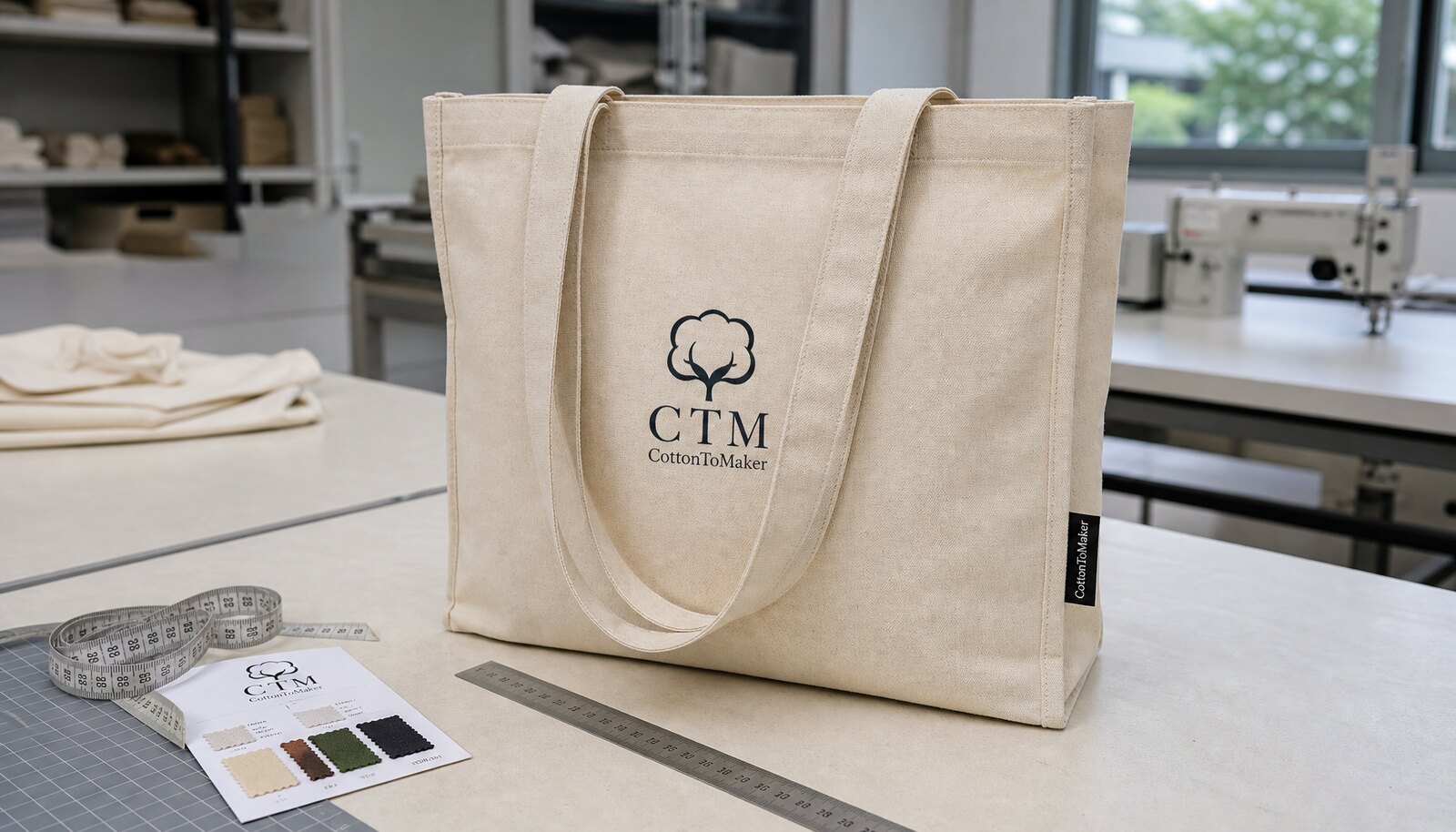
Start With the Shelf, Not the Mockup
Wholesale canvas grocery totes for gift shops are sold as retail items, not as blank decoration surfaces. The buyer is not only approving artwork. The buyer is also approving a product that has to hold shape on a shelf, survive handling by customers, and still look clean after it is unpacked, folded, and restocked. That is why the first sourcing step is not the logo file. It is the selling context: souvenir add-on, reusable checkout bag, seasonal impulse buy, or premium carry item.
Gift shops usually have tighter shelf-space and slower replenishment than mass-market channels, so the tote has to do more work per facing. A bag that looks good flat in a render can fail in-store if it slouches, wrinkles badly, or folds into an awkward stack. A bag that is too heavy may feel premium, but it can also push the retail price beyond what the shop will carry. Define the use case first, then ask suppliers to quote against that use case instead of guessing from the art alone.
- Decide whether the tote is a checkout add-on, a peg-hook impulse item, or a higher-ticket retail SKU.
- State the expected carry load and the shelf format before asking for a quote.
- Specify whether the bag must stack flat, hang cleanly, or stand upright for display.
Choose Canvas Weight and Construction First
Canvas weight drives retail feel, print behavior, freight cost, and the chance of rework. For many gift-shop assortments, 10 to 12 oz canvas is the practical middle ground because it feels substantial without pushing the bag into a rigid premium category. Lighter 6 to 8 oz canvas can work for lower-priced souvenir programs, but it often feels soft on a peg and may not justify a higher ticket. Once you move into 14 oz and above, the tote starts to feel sturdier and more giftable, but the fabric cost, sewing difficulty, and carton weight all rise.
Weight alone is not enough. Ask for weave density, finish, base color, and whether the cloth is pre-shrunk or expected to move after finishing. The same bag can behave very differently when the handle attachment is reinforced with bar-tacks versus simple double stitching. If the tote has a gusset, the shape should be engineered around that gusset from the start. A wide shopping bag with a weak bottom or poorly placed reinforcement will lose retail value fast once customers start carrying books, produce, or water bottles in it.
- Ask for oz or GSM, not just a generic canvas description.
- Confirm whether the sample and the bulk order use the same fabric state and the same mill lot.
- Check handle reinforcement and seam construction as part of the spec, not as an afterthought.
Use a Comparison Table to Remove Guesswork
A quote comparison only works if every supplier is being asked for the same tote. If one supplier includes folding, belly bands, and barcode labels while another is only quoting the sewn bag, the cheaper unit price is not actually cheaper. For wholesale canvas grocery totes for gift shops, the comparison has to include fabric weight, print method, finished size, handle construction, packing format, and the real proofing path. Otherwise, procurement teams end up comparing incomplete numbers and then paying for the missing work later.
The table above is meant to force real tradeoffs into the open. A lean retail tote may be the right choice for a low-price impulse item, but the buyer should know exactly what is being sacrificed. A premium reusable shopper may create a better shelf story, but it can also distort if the sewing tolerances are loose. If the artwork is meant to cross a gusset or sit close to a seam, the buyer should treat that as a design constraint and not as a factory inconvenience. The order should be built around the selling plan, not around the easiest way to sew the bag.
- Normalize size, fabric weight, print method, and pack format before comparing price.
- Treat sample fees, screen fees, packing labor, and carton work as part of landed cost.
- Reject any quote that cannot describe the tote body, print area, and packing method in exact terms.
Match the Print Method to the Art and the Order Size
For most gift-shop tote programs, one- to three-color screen print is still the most dependable option when the design is simple and repeat orders are likely. It gives a retail-friendly look, solid ink opacity on canvas, and a straightforward proofing path. If the bag is going to sit next to other branded goods in a gift shop, screen print usually has the cleanest balance of cost and perceived quality. The supplier can also show more realistic color behavior on a strike-off than on a digital mockup.
Transfer methods can make sense when the artwork is detailed, the run is short, or the buyer is testing a new concept with limited risk. Embroidery can feel premium on some canvas bags, but it can also pucker lighter fabric and complicate placement. The key procurement question is not what looks impressive in a render. It is what will survive handling, folding, and shelf presentation at the target price point. If the art is highly detailed, ask the supplier to explain how the chosen method will behave on the actual canvas weave, not just on the digital file.
- Use screen print for simple, repeatable art and steady replenishment programs.
- Use transfer or embroidery only when the art complexity or order size justifies the tradeoff.
- Require the proof and the bulk order to use the same decoration method.
Proof on the Sewn Tote, Not on a Flat Mockup
A PDF mockup is useful for layout, but it is not an approval tool. Canvas is textured, absorbent, and sensitive to base color, so the same art can look different on natural cloth versus bleached cloth. A clean digital image can hide problems that only show up on the sewn bag: a logo drifting too close to the seam, a gusset cutting into the print area, or handles that look symmetric on the file but land unevenly after stitching. The first approval should be a strike-off or pre-production sample on the same fabric planned for bulk.
Measure the placement against the sewn bag body, not just the flat panel. Ask for the distance from the top hem, the side seam, the bottom gusset, and the handle stitch line. If a logo must sit in a fixed area, write that measurement into the approval file. For a gift shop, this matters because the customer sees the bag from arm's length on a rack or peg. The tote has to look centered and deliberate, not technically correct only when viewed flat on a table.
- Approve the sample under daylight and standard indoor light, not only on a screen.
- Compare the print to a physical color reference and the actual sewn tote.
- Reject any proof that hides measured placement behind a generic mockup.
Set Proof Acceptance and Rejection Rules Up Front
The first proof should answer operational questions. Does the bag sit square? Do the handles attach evenly? Does the print stay legible after the tote is opened and folded? Is the fabric the same lot and base shade the factory intends to use in bulk? If any of those answers are unclear, the proof is not ready. Buyers should not approve a sample just because the supplier promises to fix it later. One weak proof often predicts a weak production run.
Set a pass/fail standard before the factory begins bulk sewing. A practical default is plus or minus 1/4 inch for body dimensions, plus or minus 1/8 inch for handle length and critical placement, and no visible seam interference with the logo unless the artwork was designed for that seam. Reject a proof if the ink is tacky, the color is off enough to change the retail look, the handles twist, the fabric lot changes, or the artwork drifts into a gusset without written approval. The tighter the retail presentation, the more valuable the first proof becomes as a gate.
- Accept only if size, placement, color, and construction all stay within the agreed tolerance.
- Reject if the print is tacky, offset, smeared, or visibly distorted by a seam or gusset.
- Reject any sample made from a different fabric lot than the one intended for bulk.
Write QC Tolerances Into the Purchase Order
QC becomes useful when it is measurable. The purchase order should include the finished size tolerance, the handle tolerance, the print placement tolerance, and the list of visible defects that count as rejects. If those rules are only discussed in email, they will get lost by the time the order reaches inspection. For tote programs sold through gift shops, the acceptance standard has to reflect retail presentation, not just whether the bag is technically functional.
A good QC plan also names the failure modes that matter most on canvas. Common rejects include open seam ends, skipped stitches, oil marks, fabric slubs that land on the front panel, loose thread clusters, needle damage, crooked handles, and print halos. If the bag is a souvenir or branded retail item, even a small visual defect can be enough to make the SKU feel cheap. Include critical defects in the PO, and tell the factory whether the shipment is pass/fail or AQL-based so there is no argument at receiving.
- Write the measurement points for body size, handle length, and print placement into the PO.
- Define the defect list in retail terms, not only in factory terms.
- Use the same inspection logic for pre-production, in-process checks, and final carton release.
Build Packing and Merchandising Into the Spec
Packing is part of the product because gift shops see the tote the moment it lands in receiving. If the bag is folded badly, the handles can twist, the print can crease, and the carton may open to a presentation that already looks discounted. Decide early whether the bag ships loose folded, in a polybag, with a belly band, or with a hang tag and barcode attached. Each choice changes labor cost and can affect shelf readiness. If the supplier asks about packing only after proof approval, the order is already under-specified.
Carton work matters just as much. Request carton dimensions, gross weight, inner pack count, and outer marks before you approve the bulk order. Gift shops and distributors often need easy receiving, so labels should be legible and consistent. If the bag will be sold on a peg, the folded format should not crush the handles. If it is going into a shelf stack, the fold should keep the print panel smooth and centered. A low-cost tote that arrives with bad packing can become an expensive receiving problem.
- Specify folded size, pack format, and barcode location before production starts.
- Confirm the inner pack count and master carton marks in the quote, not after shipment.
- Keep the print away from heavy fold lines if the tote will be packed tightly.
Ask Quote Questions That Expose Hidden Costs
A useful quote should answer more than unit price. It should show the fabric spec, decoration method, packing work, sample cost, and lead time so you can compare suppliers on the same basis. Many tote quotes look similar until you ask who pays for screens, revisions, freight from the sample room, carton labels, or a reprint caused by a late artwork change. Those missing items are not minor details. They are the difference between a controlled PO and a surprise invoice.
The fastest way to expose a weak quote is to ask about change control. If the artwork changes after the strike-off, does the supplier need a new screen or plate? If the order quantity drops, does the unit price change? If the sample is approved, are sample charges credited back? If the proof is rejected, who pays for the next round and how much time is lost? A factory that can answer those questions cleanly is easier to manage. A supplier that cannot answer them usually creates rework.
- Ask which costs are included and which are only estimated.
- Clarify the price break if the order falls below the normal run size.
- Ask how the supplier bills a reproof, a revised screen, or an artwork correction.
Control Lead Time Around Seasons and Revisions
Lead time risk in tote sourcing often starts before production, not during it. A supplier can sew quickly and still miss the window if the strike-off takes too long, the color match needs another round, or the packing format changes late. For gift shops, that delay is expensive because tote programs are often tied to seasonal traffic, museum events, or local tourist peaks. If the bags arrive after the selling window, the order can lose most of its value.
Build the schedule around proof approval, not just factory capacity. Separate sample approval, pre-production sample, bulk sewing, packing, and freight handoff. Freeze the artwork revision count early and leave room for one correction cycle. If the tote is tied to a holiday program or store launch, give the supplier a date after which no design changes are allowed unless the buyer accepts a delay. That is not padding the schedule. It is the cost of avoiding a rushed approval on a product that has to look right the first time it lands in store.
- Split the timeline into proof, sample approval, bulk, packing, and shipping.
- Freeze artwork revisions before the factory books screens or fabric.
- Add buffer for seasonal programs because tote reproofs are common.
Specification comparison for buyers
| Construction choice | Typical spec | Best for | Buyer risk to check |
|---|---|---|---|
| Lean retail tote | 6 to 8 oz unlined canvas, single-ink screen print, self-fabric handles | Seasonal gift shop add-ons, low-price souvenirs, lighter carry loads | Cloth can feel flimsy on a peg; reject open weave, twisting handles, or print show-through |
| Core gift-shop tote | 10 to 12 oz canvas, reinforced handles, one to two spot colors, flat fold pack | Most gift-shop wholesale programs where shelf appeal and real use both matter | Confirm bulk uses the same mill lot and print process as the approved sample |
| Premium reusable shopper | 14 to 16 oz canvas, boxed bottom or side gusset, bar-tacked stress points | Higher-ticket retail, museum shops, and customers who expect a sturdier bag | Heavier fabric can shrink or distort; inspect seam straightness, handle symmetry, and corner pull |
| Gusseted merch bag | Side gusset plus bottom gusset, wider footprint, larger print panel | Stores that want a true grocery-style shopper and better resale utility | Artwork can wrap into seams; reject if logo crosses a gusset without written approval |
| Natural canvas | Unbleached cotton with visible fiber speckling and variable tone | Rustic, eco-positioned, or heritage assortments | Require a physical shade tolerance; reject yellowing, gray cast, or lot-to-lot mismatch |
| Bleached or dyed canvas | Whiter or colored base fabric with tighter visual consistency | Artwork that needs strong contrast or a cleaner retail look | Confirm colorfastness and how the finish changes print adhesion and hand feel |
Buyer checklist before sampling
- Finished tote dimensions, including cut size versus sewn size, plus width, height, and gusset depth
- Canvas weight in oz and/or GSM, weave density, base color, and whether the fabric is pre-shrunk or expected to move after finishing
- Handle style, handle length, handle width, attachment method, and reinforcement such as bar-tacks or double stitching
- Print method, number of colors, Pantone references, print panel size, and exact placement measured from the top hem, side seam, and gusset
- Proof type required: strike-off, pre-production sample, or production sample made on the same bulk fabric
- Packing format: folded size, polybag or belly band, barcode location, inner pack count, and master carton marks
- MOQ by color and style, screen or plate fees, sample fees, reproof fees, and price breaks at different run sizes
- Incoterm, sample lead time, bulk lead time, carton dimensions, gross weight, and whether freight or customs are included
- Retail-ready details: UPC, fiber content, country of origin, hang tag needs, and whether the tote must be peg-ready or shelf-ready
- Written defect standard, including AQL or pass/fail rules and which issues count as critical rejects
Factory quote questions to send
- Is this quote produced in your own sewing and printing line, or are any steps subcontracted?
- What exact canvas weight, weave type, and fabric lot are you quoting, and can bulk match the approved sample lot?
- Is the quoted size a cut size or a sewn size, and what seam allowance is built into the pattern?
- What print method is included, how many colors are covered, and what are the charges for screens, plates, or artwork revisions?
- What is the measured print placement reference from the top edge, side seam, bottom gusset, and handle stitch line?
- What proof stages do you provide: PDF layout, strike-off, pre-production sample, or production sample on real bulk fabric?
- What tolerances do you accept for finished size, handle length, seam position, and color match to the approved sample?
- Does the quote include folding, polybagging, belly bands, barcode labels, and carton marks, or are those separate line items?
- What are the sample charges, and are they credited back after bulk order placement?
- What is the MOQ by color, print method, and style, and what price change applies below your standard run size?
Quality-control points to confirm
- Canvas weight matches the approved spec within the supplier's stated tolerance, and the hand feel matches the approved sample
- Finished width and height stay within plus or minus 1/4 inch, and gusset depth stays within plus or minus 1/8 inch unless your PO sets tighter limits
- Left and right handles match within 1/8 inch, attach at the same height, and show no visible twist when the tote is opened
- Seams are straight, with no skipped stitches, open seam ends, loose thread clusters longer than 1/4 inch, or needle holes on retail-facing panels
- Print placement is within plus or minus 1/8 inch for critical logos and within 1/4 inch for broader art blocks, with no seam clipping unless written into the proof
- Color matches the approved strike-off under daylight and standard indoor light, with no visible shift that changes the retail presentation
- Ink is fully cured and passes a 10-rub dry check plus a 5-rub light damp check on a white cotton cloth with no visible transfer
- No oil marks, fabric shade bands, snags, holes, puckering, or print halos appear on the side that customers will see first
- Folded count, barcode, hang tag, belly band, and inner pack labels match the PO exactly and scan correctly
- Cartons are dry, taped cleanly, clearly marked, and packed so handles are not crushed and print panels are not permanently creased