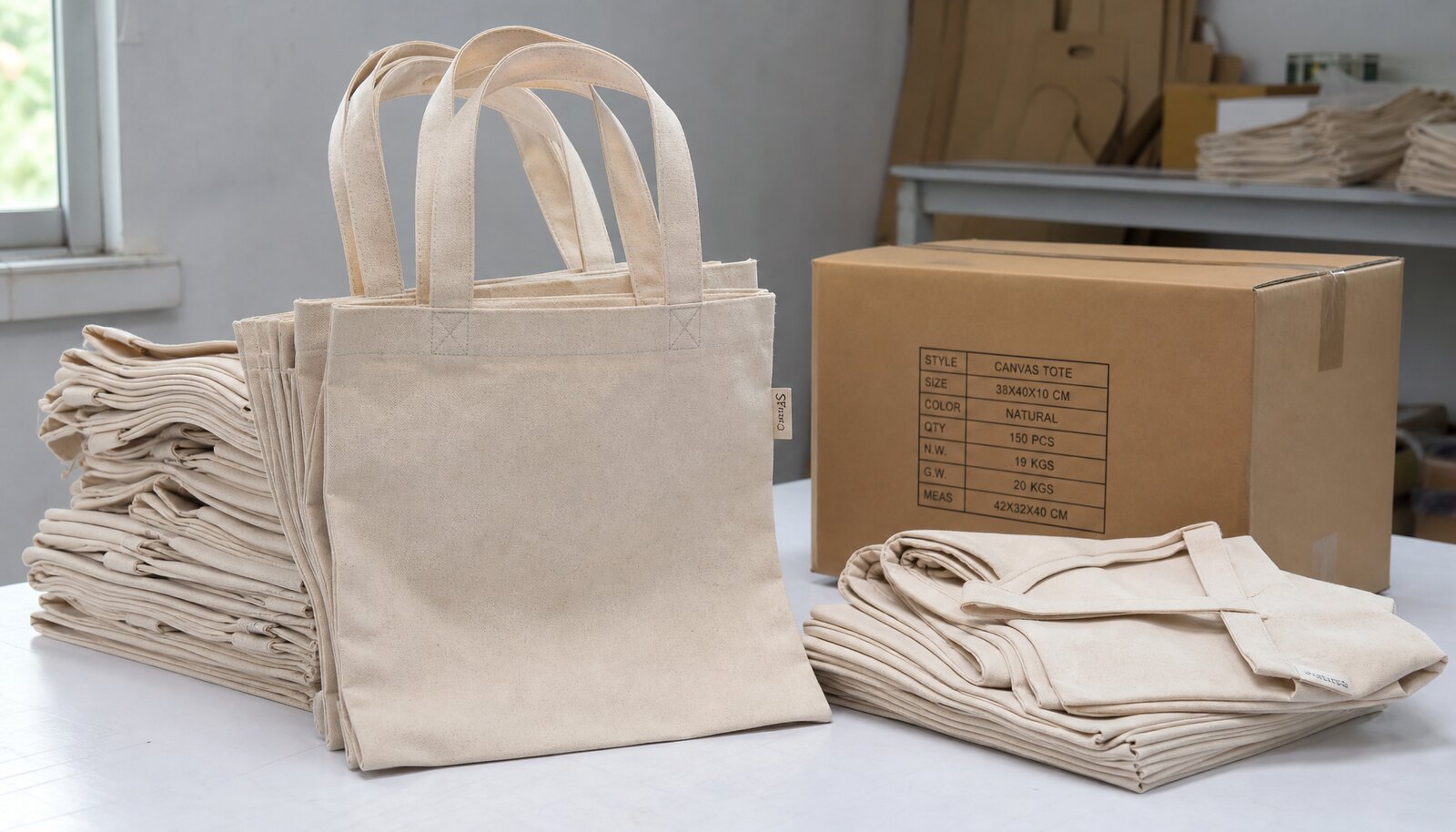
Start With the Shipment, Not the Tote
For wholesale canvas grocery totes sold through gift shops, the unit price is only one part of the buying decision. The carton plan decides whether the order lands cleanly, whether receiving staff can handle it without repacking, and whether the freight quote stays credible. A tote that looks inexpensive on paper can become costly if the carton is oversized, the pack count is unstable, or the shop needs unit-level labeling after arrival.
The first job is to define the shipping constraint. Set the receiving limit for gross carton weight, decide whether the store accepts bulk or retail-ready packing, and confirm whether the cartons will move by pallet, floor stack, or mixed-SKU consolidation. Once those points are fixed, the tote spec becomes easier to compare because every supplier is quoting the same operational reality instead of their own preferred packing method.
- Set the receiving limit: max carton weight, max carton length, and stacking method.
- Decide whether the gift shop wants loose folds, polybags, or shelf-ready units.
- Confirm whether carton labels need SKU, color, quantity, and barcode on two sides.
Choose Fabric Weight as a Carton Variable
Fabric weight drives more than hand feel. A lighter 8 oz canvas tote usually packs flatter and keeps freight cost down, but it may feel too casual for a premium gift shop line. A 10 oz build is often the best working baseline for canvas grocery totes because it balances structure, print clarity, and carton density. A 12 oz body gives a more substantial retail impression, but it also adds bulk, raises gross carton weight, and can lower the number of pieces per carton.
The construction details matter just as much as the nominal fabric weight. Self-fabric handles generally fold flatter than wide webbing handles, while webbing may improve comfort and perceived value. A deeper gusset increases usable capacity, but it also changes the folded footprint. If the tote is likely to reorder through the season, lock the handle type, gusset depth, and body weight before the first production run so the carton count does not drift later.
- 8 oz: lighter freight load and a softer promotional feel.
- 10 oz: the safest retail baseline for many gift shop programs.
- 12 oz: premium structure, but usually a heavier carton and higher freight per unit.
- Specify box-x or cross stitch on handles before sample approval because it affects fold thickness.
Print Method Changes Both Lead Time and Pack Density
Print method changes how the tote behaves in the carton. A one-color screen print is usually the most predictable option for a stable gift shop program because it cures well, stays flat, and keeps stacking simple. Heat transfer and DTF are useful when artwork changes often or the order is smaller, but they can create a stiffer print area that changes how tightly the tote folds. Embroidery adds a premium look, yet it also adds bulk at the logo point and can interfere with a clean flat pack if the design is large.
The curing and cooling step should be part of the approval process. Some factories pack immediately after printing, while others need a rest period before the tote can be stacked. That affects both lead time and final pack quality. If the logo sits near the fold line, approve a sample after curing and folding, not just a flat strike-off. A print that looks right on a table can crease or crack once the carton is closed.
- Use screen print for stable artwork and reorder programs.
- Use DTF or heat transfer when the design changes often and the buyer accepts a slightly thicker panel.
- Keep embroidery small if the tote must pack tightly.
- Approve a folded sample after print cure, not only a flat print proof.
Use Carton Count to Compare Suppliers
Suppliers often look similar at the product level and very different at the carton level. A direct factory quote usually gives the best control over fabric, stitching, pack count, and carton dimensions, but it only works if the buyer can write a clear packing brief. A trading company can simplify sourcing when the order mixes constructions or when the first buy is small, yet carton details may sit one step away from the actual line that packs the goods. A domestic stockist is fast, but it usually offers the least control over private label and carton specification.
For this product category, compare the route by carton logic, not by label alone. Ask each supplier to show a packed carton photo, a gross weight target, and the exact pieces per carton. If one quote is built around 40 pcs in a 50 x 40 x 35 cm carton and another uses 50 pcs in a 45 x 35 x 30 cm carton, the second quote has a very different freight profile even if the tote itself is the same. That is the comparison that matters for wholesale canvas grocery totes for gift shops shipping carton planning.
- Request production photos from a similar packed tote program.
- Ask for the assumed carton count, gross weight, and CBM on every quote.
- If a supplier subcontracts, require the actual packing factory to be identified in writing.
Write the RFQ Like a Packing Instruction
A usable RFQ for gift shop tote sourcing reads like a production and packing brief, not a general product request. Include the finished bag size, gusset depth, fabric weight, handle material, stitch type, print method, print placement, folded size, pieces per carton, carton dimensions, carton board grade, gross weight target, and Incoterm. That gives the supplier one unambiguous set of assumptions and makes freight estimates usable from the start.
The buyer should also define the commercial details that often get left out of a quote. State whether the sample charge is refundable, whether label artwork is included, whether hangtags or belly bands are extra, and whether a carton artwork proof is required. A tote quote without carton dimensions or pack count is not a complete quote. It is only a manufacturing estimate.
- Finished size and gusset in the same unit system.
- Fabric weight, weave, and finish.
- Handle width, drop, and reinforcement.
- Print method, colors, and placement.
- Folded size, pcs per carton, and carton gross weight.
- Incoterm, sample charge, and lead time.
Approval Samples Must Prove the Fold
The approval sample should confirm the tote can be packed exactly the way the supplier says it will be packed. Measure the finished body, handle drop, seam allowance, print placement, and folded profile. Then ask the factory to pack the sample into the proposed carton count and weigh the carton. If the approved sample changes after sign-off, the carton count and freight quote should be treated as invalid until they are updated.
The fold is often where tote programs break down. A logo too close to the fold line can crease during packing. A heavy handle stitch can make the top edge too thick to stack. A belly band that is wider than expected can reduce carton density enough to change the landed cost. That is why the pre-production sample should show the actual pack method, not just a flat printed bag in a courier pouch.
- Measure at least three to five samples for size drift before approval.
- Pull test the handle attachment and inspect the stitch line after loading.
- Check print placement against the fold line and the edge seam.
- Approve the exact carton label format, including SKU and quantity.
- Keep one sealed reference sample for inspection at arrival.
Packing Format Should Match the Gift Shop's Receiving Style
Gift shops do not all receive in the same way. Some want bulk-packed totes with clear outer carton markings and nothing else. Others expect individual polybags, insert cards, or barcoded retail units that can go straight to the floor. Bulk packing is the best choice for freight density, but it only works when the receiving team can count and shelve the bags without additional labor. Polybags protect against dust and moisture, but they add cost, create more waste, and usually reduce the number of pieces per carton.
A belly band or simple insert card is often the practical middle ground for a branded gift shop line. It gives the product a cleaner retail presentation without fully wrapping every tote. The carton spec should reflect that choice. If the bags are going to sea freight, the outer carton should resist crush and keep corner shape. If the order is moving by air, the carton should stay as compact as possible because every extra centimeter can affect billed volume.
- Use one consistent fold direction so carton count does not drift between operators.
- Put the SKU label on two adjacent carton sides for easier receiving.
- Keep gross carton weight within the manual handling limit agreed with the buyer.
- Use desiccant only when the route and fabric finish justify the added cost.
Use Carton Math to Measure Landed Cost
Carton planning is where landed cost becomes visible. Two suppliers can quote the same tote at nearly the same unit price and still produce very different freight outcomes if one uses a larger carton, more void space, or a heavier board. The correct comparison is not sewing cost alone. It is piece price plus carton cost, freight, receiving labor, and damage risk.
A practical comparison is easy to build. If one version packs 50 pcs into a 45 x 35 x 30 cm carton, the carton volume is about 0.047 cbm. If a second version packs 40 pcs into a 50 x 40 x 35 cm carton, the carton volume rises to about 0.070 cbm. That is a meaningful difference before freight rate even enters the calculation. On air freight, the larger carton can hurt twice: fewer sellable units per carton and more billed volume per unit. On sea freight, the bigger carton still matters because container space is not free.
- Compare freight per unit, not only FOB price.
- Keep one backup spec if the first choice causes oversize cartons.
- Use the same carton count in all quotes so the landed-cost calculation is valid.
- Revisit the pack count before every reorder if the print, fabric, or handle changes.
Set QC Thresholds That Hold the Reorder Standard
Quality control on canvas grocery totes should be written as acceptance criteria, not as a vague promise to inspect carefully. Define which defects are critical, which are major, and which are minor before the PO is issued. Common failure points include loose handle stitching, print misalignment, wrong carton count, stained fabric, and folded units that no longer stack correctly. For gift shop programs, odor, dampness, and crushed corners matter too because they affect sell-through even when the bag is technically usable.
The most useful threshold is the one your warehouse can enforce at receiving. For a premium retail line, the buyer may want tighter control on handle attachment and print placement than a plain promo bag. For a bulk wholesale program, it is better to allow sensible size tolerance than to over-spec cosmetic perfection that raises cost without improving shelf performance. The goal is to reject the right defects early, not to create an inspection standard that production cannot hold.
- Reject any tote with broken stitches at the handle stress point.
- Set a print-placement tolerance and keep it consistent across reorders.
- Require carton counts to match the PO, with no unexplained overpack.
- Reject stains, holes, and strong odor as non-negotiable defects.
- Check the top fold and gusset shape after the bag is stacked in cartons.
Lock the Reorder Standard Before Peak Season
Once a tote becomes a steady seller, the main risk is drift. A change in fabric source, handle supplier, carton board, or folding method can turn the same SKU into a different carton plan without changing the product name. That is why every reorder should reference the signed master sample, the packed carton photo, and the exact gross weight from the approved run. If the supplier wants to change any part of the pack method, the change should be re-quoted and re-approved rather than quietly added to production.
Gift shop buying cycles are often tight around holidays and tourist peaks, so small delays become expensive fast. Keep a simple change log for label art, carton size, and pack method. Release artwork early enough that packing is not waiting on approvals. If the supplier can hold the standard, the reorder is predictable. If not, it is better to surface the drift before cutting than to discover it in receiving.
- Keep a signed master sample and a packed carton photo for every SKU.
- Record any change to fabric source, handle type, or carton board before cutting begins.
- Freeze carton dimensions and pack count before peak season reorder windows.
- Release label or carton artwork early so packing does not wait on approvals.
Specification comparison for buyers
| Spec decision | Recommended option | When it fits | Buyer risk to check |
|---|---|---|---|
| Direct factory order with locked carton spec | Best when the buyer can write the carton plan up front and wants the factory to quote one fixed pack count, such as 40 to 50 pcs per export carton at roughly 45 x 35 x 30 cm for a midweight tote. | Recurring gift shop programs with stable artwork and predictable reorder volume. | The factory may quote a low unit price but hide a larger carton footprint, a heavier gross weight, or a different fold count that changes freight. |
| Trading company sourcing route | Useful when the buyer needs several tote constructions or a lower commitment on the first order, often with a more conservative pack plan such as 36 to 40 pcs per carton at 50 x 40 x 35 cm. | Smaller launch orders, mixed materials, or buyers who want one contact for multiple product types. | Carton data can be one step removed from the actual packing line, so the measured carton size and gross weight may drift before shipment. |
| Domestic stockist or wholesaler route | Fastest option when lead time matters more than exact private-label control, usually with smaller cartons or shelf-ready shipper packs. | Urgent seasonal replenishment or local retail programs that need immediate stock. | Higher landed cost per unit and less control over carton count, print, labels, and retail presentation. |
| Private-label cut-and-sew program | Best when the tote is part of a brand-owned gift shop line and needs custom labels, hangtags, or a fixed 10 oz or 12 oz construction with a repeatable export carton plan. | Retail buyers building a signature product with consistent presentation. | Extra sample cycles for labels, artwork, and pack method can stretch the schedule if the carton spec is not approved early. |
| Consolidated mixed-SKU shipment | Good when one buyer orders canvas totes with related bags in the same shipment, usually with mixed carton counts that must still stay under a shared pallet or container plan. | Small distributors or chains that need to spread freight across several SKU families. | Mixed carton weights and SKU labels increase receiving mistakes if the pack plan is not clear at the carton level. |
| Sea freight optimized reorder | Best for stable best sellers where CBM and carton compression matter, such as 50 pcs packed into a carton around 0.05 to 0.07 CBM instead of oversized air-freight cartons. | Ongoing programs that repeat the same spec and can fill containers efficiently. | Weak cartons or over-compressed folds can crush corners and distort the bag shape during the long lane. |
| Air freight launch order | Use for first-time market tests or seasonal deadlines that cannot wait for a full sea cycle, often with tighter carton dimensions and fewer pieces per carton to keep dimensional weight down. | Short launch windows, market testing, or replenishment after a stock-out. | Freight per unit rises quickly, so oversize cartons or loose packing become expensive fast. |
| Retail-ready pack-out with barcode on each unit | Choose when the gift shop wants shelf-ready receiving and scan-ready individual units, usually with a belly band, hangtag, or polybag that adds labor but improves store handling. | Stores that handle goods by unit, not just by master carton. | Polybags, insert cards, and barcodes increase labor and reduce pack density. |
Buyer checklist before sampling
- Fix the finished tote size, gusset depth, and handle length before comparing any quote.
- Choose the fabric weight in GSM or ounce weight and decide whether the body is natural, bleached, or dyed.
- Lock the print method, color count, and print placement, then approve the fold line against the logo position.
- Set the folded size target, pieces per carton, and maximum gross carton weight for receiving. A common manual-handling ceiling is 15 to 18 kg, or 33 to 40 lb, unless your warehouse says otherwise.
- Confirm whether the shipment is bulk packed, polybagged, or retail-ready with barcode labels.
- Ask for master carton dimensions, CBM, and carton board grade on every quote.
- Keep a signed pre-production sample and a sealed reference sample for arrival inspection.
- Require the supplier to state Incoterm, sample charge, lead time, and any extra cost for labels, belly bands, or carton artwork.
Factory quote questions to send
- What exact fabric weight, weave, and finish are you quoting for the tote body?
- What are the finished dimensions, handle length, and gusset depth used in your price?
- Which print method, number of colors, and print area are included in the quote?
- What folded size, pieces per carton, gross weight, and CBM per carton are assumed?
- Is the carton 3-ply or 5-ply, and what outer label format will you use?
- Will the bags be folded by hand or by a standard packing method, and does that change carton count?
- What is the sample lead time, and which changes trigger a new pre-production sample?
- Can you share photos or a packing video from a similar canvas tote program?
- What is the target carton gross weight in kg or lb for this SKU?
- Can you quote the same tote with one alternate pack count so we can compare freight impact directly?
Quality-control points to confirm
- Fabric GSM or ounce weight must stay within the approved tolerance and match the approved hand feel.
- Handle attachment must hold under a firm pull test with no thread popping or broken box-x stitching.
- Print placement must stay within the agreed tolerance and remain aligned after folding.
- Finished dimensions, including gusset and handle drop, must match the signed sample within the buyer tolerance.
- Folded tote count per carton must match the purchase order and packing instruction.
- Carton dimensions and gross weight must match the quoted packing plan so freight estimates stay valid.
- Master cartons must be clean, dry, and free from crushing, dampness, odor, and visible stain marks.
- SKU label, barcode, and outer carton marks must be readable on two sides of the carton.
- Reject cartons with weak tape closure, corner split, or obvious compression that could fail in transit.