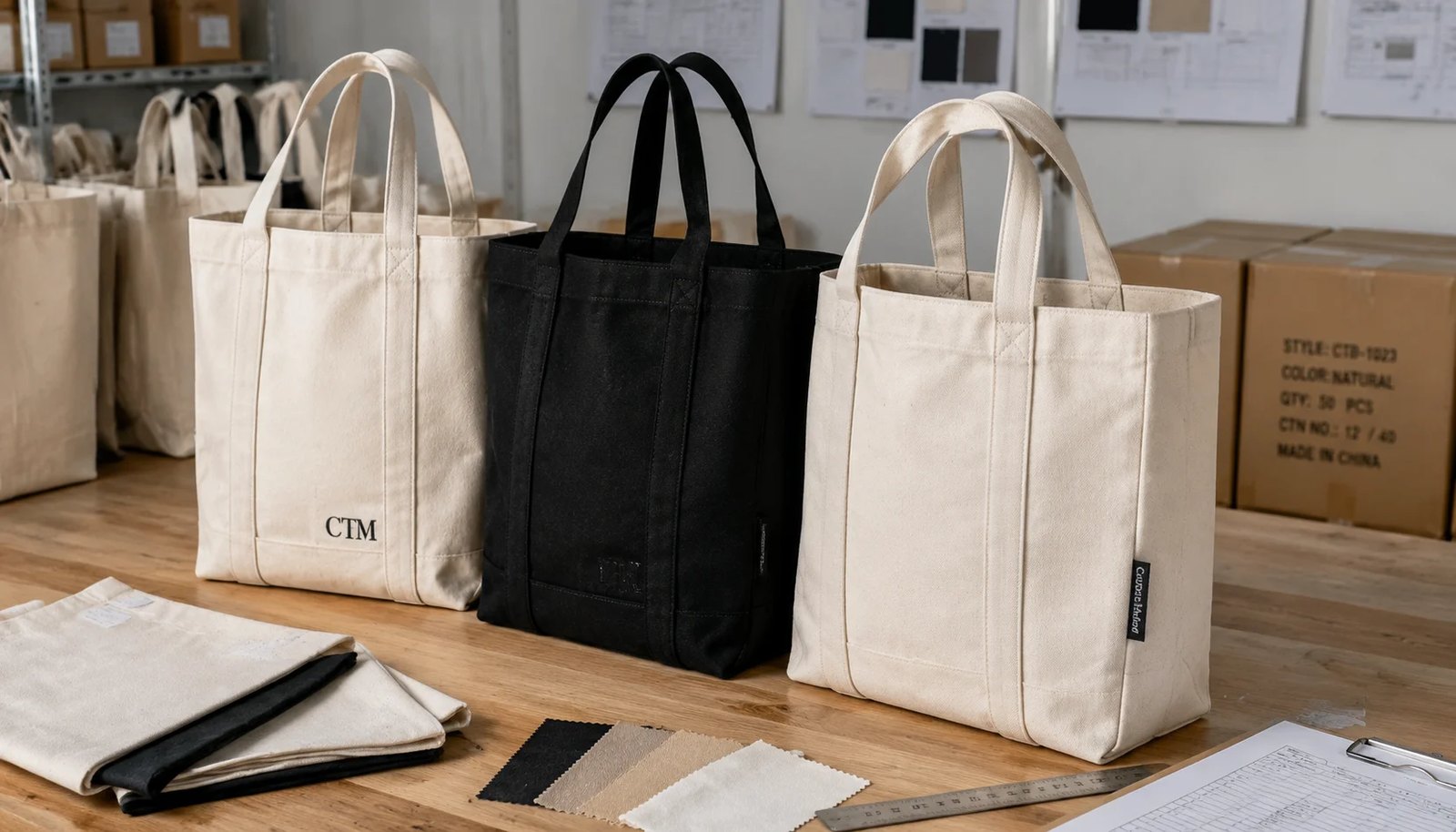
Wholesale canvas grocery totes for liquor retailers lead time planning guide: what actually controls delivery
This wholesale canvas grocery totes for liquor retailers lead time planning guide is most useful when the buying team treats lead time as a chain of approvals, not a single factory promise. Canvas tote programs for liquor retail look simple on paper, but they often carry heavy glass, need cleaner brand presentation than generic promo bags, and must hit fixed seasonal dates. Those realities make the schedule more sensitive to spec changes than many buyers expect.
The biggest planning mistake is assuming the clock starts when the supplier sends a quote. In practice, the real lead-time clock starts only after the bag specification is stable enough for sampling and bulk planning. If the team changes fabric color after approving print, adds a gusset after sampling, or shifts from natural canvas to dyed black late in the process, the factory may need to restart material booking, print setup, or even sample approval.
For liquor retailers, missed dates have a higher commercial penalty than a modest difference in unit price. Holiday promotions, gift-with-purchase periods, state-specific marketing windows, and new store launches all have hard stop dates. A tote that arrives after the promotion is not just late inventory; it may become irrelevant inventory. That is why useful procurement planning needs benchmark ranges, decision rules, and clear quality gates rather than general advice.
- Treat ex-factory date, departure date, and DC-available date as three separate milestones.
- Freeze size, gusset, fabric route, and print method before asking the supplier to lock a production window.
- Use the in-store date to build backward timing rather than using the first supplier estimate as the schedule anchor.
Start with the bag spec that matches bottle-carry use, not a generic tote description
The fastest quote is not always the fastest delivered order, because unclear specs create sample loops. For liquor retailers, the RFQ should state whether the tote is meant for two bottles, three bottles, or mixed basket purchases including snacks and accessories. A bag that only needs to look good for a promotion can be lighter and simpler than a bag expected to serve as a true reusable grocery carrier.
A practical baseline for many liquor retail programs is 12 oz canvas, roughly 330-360 GSM finished, with a boxed bottom and side gusset around 10-15 cm. That type of construction gives the bag shape at checkout and reduces seam stress compared with a flat tote when bottles are packed upright. Many buyers can use a finished size around 35-40 cm width, 35-38 cm height, and 10-15 cm gusset as a starting point, but the right dimensions depend on bottle height, pack style, and whether the bag needs shoulder carry or hand carry.
Handle specification matters more than many first quotes suggest. A long handle without proper reinforcement may look fine on a sample table but fail earlier in use once the bag is loaded with glass bottles. For this category, the RFQ should specify handle material, total handle length, handle drop, and reinforcement method. Even small omissions here make supplier quotes look comparable when they are not.
- State target load in kilograms, not only bottle count, because bottle formats vary.
- If upright wine bottle carry is required, confirm internal finished height after top hem and seam allowance.
- Ask suppliers to quote the same handle reinforcement method on every comparison line.
Lead-time benchmarks by scenario: stock natural canvas, dyed fabric, samples, bulk, ocean, and air
Qualitative wording like 'a few extra days' is not enough for real planning. Buyers need scenario ranges. Exact timing varies by season, factory load, and shipping lane, but benchmark ranges are still useful for RFQ evaluation and internal calendar planning.
For a relatively simple program using stock natural canvas, one-color screen print, and standard reinforced handles, a physical pre-production sample often takes about 5-10 calendar days after artwork and spec confirmation, plus courier time. Bulk production after sample approval often falls around 20-35 calendar days for a moderate order size, assuming fabric is truly in stock and the print queue is normal.
For custom-dyed canvas, add a fabric approval stage. Lab dip or shade approval may take about 3-7 days, and bulk fabric dyeing plus readiness may add roughly 5-12 more days depending on the supplier's fabric route and whether color has been developed before. Once the material is ready, bulk production may still sit in a similar 22-38 day range, but the total schedule grows because cutting cannot start until approved fabric arrives.
Shipping changes the planning model again. Ocean freight is usually the default for landed cost, but it only works when the buyer has enough buffer after cargo-ready date. Air freight or a split shipment can compress the final leg dramatically, yet the bag still needs production, inspection, and export handling. Air is not a substitute for late spec control; it is a contingency tool.
- Sample benchmark: about 5-10 days for a physical PP sample after spec lock, plus courier transit.
- Bulk benchmark: about 20-35 days for stock natural canvas; about 22-38 days after dyed fabric is approved and ready.
- Dyed fabric benchmark: add about 5-12 days beyond stock fabric planning, often plus lab dip review.
- Ocean works best when the program has schedule buffer; air is usually a rescue option, not the base plan.
Material and decoration choices that most often change the schedule
The most reliable schedule shortcut is usually stock natural canvas with simple screen printing. That route removes the color-approval stage on the base fabric and reduces the chance that production stalls while waiting for dyed material. For many regional tests or lower-MOQ launches, that is the most efficient path.
Custom-dyed canvas is often worth it for liquor retailers that want a premium black, navy, forest green, or brand-specific look across a chain program. The tradeoff is that dyed fabric introduces shade approval, possible re-dye risk, and tighter coordination between fabric readiness and print scheduling. Buyers should lock dyed color early and avoid changing print artwork after shade approval if possible, because dark grounds often need opacity checks and revised print sequencing.
Print method matters too. One-color or two-color screen print is usually the most stable and repeatable method for canvas grocery totes. It handles solid retail logos well and tends to be easier to control across reorders. Heat transfer or digital printing can make sense when artwork is photo-heavy or the run is short, but those methods deserve extra scrutiny for curing, surface rub, and packed-carton abrasion.
- Fastest standard route: stock natural canvas + 1-color screen print + standard reinforced handles.
- Longest common route: custom-dyed canvas + lab dip approval + multi-position print + multi-SKU packing.
- Dark fabric programs need both shade review and print opacity review before bulk release.
MOQ, SKU count, and supplier comparison rules that prevent false savings
MOQ on canvas tote bags is not just a factory policy number. It reflects material efficiency, print setup, and line planning. A buyer may receive a very low MOQ offer on natural canvas with one print, then find that the same supplier needs a much higher threshold for dyed fabric, multiple store versions, or custom dimensions. That is normal, but it should be visible in the quote.
The more useful question is not simply 'What is your MOQ?' but 'What variable drives your MOQ on this exact bag?' Some suppliers are flexible if the size and body fabric stay common across designs. Others can combine MOQ across logos but not across colorways. This matters because liquor retail programs often split by state, store banner, seasonal artwork, or regional compliance wording.
To compare suppliers fairly, normalize the specification before you compare prices or lead times. If one quote is based on 10 oz fabric with straight-stitched handles and another is based on 12 oz fabric with full reinforcement, the cheaper offer is not equivalent. The same applies to packing assumptions. A quote with oversized, overweight cartons may look cheaper but create downstream handling problems or freight inefficiency.
- Ask whether MOQ is per SKU, per colorway, per shipment, or combined across the PO.
- If timing is tight, reduce complexity by keeping body fabric and dimensions common across all designs.
- Normalize fabric, reinforcement, print method, and carton standard before ranking suppliers.
A practical approval workflow buyers can use instead of a vague schedule promise
A strong workflow is a better delivery tool than repeated follow-up emails. The buying team should define approval gates and owners before the RFQ goes out. At minimum, that means one owner for bag dimensions and use case, one owner for branding and artwork, one owner for logistics timing, and one owner for final purchase release.
A simple approval sequence works well: first, lock the construction spec and artwork file; second, approve any lab dip if dyed fabric is required; third, approve a physical pre-production sample made from bulk-intended materials; fourth, approve carton markings and packing method; fifth, hold a pre-shipment inspection against the agreed checklist. This sequence may look slower on paper than a loose process, but it usually reduces rework and surprise delay.
Internal buyer delays often equal or exceed supplier delays. If legal, merchandising, store operations, and logistics all need to review the program, put due dates on the buyer side too. Many production schedules slip because the factory waits three days for artwork comments, four days for a revised barcode, and another two days for final sign-off. Those days count just as much as sewing time.
- Assign one approval owner per topic to avoid cross-department delay loops.
- Do not approve bulk from a concept sample made with substitute fabric.
- Include carton markings and barcode position in the same approval pack as the sample.
Quality control for bottle-carry canvas totes: inspection method, thresholds, and tests
Quality control on liquor retail totes should focus on function first, then appearance. Cosmetic defects matter, but the highest-cost failures are usually structural: weak handle joins, low stitch density at stress points, seam opening at the gusset, or print offset after transit compression. A bag that fails under bottle weight damages both product and customer trust.
The inspection brief should state measurement points, visual defect standards, and performance checks. Width, height, gusset, and handle length should be measured on finished bags, not only on cut panels. A practical tolerance example for many sewn totes is around plus or minus 1.0 cm on body dimensions and around plus or minus 0.5-1.0 cm on handle length, depending on the design and construction method. If the bag has to fit a fixed retail display or bottle count exactly, tighten the tolerance in writing.
Stitch quality should be inspected at main seams and especially at handle attachments. Many medium-heavy canvas bags run around 6-8 stitches per inch on body seams, though the exact target depends on machine setup and approved sample. More important than the exact number is consistency, complete reinforcement, and absence of skipped or broken stitches. Handle reinforcement should be checked on both sides, not only the visible front side.
Load testing should use realistic contents. One simple method is to place the agreed test load inside the bag, suspend or carry it for a fixed period, then inspect seam opening, thread breakage, handle distortion, and bottom deformation. Carton testing matters too. Even a strong bag can arrive damaged if the carton fails under stacking or rough handling. Buyers should state a carton drop expectation and confirm carton wall strength before shipment.
- Use finished-bag measurement sheets with named measuring points and photo references.
- Check stitch consistency at handles, side seams, bottom seam, and top hem.
- Apply load testing to random bulk samples, not only to the showroom sample.
- Define AQL in advance so inspection disputes do not start after production ends.
Packing, freight, and timeline risk planning for ocean and air contingency
Packing decisions affect more than appearance. They change labor time, freight efficiency, carton failure risk, and DC handling speed. Heavy canvas can create overweight cartons quickly, especially when the bag has a gusset and reinforced handles. A carton that looks efficient on pieces per case may be inefficient if it exceeds warehouse handling preference or crushes in stacking.
For most liquor retail programs, flat-packed bulk cartons without individual polybags are commercially sensible unless the bags are premium gift formats or store-ready retail units. If the bags go through a distribution center, too much unit-level packaging often adds cost without adding much value. But if each design needs its own barcode or direct shelf handling, packing details should be planned from the start rather than left for the supplier to decide.
Freight planning should include a contingency path. Ocean is usually the baseline because the bag is relatively low value per cubic volume compared with air cost. However, a split shipment can be useful: release a smaller first quantity by air or the earliest available sailing if a launch date is at risk, then move the balance by standard ocean. This works only if the factory knows in advance that partial release may be needed and packs export documents accordingly.
- Set a carton gross weight cap that matches your DC handling standard.
- For printed dark canvas, request packed-sample rub review before approving high compression packing.
- If launch timing is tight, ask the supplier whether partial shipment can be packed and released without disrupting the balance PO.
A risk-priority matrix buyers can use to choose faster, safer specification routes
Procurement teams often need a quick way to decide which specification choices are worth the schedule risk. A simple risk-priority view helps. Not every delay source is equally dangerous. For many canvas tote programs, dyed fabric and late artwork changes create higher schedule risk than gusset sewing itself. Likewise, a cheap quote based on weak handle construction may create greater commercial risk than a slightly longer but better-controlled supplier route.
The practical use of a risk matrix is to match the order type to the right route. A first-time launch with a fixed in-store date should usually favor stock material, limited color complexity, and a physical pre-production sample. A mature reorder with a stable supplier can tolerate more customization because more variables are already validated. A premium holiday gift bag may justify dyed fabric and more careful decoration, but only if booked earlier.
- Use lower-risk specs on first orders and launch-critical dates.
- Spend complexity budget on features shoppers notice, not on hidden details that do not improve use.
- Document which risks are accepted and which require contingency plans.
RFQ package example: what to send so suppliers can quote and schedule correctly
The final step is turning all of this into a usable RFQ package. Many inquiries fail because the buyer sends artwork and rough dimensions but not the details that control cost, quality, and timing. A better RFQ for wholesale canvas grocery totes for liquor retailers should let suppliers answer with normalized pricing, benchmark lead times, and clear assumptions.
A practical RFQ package should include: finished size, gusset, target load, fabric weight, natural versus dyed fabric route, print method, artwork file, print size and position, handle specification, reinforcement method, packing rules, carton gross weight cap, target Incoterm, destination port, sample requirement, inspection standard, and latest acceptable ship date. If there are optional routes, ask the supplier to quote them separately instead of blending all assumptions into one line.
Below is a simple structure buyers can adapt. It turns the earlier checklist and quote questions into one document that suppliers can price against without guessing.
- Ask for one base quotation route and one faster or lower-risk alternative route.
- Require suppliers to state what timing starts from: artwork approval, sample approval, or deposit receipt.
- Request separate timing for sample stage, bulk stage, and export release stage.
Specification comparison for buyers
| Decision area | Option A | Option B | Lead-time impact | Cost impact |
|---|---|---|---|---|
| Base fabric route | Stock natural canvas | Custom-dyed canvas | Stock fabric is usually fastest; dyed fabric often adds about 5-12 days for lab dips, fabric booking, and shade confirmation | Dyed fabric is usually higher due to dyeing, approval, and MOQ pressure |
| Fabric weight | 10 oz / about 280-300 GSM | 12 oz / about 330-360 GSM | Heavier fabric can slightly slow cutting and sewing but usually not by much if material is ready | Heavier fabric raises unit cost and freight weight |
| Bag structure | Flat tote | Boxed bottom with side gusset | Gusseted construction can add sewing time but is usually worth it for retail use | Gusseted bags cost more in fabric and labor |
| Handle attachment | Straight stitch only | X-box or cross reinforcement | Reinforcement adds minor sewing time but improves reliability | Slightly higher labor cost |
| Artwork route | Digital proof only | Physical pre-production sample | Physical sample adds about 5-10 days depending on print queue and courier time | Sample cost and courier cost increase |
| Print method | 1-color screen print | Heat transfer / digital print | Screen print is often more stable for repeat orders; digital may need tighter curing review | Digital or transfer can be higher on larger runs |
| Order configuration | Single SKU, one colorway | Multiple SKUs or multiple colorways | Mixed programs add scheduling complexity and can extend bulk planning by several days | Smaller SKU splits can raise cost per piece |
| Freight plan | Ocean booking | Air contingency or split shipment | Ocean is slower; air can save weeks if launch date is at risk | Air sharply raises landed cost |
| Approval path | Artwork then production | Artwork, PP sample, inspection hold points | Extra approval gates add days but reduce bulk error risk | May reduce claim risk and rework cost |
Buyer checklist before sampling
- Define the real use case: 2-bottle, 3-bottle, or mixed grocery basket carry, and state target load in kg per bag.
- Specify finished size with width x height x gusset, plus handle length and handle drop, not just 'grocery tote.'
- State fabric as cotton canvas by finished GSM or oz equivalent, with acceptable tolerance such as +/-5% or supplier standard if documented.
- Confirm whether stock natural canvas is acceptable or whether Pantone-matched dyed fabric is required for all stores.
- Match print method to artwork and reorder plan: screen print for standard logos, transfer or digital only if artwork complexity justifies it.
- Request a pre-production sample made from intended bulk fabric, intended print method, and intended handle reinforcement.
- Set a timeline backward from in-store date including internal approvals, sample courier time, bulk production, inspection, booking, transit, customs, and DC intake.
- Ask for price breakout by bag body, print setup, print run charge, reinforcement, sample fee, labeling, packing, and freight basis if quoted.
- Define packing: pieces per carton, carton size limit, gross weight cap, barcode label position, assortment logic, and whether individual polybags are prohibited or required.
- Include quality thresholds for measurements, stitch quality, print position, shade consistency, load test, odor, carton condition, and AQL level.
Factory quote questions to send
- Is the quote for wholesale canvas grocery totes for liquor retailers based on stock natural canvas or custom-dyed canvas, and what exact finished GSM is included?
- What is the exact fabric specification by fiber content, weave, finished GSM, oz weight, and tolerance?
- Does the quoted construction include side gusset, boxed bottom, top hem, and X-box reinforcement at all handle attachment points?
- What finished dimensions are included in the price, and what measurement tolerance do you apply for width, height, gusset, and handle length?
- What MOQ applies to this exact size and print method, and is MOQ per SKU, per colorway, or combined across the PO?
- If dyed fabric is required, how many calendar days are needed for lab dip approval, fabric dyeing, and fabric arrival before cutting?
- How many days are needed for one physical pre-production sample using bulk-intended fabric and print process, and can sample photos be sent before courier dispatch?
- What is your benchmark bulk lead time for: stock natural canvas + 1-color print, dyed canvas + 1-color print, and dyed canvas + 2-sided print?
- What are the most common delay points on similar tote orders: fabric booking, print queue, sewing capacity, inspection rework, or export booking?
- What packing is included: bulk pack or individual polybag, pieces per carton, carton dimensions, gross weight per carton, and carton wall spec?
Quality-control points to confirm
- Fabric weight should be checked against quoted finished GSM on incoming or pre-cut fabric, with recorded tolerance and test method basis.
- Finished bag measurements should be checked for width, height, gusset, top opening, handle length, and handle drop; a practical example is +/-1.0 cm on body dimensions and +/-0.5-1.0 cm on handles depending on bag size.
- Body seams and handle joins should be inspected for skipped stitches, broken threads, seam grin, uneven stitch lines, and reinforcement completeness on both sides of the bag.
- A usable stitch density benchmark for many medium-heavy canvas totes is roughly 6-8 stitches per inch on main seams, with dense and complete reinforcement at stress points; the exact target should match the factory machine setup and approved sample.
- Handle attachment should be load-tested using realistic bottle weight; a simple method is to hang or carry the bag with the agreed test load for a set time, then inspect seam opening, stitch breakage, handle distortion, and bottom deformation.
- Print position should be measured from sewn reference edges after finishing, not from cut panels; set a practical tolerance such as +/-0.5-1.0 cm based on logo size and bag construction.
- Print cure and rub resistance should be checked on unpacked and packed samples, especially for dark canvas or large solid prints that may offset under carton pressure.
- Shade consistency should be reviewed under standard lighting for all visible panels and handles, especially on black, navy, forest green, or other dyed programs common in liquor retail.
- Cartons should be checked for count accuracy, barcode placement, dry clean interior, corner strength, and gross weight compliance with buyer warehouse limits.
- Carton integrity should be verified with a simple drop standard agreed in advance, such as one filled-carton drop sequence from realistic handling height, followed by review for burst corners, crushing, and product contamination risk.