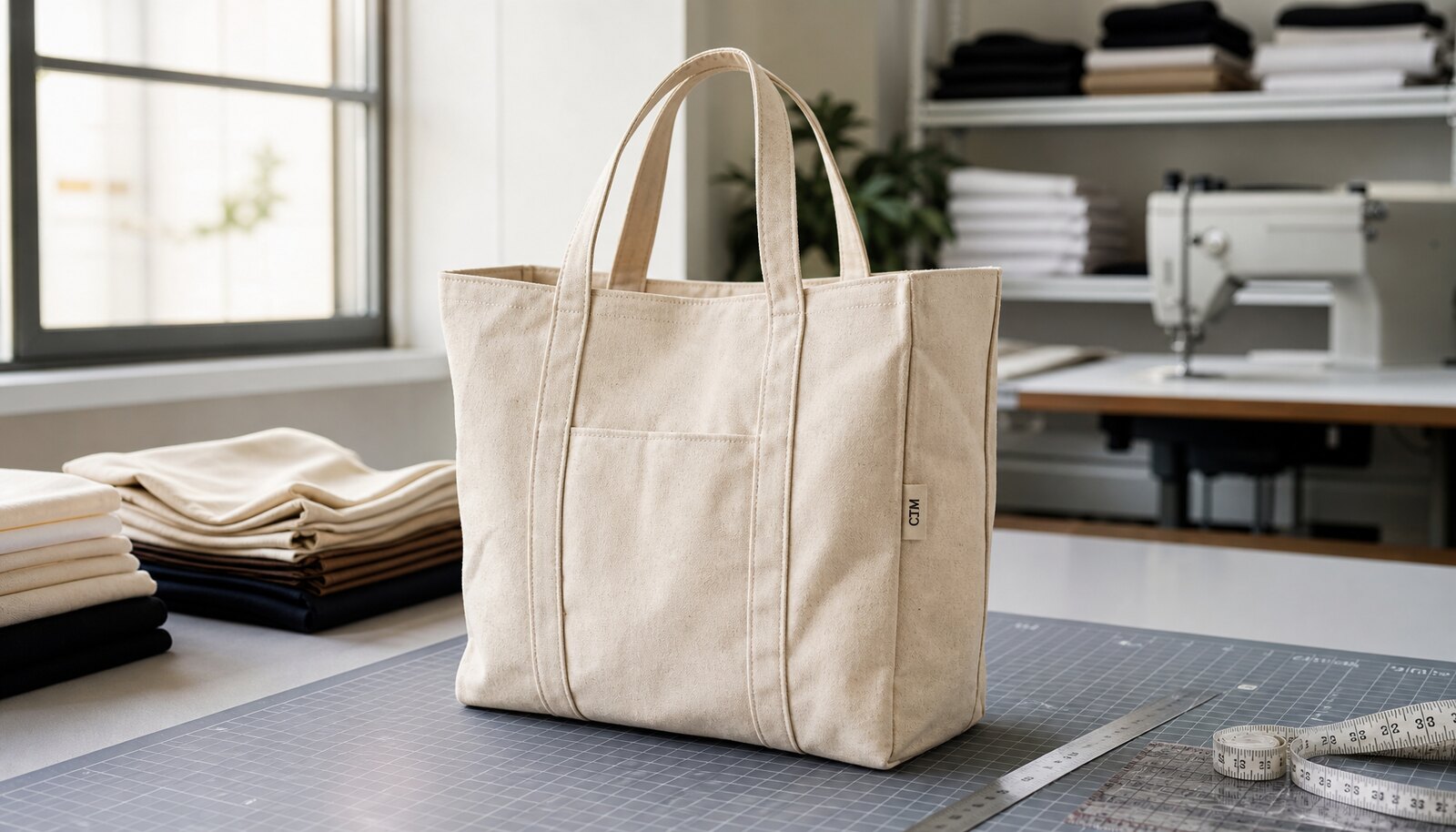
Why MOQ negotiation changes the whole tote quote
For wholesale canvas grocery totes for gift shops, MOQ is not just a supplier hurdle. It changes fabric sourcing, cutting yield, print setup, sewing line efficiency, and the amount of packing labor a factory can absorb without inflating the unit price. If you treat MOQ as a single number, you usually miss the real cost drivers and end up comparing quotes that are not built on the same assumptions.
The practical goal is not to force the lowest MOQ at any cost. It is to align the order structure with what the factory can run efficiently, then negotiate the pieces that affect shelf performance and margin. A gift shop tote has to look retail-ready, hold its shape, and survive repeated carrying. If the bag fails on those points, a slightly lower unit price is not a win.
- MOQ is usually driven separately by fabric, print, and packing.
- A low MOQ with custom specs often costs more per unit than a larger run with a stable spec.
- Gift shops usually need clean retail presentation, not only basic utility.
Start with the spec that fits the shelf, not the factory
Canvas grocery totes for gift shops work best when the spec matches the selling environment. A tote that is meant to sit near checkout or in a display wall needs a cleaner silhouette, straight seams, and a print area that reads from a short distance. If the bag is sold as a reusable grocery tote, it also needs enough structure to stand up to repeated use, not just one purchase cycle.
A practical baseline for many retail programs is 12 oz finished canvas, though some buyers stay at 10 oz for lighter souvenir-style items and move to 16 oz for premium gift lines. Ask the supplier to quote both oz and GSM because factories may use different measurement language, and the conversion can vary after washing, dyeing, or finishing. For weave, a tight plain weave or dense duck canvas usually prints cleaner and presents better than a loose, uneven weave. Handle construction matters too: same-fabric handles around 1 to 1.5 inches wide work for lighter totes, while heavier programs often need wider handles and stronger reinforcement at the attachment points.
- Use 12 oz as a practical baseline if the tote needs retail presence and controlled cost.
- Reserve 16 oz for premium gift shops or heavier load expectations.
- State whether you want natural, bleached, dyed, or washed canvas because each changes MOQ, lead time, and shade control.
How factories build MOQ: what actually pushes the number up
Factories do not set MOQ at random. They calculate it from fabric roll usage, cutting loss, sewing line changeover, print screen setup, and packing labor. If your tote uses a standard size with a common canvas weight, MOQ can stay manageable. Once you change the size, add a gusset, require a custom woven label, or ask for multiple print colors, the minimum rises because each step creates extra handling and more opportunities for rejects.
The most common negotiation mistake is arguing only about quantity while ignoring complexity. A supplier may lower MOQ if you simplify the build. For example, a single-color print on natural canvas with bulk packing is much easier to approve at a lower quantity than a four-color design with individual polybags, hangtags, and custom inserts. If you want the buyer-side leverage, reduce variables that do not add retail value.
- Size changes affect cutting waste and seam consistency.
- Print color count affects screen setup, registration, and press time.
- Custom labels and retail packing add labor that factories price into MOQ.
Compare sourcing routes before you push on quantity
For gift shop buyers, the sourcing route matters as much as the product spec. A direct factory usually gives the cleanest control over fabric weight, seam construction, and packing, but only if the factory actually sews and finishes the tote in-house or through a tightly managed line. A trading company can help when you need several product lines in one shipment, yet the quote may include an extra margin layer that makes comparison harder. Stock programs reduce risk for a first order, but they rarely deliver the exact retail look you want for a branded assortment.
The right route depends on whether the tote is a one-off seasonal program or a repeatable line. If you expect reorders, spend more time validating the factory's capability and less time chasing the lowest first quote. If the bag is only for a short gift shop test, a stock blank with a clean logo application may be the safer path. Either way, ask the supplier to identify what is standard and what is customized so you can see where the MOQ really comes from.
- Direct factory sourcing gives the most room to tune fabric, sewing, and packing.
- Trading companies are useful when you need mixed-category shipment consolidation.
- Stock-to-print routes are practical for pilots, but they limit customization.
Use the quote to separate real cost from noise
A usable quote for wholesale canvas grocery totes should break out the base bag, print setup, sample cost, packing method, and carton data. If those pieces are bundled into one line item, you cannot tell whether the factory is competitive or simply hiding complexity inside the price. For buyers comparing supplier offers, the first task is to normalize the quote: same fabric weight, same size, same print coverage, same packing, and same trade term.
The biggest cost drivers are usually fabric weight, print complexity, and labor-heavy finishing. Heavier canvas adds material cost and can slow sewing. Multiple print colors add screens and registration risk. Retail-ready folding, individual polybags, barcode labels, and hangtags add labor that does not always show up until the pallet is on the receiving dock. To compare landed cost properly, include freight cube, duty, brokerage, and any warehouse repacking needed because the tote was packed too loosely or too tightly.
- Ask for ex-factory pricing and separate freight if you want a clean comparison.
- Normalize all supplier quotes to the same carton quantity and pack method.
- Treat custom labels and retail inserts as separate cost items, not free extras.
Sample approval is where most tote mistakes should be caught
The sample should prove that the tote can be produced consistently, not just that the logo looks acceptable once. When you review the first sample, measure the body size, check handle symmetry, inspect seam allowance, and look at print placement relative to the top hem and side seam. For a gift shop line, the bag should also fold cleanly and stand visually upright, because an uneven tote looks low quality even if it is technically functional.
Do not approve samples by image alone. Ask for a physical sample if the order will sell at retail, because canvas weight, hand feel, seam stiffness, and print texture are difficult to judge from a mockup. For repeat programs, keep a signed pre-production sample and record the exact fabric spec, print code, label position, and carton format. That way, the second order does not silently drift from the first one.
- Measure the tote; do not rely on the factory's nameplate size.
- Check seam straightness, handle alignment, and print registration on the physical sample.
- Lock the approved sample as the production reference for repeat orders.
Quality control needs measurable acceptance criteria
QC guidance should be specific enough to stop disputes before shipment. Set the fabric-weight tolerance first, then define what you will accept for stitch density, seam quality, print registration, and carton condition. For a retail tote, AQL 2.5 for major defects and 4.0 for minor defects is a common starting point, but you can tighten it if the bag is premium or if the retail channel is strict about presentation. The point is to make defect decisions repeatable, not subjective.
For stitch quality, require a consistent seam structure on every bag. A main seam at roughly 8 to 10 stitches per inch is a reasonable target for many canvas totes, with top hems slightly tighter. Ask the supplier to show you where reinforcement is added at the handle joins, and define how much seam opening or handle slippage fails the lot. If the bag is supposed to carry groceries, use a weighted load test and set a clear pass/fail rule. The factory should know the test before production starts, not after the inspection report comes back.
- Set fabric-weight tolerance in writing, preferably before the fabric is cut.
- Require a defined seam structure and stitch density, not just a visual approval.
- Use a static load test with an agreed weight, hold time, and no-fail criteria.
Packing and carton data affect both retail readiness and freight
Gift shop totes often fail in the last mile, not in sewing. A tote can pass inspection but still arrive wrinkled, crushed, or poorly folded if the pack method is weak. Clarify whether you want bulk folding, individual polybagging, insert cards, barcode stickers, or ready-to-hang retail packing. The more retail-ready the pack, the more control the factory needs over folding accuracy and carton fill, which can affect both labor and freight volume.
Carton information should be part of the quote, not an afterthought. Ask for gross weight, net weight, carton dimensions, and units per carton so you can estimate cube and compare landed cost properly. Tote bags are lightweight but bulky, so oversized cartons or sloppy folding can make freight expensive even when the unit price looks strong. If the bags go to a distribution center, confirm barcode readability and carton count before you release the shipment, because rework at receiving can erase the savings from a cheap factory quote.
- Use compact folding if the tote will ship in volume and be merchandised later by the retailer.
- Use individual polybags only when the sales channel needs cleaner presentation or extra protection.
- Verify barcode readability and carton count before release, especially for DC-bound orders.
Negotiate MOQ by trading complexity, not by pushing harder
A factory is more likely to reduce MOQ when you remove friction from the order. If you need a lower quantity, simplify to one print color, one tote color, standard natural canvas, and bulk packing. If the artwork needs multiple colors, you may be able to negotiate on another variable, such as using the factory's standard label position or accepting a longer lead time so the order fits into a larger production run.
The best negotiation position is a clear forecast. Factories respond better when you present a pilot order plus a realistic reorder path than when you ask for a one-time low minimum with no future volume. If the initial order is small but the product has repeat potential, say so. That gives the supplier a reason to accept a tighter margin on the first run in exchange for a better long-term relationship. It also helps you push for tier pricing that drops once the order volume climbs.
- Lower MOQ by reducing print colors, labels, and packing complexity.
- Offer a repeat-order forecast if you want the factory to treat the first run as strategic.
- Be explicit about which variables are flexible and which are fixed.
Lead time risk is usually hidden in raw material and approval timing
Canvas tote lead time depends on more than sewing capacity. Natural canvas may be available faster than custom-dyed fabric, but if the supplier has to wait for yarn or a dye lot, the schedule slips before production even starts. Print approval can also become the critical path if artwork is not finalized early or if you change the color after the sample stage. A buyer who wants to keep a tote on shelf for a gift season should work backward from the retail launch date and leave enough room for corrections.
A realistic schedule includes sample approval, material booking, production, inspection, and packing release. For repeat orders, the fastest route is usually to keep the same fabric, same size, and same pack method, then update only the print. When buyers try to change too many variables at once, the order becomes a development project instead of a replenishment order. That shift tends to raise MOQ, extend lead time, and weaken the supplier's willingness to sharpen the price.
- Book extra time if the tote uses dyed fabric, woven labels, or special packing.
- Treat artwork approval as part of the schedule, not a separate admin step.
- Hold buffer time for inspection fixes and carton relabeling.
Specification comparison for buyers
| Build option | Typical MOQ | Indicative price band | Best fit | Landed-cost implication / buyer risk |
|---|---|---|---|---|
| Stock blank with logo | Lowest, often a few hundred pieces per color/size | Lowest unit price, but setup can still matter | Pilot programs, seasonal tests, fast gift shop replenishment | Lower first-order risk, but verify fabric weight, handle length, and print area before you lock pricing |
| Standard canvas, one-color print | Common mid-range MOQ, often 500 to 2,000 pieces per style | Usually the best balance of price and flexibility | Core gift shop reusable tote programs | Good freight efficiency if bulk packed; risk rises if the quote hides screen fees, labeling, or carton changes |
| Standard canvas, multi-color print | MOQ usually rises once extra screens are needed | Mid to higher unit price because of setup and registration labor | Branded retail assortments with stronger shelf impact | More setup waste and higher reject risk; compare the quote on a like-for-like print basis |
| Heavy canvas with reinforced handles | Higher MOQ than light promotional bags | Higher unit price, but better perceived value | Premium gift shops and durable grocery-use positioning | Heavier cartons and higher freight cube; check if the retail margin supports the extra cost |
| Custom dyed or washed canvas | Often the highest MOQ among standard tote builds | Usually the highest cost because color matching and finishing add complexity | Private label and design-led gift shop lines | Watch for shade variation, dye lot risk, and longer lead time; landed cost can move quickly |
| Custom woven label, hangtag, and retail pack | MOQ depends on each added component | Small per-unit increases that add up across the order | Shelf-ready retail programs | Pack labor and carton cube often cost more than buyers expect; ask for separate pricing by component |
Buyer checklist before sampling
- Define the end use first: retail gift item, reusable grocery bag, or premium branded carry bag, because each one changes fabric weight, handle width, seam reinforcement, and print method.
- Lock the tote dimensions, gusset depth, and handle drop before asking for quotes, or factories will price different structures as if they were equivalent.
- State the target fabric weight in oz and GSM and ask for the post-finishing weight, not just a generic fabric description.
- Specify the weave type if it matters to presentation: tight plain weave for a cleaner retail look, duck canvas for a denser hand, and avoid loose weave if you want sharper print edges.
- Set the handle construction in writing: same-fabric or webbing, handle width, handle length, handle drop, and whether the handles are double-stitched or bartacked.
- Define the seam construction: overlocked inside seams, bound seams, or flat-felled seams, plus the seam allowance the factory must hold to.
- Spell out print coverage, number of colors, print position, and whether the artwork must stay inside a safe margin from seams, hems, and gussets.
- Ask for sample photos of stitching, bartacks, inside seam finishing, and label placement, not just a front-view mockup.
- Confirm packing before pricing is compared: bulk fold, individual polybag, barcode sticker, hangtag, or retail-ready fold.
- Request carton dimensions, carton gross weight, and packing quantity per carton so you can estimate freight cube and warehouse receiving cost.
Factory quote questions to send
- What exact canvas construction is this quote based on: plain weave, duck canvas, or another structure, and what is the finished fabric weight in both oz and GSM?
- What is the MOQ if we keep the same size, same fabric, and one-color print, and how does MOQ change if we add a woven label, hangtag, or individual polybag?
- Is the price quoted ex-factory, FOB, or delivered, and can you separate the bag price from print setup, sampling, labeling, and packing?
- What are the finished body measurements, handle width, handle drop, seam allowance, and bartack spec you will run on production?
- How many stitches per inch do you use on the main seams and top hem, and what seam construction do you use inside the bag?
- What is your fabric-weight tolerance lot to lot, and how do you handle shade or shrinkage variation after washing or finishing?
- What is your AQL target for this program, and which defects count as major versus minor?
- What seam-strength or load test do you run, what weight do you use, how long is the hold time, and what is the pass/fail criterion?
- What are the sample charge, sample lead time, and whether the sample cost is credited back after order confirmation?
- What carton size, units per carton, and gross weight do you recommend for ocean freight, warehouse receiving, and retail resale planning?
Quality-control points to confirm
- Fabric weight tolerance: set an acceptance target of plus or minus 5% for standard canvas and plus or minus 3% for premium or dyed runs, measured after finishing and before packing.
- Weave and surface quality: reject loose weave, visible holes, broken yarns, heavy oil marks, and uneven slub concentration that makes the tote look inconsistent on shelf.
- Stitching quality: main seams should typically hold around 8 to 10 stitches per inch, with top hems around 9 to 11 stitches per inch, unless your spec calls for something different.
- Handle reinforcement: require bartacks or equivalent reinforcement at each handle join, and verify that both handles are matched for placement and length.
- Seam strength: define a static load test, such as a weighted hold at the agreed load for 2 hours, with no seam opening, no handle slippage, and no broken stitches.
- Dimensional tolerance: set critical dimensions such as body width, height, gusset depth, and handle drop to within plus or minus 0.25 inch, or a tighter range if the bag sits in a retail fixture.
- Print quality: check registration, opacity, edge sharpness, and bleed; for a retail program, keep major print misalignment within about 1 to 2 mm unless the artwork is intentionally distressed.
- Packing QC: confirm fold consistency, barcode readability, polybag seal quality, carton count, and carton compression resistance before shipment approval.
- Inspection standard: use an AQL plan that fits the program, often AQL 2.5 for major defects and 4.0 for minor defects, with tighter targets for premium retail orders.