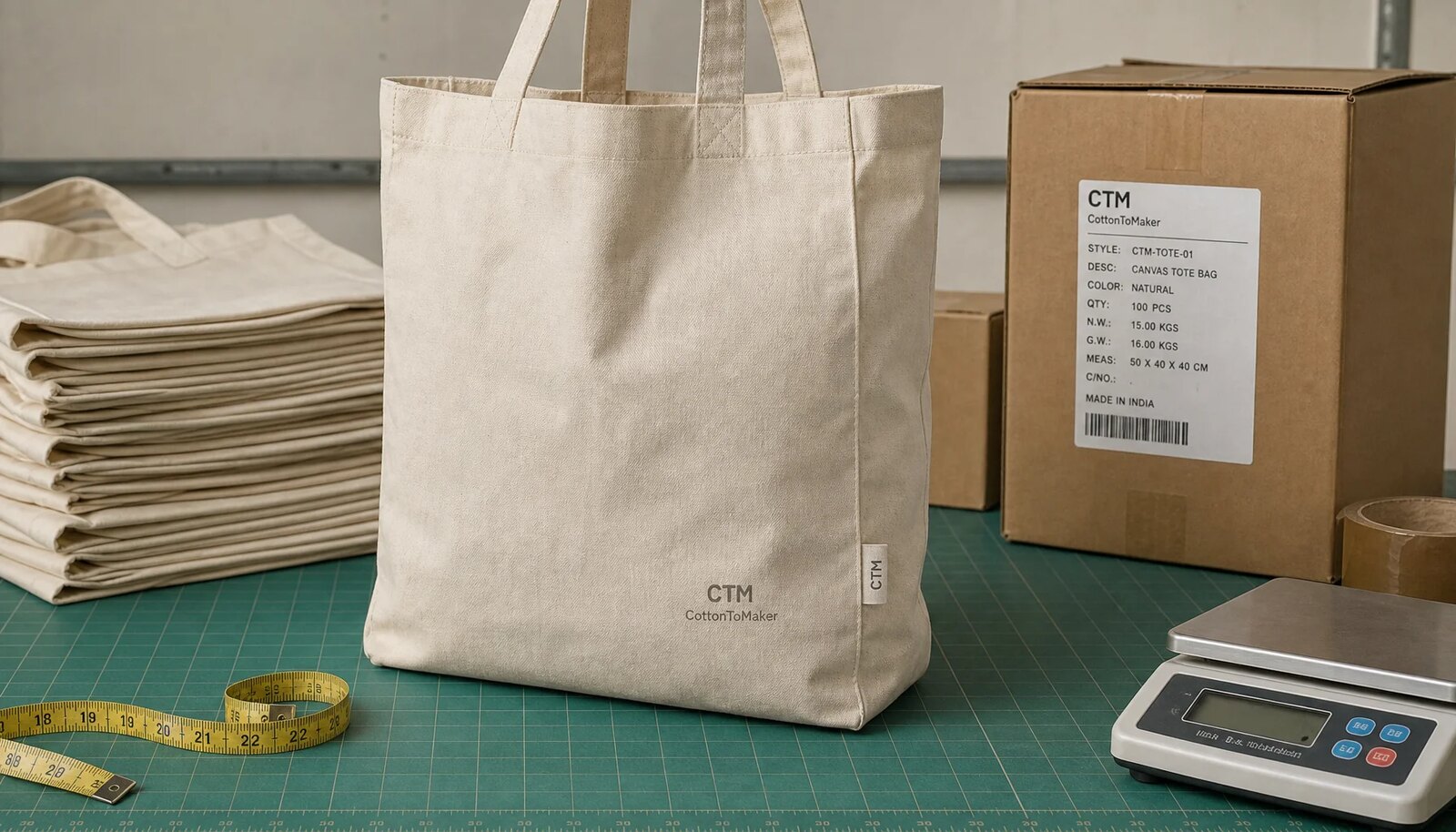
1. Treat the carton as part of the product
For wholesale canvas grocery totes for event planners, the tote and the carton are one purchasing decision. The bag has to look right in a sample review, but it also has to survive printing, folding, stacking, export packing, warehouse handling, and a rushed event setup. A cheap tote price loses its advantage when cartons arrive overweight, crushed, mislabeled, or packed in a way that forces staff to open and recount everything before doors open.
Event orders leave little room for improvisation. The delivery date is tied to a show, conference, brand activation, market, or company meeting. The receiving point may be a hotel dock, decorator warehouse, convention center, 3PL, or temporary storage room. The people unloading the shipment may not know the product or the sponsor versions. When carton marks are vague or pack counts are wrong, the problem shows up at the worst possible time.
A serious quote should include the finished tote specification and the packing plan in the same document. Ask for bag size, gusset, handle length, fabric weight, print method, folded size if available, units per carton, carton dimensions, gross weight, net weight, carton board, inner packing, carton marks, and estimated shipment cube. Those details let procurement compare landed cost, freight impact, and receiving labor, not just the unit price on the tote.
- Request carton data in the first RFQ, before approving the unit price.
- Compare suppliers by unit cost, setup charges, carton cube, gross weight, pack method, and receiving efficiency.
- Make carton configuration an approval item when delivery date, venue rules, or freight budget is firm.
2. Start with the real event load
A canvas grocery tote can be a light registration handout, a pre-packed attendee kit, a sponsor sample bag, a retail-style giveaway, or post-event merchandise. Those uses may look similar on a mood board, but they do not behave the same in production or shipping. A bag holding a notebook and badge can use a different construction than one carrying boxed samples, bottled drinks, apparel, food items, and printed catalogs.
Write down the expected contents before choosing the fabric weight. Include the normal load and the heaviest realistic load. If the tote will be pre-packed, test how the contents sit inside the gusset and how the handles behave when lifted from a table. If the tote will be distributed empty at registration, speed matters: cartons should open cleanly, stacks should be easy to pull, and artwork versions should be obvious from the carton labels.
Finished dimensions should be stated as width, height, and gusset depth. Grocery totes normally need a side gusset, bottom gusset, or box-bottom construction to carry bulky goods. A flat tote may pack efficiently, but it will not behave like a grocery bag once attendees add rounded or boxed items. Ask the supplier to name the construction clearly and confirm how the size is measured.
Handle length deserves more attention than it usually receives. Short handles reduce tangling and folded bulk, but they may only work for hand carry. Longer shoulder handles are better for all-day conferences and public events, yet they add volume and require a consistent folding method. If the bag will be packed with contents before the event, approve the handle length after a loaded test, not from a flat photo.
- Define expected contents, maximum load, distribution method, and reuse target before choosing fabric weight.
- Specify width, height, gusset depth, handle length, handle width, and measurement tolerance.
- Confirm whether the tote will be handed out empty, pre-packed, sold, or stored for later distribution.
3. Use canvas weight as a controlled spec
Canvas weight drives cost, durability, hand feel, folded thickness, and carton weight. For light event handouts, 10 to 12 oz canvas can be enough when contents are mostly paper, a small notebook, or lightweight gifts. For reusable grocery-style event totes, 12 to 14 oz is often the practical middle range. A 16 oz canvas can feel structured and premium, but it should be chosen for a clear load, brand, or reuse reason rather than because heavier automatically sounds better.
Ask how the supplier states fabric weight. Ounces usually mean ounces per square yard, while gsm means grams per square meter. Conversions help, but they do not tell the full story. Strength and feel also depend on yarn, weave density, finishing, shrinkage, dyeing, washing, and whether the canvas is natural or treated. Two fabrics with similar stated weight can fold, print, and carry differently.
Heavier canvas changes the carton plan. It can increase gross weight, reduce units per carton, and require more carton volume to avoid hard compression. That matters for air freight, courier shipments, manual receiving, and pallet planning. If a supplier offers a heavier fabric at a similar unit price, check the total carton count and shipment cube before treating the quote as better value.
For repeat event programs, keep the approved swatch, finished sample, and written fabric basis together. Reorders should reference the same canvas weight, color, finishing, handle construction, and measurement method. The phrase natural canvas tote is too loose for procurement control; it can hide changes in hand feel, shrinkage, folded volume, and print result.
- Use 10-12 oz for light event handouts and document loads.
- Use 12-14 oz for most reusable grocery-style event totes.
- Use 16 oz when premium structure or heavier load is clearly required and freight impact is accepted.
4. Build carton math around weight, cube, and labor
Carton planning is a balance between units per carton, carton dimensions, gross weight, board strength, and the way the shipment will be handled. Optimizing one number in isolation creates new problems. A high pack count can lower carton quantity but create bulging cartons or lifting risk. A low pack count can protect presentation but increase freight cube and force the event team to handle more cartons.
Set a maximum gross weight before the quote is finalized. Many manually handled event cartons are easier to manage in the 15-22 kg range, but the right limit depends on labor rules, venue access, stairs, elevators, palletization, and local safety expectations. Do not assume the factory knows the receiving limit for your venue. Put the maximum weight in the RFQ and ask the supplier to design the pack count around it.
Ask for carton dimensions and calculate total cube. Ocean freight is sensitive to cubic volume. Air and express shipments may bill by chargeable weight, which can be based on actual or volumetric weight. Domestic truck delivery may depend on pallet footprint, stack height, carton strength, and appointment rules. The best carton is not always the smallest one; it is the carton that protects the bags and makes receiving predictable.
If palletization is required, ask for cartons per layer, layers per pallet, pallet height, pallet weight, and whether cartons overhang the pallet. For split event shipments, carton numbering should support the destination plan. Sorting mixed sponsor designs at a venue is expensive in time and attention. It is better to build the split into the packing plan before the goods leave the factory.
- Ask for units per carton, carton dimensions, gross weight, net weight, and total estimated cube.
- Set a maximum gross weight that matches your receiving conditions.
- For palletized freight, confirm cartons per layer, layers per pallet, pallet height, and pallet label content.
5. Choose print methods with pack-out in mind
Print decisions affect appearance, cost, lead time, and carton risk. Screen printing is often efficient for simple logos, solid colors, and larger runs. Heat transfer can support detailed or multi-color artwork, but buyers should approve hand feel, edge quality, adhesion, and behavior after folding. Sewn labels, woven patches, and side labels can be useful when the branding should be quieter or when large ink areas create pack-out concerns.
Artwork approval should include placement rules, not just the logo file. Define print size, distance from the top edge or seam, print side, orientation, and acceptable tolerance. For many tote orders, plus or minus 5 mm to 10 mm may be practical depending on construction and artwork size, but the buyer and factory should agree before production. Multi-sponsor events also need exact artwork filenames and item names so carton labels match the packing list.
Printed totes should be checked after folding and stacking. Fresh prints can look fine on a table and still block, scuff, crack, or transfer when compressed inside cartons. Heavy ink coverage may leave pressure marks. Heat transfers can react poorly to heat, long storage, or high compression if the application is not suited to the packing method.
Ask the factory how printed bags are dried, cured, rested, inspected, folded, and protected. The answer should be specific enough to verify during inspection. For large solid logos, consider tissue separation, adjusted fold lines, lower carton compression, or a different branding method. A print that photographs well but marks the opposite side in transit is not event-ready.
- Provide vector artwork, Pantone references, print dimensions, print side, placement, and version names.
- Approve print after folding and stacking, not only as a loose flat sample.
- Check rubbing, blocking, cracking, peeling, odor, registration, and fold-line marks before shipment.
6. Match inner packing to distribution
Most event planner orders do not need individual polybags. If totes will be handed out at registration, inserted into kits, or staged behind a counter, bulk packing is usually faster and creates less waste. Individual polybags can make sense for retail resale, VIP gifting, long storage, or situations where each tote must stay clean until the final recipient opens it.
Bulk packing still needs a written standard. State whether bags should be folded once, folded flat with handles tucked, stacked in alternating directions, bundled by count, wrapped in a carton liner, or separated with tissue. Natural cotton can absorb moisture and odor, so a clean inner liner or moisture-aware packing plan may be more useful than individual plastic bags, especially for ocean freight or longer storage.
Inner bundles can reduce event labor. A carton of 100 totes bundled in groups of 25 can be moved quickly to four registration counters without recounting every unit. That factory step adds labor, so request it when it saves real receiving or distribution time. If bundle counts matter, include them in inspection, not just in the packing note.
Avoid using standard export packing as the only instruction. A clearer packing line would be: 100 pieces per 5-ply export carton, folded once, handles tucked, bulk packed with inner liner, no individual polybag, carton marks on two long sides, cartons numbered 1 of X. That wording helps the supplier price correctly and gives QC something concrete to inspect.
- Use bulk packing for most registration handouts and kit assembly orders.
- Use individual polybags when resale, premium presentation, long storage, or contamination control requires them.
- Use inner bundles when staff must split cartons quickly across counters, rooms, booths, or destinations.
7. Approve samples that prove the tote and the carton
A tote sample should be judged as both a product and a packed item. Inspect fabric hand feel, color, weight basis, dimensions, gusset shape, handle attachment, seam finish, print method, print placement, and overall appearance. Then fold it the way production will fold it and look at the stack. A tote can look correct as a loose sample and still be too bulky, springy, or wrinkle-prone for the intended carton count.
A pre-production sample is more useful than a generic showroom sample when the order has custom artwork, a fixed event date, or a tight freight budget. It should use the intended fabric, handle construction, seam method, print method, label details, and approximate packing method. If final artwork is not ready, a blank sample can support size and carton testing, but it should not replace a print strike-off or printed pre-production sample.
Load testing should reflect the event. Ask the factory to use an agreed test weight and duration, or test the sample with the actual planned contents. Watch handle stress points, side seam strain, bottom sag, stitch popping, and carry comfort. For pre-packed kits, leave the bag loaded for several hours before checking shape and stress, because strain can appear after the first lift.
Carton-fit approval should be recorded. Pack the intended number of folded totes into the proposed carton or a measured mock-up. The carton should close without excessive force, keep square corners, and avoid severe fold damage. Record pack count, carton dimensions, gross weight estimate, and any required changes before mass production starts.
- Approve fabric, construction, print, folded size, carton fit, and carton marks before bulk production.
- Keep a golden sample and written approval sheet for future reorders.
- Do not release full production until print and pack-out risks have both been checked.
8. Put QC tolerances in the purchase order
Quality control works best when tolerances are written before production. For tote body dimensions, many buyers use an agreed tolerance such as plus or minus 1 cm, depending on size and construction. Handle length may need its own tolerance because shoulder fit and carry comfort are sensitive. Print placement should be measured from fixed points, such as the top edge, side seam, or center line, with the tolerance agreed before printing begins.
Inspection should cover function, appearance, and packaging. Function checks include handle pull, seam strength, gusset shape, and load behavior. Appearance checks include stains, oil marks, rust marks, water marks, fabric defects outside the approved standard, loose threads, odor, and print defects. Packaging checks include carton strength, count accuracy, label accuracy, moisture condition, tape security, and whether cartons are bulging.
For print QC, do not rely only on a digital mockup. Compare production prints to the approved strike-off or sample under consistent lighting. Check color, registration, coverage, edge sharpness, cracking, rubbing, peeling, and transfer after stacking. If the order has several sponsor versions, inspect each version and match it to carton labels and packing list lines.
Pre-shipment inspection should include random carton opening. Count the units, confirm the inner packing, verify the SKU or artwork version, and inspect bags from the top, middle, and bottom of cartons. Cotton totes at the bottom of an overfilled carton may show more compression and fold marking than those on top. Packaging quality is part of delivery performance for event orders.
- State size tolerance, handle tolerance, print placement tolerance, and color reference in the PO.
- Inspect product quality and carton quality in the same pre-shipment check.
- Open cartons randomly to verify count, print version, inner packing, and compression condition.
9. Control labels, carton marks, and receiving documents
Carton marks should let a receiving team act without opening every carton. Each carton should show item name, PO number, color, print version, quantity, carton number, destination if needed, and handling instructions. If country-of-origin labeling, fiber content labeling, or other compliance information is required for your market or sales channel, confirm it before labels and carton marks are printed.
Version control matters in sponsor-heavy event orders. The same tote size may ship in several artwork versions, colors, or destination splits. Use short, consistent item names and match them exactly across the purchase order, packing list, commercial invoice, carton labels, and any warehouse receiving system. Small naming differences can create exception reports and slow down receiving.
The packing list should show total pieces, total cartons, units per carton, gross weight, net weight, carton dimensions, mixed-carton details if any, and carton number sequence. Mixed cartons should be avoided when event staff need fast distribution, but if they are necessary, contents must be listed by carton number. Sequential numbering helps the receiving team identify missing cartons early.
If goods will pass through a 3PL, decorator warehouse, hotel, or venue dock, ask for receiving rules before shipment. These may include delivery appointment windows, pallet height limits, liftgate requirements, advance shipment notices, labeling rules, or restrictions on floor-loaded delivery. Treat these rules as part of the packing plan, not as a last-minute logistics note.
- Match item names on carton marks, PO, packing list, invoice, and receiving documents.
- Use clear version names for sponsor designs, colors, destinations, and split shipments.
- Review packing documents before shipment so corrections can be made before goods leave the factory.
10. Compare quotes by total operating cost
The lowest tote unit price is not always the lowest-cost event order. One quote may exclude export cartons, screen charges, artwork setup, carton marks, palletizing, inspection support, inland freight, or document fees. Another may include stronger cartons, clearer packing, and better sample control. Procurement should compare the full operating cost: product, decoration, packing, freight impact, inspection, receiving labor, and risk to the event schedule.
A quote is incomplete if it only states bag size, quantity, and unit price. It should list canvas weight and basis, finished dimensions, gusset, handle material, handle length, construction, print method, print colors, print positions, setup charges, MOQ, sample cost, lead time, pack count, carton dimensions, carton material, gross weight, net weight, trade term, and payment term. Missing carton data means freight planning is still guesswork.
Incoterms change the comparison. EXW, FOB, CIF, DAP, and other terms assign different responsibilities and costs. A low EXW price may leave inland trucking, export clearance, and loading costs outside the supplier quote. A DAP quote may include more freight responsibility but exclude duties and taxes. Ask each supplier to state inclusions and exclusions in plain language.
The strongest RFQ gives the factory enough detail to quote without guessing. Include event date, delivery location, quantity, tote style, finished measurements, canvas weight target, handle type, artwork, print position, packing preference, maximum carton weight, carton marks, inspection requirement, and trade term. If you do not know the ideal pack count, ask for two options: one optimized for lower cube and one optimized for easier manual handling.
- Compare unit price together with setup costs, carton cube, gross weight, pack labor, freight assumptions, and exclusions.
- Do not compare EXW, FOB, CIF, and DAP prices as if they include the same responsibilities.
- Use one detailed RFQ so suppliers quote the same tote, print, carton, quality, and delivery requirements.
Specification comparison for buyers
| Spec decision | Recommended option | When it fits | Buyer risk to check |
|---|---|---|---|
| Sourcing route | Factory or trading partner that can control sewing, printing, folding, carton marking, and export packing | Recurring event programs, multiple sponsor versions, fixed arrival dates, and orders where carton count affects freight planning | Confirm who owns final pack count, carton strength, carton marks, inspection access, and correction cost if packing does not match the PO |
| Canvas weight | 10-12 oz for light handouts, 12-14 oz for most reusable event grocery totes, 16 oz only for premium structure | Use the lightest weight that meets the expected load, brand feel, and reuse target | Heavier canvas increases material cost, folded thickness, carton gross weight, and sometimes total carton count |
| Fabric basis | State weight as oz per square yard or gsm, with shrinkage and finishing noted | Comparing factories that quote different measurement systems or fabric finishes | An ounce-to-gsm conversion alone does not prove equal strength; yarn, weave density, and finishing also matter |
| Bag construction | Gusseted grocery tote with reinforced side seams, controlled bottom seam, and secure handle attachment | Attendees will carry boxed samples, water bottles, catalogs, apparel, or sponsor kits | A large flat size can hide a shallow gusset, weak bottom, or handle attachment that fails under real loads |
| Handle build | Cotton webbing or self-fabric handles with double stitching and bartack or box-x reinforcement where appropriate | Bags are pre-packed, carried all day, or expected to support grocery-style weight | Check handle length tolerance, twisting, stitch density, skipped stitches, and stress marks after the tote is loaded and packed |
| Print method | Screen print for solid-color logos, heat transfer for detailed artwork, sewn label or patch for low-ink branding | Select by artwork complexity, order quantity, hand feel, color target, and pack-out risk | Approve curing, rub resistance, fold-line behavior, blocking risk, and print placement tolerance before production |
| Carton pack count | Set by folded bag volume, maximum gross weight, carton dimensions, carton board strength, and receiving workflow | Freight-sensitive orders, venue deliveries, mixed sponsor versions, and air or courier shipments | A high pack count can create bulging cartons; a low pack count can increase cube, carton handling, and receiving labor |
| Inner packing | Bulk packed with clean folding, inner liner, and optional count bundles unless retail presentation requires individual polybags | Most event planner orders where totes are distributed quickly, inserted into kits, or staged behind counters | Individual polybags add labor, plastic waste, carton volume, and unpacking time if the event team does not need retail presentation |
| Carton construction | 5-ply export carton or equivalent strength confirmed by route and handling conditions | Ocean freight, transshipment, pallet stacking, warehouse staging, or long-distance domestic movement | Thin cartons may split, crush, lose square shape, or arrive unreadable when compressed cotton weight shifts during transit |
Buyer checklist before sampling
- Confirm finished bag width, height, gusset depth, handle length, handle width, canvas weight basis, shrink allowance, and whether dimensions are measured before washing, after finishing, or on the final sewn tote.
- Define the actual event use: empty registration handout, pre-packed attendee kit, sponsor sample bag, grocery-style retail giveaway, VIP gift, or post-event merchandise.
- List expected contents and approximate load weight, including heavy items such as bottles, catalogs, boxed samples, apparel bundles, or packaged food.
- State quantity by bag color, print design, delivery destination, required arrival date, and whether partial shipments or split destinations are needed.
- Provide vector artwork, Pantone or brand color references, maximum print size, print side, print position, version names, and any sponsor approval requirements.
- Ask the supplier to quote units per carton, carton dimensions, gross weight, net weight, carton material, estimated total carton count, and shipment cube.
- Set a maximum carton gross weight, commonly in the 15-22 kg range when cartons will be handled manually, unless your receiving team approves a different limit.
- Confirm whether totes will be bulk packed, inner bundled by count, wrapped in a carton liner, tied, separated with tissue, or individually polybagged.
- Request a pre-production sample that includes final fabric, handle construction, print position, folded size, proposed packing method, and carton-fit evidence.
- Define tolerances for finished size, handle length, print placement, print color, loose threads, stains, odor, moisture marks, carton damage, and count accuracy.
Factory quote questions to send
- What canvas weight are you quoting, stated in gsm or ounces per square yard, and what yarn, weave, shrinkage, and finishing details affect the final hand feel and strength?
- What are the finished bag dimensions, gusset depth, handle length, handle width, seam allowance, and mass-production tolerance for each measurement?
- What load test do you recommend for this construction, and how will handle attachment, side seams, gusset corners, and bottom seams be checked?
- What pack count per carton do you recommend, and what are the carton dimensions, gross weight, net weight, and cubic volume per carton?
- What carton board construction is included, such as 5-ply export carton, and is the quote based on loose cartons, palletized cartons, or another packing standard?
- How many print colors, screens, setup charges, print positions, and artwork versions are included, and what changes the price after sample review?
- How will printed bags be dried, cured, rested, folded, and protected so ink does not block, rub, transfer, crack, or mark the opposite side in the carton?
- What is the MOQ by fabric color, bag size, print design, handle type, label type, and carton configuration, and can mixed designs ship together?
- Which sample stages are included: blank fit sample, fabric swatch, print strike-off, pre-production sample, production sample, golden sample, or carton-fit sample?
- Who approves carton marks, inner packing, item labels, country-of-origin labeling, carton numbering, pallet labels, and packing list format before shipment?
Quality-control points to confirm
- Finished dimensions should be measured on naturally flattened production bags, using fixed measurement points and an agreed tolerance such as plus or minus 1 cm for body dimensions unless a tighter standard is approved.
- Canvas weight should be checked from production fabric, not only from development samples, with records stated in gsm or ounces per square yard so buyer and factory use the same basis.
- Handle length, handle width, and handle placement should be measured because small variation changes shoulder comfort, folded stack behavior, and perceived quality at handout.
- Handle stitching should show consistent stitch density, secure bartacks or box stitching where specified, no skipped stitches, no loose thread tails at stress points, and no twisting.
- Side seams, bottom seams, gusset corners, and handle joins should be inspected after a practical load test using agreed weight or representative event contents.
- Print placement should be measured from fixed edges or seam references, with a stated tolerance such as plus or minus 5 mm to 10 mm depending on artwork size and tote construction.
- Print quality should be checked for color match, coverage, pinholes, registration, edge sharpness, rubbing, peeling, cracking, odor, blocking, and fold-line marks after stacking.
- Natural canvas should be checked for oil stains, rust marks, water marks, mildew odor, heavy slubs outside the approved standard, dirt transfer, and excessive lint or thread waste.
- Cartons should be checked for board strength, square shape, intact corners, clean tape lines, readable marks, no bulging, no torn seams, and no over-compression of folded totes.
- Carton counts should be verified by random carton opening and matched to the packing list, carton sequence, SKU, color, print version, and inner bundle count if used.