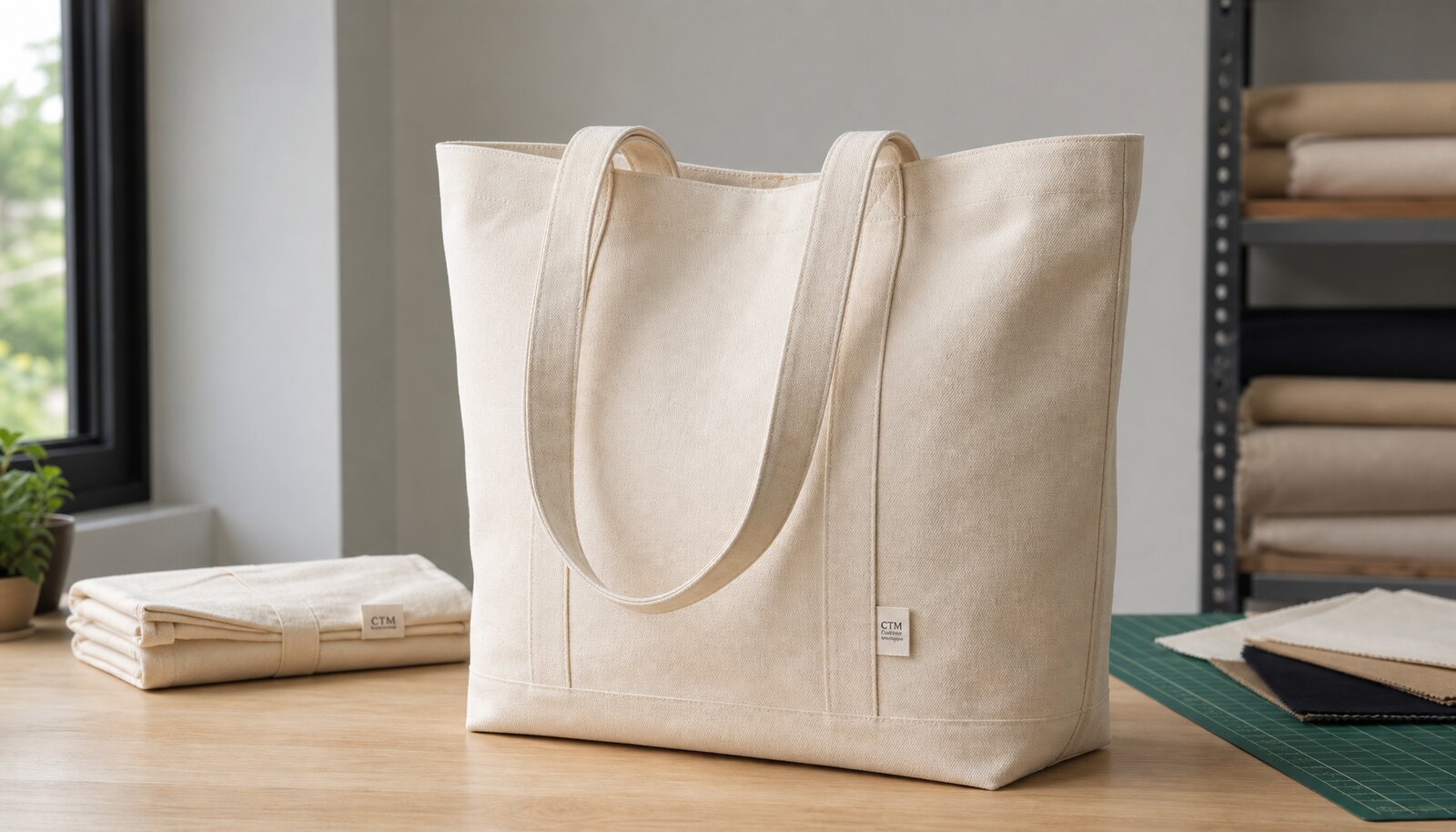
Start With The Business Use, Not The Lowest MOQ
MOQ is not one number that sits outside the product. For wholesale canvas grocery totes for corporate gifting, the minimum is shaped by fabric stock, cutting yield, sewing setup, decoration method, packing material purchases, version count, and the delivery calendar. When procurement opens with only, "What is your lowest MOQ?", suppliers often answer around their easiest standard product rather than the buyer's real program.
A better first brief explains how the tote will be used. A conference handout may be fine with 10 oz natural canvas, one-side screen print, and bulk carton packing. A client welcome gift may need a firmer 12 oz canvas, cleaner panels, tighter folding, and a logo that holds its position when the tote is packed with other items. A grocery promotion needs capacity, a flat or boxed bottom, comfortable handles, and reinforced anchor points. Same broad product name, very different buying risk.
Give the supplier enough commercial context to make useful suggestions. State the audience, target quantity range, delivery date, shipping destinations, presentation standard, and whether this is a first order or a repeatable program. If the tote will hold bottles, notebooks, apparel, food samples, or event materials, include approximate weight and dimensions. Those details help the factory reduce complexity in the right places instead of quietly thinning the fabric, shortening the handle, or changing the construction to reach a lower price.
- Write the intended use in one sentence: event giveaway, employee kit, client gift, grocery promotion, retail-style merchandise, or fulfillment pack.
- Separate must-have performance requirements from nice-to-have presentation upgrades before asking for MOQ concessions.
- Tell the supplier whether MOQ flexibility matters more than unit price, speed, exact brand color, heavier fabric, or retail-ready packing.
Build One Quote Spec Before Comparing Suppliers
The phrase "canvas grocery tote" is too loose for serious quote comparison. One supplier may quote a flat 8 oz tote, another a 10 oz gusseted bag, and another a 12 oz tote with longer handles and stronger bottom construction. The cheapest quote can look attractive until the sample arrives and the structure is wrong for the gift program. Procurement should send one controlled specification to every supplier before discussing price breaks or MOQ.
The specification does not need to be complicated, but it does need to be measurable. Include body width, body height, bottom or side gusset, handle drop, handle tape width, top hem, seam allowance, bottom construction, fabric color, fabric weight, print size, print location, and packing method. Define how measurements are taken: body measured flat, gusset measured at the bottom fold, handle drop measured from top edge to handle apex, and print position measured from the top hem and nearest side seam.
Small construction details often decide whether a tote feels like a gift or a throwaway. A folded top hem usually looks cleaner and gives the handle stitching a stronger base. A wider handle tape can improve comfort when the bag carries groceries or event materials. A boxed bottom helps the tote stand and pack more neatly than a simple flat body. Each upgrade may affect MOQ, so buyers should ask which dimensions are already standard for the factory and which require custom pattern work, special cutting, or new material purchasing.
- Define body width, body height, gusset depth, handle drop, handle tape width, top hem width, seam allowance, print size, and print position.
- State the construction clearly: open top, snap, zipper, inner pocket, flat bottom, boxed bottom, side gusset, bottom board, or no bottom insert.
- Ask which parts of the spec use existing factory standards and which parts create custom setup, higher cutting minimums, or longer lead time.
Choose Canvas Weight With Cost, Feel, And Availability In Mind
Canvas weight is one of the first real MOQ levers. A 10 oz cotton canvas, commonly about 330-360 gsm, is often a practical middle ground for reusable grocery totes, employee kits, and broad event distribution. It can feel sturdy enough for everyday use while keeping material cost and freight weight under control. A 12 oz canvas, commonly about 400-430 gsm, usually feels more substantial and can hold shape better for client gifts, branded merchandise, or welcome kits where handfeel matters.
Weight alone does not tell the whole story. A tightly woven 10 oz fabric can look cleaner than a loosely woven heavier canvas. Natural canvas may show cotton flecks, seeds, and slubs; that may suit an unbleached brand look, but it can also interfere with fine logo detail. Bleached or dyed canvas can create a cleaner branding surface, yet dyed fabric may require lab dip approval, shade control, higher fabric minimums, and extra lead time. The buyer should see swatches before locking the quote basis.
Be precise with material claims. If the program requires recycled cotton, organic cotton, or a defined compliance position, ask what documentation is available and whether it applies to the exact fabric being quoted. Broad wording such as "eco canvas" or "sustainable cotton" is not enough for procurement records. Specialty yarns or certified fabrics may not be available in small quantities, so quote the standard natural canvas base first and price verified material upgrades separately.
- Use 10 oz / 330-360 gsm when broad distribution, utility, and landed-cost control are the priority.
- Use 12 oz / 400-430 gsm when the tote must feel more substantial, stand better, or support a premium gifting position.
- Request fabric swatches, composition details, color options, shrinkage expectations, available test reports, and certificate scope before bulk approval.
Match Decoration Method To Artwork Risk
Decoration can change MOQ as much as the sewing spec. One-color screen printing is often the most stable option for wholesale canvas grocery totes when the artwork is bold, solid, and repeatable. It works well for corporate logos, campaign marks, and programs that may reorder later. The main risk is edge clarity. Canvas texture can soften small type, fill tight counters, and make thin strokes look heavier than they do in a digital proof.
Full-color logos, gradients, photographic artwork, QR codes, and department-level variations require a different conversation. Heat transfer, DTF-style transfer, or digital print may support more colors or lower version quantities, but they need more approval checks: handfeel, edge lifting, cracking, adhesion, dry rub, wet rub, and performance on the selected canvas weight. A transfer that looks clean on a smooth test sheet may behave differently on 12 oz cotton canvas. Approve the decoration on the actual tote material, not on a mockup.
Color control also belongs in the RFQ, not after sampling. Pantone references help, but ink on natural cotton canvas will not match coated paper, uncoated paper, or a backlit screen exactly. If brand color is strict, request an ink drawdown, strike-off, or printed panel and approve it under consistent lighting. If the program can accept a close standard ink, document that choice so the supplier does not chase unnecessary setup changes.
- Use screen print for simple logos, solid artwork, repeat orders, and programs where unit cost and consistency matter.
- Use transfer or digital methods when artwork has many colors, gradients, smaller version quantities, or personalization.
- Approve minimum stroke width, small text, QR code readability, print size, ink coverage, curing, rub resistance, and placement tolerance on actual canvas.
Compare Supplier Routes On The Same Basis
Factory-direct sourcing usually gives the clearest control when the tote has custom construction, strict logo placement, or repeat order potential. A capable factory should be able to explain whether MOQ is driven by fabric rolls, cutting, sewing line setup, printing, packing, or scheduling. If the buyer can accept stock natural canvas, a standard body size, one artwork, and bulk packing, the factory may have room to lower the minimum. If the buyer needs custom dyeing, several body colors, multiple artwork versions, and individual gift packing, MOQ pressure rises quickly.
A trading company can be useful when a corporate gifting program includes several product categories under one PO. The advantage is coordination. The risk is visibility. Procurement should ask for factory disclosure, production photos, inspection access, and line-item costing. The point is not to exclude the trading partner; it is to confirm that the quoted tote is comparable to other offers in construction, material, decoration, packing, and QC responsibility.
Domestic decorators are practical for rush orders and smaller quantities when blank totes are already in stock. This route can solve timing, but it limits product control. The blank tote's size, canvas weight, handle length, color, and print area are fixed by inventory, and the exact blank may change between lots. Before releasing artwork, approve the actual blank inventory that will be decorated. A local decoration quote should not be compared directly against a custom sewn, decorated, packed, inspected, export-ready quote.
- Compare every route using the same tote size, fabric weight, handle spec, gusset, artwork count, print method, packing method, carton count, and delivery term.
- Ask who is responsible if sewing passes but decoration fails, or if decoration passes but carton assortment and labels are wrong.
- Confirm whether cutting, sewing, printing, packing, and inspection are controlled by one supplier or split across subcontractors.
Negotiate MOQ By Constraint, Not Pressure
Useful MOQ negotiation starts with the reason behind the minimum. The constraint may be fabric roll quantity, dyeing lot size, cutting efficiency, sewing setup, screen setup, transfer sheet minimum, packing material purchase quantity, carton labels, or production scheduling. Once the buyer knows the constraint, the negotiation becomes practical. If dyeing drives the MOQ, consider stock natural canvas. If artwork versions drive setup, consolidate departments for the first run. If individual packing drives labor and material minimums, bulk pack at origin and let a fulfillment center kit regionally.
Ask for MOQ at several decision points instead of treating it as one fixed answer. Request a base MOQ for standard natural canvas, one standard size, one-color one-side screen print, and bulk carton packing. Then ask what changes when moving to 12 oz canvas, custom-dyed fabric, two-side print, individual packing, insert cards, or multiple artwork versions. This gives procurement a clear map of which upgrades are worth keeping and which are creating avoidable minimums.
Clarify whether MOQ applies per total order or per SKU. A 3,000-piece order split across three fabric colors, five departments, and two packing labels is not operationally the same as 3,000 identical totes. Each variation adds cutting, printing, packing, labeling, and inspection work. If versioning is required, ask the supplier to quote one version, three versions, and five versions, including how versions will be marked, separated, inspected, and packed.
- Ask, "What is the MOQ for the exact spec, and which single change would reduce it the most?"
- Request MOQ by fabric color, tote size, artwork version, print method, packing type, carton label, delivery destination, and repeat order.
- Use one base SKU for the first order when MOQ flexibility is more important than personalization.
Turn The Quote Into A Cost Table
A serious supplier quote should read like a production document, not just a unit price in an email. Ask for line items covering fabric, cutting, sewing, decoration, packing materials, export cartons, sample fees, screen or setup charges, testing, inspection, and freight terms. Some quotes include export cartons but exclude barcode labels. Some include one sample but charge separately for screens. Some quote FOB while others quote delivered terms. A low unit price may simply mean parts of the requirement are missing.
Freight assumptions matter because canvas totes can be bulky for their value. Carton dimensions, pieces per carton, gross weight, and packing method can change landed cost. A small difference in unit price may disappear once volumetric freight, local handling, duties, cartons, and distribution are included. Procurement does not need every supplier to quote every possible shipping term, but it does need a clear point where cost and responsibility transfer.
Use one RFQ table so gaps are easy to see. The table should include the tote spec, artwork file, target quantity, quantity breaks, delivery address or port, required delivery date, packing instructions, inspection expectations, compliance requirements, quote validity, and Incoterms. Ask suppliers to return the quote in the same structure. If a supplier cannot state fabric gsm, print method, carton count, tolerance, or lead time by production stage, that is execution risk, not just missing paperwork.
- Compare unit price only after confirming fabric, size, handle, gusset, decoration, packing, cartons, inspection, and freight basis.
- Ask whether sample fees, screens, artwork setup, barcode labels, insert cards, hangtags, third-party inspection, and testing are included or excluded.
- Request a quote matrix with base option, heavier fabric option, upgraded packing option, and repeat-order pricing.
Use Samples As Production Proof
The sample stage should prove that the agreed tote can be manufactured, decorated, folded, and packed as ordered. A showroom sample is not enough if it uses different fabric, different thread, different handle tape, different ink, or cleaner workmanship than the factory intends to use for bulk. The preproduction sample should match the planned canvas weight, color, thread, handle tape, reinforcement pattern, decoration method, print size, and packing format. If any material is substituted, approval should be conditional and the open point should be written into the order file.
Review samples with measurements, not just a quick visual check. Lay the tote flat and measure body width, body height, gusset, handle drop, handle tape width, print position, and folded size. Check the logo panel for stains, oil marks, heavy slubs, uneven weave, loose threads, needle damage, print ghosting, and distorted seams. Pull the handles by hand and look for stitch movement or opening. Fill the tote with a realistic load so the team can see whether the bottom shape, handle comfort, and logo presentation still work in use.
After approval, the sample becomes the production reference. Keep a signed golden sample when possible. If approval is remote, build a digital approval file with front, back, gusset, handle, seam, print close-up, folded view, carton label, and packing photos. Include measurements, fabric swatch image, color reference, and any accepted deviations. Share the same file with procurement, marketing, supplier quality, fulfillment, and any third-party inspector so the order is judged against one target.
- Do not approve an important program from a rendered mockup alone; require a printed or decorated sample on the selected canvas.
- Record measurements and tolerances at sample stage so bulk inspection can use objective pass/fail criteria.
- Approve the tote empty, filled, folded, and packed because each view reveals different risks.
Set QC Tolerances Before Bulk Cutting
Quality control is much easier before fabric is cut than after cartons are sealed. Canvas grocery totes have predictable defect areas: wrong fabric weight, uneven dimensions, twisted seams, weak handle stitching, print drift, ink smudging, dirty front panels, inconsistent folding, incorrect carton counts, and mixed versions. These can be converted into inspection points instead of left as vague expectations. Procurement should define critical, major, and minor defects based on the channel, brand sensitivity, and recipient experience.
Use concrete tolerances wherever possible. Body width and height may be controlled within plus or minus 5 mm to 10 mm depending on bag size. Handle drop may be plus or minus 10 mm. Fabric weight is commonly checked within plus or minus 5 percent unless the buyer sets a stricter rule. Corporate logo placement may need plus or minus 3 mm to 5 mm from the approved position. Tighter tolerances can be valid, but they should be agreed before costing because they may affect price, inspection failure rate, and production feasibility.
Ask how the supplier checks quality in-line, after decoration, and before shipment. In-line checks catch sewing problems before thousands of pieces are finished. Decoration checks catch print defects before folding hides the front panel. Final inspection confirms dimensions, logo placement, stains, loose threads, packing, carton marks, and quantities. For higher-value or time-sensitive orders, third-party inspection can be useful, but only if the inspector receives the spec sheet, approved sample photos, defect definitions, and packing instructions.
- Set tolerances for body dimensions, gusset depth, handle drop, fabric gsm, print position, print color, stitch density, stains, loose threads, and carton quantity.
- Require handle stress checks on random units, especially when the tote is promoted as grocery, utility, or reusable merchandise.
- Inspect logo panels before folding and packing because stains, misprints, and ink marks are easier to catch while the bag is flat.
Control Packing, Cartons, And Versioning
Packing is not an afterthought. It is a cost driver, MOQ driver, and presentation decision. Bulk folding in export cartons is usually the simplest choice for internal distribution or fulfillment kitting. It uses fewer materials, reduces labor, and creates fewer version-control points. But bulk packing may not work when the tote must arrive ready for direct handout, direct mail, retail display, or premium gift presentation. Choose the packing method based on the distribution model, not at the end of production.
Individual polybags, paper bands, tissue, insert cards, hangtags, barcode labels, and retail folding all add steps. Each step can create a material minimum and a new defect category. If an insert card is required, specify dimensions, paper weight, print sides, language version, and placement. If barcode labels are required, define barcode type, label size, label position, SKU logic, and whether carton labels must match inner labels. If multiple departments or regions use different artwork, version control must be built into packing and inspection from the start.
Cartons affect freight and downstream handling. A carton that is too large may increase volumetric freight cost; a carton that is too tight may crease totes or distort printed panels. Define pieces per carton, fold direction, inner pack, master carton dimensions, carton marks, gross weight, and moisture protection. For natural cotton canvas, dirt and humidity control matter during storage and transit. Ask for packed carton photos or a packing sample before mass packing begins, especially when the order ships directly to events or multiple business units.
- Choose bulk packing when the priority is lower cost, simpler MOQ, fewer labels, and internal or fulfillment-center distribution.
- Choose individual packing only when presentation, direct handout, direct mail, or retail handling truly requires it.
- Approve a packing sheet covering fold direction, pieces per carton, insert placement, barcode labels, carton marks, assortment, and moisture protection.
Specification comparison for buyers
| Decision area | Recommended buying position | When it fits | Procurement risk to control |
|---|---|---|---|
| Supplier route | Factory-direct supplier with disclosed sewing, decoration, and packing control | Repeat corporate gifting programs, custom tote size, controlled construction, or strict logo placement | Confirm whether printing, cutting, sewing, and packing are in-house or subcontracted; assign one accountable owner for sample approval, bulk QC, and corrective action |
| Supplier route | Trading company with factory disclosure and line-item costing | Programs that combine totes with other gift items under one PO or require sourcing coordination across categories | Hidden margin can sit in freight, packing, or sample fees; request factory name, production photos, inspection access, and cost separation |
| Supplier route | Domestic decorator using imported blank totes | Small rush orders, local event deadlines, or simple logo decoration on available stock blanks | Blank dimensions, fabric weight, handle length, and print area may change by lot; approve the exact blank inventory before artwork release |
| Fabric weight | 10 oz canvas, typically about 330-360 gsm, with reinforced handle anchors | Broad event distribution, employee kits, grocery promotions, and cost-controlled corporate gifting | Loose weave can feel thin even at the stated weight; check gsm, weave density, shrinkage, slubs in logo area, and handle stress points |
| Fabric weight | 12 oz canvas, typically about 400-430 gsm, with boxed bottom or flat bottom gusset | Client gifts, retail-facing branded merchandise, welcome kits, or programs where handfeel matters | Higher material weight can raise unit cost, freight cost, needle wear, and MOQ if stock fabric is unavailable |
| Construction | Open-top grocery tote with folded top hem, boxed bottom, side seams, and bar-tacked handles | Most practical default for groceries, documents, apparel, snacks, and event materials | Define seam allowance, gusset depth, handle drop, stitch density, and reinforcement pattern; weak anchors are a common failure point |
| Decoration | One-color screen print on one side with approved ink and placement tolerance | Best for bold logos, campaign marks, repeat orders, and unit-cost discipline | Fine text can fill in on canvas; approve minimum stroke width, ink coverage, print size, curing, rub resistance, and placement tolerance |
| Decoration | Heat transfer, DTF-style transfer, or digital print on actual canvas sample | Low MOQ, full-color artwork, gradients, or multiple department versions under one program | Check handfeel, edge lifting, cracking, wash/rub performance, and adhesion on the selected canvas weight |
| Packing | Bulk fold in export cartons with fixed fold direction and carton count | Internal distribution, fulfillment kitting, and lowest packing complexity | Presentation can vary if folding is not documented; define pieces per inner pack, carton marks, moisture protection, and barcode labels |
Buyer checklist before sampling
- Issue one controlled RFQ before negotiating MOQ: body width, height, gusset depth, handle drop, handle tape width, top hem, seam allowance, closure, and bottom construction.
- Specify canvas by both oz and gsm, such as 10 oz / 330-360 gsm or 12 oz / 400-430 gsm, and state whether the fabric is natural, bleached, dyed, recycled cotton, organic cotton, or a blend.
- Define practical tolerances before quoting: body dimensions plus or minus 5 mm to 10 mm, handle drop plus or minus 10 mm, fabric weight plus or minus 5 percent, and print placement plus or minus 3 mm to 5 mm depending on artwork sensitivity.
- Attach vector artwork and state print method, print size, side, position from top edge and side seam, number of colors, Pantone or brand reference, minimum stroke width, and whether small text or QR codes must scan.
- List every add-on before quote comparison: inner pocket, zipper, snap, bottom board, woven label, care label, hangtag, insert card, custom handle color, contrast stitching, barcode label, or individual packing.
- Ask for MOQ by version, not only order total: per fabric color, per tote size, per artwork, per print method, per packing format, per label language, and per carton mark.
- Request a cost table separating fabric, cutting, sewing, decoration, packing materials, cartons, sample fees, screens/setup, testing, inspection, freight, and duties or taxes when quoted under delivered terms.
- Identify the real MOQ driver: fabric roll minimum, dyeing lot, cutting yield, sewing line setup, print setup, packing material purchase minimum, carton minimum, or production scheduling.
- Approve a preproduction sample made with the same fabric weight, fabric color, thread, handle tape, reinforcement method, decoration process, and packing format as bulk production.
- Retain a signed golden sample or approval file with measurements, photos, fabric swatch, print close-up, color reference, carton label, packing sheet, and any agreed deviations.
Factory quote questions to send
- What is the MOQ for one tote size, one fabric weight, one body color, one artwork, one print method, and one packing method?
- Is MOQ counted per total order, per SKU, per fabric color, per artwork, per print color, per packing version, per carton label, or per delivery destination?
- Can you provide a line-item quote for fabric, cutting, sewing, printing, packing materials, cartons, samples, screen/setup charges, testing, inspection, and freight terms?
- Which specific factor sets the MOQ: ready fabric stock, custom weaving, fabric dyeing, cutting loss, sewing line efficiency, screen setup, transfer sheet minimum, packing material MOQ, carton minimum, or schedule slot?
- What price, MOQ, and lead-time changes occur if we move from 12 oz to 10 oz canvas, dyed canvas to natural canvas, or multi-color decoration to one-color screen print?
- What is your lowest practical MOQ if we use your standard tote size, natural stock canvas, standard handle length, one-side one-color print, and bulk carton packing?
- Can you quote a base option and two upgrade options showing the exact cost impact of heavier fabric, individual packing, extra print colors, woven labels, or insert cards?
- What are your production tolerances for body width, body height, gusset depth, handle drop, handle width, fabric gsm, print placement, print color, stitch density, and carton count?
- Will the preproduction sample use the same fabric lot, thread, handle tape, ink or transfer material, curing process, and packing method planned for bulk?
- How do you control shade variation between fabric rolls, and will mixed fabric lots be allowed within one order?
Quality-control points to confirm
- Fabric weight should be checked against the approved spec within the agreed tolerance, commonly plus or minus 5 percent unless the buyer sets a stricter requirement.
- Body width, body height, gusset depth, handle drop, handle tape width, seam allowance, and print position should be measured from random units against the approved sample and inspection sheet.
- For common B2B tolerances, body dimensions may be set at plus or minus 5 mm to 10 mm, handle drop at plus or minus 10 mm, and logo placement at plus or minus 3 mm to 5 mm depending on brand requirements.
- Handle anchors should use the approved reinforcement, such as bar-tacks, box stitch, or cross stitch, with no skipped stitches, open seams, needle cuts, or loose thread clusters at stress points.
- Stitch density should be consistent across handles, top hem, side seams, and bottom gusset; record the agreed stitches per inch or stitches per centimeter if the buyer has a durability requirement.
- The tote should sit square when lightly filled, with side seams and gusset seams aligned; twisting, uneven bottom shape, or visibly skewed panels should be classified before inspection.
- Screen print or transfer placement should stay within the agreed tolerance from top edge and side seam, and logo angle should be checked so a straight logo does not appear tilted on the front panel.
- Logo edges should match the approved strike-off; small text, fine lines, QR codes, and reversed artwork require extra approval on actual canvas because weave texture can reduce clarity.
- Print color should be checked against the approved Pantone, ink drawdown, strike-off, or buyer reference under consistent lighting, with natural canvas color considered in the approval decision.
- The visible logo panel should be free from oil marks, water stains, dirt, adhesive residue, heavy slubs, needle damage, misprints, ghosting, scorch marks, and visible handling marks.