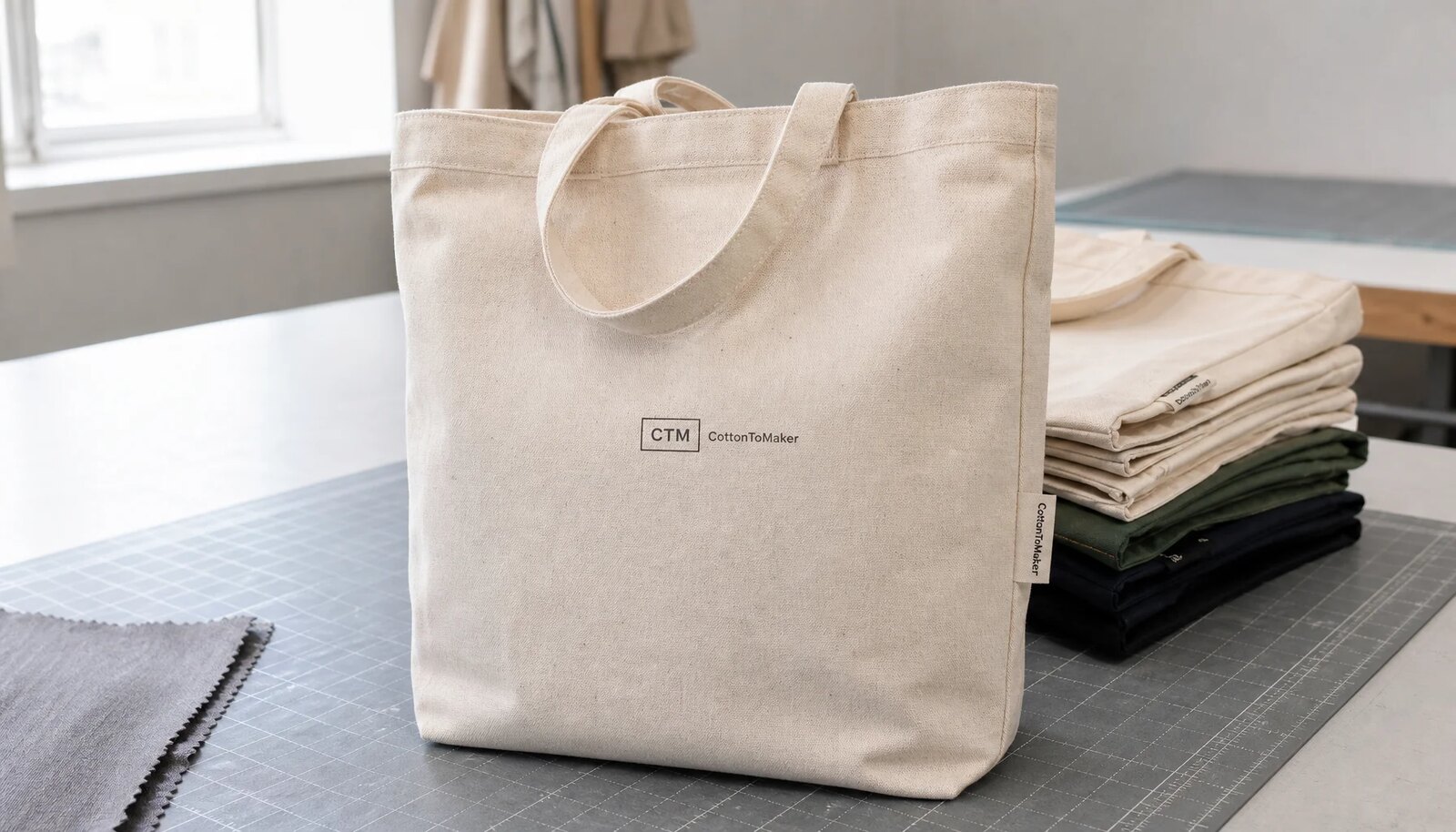
Why lead time for grocery totes is different from other cotton bag programs
A canvas grocery tote looks simple, but the schedule is driven by more than sewing time. For coffee roasters, the order often includes brand printing, a specific handle drop, carton labeling, and retail or wholesale packing. That means lead time starts with fabric readiness, not just the sewing line. If the factory has to source canvas, confirm the print screens, and revise artwork, the calendar expands quickly even when the bag itself is plain.
Buyers usually get burned when they compare only the factory production days and ignore pre-production work. A quote that says 20 days may still become 30 or 35 days once you add fabric reservation, sample approval, and packing changes. The right way to plan this item is to treat it as a short production chain: fabric, cut and sew, print, inspection, packing, and outbound booking. Each step can absorb time if the specification is not frozen early.
- Do not treat a canvas grocery tote as a stock blank if the print, size, or packing is custom.
- Lead time risk is usually created by artwork approval and packing detail, not by the sewing itself.
- For seasonal coffee promotions, use the ship date, not the order date, as the planning anchor.
Spec choices that change schedule and cost the most
The biggest schedule lever is fabric weight. A 10 oz canvas tote is often fast and economical, while a 12 oz tote usually feels better in hand and carries heavier retail loads. Once you move into heavier canvas, the factory may need stronger needles, slower sewing speed, and more careful trimming. That is still manageable, but it is not the same production profile as a light promo bag. If the tote is intended for coffee beans, merch, or bundled retail goods, the buyer should decide whether structure matters more than unit price.
Print method is the second major lever. Screen print is the normal choice for volume because it is repeatable and efficient for simple branding. Heat transfer can work for short runs or multicolor art, but it adds process sensitivity and is more vulnerable to handling damage during packing. Embroidery is rare for large grocery totes because it adds labor and can distort the fabric surface. When a coffee roaster wants a premium retail feel, it is usually better to upgrade fabric and handle construction before chasing a complicated decoration method.
- 10 oz canvas: lower cost, lighter hand, faster to source.
- 12 oz canvas: better structure, better shelf presentation, slightly longer make time.
- One or two spot colors: easiest for screen print and fastest to approve.
- Heavy graphics or full-color art: expect more sample iterations and tighter inspection on registration.
How to compare supplier options without comparing the wrong quote
Not every quote comes from the same sourcing route. A direct factory quote usually gives the buyer more control over fabric, sewing, printing, and packing, but it may require clearer specifications and more lead time discipline. A trading company can respond quickly and may simplify communication, but the production source can still be a separate factory with its own backlog and constraints. If a quote is much cheaper, you need to understand whether it excludes print setup, carton work, or export packing, because that is where the margin often disappears later.
The useful comparison is not just price per tote. It is price, lead time, MOQ, sample access, and what is actually included in the production scope. A supplier that can show recent tote runs, real QC photos, and carton pack examples is usually easier to manage than one that only sends a clean PDF. For coffee roasters, the best option is often the supplier that can repeat the same tote consistently across restocks, not the one that gives the lowest first order quote.
- Direct factory: better for repeat programs and tighter spec control.
- Trading company: useful when you need speed, bundling, or multi-item sourcing.
- Regional stock holder: fastest for urgent launch dates, but customization is limited.
- Low quote with vague inclusions should be treated as a risk flag, not a win.
What a clean RFQ should include before you ask for lead time
Most lead time arguments start because the RFQ is missing something basic. A complete request should state finished size, canvas weight, handle length, print placement, quantity, carton requirements, and the ship window. If you do not specify whether the tote is single-layer or lined, the supplier may quote based on their assumption and later revise the schedule when your packing or retail presentation changes. For coffee roasters, this matters because the tote may need to carry product bundles, gift sets, or subscription inserts, which changes both strength and packing time.
You also need to define the quote basis. Ask the supplier to separate unit price, setup fee, sample fee, and freight assumptions. If the factory bundles everything into one price, you cannot tell whether the lead time is being held hostage by a print setup delay, carton shortage, or art correction. A tight RFQ reduces back-and-forth and gives you a cleaner date commitment. It also makes the quotes from different factories comparable on the same production basis.
- Finished size and tolerance.
- Canvas GSM or ounce weight.
- Handle length, stitching detail, and reinforcement points.
- Artwork file format, print colors, and placement dimensions.
- Pack count per carton and barcode or label requirement.
- Target order date, target ship date, and destination port or warehouse.
Sample approval should be treated as a schedule gate, not a formality
For custom canvas grocery totes, the first sample is not only about appearance. It is the moment to prove that the handle length works, the print sits correctly, and the tote stands up in a retail or wholesale use case. A buyer should review the sample with the actual fill scenario in mind. If the bag will hold coffee bags or bundled retail goods, put weight inside it and see whether the seam pulls, the mouth opens too much, or the bag loses shape. That tells you more than a tabletop photo ever will.
The approval sequence should start with fabric confirmation if the canvas is dyed or if the hand feel matters. Then review the pre-production sample, not just a printed art proof. If the sample is off on color, measurement, or print placement, correct it before bulk cutting begins. A one-week delay at sample stage is usually cheaper than a full lot reprint or a pallet of rejected goods. For many coffee roasters, the main production mistake is approving a bag that looks fine in a photo but fails in real handling.
- Test the tote with real filler weight, not empty.
- Measure handle drop and mouth width against the approved spec.
- Inspect print edges under normal light, not only in a digital proof.
- Get written sign-off on the approved sample version before bulk starts.
MOQ logic and why the lowest minimum is not always the best path
MOQ for canvas grocery totes is usually shaped by fabric consumption, print setup, and sewing efficiency. A simple unprinted tote can often run at a lower minimum than a custom printed tote, because the factory is not spending time on screens, color matching, or packing changeovers. Once you add a custom logo and special labels, the minimum can rise because the factory wants the line to run efficiently and recover setup time. That is normal, not a penalty. The practical buyer question is whether the MOQ aligns with your sales velocity and storage capacity.
If you are testing a new tote with a coffee launch, do not force a large MOQ just to get a slightly lower unit price. The hidden cost of overbuying is storage, obsolescence, and cash tied up in a design that may change next quarter. On the other hand, a too-small order can be expensive if the supplier must charge a high setup fee or source partial fabric lots. The right balance is usually a quantity that allows efficient cutting and printing while still matching your forecast and replenishment cycle.
- Lower MOQ is useful for launch tests, but it often raises the unit price.
- Higher MOQ can reduce price if the artwork and packing are stable.
- Ask for tiered pricing at two or three quantity points to see the real step-down.
- Do not compare MOQ without also comparing sample, setup, and carton work.
Packing details that quietly add days to the schedule
Packing is where otherwise simple tote orders get delayed. If the buyer needs individual polybags, printed inserts, barcode stickers, assorted set packing, or master carton markings for a retail warehouse, the factory must allocate extra labor and quality time. Those tasks are not hard, but they are easy to underquote. A bag that is packed loose in bulk can move quickly; a bag that must be folded to exact dimensions and labeled for retail receiving needs more handling time and a clearer packing instruction sheet.
For coffee roasters and distributors, packing should be decided before production begins. If the totes are going into a warehouse system, the carton count and carton dimensions should fit the inbound receiving rules. If they are going to a retail program, the barcode placement, inner pack count, and hangtag or insert card format need to be fixed early. The fastest tote order is the one that does not force the line to stop and ask how the bags should be folded, counted, or labeled.
- Bulk pack is fastest and cheapest when retail presentation is not required.
- Polybag and insert cards add time and labor, but they reduce warehouse handling confusion.
- Carton marks should match the buyer PO and item code exactly.
- If you need retail-ready packing, include a folding standard in the RFQ.
Lead time planning from launch date backward
The most reliable planning method is to start with the launch or warehouse receipt date and work backward. If the totes are part of a coffee promotion, a subscription bundle, or a seasonal retail reset, the ship date is not the real deadline. You need time for inland transit, port handling, customs, and warehouse receiving. A factory that promises a 20-day production window may still be a poor fit if you need the goods in a store two weeks after shipment. That is why buyers should build a schedule with fixed checkpoints rather than trusting one final date.
A realistic order timeline usually includes brief but non-zero time for sampling, approval, material prep, production, inspection, and freight booking. Even if each step is only a few days, the total adds up. Buyers who create a buffer of 2 to 4 weeks around the quoted production days are usually better protected against art revisions, fabric shortages, or packing changes. The goal is not to pad the schedule. The goal is to avoid turning a normal production issue into a missed launch.
- Launch date minus freight and receiving time gives your real ship deadline.
- Sample approval should happen before the bulk fabric is cut.
- Build in buffer if the season is busy, especially Q4 or trade show periods.
- If the supplier cannot explain their step-by-step calendar, the date is not reliable.
Landed cost is the real buying decision, not factory price alone
For wholesale canvas grocery totes, landed cost can change materially depending on the sourcing route and packing scope. A low ex-factory quote can become expensive once you add sample revisions, export cartons, special folding, inland trucking, or a slower freight method. A slightly higher factory quote may actually be the better buy if it includes cleaner packing, fewer defects, and fewer last-minute corrections. For a buyer managing coffee retail or distributor replenishment, predictability is worth money because missed availability costs more than a small unit-price gap.
A useful comparison is to ask each supplier to quote the same program on the same basis. Use the same fabric weight, print count, packing style, and delivery term. Then compare not just the line-item total but also the probability of rework. A factory that gives a tighter, more complete quote often saves you time in both production and receiving. The cheapest quote is only cheap if it arrives on time and passes inspection without hidden changes.
- Compare unit price after setup, packing, and sample fees.
- Include freight and warehouse handling when evaluating the true landed cost.
- Assign a value to schedule risk if the bags are needed for a fixed launch.
- Repeat-order stability is often more valuable than first-order savings.
Red flags that usually turn into delay or rework
There are a few signs that a canvas tote order will slip. One is a quote that avoids stating fabric weight, print method, or packing scope. Another is a supplier who sends only a generic sample image but cannot show recent production photos or carton examples. A third is a factory that accepts every change without asking how it affects schedule. That can feel convenient, but it often means the production plan is not real yet. When the supplier says yes too quickly, the buyer often pays for it later in corrections or missed dates.
The best prevention is not aggressive oversight. It is forcing clarity up front. Once the tote spec, sample, and packing standard are approved, the order becomes much easier to run. Coffee roasters that treat the tote as a controlled production item, not a casual promo accessory, usually get better consistency and better replenishment performance. In this category, disciplined buying reduces both defect risk and stockout risk.
- Vague quote language on fabric, print, or packing.
- No written sample approval step.
- No clear answer on what happens if artwork changes after confirmation.
- No carton plan or shipping basis in the commercial quote.
Specification comparison for buyers
| Spec decision | Recommended option | When it fits | Buyer risk to check |
|---|---|---|---|
| Fabric weight | 10 oz to 12 oz canvas | Daily grocery use, decent structure, balanced cost | Too light can bag out; too heavy increases cost and longer sewing time |
| Handle build | Cross-stitched handles with 22 to 24 inch total drop length | Retail-ready tote that carries bottled goods or coffee bags | Short handles reduce usability; weak reinforcement can fail in field use |
| Print method | 1 to 2 color screen print for volume, heat transfer only for short runs | Simple branding and repeat orders with stable artwork | Complex art may need more setup time or tighter registration tolerance |
| Construction | Single-layer canvas with inside hems or partial lining if needed | Standard grocery tote programs where cost and lead time matter | Unfinished interior edges or loose seam allowances cause returns and complaints |
| Supplier route | Direct factory with in-house printing and packing | Medium to high volume buyers who need tighter control | If printing is outsourced, schedule risk and communication errors rise |
| Sample path | Pre-production sample plus bulk fabric swatch approval | Orders with custom color, logo placement, or gift packaging | Skipping fabric approval can create shade variation or wrong hand feel |
| Packing format | Bulk polybag by count with carton labels and carton marks | Wholesale and distributor shipments with warehouse receiving | Retail-ready sets may need inserts or barcode work that changes labor time |
| Lead time plan | Build 2 to 4 weeks of buffer over factory quoted days | Seasonal launches, coffee subscription promos, or retail resets | Port congestion, print corrections, and sample delays often eat the buffer |
| Supplier profile | Factory with recent tote production references and clear QC photos | Buyers who need predictable repeat lots | A trading company may quote faster but hide the real production bottleneck |
Buyer checklist before sampling
- Confirm finished size, fabric weight, handle length, seam type, and whether the tote is single-layer or lined.
- Lock artwork files, print colors, logo placement, and acceptable color variance before sampling starts.
- Ask for a pre-production sample, bulk fabric swatch, and carton pack plan before releasing the order.
- State target ship date, delivery window, and the freight mode you plan to use so the factory can work backward.
- Request an order-specific QC standard for stitch strength, print registration, and measurement tolerance.
- Clarify carton count, carton size limit, barcode needs, and whether inner polybags are required.
- Compare quotes on the same basis: fabric GSM, print method, packing, sample fees, and lead time exclusions.
- Reserve buffer time for artwork correction, sample approval, and any reprint or rework if the first sample misses spec.
Factory quote questions to send
- What fabric weight, weave density, and shrinkage range are you quoting for the tote body?
- Is printing done in-house, and how many colors are included in the quoted setup and unit price?
- What is the standard lead time after sample approval, and what events would extend it?
- How many days are needed for a pre-production sample, and is the sample fee creditable against bulk?
- What are the MOQ levels for stock color canvas, custom dyed canvas, and custom printed artwork?
- What packing format is included in the quote: bulk pack, polybag, insert card, barcode, or master carton labels?
- What measurement tolerances and stitch standards do you use for first article and final inspection?
- What freight terms are assumed in the quote, and what is excluded from the factory price?
Quality-control points to confirm
- Finished size within agreed tolerance, typically plus or minus 0.5 inch for a simple grocery tote unless your program needs tighter control.
- Fabric weight confirmed against the approved swatch, with no obvious thin spots, broken yarns, or uneven dye on dyed canvas.
- Handle attachment reinforced at the same stitch count and pattern on every tote, with no skipped stitches or loose thread tails.
- Print position centered within the approved artwork window, with acceptable registration and no pinholes, smears, or washout on the print.
- Seams straight and closed, with seam allowance consistent and corners trimmed cleanly to avoid bulk or fraying.
- Carton pack count correct, cartons labeled clearly, and any inner packaging or inserts matching the packing instruction sheet.
- Random sample pull from each carton lot for measurement, print, and construction review before release for shipment.