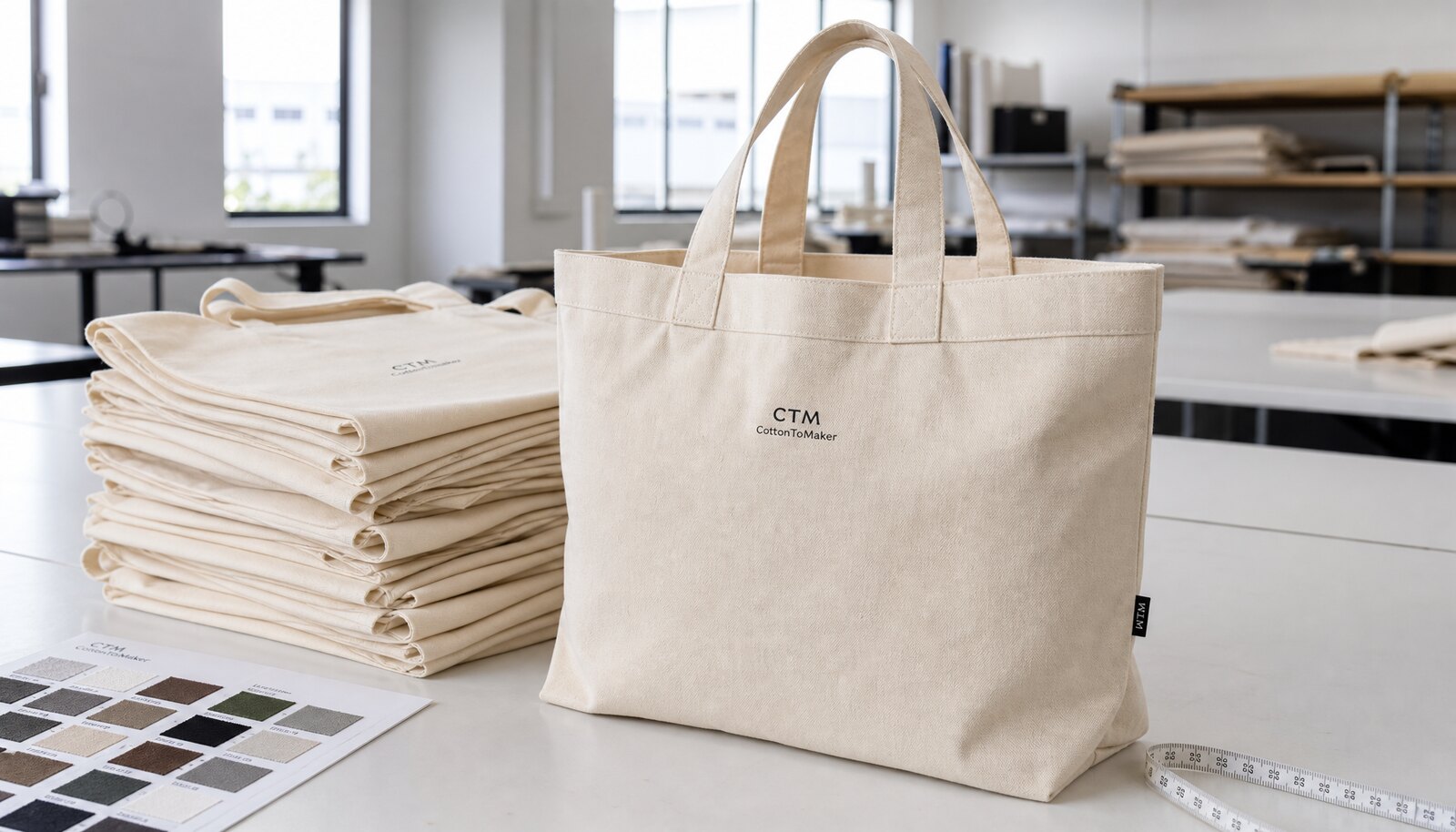
Why a winery tote order needs procurement discipline, not just style taste
Boutique wineries often buy canvas grocery totes for three different reasons: resale in the tasting room, gift-with-purchase programs, and branded carry bags for events or club shipments. Those use cases sound similar, but they stress the product differently. A tote that looks charming on a shelf may still fail when a customer loads two wine bottles, a brochure, and a few groceries. If procurement treats the bag as a simple promotional item, the business ends up paying for avoidable defects later.
The practical risk is not abstract. Canvas that is too soft can look premium in a sample photo and still collapse under load. Handles that feel wide enough can still be stitched with poor reinforcement. A logo that looks crisp in a PDF can crack after folding, rubbing, or carton compression. For winery programs, the tote becomes part of the brand experience, so quality problems are visible to the customer in exactly the place you least want them: at point of sale and in repeated use.
This is why sourcing needs a buyer workflow. You need a spec that a factory can build, a sample that mirrors production, a QC plan that catches the right defects, and a quote comparison method that removes hidden variables. The goal is not to buy the cheapest canvas bag. The goal is to buy a tote that holds up in retail, travels well, and can be reordered without re-learning the same lesson every season.
- Retail and gift programs need a cleaner finish and tighter size control than a free giveaway bag.
- Bottle-carry use creates stronger requirements for handles, bottom seams, and load behavior.
- The tote is part of brand presentation, so cosmetic defects matter as much as functional ones.
Start with fabric weight, finish, and real-world feel
For wholesale canvas grocery totes for boutique wineries, the safest starting point is usually 10 oz to 12 oz canvas, roughly 340–410 GSM. That range is broad enough to fit most retail programs without forcing a buyer into a rigid, overly expensive bag. Ten-ounce cloth is usually the more economical choice when the tote is folded flat for merchandising or used for lighter grocery loads. Twelve-ounce cloth generally gives a more premium handfeel and better upright structure, which many wineries prefer when the tote is displayed beside wine accessories or seasonal gift sets.
But weight alone is not enough. Buyers should ask how the cloth is finished. Preshrunk or controlled-finish canvas reduces dimensional drift after printing, pressing, or humid storage. Light calendaring can make the surface cleaner for printing, but over-calendered fabric may reduce ink absorption and change how the bag ages. If the supplier only says ‘canvas,’ you are not comparing a real specification; you are comparing assumptions.
The right question is not whether a fabric is ‘good.’ It is whether the finished fabric behaves correctly for your channel. A tasting-room retail tote needs to look neat on display, survive repeated handling, and keep its shape after being folded into a club shipment. A promotion tote may tolerate a softer hand and looser structure, but a resale bag usually cannot. Build that use case into the spec before you ask for quotes.
- 10 oz is usually better for lower-cost retail or event use.
- 12 oz is usually better for premium resale and stronger shape retention.
- Ask whether the fabric is preshrunk, washed, calendared, or left unfinished.
- Request a finished-weight tolerance, not a vague fabric description.
Choose the tote structure based on how the winery will use it
The same bag shape does not work equally well for every winery program. A flat tote with simple side seams is often enough for brochures, single-bottle purchases, or light retail items. A gusseted tote is more practical when the bag has to carry bottles, boxed sets, or mixed grocery goods. The gusset gives volume, but it also changes seam load and how the bag stands on a retail shelf. That means the structure affects both performance and presentation.
Handle drop is another detail buyers often under-specify. If a guest may carry the tote over the shoulder between tastings and the car, handle drop becomes a comfort issue. If the bag is mostly handed over at checkout, a shorter drop may still be acceptable. In procurement terms, the handle is not just a dimension; it is part of the use case. Ask the supplier to quote the same bag with the same handle material but different drop lengths if you are deciding between gifting and retail resale.
Top hem construction also matters. A clean turned hem gives a more finished look and reduces raw edge exposure. A reinforced top opening can help the bag hold form and reduce distortion after repeated loading. For a winery program, this is usually worth paying for if the tote will be displayed as a premium accessory rather than handed out as a simple promo item.
- Flat tote: simpler and cheaper, but less useful for bottle volume.
- Gusseted tote: better for mixed contents and bottle-friendly capacity.
- Longer handle drop improves shoulder carry and customer comfort.
- A reinforced top hem improves appearance and long-term shape retention.
Compare sourcing routes the way a procurement team should, not the way a sales email suggests
A factory-direct quote and a trading-company quote can both look professional, but they do not control risk in the same way. Direct factories usually give better visibility into sewing methods, print repeatability, and how a reorder will behave six months later. That is useful when the winery wants the same tote every season or needs a stable look for a club program. Trading companies can be helpful when the buyer needs multiple styles, mixed cartons, or a smaller trial order, but they can also obscure which factory actually makes the bag and what quality system is really in place.
The mistake is comparing only unit price. A lower quote may exclude inner polybags, carton labels, pre-shipment inspection, or even the exact print process. Another supplier may include those items and still not be cheaper once the landed spec is normalized. Buyers should force every quote onto the same basis: same fabric, same artwork size, same handle build, same packaging, same inspection expectation. Without that, the spreadsheet is not a comparison; it is a list of different products that happen to share a name.
A practical sourcing rule: if the order will repeat, favor the route that gives you the most repeatability and the cleanest version control. If the order is exploratory, seasonal, or multi-SKU, a trading route can be efficient as long as you verify the actual maker, the production site, and the QC process. Either way, ask for production photos and reference samples from the same factory line if the supplier claims they have made similar canvas totes before.
- Direct factory is usually stronger for repeat orders and tighter process control.
- Trading companies can help with mixed programs, but verify the real factory.
- Normalize quotes for packaging, inspection, and artwork before comparing price.
Build the RFQ so every supplier quotes the same tote
If you send out a one-line request for a ‘canvas grocery tote with logo,’ you will get a pile of non-comparable answers. One supplier will assume flat seams, another will assume folded edges, and a third may quote a totally different handle build. Procurement teams need an RFQ that looks more like a production brief than a marketing note. The supplier should know the final size, fabric target, construction method, logo placement, packaging, and acceptable tolerance before they price the job.
For a winery order, the most important dimensions are usually finished width, finished height, gusset depth, and handle drop. Those values should be stated after sewing and pressing, not as cut dimensions. If you care about bottle carry, ask for the bag to be dimensioned around the real contents, not around a generic retail tote. Artwork should also be pinned down in production terms: exact print size, location from the seam or hem, Pantone references if applicable, and whether the artwork is one-sided or two-sided.
This level of detail helps the supplier quote responsibly and protects you during inspection. If the finished tote arrives 2 cm shorter than planned or the logo sits too close to the seam, the disagreement is much harder to resolve if you never wrote the rule down. The more you define at RFQ stage, the fewer surprises you will manage in production.
- State finished size after sewing, not cut size.
- Specify logo position in centimeters from a seam or hem.
- Ask for construction details: seam type, reinforcement, and thread color.
- Include packaging and carton-marking requirements in the RFQ.
Print method tradeoffs: cost, durability, and visual finish
For most boutique winery logos, screen printing remains the workhorse option. It is usually the best balance of cost and durability when the artwork is simple, the color count is low, and the order is large enough to justify setup. Screen print also tends to give a more retail-ready look on canvas because the ink sits cleanly on the surface when properly cured. That said, it only works well when the factory controls registration, ink thickness, and cure time. A bad screen-print process can leave a print that cracks, feels tacky, or looks uneven at the edges.
Digital printing and transfer methods are useful when the design is more complex, when the buyer wants multiple colors, or when the order is too small to absorb the setup cost of screens. The tradeoff is that the print may feel different on the bag, and some transfer systems can age less gracefully under folding and abrasion. For a winery, this matters because totes are often stored flat, moved in and out of cartons, and handled by customers before they are ever fully used. The print has to survive the life of the packaging, not only the first day on display.
The procurement-safe approach is to ask exactly how the print is made, what inks or films are used, how curing is checked, and what the supplier considers acceptable for rub resistance or wash performance. If you plan to sell the tote as a retail product, not just a promotional item, those details become more important. A tote that looks fine in a photo but fails after handling is a return and brand issue, not just a print defect.
- Screen print is usually best for simple, repeatable winery logos.
- Digital or transfer is better for complex art or smaller test runs.
- Ask what ink system is used and how curing is verified.
- Do not approve artwork before confirming print size, placement, and finish.
What a production-representative sample should prove before bulk starts
A sample is only useful if it predicts production. That means the sample should use the same fabric weight, the same handle material, the same print method, the same seam construction, and the same packaging as the bulk order. If the supplier sends a hand-finished showpiece made by a skilled sample room but bulk will be stitched in a different line, you are approving the wrong thing. In that case, the sample is a sales object, not a production reference.
When you inspect the sample, start with measurement. Check height, width, gusset, handle length, handle drop, logo position, and any label placement. Then look at alignment and finish quality: are the top hems even, are the seams straight, is the bottom panel square, and is the print centered consistently? Finally, test the product in the way a winery customer would actually use it. Put in bottles or equivalent weight, lift it by the handles, carry it a short distance, set it down, and check for permanent stretch or seam creep.
A strong sample approval memo should record what was measured, what was acceptable, and who approved the result. That memo protects both buyer and supplier. If the production run later drifts, you have a reference for where the deviation started. In repeat orders, this is one of the simplest ways to avoid disputes over whether the second batch matches the first.
- Use a production-representative sample, not a generic mock-up.
- Measure finished size, handle drop, print placement, and label location.
- Perform a real load check with the intended use weight.
- Record approval in writing with photos and measured values.
Set QC thresholds the way a procurement team would, including AQL and defect classes
For winery tote programs, quality control should be written around defect classes, not just vague phrases like ‘good quality.’ A practical structure is to separate defects into critical, major, and minor categories. Critical defects are the ones that make the tote unsafe or unusable, such as broken handles, open seams, severe contamination, or missing print on a paid retail item. Major defects are those that make the bag unsellable or likely to trigger complaints, such as wrong size, serious misregistration, obvious stain, or crooked construction that a customer will notice immediately. Minor defects are cosmetic or low-impact issues, such as small loose threads or slight print variation that stays within the agreed limit.
AQL is most useful when it is written into the order before production begins. For a consumer-facing branded tote, many buyers use a sampling plan around AQL 2.5 for major defects and AQL 4.0 for minor defects, with critical defects at zero acceptance. The exact numbers should match your risk tolerance and order value, but the key point is to define them before inspection starts. If a supplier pushes back on AQL language, ask them what they use for other retail orders and what defect photos they consider rejectable. A supplier that cannot speak in defect terms will usually struggle to manage consistency at scale.
You also need measurement tolerances. For example, you may allow finished size within plus or minus 1 cm for smaller bags and plus or minus 1.5 cm for larger ones, depending on the build. Handle length can often be held to a tighter tolerance than bag body dimensions. Stitch quality can be measured by stitches per inch or stitches per 3 cm; what matters is consistency and enough density to support load. You do not need to use a complicated factory standard, but you do need a standard that an inspector can apply without improvising.
- Classify defects as critical, major, and minor before inspection.
- Common buyer baseline: AQL 0 for critical, AQL 2.5 major, AQL 4.0 minor.
- Set size and placement tolerances in centimeters, not in ‘close enough’ language.
- Define stitch density expectations and reinforcement requirements in the PO or QC sheet.
Use a practical inspection checklist on the factory floor, not just a desktop review
The fastest way to miss defects is to inspect only paperwork. A tote bag inspection should include a table-level review and a hands-on functional check. Start with random carton selection, then count pieces, confirm packaging, and inspect enough units to reflect the sampling plan. Once a piece is pulled, measure the dimensions, check the print, inspect the stitching, and look for contamination or shade variation. If the order includes multiple colors or multiple print placements, sample each variant separately instead of assuming the same result across styles.
On the sewing side, the inspector should look at handle anchors, side seams, bottom seam, hem finish, and thread trimming. Pay special attention to the points where load transfers into the bag: the top corners, the base, and the handle joins. Those are the locations where a tote can appear perfect but still fail under repeated use. On the print side, confirm alignment against the approved proof and examine whether edges are crisp and the ink coverage is even. If the tote is a retail product, the buyer should reject obvious visible defects even if they do not affect function, because the customer will see them at shelf level.
The checklist should end with a simple load test. You do not need a laboratory to catch obvious failures. Use the intended weight or a realistic approximation, hold the bag by the handles, and check whether the seams stretch, the handles twist, or the print creases in an unacceptable way. Then release the load and confirm that the bag returns to shape without permanent distortion beyond the agreed standard.
- Select cartons randomly rather than accepting hand-picked samples.
- Inspect stitching, print, label placement, and contamination on each sampled piece.
- Perform a simple load test using intended-use weight.
- Record pass/fail against the written standard, not against memory.
What to verify in packing, labeling, and export-ready carton control
Packing quality can make or break the first retail impression. Canvas bags that are stuffed too tightly into cartons can develop hard creases across the print area, while loose packing can let the goods shift, rub, and collect dust. For a winery program, the best packing method depends on the channel. If the tote is a resale item, individual polybags and neat master carton packing usually make sense. If the tote is a low-cost promotional insert, controlled bulk packing may be acceptable as long as the bags stay clean and count-accurate.
Carton marking should be treated as part of compliance, not decoration. Style number, color, quantity, carton number, and purchase order reference should be clear and consistent. If required for your lane, include country of origin, lot number, and any barcodes or retail labels. The carton should also protect against moisture and odor pickup during transit, especially on long ocean moves or in humid warehousing. Canvas absorbs handling conditions more easily than hard goods, so the packing spec needs to address cleanliness as well as quantity.
Buyers should also confirm that the packed carton does not change the bag's shape in a way that hurts retail presentation. If a bag folds over the logo or leaves a permanent crease in the front panel, that is not just a packing detail; it becomes a merchandizing problem. Ask the supplier to share the carton packing method with photos before mass packing begins, especially if the design includes side labels, woven labels, or printed care tags.
- Choose packing based on whether the tote is retail resale or promotional insert use.
- Require clean carton labels that match PO data exactly.
- Protect against moisture, dust, and rub marks during transit.
- Ask for carton-packing photos before the full run is sealed.
Specification comparison for buyers
| Spec decision | Option A | Option B | Buyer implication | Buyer risk to check |
|---|---|---|---|---|
| Fabric weight | 10 oz / ~340 GSM canvas | 12 oz / ~410 GSM canvas | 10 oz usually lowers cost and folds more easily; 12 oz feels more premium and holds shape better for retail resale | Lighter fabric may sag with bottle packs; heavier fabric may raise freight and unit cost |
| Fabric finish | Unfinished or lightly finished canvas | Preshrunk / controlled-finish canvas | Controlled finish reduces size drift after printing, folding, or humid storage | Over-finished cloth can reduce ink anchoring; unfinished cloth may shrink after use or ironing |
| Handle construction | Single-layer handles with standard stitching | Double-layer handles with bar-tacks or box-X reinforcement | Reinforced handles are safer for grocery loads and repeated shoulder carry | Under-stitched handles can twist, creep, or tear at anchor points |
| Print method | Screen print for simple logos | Digital / transfer for complex art or short runs | Screen print is usually more durable and cost-effective at scale; digital helps with multi-color art and low MOQs | Transfer films can crack or feel heavy; screen print needs solid curing control |
| Supplier route | Direct factory | Trading company or sourcing agent | Factory-direct usually helps repeatability and clearer process control; trading can help if you need multiple SKUs or smaller trial orders | Trading quotes may hide the real maker; factory quotes may omit packaging or inspection details |
| MOQ strategy | Higher MOQ with lower unit cost | Lower MOQ with higher per-unit cost | Higher MOQ can stabilize quality and shade consistency; lower MOQ supports seasonal testing | Very low MOQ can increase shade variation, setup costs, and inconsistent carton packing |
| Packing method | Bulk packed with dividers or simple polybag | Individual polybag with moisture protection and carton labeling | Retail resale and ecommerce usually need cleaner presentation; promo use may not need individual bags | Loose packing increases dust, creases, and transit abrasion |
| Inspection plan | Basic visual check only | AQL-based visual and functional inspection with load tests | AQL-based inspection gives buyers a defensible standard for shipment release | Without a written QC plan, defects are negotiated after production instead of prevented |
Buyer checklist before sampling
- Confirm finished fabric weight, weave type, and tolerance in writing before quote comparison.
- Lock finished dimensions, handle drop, gusset depth, and logo placement in the spec sheet.
- Ask for stitch construction details: seam type, stitches per inch, reinforcement method, and thread color.
- Approve the exact print method, ink type, artwork size, Pantone references, and curing method before bulk.
- Request a production-representative pre-production sample, not a sales sample or hand-finished mock-up.
- Set a written inspection standard with defect categories, AQL level, and pass/fail thresholds.
- Require functional testing on a filled bag using the intended use load, not only empty visual review.
- Confirm carton pack count, inner packaging, labeling, moisture protection, and outer master carton dimensions.
- Separate sample timeline, material lead time, bulk production, and final inspection in the delivery schedule.
- Ask for photos at the first article, sewing line, print stage, and packed-carton stage if the order is large or time-sensitive.
Factory quote questions to send
- What is the finished GSM or ounce weight after finishing, not just the raw fabric estimate?
- What weave construction is used, and is the canvas preshrunk, washed, or calendared before sewing?
- How many stitches per inch are used on side seams, top hems, and handle anchors?
- Where exactly are the bar-tacks or box-X reinforcements placed, and how many are used per handle?
- What is the exact finished size tolerance for height, width, and gusset after sewing and pressing?
- Which print method is included in the quote, how many colors are priced, and what setup fee applies per design?
- Can you share the ink system, curing method, and whether the print is intended to be wash-resistant or display-only?
- What is the MOQ by color, fabric type, and print design, and what changes if we alter handle length or label type?
- Can the pre-production sample use the same fabric lot, print size, and packaging configuration as bulk production?
- What is included in the unit price: inner bag, master carton, carton labels, moisture protection, and inspection?
Quality-control points to confirm
- Fabric must match the approved GSM/ounce target within the agreed tolerance, and the weave should be even with no thin streaks, broken yarn clusters, oil marks, or obvious slubs in visible panels.
- Finished dimensions should remain within the agreed tolerance after pressing and folding; measure height, width, and gusset on a representative sample and record the average plus extremes.
- Seams should be straight and balanced, with no skipped stitches, no seam runout, no open stitches, and no loose thread tails longer than the agreed limit.
- Handle anchors must include the approved reinforcement pattern and survive a practical pull test without seam slippage, tearing, or handle twist at the shoulder carry point.
- Top hems should be even and flat, without puckering, twisting, or visible distortion at corners where the handle joins the bag body.
- Print must match the approved artwork in size, placement, color, and sharpness; reject obvious misregistration, pinholes, cracking, smearing, ghosting, or inconsistent ink density.
- Bag must pass a functional load test using the intended use case weight; reject if handles stretch excessively, seams open, or the bag permanently distorts after the load is removed.
- Packing must preserve bag presentation and count accuracy; reject cartons with incorrect piece counts, damaged retail polybags, or labels that do not match the PO.
- Cartons should show no serious crush damage, water exposure, or contamination; verify inner moisture protection if the route includes humid storage or sea freight.
- If the order includes multiple colors or fabric lots, control shade variation lot-to-lot and reject obvious panel mismatch beyond the agreed visual standard.