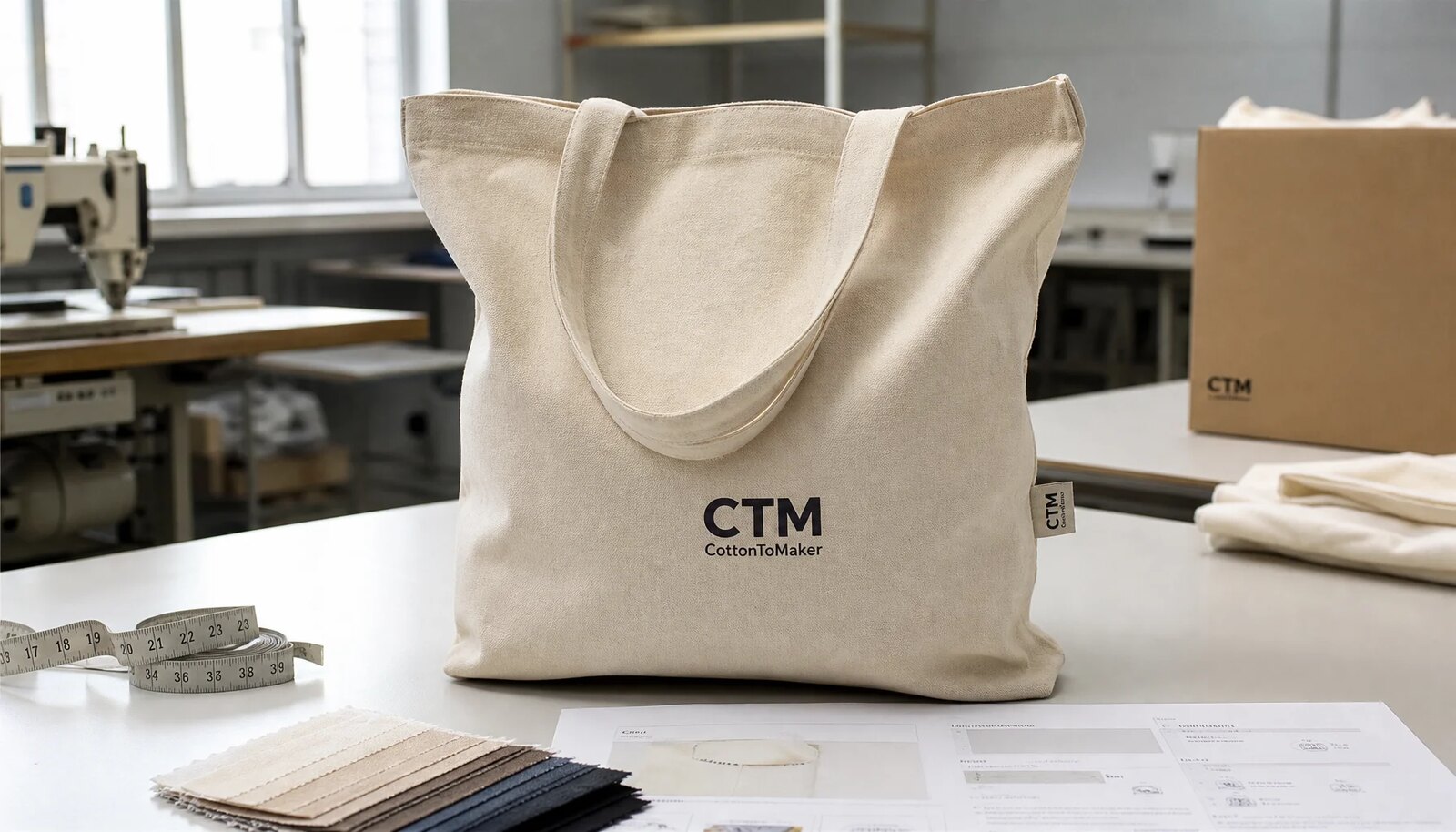
Why proofing matters on a farmers market tote order
A canvas grocery tote looks straightforward until the first production run turns up with the wrong body weight, a shifted logo, or handles that feel fine on a sample but fail once the bag is loaded with produce. For farmers market vendors, the tote is both a utility item and a visible brand carrier. It is handled, folded, stuffed, and reused. That means the print has to remain readable, the stitching has to stay stable, and the bag has to survive more abuse than a one-time promo item.
The risk is not theoretical. Small issues compound quickly when an order moves from the sample room to bulk production. A logo that looked centered on a mockup may sit too low on the actual panel. A fabric that was described as heavy can arrive softer than expected. Packing can flatten a tote so hard that crease marks remain on the front print. If the buyer did not define acceptance criteria early, the factory will often ship the lot because the job matched its own interpretation of the brief.
The procurement goal is simple: turn a visual product into a measurable one. That means three things should be fixed before price comparison starts. First, the bag build. Second, the print method. Third, the pass-fail standard. Once those are clear, the supplier is no longer pricing guesswork. The quote becomes comparable, the sample becomes meaningful, and the inspection team has something objective to check at receiving.
This is especially important for wholesale canvas grocery totes for farmers market vendors because the same tote may need to work as a retail bag, a giveaway at an event, and a reusable carry bag in daily use. Each use case pushes the spec in a slightly different direction. Buyers who proof the order carefully reduce rework, replacement shipments, and the hidden cost of explaining the same defect three times to different departments.
- Treat the tote as a manufactured product, not a blank promotional item.
- Proof the artwork against the actual finished panel size, not a mockup canvas.
- Lock the acceptance standard before the first sample is made so approval is not subjective.
Define the bag spec before you ask for prices
A tote quote is only useful when everyone is pricing the same bag. That starts with finished dimensions, not a loose sketch or a flat layout. A bag that is 15 x 16 x 4 inches finished is not interchangeable with one that is 14 x 15 x 3 inches cut size. Gusset depth, hem allowance, and handle attachment all affect both carrying capacity and artwork placement. If the dimensions are vague, the supplier will usually substitute a standard pattern. That may be fine for a generic promotion. It is risky for a production order that has to be repeated later.
The practical spec sheet does not need to be long, but it does need to be complete. List the finished width, height, and gusset depth; handle length and width; seam allowance; reinforcement method; and whether the tote has a bottom gusset, side gussets, or a reinforced base. If the product is intended for farmers market vendors, describe what it will carry. Produce, bottles, dry goods, mixed retail items, and heavier market loads all put different stress on the bag. A tote that only needs to hold flyers does not require the same structure as one carrying jars and root vegetables.
The closer the spec is to actual use, the better the quote will be. Buyers often ask for a "good quality canvas tote" and then spend the rest of the project correcting assumptions. That is avoidable. Ask the factory to restate the spec back to you in its own words before samples are made. If the language comes back as "heavy canvas shopping bag," the brief is still too loose. If it comes back as "natural cotton canvas, 10 oz nominal, 15 x 16 x 4 finished, 23 inch self-fabric handles, reinforced at the anchor points," you have something the factory can actually build against.
When you are managing multiple vendors, this step matters even more. A direct factory, a decorator, and a sourcing agent can all quote the same headline product while actually describing three different constructions. Procurement buyers do not need more marketing language. They need one definition that can survive quoting, sampling, inspection, and reorder.
- Use finished dimensions and state the tolerance you will accept.
- Specify handle width, handle drop, seam allowance, and reinforcement method.
- Describe the tote's real use case so the factory can match structure to load.
Choose canvas weight, weave, and finishing deliberately
Fabric weight is usually the first technical choice that affects price, feel, and performance. For a farmers market tote, 8 oz canvas can be acceptable for light promotional use, but it can feel underbuilt once the bag is loaded with groceries. A 10 oz or roughly 340 GSM canvas is a practical baseline for most programs because it balances cost, body, and printability. If the tote needs to carry denser goods, present a more premium feel, or hold its shape on a retail shelf, 12 oz or around 400 GSM may be the better fit.
Weight is only part of the story. Two fabrics with the same nominal GSM can behave differently if the weave is loose, the finish is soft, or the material is not pre-shrunk. Ask whether the fabric is bleached, natural, enzyme-washed, calendared, or otherwise finished. Ask how the weight is measured and whether it is reported before washing or after finishing. These are small details on paper and major differences in production. They affect shrinkage, print sharpness, and how the tote sits after repeated folding.
Factories also use canvas language loosely. One supplier may quote ounces, another GSM, and a third may use a trade description that sounds precise but is not. That is where orders get derailed. A note such as "natural cotton canvas, 10 oz nominal, pre-shrunk, medium weave" is more useful than "premium canvas." It gives procurement, production, and receiving teams the same reference point. It also makes replenishment easier because the second order can be compared to the first without reverse engineering what the first supplier meant.
For wholesale canvas grocery totes for farmers market vendors, the best fabric choice is the one that matches the job, not the one that sounds most substantial. If the tote will be handed out in volume at a market or used for light retail carry, a midweight canvas may be enough. If it is meant to be part of a store program or a higher-value branded item, the heavier cloth often justifies itself. The buyer should make that decision intentionally, not accept whatever fabric happens to be standard in the quote.
- Use 10 oz or about 340 GSM as the practical baseline for most grocery tote programs.
- Move heavier if the tote carries dense goods, supports premium positioning, or needs better body.
- Confirm whether the quoted GSM is raw, finished, or washed, because factories do not always standardize this the same way.
- Ask for a simple weave and finish description so the same fabric can be reordered without interpretation drift.
Match print method to the artwork, volume, and handling
Screen printing is still the most practical method for many canvas grocery tote programs. It works well for one to three spot colors, strong logos, and repeatable production. The economics are also easier to manage once the art is frozen. For procurement buyers, that matters. You can compare setup charges, print counts, and rerun costs more cleanly than with a method that changes from order to order.
That does not mean every order should be screen printed by default. If the artwork includes fine type, small rules, or highly detailed graphics, the supplier needs to prove that the canvas weave can hold the image cleanly. If the design is complex but the volume is low, digital print or transfer may be worth considering. The tradeoff is durability and finish. Transfer can show edge lift or a different hand feel. Digital can be sensitive to abrasion and repeated folding. For a tote that will be used at a farmers market, rubbed against produce, and stuffed into cars and carts, those risks should be tested against the actual fabric, not assumed away from a PDF.
Print placement is another point where orders go off track. The buyer should specify the print side, the distance from the top edge, whether the artwork is centered on the usable panel, and whether the image must avoid the gusset seam. If the tote has a label or decorative seam nearby, set the placement window in writing. A proof that says "centered logo" is not enough. The supplier needs a measurable zone. That prevents small shifts from becoming disputes later.
Color control also needs plain language. If a brand color matters, name the approved Pantone or state the acceptable visual range on canvas. Then ask whether the supplier uses underbase, water-based ink, or discharge. On natural fabric, ink choice affects opacity, sharpness, and feel. A good proofing process does not just confirm that the logo is present. It confirms that the print method and the cloth behave together in the way the buyer expects.
- Use screen print for repeatable logos and simple illustrations.
- Use transfer or digital only when the artwork genuinely needs the added detail.
- Get a strike-off on the same fabric, not on a substitute swatch or synthetic mockup.
- Specify print position from finished edges so the factory is not guessing placement.
Build an apples-to-apples factory quote
Unit price alone is not a sourcing decision. Two quotes can look close on paper and be completely different in what they include. One supplier may price heavier canvas, sewn labels, and packed cartons. Another may exclude those items and add them back later as setup charges or freight adjustments. A fair quote should state the fabric weight, tote dimensions, print colors, print sides, handle construction, stitching detail, packing method, and any setup fee for screens or plates. Without that detail, low pricing is often just delayed pricing.
MOQ deserves the same scrutiny. Every additional color or print placement can create separate setup work. Some factories will quote a minimum per artwork, others per colorway, and others per production run. If you are planning multiple seasonal runs or region-specific variants, ask how combinations are handled. Can one body be reused with several prints? Can later replenishments reuse screens? Does a color change trigger a fresh minimum? Those answers matter more than the headline unit cost if the tote program will continue beyond one shipment.
A clean RFQ should force every supplier to answer the same line items. Ask for the exact fabric construction, the finished dimensions, the print process, the packing format, the incoterm, the sample fee, and the excluded costs. That should include artwork cleanup, scan charges, cartons, labels, inner bags, palletizing, and inland freight if any of those are separate. If one quote says "all inclusive" and another breaks out each cost element, do not compare them until the assumptions are aligned. Procurement accuracy comes from removing ambiguity, not from averaging it out.
For buyers who manage multiple vendors, the best comparison sheet is usually the simplest one. Column one: included. Column two: excluded. Column three: risk. If the factory can state exactly what happens before the bulk run and what gets repeated on a reorder, the quote becomes usable. If the answer is vague, the apparent savings are not reliable.
- Ask the supplier to show what is included and what is excluded in the unit price.
- Separate body cost, print setup, packing cost, and freight in your comparison sheet.
- Treat each artwork variant as a separate economic decision rather than a minor change.
- Force all vendors to quote the same incoterm and packing basis so landed cost can be compared honestly.
Use the sample stage to catch mistakes before bulk production
A sample is only useful if it reflects the production route. A PDF proof can confirm spelling and layout, but it does not tell you how the ink will sit on the canvas or whether the seam allowance changes the final print position. A strike-off checks the print system. A pre-production sample checks the actual tote. Buyers need both. If the factory sends a nice-looking random blank bag that is not built from the intended fabric or sewing route, the approval process is incomplete.
The sample should be tied to the same inputs planned for bulk: fabric lot or verified equivalent, thread spec, print method, handle construction, and packing method. If any of those differ, the sample is not a full reference. This is especially important for wholesale canvas grocery totes for farmers market vendors because the difference between a soft sample and a finished production bag can be large once the bag is washed, printed, folded, and packed. A buyer should not have to discover that difference after the order is in transit.
Sample approval should also be written down in a way that leaves little room for interpretation. State the approved artwork file name, the revision number, the exact tote dimensions, the placement window, and the acceptable shade range. If the tote includes a sewn side label, define the label type and location in the same approval. If the reverse side is blank, say so. If the supplier proposes a substitute fabric, a different handle length, or a revised print route, that change should be called out before the sample is signed. The goal is not to slow the process down. The goal is to remove the hidden assumptions that usually come back as defects.
A photo record helps when the approval happens remotely. Ask for front, back, inside, handle close-up, seam close-up, and print placement photos with a ruler or dimension board in frame. Keep the approved physical sample tagged with the PO number and date if the order is large enough to justify it. That gives the buyer a controlled reference when receiving starts and prevents the common problem of people arguing from memory instead of from the signed sample.
- Approve the artwork proof, strike-off, and pre-production sample as separate steps.
- Record the exact file name and revision number approved for bulk.
- Reject any sample that changes fabric weight, handle length, or print placement without notice.
- Keep a tagged physical reference sample or photo record tied to the PO.
Set QC thresholds the factory can actually measure
Quality control works when it is numerical. For tote bags, that usually means finished size tolerance, print placement tolerance, and a clear defect threshold for stains, loose threads, skipped stitches, and shade variation. If the print is close to an edge or aligns to a gusset, the placement window needs to be tighter. If the artwork is centered on a large front panel, the tolerance can sometimes be a little broader. Either way, the factory should not be left to guess what acceptable means.
Sewing control deserves the same attention. Handle attachment points, bar tacks, and seam consistency are where grocery totes usually fail under load. Ask for a pull check if the bag will carry heavier produce or bottled goods. If the bag is meant to survive repeated folding, inspect for seam puckering, crooked labels, and print scuffing along the folded edges. A tote that looks acceptable on a clean table can still be problematic once it is packed tightly and moved through a warehouse. The inspection standard needs to reflect that reality.
A useful QC sheet is short, not vague. It should tell the inspector what to measure, where to measure it, and what to do if the batch falls outside the limit. If the order size justifies it, ask for an AQL-style inspection plan or a documented in-line and pre-shipment check. The point is not to create paperwork for its own sake. The point is to make the pass-fail decision repeatable so the supplier can act on it and the buyer can defend it. If a defect is called "normal," ask for the numeric threshold that makes it normal and the one that makes it rejectable.
For these tote orders, the most useful quality controls are also the least glamorous. A ruler, a sample board, a print reference, and a written defect list will catch more problems than a long approval email. Procurement teams that keep the QC standard lean and measurable usually get better results than teams that rely on broad adjectives like "premium" or "clean finish."
- Define tolerances for size, print position, and seam location.
- Use a defect sample limit that the inspector can apply consistently.
- Add a simple load and handle check if the tote will carry heavier market goods.
- Write the inspection response plan in advance, including rework, sorting, or replacement.
Treat packing and labeling as part of the product
Packing is not a separate logistics detail. It affects appearance, damage risk, and receiving speed. Bulk packing is usually cheaper and better for warehouse handling. Individual polybags protect the tote face, reduce scuffing, and help retail presentation. The right choice depends on where the bags are going. If the totes are going straight to a distributor, bulk pack may be enough. If they need to arrive shelf-ready, the pack standard should be tighter from the start.
Carton design should match the tote shape. Canvas bags hold folds, and too much compression can leave lasting crease lines or rub marks on the print. Too little compression can allow the contents to shift, which leads to wrinkling and carton damage in transit. Ask the supplier to state pack count, carton dimensions, gross weight target, and whether the cartons are pallet-ready. If the tote includes a folded insert card, hangtag, or retail barcode, make sure the production sequence is tested so the factory does not introduce a manual step that slows the line or creates a packing error.
Labels need the same discipline. If there is a sewn label, define the type, size, placement, and stitch color. If there is a barcode, say whether it belongs on the bag, the polybag, or the carton. If there are carton marks or purchase-order references, state them exactly. Small label errors can create receiving delays and chargebacks that do not show up in the unit price. They show up later at the dock, when the shipment is already committed.
For procurement buyers, the practical rule is simple: if a packing choice can scuff a printed face, change the shape of the tote, or slow receiving, then it is part of the product spec. It should be approved and quoted that way.
- Choose bulk pack, polybag, or retail-ready pack based on the receiving channel.
- Confirm carton count and gross weight before production starts.
- Test whether the folded tote still looks clean after packing pressure and carton compression.
- Specify label placement and barcode location so receiving teams do not have to relabel cartons.
Manage lead time risk before the order slips
Lead time is often described as a single number, but tote production is really a chain of steps: fabric booking, print setup, sample approval, sewing, curing, packing, inspection, and dispatch. If one step shifts, the date moves. Buyers who are planning for a seasonal market launch should assume at least one revision cycle if the artwork is new, especially when color matching or print placement is important. A schedule that ignores sample time is not realistic, no matter how short the sewing line claims to be.
Late changes are the usual reason orders slip. A revised logo after screens are made, a handle color update, or a carton label change can all add work that looks small and behaves like delay. The better practice is to freeze the artwork and packaging files before sample signoff and then treat any later change as a formal revision. If the factory is handling print, sewing, and packing internally, ask where the bottleneck usually sits. The answer is often not sewing. It may be print curing, file approval, or packing labor. Knowing that early helps the buyer decide where to protect time.
Reorder planning deserves the same attention. The first order carries development cost. A repeat order should reuse approved screens, artwork masters, packing masters, and inspection references whenever possible. Ask the supplier what they retain and how long they keep it. If they do not preserve those items, every replenishment becomes a new project. That is inefficient and usually unnecessary. For wholesale canvas grocery totes for farmers market vendors, the best supplier relationship is the one that makes the second order easier than the first, not harder.
The most important schedule rule is plain: do not let a tote program depend on assumptions that no one has written down. When the timeline is explicit, the factory can plan capacity and the buyer can plan launch inventory with less guesswork.
- Separate sample lead time from bulk lead time in the plan.
- Freeze artwork and packaging before screen or plate work starts.
- Ask the supplier which production step usually becomes the bottleneck and why.
- Confirm what artifacts are retained for repeat orders so reorders do not restart from zero.
Compare sourcing routes by landed cost, not just unit price
A direct factory quote is not automatically the cheapest landed option, and a local printer is not automatically the fastest route to a reliable result. The right sourcing channel depends on volume, artwork complexity, required speed, and how much time your team can spend managing follow-up. A direct tote factory usually makes sense when the spec is stable and the order will repeat. A local decorator can be a good fit when speed matters more than fabric optimization. A sourcing agent can add value when you need comparison support across multiple plants, but only if the real production source is clear.
To compare routes properly, include the costs that are easy to overlook. Screen setup, sample shipping, artwork cleanup, carton labeling, replacement units, warehousing, freight, import handling, and any time your team spends correcting defects all belong in the real cost picture. A supplier with a slightly higher ex-factory price can still be the better option if it reduces rework, protects the print, and keeps reorder specs stable. Procurement buyers should care about total landed cost and repeatability, not just the first invoice.
One question is especially useful: which sourcing route gives you the most control over future variance? If the supplier can keep the same fabric spec, the same print screens, and the same packing standard across replenishments, the program becomes easier to manage. That lower administrative load matters. It reduces receiving disputes, shortens approval cycles, and lowers the odds of a surprise quality issue on the next run. The cheapest tote is not cheap if every reorder forces a new spec debate.
For this category, the best supplier is often the one that can reproduce the same tote with the least interpretation. That is what keeps the buying program predictable after the first order has already shipped.
- Compare total landed cost, not just ex-factory price.
- Include setup, packing, freight, and rework exposure in the comparison.
- Choose the route that reduces repeat approval work on future orders.
- Favor the supplier that can preserve the same spec across replenishments with minimal variance.
Specification comparison for buyers
| Spec decision | Recommended option | When it fits | Buyer risk to check |
|---|---|---|---|
| Direct factory with in-house sewing and printing | Best for repeat programs where one supplier must own fabric, sewing, print, packing, and final inspection | You want one accountable production source and a tighter proofing loop across sample and bulk | Confirm who approves the strike-off, who signs the pre-production sample, and whether the bulk run uses the same fabric lot or a verified equivalent |
| Trading company or sourcing agent | Useful when you need supplier benchmarking across several plants or product families | You are building a tote program and want one point of contact for quoting, documentation, and schedule follow-up | Verify the real factory, request factory-specific QC records, and make sure the quoted spec is not being translated loosely between parties |
| Local printer on imported blank totes | Good for short runs, regional events, or fast reprints with simple decoration | You need small-quantity customization and local delivery speed matters more than fabric optimization | Check blank tote quality, handle strength, shrinkage, and whether the print survives folding, abrasion, and warehouse handling |
| Stock tote with overprint | Best when your artwork is simple and you can accept a standard body | You need the fastest path to branded inventory with minimal development work | Confirm stock dimensions, fabric weight, finish, and bag construction before approving artwork placement |
| Factory with separate sample room and bulk line | Strong choice for buyers who need formal pre-production approval | You want the sample to mirror the real bulk process rather than a hand-finished one-off | Ask whether the sample uses the same fabric roll, print screen, thread spec, and sewing route as production |
| Decorator that outsources sewing | Works when print is the main value and the tote construction is stable | Your artwork is simple and you want a low-friction branded tote without complex build changes | Ask how sewing tolerance is controlled, how defects are traced back, and who owns corrective action if the sewing partner misses spec |
| Low-MOQ digital print supplier | Useful for artwork tests, seasonal promotions, or SKU validation | You need multiple designs with small initial volume or fast art iteration | Check abrasion resistance, color depth, edge definition, and whether the print softens after repeated folding or retail handling |
| General promotional product supplier | Fits buyers who already source many branded items through one vendor | You want consolidated billing and a simpler procurement workflow | Require actual tote specs, not a listing headline, and compare hidden setup charges, freight assumptions, and sample fees |
Buyer checklist before sampling
- Lock finished dimensions, not just cut size or flat panel size, and state the tolerance for width, height, and gusset depth.
- State fabric weight in GSM or oz and note whether the weight is measured before washing, after finishing, or after pre-shrink treatment.
- Define the print method, print location, number of colors, and acceptable color variation in writing before art proof approval.
- Approve handle length, handle width, handle drop, and reinforcement style at the seam and bar tack.
- Request a pre-production sample or strike-off that uses the intended fabric, ink system, and sewing route, not a substitute blank.
- Confirm carton pack count, inner polybag requirement, and whether you need retail hangtags, barcode labels, or case marks.
- Set defect tolerance for print misalignment, broken stitches, stain marks, loose threads, shade variation, and crooked labels.
- Ask the factory to state lead time separately for sample, bulk production, curing, inspection, packing, and export or domestic dispatch.
- Request a written change-control rule so artwork, packaging, and size changes after sample approval cannot be absorbed informally.
- Ask for a top-1 or AQL-based inspection plan if the order is large enough to justify formal incoming or pre-shipment checks.
Factory quote questions to send
- What is the exact fabric construction, GSM or oz weight, weave type, and finishing of the canvas?
- Is the quote based on cut size or finished size, and what are the final dimensions after sewing and hemming?
- How many print colors, screens, setup charges, or plate charges are included in the quote?
- What is the MOQ per artwork, per colorway, and per print side, and can variants be combined across one fabric base?
- Will the pre-production sample use the same fabric lot, print method, thread spec, seam construction, and packing method as bulk production?
- What packing method is included: bulk pack, polybag, set pack, or retail-ready packaging?
- What are the stated tolerances for print placement, seam location, and finished dimensions?
- How does the factory handle shade variation between fabric lots and between different print batches?
- What is the production lead time after sample approval, and which events can extend it?
- Which costs are excluded from the quote, such as artwork cleanup, scan charges, cartons, labels, inner bags, palletizing, or inland freight?
Quality-control points to confirm
- Finished size should stay within the agreed tolerance for width, height, and gusset depth, with the same tolerance applied to all lots.
- Print placement should remain centered and within the approved position window on every panel, including alignment to seams and gussets.
- Ink coverage should be even, with no pinholes, smears, double strikes, ghosting, or color contamination on the approved viewing side.
- Stitching should be straight, secure, and free from skipped stitches, loose thread tails, seam puckering, and broken seam lines.
- Handle attachment should pass a pull check and show consistent bar tack or reinforcement stitching at both anchor points.
- Fabric should be free from oil marks, weave snags, broken yarns, holes, and visible shade inconsistency beyond the approved range.
- Cartons should match the agreed pack count and protect tote shape during transit without crushing the body or scuffing the print.
- Labels, barcodes, carton marks, and purchase-order text should match the approved documents exactly.
- The approved artwork file should match the bulk screen layout, plate file, or digital print file before mass production begins.
- Any folded-pack or compressed-pack method should be tested for wrinkling, print scuffing, handle deformation, and carton compression marks.