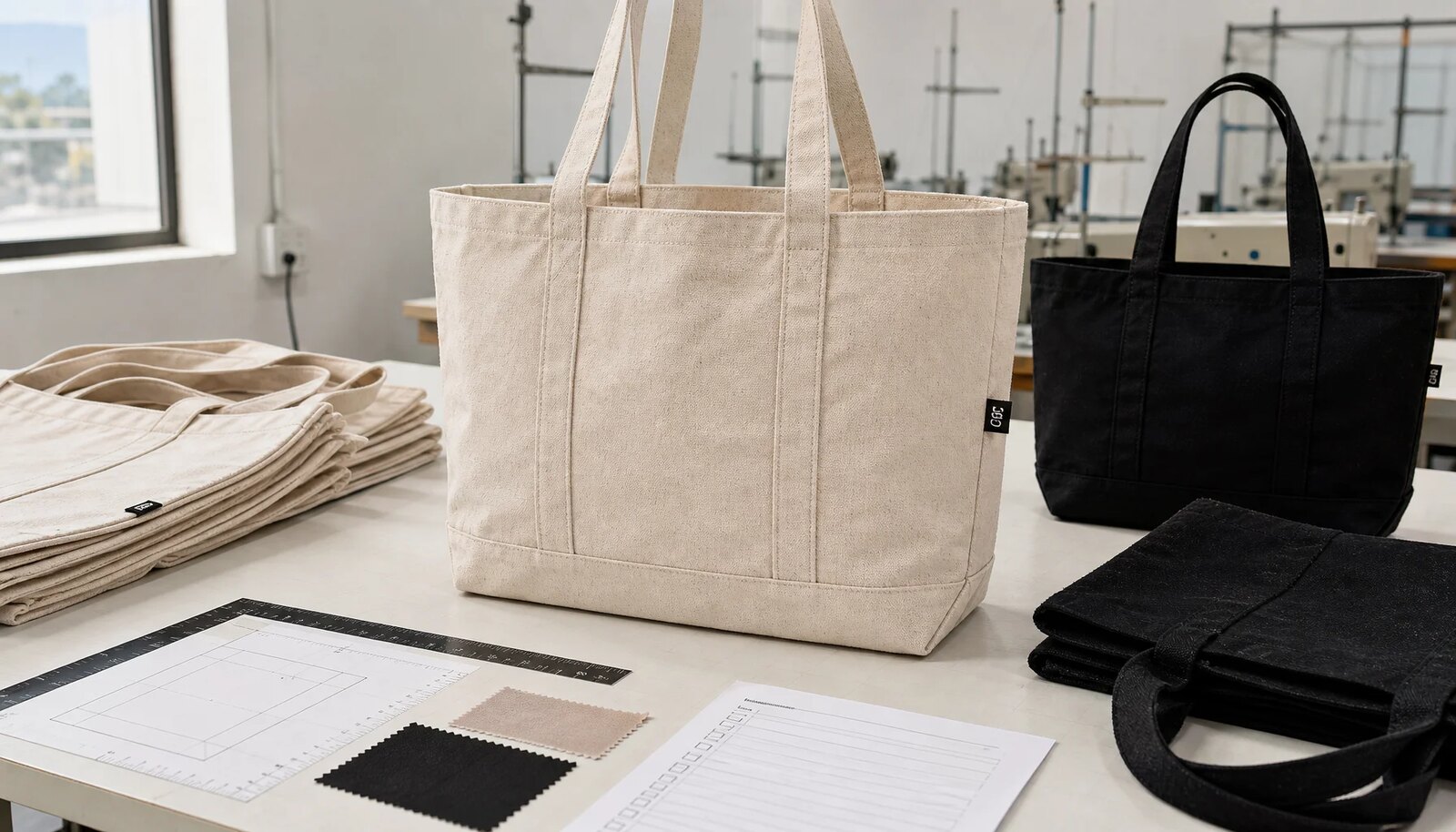
Start With The Buying Risk
Wholesale canvas grocery totes are often treated like simple add-ons, but procurement risk hides in the parts that are easy to skip. A supplier can quote the same size and logo while changing the fabric weight, weave, handle webbing, stitch reinforcement, print setup, or carton pack. The buyer sees a lower unit price; the receiving team later sees soft bags, crooked prints, cracked ink, weak handles, or cartons that do not match the purchase order.
For eco apparel brands, the tote is also part of the brand promise. It may sit beside organic cotton tees, recycled fleece, denim, or accessories in a retail store. If the bag claims recycled or organic content, the sourcing file needs evidence. If it is sold or gifted as a reusable grocery tote, it must survive a realistic carry load. If it carries a hangtag or barcode, the packing has to support retail receiving without repacking.
This quality inspection checklist is written for buyers who need a repeatable sourcing process, not just a nice sample. Use it to build a tighter RFQ, compare offers on the same assumptions, approve samples with measurable criteria, and inspect bulk goods before they leave the factory.
- The cheapest quote may simply be missing fabric, testing, packing, or QC assumptions.
- A good sample is useful only when it represents the actual bulk fabric, decoration, and sewing method.
- Eco apparel buyers should connect product quality, sustainability documents, retail presentation, and landed cost in one sourcing file.
Define The Tote Spec Before Price
A strong RFQ starts with finished measurements. Finished size means the tote after sewing, pressing, and any washing or finishing, not the cut panel size. Include body width, body height, gusset depth, handle length, handle drop, handle width, and print placement. If the bag must fit folded apparel, shoeboxes, grocery items, or event materials, mention that use case rather than relying on a generic grocery tote description.
Canvas weight should be stated in GSM or ounces per square yard, but do not use weight as the only quality signal. A loosely woven heavier cloth may not behave like a tighter weave at a lower weight. For many retail grocery totes, buyers often evaluate mid-weight canvas around the 300-410 GSM range, then adjust based on required structure, price target, print result, and load test. That range is a starting point for discussion, not a universal standard.
Specify whether the canvas is natural, bleached, dyed, pigment dyed, recycled, organic, or blended. Natural unbleached canvas can vary in shade from lot to lot, so approve a shade band rather than one perfect swatch. Dyed canvas requires lab dip approval and may need colorfastness testing depending on market, label claim, and retail requirements.
- Write finished body width, height, gusset, handle drop, and handle width in the tech pack.
- Identify fabric content, GSM, weave appearance, color, finish, and shrinkage expectation.
- Call out whether the tote is for retail sale, gift-with-purchase, event giveaway, staff use, or checkout packaging.
- Add a simple drawing or annotated photo showing print center, label position, hangtag location, and fold direction.
Choose Canvas And Claims Carefully
Eco apparel brands often want the tote to support a sustainability message, but claim language must match the documentation. If the tote is described as organic cotton, recycled cotton, recycled blended cotton, undyed, low-impact dyed, or reusable, ask what proof the supplier can provide. A generic fabric certificate is not enough if it does not connect to the supplier, item, order, transaction, or production lot.
For organic cotton, the documentation route may include scope certificates and transaction certificates depending on the standard and supply chain. For recycled cotton or recycled blends, ask for the applicable recycled-content documents and clarify whether the claim applies to the full fabric, part of the yarn, or only a percentage of the material. If the brand will print a sustainability claim on a hangtag, product page, or woven label, have compliance review the wording before production.
Dye and chemical expectations also belong in the sourcing file. If the tote will be sold in a restricted retail channel, ask whether the fabric and decoration can meet the buyer's chemical requirements. Colorfastness may matter for black, navy, red, or heavily dyed bags that could rub onto light garments. Decoration inks, transfers, and label adhesives should be included in the compliance conversation, not treated as separate afterthoughts.
- Ask whether certificates apply to the factory, fabric mill, yarn, transaction, or only a previous sample.
- Match every sustainability claim to a document your team can file and defend.
- Request fabric lot information on the pre-production sample and final shipment documents.
- Include ink, transfer film, embroidery thread, labels, hangtags, and packaging in the compliance review when the channel requires it.
Match Construction To Use
A grocery tote needs volume, handle strength, and shape recovery. A flat tote can work for light promotional use, but a gusseted tote is usually better when customers carry folded apparel, boxed products, produce, or multiple items from a store. Bottom gussets create more usable capacity, while side-bottom gussets can improve the bag's standing shape depending on pattern and fabric weight.
Handle attachment is one of the highest-risk areas. Cotton web handles are common, but width, thickness, stitch pattern, and reinforcement length matter. A short handle root with sparse stitching may look acceptable on a table and still fail under repeated use. Ask for box stitch, cross stitch, bar-tack, or another agreed reinforcement method, then photograph and measure the approved sample so the sewing line has a clear standard.
Seam choice also affects durability. Top hems should be even and secure. Gusset corners should not be thin, distorted, or cut too close to the seam allowance. If the tote will be sold at retail, loose threads and uneven stitching become presentation defects as well as quality issues. The goal is not to over-engineer a basic bag; it is to align construction with the load, price point, and brand standard.
- Use a gusset when the tote needs to carry bulky apparel, groceries, or boxed accessories.
- Measure handle drop for comfort and handle width for carrying feel, not just appearance.
- Treat handle roots, gusset corners, top hem, and bottom seam as stress zones during inspection.
- Keep one approved sample open at the sewing line so operators can compare stitch placement and reinforcement.
Select Decoration With Testing In Mind
Decoration choice should follow artwork, fabric, quantity, and selling channel. Screen print is often the most practical option for simple logos and larger volumes because it gives a clean result with controlled unit cost. The result still depends on mesh, ink, curing, fabric finish, and operator control. A thick ink deposit can crack on folds; a weak deposit can look faded or inconsistent.
Heat transfer can handle fine detail and color complexity, but it may sit on the fabric surface and can feel less integrated than ink. Embroidery and woven labels create a more apparel-like presentation, yet they add setup cost and can pucker lighter canvas if backing and stitch density are not managed. For eco apparel brands, woven side labels or hangtags can be useful when the tote needs to sit beside garments, but label content must match the verified product claim.
Approve decoration on final fabric whenever possible. A strike-off on a similar blank does not prove the result on dyed canvas, recycled canvas, or a heavier weave. Check print placement with a ruler, compare color under normal light, rub the print lightly after curing, and fold the panel along the expected pack line. If the tote ships folded through the print area, decoration durability needs to be judged after folding, not only while flat.
- Use screen print for clean logo work, limited colors, and better volume economics.
- Use transfer methods when detail or color range is more important than a fabric-integrated feel.
- Use embroidery or woven labels when the tote is positioned as a premium apparel accessory.
- Approve color, placement, curing, adhesion, label position, and folding behavior before bulk production.
Read MOQ, Price, And Landed Cost Together
MOQ is rarely one simple number. A supplier may have a sewing-line minimum, a fabric minimum, a dye-lot minimum, a screen setup minimum, and a label minimum. A quote for 1,000 pieces may still require 300 pieces per color, 500 pieces per artwork, or a surcharge for split packing. If your assortment includes natural, black, and seasonal colors, MOQ by color can matter more than total MOQ.
Ask for price breaks at practical quantities such as 500, 1,000, 2,500, and 5,000 pieces if those volumes match your forecast. Keep setup charges visible. Screen fees, embroidery digitizing, woven label setup, barcode printing, sample cost, testing, and packing materials should not disappear into a blended unit price unless you also ask for reorder pricing. Otherwise, the first order and reorder economics become hard to compare.
Landed cost is the number procurement can defend. Put every supplier quote into the same comparison sheet with the same Incoterms, pack count, carton size, gross weight, destination, duty assumption, and inspection cost. A higher unit price can still be the better buy if the supplier includes stronger packing, cleaner documentation, fewer rework risks, or more reliable inspection support.
- Separate one-time setup charges from recurring unit price.
- Confirm MOQ by total order, color, artwork, label, and packing configuration.
- Compare ex-works, FOB, CIF, DDP, or other terms only after normalizing what each quote includes.
- Add carton dimensions and gross weight to the cost model before ranking suppliers.
Approve Samples In Stages
Sample approval should move from idea to production reality. A reference sample shows the target shape or quality level. A salesman sample can help design and merchandising evaluate the look. A pre-production sample should use final fabric, final construction, final decoration, final labels, and final packing. The signed golden sample becomes the physical standard used by the factory, inspector, and buyer.
For a first order, do not approve bulk from photos alone unless the risk is intentionally accepted. Measure the physical sample and write comments directly against the tech pack. Check body width, height, gusset, handle drop, print placement, label placement, finished weight, seam appearance, and fold method. If changes are needed, ask the supplier to confirm whether they require a revised sample or can be controlled through written production comments.
The golden sample should not be a perfect one-off that the factory cannot repeat. It should represent the actual production method. Keep one signed sample sealed for dispute resolution and one working sample available for comparison. If the supplier keeps one too, make sure all three versions are aligned with the same date, item code, artwork version, and fabric reference.
- Reference sample: confirms target quality, shape, and approximate hand feel.
- Pre-production sample: confirms final fabric, sewing, decoration, trims, and pack method.
- Golden sample: signed physical approval standard for bulk production and inspection.
- Bulk photo review: confirms production has not drifted before shipment is booked.
Use A Real Inspection Plan
The quality inspection checklist for wholesale canvas grocery totes should be written before cutting starts. Define defect classes, sampling method, measurement tolerances, and functional tests. Many import buyers use an AQL-based final random inspection, often with general inspection level II for visual checks, but the exact level should match order size, channel risk, and buyer policy. The important point is to name the standard rather than leaving acceptance to opinion.
Measurement tolerances should be practical and visible. For example, a buyer may allow a small tolerance on body width and height, a tighter tolerance on print placement, and near-zero tolerance for wrong artwork or missing labels. The actual tolerance depends on tote size, fabric behavior, and retail requirement, so agree it in writing. Inspectors should measure several pieces across the lot, not just the first clean sample on the table.
Functional testing must be simple enough to repeat. A common approach is to load the tote with the agreed weight, hold or suspend it for a defined time, then inspect handles, seams, gusset corners, and deformation. Some buyers add a short lift-and-carry simulation. The pass/fail rule should be plain: no seam opening, no handle tearing, no broken reinforcement, and no major shape failure beyond the approved sample standard.
- Define critical, major, and minor defects before production starts.
- State inspection level, AQL or sampling table, lot size, sample size, and acceptance criteria.
- Write measurement tolerance for body, gusset, handle drop, print placement, and label placement.
- Require inspection photos, defect counts, measurement sheet, load-test result, carton count, and final pass/fail decision.
Control Packing And Retail Details
Packing affects both landed cost and brand presentation. A tote folded through a heavy print may arrive with a crease that looks like a print defect. A tote packed too loosely can inflate carton volume and freight cost. A tote packed in the wrong direction may force the warehouse or store team to unfold and repack every unit before sale. Decide the fold method, bundle count, polybag use, tissue use, hangtag position, and barcode orientation before bulk packing begins.
Eco apparel brands should also decide how much packaging is necessary. Individual polybags may protect against dust and moisture, but they may conflict with plastic-reduction goals or retail preferences. Paper bands, belly bands, hangtags, or bulk bundling may be better for some channels. The right choice depends on transit route, destination humidity, store handling, barcode needs, and the brand's packaging policy.
Carton data should be part of the quote and the inspection. Require pieces per carton, carton dimensions, gross weight, net weight, carton material, desiccant use if needed, country-of-origin marking, item code, color code, PO number, and shipping marks. If the carton arrives damaged or mislabeled, even perfect totes can become a receiving problem.
- Approve a fold method that protects the print and supports retail handling.
- Confirm whether the tote ships loose, bundled, belly-banded, polybagged, or with hangtag attached.
- Check carton marks against the PO, not against an informal sample-room label.
- Include carton count, dimensions, gross weight, and barcode position in final inspection.
Build The Buyer File For Reorders
The first order should create a sourcing file that makes the second order easier. Save the tech pack, approved artwork, quote comparison, fabric swatch, lab dip, sample comments, golden sample photos, sustainability documents, test reports, packing spec, inspection report, and shipment data. Reorders fail when teams rely on memory or old email threads instead of a controlled item file.
For eco apparel brands, the reorder file should also include claim substantiation. If the tote is marketed as recycled cotton, organic cotton, undyed canvas, or reusable packaging, keep the exact wording, approved documents, and supplier declarations together. When the next order changes color, fabric source, or factory, review whether the claim still applies. A repeat order is only repeatable if the material and documentation repeat too.
After shipment, review what actually happened. Did the sample cycle take longer than planned? Did carton dimensions match the quote? Did the final inspection find recurring loose threads, print shift, or handle problems? Did the warehouse need to repack units? Feed those notes into the next RFQ. Procurement quality improves fastest when each order leaves behind cleaner specifications, not just a paid invoice.
- Keep signed approvals, documents, and inspection records in one controlled item file.
- Review sustainability claim documents whenever fabric source, color, or factory changes.
- Use receiving feedback to update packing, carton, and barcode requirements.
- For reorders, ask the supplier to confirm no change in fabric mill, dye lot approach, sewing line, decoration process, or packing method without written approval.
Specification comparison for buyers
| Spec decision | Recommended option | When it fits | Buyer risk to check |
|---|---|---|---|
| Canvas weight | 300-410 GSM for many grocery and apparel retail programs; heavier only when structure is required | Reusable checkout totes, merchandise add-ons, event retail, and mid-weight carry loads | GSM alone does not prove strength; confirm weave, shrinkage, handle reinforcement, and load-test result |
| Canvas content | Conventional, recycled, organic, or blended cotton canvas based on claim and budget | Eco apparel brands that need sustainability claims to match hangtags or website copy | Require current transaction certificates or supplier declarations that match the order, fabric lot, and claim language |
| Fabric color | Natural unbleached canvas for lower dye complexity; dyed canvas for brand color matching | Natural works for earthy retail programs; dyed works when the tote must match a collection palette | Natural shade can vary by lot, while dyed shades need lab dip approval and colorfastness checks |
| Gusset construction | Bottom or side-bottom gusset with reinforced corners for grocery use | Orders expected to carry folded apparel, boxed accessories, produce, or heavier store purchases | A flat promotional tote may look cheaper but can distort faster and hold less usable volume |
| Handle style | Cotton webbing, 25-38 mm wide, with box stitch or bar-tack reinforcement | Reusable bags where comfort, repeated carry, and appearance matter | Narrow handles, short stitch runs, or weak anchoring can fail even when the body fabric is acceptable |
| Decoration method | Screen print for simple logos; embroidery, woven label, or transfer only when the brand effect justifies it | Screen print suits volume and clean graphics; labels suit premium apparel positioning | Approve decoration on final fabric, because ink, puckering, and color can change with fabric finish |
| Retail packing | Flat or controlled fold with barcode, hangtag, or belly band as required by channel | Stores that need quick receiving, shelf-ready display, or sellable individual units | Over-tight folding can crease prints; wrong label placement can force repacking at destination |
| Inspection standard | Written final inspection plan using AQL or an agreed sampling table plus functional tests | First orders, retail programs, export orders, and repeat programs with chargeback risk | Do not leave defect judgment informal; define critical, major, and minor defects before production |
Buyer checklist before sampling
- Freeze finished body width, height, gusset depth, handle drop, handle width, fabric GSM, fabric color, and decoration area before requesting bulk pricing.
- State whether the canvas is conventional, recycled, organic, unbleached, dyed, or certified, and require documents that support any sustainability claim used by the brand.
- Request a quote by volume tier and separate fabric, sewing, decoration, packing, setup, testing, sample, and inland handling costs where possible.
- Confirm MOQ by total order, color, artwork version, fabric lot, label version, and packing configuration so assortment plans do not break the factory minimum.
- Approve lab dips or fabric swatches before print strike-off when color, natural shade, or sustainability claim matters to the retail presentation.
- Use a reference sample, pre-production sample, and signed golden sample; do not approve bulk from a photo-only sales sample on a similar blank.
- Define inspection level, AQL or sampling approach, measurement tolerances, defect classes, carry-load test, and pass/fail documentation before cutting starts.
- Require bulk photos that show body shape, handle attachment, print placement, label location, folded pack, carton marks, and master carton condition before shipment.
- Compare landed cost using the same Incoterms, carton pack count, carton dimensions, gross weight, duty assumption, and destination handling cost.
- Keep all approval records in one file: quote, tech pack, artwork, swatches, sample comments, test reports, packing spec, inspection report, and shipping marks.
Factory quote questions to send
- What finished dimensions, gusset construction, fabric GSM, weave, shrinkage allowance, and handle reinforcement are included in this price?
- Is the canvas conventional, recycled, organic, unbleached, dyed, or blended, and what documents can you provide for the exact fabric lot used in bulk?
- What decoration method is quoted, and does the price include screens, plates, embroidery setup, woven labels, hangtags, barcodes, or retail packaging?
- What are the MOQ and price breaks by total quantity, fabric color, artwork version, label version, and packing format?
- Which sample stages do you provide, which sample uses final fabric, and which approval becomes the golden sample for production inspection?
- What measurement tolerances do you recommend for body width, height, gusset, handle drop, print placement, and label placement?
- What inspection plan do you use for in-line and final inspection, including AQL level, sample size reference, defect classification, and functional tests?
- What load test can you perform on the tote, how much weight is used, how long is the hold or carry simulation, and what counts as failure?
- What testing or compliance documents are available for colorfastness, restricted substances, recycled or organic content, country of origin, and care or warning labels?
- What pack method, units per polybag or bundle, pieces per carton, carton dimensions, carton weight, desiccant use, and shipping marks are assumed in the quote?
Quality-control points to confirm
- Approved fabric swatch, GSM, color, hand feel, weave appearance, and sustainability documentation match the purchase order and current bulk lot.
- Finished body width, height, gusset depth, handle drop, handle width, print placement, and label placement stay within the written tolerance, such as plus or minus 5 mm for small placement points or the agreed tolerance for larger dimensions.
- Handle roots use the approved reinforcement, with consistent stitch density, no missed bar-tacks, no twisting, and no loose anchoring at stress points.
- Top hem, side seams, gusset corners, and bottom seam are straight and secure, with no open seams, skipped stitches, broken threads, needle cuts, or severe puckering.
- Decoration matches the approved strike-off for color, opacity, edge clarity, placement, curing, registration, and adhesion, with no unacceptable cracking, bleeding, ghosting, or ink contamination.
- Functional carry test uses the agreed load, hold time, and handling method; failure includes handle tearing, seam opening, stitch breakage, or major deformation beyond the approved standard.
- Critical defects include wrong artwork, wrong color, wrong size range, missing required label, unsafe sharp object contamination, severe odor, mold, and any structural failure during load testing.
- Major defects include open seams, obvious stains, severe print misplacement, loose handle attachment, missing hangtag or barcode, wrong carton count, and defects likely to make the tote unsellable.
- Minor defects include trim threads, small washable marks, slight natural shade variation within approved range, and cosmetic stitching variation that does not affect function or retail presentation.
- Inspection records include sample size, lot size, defect counts by class, photos of failures, measurement sheet, load-test result, carton check, inspector name, inspection date, and clear pass/fail disposition.