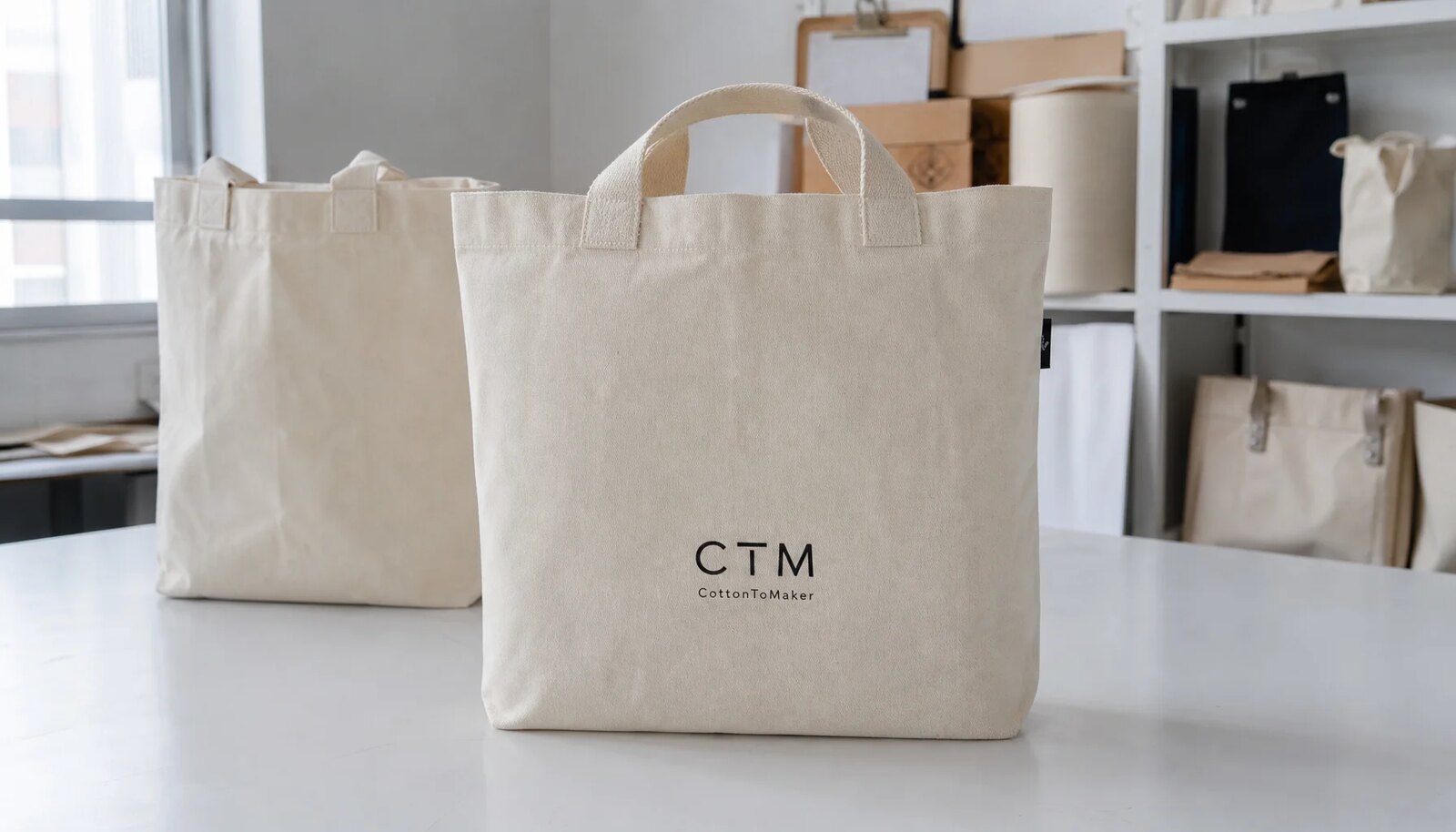
Buying Problem: Visible Logo Without Production Surprises
Wholesale canvas grocery totes for craft fairs look simple until the logo is printed too high, hidden by the handle fold, or distorted by a gusset. Procurement teams often compare quotes by bag size and unit price, but the logo placement decision drives a large part of the buyer's real outcome. A tote that looks correct on a flat artwork proof may look unbalanced once it is filled with candles, jars, books, packaged snacks, or handmade products.
The useful starting point is to treat the front panel as a working print area, not as the whole bag face. For a common 380 x 420 mm canvas grocery tote with a 100 mm gusset, the safe front logo zone is normally centered horizontally and placed far enough below the opening to avoid handle stitching and folding pressure. A practical logo width is often 220-280 mm for simple brand marks, with smaller sizing for detailed illustrations or fine text.
- Use the finished bag size, not the cut panel size, when calculating the print position.
- Keep artwork at least 45 mm away from side seams and gusset folds unless the design is intended to wrap.
- Measure logo height from the top opening after sewing, not from the raw fabric edge.
- Approve the logo on a filled tote because grocery-style contents change how the front panel hangs.
Canvas Weight and Structure Affect Logo Placement
For craft fair resale or brand merchandise, 10-12 oz canvas, roughly 340-410 GSM, is a common commercial range. It has enough body to feel reusable and to stand better on a table, while still being printable and packable. Lighter 6-8 oz cotton can work for giveaway shopping bags, but it tends to collapse, show wrinkles through the print, and feel less suitable for grocery loads. Heavier 14-16 oz canvas gives a premium hand feel but raises freight cost and may require stronger sewing needles, slower stitching, and more careful folding.
The fabric weight also affects logo behavior. A low GSM bag may stretch around the print and make a centered logo appear wavy. A very heavy canvas can cause screen ink to sit on the surface with a stronger hand feel, especially when the artwork uses large solid areas. If your brand mark has small letters, fine outlines, or registration between colors, the buyer should require the supplier to test it on the nominated canvas weight before confirming bulk production.
- Promotional craft fair giveaway: 8 oz canvas may be acceptable when load expectations are low.
- Reusable grocery tote: 10-12 oz canvas is usually the safer commercial specification.
- Premium retail tote: 12-16 oz canvas can work if freight, folding, and sewing cost are accepted.
- Natural canvas may show seed flecks and shade variation; bleached canvas gives cleaner print contrast.
Choose the Logo Position by Use Case
Craft fair totes are seen in three situations: hanging on a booth display, carried by shoppers, and stacked or folded at checkout. A high logo can look good while hanging empty, but it may disappear under the top fold when the bag is packed flat. A low logo can look modern, but it may be covered by table edges, basket displays, or the shopper's hand. For most grocery totes, a center-front position with the top of the logo around 80-110 mm below the opening is a stable starting point.
Logo placement should be adjusted for handle stitching and bag construction. If the handles are sewn down the front panel in long vertical strips, the safe print area becomes narrower. If the bag uses a boxed bottom, the visible front panel changes when the base opens. A factory should provide a marked sample photo showing the print area, handle attachment, seam allowances, and gusset fold lines before screens or transfers are made.
- Centered front print is best for brand visibility and easier production control.
- Lower-corner print works for boutique positioning but should stay clear of the gusset fold.
- Side seam labels support retail branding when the main front logo is hidden in folded stacks.
- Two-sided printing helps sponsor or event branding but doubles placement checks and can increase rejects.
Print Method Tradeoffs for Bulk Craft Fair Orders
Screen printing remains the most reliable option for wholesale canvas grocery totes when the logo uses one to three solid colors. It gives strong color, good durability, and predictable cost once screens are made. The buyer should provide vector artwork and Pantone references, then approve a print strike-off on the actual canvas. For natural canvas, colors usually appear warmer and less bright than they do on a coated paper proof or digital screen.
Heat transfer can solve gradients, photographs, or small multicolor artwork, but it is not automatically better. On canvas grocery totes, transfers may feel heavier and can crack or peel if the adhesive, pressure, or curing is wrong. Embroidery has a premium look for small logos, but it can pucker canvas and is not efficient for large front graphics. Woven labels are useful as secondary branding, especially on side seams, but they do not replace a clear front print for event visibility.
- Screen print: best for simple logos, repeat orders, and clear price control.
- Heat transfer: useful for full-color art, but test wash, fold, and rub resistance.
- Embroidery: suitable for small premium marks, not large grocery tote graphics.
- Woven label: good for side branding, retail identity, and lower visual impact.
Cost Drivers Behind the Quote
A useful quote for wholesale canvas grocery totes should separate the drivers that affect cost. Fabric weight, canvas finish, bag size, gusset depth, handle length, print colors, print area, packing method, and inspection requirements all matter. A cheap quote may be based on a lighter fabric, smaller print area, no reinforced stitching, or bulk packing without moisture protection. Procurement teams should not compare two suppliers until the same construction and artwork assumptions are visible.
MOQ logic is also important. A supplier may accept 300 pieces for a natural canvas tote with one-color screen print because the fabric is available. The same supplier may require a higher MOQ for custom dyed canvas, unusual handle color, large all-over print, or special label. Screen setup cost is spread across the order quantity, so very small orders may show a high unit price even when the sewing cost is reasonable. For craft fair programs, it is often smarter to standardize the tote body and vary the logo or label by event.
- Fabric cost rises with GSM, dyed colors, washing, and tighter shade requirements.
- Print cost rises with color count, artwork size, registration difficulty, and curing time.
- Sewing cost rises with boxed bottoms, reinforced handles, inside pockets, and binding.
- Packing cost rises with individual polybags, barcode stickers, hangtags, and retail cartons.
- Freight cost rises quickly with heavy canvas and oversized cartons, even when unit price looks low.
Sample Approval Should Simulate Real Craft Fair Use
The most useful sample is not just a flat tote with a logo. It should show the final fabric weight, handle construction, gusset, print method, logo size, logo position, label placement, and folding method. Buyers should load the sample with typical craft fair contents, such as two jars, a book, a boxed candle, or folded apparel, then review whether the logo still sits straight and visible. A bag that passes a desk review may fail once weight pulls the front panel downward.
Sample approval should be split into construction approval and print approval. The blank construction sample confirms size, GSM, seams, handle length, and load feel. The print strike-off confirms color, ink coverage, curing, and line sharpness. The pre-production sample combines both and becomes the control sample for bulk inspection. If the buyer changes artwork after the pre-production sample, the factory should issue a revised strike-off before production starts.
- Measure finished width, height, gusset, handle drop, and logo distance from top edge.
- Rub the print with dry and slightly damp white cloth to catch weak curing or excess pigment.
- Fold the tote as it will be packed and check whether ink transfers or creases.
- Hang the filled tote from the handle and confirm the logo remains level enough for approval.
Acceptance Criteria for Logo and Sewing Quality
Bulk quality control needs measurable tolerances. For logo placement, a practical tolerance is often plus or minus 5-8 mm for centered screen printing on sewn canvas bags, but the exact number should be agreed with the factory. If the artwork is close to seams or handles, tighter tolerances may increase rejects and cost. Color should be judged against an approved strike-off under consistent lighting, not against a phone photo.
Sewing quality matters because craft fair buyers often carry mixed, uneven loads. Handle joins should be reinforced with bar tacks, box stitching, or dense back-and-forth stitching depending on the design. Seams should not open when the bag is gently loaded to the expected use weight. Natural canvas can have small slubs and flecks, but stains, oil marks, broken yarns in high-visibility areas, and severe shade panels should be classified before inspection begins.
- Logo center deviation: define allowable shift from the center line before production.
- Logo height deviation: measure from the finished top opening to a fixed artwork point.
- Print defects: reject obvious smearing, pinholes in solid logos, poor registration, and under-cured ink.
- Sewing defects: reject open seams, skipped stitches, weak handle joins, twisted handles, and distorted gussets.
- Fabric defects: separate acceptable natural cotton flecks from stains, holes, and heavy weaving flaws.
Packing Choices That Protect the Print
Packing is not only a warehouse detail. Canvas grocery totes are often folded while the ink is still relatively new, then compressed in cartons for weeks. If the print is large or has high ink coverage, poor folding can create pressure marks or ink-to-fabric transfer. A better plan is to confirm the folding direction, the number of pieces per bundle, and whether tissue or interleaving is needed for dark prints or heavy coverage.
For wholesale orders, flat packing in bundles of 50 pieces and export cartons of 100-150 pieces is common, but carton count depends on fabric weight, gusset size, and print protection. Individual polybags may be required for retail buyers, but they add labor, plastic use, and carton volume. If the totes will go directly to craft fair vendors, carton labels should include SKU, color, logo version, quantity, gross weight, and carton number so the distributor can allocate stock without opening every carton.
- Avoid over-compression when the print area uses thick ink or transfer film.
- Use moisture protection for ocean freight, humid routes, or long warehouse storage.
- Confirm carton dimensions early so freight quotes are based on realistic volume.
- Align barcode, hangtag, and master carton labels with the buyer's receiving rules.
Lead Time and Schedule Risk
Lead time usually starts after artwork, fabric, sample, and deposit are approved, not after the first inquiry. A straightforward natural canvas tote with one-color screen print can move faster than a dyed canvas bag with custom labels and retail packing. The schedule risk often sits in artwork revision, fabric sourcing, print strike-off approval, and carton label confirmation. When buyers wait until the end to approve packing, cartons may be produced late or incorrectly.
For craft fair seasons, the buyer should build the timeline backward from the required warehouse arrival date. Include sample making, courier time, approval review, bulk fabric preparation, cutting, printing, curing, sewing, trimming, packing, inspection, export documents, and transit. If the order is for multiple logo versions, the factory should show how print screens, labels, and packing lists will be controlled to avoid mixed cartons.
- Artwork and placement confirmation should happen before screen making.
- Fabric availability should be confirmed before promising delivery to retail partners.
- Inline inspection should occur after the first production pieces, not only after packing.
- Final inspection should include carton labels and assortment control, not only bag appearance.
- Transit planning should include customs clearance and destination warehouse appointment time.
How to Compare Landed Cost, Not Just Unit Price
A lower factory unit price can lose value if the tote is too light, the print is smaller, the carton is oversized, or the supplier excludes sample and setup charges. Landed cost comparison should include unit price, screen charge, sample charge, packing cost, inspection cost, inland freight, export handling, ocean or air freight, duty, customs brokerage, and destination delivery. Heavy canvas grocery totes can have a meaningful freight impact because they are both weighty and bulky.
For distributors and retail buyers, also compare commercial risk. A supplier that provides a clear print area drawing, fabric GSM evidence, pre-production sample, carton data, and inspection photos may be worth more than a cheaper quote with vague specifications. The right RFQ format makes suppliers reveal whether they understand craft fair use, logo placement control, and bulk packing. That is how buyers avoid approving an attractive sample that cannot be repeated consistently in production.
- Compare quotes using the same finished size, GSM, gusset, handle, and print area.
- Request carton dimensions and gross weight before estimating freight.
- Separate one-time setup charges from repeat-order unit cost.
- Include expected reject allowance if the logo placement tolerance is tight.
- Value supplier documentation when the order has multiple artwork versions or retail receiving rules.
Specification comparison for buyers
| Spec decision | Recommended option | When it fits | Buyer risk to check |
|---|---|---|---|
| Front logo position | Centered 80-110 mm below bag opening, with at least 45 mm clear space from side seams | Best for craft fair booths where the tote hangs flat on hooks or chair backs | Logo may sit too high when filled if the bag has a deep gusset and soft fabric |
| Print size for grocery tote | 220-280 mm wide for a 380 x 420 mm body; reduce for dense artwork | Good balance between brand visibility and low ink coverage cost | Large solid blocks can crack on heavy canvas or increase hand feel complaints |
| Canvas weight | 10-12 oz cotton canvas, about 340-410 GSM, for reusable grocery load | Works for retail resale, brand merchandise, and craft fair shopper bags | Too light feels promotional; too heavy raises freight and may reduce booth margin |
| Bottom construction | Boxed bottom with 90-120 mm gusset and bar-tacked handle joins | Useful when buyers carry jars, candles, books, packaged food, or small ceramics | Flat totes look cheaper and tip over when loaded with grocery-style products |
| Logo method | Screen print for 1-3 spot colors; heat transfer only for gradients or photo art | Screen print is usually the safest choice for repeat bulk craft fair orders | Unapproved transfers can feel plastic-like and may peel after washing or folding |
| Handle length | 550-600 mm total handle length with 30-35 mm webbing width | Allows shoulder carry without looking oversized on a retail display rack | Short handles reduce usability; very long handles drag when the tote is hand-carried |
| Label branding | Small side seam woven label plus main front print when resale value matters | Helps brands keep identity visible even when the front panel is folded or covered | Labels add sewing steps and need placement approval before bulk cutting |
| Packing plan | Flat pack 50 pcs per inner bundle, 100-150 pcs per export carton with moisture protection | Keeps freight efficient and protects print faces during inland and ocean transit | Overtight cartons can crease heavy ink areas and distort boxed bottoms |
Buyer checklist before sampling
- Define final bag size, gusset depth, handle length, fabric weight, and shrinkage allowance before artwork placement is approved.
- Send vector artwork with Pantone references, logo width, print location from top edge, and acceptable position tolerance.
- Request a physical pre-production sample using the nominated fabric, not a lighter sample-room substitute.
- Approve print hand feel, edge sharpness, color match, curing, and logo position after the bag is filled and hung.
- Confirm whether the tote will be sold retail, given free with purchase, or used as vendor packaging because this changes acceptable GSM and finishing.
- Specify carton quantity, folding method, polybag policy, desiccant need, barcode label format, and carton drop expectations.
- Require quote lines for fabric weight, print method, number of print colors, MOQ, sample charge, lead time, packing, and Incoterm.
- Hold bulk production until fabric lot, print strike-off, sewing construction, and packing sample are approved in writing.
Factory quote questions to send
- What exact canvas weight are you quoting in oz and GSM, and is it greige, bleached, dyed, or washed canvas?
- What is the maximum printable area on the proposed tote size after allowing for seams, gusset fold, and handle attachment?
- For this artwork, do you recommend screen print, pigment print, heat transfer, embroidery, or woven label, and why?
- What MOQ applies to the fabric color, bag size, and print method separately, not only to the finished tote?
- Can you quote both natural 10 oz canvas and 12 oz canvas with the same logo placement so we can compare landed cost?
- What sample types will be provided: blank construction sample, print strike-off, pre-production sample, or full packing sample?
- What logo position tolerance do you control in bulk production, and how is it measured during inline inspection?
- How many pieces per carton, what carton dimensions, and what gross weight should we use for freight estimation?
- What is the normal production lead time after sample approval, and what steps are on the critical path?
- Which defects are considered major for this product: skewed print, weak handle stitching, stains, fabric slubs, or carton damage?
Quality-control points to confirm
- Fabric weight should be checked against the approved GSM with tolerance stated before bulk cutting.
- Finished bag size should be measured flat and filled because gusset depth changes perceived logo height.
- Logo placement should be measured from the top opening and center line, with tolerance agreed before production.
- Screen print curing should pass rub testing and tape pull testing before cartons are closed.
- Handle attachment should use reinforced stitching or bar tacks suitable for the stated load expectation.
- Seams should be even, with no open stitches, skipped stitches, loose threads, or puckering around gussets.
- Natural canvas shade variation should match the approved swatch range, not only a single sample piece.
- Cartons should protect printed panels from pressure marks, moisture, and transfer during long-distance shipping.