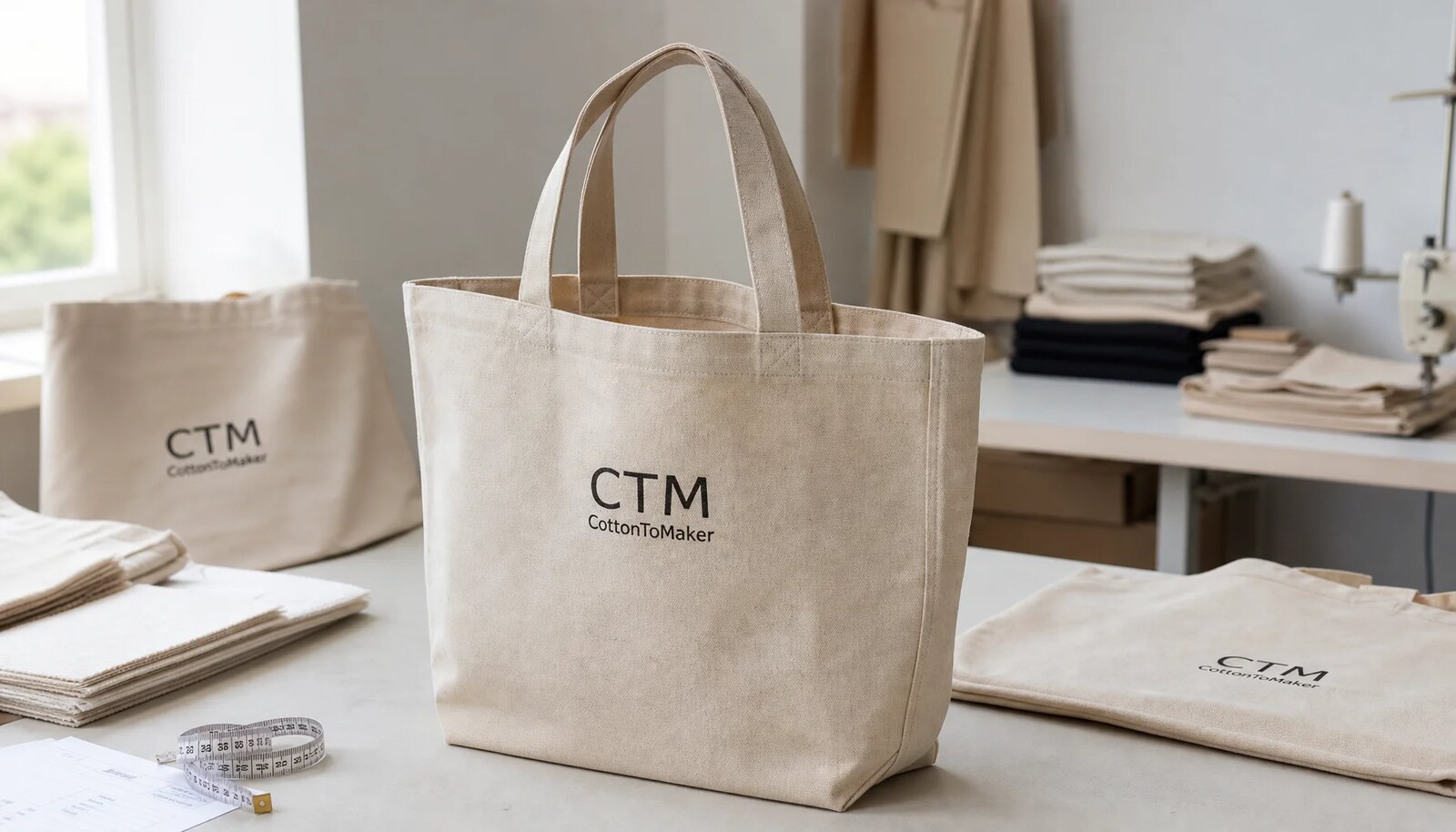
Start With The Warehouse Date
When buying wholesale canvas grocery totes for craft fairs, the most expensive problem is often not a few cents of unit cost. It is a shipment that lands after booth kits are packed, sponsor boxes have gone out, or vendors are already on the road. At that point, even a well-made tote has lost most of its operational value. Procurement should start with the required warehouse in-hand date, then build the schedule backward through approvals, production, inspection, freight, customs, receiving, and event allocation.
A custom printed canvas grocery tote often needs 45-65 days of production time after all major approvals are complete. That window usually assumes available fabric, standard sewing, normal screen printing, limited artwork versions, and straightforward packing. It does not include ocean transit, customs delay, local trucking, warehouse receiving, or repacking into craft fair kits. For overseas ocean programs, a 10-14 week plan from sourcing kickoff to warehouse receipt is more realistic than relying on a production-only promise.
The lead time clock should be defined in writing. Some suppliers count from deposit. Others count only after fabric is confirmed, vector artwork is approved, print colors are locked, and the pre-production sample is signed off. If the start condition is unclear, both sides may think the order is on schedule while it is still waiting for a logo file, internal buyer approval, or carton mark. Ask for a dated timeline with dependencies, not just a single number of days.
- Use the warehouse in-hand date as the schedule anchor, not the craft fair opening day.
- Write the lead time start condition into the RFQ and purchase order.
- Separate production lead time from freight, customs, and local distribution time.
- Reserve extra time for dyed fabric, custom labels, many print designs, or retail packaging.
- Set internal approval deadlines for design, procurement, sales, warehouse, and finance teams.
Turn Event Use Into Specs
Craft fair grocery totes work harder than simple giveaway bags. They may carry candles, jars, packaged food, ceramics, books, apparel, catalogs, sponsor inserts, and purchases collected from several booths. They also need to look good on a vendor table, hang neatly from a display hook, and fold into cartons without damaging the print. A good specification describes how the tote will be used, not only how it should look.
The common grocery-friendly structure is an open-top tote with bottom and side gussets. Many programs sit in the range of 35-40 cm wide, 35-42 cm high, and 8-12 cm deep, but the right size depends on the products going inside. A 10 cm gusset can make the bag feel much more useful than a flat tote, even when the front panel looks almost identical in a mockup. If the tote needs to hold jars, boxed goods, event folders, or packaged merchandise, approve the sample with real products or realistic substitutes.
Handle details deserve the same attention as the body. A 20-25 cm handle drop is usually more comfortable for shoulder carry, while shorter handles may be acceptable for hand-carry market bags. Handle width matters too; narrow handles can dig into the hand when the bag carries heavier purchases. For reusable grocery positioning, specify self-fabric canvas handles or cotton webbing handles, and require reinforcement at every attachment point.
- Specify finished width, height, bottom gusset, side gusset, handle width, handle length, and handle drop.
- Confirm whether the tote must stand upright at booth display or only function as a carry bag.
- Use load checks with intended products or realistic substitutes before pattern approval.
- Require reinforced handle stitching at every handle end for reusable grocery positioning.
- State whether the tote is for giveaway, resale, sponsor kit, vendor packaging, or multi-event distribution.
Choose Canvas Weight Carefully
Canvas tote quotes are hard to compare unless fabric weight and fabric type are clear. For craft fair grocery totes, 10 oz to 12 oz cotton canvas, approximately 340-410 GSM, is a practical B2B range. It gives the bag enough body for repeated use while still allowing efficient sewing, folding, and carton packing. Lighter 6 oz or 8 oz cotton can work for low-cost promotional totes, but it may collapse on display or distort under heavier contents. Heavier 14 oz canvas can feel premium, but it raises material cost, sewing difficulty, carton weight, and freight exposure.
Buyers should also distinguish natural, bleached, dyed, and recycled-content canvas. Natural cotton canvas fits many craft fair programs and usually prints well, but it may show seed specks, slubs, and shade variation. Bleached canvas gives a cleaner background for artwork but changes the look and sometimes the price. Dyed canvas can be attractive for brand programs, yet it may require lab dips, fabric minimums, bulk shade approval, and extra time. Recycled cotton or blended canvas can support sustainability positioning, but strength, shade consistency, fiber blend, and print behavior should be verified before tying the order to a fixed event date.
Fabric weight affects landed cost, not just handfeel. Thicker canvas changes carton CBM and gross weight, and it can slow sewing output. A low quote may simply mean lighter fabric, a flatter gusset, shorter handles, or weaker thread. Ask every supplier to quote both ounce and GSM because ounce descriptions can vary by market. Keep an approved fabric swatch or sample panel and use it as the production inspection standard.
- Use 6 oz to 8 oz cotton only for lighter promotional positioning.
- Use 10 oz to 12 oz canvas for reusable grocery tote balance and practical shipping weight.
- Consider 14 oz canvas only when premium handfeel justifies higher cost and freight.
- Approve natural canvas shade, speck level, and slub range from physical samples.
- Ask whether fabric is in stock before accepting a compressed production calendar.
Lock Print Decisions Early
Most wholesale canvas grocery totes for craft fairs use screen printing because it is efficient for one to three spot colors, event logos, sponsor marks, and seasonal graphics. The buyer should provide vector artwork, brand color references, final print size, print side, placement from fixed edges, and any limit on heavy ink coverage. A low-resolution screenshot, social media image, or event flyer is not enough for accurate pricing or clean production. If artwork needs cleanup, put that task on the schedule instead of treating it as invisible admin work.
Heat transfer can make sense for short runs, gradients, full-color artwork, or pilot programs where screen setup is inefficient. The sample should be checked for edge visibility, flexibility, handfeel, bonding, and appearance after folding. Embroidery can create a premium retail look, but it is slower, usually more expensive, and may pucker lighter canvas if backing and stitch density are not controlled. Choose the print method based on quantity, artwork complexity, fabric texture, handling conditions, and deadline before approving price.
Large solid print areas need extra scrutiny. Canvas texture can make coverage uneven, and heavy ink deposits can crack or transfer if curing is incomplete. These totes are folded, stacked, boxed, shipped, and handled several times before the event. The printed pre-production sample should be checked for color, coverage, placement, dryness, rub resistance, odor, and appearance after folding. If sponsor logos have strict brand rules, define acceptable color and placement variation before mass printing begins.
- For screen print, define ink colors, print size, print side, and placement from top and side edges.
- For large solids, request cure, rub, fold, and stacking checks before mass printing.
- For heat transfer, check edge bonding, flexibility, handfeel, and carton-compression behavior.
- For embroidery, confirm backing, stitch count, thread color, logo size, and reverse-side appearance.
- Lock final artwork file names and version numbers to prevent printing an outdated design.
Break MOQ Into Real Drivers
MOQ conversations get messy when buyers ask for one minimum and suppliers answer from one constraint. A canvas grocery tote order may have separate minimums for fabric purchasing, dyeing, cutting efficiency, screen setup, embroidery setup, label production, carton printing, carton marks, and export handling. A factory may accept a small stock natural canvas order, but the unit price can rise quickly when that order is split across many logos, destinations, or packing formats.
Craft fair programs often include several cities, sponsor groups, booth packages, or vendor categories. The cost-efficient route is usually to standardize one base bag and change only the print, as long as each print version reaches a practical production quantity. Ask for the same 2,000-piece program priced as one print run and as four 500-piece artwork lots. The comparison will reveal screen charges, changeover time, inspection sampling needs, replacement planning, carton marks, and packing complexity.
If the order ships to several destinations, MOQ and packing should be discussed together. A design that ships to three warehouses may need separate destination codes, carton sequences, and packing lists. Mixed-design cartons can reduce leftovers, but they raise receiving and shortage risk unless the warehouse has requested that method. Design-separated cartons are easier to inspect and allocate, though they may create uneven carton counts. These details affect cost and timing even when the tote itself is unchanged.
- Request price tiers at 500, 1,000, 2,000, and 5,000 pieces where relevant.
- Clarify MOQ by fabric color, bag size, print design, carton mark, destination, and shipment.
- Separate one-time setup charges from repeat-order unit pricing.
- Avoid excessive artwork splits on first production unless each design has demand and inspection control.
- Use one base tote across events when schedule reliability matters more than small construction changes.
Use Sampling As A Gate
Sampling should prove construction and process control, not just create a photo for approval. For a new canvas grocery tote, the first useful sample is usually a blank construction sample. It confirms fabric handfeel, finished dimensions, gusset shape, handle drop, handle comfort, seam strength, and folded appearance. This matters most when moving from a flat promotional tote to a gusseted grocery-style tote. The bag body should be right before print artwork is locked.
After the blank sample is approved, request a printed pre-production sample using the intended fabric, print method, ink or transfer, print size, print position, curing method, thread, and handle construction. This sample becomes the working standard for production and inspection. It should not be treated as a decorative mockup if bulk production will use different fabric, different ink, or a different fold. If the schedule forces photo approval, require rulers, stitching close-ups, print placement measurements, fabric texture, reverse-side views, and packing photos.
Test the sample in the way the tote will actually be used. Fill it with the expected load, carry it by hand and shoulder, set it on a table, fold it into the expected carton configuration, and rub the print against another bag surface. Measure the sample and record the results against the specification sheet. If it fails, give measurable comments such as increase handle drop to 24 cm or move print 15 mm lower. Vague notes like make stronger or print higher create avoidable sample rounds.
- Approve blank construction before approving final print placement.
- Use the same fabric weight, handle construction, thread, seam method, and fold planned for bulk.
- Record sample measurements, print coordinates, and comments in a dated approval sheet.
- Keep one approved pre-production sample with the factory and one with the buyer or inspector when possible.
- Treat any post-approval size, fabric, artwork, or print-method change as a lead time risk.
Build A Quote Sheet That Holds
A useful RFQ for wholesale canvas grocery totes includes enough detail to compare production value and landed cost, not only unit price. Required fields include fabric type, fabric weight in oz and GSM, finished dimensions, gusset style, handle width, handle drop, seam construction, print method, number of print colors, print area, print side, tolerances, MOQ, sample cost, setup charges, production lead time, packing quantity, carton dimensions, gross weight, net weight, CBM, Incoterms, payment terms, and quote validity.
Cost gaps often come from details that are not visible in a catalogue photo. A 12 oz gusseted tote with a wide print area is not comparable to an 8 oz flat tote with a small logo. A quote that includes export cartons, inner bundles, screen charges, carton marks, and inspection support is not comparable to one that excludes them. If the buyer adds barcodes, hangtags, belly bands, individual polybags, woven labels, destination stickers, or special carton marks after price approval, both cost and schedule may change.
The RFQ should ask for assumptions and exclusions. Cotton fabric price, exchange rate, carton material, rush production, ink coverage, and freight conditions can all affect pricing. A supplier may hold pricing for 7, 15, or 30 days depending on material availability. Procurement should capture quote validity and confirm the Incoterm, such as EXW, FOB, CIF, or DDP. Comparing FOB from one supplier with EXW from another supplier can distort the landed-cost decision.
- Compare quotes by finished specification, not by product keyword or catalogue image.
- Request carton CBM and gross weight early so freight impact is visible.
- List setup charges separately so repeat-order pricing is clear.
- State Incoterms, port, destination, and required delivery date before landed-cost comparison.
- Ask suppliers to identify exclusions, assumptions, and price-change triggers in writing.
Plan Packing Before Production Ends
Canvas grocery totes are simple products, but packing can protect or damage the program. Flat packing is normally efficient for wholesale orders. A common export arrangement is 50 pieces per carton with inner bundles of 10 or 25 pieces. This supports count control, distributor allocation, and dust protection. If the front print is large, dark, or recently cured, however, tight compression can create fold marks, ink transfer, or surface abrasion. Packing should be tested during approval, not improvised after bulk production.
Carton marking becomes important as soon as multiple events or artwork versions are involved. Each carton may need SKU, design code, event name, PO number, destination, carton number, quantity, gross weight, net weight, and country-of-origin marking where required. Mixed-design cartons should be avoided unless the receiving warehouse specifically wants them and the packing list controls the mix. Once cartons are sealed, reopening for relabeling or sorting adds labor and increases shortage risk.
Request carton dimensions and weight during quotation. Carton CBM affects freight cost, container loading, warehouse space, pallet planning, and downstream parcel or LTL handling. Very heavy cartons can be difficult for receiving teams, while under-filled cartons waste freight space and may collapse when stacked. If the goods will be palletized, specify pallet height limits, carton orientation, stretch wrap expectations, and whether carton labels must face outward.
- Use flat pack cartons that avoid excessive pressure on printed panels.
- Define inner bundle quantity so receiving teams can count quickly.
- Separate artwork designs by carton unless controlled mixed cartons are required.
- Confirm carton board strength, moisture protection, and readable carton marks for export handling.
- Ask for packing photos or a packing test before final carton sealing on first orders.
Write QC Before Inspection Day
Quality inspection works best when the acceptance standard is written before production starts. For canvas grocery totes, inspection should cover finished dimensions, fabric weight, shade, stains, seam strength, handle reinforcement, stitch density, loose threads, print position, print adhesion, print color, packing quantity, carton marks, odor, and moisture issues. AQL inspection may be used for larger orders, but critical defects should still be named. Wrong artwork, wet ink, mold, broken handle stitching, major stains, and incorrect carton quantities should not be treated the same as a loose thread that can be trimmed.
Natural canvas needs realistic standards, but not vague standards. Small cotton specks and minor shade variation may be normal for unbleached cotton. Oil marks, strong yellowing, grey tone shifts, holes, heavy slubs through the logo area, and dirty handling marks are a different matter. The approved sample or swatch should define the acceptable range. If the bag is sold as natural canvas, buyers should not expect a perfectly uniform paper-white surface unless bleached fabric has been specified.
Print inspection should include measurement and performance. Position can be measured from the top edge and side edge, commonly with a tolerance such as plus or minus 5 mm for normal sewn textile production unless the artwork requires tighter placement. Ink should be dry and cured, with no tackiness, smearing, heavy cracking, or transfer when rubbed against another bag surface. For large print areas, inspectors should check folded samples and pieces from the middle of cartons, not only freshly printed pieces from the top of a stack.
- Classify wrong artwork, wrong size, wet ink, mold, weak handles, and major stains as serious defects.
- Set tolerances for body width, height, gusset depth, handle width, handle drop, and print position.
- Inspect print cure, rub resistance, and fold behavior before final carton sealing when possible.
- Use approved samples to judge natural canvas shade, texture, and print coverage.
- Verify carton quantity, SKU separation, carton marks, and packing list accuracy before shipment release.
Control Delays Before Rush Freight
Many canvas grocery tote delays happen before sewing begins. Common causes include incomplete artwork, slow internal approval, unclear handle changes, unavailable fabric, repeated sample revisions, late deposit, screen remake, changed carton marks, late barcode files, and last-minute packing instructions. Each delay may look small on its own. Together, they consume the buffer needed for ocean freight. A lead time planning guide should turn each decision into a dated approval gate rather than leaving it as an open conversation.
A practical gate sequence is simple. Gate one approves bag construction: fabric, size, gusset, handle, seam, and tolerances. Gate two approves artwork: file format, color reference, print size, print side, and print coordinates. Gate three approves the printed pre-production sample. Gate four releases bulk production with packing, carton marks, inspection requirements, and shipment terms. If any approved item changes, the supplier should confirm cost and schedule impact before proceeding.
Seasonality matters for craft fairs, holiday markets, farmers markets, and promotional buying cycles. During peak months, printing capacity, sewing lines, inspection appointments, and freight bookings may tighten at the same time. Buyers should book inspection early, confirm freight options, and decide whether partial shipment is acceptable. If air freight is considered as a backup, carton dimensions and gross weight need to be known early because canvas totes are bulky and can be costly to fly.
- Freeze bag size and fabric before print sampling begins.
- Avoid changing print size after screens, films, or transfers are prepared.
- Approve packing instructions and carton marks before bulk sewing is complete.
- Book inspection and freight space early during peak event and holiday production months.
- Ask for a revised timeline whenever artwork, fabric, packing, or shipment terms change.
Specification comparison for buyers
| Spec decision | Recommended option | When it fits | Buyer risk to check |
|---|---|---|---|
| Fabric weight for grocery use | 10 oz to 12 oz cotton canvas, approximately 340-410 GSM, with an approved swatch kept for reference | Craft fair vendors, farmers market kits, reusable grocery programs, event merchandise, and retail gift-with-purchase bags that need body and repeat-use feel | Quotes may describe fabric differently. Verify GSM, ounce basis, finish, shrinkage expectation, and whether natural specks or slubs are acceptable |
| Bag structure | Open-top tote with 8-12 cm bottom gusset and matching side gussets | Orders carrying jars, books, boxed goods, apparel, catalogs, craft supplies, or multi-item shopper purchases | Flat totes cost less but hold less. Vague gusset wording can create one pattern in sampling and another in bulk cutting |
| Finished size control | Define width, height, bottom gusset, side gusset, handle width, handle drop, handle length, and print coordinates on one measurement sheet | Buyers comparing supplier quotes, approving a new factory, or changing size, handle, or construction | Photo approval hides size drift. Sewn textile tolerances must be written before bulk cutting |
| Handle construction | Self-fabric canvas handles or cotton webbing handles with box-X stitching, cross-stitching, or bar-tack reinforcement | Reusable bags expected to carry roughly 6-10 kg in normal retail, grocery, or event use | Short handle drop limits shoulder carry. Weak stitching or small reinforcement zones may fail before the canvas body does |
| Print method | Screen print for 1-3 spot colors; heat transfer for short runs or complex color artwork; embroidery only when premium positioning supports cost and time | Most craft fair logos, sponsor marks, seasonal graphics, and resale tote artwork on natural canvas | Large solids need cure, rub, fold, and stacking checks. Transfers can show edge lines. Embroidery may pucker lighter canvas |
| MOQ strategy | Use one base fabric color and one approved bag body, then split artwork only into factory-efficient lots | Distributors consolidating several craft fairs, cities, sponsors, or vendor programs under one tote specification | Too many design splits increase setup charges, screen changes, carton errors, inspection workload, and schedule risk |
| Sampling route | Approve the blank construction sample first, then approve the printed pre-production sample before mass cutting or printing | New dimensions, first factory order, revised handle drop, custom fabric, new artwork, or new print method | Skipping blank approval can lock in wrong capacity, weak handle comfort, poor standing shape, or an impractical fold |
| Packing method | Flat pack 50 pcs per export carton, with inner bundles of 10 or 25 pcs and design-separated carton marks where possible | Warehouse receiving, distributor allocation, event-kit packing, carton-level inventory control, and multi-design programs | Over-compression can cause wrinkles or ink transfer. Mixed SKUs require tight packing lists and count verification |
| Lead time buffer | Plan 10-14 weeks to warehouse for ocean programs; 45-65 days is often only the production window after full approvals | Seasonal craft fair launches, multi-event calendars, distributor replenishment, and overseas custom production | Lead time usually starts after deposit, fabric confirmation, artwork approval, and sample sign-off, not after the first inquiry |
Buyer checklist before sampling
- Set the required warehouse in-hand date first, then work backward through sample approval, bulk production, inspection, freight booking, customs, inland trucking, repacking, and craft fair allocation.
- Define finished tote dimensions in centimeters or inches: width, height, bottom gusset, side gusset, handle width, handle length, handle drop, and print position from fixed edges.
- Specify cotton canvas by ounce and GSM, fabric color, finish, shrinkage expectation, shade tolerance, and whether natural cotton specks, slubs, or minor shade variation are acceptable.
- Confirm whether the tote is intended for giveaway, resale, sponsor kit, vendor packaging, or reusable grocery use because each purpose changes acceptable fabric weight, print durability, and QC severity.
- Limit first production to a controlled number of print designs unless the MOQ supports separate setup, tracking, inspection sampling, and carton marking per design.
- Approve a physical blank sample for capacity, gusset shape, seam construction, handle comfort, standing behavior, and folded packing appearance before approving printed artwork.
- Approve a printed pre-production sample using the same fabric, ink or transfer, print size, print position, curing method, and handle construction intended for bulk production.
- Set print acceptance criteria for position tolerance, color reference, ink coverage, curing, rub resistance, folding behavior, and acceptable variation over textured canvas.
- Request carton dimensions, carton weight, pieces per carton, inner bundle method, SKU separation, carton marks, palletization option, and loading estimate before comparing landed cost.
- Confirm whether quoted lead time starts after deposit, fabric booking, artwork approval, sample approval, or only after all pre-production conditions are complete.
Factory quote questions to send
- What exact fabric weight will be used in oz and GSM, and is it stock canvas, greige canvas, bleached canvas, stock dyed fabric, or mill-dyed made-to-order fabric?
- What are the finished dimensions after sewing, including width, height, bottom gusset, side gusset, handle width, handle length, handle drop, and seam allowance assumptions?
- What tolerances are included for body width, body height, gusset depth, handle drop, handle length, handle width, and print position, and will these appear on the approval sheet?
- What MOQ applies per fabric color, per bag size, per print design, per carton mark, per destination, and per shipment, and how does pricing change if the order is split?
- Which print method is included, how many colors are included, what is the maximum print area, what ink or transfer type is planned, and are screen, film, plate, or setup charges separate?
- Can you provide a blank construction sample and a printed pre-production sample, and how many calendar days are needed for sample making, buyer review, revision, and courier time?
- Will the printed sample use the same fabric batch, ink, curing process, print size, handle construction, thread, and packing fold planned for bulk production?
- What production lead time applies after deposit and final sample approval, and which step is currently the longest bottleneck: fabric, cutting, sewing, printing, curing, packing, inspection, or export booking?
- What are the carton dimensions, pieces per carton, gross weight, net weight, CBM, inner bundle method, moisture protection, and recommended loading quantity for 20-foot or 40-foot containers?
- Which pre-shipment quality checks are included, and can the inspection report show measurements, seam strength observations, stitch density, print position, print rub results, packing, carton marks, and defect photos?
Quality-control points to confirm
- Finished size tolerance should normally be controlled within plus or minus 1 cm for width and height, plus or minus 0.5-1 cm for gusset depth, and plus or minus 0.5-1 cm for handle drop, depending on bag construction and fabric behavior.
- Fabric weight should match the approved standard; retained swatches or random cut pieces can be weighed to verify GSM instead of relying only on supplier descriptions such as heavy canvas or premium cotton.
- Canvas shade should be compared against an approved swatch or production sample under consistent lighting; natural specks and minor slubs are acceptable only if they match the approved range.
- Fabric defects should be sorted by severity: small natural seed specks may be minor, while oil stains, mold, strong yellowing, holes, heavy slubs through the logo area, or dirty handling marks may be major.
- Handle attachment must show consistent cross-stitch, X-stitch, or bar-tack reinforcement with no skipped stitches, broken threads, loose ends, tearing, or misaligned stress points.
- Stitch density and seam allowance should be consistent around side seams, bottom gusset corners, top hem, and handle attachment areas where grocery weight concentrates during use.
- Print position should be measured from top edge and side edge with a defined tolerance, commonly plus or minus 5 mm for normal tote production unless the design requires stricter placement.
- Ink should be fully cured and dry with no tackiness, transfer, heavy cracking, obvious pinholes, smearing, or unacceptable coverage loss over raised canvas texture.
- Large dark print areas should be checked after folding, stacking, and carton compression because pressure marks, ink transfer, and abrasion can appear after packing rather than immediately after printing.
- Cartons should be dry, correctly counted, not over-compressed, readable in carton marks, separated by SKU or design, and matched to the purchase order, packing list, and destination plan.