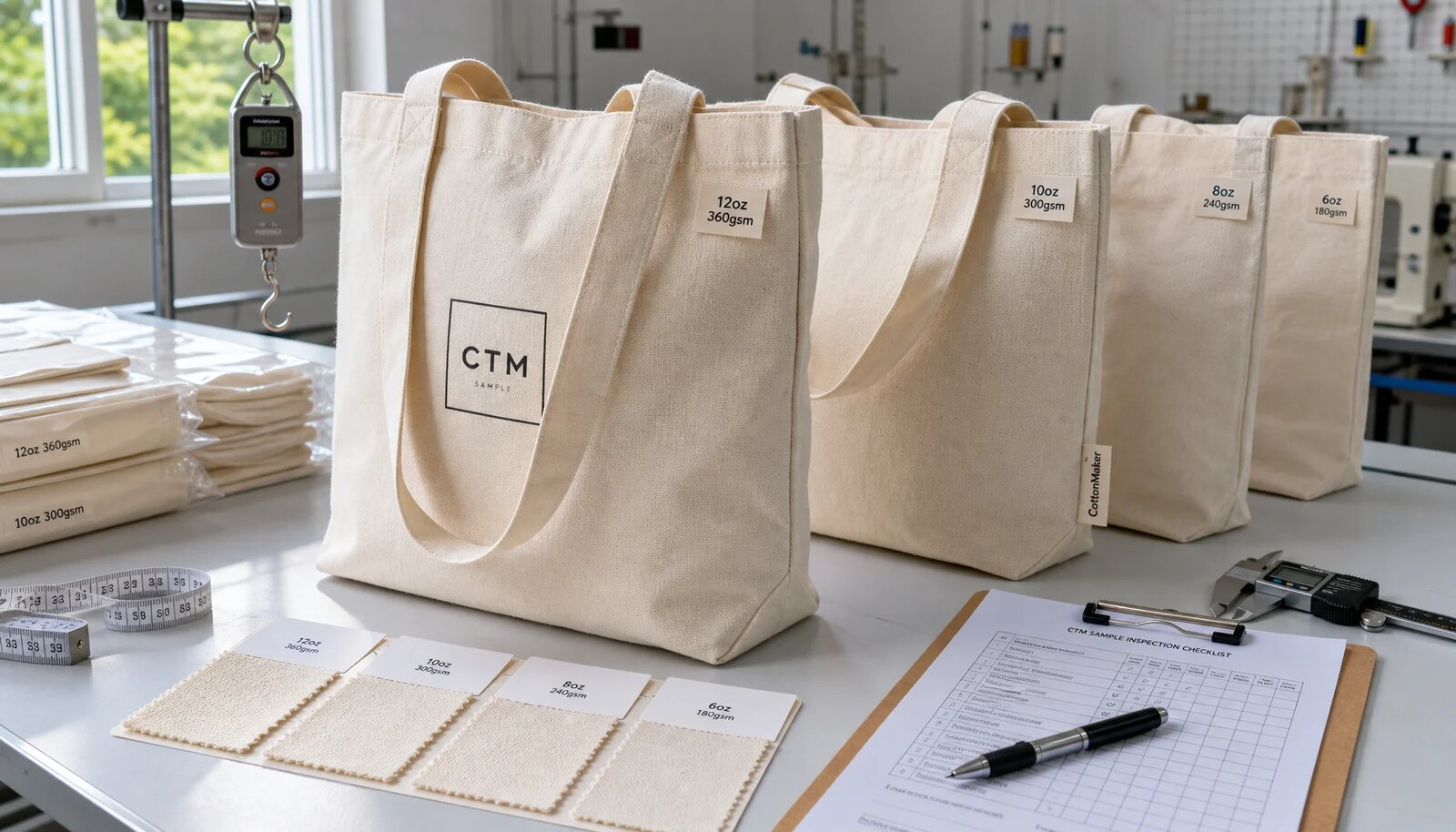
Start With The Buying Scenario
Fabric weight is not the first decision for wholesale canvas grocery totes for craft fairs. The first decision is what the bag must survive. A sponsor giveaway handed out at registration does a different job from a paid tote on a ceramic vendor's table. A distributor stocking seasonal market bags has different priorities again: repeatable specs, carton consistency, and pricing that can be reordered without surprises.
Craft fair totes tend to be loaded in uneven ways. One shopper may carry candles and folded apparel. Another may add books, jars, paper goods, flowers, soaps, and a small boxed gift in the same bag. That mix creates point pressure at the bottom corners and pulling stress at the handles. A flat promotional tote may look fine when empty, then sag hard once the customer walks the venue.
Write the use case into the RFQ before asking for price. State whether the tote is for paid resale, vendor merchandise packaging, event distribution, branded sponsor merchandise, farmers market crossover use, grocery loading, or distributor inventory. Then connect that use to finished size, expected load, print method, handle drop, and packing style. Suppliers can price a practical product only when they know the job the tote is being asked to do.
- Use 8 oz only when the expected load is light, the tote size is controlled, and the commercial goal is low cost.
- Use 10 oz when the buyer wants a reusable feel, reasonable foldability, and a competitive wholesale price.
- Use 12 oz when the tote will be sold, displayed, or reused often enough to justify stronger hand feel and structure.
- Use 14 oz when stiffness, heavy-duty positioning, or premium retail presentation is part of the product strategy.
- For a first order, limit the number of weights, sizes, and handle variants so price comparison and QC stay manageable.
Read Fabric Weight Correctly
Canvas weight is usually quoted in ounces per square yard. Many international factories also quote GSM, or grams per square meter. As a sourcing guide, 8 oz is approximately 270 GSM, 10 oz is approximately 340 GSM, 12 oz is approximately 407 GSM, and 14 oz is approximately 475 GSM. Those conversions help buyers compare offers, but they do not replace a labeled swatch, a sample, and an agreed tolerance.
The same ounce number can feel different from mill to mill. A tight 10 oz canvas may feel firmer than a loose 12 oz canvas. Washed canvas can feel softer and more relaxed than untreated canvas. Dyed fabric may change shrinkage and print color. A cotton-poly blend may reduce wrinkling or shrinkage, but it also changes hand feel, fiber claims, finishing behavior, and sometimes print performance. Organic cotton and recycled cotton blend options can add MOQ, documentation, and availability questions.
For procurement, describe fabric as a complete specification, not a single number. Include the ounce rating, GSM, composition, finish, color, and tolerance. State whether the quoted weight is measured before finishing, after dyeing, after washing, or after another treatment. Identify the approved swatch by reference number, color, finish, and date. If the supplier proposes a substitute fabric, even one with the same nominal weight, require a physical review before cutting.
- State fabric as 10 oz cotton canvas, approximately 340 GSM, or 12 oz cotton canvas, approximately 407 GSM, instead of using only one unit.
- Ask whether weight is measured before finishing, after finishing, or after washing because the answer can affect comparison.
- Require a fabric weight tolerance, often plus or minus 5 percent unless a tighter or wider range is agreed.
- Keep one buyer-retained swatch and one factory-retained swatch for incoming fabric and final inspection checks.
- Do not approve a fabric substitution from a photo; require a physical swatch or sample when shade, feel, or print result matters.
Choose 8 Oz, 10 Oz, 12 Oz, Or 14 Oz
For most wholesale canvas grocery totes for craft fairs, the practical buying range is 10 oz to 12 oz. This range balances cost, structure, sewing efficiency, printability, carton weight, and hand feel. A well-built 10 oz tote can perform well when the body is not oversized and the handles are properly reinforced. A 12 oz tote feels more substantial, stands better on a table, and is easier to position as a paid resale item or higher-value event bag.
Size changes the answer. A small tote naturally limits the load, so lighter fabric can work if the seams and handles are still built correctly. A larger grocery tote with an 8-12 cm gusset invites heavier loading. More volume means more strain at the top hem, handle stitch box, gusset corners, and bottom seam. For a grocery-style body around 38 x 40 cm with an 8-10 cm gusset, 10 oz can be a strong commercial choice. For larger formats, glass-heavy vendor categories, or premium resale, 12 oz is often easier to defend.
Fourteen-ounce canvas has a place, but it should not be selected just because it sounds stronger. It raises fabric cost, creates thicker seam intersections, slows sewing, adds carton weight, and increases freight volume. Folded corners can also press harder into printed areas, which may create visible crease marks or print cracking on fold lines. Approve 14 oz only after checking the filled sample, folded packing, carton data, production lead time, and landed cost. In many programs, a properly engineered 12 oz tote is the better buy.
- 8 oz: best for light giveaways, sponsor bags, small goods, and price-sensitive packaging with reinforced stress points.
- 10 oz: good all-round choice for reusable craft fair totes when cost, foldability, and credible durability all matter.
- 12 oz: better for paid resale, heavier mixed purchases, improved table presence, and stronger perceived value.
- 14 oz: suitable for premium heavy-duty programs, but only after checking seam bulk, freight, fold marks, and production lead time.
- When uncertain, quote the same design in 10 oz and 12 oz with every other variable held constant.
Specify Construction, Not Just Cloth
A heavy canvas body will not rescue weak construction. The usual failure points are predictable: handle attachment, top hem, side seams, bottom seam, gusset corners, and thick intersections where several fabric layers meet. A supplier can quote the correct 12 oz canvas and still reduce cost by narrowing the handles, shortening the stitch box, lowering stitch density, using a small seam allowance, or leaving raw edges inside. The RFQ needs to describe the tote, not just the cloth.
For grocery-style craft fair use, a gusseted or boxed bottom is usually more useful than a flat tote. It gives the bag more real carrying volume, helps it sit more cleanly on a booth table, and makes the product feel closer to a true market bag. Common gusset depths are about 8-12 cm. Go deeper only when the contents justify it, because more volume encourages customers to load the bag heavier.
Handles should be specified with the same care as fabric. Self-fabric handles can look cohesive and retail-ready. Cotton webbing handles can reduce bulk and feel comfortable in the hand. Common handle widths are about 2.5-3.8 cm. Handle drop should match the intended carry style: hand, forearm, or shoulder. Longer handles are convenient, but they change the pull angle and can increase stress on the attachment when the tote is loaded.
- Define flat tote, side gusset, bottom gusset, or boxed bottom so suppliers do not price different structures.
- Specify handle material, handle width, handle length, finished handle drop, and attachment position.
- Require a defined reinforcement method such as box stitch, cross stitch, bartack, or double row stitching.
- Ask for stitch density, seam allowance, thread type, and inside seam finish at the quotation stage.
- Review inside seam photos and physical samples, not only front-view product images.
- Avoid placing artwork across thick seam intersections or folded corners where print pressure and durability are harder to control.
Build A Comparable RFQ
A fabric weight guide only helps if the quotes are comparable. Canvas tote prices move with fabric weight, fabric width, cutting yield, handle construction, print size, number of colors, label type, packing method, inspection requirement, carton quantity, and Incoterm. A lower price may be a better deal. It may also be a different bag.
Send each supplier the same technical sheet. Include finished dimensions, gusset depth, fabric weight and tolerance, fabric color, composition, handle construction, print method, logo size, logo placement, label requirements, packing format, carton marks, inspection standard, order quantity, delivery date, and Incoterm. Then ask for controlled alternates. For example, quote the same tote in 10 oz and 12 oz, or quote natural canvas and dyed canvas, with no other changes.
MOQ details deserve attention early. Some suppliers calculate MOQ by total order quantity. Others apply it per fabric color, print design, label version, packing format, or artwork. Screen setup charges may apply per color, per design, per side, or per repeat order. Dyed canvas can have a separate mill MOQ. Hangtags, barcode labels, retail bands, and custom packaging may have their own minimums. Put these questions in the RFQ so they do not appear after the sample is approved.
- Ask for 10 oz and 12 oz quotes using the same size, gusset, handle, print, label, packing, carton count, and Incoterm.
- Separate one-time costs such as sample fees, screens, artwork adjustment, hangtag tooling, and barcode label setup.
- Clarify whether print setup charges apply per color, per design, per side, or per repeat order.
- Confirm whether fabric is stock fabric, mill-run fabric, dyed to order, or subject to a mill minimum.
- Request estimated carton dimensions and CBM before comparing landed cost.
- Include the inspection standard and required sample approval steps in the RFQ so they are priced into production.
Plan Printing Around Canvas
Screen printing is usually the practical choice for solid logos, sponsor graphics, event marks, and simple craft fair branding. It works well at wholesale quantities and suits cotton canvas when the artwork is prepared for texture. The fabric surface matters. Small type, thin borders, delicate line art, and fine halftones can break up on the weave, especially on heavier or rougher canvas. A clean digital mockup is not enough evidence.
Natural canvas affects ink color. A Pantone color approved on coated paper may look warmer, duller, or less saturated on unbleached cotton. Dyed canvas adds another layer of risk. Light inks may need an underbase, and the fabric shade can shift the final color. For a branded program, approve a physical strike-off or pre-production print on the actual fabric weight and color. Keep that sample as the standard for repeat orders and final inspection.
Heat transfer and embroidery can be useful, but neither is automatically better. Heat transfer can reproduce complex art and gradients, yet it may feel plastic, lift at the edges, crack on fold lines, or show abrasion. Embroidery can look premium, but it may pucker the panel, stiffen the bag, or leave an uncomfortable reverse side. Match the decoration method to the tote's use, folding method, price point, and artwork style.
- For screen print, enlarge small type and simplify fine detail before approving artwork for textured canvas.
- For natural canvas, approve ink color on the actual fabric rather than relying only on a paper proof.
- For dyed canvas, ask whether an underbase is needed and whether it changes cost, hand feel, or curing time.
- For heat transfer, fold the sample through the graphic and check cracking, edge lifting, and surface abrasion.
- For embroidery, check puckering, backing, thread density, reverse-side finish, and panel stiffness.
- Set print placement tolerance from fixed edges, such as plus or minus 0.5-1 cm if the factory confirms it can hold that range.
Use Samples As A Control System
Do not approve canvas weight from a photo. Photos hide stiffness, sagging, seam bulk, handle comfort, shrinkage, print texture, and fold behavior. A better sample path starts with fabric swatches, moves to artwork or print strike-off, then to a prototype if construction is new, and ends with a pre-production sample made with final fabric, final construction, final print, final labels, and final packing.
Test the sample like a real grocery tote. Load it with the type of goods expected at the event: jars, books, candles, folded apparel, paper goods, small boxes, or protected ceramic pieces. Carry it for several minutes. Set it on a table. Lift it by one handle. Fold it into the proposed packing method. Check the print after folding and handling. This is not a laboratory performance claim; it is a practical screen for obvious mismatch before bulk cutting starts.
Document the approved sample in measurable terms. Record body width, body height, gusset depth, handle width, handle drop, logo placement, empty bag weight, seam construction, label placement, packing method, carton count, and accepted variation. Photograph the inside seams, handle attachment, bottom corners, printed panel, folded packing, and carton layout. The buyer and factory should each retain a clearly identified sample so final inspection is tied to the same standard.
- Measure body width, height, gusset, handle drop, handle width, and logo placement from fixed edges.
- Compare the sample fabric to the approved swatch for weight, shade, texture, stiffness, and finish.
- Run a buyer-defined load check and record the target weight, duration, and result.
- Rub the print with a dry white cloth to catch obvious curing, smearing, or transfer problems.
- Fold the tote as it will be packed and check for hard creases through the artwork.
- Approve the physical pre-production sample in writing before mass cutting, printing, or sewing begins.
Set Tolerances And QC Rules
Canvas grocery totes are simple products, but simple does not mean inspection can be vague. Natural cotton canvas may include slubs, yarn irregularities, and minor shade variation. Those can be acceptable if they match the approved standard. Oil stains, holes, open seams, broken handle reinforcement, wrong print color, heavy smearing, and incorrect carton quantities are different issues. Define defect severity before production so the supplier, inspector, and receiving team apply the same rules.
Good tolerances are measurable. For sewn canvas goods, many buyers start with plus or minus 1 cm for body dimensions, gusset depth, and handle drop unless tighter control is negotiated and proven by sampling. Fabric weight tolerance is commonly plus or minus 5 percent unless a different range is contracted. Print placement should be measured from fixed bag edges, not judged by visual centering on a gusseted panel that may not lie perfectly flat.
QC should happen before the final cartons are sealed. Incoming fabric inspection catches shade problems, incorrect weight, stains, and holes. In-line sewing checks catch missed bartacks, skipped stitches, twisted handles, loose seams, and top-hem issues while the factory can still correct them. Print checks catch registration, curing, pinholes, ghosting, and color problems before folding hides the defect. Final inspection should verify dimensions, workmanship, print, packing, carton marks, quantities, and document consistency.
- Critical defects: unsafe handle failure, sharp contamination, severe mold, wrong product, or other issues that make the tote unusable or unsafe.
- Major defects: open seams, missed reinforcement, large stains, wrong logo, wrong color, severe print defects, wrong size beyond tolerance, or wrong packing.
- Minor defects: small loose threads, slight slubs, minor shade variation, or small cosmetic marks within the approved standard.
- Measurement checks: body width, body height, gusset depth, handle drop, handle alignment, and logo placement.
- Workmanship checks: stitch density, seam closure, trimming, thread color, raw edges, needle damage, and handle reinforcement.
- Packing checks: folding method, inner protection, carton count, carton marks, SKU labels, gross weight, net weight, and packing list accuracy.
Control Shrinkage, Color, And Claims
Shrinkage is easy to overlook because craft fair totes are not apparel. It still matters. A reusable tote with a printed logo, published size, or tight carton plan can create receiving and customer-service issues if the finished dimensions change more than expected. Untreated cotton canvas can shrink more than pre-shrunk or sanforized fabric. Washing, dyeing, and finishing can also change hand feel, shade, and size before sewing.
Ask the supplier what shrinkage to expect after a standard cold wash and whether the fabric has been pre-shrunk, washed, or sanforized. If washability is part of the product claim, define the wash method and acceptable dimensional change. If the tote is not intended for machine washing, avoid broad wash claims in product copy. Procurement language should keep marketing, sales, and customer service from overpromising.
Fiber and sustainability claims need the same discipline. If the bag is sold as organic cotton, recycled cotton, or a specific blend, request the relevant documentation and make sure the quote, label, invoice, and product description all match. Natural color is not proof of organic content. A recycled claim should not be used without documentation. These choices can affect MOQ, unit price, lead time, labeling, and import paperwork, so address them before sample approval.
- Ask whether the fabric is untreated, washed, pre-shrunk, sanforized, dyed, or finished after weaving.
- Define expected shrinkage after the agreed wash method if washability or repeated-use claims matter.
- Check whether logo placement remains acceptable after shrinkage if the buyer publishes precise dimensions.
- Approve dyed fabric shade under consistent lighting and compare it to the retained swatch.
- Request documentation for organic cotton, recycled cotton, or blend claims before using those claims in product copy.
- Make sure care instructions, hangtags, invoices, and product listings do not overstate fabric performance or content.
Plan Packing, Freight, And Receiving
Fabric weight shows up again in freight. A 12 oz or 14 oz tote may look reasonable at unit price level, then add cost through carton gross weight, carton volume, and handling. Tight packing can reduce CBM but may press hard fold lines across the logo. Loose packing can raise freight cost and allow cartons to crush or shift. Treat packing as part of the product specification, not as a warehouse afterthought.
Flat folding is common for wholesale grocery totes. When possible, keep fold lines away from dense ink areas. Individual polybags protect against dust and moisture, but some buyers prefer less plastic. Alternatives include master poly liners, paper bands, belly bands, hangtags, or inner cartons. Each choice affects labor, presentation, carton count, and receiving. Retail-ready packing may justify extra cost for paid resale. Distributor stock may care more about consistent carton quantities and clear labels.
Before issuing the PO, request carton dimensions, pieces per carton, net weight, gross weight, and estimated CBM. Use those figures to compare landed cost between 10 oz, 12 oz, and 14 oz options. Confirm carton marks with item code, PO number, color, print version, quantity, country of origin where required, and routing details. The receiving team should know what is inside the carton without opening every box.
- For natural canvas, protect against dust, moisture, oil marks, dirty handling, and carton abrasion.
- For printed totes, prevent ink surfaces from rubbing directly against rough carton interiors or hardware.
- For retail resale, include hangtags, belly bands, barcodes, and presentation folding in the sample and quote.
- For distributor stock, standardize carton quantities and keep carton weights practical for warehouse handling.
- For air shipment, compare volumetric weight because bulky gusseted totes can cost more than expected.
- For final inspection, verify packed carton quantity, carton marks, PO data, SKU labels, gross weight, and packing list consistency.
Specification comparison for buyers
| Spec decision | Recommended option | When it fits | Buyer risk to check |
|---|---|---|---|
| Main fabric weight | 10 oz to 12 oz cotton canvas, approximately 340-407 GSM before finishing unless otherwise specified | Most wholesale canvas grocery totes for craft fairs carrying produce, books, candles, jars, apparel, soaps, paper goods, and mixed purchases | Confirm fabric weight tolerance, composition, shrinkage, and approved swatch because nominal ounce ratings can vary by mill, finish, and moisture content |
| Budget fabric option | 8 oz canvas, approximately 270 GSM, with modest bag size and reinforced handles | Sponsor bags, lightweight giveaways, low basket-weight events, small handmade goods, or vendor packaging where cost is the primary constraint | Panel transparency, sagging, handle tear-out, print show-through, and reduced perceived value need sample checks before bulk approval |
| Premium fabric option | 12 oz canvas, approximately 407 GSM, with gusseted or boxed bottom and reinforced handle attachment | Paid resale, boutique craft fairs, farmers market crossover programs, distributor stock, and buyers wanting a stronger hand feel | Higher fabric cost, carton weight, fold memory, and seam bulk should be included in landed cost and packing review |
| Heavy-duty fabric option | 14 oz canvas, approximately 475 GSM, used only when the commercial position supports the added cost and bulk | Premium retail tote, repeated grocery use, heavier glass products, ceramic vendors, or branded programs where stiffness and durability are part of the offer | Bulkier cartons, slower sewing, thicker seam intersections, needle damage, higher freight volume, and print cracking on fold lines |
| Fabric finish | Natural, dyed, washed, pre-shrunk, sanforized, organic, recycled blend, or conventional cotton clearly named in the RFQ | Any buyer comparing suppliers or repeating a tote program across seasons | A same-weight canvas can change feel, shade, shrinkage, print color, and unit price after finishing |
| Bottom construction | Boxed bottom or gusseted base, commonly 8-12 cm for grocery-style craft fair totes | Bags that need usable volume and better table presentation for jars, flowers, paper goods, folded apparel, or pottery | Flat totes reduce cost but collapse more easily, provide less volume, and invite seam strain when overloaded |
| Handle construction | Self-fabric or cotton webbing handles, commonly 2.5-3.8 cm wide, reinforced by box stitch, cross stitch, bartack, or equivalent | Reusable totes carried around venues, markets, pop-ups, and vendor aisles | Weak thread, narrow handles, short stitch boxes, poor alignment, or missed reinforcement can fail even when the canvas body is heavy |
| Print method | Screen print for solid art; heat transfer or embroidery only after application-specific testing | Event logos, vendor marks, sponsor graphics, retail branding, and simple multi-color art | Canvas texture breaks fine detail; heat transfers may lift or crack; embroidery can pucker panels or create stiffness |
| Dimensional control | Finished body, gusset, handle drop, and logo placement tolerances stated on the tech sheet | Retail programs, distributor stock, repeat orders, and branded merchandise with published dimensions | Uncontrolled shrinkage or sewing variation can change capacity, handle comfort, logo position, carton count, and customer perception |
Buyer checklist before sampling
- Define the primary use case before selecting weight: sponsor giveaway, paid retail tote, grocery loading, vendor merchandise packaging, distributor stock, or event organizer program.
- State fabric weight in both oz per square yard and GSM, and require the supplier to confirm whether the value is before or after washing, dyeing, or finishing.
- Specify fabric composition and finish: 100 percent cotton, cotton-poly blend, organic cotton, recycled cotton blend, natural, greige, bleached, dyed, washed, pre-shrunk, sanforized, or untreated.
- List finished body width, finished height, gusset depth, handle width, handle length, handle drop, seam finish, stitch type, and handle reinforcement method in the RFQ.
- Request physical swatches for 8 oz, 10 oz, 12 oz, and 14 oz canvas if the buying team has not recently reviewed these weights by hand.
- Confirm tolerances before ordering: fabric weight, finished dimensions, handle drop, print placement, print color, shade variation, carton quantity, and packing format.
- Ask the supplier to quote 10 oz and 12 oz versions using the same size, gusset, handle, print, label, packing, inspection requirement, and Incoterm.
- Approve one physical pre-production sample made with final fabric, final print, final handle construction, final label placement, and final packing method.
- Run a practical load test on the sample using the buyer's target weight and realistic contents such as jars, books, candles, folded apparel, or paper goods.
- Review the empty sample weight, handle comfort, panel sag, seam bulk, print clarity, fold behavior, and whether the tote stands acceptably when filled.
Factory quote questions to send
- What is the exact canvas weight in oz and GSM, and is this measured before or after finishing, washing, dyeing, or coating?
- What fabric weight tolerance do you apply during incoming inspection, and how will you measure it for this order?
- Is the canvas 100 percent cotton, cotton-poly blend, organic cotton, recycled cotton blend, or another composition?
- Is the fabric natural, greige, bleached, dyed, washed, pre-shrunk, sanforized, or untreated, and what shrinkage should we expect after a standard cold wash?
- Can you quote 10 oz and 12 oz versions using the same finished size, gusset, handle, print, label, packing, carton quantity, and Incoterm?
- What finished size tolerance do you recommend for this construction, and can you hold plus or minus 1 cm on body dimensions and handle drop?
- What handle reinforcement will be used: box stitch, cross stitch, bartack, double row stitch, or another construction?
- What thread type, thread count, and stitch density will be used at side seams, bottom seam, gusset corners, top hem, and handle attachment?
- What is the proposed seam allowance and seam finish, and will any raw edges remain visible inside the tote?
- What is the maximum recommended logo size for clean screen printing on this panel size and canvas texture?
Quality-control points to confirm
- Fabric weight should match the approved swatch within the agreed tolerance, commonly plus or minus 5 percent unless the buyer and supplier contract a different range.
- Fabric composition and finish should match the PO, approved swatch, and any fiber claim documents; substitutions should not be used without buyer approval.
- Finished body width, body height, gusset depth, handle width, and handle drop should stay within the approved tolerance, often plus or minus 1 cm for sewn canvas goods unless tighter control is agreed.
- Handle attachment must meet the buyer's load test target without seam opening, thread breakage, stitch slippage, bartack failure, or fabric tearing around the stitch box.
- Side seams, bottom seams, top hems, and gusset corners should show consistent stitch density, no skipped stitch runs, no open seams, no unraveling, and no raw edges beyond the approved construction.
- Print placement should be measured from fixed edges, not judged visually, especially on gusseted grocery tote panels that may not lie perfectly flat during inspection.
- Ink coverage must be even enough for the approved standard, with no severe pinholes, smearing, ghosting, off-register color, ink build-up, scorching, transfer, or curing problems.
- Color approval should use a physical print sample or agreed Pantone reference on the actual fabric because natural, bleached, and dyed canvas all change perceived ink color.
- Loose threads, skipped stitches, needle holes, dirty marks, oil stains, fabric slubs, holes, shade bands, and crease marks should be graded by severity before shipment release.
- Packed totes should match the approved folding method so logos are not damaged by hard fold lines, abrasion, moisture, or unnecessary compression.