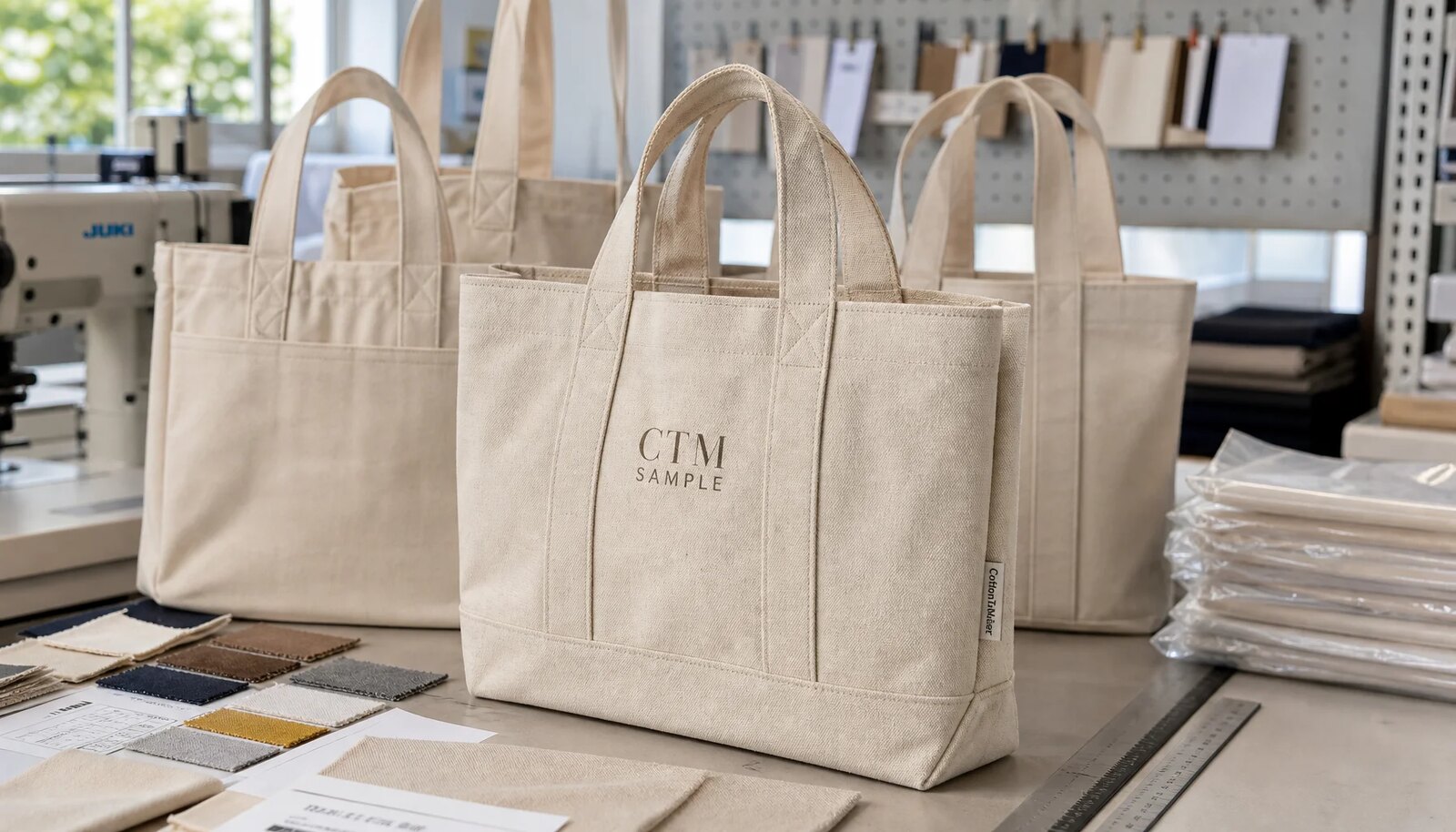
Why MOQ Gets Complicated for Craft Fair Totes
Wholesale canvas grocery totes for craft fairs look straightforward from the outside: fabric, handles, logo, carton. On a factory floor, the minimum order quantity is usually several minimums layered together. Fabric roll purchasing, cutting-table efficiency, sewing-line setup, screen preparation, ink mixing, curing time, packing labor, carton planning, and inspection sorting all affect the number a supplier gives you. If procurement treats MOQ as a single supplier preference, the conversation often turns into a price argument. If you separate the operating constraints, the factory has more room to suggest a workable route.
Craft fair programs also tend to be fragmented. One order may include a main fair logo, a sponsor version, a VIP gift version, and allocations for different booths or stores. The total quantity may be attractive, but each artwork version may be small. A supplier that can sew 1,000 blank totes efficiently may still resist ten printed versions at 100 pieces each because every version needs file checking, setup, alignment, drying or curing, sorting, labeling, and packing control.
The best negotiation protects factory efficiency while keeping buyer flexibility. Standardize the physical tote, use one stock fabric where possible, combine all versions into one blank sewing run, and split only at decoration. That structure gives you a better chance of negotiating a lower minimum per artwork without asking the factory to restart fabric purchasing, cutting, sewing, and packing for every design.
- Separate fabric MOQ, blank tote MOQ, print MOQ, packing MOQ, and accessory MOQ before negotiating the final unit price.
- Ask whether the supplier can produce one shared blank tote run and decorate artwork versions afterward.
- Avoid changing size, fabric color, gusset depth, handle material, label type, or packing format between artwork versions unless the quantity supports it.
- Treat very low MOQ as a cost tradeoff; setup fees may appear as separate charges or be built into a higher unit price.
- Use a tiered RFQ to compare 300, 500, 1,000, 2,000, and 5,000 pieces instead of negotiating from one quantity only.
Lock the Specification Before Talking Price
MOQ negotiation should not begin with, “What is your minimum?” It should begin with a clear product definition. A canvas grocery tote for craft fairs is expected to carry more than a thin promotional bag. Shoppers may use it for candles, ceramics, books, jars, packaged food, produce, folded textiles, or several small purchases from different booths. If the tote is too narrow, too light, or poorly reinforced, the order can be cheap and still fail its purpose.
A practical grocery tote specification includes finished width, finished height, gusset depth, handle drop, fabric weight, fabric finish, print position, seam construction, handle reinforcement, and packing method. Finished size matters because factories cut fabric larger than the final measurement to allow for seams, folding, pressing, and shrinkage. If one quote is based on cutting size and another on finished sewn size, procurement may think suppliers are pricing the same bag when they are not.
For many craft fair programs, a useful starting point is a finished tote around 38 W x 35 H x 10 D cm with a boxed bottom or side gusset. This gives enough volume for mixed purchases without making the bag too bulky for carton packing. Handles in the 55-65 cm total-length range, or a clearly stated shoulder-friendly handle drop, are usually more useful than short hand-carry handles for visitors walking through an event for several hours.
- State finished dimensions and measurement points in centimeters or inches.
- Define handle drop separately from total handle length so suppliers do not interpret it differently.
- Specify boxed bottom, side gusset, or flat construction because each changes capacity, sewing time, carton cube, and cost.
- Use a realistic load requirement such as light groceries and craft goods instead of the vague phrase “heavy duty.”
- Attach a simple technical sketch showing body size, gusset, handle placement, print area, seam direction, and label position.
Fabric Weight, GSM, Weave, and Finish
Fabric is one of the largest cost drivers in canvas grocery totes, and it is also one of the easiest places for quotes to drift apart. Canvas is often described in ounces, while mills and inspection teams may also use GSM. If the ounce value is quoted as ounces per square yard, 10 oz is approximately 339 GSM and 12 oz is approximately 407 GSM. Even so, ask the supplier for its stated GSM because local trade language, finishing loss, moisture, and fabric construction can make quoted values inconsistent.
For craft fair grocery totes, 10 oz to 12 oz cotton canvas is a practical B2B starting range when the bag needs to feel reusable and carry mixed purchases. Lighter fabric may work for giveaways, but it can feel more like a promotional tote than a grocery tote. Heavier fabric can improve perceived value, but it may increase sewing difficulty, needle damage risk, carton weight, freight cube, and unit cost. A physical swatch matters because a tight 10 oz fabric can feel more stable than a loose fabric labeled heavier.
Natural unbleached canvas is often the easiest route for MOQ control. Factories may have stock rolls or faster access to standard fabric. Dyed canvas, washed canvas, bleached canvas, and custom GSM fabric can support stronger branding, but each adds variables. Dyed fabric may require lab dips and shade approval. Washed canvas can increase shrinkage and dimension variation. Bleached canvas gives a cleaner base for print but may show handling stains more easily.
- Ask for ounce weight, GSM, weave description, fabric width, yarn count if available, and a swatch from the intended production source.
- Confirm whether the fabric is stock natural canvas or requires mill production, dyeing, bleaching, washing, or special finishing.
- Request the expected shrinkage range if washing, steam pressing, tumble drying, or heat curing will affect the fabric.
- Approve acceptable cotton flecks, slubs, and natural shade variation so inspection separates normal canvas texture from true defects.
- Check whether the fabric width creates cutting waste for the selected tote width, gusset depth, and handle construction.
Handles, Seams, and Load Testing
Handle failure is one of the most serious quality risks for canvas grocery totes. The buyer should specify more than “reinforced handles.” A useful specification names the handle material, handle width, handle length or drop, stitch pattern, reinforcement box size, thread color, thread strength if required, and where the handle ends are inserted or sewn. Cotton webbing handles are common because they are consistent and efficient. Self-fabric handles can look more integrated but may add cutting and folding labor.
A common shoulder-carry setup uses 30-35 mm wide handles and a handle length around 55-65 cm, but the buyer should approve the actual handle drop on a fit sample. A tote can look correct on a flat table and still feel awkward when loaded. The attachment should usually use a box stitch or box-X stitch at each stress point, with enough stitch density to secure the handle without cutting the fabric. Very dense stitches can perforate canvas; very sparse stitches can pull out.
Load testing must be repeatable. For a grocery tote, a buyer may specify a static load test such as 10-15 kg for a defined period, or a shorter dynamic lift test, but the method, weight, duration, number of tested pieces, and failure definition must be written before production. The bottom seam and gusset corners should be included because the load travels through the whole bag, not only the handle attachment.
- Specify handle material, width, length, drop, attachment depth, reinforcement pattern, and stitch density.
- Measure both handles during inspection because uneven handle length is visible and affects comfort.
- Define load-test method, test weight, duration, sample quantity, and pass/fail criteria before bulk sewing.
- Check bottom seams, gusset corners, and side seams, not only handle attachment points.
- Require no skipped stitches, broken stitches, needle cuts, seam openings, fabric tearing, or loose handle ends at stress points.
Print Method, Artwork Split, and Setup Cost
Decoration often decides whether a low MOQ is realistic. Screen printing is a common choice for canvas grocery totes because it works well for one to three solid colors, fair logos, market names, sponsor marks, and repeat event branding. The hidden MOQ issue is setup. Each artwork and each color may require a screen, ink mixing, alignment, test strike-off, curing, cleaning, and version sorting. A 1,000-piece order with one artwork can be efficient; a 1,000-piece order split into ten artworks may behave like ten small jobs.
Heat transfer can help when artwork includes gradients, photographs, many colors, or small per-design quantities. It must be tested on the exact canvas because texture affects adhesion and edge definition. Buyers should check hand feel, edge lift, cracking, adhesive bleed, flexing, dry rub, and wash or wet rub requirements if the product claim includes washability. Embroidery can create a premium accent for a small logo, but it is usually not economical for large grocery-tote graphics and can pucker lighter canvas.
The RFQ should state print method, number of print positions, print size, color count, Pantone or Lab target where available, and whether the print crosses seams, gussets, or pockets. Large ink coverage can stiffen the panel and increase curing risk. Two-sided printing increases handling time. Printing close to the bottom fold, side seam, or boxed corner can create registration issues. These details affect MOQ and cost more than many buyers expect.
- For screen print, ask for setup cost per screen, color, artwork, position, strike-off, and repeat order.
- For heat transfer, request adhesion, flex, edge-lift, and rub checks on the approved canvas.
- For embroidery, confirm stitch count, backing, logo size, needle size, and acceptable puckering standard.
- Keep artwork versions the same print size and position when negotiating smaller minimums per design.
- Ask whether screens, films, and digital setup files are retained for repeat orders and for how long.
MOQ Structures Factories Can Actually Use
A productive MOQ negotiation gives the factory an efficient production plan. Instead of asking only, “Can you do 300 pieces?” ask the supplier to price specific operating scenarios. For example: 500 pieces using stock natural canvas with one artwork; 1,000 pieces using stock natural canvas with four artwork versions; 2,000 pieces using custom dyed canvas; and 5,000 pieces with destination-sorted cartons. This makes the true constraint easier to see.
One effective route is to negotiate a shared blank tote MOQ and a smaller per-artwork decoration MOQ. The factory cuts and sews one standard blank tote, then prints separate artwork versions. Another route is to accept a higher unit price for a first pilot order while keeping setup fees transparent. That can be reasonable when a buyer needs to test sell-through, sponsor approval, or event demand before funding a larger reorder.
Be careful with repeat-order promises. A forecast can help the supplier plan, but a promise that is not approved or funded can damage trust. If future volume is likely but not guaranteed, state it as a forecast and ask what price improvement would apply if the next order is placed within a defined period using the same tote specification, artwork size, and packing method.
- Negotiate one fabric, one size, one handle construction, and one packing method first; split only print artwork if needed.
- Request price tiers with separate setup fees so the buyer can compare true order economics.
- Offer flexible artwork allocation if the factory can only support a minimum total print run per setup day.
- Consolidate sponsor logos into one shared design when many small sponsor versions would create inefficient print changes.
- Avoid destination-specific packing unless allocation accuracy is worth the added handling cost.
- Document whether MOQ is per order, per fabric color, per artwork, per print position, per carton format, or per shipment.
RFQ Data for Apples-to-Apples Quotes
Two suppliers can quote the same unit price while pricing different products. One quote may include 10 oz natural canvas, one-color front screen print, and bulk packing. Another may include 12 oz canvas, two-sided print, inner bundles, hangtags, barcode labels, and stronger export cartons. Without a structured RFQ, procurement may choose the lower quote and later discover that important requirements were excluded.
A complete RFQ for wholesale canvas grocery totes should include product specification, decoration details, packing rules, commercial terms, and inspection expectations. For importers, distributors, and event operators, carton data is not optional. Carton dimensions, pieces per carton, gross weight, and packing method affect freight cube, warehouse receiving, allocation, and event delivery. A supplier that cannot provide estimated carton data at quote stage may not have fully engineered the order.
The RFQ should also ask suppliers to identify assumptions. If the factory assumes bulk packing, stock fabric, one artwork, no barcode, no third-party inspection, or no carton sorting, that should be visible. Procurement can then compare landed cost per usable tote instead of only ex-factory price. Landed cost includes setup fees, samples, inspection, freight cube, duties if applicable, repacking, and the cost of late or defective goods.
- Product: finished size, gusset, handle drop, handle material, fabric weight, seams, reinforcement, and label placement.
- Fabric: GSM, ounce weight, color, finish, stock status, fabric width, shrinkage, and swatch availability.
- Print: method, color count, Pantone targets, artwork split, print size, print position, and setup charges.
- Packing: bulk pack, inner bundles, polybags, hangtags, barcode labels, carton marks, carton dimensions, and gross weight.
- Commercial: MOQ, price tiers, sample fees, quote validity, payment terms, lead-time trigger, inspection window, and Incoterms.
- Compliance: fiber content claims, labeling rules, restricted-substance requirements, polybag warnings if applicable, and retailer-specific testing standards.
Sample Approval That Reduces Bulk Risk
Sample approval should be treated as risk control, not as a courtesy photo. A fabric swatch confirms the material, but it does not prove that the tote will carry well, stand squarely, or print cleanly. A blank fit sample shows body proportion, gusset shape, handle comfort, seam bulk, fold line, and sewing quality. A print strike-off or printed pre-production sample confirms artwork scale, placement, color, curing, and overall presentation before bulk printing starts.
Physical samples are especially important for craft fair totes because the bag is often sold or distributed in a high-visibility event environment. A crooked logo, rough handle, stiff print patch, odor, or collapsing bottom can be noticed immediately at a booth. Photos help with quick review, but they cannot confirm hand feel, fabric stiffness, true color, odor, handle comfort, or carton packing pressure. For first orders, physical approval is usually worth the added time.
The approved sample should become the production standard. Procurement should keep one reference sample, and the factory should keep one sealed or signed sample. If the buyer approves a change by email or message after sample approval, that change should be added to the specification sheet and purchase order. Otherwise, disputes become difficult because the factory may follow the sealed sample while the buyer expects the later message to control production.
- Fabric swatch approval: weight, weave, shade, hand feel, surface cleanliness, print suitability, and acceptable natural texture.
- Blank fit sample approval: measurements, gusset proportion, handle drop, stitch type, seam bulk, and tote shape when lightly filled.
- Print approval: color target, placement, registration, edge sharpness, ink coverage, hand feel, curing, and rub result.
- Packing approval: fold method, bundle count, polybag or no polybag, hangtag placement, barcode placement, and carton mark format.
- Reference control: keep a signed or sealed sample and align inspection criteria with that approved sample.
Tote-Specific QC and Inspection Criteria
Canvas totes need a quality-control checklist designed for soft bags, not a generic apparel or packaging inspection. The highest-risk failures are handle detachment, weak bottom seams, poor print curing, visible stains, mold or odor, wrong artwork, incorrect size, and packing mix-ups. AQL inspection can be used, but the defect categories must define what is critical, major, and minor for a reusable grocery tote.
A common starting point for general consumer goods inspection is General Inspection Level II with AQL 2.5 for major defects and 4.0 for minor defects, with critical defects not accepted. Buyers should adjust this based on brand risk, retailer rules, order value, and end use. The key is to classify tote-specific defects before production. “Good quality” is not enforceable when an inspector is deciding whether a misaligned print, loose thread, or fabric slub should fail.
Print QC should include placement, color, curing, adhesion, rub resistance, registration, and cleanliness. Screen-printed canvas may show practical tolerance differences from coated paper or plastic packaging, so the approved sample matters. Natural canvas can include small flecks or slubs, but stains, oil marks, weaving holes, mold odor, and heavy shade bands should be defects. Inspection should also pull goods from sealed cartons so packing accuracy and carton condition are verified.
- Critical defects: wrong logo, wrong artwork, unsafe contamination, mold odor, handle detachment under agreed test, or severe structural failure.
- Major defects: obvious stain, broken seam, skipped reinforcement, poor curing, misaligned print, wrong size beyond tolerance, severe shade variation, or incorrect carton count.
- Minor defects: small thread end, light removable crease, or minor natural slub within the approved fabric standard.
- Measurement checks: body width, height, gusset depth, handle drop, print position, and carton quantity.
- Packed-carton checks: verify folding, bundle count, artwork sorting, barcode label, carton mark, carton compression, and mixed-version rules.
Packing, Cartons, Lead Time, and Allocation
Packing decisions affect more than presentation. They influence labor cost, carton cube, freight cost, warehouse receiving, inspection speed, sustainability profile, and final distribution at the craft fair. Bulk packing is usually the most economical format when the buyer distributes totes by carton or repacks locally. Inner bundles of 10-25 pieces can make allocation easier without adding as much material as individual polybags.
Individual polybags may be justified for retail cleanliness, barcode scanning, direct-to-store handling, or premium presentation. They add material, labor, carton volume, and inspection time. If individual packaging is required, the RFQ should state bag material, warning text if applicable, barcode position, sticker type, and whether the buyer wants recyclable packaging, paper bands, or no plastic. Carton marks should show item code, artwork version, quantity, gross weight, net weight, carton size, PO number, and destination reference.
Craft fair tote orders are calendar-driven. A late shipment can miss the selling window, sponsor activation, or event opening day. Lead time is not only production days. The full schedule includes artwork approval, sample development, sample shipping, buyer review, fabric reservation, cutting, sewing, printing, curing, trimming, packing, inspection, payment, export booking, and local delivery. The PO should state when production lead time begins and what date goods must be inspection-ready.
- Use bulk packing for lowest cost when totes ship to central event inventory or a distributor warehouse.
- Use inner bundles when staff need fast counting and allocation by booth, vendor group, store, sponsor, or fair date.
- Use individual polybags only when cleanliness, barcode control, retail presentation, or direct-store handling justifies added cost and waste.
- Define whether mixed-artwork cartons are allowed or each carton must contain one version only.
- Request carton dimensions and gross weight early enough to calculate freight cube and landed cost.
- Build the calendar backward from the event date, including inspection, cargo handover, destination receiving, and local distribution buffer.
Specification comparison for buyers
| Spec decision | Recommended option | When it fits | Buyer risk to check |
|---|---|---|---|
| Fabric weight for grocery load | 10 oz to 12 oz cotton canvas when quoted as oz/yd², approximately 339-407 GSM before finishing; confirm the supplier's own GSM because some factories use local shorthand differently | Reusable grocery totes sold, gifted, or used as event merchandise where shoppers may carry jars, candles, books, produce, folded textiles, or several craft purchases | Do not compare ounce labels alone. Request GSM, weave density, yarn count if available, fabric width, shrinkage range, finish, and a swatch from the planned production fabric source. |
| Finished bag size and bottom shape | Finished size around 38 W x 35 H x 10 D cm, with boxed bottom or side gusset; tolerance commonly ±1 cm on width/height and ±0.5 cm on gusset unless tighter standards are agreed | General craft fair retail use where the tote should hold mixed purchases and stand better on a table or floor than a flat promotional bag | Confirm the quote is for finished sewn dimensions, not cutting dimensions. Ask how the factory measures gusset depth, handle drop, and body width after pressing. |
| Handle construction | 30-35 mm cotton webbing or self-fabric handles, 55-65 cm total length or a clearly stated handle drop, with box-X stitch or reinforced box stitch | Shoulder carry for shoppers walking between booths and carrying heavier handmade goods | Require handle material, width, attachment depth, reinforcement size, stitch density, thread type, and pull/load test method in the approved sample file. |
| Print method for logos | Screen print for 1-3 solid colors; heat transfer for detailed multi-color artwork; embroidery only for small premium logos where puckering is controlled | Craft fair branding, sponsor logos, farmers market names, retail store graphics, and repeat seasonal programs | Low-MOQ print quotes often hide setup cost. Compare screen fees, ink count, artwork minimum, print position, curing method, registration tolerance, and repeat-order setup policy. |
| MOQ negotiation structure | Negotiate separately for fabric MOQ, blank tote MOQ, per-artwork print MOQ, packing MOQ, and accessory MOQ | Mixed craft fair programs with multiple event dates, sponsor versions, store locations, or seasonal graphics | A factory may accept 300-500 blanks from stock fabric but require a higher minimum for custom dyeing, washed fabric, specialty labels, or many artwork versions. |
| Color and finishing choice | Natural unbleached canvas for the easiest low MOQ; dyed, bleached, enzyme-washed, or pigment-washed canvas only when brand value justifies extra controls | Buyers who need reliable event delivery and want lower sampling, fabric, and shade risk | Dyed or washed canvas may require lab dips, shade bands, higher fabric MOQ, higher shrinkage allowance, colorfastness checks, and longer lead time before cutting. |
| Packing format | Bulk packed 50-100 pcs per export carton with inner bundles of 10-25 pcs unless retail presentation requires individual packing | Distributors, event operators, and brand teams allocating totes by booth, fair, store, sponsor, or local fulfillment point | Individual polybags add labor, material, carton cube, inspection time, and sustainability concerns. Specify bundle count, barcode rules, carton marks, carton strength, and artwork sorting. |
| Sample approval route | Approve production fabric swatch, blank fit sample, printed pre-production sample, and sealed reference sample before bulk production | New artwork, new size, new handle length, new print method, custom fabric, or first order with a factory | Skipping the blank fit sample can miss shrinkage, seam bulk, handle comfort, gusset proportion, and print placement before fabric is cut and screens are made. |
| Quality tolerance | Use tote-specific QC: dimensions, seam strength, handle load, print rub/adhesion, fabric appearance, packing accuracy, and defect classification | Wholesale orders moving through importers, distributors, warehouses, event teams, and retail counters | Generic AQL language is not enough. Add handle load, bottom seam security, print curing, carton compression, artwork-version sorting, and measurement method. |
Buyer checklist before sampling
- Define finished tote width, height, gusset depth, handle drop, seam style, handle material, handle width, and intended carrying load before asking for MOQ concessions.
- Request fabric ounce weight, GSM, weave description, yarn count if available, fabric width, shrinkage range, and whether the material is greige, natural, bleached, dyed, washed, or stock finished.
- Separate the RFQ into fabric MOQ, blank bag MOQ, print MOQ per artwork, color MOQ, packing MOQ, label MOQ, hangtag MOQ, barcode MOQ, and any carton-marking MOQ.
- Provide artwork files with final print size, Pantone or Lab target if available, color count, print position, print coverage, and confirmation of whether artwork crosses seams, pockets, gussets, or handle areas.
- Ask for tiered pricing at realistic quantities such as 300, 500, 1,000, 2,000, and 5,000 pieces, with setup fees, sample charges, artwork charges, and packing charges shown separately.
- Confirm whether multiple print artworks can share one fabric lot, cutting plan, sewing run, inspection lot, and carton format, then ask what minimum quantity applies per artwork version.
- Approve physical fabric swatches, a blank fit sample, a print strike-off if needed, and a printed pre-production sample using the same fabric, ink, handle construction, and packing approach intended for bulk production.
- Define QC tolerances for finished dimensions, handle drop, stitch density, handle pull, bottom seam strength, print placement, print adhesion, stains, fabric defects, shade variation, odor, and carton condition.
- Set defect classifications before production: critical defects at zero tolerance, major defects such as wrong artwork or broken handle, and minor defects such as small removable thread ends within the approved standard.
- Confirm carton quantity, carton dimensions, gross weight, net weight, inner bundle count, carton marks, barcode or label placement, and whether cartons must be sorted by artwork, event, booth, sponsor, store, or destination.
Factory quote questions to send
- What is the MOQ for the blank canvas grocery tote if we use your available stock natural canvas in the quoted GSM?
- What MOQ applies if we require dyed canvas, bleached canvas, washed canvas, custom GSM, custom weave, or a non-stock fabric color?
- Can multiple print artworks share one fabric lot, cutting setup, sewing run, inspection lot, and packing format, and what minimum quantity applies per artwork?
- Which fabric weight are you quoting in both oz/yd² and GSM, what is the fabric width, and can you send a swatch from the same source planned for bulk production?
- Is the quoted size a finished sewn size or a cutting size, and what measurement tolerance do you apply to width, height, gusset depth, handle length, and handle drop?
- What handle material, handle width, stitch pattern, stitch density, thread type, and reinforcement size are included in the quoted price?
- What static load test, dynamic pull test, or internal strength check do you use for grocery totes, and can the method and pass/fail level be included in the inspection checklist?
- What print method is included in the unit price, and what setup fees apply per color, per artwork, per position, per strike-off, and per repeat order?
- How do you control print curing, dry rub resistance, wet rub resistance if required, tape adhesion, registration, and color matching for screen print or heat transfer on cotton canvas?
- What sample stages do you recommend, what does each sample cost, and how many working days are required for fabric swatch, blank sample, print strike-off, printed pre-production sample, and packing sample?
Quality-control points to confirm
- Finished dimensions should stay within the agreed tolerance, commonly ±1 cm for body width and height and ±0.5 cm for gusset depth unless a retailer or distributor standard requires tighter control.
- Handle drop should match the approved sample and remain consistent between both handles; uneven handle length over the agreed tolerance is both a visible and functional defect.
- Handle attachment should use the approved box stitch, box-X stitch, or reinforcement pattern with no loose thread, skipped stitch, broken stitch, needle cutting, fabric tearing, or misaligned stress-point reinforcement.
- Handle pull or load testing should be agreed before production. A practical RFQ starting point is a static load such as 10-15 kg for a defined time, but the buyer and factory must agree the exact weight, duration, sample size, and pass/fail criteria.
- Bottom seam and gusset corners should be checked with the same seriousness as handles because grocery loads stress the full bag structure, not only the handle attachment.
- Canvas surface should be free from heavy slubs, stains, oil marks, weaving holes, mold odor, dirty fold lines, and obvious shade variation across the same carton or artwork lot.
- Natural canvas should be judged against an approved swatch because small cotton seed flecks and minor natural texture may be acceptable while stains, holes, dark streaks, and contamination should not be.
- Print should match the approved sample within the agreed tolerance and should pass basic dry rub, tape adhesion, and visual curing checks after ink has fully cured.
- Print placement should be measured from consistent reference points such as top edge, side seam, gusset fold, or center line, with a defined vertical and horizontal tolerance such as ±5 mm or ±10 mm depending on artwork size.
- Screen-print registration should be checked for multi-color artwork, especially small text, sponsor logos, QR codes, and fine lines that may become unreadable on coarse canvas.