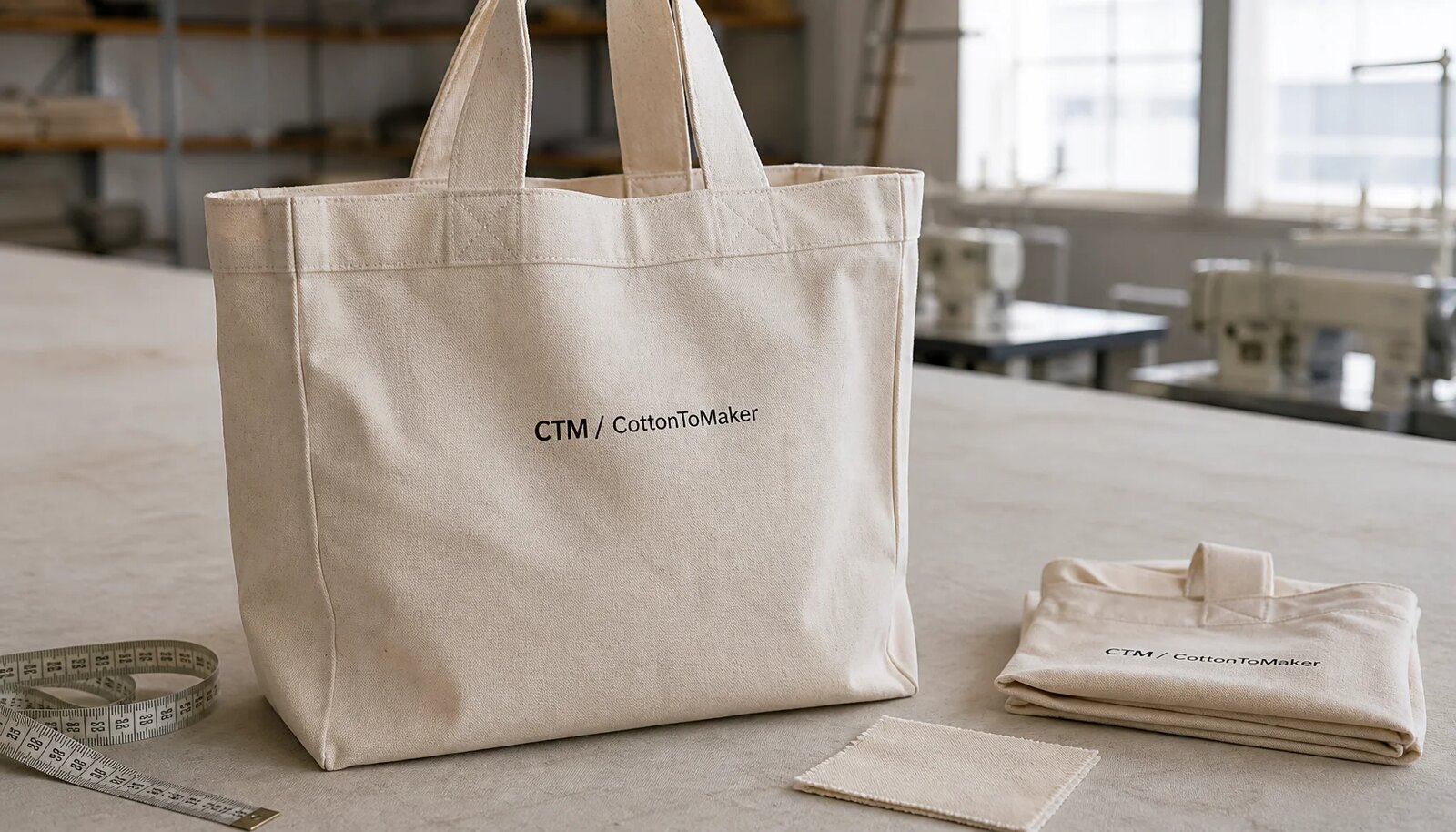
Start with the way the tote will actually be used
Wholesale canvas grocery totes for craft fairs should not be sourced like simple flat promotional bags. At a fair, one bag may move through several jobs in a single day. It may be sold as event merchandise, handed out with a sponsor logo, filled at multiple booths, placed on a dusty floor, hung from a chair, packed into a car, washed later, and reused at another market. The contents are rarely light and neat. Buyers should expect jars, candles, books, handmade ceramics, packaged food, produce, small potted plants, framed prints, soaps, and boxed goods.
That use pattern changes the specification. Dense products pull hard on the handle base. Bulky items stress the gusset and bottom seam. Repeated folding can mark the printed panel. Natural canvas may look charming in photos but still arrive with odor, oil spots, heavy slubs, or inconsistent shade. Two supplier images can look almost identical while the actual bags differ in GSM, yarn density, handle width, thread quality, stitch density, print curing, and carton packing.
A stronger B2B brief describes performance first and appearance second. It gives procurement, marketing, quality, and the factory the same target. Instead of asking for a natural canvas grocery tote with a logo, define load expectation, finished size, fabric weight, handle construction, seam finishing, print method, tolerances, packing, and inspection rules. That makes quotes easier to compare and samples easier to judge. It also protects fixed fair dates, where late rework can cost more than a better specification at the start.
- Common craft fair contents: jars, candles, books, packaged food, produce, plants, ceramics, framed prints, soaps, and boxed handmade goods.
- Main stress zones: handle base, top hem, side seam, bottom gusset, inside finishing, and printed front panel.
- Commercial risks: missed event dates, booth complaints, product returns, resale markdowns, and inconsistent sponsor presentation.
- RFQ goal: make every supplier quote the same fabric, size, handle, seam, print, packing, and QC standard.
- Approval goal: verify load behavior, seam strength, handle comfort, print adhesion, folding marks, odor, and carton condition before bulk production.
Turn the use case into measurable dimensions
Start the specification with the expected carrying load, then move to finished dimensions. Many craft fair grocery totes are tested in a practical sample range of 8 kg to 12 kg, depending on size, canvas weight, handle width, and seam construction. This is not the same as advertising a certified load rating. It is a procurement control: the sample should survive the kind of weight buyers know shoppers may carry.
Write dimensions as finished measurements after sewing and finishing, not as cutting dimensions. A grocery-style craft fair tote might be 35-42 cm wide, 35-40 cm high, and 10-15 cm deep at the gusset. A smaller tote can still need strong handles if it is intended for candles, preserves, books, or ceramics. Handle drop should be measured from the top edge of the bag to the peak of the handle while the bag lies flat. Around 25-30 cm often works for shoulder carry, while shorter drops are better for hand carry.
Tolerance belongs in the RFQ, not in a later dispute. Cotton canvas relaxes. Seams consume fabric. Washing, dyeing, and pressing can change size. A practical starting point is plus or minus 1 cm for body width, height, and gusset depth, and plus or minus 1.5 cm for handle drop unless the factory agrees tighter control is realistic. Print placement needs its own tolerance, usually plus or minus 0.5 cm to 1 cm depending on print method and bag shape. Use the same measuring method for the sample, inspection, and receiving check.
- Define sample test weight, loading method, suspension time, sample quantity, and pass criteria.
- State finished width, height, and gusset depth after sewing and any finishing.
- Specify handle width, total handle length, handle drop, and allowed handle tolerance.
- Include top hem depth because it affects handle reinforcement and the front-panel print area.
- Choose box gusset or flat-bottom construction when the tote must stand and hold bulky goods.
- Measure flat, smooth fabric without stretching, and record actual values on the sample approval sheet.
Do not buy canvas by ounce weight alone
Canvas weight matters, but it is only one part of durability. A buyer may see two quotes for 10 oz canvas and assume they are equivalent. They may not be. GSM, yarn density, weave tightness, finishing, shrinkage, and fabric defects all affect strength, hand feel, print quality, and sewing performance. For wholesale canvas grocery totes for craft fairs, 10 oz to 12 oz cotton canvas is often a useful range when the bag needs a substantial feel without becoming overly stiff or freight-heavy.
As a working reference, 10 oz canvas is approximately 340 GSM and 12 oz canvas is approximately 407 GSM. Exact figures can vary by supplier definition and by whether the weight is measured before or after dyeing, washing, coating, or other finishing. An 8 oz canvas can be acceptable for light giveaways, brochures, or flat purchases, but it is usually a weaker choice for grocery-style event use unless handles and seams are upgraded and the buyer accepts a lighter hand feel.
Fabric finish changes the risk profile. Natural canvas is popular at craft fairs because it feels simple, tactile, and affordable. It can also show seed flecks, slubs, oil spots, panel shade differences, and odor. Dyed canvas gives stronger brand control but needs lab dip approval, shade tolerance, dry rub testing, and wet rub testing. Washed canvas feels softer but may affect shrinkage and print adhesion. Water-repellent or otherwise treated canvas should be approved on final fabric because treatments can change print bonding, hand feel, and compliance requirements for the destination market.
- 8 oz canvas: workable for light use, but higher risk for loaded grocery-style craft fair totes.
- 10 oz canvas: common balance for reusable fair totes with moderate load, good hand feel, and manageable freight.
- 12 oz canvas: stronger retail feel, with higher cost, heavier cartons, and more sewing-machine stress.
- Natural canvas: faster and often lower-cost, but inspect flecks, odor, oil spots, slubs, and shade variation.
- Dyed canvas: better brand control, but requires lab dip, dry rub, wet rub, and handle-to-body shade checks.
- Washed or treated canvas: approve performance on final fabric because finishing can change size, print adhesion, and hand feel.
Engineer handles, hems, and seams as one system
Most tote failures do not begin in the middle of the fabric panel. They start where the handle meets the bag. A tote can use heavy canvas and still fail if the top hem is shallow, the reinforcement box is too small, the handle is narrow, or the thread tension is poor. The handle attachment should spread the load across the top hem and body panel instead of concentrating force on a small stitch area.
Handle material is both a performance and presentation choice. Self-fabric canvas handles match the body and can look more finished, but they require clean folding, even width, and consistent stitching. Cotton webbing handles are stable and efficient. For grocery-style loads, a 1.5 inch handle is usually more comfortable than a narrow 1 inch handle. The RFQ should state handle width, handle drop, total handle length, reinforcement stitch pattern, thread type, thread color, stitch density, and whether handles are inserted into the top hem or sewn onto the outside panel.
Inspect seam construction from the inside of the bag. Side seams and bottom gussets need finishing so raw edges do not fray after repeated use or light washing. Inside overlock is common for cost-effective production. Bound seams can look cleaner on premium totes. The top hem should be deep enough to support the handle attachment, and stitching should not sit too close to the fabric edge. During sample review, turn the tote inside out and check every stress point before approving bulk production.
- Specify box-and-cross stitching, bar-tack, or another approved stress-point reinforcement pattern.
- Define reinforcement box height and width so the factory does not reduce it during mass production.
- Avoid overly narrow handles for grocery use because they reduce comfort and increase stress at the seam.
- Require even thread tension, consistent stitch density, secure back-tacking, and no broken or loose thread loops.
- Check overlock, binding, raw edges, thread tails, seam alignment, and bottom gusset neatness inside the bag.
- Request close-up sample photos of handle bases, top hem, inside seams, bottom gusset, and print area before courier approval.
Choose the print method around fabric texture
Craft fair totes are handled constantly. They are folded, stacked, displayed in bins, carried in damp weather, pressed against other purchases, and sometimes washed by the end user. The print must tolerate rubbing, bending, and carton pressure. For simple one-color or two-color logos, screen printing is usually the most predictable and cost-effective method on canvas. It handles solid graphics well when the artwork is clean, the screen is prepared correctly, and the ink is cured according to the supplier's process.
Ink choice affects hand feel, opacity, and durability. Water-based ink can feel softer and suits a natural craft aesthetic, but coverage on dark dyed canvas should be tested. Heavier ink systems can improve opacity, yet they may feel stiff or crack if curing is poor or the print area is large. Heat transfer can reproduce gradients and full-color artwork, but it brings edge-lift and peeling risk if film type, temperature, pressure, and wash behavior are not validated. Digital print can work for detailed artwork, although edge sharpness and color penetration need review on the actual canvas texture.
Artwork should be production-ready before screens, transfers, or digital setup begin. Provide vector files when possible. Specify Pantone or other color references, print size in centimeters, and placement from the top edge and side seams. For gusseted totes, confirm whether printing happens before or after sewing because that affects placement and distortion. Approve the print on final canvas rather than on a smooth test panel. Heavy canvas texture changes opacity, line definition, and ink consumption.
- Screen print: best for solid logos, event marks, sponsor names, and moderate artwork coverage.
- Water-based ink: softer feel, but test opacity and rub performance on dark or coarse canvas.
- Heavier ink systems: stronger coverage, but check stiffness, cracking, curing, and print-through.
- Heat transfer: useful for gradients and full color, but test bend, peel, edge lift, and wash behavior.
- Print placement: specify size, distance from top edge, distance from side seams, and placement tolerance.
- Approval checks: inspect opacity, edge sharpness, color match, hand feel, rub transfer, cracking, and folding marks.
Make supplier quotes comparable before negotiating
MOQ is not only a supplier preference. For wholesale canvas grocery totes, minimum order quantity may be driven by fabric roll availability, dye lot size, printing setup, cutting efficiency, handle material purchase, label MOQ, packing material minimums, or carton production. A stock natural canvas tote with one-color screen printing usually has a lower MOQ than a dyed tote with custom handles, two-sided artwork, hangtags, barcodes, and retail packing.
Unit prices are only comparable when the specification is normalized. A cheaper quote may use lower GSM, narrow the handle, reduce the reinforcement box, make the gusset shallower, print a smaller logo, pack more pieces into each carton, exclude carton marks, or quote a different Incoterm. Ask suppliers to complete the same quote sheet with fabric weight, finished dimensions, tolerances, handle construction, seam finishing, print method, print size, color count, packing style, carton data, sample charge, setup charge, lead time, payment terms, and price validity.
Operational complexity also changes cost. Split shipments, several artwork versions, mixed colors, custom labels, paper bands, barcode stickers, special carton marks, third-party inspection, or urgent courier delivery can all add handling. Cost savings are still possible. Stock natural canvas, a standard size, one-sided screen print, bundle packing, and a longer production window usually help. The important point is visibility: the buyer should know exactly which tradeoffs are included before approving the sample.
- Fabric drivers: GSM, yarn quality, dyeing, washing, shrinkage allowance, usable fabric width, and stock availability.
- Construction drivers: handle width, reinforcement pattern, top hem depth, seam finishing, gusset style, and sewing time.
- Print drivers: color count, print area, ink type, setup screens, curing time, and artwork versions.
- Packing drivers: individual polybags, paper bands, hangtags, barcode stickers, carton strength, and pieces per carton.
- Logistics drivers: gross weight, CBM, split shipment, delivery urgency, Incoterm, and inspection window.
- Quote control: compare suppliers only after every quote field is answered in the same format.
Use samples to approve performance, not just appearance
A useful sampling process separates early appearance review from production approval. A visual sample can confirm general size, handle drop, logo placement, and construction direction. That is helpful when the schedule is tight. It should not, however, approve bulk production if it uses substitute fabric, substitute ink, different handles, or a different folding method.
The pre-production sample should use final bulk fabric, final thread, final handle material, final print method, final artwork size, final labels, and final packing method. Feedback should be measurable. Instead of saying the bag should be stronger, specify 12 oz canvas instead of 10 oz, 1.5 inch webbing instead of 1 inch, a deeper top hem, a larger box stitch, bound inside seams, or a revised load test target. Instead of saying the print looks weak, state the opacity issue, color target, placement deviation, edge sharpness problem, curing concern, or print size adjustment.
Keep one signed pre-production sample as the golden sample and give the same reference to the inspector or receiving warehouse. If the order has multiple fabric colors, print versions, or packing styles, keep an approved reference for each version. For event-driven orders, build in time for one sample revision. Skipping the physical sample may save a few days, but it can create a much larger problem if final goods arrive with wrong handle drop, poor print adhesion, strong odor, or carton creases across the logo.
- Measure finished size on a flat table and record actual width, height, gusset, top hem, and handle drop.
- Load the sample with the agreed weight and inspect handle bases, top hem, side seams, and bottom gusset after suspension.
- Lift and lower the loaded tote several times to observe handle comfort, stitch movement, seam stress, and shape recovery.
- Fold and unfold the printed panel to check cracking, stiffness, transfer, and pressure marks.
- Rub the print with a dry cloth and a slightly damp cloth to observe transfer, smudging, or surface damage.
- Pack the sample using the proposed folding method to see whether the logo creases, handles twist, or gusset deforms.
Define durability tests and defect thresholds
Durability testing for craft fair totes should be practical enough to run during sample approval and repeat during inspection. Not every wholesale canvas tote order needs a laboratory report, but every order needs clear acceptance criteria. The supplier should know what counts as a critical, major, or minor defect before production starts.
A torn handle, open seam, mildew odor, wrong artwork, unsafe needle fragment, or severe packing damage should be treated as critical. A twisted handle, visible stain, skipped stitch at a stress point, crooked print, poor opacity, or dimension outside tolerance is usually major. A small trimable thread tail may be minor if it does not affect appearance or function. These categories help the buyer decide whether goods can ship, require rework, or need replacement.
A static load test is one of the most useful checks. Agree on weight, loading method, suspension time, sample quantity, and pass criteria. For example, fill the tote with evenly distributed weight in the agreed range, suspend it by the handles for the defined period, then check for seam opening, stitch breakage, fabric tearing, top hem deformation, and handle elongation. Add a dynamic lifting check because shoppers do not carry bags in laboratory stillness. Print QC should be just as clear: dry rub, light wet rub, bend resistance, curing, opacity, and placement should all be checked against the approved sample and specification sheet.
- Critical defects: torn handles, open seams, wrong artwork, mildew odor, unsafe metal contamination, or unusable packing damage.
- Major defects: skipped stitches at stress points, twisted handles, visible stains, crooked print, poor opacity, or wrong dimensions outside tolerance.
- Minor defects: trimable thread tails, small approved natural flecks, or slight folding variation within the approved standard.
- Static load check: define weight, duration, loading method, sample quantity, and pass or fail criteria before production.
- Print check: define dry rub, wet rub, bend test, tape-lift where appropriate, and visual standards for cracking or peeling.
- Inspection reference: provide signed sample, specification sheet, artwork placement drawing, packing instruction, and defect classification.
Plan packing, cartons, and moisture control early
Packing is part of product quality. A well-made tote can still reach the buyer with creased logos, twisted handles, damp odor, or crushed corners. Canvas holds pressure marks, and printed panels may show carton compression if the packing is too tight. For distributors and event organizers, bundle packing in 25 or 50 pieces is often efficient, easy to count, and lower cost. For retail resale, paper bands, hangtags, barcode stickers, or individual polybags may be needed, but each option affects labor, unit price, carton volume, sustainability goals, and receiving time.
Decide whether the printed logo should face inward for protection or outward for faster booth display. If totes will be sold from open bins, consistent folding improves presentation. If totes will be packed into event kits or shipped to multiple locations, piece count accuracy and carton marks become more important. Moisture control is essential. Canvas should not be packed damp after washing, dyeing, printing, or steaming, and cartons should be stored away from wet floors and humid areas. Mildew odor can make otherwise acceptable goods difficult to sell.
Carton data should be requested during quoting, not discovered at shipment. A 12 oz tote may change freight cost through both gross weight and carton volume. Larger gussets can increase CBM. Ask for pieces per carton, carton dimensions, net weight, gross weight, and estimated CBM. For urgent craft fair deliveries, carton size can affect courier or air freight charges as much as product weight.
- Bulk bundles: efficient for wholesale distribution, booth replenishment, fast counting, and lower packing cost.
- Retail packing: improves presentation but adds labor, labels, bands, polybags, carton volume, and receiving complexity.
- Folding method: approve how the logo, handles, top hem, and gusset are folded before bulk packing.
- Moisture control: pack only dry goods, avoid damp storage, and reject cartons with mildew odor or water damage.
- Carton data: request pieces per carton, carton size, net weight, gross weight, and CBM in the quote.
- Receiving control: use clear carton marks for artwork version, color, quantity, PO number, and destination.
Protect fixed event dates with approval gates
Craft fair orders usually have fixed selling windows. A late shipment can make the order far less valuable even if the tote quality is acceptable. Lead time should be broken into artwork confirmation, swatch or lab dip approval, sample production, sample courier time, buyer review, sample revision if needed, material preparation, cutting, sewing, printing, curing, finishing, inspection, packing, export documents, and shipping. When those steps are hidden inside one delivery promise, the buyer has little warning before the schedule slips.
Risk rises when the order includes dyed canvas, washed finishing, multi-color artwork, heat transfer, custom labels, retail packing, multiple warehouse destinations, special carton marks, or third-party inspection. Procurement should create written approval gates with target dates: artwork approval, fabric approval, pre-production sample approval, bulk production start, inline review if needed, final inspection, shipment release, and delivery deadline. These gates help the supplier reserve production time and help the buyer avoid late changes that force air freight or quality compromises.
Leave room for one sample revision and a final inspection window whenever the event date allows it. If artwork is approved late or handle length changes after sampling, the factory may need to remake screens, revise sewing instructions, or re-cut fabric. If final inspection finds major defects, rework time must exist before the shipment leaves. Good timing is not separate from quality control. It is what gives quality control enough space to work.
- Fastest route: stock natural canvas, standard size, one-color screen print, bulk bundle packing, and standard carton marks.
- Higher-risk route: dyed canvas, washed finish, full-color print, retail packing, custom labels, and split destinations.
- Artwork gate: approve vector file, print size, color reference, and placement before screens or transfers are made.
- Sample gate: do not start mass cutting before written pre-production sample approval unless the buyer accepts the risk.
- Inspection gate: reserve time for rework, recounting, repacking, or replacement if major defects are found.
- Shipping gate: compare sea, rail, air, truck, or courier timing against the required booth or warehouse delivery date.
Specification comparison for buyers
| Spec decision | Recommended option | When it fits | Buyer risk to check |
|---|---|---|---|
| Canvas fabric weight | 10 oz to 12 oz cotton canvas, approximately 340-407 GSM before washing or special finishing | Reusable grocery totes sold, gifted, or bundled at craft fairs where shoppers may carry jars, candles, books, packaged food, produce, plants, ceramics, or boxed handmade items | Do not compare ounce weight alone. Confirm GSM, yarn density where available, weave tightness, shrinkage allowance, fabric finish, visible defects, and whether the quoted fabric is stock, greige, dyed, washed, brushed, treated, or coated. |
| Handle construction | Self-fabric canvas handles or 1.5 inch cotton webbing handles with box-and-cross, bar-tack, or equivalent reinforcement | Orders where a tote may carry 8-12 kg during a full event day and still be reused after the fair | Narrow 1 inch handles can feel uncomfortable and may fail at the stitch line even when the body fabric is heavy. Confirm handle width, handle drop, reinforcement size, top hem depth, thread type, and stitch density. |
| Seam method | Lockstitch seams with inside overlock or bound seam finishing, reinforced top hem, and controlled stitch density | Bulk craft fair programs where bags are folded, packed, unpacked, displayed, filled, and reused many times | Raw edges, loose thread tails, skipped stitches, weak back-tacking, and low stitch density reduce wash durability and make resale goods look cheap. |
| Bottom structure | Box gusset or flat-bottom construction with consistent gusset depth and reinforced side-to-bottom stress areas | Grocery-style use where the tote needs to stand better and hold bulky retail purchases | A flat promotional tote may quote cheaper but perform poorly with jars, bakery packs, produce, small plants, ceramics, or boxed craft items. Confirm finished gusset tolerance and bottom seam finishing. |
| Print method | Screen print for solid logos and simple event graphics; heat transfer or digital print only after adhesion, bend, rub, and wash-behavior checks | Brand logos, farmers market artwork, craft fair graphics, sponsor marks, resale totes, or multi-vendor event merchandise | Ink cracking, poor curing, weak opacity, dye migration, print-through, and peeling are common when artwork size, ink type, curing conditions, and fabric finish are not specified. |
| Color choice | Natural, black, or dyed canvas with an approved swatch or lab dip and defined shade tolerance | Natural canvas for lower cost and faster sourcing; dyed canvas for retail brands requiring a controlled presentation color | Dyed canvas can bleed, crock, shrink, or show shade variation. Require dry rub, wet rub, panel shade checks, and handle-to-body shade comparison before bulk approval. |
| Packing method | Folded in consistent bundles of 25-50 pieces, or individually packed only when retail presentation requires it, with export cartons and moisture protection | Distributor, event organizer, and retail buyer orders needing quick counting, clean booth setup, and predictable freight planning | Over-compressed cartons create permanent fold marks and distorted handles. Loose packing increases CBM and can damage printed panels. Confirm pieces per carton, carton strength, gross weight, net weight, and CBM. |
| Sampling route | Pre-production sample made with final bulk fabric, handle material, thread, print ink or transfer, artwork size, and folding method | Any order with resale value, new artwork, dyed fabric, non-standard handles, special packing, or a fixed event date | Approval samples made from substitute materials can hide shrinkage, handle comfort, seam slippage, print adhesion, odor, and carton compression problems. |
| Inspection standard | AQL-based final inspection with defined critical, major, and minor defects, plus agreed sample load and print checks | B2B orders where the buyer needs release criteria before paying balance or authorizing shipment | A general workmanship inspection is not enough. Define load weight, hold time, sample quantity, measurement tolerance, print placement tolerance, fabric defect limits, packing checks, and rework rules. |
Buyer checklist before sampling
- Define the intended use and expected practical load per tote in kilograms, including likely craft fair contents such as glass jars, books, candles, packaged food, ceramics, produce, framed prints, or small plants.
- Specify canvas weight in both oz and GSM, and ask whether the figure is measured before or after washing, dyeing, coating, brushing, or other finishing.
- Request fabric swatches before bulk cutting, and require lab dip approval for dyed canvas if brand color, sponsor color, or resale presentation matters.
- State finished dimensions with tolerances: width, height, gusset depth, handle drop, handle width, top hem depth, bottom fold, and print placement.
- Define the measurement method: measure the finished tote on a flat table without stretching, after sewing and any finishing, using the same method for samples and final inspection.
- Choose the bottom structure by use case: flat tote for light flat goods, box gusset or flat-bottom construction for grocery-style craft fair purchases.
- Require reinforced handle stitching and ask the factory to confirm stitch pattern, reinforcement size, thread type, thread color, and minimum stitch density with sample photos.
- Match print method to artwork: screen print for solid logos; transfer or digital print only after adhesion, bend, rub, opacity, and folding checks on final canvas.
- Approve a pre-production sample made from final fabric, final handle material, final thread, final ink or transfer, final print size, final label, and final folding method.
- Set acceptance criteria for seam slippage, handle pull, print rubbing, print cracking, wash shrinkage if relevant, color crocking, stains, odor, needle damage, and carton condition.
Factory quote questions to send
- What is the exact canvas weight in oz and GSM, and is the quoted fabric stock, custom woven, dyed, washed, brushed, water-repellent treated, laminated, or otherwise finished?
- Is the GSM measured before or after dyeing, washing, or coating, and what shrinkage range should the buyer expect after normal sewing and any finishing process?
- What finished tote dimensions and tolerances are included in the quote, including width, height, gusset depth, top hem depth, handle width, handle length, and handle drop?
- What handle material, width, total length, reinforcement stitch pattern, thread type, thread color, and minimum stitch density will be used for this grocery tote?
- What seam construction is quoted for the side seams, bottom gusset, top hem, handle attachments, and inside finishing, and are stress points bar-tacked or box-stitched?
- What print method is quoted, what ink or transfer system is used, and what maximum print size, placement tolerance, number of colors, and curing or pressing conditions are included?
- Is the MOQ driven by fabric availability, dye lot size, printing setup, cutting efficiency, handle material purchase, label MOQ, packing material minimums, or carton production?
- Can the pre-production sample be made from final bulk fabric and final printing, and how many working days are needed after artwork, lab dip, and specification approval?
- What in-line and final inspection points does the factory use for handle strength, seam quality, print curing, finished size, fabric defects, odor, shade consistency, and carton packing?
- What sample load test can the factory perform, what weight and duration will be used, how many samples will be tested, and what pass or fail criteria will be recorded?
Quality-control points to confirm
- Finished size tolerance should normally be controlled within plus or minus 1 cm for body dimensions and plus or minus 1.5 cm for handle drop unless the design requires tighter control and the factory confirms feasibility.
- Print placement tolerance should be stated in centimeters from the top edge and side seams. For most canvas tote orders, plus or minus 0.5 cm to 1 cm is more realistic than a photographic-perfect placement standard.
- Handle attachment should show dense, even stitching without skipped stitches, loose thread loops, needle damage, broken thread, uneven reinforcement placement, weak back-tacking, or stitching too close to the fabric edge.
- A practical static load test should suspend the tote with the agreed weight for a defined period, such as 8 kg to 12 kg depending on the specification, and then check handle seams, side seams, top hem, and bottom gusset for tearing, seam opening, stitch failure, or permanent deformation.
- A short dynamic check can be added by lifting and lowering a loaded sample multiple times to observe handle comfort, seam movement, stitch stress, and whether the bag shape remains usable under repeated carrying.
- Print adhesion should be checked by dry rub, light wet rub, bend test, tape-lift where appropriate, and visual inspection after curing, especially on dark dyed canvas, washed canvas, heavy ink coverage, or heat transfer designs.
- Natural canvas should be inspected for oil spots, excessive seed flecks, mildew odor, shade inconsistency, weaving holes, slubs that affect print quality, panel-to-panel shade mismatch, and visible contamination.
- Dyed canvas should be checked for dry crocking, wet crocking, panel shade consistency, handle-to-body shade consistency, and any bleeding onto labels, packing paper, polybags, or adjacent light materials.
- Cartons should protect against moisture and compression, with correct carton marks, accurate piece count, clean folding, no sharp pressure marks on printed panels, and no crushed corners that suggest export damage.
- Random final inspection should include measurement, workmanship, load test sampling, print position, packing method, carton marks, carton condition, and comparison against the signed pre-production sample and approved specification sheet.