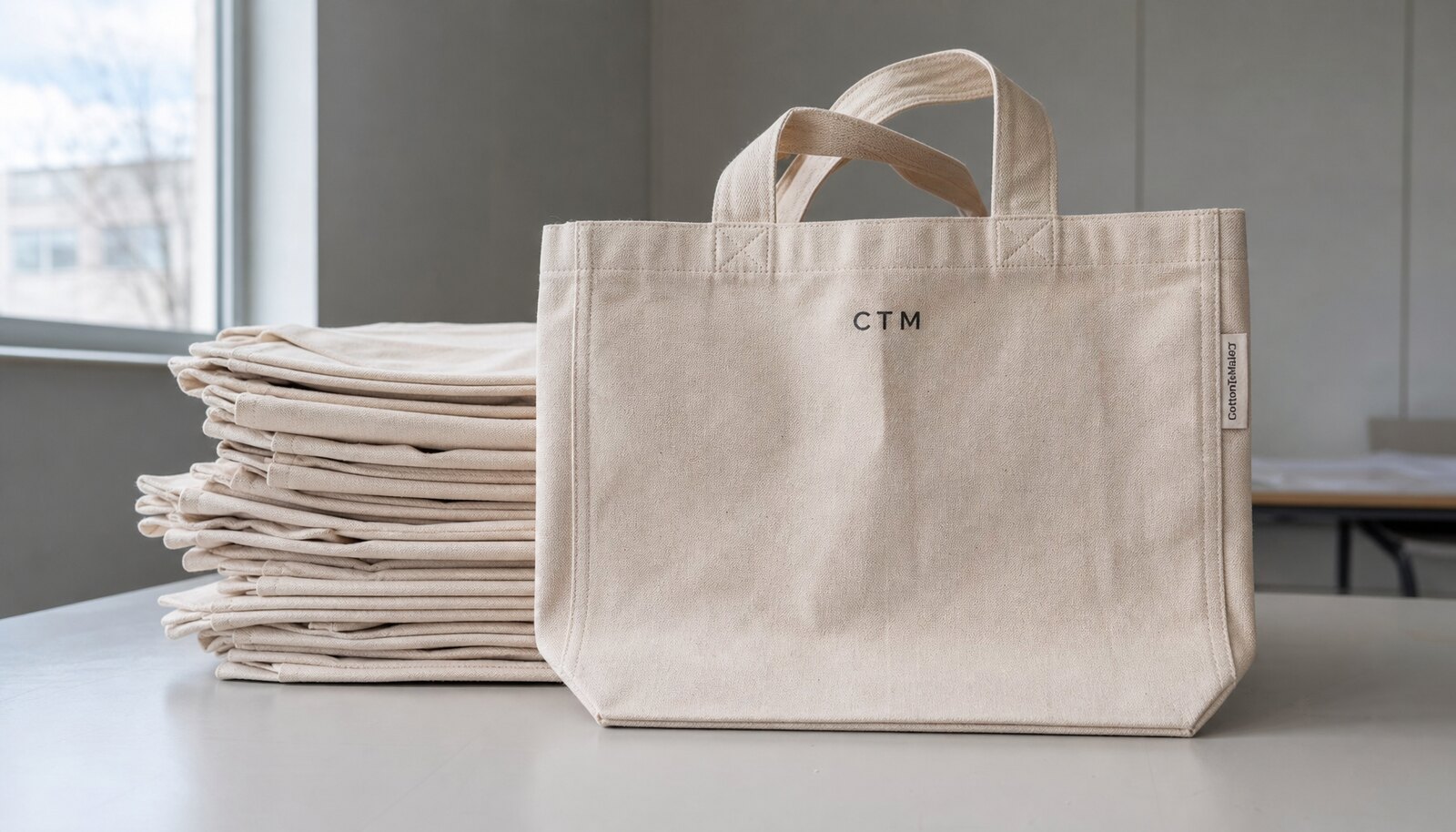
Plan backward from the real in-hand date
Wholesale canvas grocery totes for corporate gifting are easy to underestimate because the product looks straightforward. In practice, the lead time includes artwork approval, fabric confirmation, sample making, buyer review, bulk production, inspection, export booking, customs, local delivery, and sometimes kitting. A quote that says 25 days may be useful only if everyone agrees what starts those 25 days.
Start with the date the totes must be usable, not the date they should leave the factory. An event order may need to arrive at a venue warehouse several days before setup. A client gift may need to reach a kitting partner before the carrier pickup window. An employee welcome program may need staggered replenishment instead of one large shipment. The same tote specification can require different calendars depending on the receiving process.
A practical backward plan uses date ranges rather than one optimistic number. For a custom overseas order, buyers often need time for RFQ alignment, sample production and courier transit, internal approval, bulk production, inspection, freight, customs, and local delivery. Faster routes are possible when blank stock is available or when air freight is approved, but the cost and specification tradeoffs should be visible before deposit.
- Example backward plan for a custom order: 3 to 5 business days for quote alignment and artwork proof, 7 to 14 days for sample making, 2 to 5 days for sample courier transit, 2 to 7 days for buyer review, 20 to 35 days for bulk production, 1 to 3 days for final inspection, 5 to 10 days for air freight or 25 to 45 days for ocean freight and local delivery, plus a 5 to 10 day buffer for event-critical programs.
- Go/no-go before deposit: final spec is written, supplier route is known, sample stage is agreed, production start trigger is defined, packing method is costed, and shipping route matches the in-hand date.
- Do not count internal brand, legal, finance, or event approvals as supplier time; put them on the calendar as buyer-owned steps.
- For urgent programs, ask whether a split shipment is possible: a smaller air shipment for the event date and a larger economical shipment for later use.
- Confirm the deadline in writing as in-hand date, warehouse receiving date, or event setup date, because those are not the same milestone.
Define the tote around the gift program
The best specification starts with the recipient experience. A grocery tote used for food items, drinkware, catalogs, or retail merchandise needs different construction than a flat tote used as a lightweight conference handout. If the bag must stand upright while packed, a gusseted or boxed-bottom structure matters. If the tote will be mailed inside a kit, fold size, print scuffing, and unit packing may matter more.
Corporate gifting buyers should describe the expected contents and handling route in the RFQ. A tote that looks acceptable on a desk sample can fail the program if handles are uncomfortable, the gusset is too shallow for the gift set, or the logo creases across the fold. The supplier does not need a long creative brief, but it does need the physical use case.
Write the product in measurable terms: finished width, finished height, gusset depth, handle drop, handle width, fabric weight, stitch reinforcement, logo size, print placement, label requirement, and packing method. This prevents suppliers from quoting different versions of a vague canvas bag and makes the cheapest quote easier to evaluate fairly.
- Use flat totes when cost, simple folding, and lightweight handout use are the priorities.
- Use gusseted or boxed-bottom totes when the bag must hold groceries, kits, boxed items, or retail merchandise.
- Specify handle drop separately from total handle length so shoulder carry and presentation are clear.
- Share the approximate packed weight or contents if the tote is expected to carry more than light materials.
- Ask for a blank sewn sample when construction is uncertain, even before final artwork is approved.
Choose fabric weight and finish deliberately
For many wholesale canvas grocery totes for corporate gifting, 10 oz to 12 oz cotton canvas is a practical working range. It provides useful body, supports a clean logo print, and remains manageable for sewing, folding, and freight. Lighter canvas can work for budget programs or short-term event use, while heavier canvas may feel more substantial but can increase cost, slow sewing, and add carton volume.
The fabric weight must be defined clearly. Some quotes refer to greige fabric before finishing, while others refer to finished fabric. Bleaching, dyeing, washing, pressing, and heat exposure can affect handfeel, shrinkage, and perceived weight. Ask the supplier to state the weight in oz and GSM, identify the measurement stage, and provide an acceptable tolerance.
Finish and color also affect timing. Natural canvas can vary by cotton lot and has a warmer tone. Bleached canvas can give stronger logo contrast but may need closer shade review. Dyed canvas introduces lab dips, shade approval, and sometimes longer fabric booking. For a time-sensitive corporate gift, natural or bleached canvas with a logo color that prints cleanly is often the most predictable route.
- Ask for fabric composition, weave, finish, weight, and tolerance in the quote.
- Request a swatch or blank sample before approving a high-quantity order.
- Use shade bands for dyed or bleached fabric when color consistency matters.
- Avoid changing fabric color after sampling unless the schedule is reset.
- Retain the approved fabric sample so production and inspection use the same reference.
Match decoration to quantity and schedule
Decoration is often the step that turns a simple tote into a delayed order. A one-color screen print is usually efficient for corporate logos, volume orders, and repeat programs. Two-color screen print can work well when artwork is bold and registration is not too tight. Complex artwork, gradients, fine reversed type, large ink coverage, and multiple logo versions add setup and inspection risk.
Digital print or heat transfer can be useful in specific cases, especially for shorter runs or artwork that cannot be simplified. The buyer should still approve the method on the final canvas, not only on a digital mockup. Canvas texture, ink absorption, curing, handfeel, and folding can all affect how the final logo appears.
Make decoration measurable. The RFQ should include print side, print size, number of colors, color references, placement measurement, and tolerance. Instead of saying the logo should be centered, state the distance from the top edge, side seam, or handle attachment point. This gives the production team and inspector the same standard.
- Choose 1-color screen print for simple logos, larger quantities, and tighter schedules.
- Use additional print colors only when the brand value justifies the extra setup and registration checks.
- Avoid fine type on textured canvas unless a sample proves it remains readable.
- Confirm whether each logo version is a separate run with its own setup cost and MOQ.
- Approve print density, curing, and placement on a physical sample before bulk production.
Compare supplier routes before comparing price
A supplier route is a procurement decision, not a footnote. Direct factory production, a sourcing agent, a distributor, and a local decorator may all be valid, but they create different levels of visibility, speed, and control. The right route depends on quantity, customization, approval complexity, and the firmness of the delivery date.
Direct factory sourcing can be strong for larger or repeat orders because the buyer can clarify fabric availability, production capacity, stitch details, print setup, and carton packing. It also requires the buyer to be organized with specifications, approvals, and inspection criteria. A sourcing agent or trading company can help coordinate multiple gift categories, but the buyer should still know who controls tote production and who authorizes changes.
Local stock plus decoration can be the fastest route when the blank tote already meets the requirement. It is less suitable when exact fabric weight, custom size, custom label, or special packing is important. Speed should come from real stock availability, not from accepting a weaker product without realizing it.
- Ask whether the supplier is the factory, a trading company, a distributor, or a decorator using blank stock.
- Request confirmation of available capacity for the target production window, not only a generic lead time.
- Check whether the quoted tote is custom-made or pulled from existing blank inventory.
- Clarify who owns rework, replacement, or discount decisions if final inspection finds defects.
- Compare supplier responsiveness and technical clarity alongside unit price.
Use an RFQ table that exposes hidden cost
Unit price alone can mislead procurement teams. One quote may include final fabric, reinforced handles, screen setup, bulk packing, and export cartons. Another may exclude setup, sample freight, labels, individual packing, inspection support, or carton marks. The quotes may appear comparable while describing different commercial realities.
A useful RFQ table has three groups: product specification, schedule, and landed-cost assumptions. Product fields should include fabric weight, tote size, gusset, handle drop, print method, print area, label, and packing. Schedule fields should include proof time, sample time, production start trigger, bulk lead time, inspection time, freight route, and delivery estimate. Cost fields should include MOQ, unit price, setup fees, sample fees, packing cost, incoterm, carton dimensions, estimated CBM, and payment terms.
This structure also improves negotiation. Instead of asking a supplier to lower the price without context, the buyer can decide whether to simplify the print, remove individual packing, use standard fabric, adjust carton requirements, or change the shipping route. The conversation becomes specific and operational.
- Quote base tote and add-ons as separate line items.
- Compare carton dimensions and estimated CBM because freight can change the landed cost.
- List setup charges separately from unit cost and confirm which charges repeat on reorders.
- Ask for separate pricing for bulk packing, individual packing, inserts, barcode labels, and pallet requirements.
- Evaluate total delivered program cost, not only ex-factory or FOB unit price.
Approve samples with go/no-go discipline
A digital proof confirms artwork layout, but it does not prove fabric handfeel, final size, handle comfort, stitch quality, print density, or fold presentation. For important corporate gifting orders, a sewn pre-production sample should use the final fabric, final construction, final decoration method, and final packing direction whenever the schedule allows.
Review the sample with a checklist and measurements. Check body width, height, gusset depth, handle drop, handle width, print size, print location, seam quality, loose threads, stains, odor, and fold appearance. If the tote will carry heavier items, load it with a realistic weight and check the handle attachment points. If the tote will be packed into a kit, test the fold and how the print looks after unpacking.
Before deposit or bulk release, define go/no-go points. The order should not move forward if the supplier cannot state the production start trigger, cannot meet the in-hand date with a credible shipping route, cannot provide a physical sample when needed, or cannot agree to inspection criteria. These decisions are easier before fabric is cut than after production is already moving.
- Approve artwork proof, fabric, construction, print, label, and packing as separate items.
- Keep one approved sample with the buyer and one with the supplier; arrange an inspector sample for large or high-risk orders.
- Record acceptable tolerances for dimensions, shade, print placement, and minor fabric variation.
- Do not treat silence as approval; use written sample approval and written production release.
- If the sample requires changes, ask whether the schedule resets or whether changes can be made without a new sample.
Control packing while there is still time
Packing affects presentation, labor time, carton volume, freight cost, and receiving accuracy. Bulk packing is usually efficient for warehouse distribution, event loading, or secondary kitting. It can reduce unit labor and carton volume, but it still needs a defined fold method, inner protection, carton quantity, and carton marks.
Individual packing can be valuable for direct-to-recipient gifts, client kits, retail-style programs, or orders handled multiple times after import. It can protect the tote and make distribution cleaner. It also adds material purchasing, packing labor, inspection points, and carton volume. Procurement should cost it intentionally instead of accepting it as an assumed premium feature.
Carton planning should be completed before production is finished. Confirm units per carton, fold size, carton dimensions, gross weight range, carton marks, barcode labels, pallet limits, and whether mixed SKUs are allowed. If the receiving warehouse has routing rules, appointment requirements, or label standards, share them before cartons are printed.
- Use bulk packing when totes will be unpacked, kitted, or distributed by a warehouse team.
- Use individual packing when the tote goes directly to a recipient or must stay clean through secondary handling.
- Specify whether the logo should face in or out after folding.
- Request packing photos before shipment release, especially for first orders.
- Confirm carton count against the packing list before final payment or shipment approval.
Build QC into the calendar
Quality control should be scheduled, not squeezed in after production. The most important checks for canvas grocery totes are fabric weight and appearance, finished dimensions, handle reinforcement, print clarity, print placement, labels, packing, carton marks, and total quantity. These are the points that affect recipient experience and are difficult to repair after shipment.
Inspection criteria should be measurable. Finished size can have an agreed tolerance. Print position can be measured from a fixed edge or seam. Handle drop can be checked across sampled units. Carton count can be reconciled against the packing list. Without measurable criteria, a final inspection becomes a debate about appearance rather than a buyer-controlled release step.
Inline checks are useful when the schedule allows because they catch sewing, printing, or packing issues while correction is still possible. Final inspection remains important because it confirms what will actually ship. For event-critical programs, leave time between inspection and freight booking so minor rework does not threaten the delivery date.
- Schedule final inspection 1 to 3 business days before planned shipment release when possible.
- Inspect using the approved sample, written specification, artwork file, and packing instruction.
- Check handle reinforcement as a functional point, not only a visual detail.
- Open random cartons to verify count, packing method, labels, and carton marks.
- Do not release shipment until inspection findings, rework decisions, and packing list quantities are documented.
Reduce timeline risk before the deposit
The best time to reduce risk is before money and fabric are committed. A supplier may offer an attractive price, but procurement should pause if the quote is incomplete, the sample path is vague, the production start date is undefined, or the packing requirement is not costed. These gaps usually become more expensive after deposit.
A strong purchase decision has a complete RFQ response, a realistic backward calendar, clear approval owners, and a documented shipment route. The supplier should know the final in-hand date, the buyer should know which approval starts bulk production, and both sides should know what happens if a sample needs revision or inspection finds defects.
For repeat corporate gifting programs, keep the production file after delivery. Save the approved spec, artwork, sample notes, carton details, inspection findings, and reorder changes. Reorders move more smoothly when the buyer does not have to rebuild the tote from memory every season.
- Go before deposit when the spec is complete, sample path is agreed, lead time is tied to approval milestones, and packing and freight assumptions are visible.
- Pause when the supplier cannot confirm fabric availability, MOQ drivers, inspection access, or the production start trigger.
- Revise the spec when the calendar is too tight for custom fabric, complex decoration, or individual packing.
- Use air freight only after checking whether the added cost protects the actual business deadline.
- After delivery, record defects, carton accuracy, recipient feedback, and reorder improvements for the next buy.
Specification comparison for buyers
| Procurement choice | Best fit | Lead-time impact | Buyer risk to check |
|---|---|---|---|
| Direct factory custom production | Large or repeat corporate gifting orders with defined fabric, construction, print, and packing requirements | Usually longer upfront sampling, but better control once approvals are clear | Confirm when production starts, whether fabric is in stock, and who signs off on rework if inspection fails |
| Local stock tote plus decoration | Urgent smaller programs where an available blank tote already meets quality and size needs | Can be fastest because sewing is already complete; decoration queue becomes the main schedule risk | Blank tote specs may be fixed; check fabric weight, handle strength, stock quantity, and shade consistency before approving |
| Trading company or sourcing agent | Programs combining totes with multiple gift items, kitting, or mixed supplier categories | Can simplify coordination but may add communication layers around sample changes and inspection | Ask who owns production decisions, where the tote is made, and how defects or delays are escalated |
| Bulk packing | Warehouse distribution, event loading, or later kitting where presentation is handled downstream | Shortest packing time and usually lower carton volume | Specify fold method, inner protection, carton count, and whether units can rub, soil, or crease in transit |
| Individual packing | Client-facing gifts, employee kits, mailers, or retail-style handouts | Adds labor, material ordering, carton volume, and inspection points | Confirm bag material, insert placement, barcode needs, suffocation warnings if applicable, and final carton CBM |
| 1-color screen print | Simple logos, high-volume orders, tight approval paths, and budget-sensitive programs | Efficient setup and inspection once artwork is approved | Check ink color, curing, print position tolerance, and whether canvas texture affects fine detail |
| 2-color or multi-color screen print | Brand marks that require more than one solid color | Adds screen setup, registration checks, and possible sample revisions | Confirm trapping, registration tolerance, ink coverage, and whether extra colors change MOQ or production days |
| Digital print or transfer | Shorter runs, complex artwork, gradients, or artwork not suited to standard screen print | May reduce screen setup but can add durability testing or approval time | Approve handfeel, wash/rub resistance expectations, color consistency, and unit cost at the real quantity |
| Ocean freight | Planned programs with enough calendar space and larger carton volume | Lowest freight route for many bulk programs but requires booking, sailing, customs, and local delivery time | Build buffer for vessel schedules, port handling, customs questions, and delivery appointment availability |
Buyer checklist before sampling
- Set the required in-hand date, event setup date, warehouse receiving date, or kit assembly date before requesting pricing.
- Define the use case: grocery carry, conference bag, employee welcome kit, client gift, retail promotion, donor gift, or internal merchandise.
- Specify final tote dimensions, gusset or boxed bottom, handle drop, handle width, fabric weight, fabric color, stitch reinforcement, print area, and packing method.
- Ask whether quoted fabric weight is greige, finished, washed, or post-shrinkage weight, and request the same unit in oz and GSM when possible.
- Separate the base tote price from add-ons such as extra print colors, second-side print, woven labels, hangtags, inserts, barcode labels, individual packing, and palletization.
- Request a backward production calendar showing sample time, buyer approval time, fabric booking, cutting, printing, sewing, finishing, inspection, freight, customs, and final delivery buffer.
- Confirm what starts bulk lead time: deposit, approved artwork, approved sample, fabric receipt, or written production release.
- Require a pre-production sample made with final fabric, final construction, final decoration, and final packing direction before bulk cutting starts.
- Set go/no-go criteria before deposit: supplier route disclosed, quote complete, production start trigger clear, sample path confirmed, packing cost visible, and inspection access agreed.
- Agree measurable QC criteria for fabric weight, dimensions, handle reinforcement, print clarity, print placement, labels, carton marks, stains, odor, and quantity reconciliation.
Factory quote questions to send
- What exact fabric weight are you quoting in oz and GSM, and is it greige weight, finished weight, or post-shrinkage weight?
- Is the fabric natural, bleached, dyed, washed, or treated, and what shade tolerance will production follow?
- Are the quoted dimensions finished dimensions after sewing and pressing, and what tolerance applies to width, height, gusset, and handle drop?
- What handle width, handle length, stitch pattern, and reinforcement method are included in the unit price?
- Is the decoration price based on one side or two sides, how many colors are included, and what setup or screen charges apply?
- What print size and placement tolerance will you hold, and from which edge, seam, or handle point will placement be measured?
- Which parts of the order have separate MOQs: fabric color, tote construction, logo version, woven label, insert, individual packing, or carton label?
- Can you quote bulk packing and individual packing separately, including units per carton, carton dimensions, gross weight, and estimated CBM?
- What sample stages are available, and which one is required before bulk production: digital proof, blank sewn sample, printed sample, or full pre-production sample?
- When does bulk lead time officially begin, and what buyer approvals or payments must be complete before that date?
Quality-control points to confirm
- Fabric weight should be checked against the approved oz or GSM tolerance, with review for thin areas, broken slubs, visible weave gaps, stains, odor, and shade variation on front-facing panels.
- Finished tote dimensions should be measured after sewing, pressing, and cooling, because shrinkage, seam allowance, and pressing can change final size.
- Handle reinforcement should match the approved box-X, bar-tack, cross-stitch, or other stitch pattern, with no skipped stitches, loose thread tails, pulled seams, or weak stress points.
- Print should match the approved artwork size, ink color, ink density, curing standard, and placement, with no ghosting, smudging, pinholes, heavy buildup, or distortion near folds or seams.
- Decoration placement should be measured from fixed edges or seams using an agreed tolerance, not judged by visual centering alone.
- Labels, hangtags, inserts, and barcode stickers should match approved artwork, language, orientation, and placement, with no missing or mixed versions inside the same carton.
- Packing should follow the approved fold method, unit count, inner pack requirement, carton mark format, carton dimension range, and gross weight range.
- Cartons should be clean, dry, export-suitable, and correctly sealed, with no crushed corners, moisture exposure, mixed SKUs, loose units, or unapproved substitutions.
- A retained approved sample should stay with the supplier, buyer, and inspector when possible so workmanship, color, print, and packing are judged against the same physical reference.
- Final inspection should include random carton opening, quantity reconciliation, workmanship review, measurement checks, print checks, packing verification, carton mark review, and shipment-release documentation.