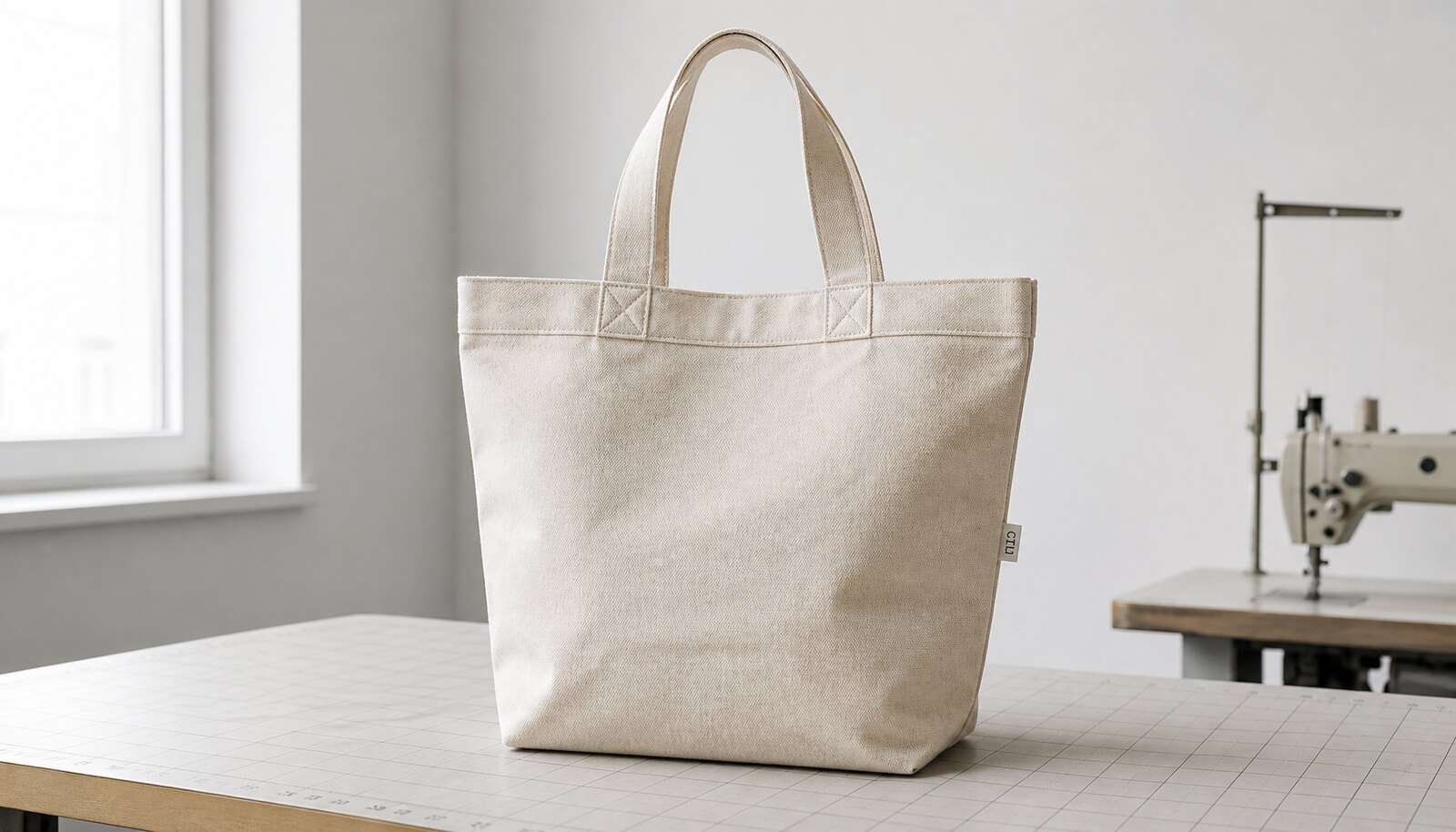
Start With the Use Case, Not the Artwork
Most problems with wholesale canvas grocery totes for corporate gifting start before the factory ever cuts fabric. Buyers often send the logo first and treat the bag as a generic container, but the real decision is how the tote will be used. A tote for a holiday gift set needs a cleaner surface, better print registration, and more predictable packing than a tote for a trade-show handout. A tote that will carry bottles, books, or produce needs stronger seams and a fabric weight that will not distort after the first use. If the use case is vague, the quote will be vague too, and the first sample will usually reveal the gap.
For corporate gifting, define the tote as a product, not a marketing accessory. State the item weight it must carry, whether it needs to stand upright, and whether the buyer will notice the inside finish. If the bag is going into an onboarding kit, the pack-out dimensions matter more than a tiny cost difference in fabric. If it is being handed out at events, speed and consistency matter more than premium finishing. Once the use case is clear, the rest of the spec becomes easier to control and the supplier has fewer places to guess.
- State the primary use: carry bag, gift bag, retail reuse, or grocery utility.
- Define the expected load in practical terms, such as books, bottles, or boxed gifts.
- Decide whether the tote must look premium enough for client-facing gifting or only functional for internal distribution.
Pick the Right Canvas Weight and Finish
For wholesale canvas grocery totes, the biggest cost and quality swing is usually fabric weight. In most corporate gifting programs, a finished canvas in the 10 oz to 12 oz range is the practical starting point because it balances cost, structure, and print quality. Around 340 to 400 gsm works well for common hand-carry totes. If the bag must feel more substantial or support heavier contents, 14 oz or roughly 400 to 470 gsm can make sense, but the price, sewing effort, and freight weight all rise with it. Lightweight canvas can still be acceptable for very short-life promotions, but it tends to look limp and can telegraph poor value in a gift program.
Finish matters almost as much as weight. Natural canvas usually gives a cleaner merchandising look and accepts simple branding well. Bleached canvas can make logos stand out, but it can also expose weave inconsistency if the fabric quality is weak. Washed or softened canvas has a better hand feel, but it may shrink more and complicate size consistency. If you want a premium gifting look, ask for the finish to be stated explicitly in the quote and sample approval. A supplier saying "canvas" without GSM, weave count, and finish is not giving you a usable spec.
- Use 10 oz to 12 oz canvas for mainstream gifting and event use.
- Move to 14 oz only when load, structure, or brand perception justifies the higher cost.
- Write the finish into the RFQ: natural, bleached, dyed, washed, or softened.
- Ask for finished GSM, not only raw fabric weight.
Specify Construction in Measurable Terms
A tote can look fine in a photo and still fail in production because the construction spec was left open. For this category, the critical points are seam allowance, handle attachment, bottom reinforcement, and stitch density. A simple shoulder tote with no gusset may be acceptable for low-load gift packs, but corporate gifting buyers often want a bag that keeps its shape and survives repeated use. That means you should specify whether the handles are folded and stitched, whether the bottom seam is double-stitched, and whether bartacks or box-x reinforcement are required at the stress points.
Do not leave handle length or drop to the factory's judgment. A handle that is too short makes the tote awkward to use; one that is too long changes the look and often drags the bag down visually. For most grocery-style tote proportions, a handle drop around 9 to 11 inches is a workable starting point, but the right number depends on body height and what the bag must clear when carried by hand or over the shoulder. Use a measured sample, not a verbal description, because construction errors compound quickly across a bulk order.
- State body dimensions, gusset depth, and handle drop in inches or centimeters.
- Require reinforcement at the handle roots if the tote will carry heavier items.
- Define stitch type and density where possible, especially at load points.
- Keep one approved physical sample for size comparison during bulk inspection.
Choose a Print Method That Will Survive Real Use
The right print method depends on the artwork and the expected life of the bag. For most wholesale canvas grocery totes, screen printing remains the default for one to three solid colors because it is efficient, readable, and durable when cured correctly. If the logo needs fine detail, a tonal effect, or a larger graphic area, the factory may suggest digital printing or heat transfer, but those methods should be tested carefully on canvas because some finishes do not age well. Embroidery is usually better for a woven label, patch, or premium accent than for a full tote face, especially when the buyer wants cost control.
The inspection question is not only whether the logo looks correct on day one. It is whether the print holds up after folding, rubbing, and light use. Ask how the ink is cured, whether the print has a hand feel you can accept, and whether the factory has a standard rub or adhesion test for this substrate. For corporate gifting, a slightly simpler print that stays sharp is better than a complicated artwork that cracks, smears, or shifts in the first handling cycle.
- Use screen printing for most one- to three-color bulk orders.
- Use digital print only when the artwork needs more detail and the supplier can prove color stability.
- Ask for print placement tolerance and a rub test method.
- Approve the logo on the actual fabric color, not on a paper proof alone.
Compare Supplier Routes Before You Compare Unit Price
A low unit price can hide a weak sourcing route. The same canvas grocery tote quoted by a direct factory, a trading company, and a domestic decorator can look similar on paper but behave very differently in production. Direct factories usually give the best control on construction and print because the sewing and finishing happen in one place. Trading companies are useful when you need one point of contact, but you have to know who actually owns quality control. Domestic decorators can be fast, but they often rely on whatever blank tote they can source that week, which makes repeatability harder.
The decision should match order size, timeline, and internal risk tolerance. If you are buying a gift program for a brand launch, visibility into the production line matters more than saving a few cents on the quote. If you are running a one-off event with a short deadline, a local decorator may be the practical choice. For recurring corporate gifting, the best route is usually the one that can repeat the same bag, the same print, and the same packing without re-arguing the basics every time.
- Direct factory: best for repeat orders and better process control.
- Trading company: useful for consolidated communication, but demand proof of factory ownership.
- Local decorator: useful for urgent short runs, but unit cost and blank quality are less stable.
- Agent-led sourcing: useful for first-time importers if the agent documents inspection and sample control.
Build the RFQ So Quotes Are Actually Comparable
Most quote confusion comes from missing data. If one supplier prices a 10 oz tote with screen print and another prices a lighter canvas with loose packaging assumptions, the numbers are not comparable. A clean RFQ should include fabric weight, finished size, handle length, print method, print size, color count, stitching details, packing format, destination terms, and target delivery window. If you need insert cards, tissue wrap, belly bands, or barcode labels, list them separately. The more of this you define up front, the less the supplier can hide behind "final confirmation" later.
Ask for the quote in line-item form. Unit price, setup charges, sample fees, packaging costs, and freight assumptions should all be visible. For corporate gifting buyers, this matters because the difference between a tote that looks inexpensive and one that lands inside budget is often not the fabric alone. It is the total package: decoration, packing, carton count, and the number of times the supplier says something is "included" when it really is not.
- Separate blank bag price from decoration price.
- Request the quote by size, color, and artwork version.
- Make sure the supplier states whether packaging is retail-ready or bulk-packed.
- Ask for destination terms so freight and duty are not hidden in the comparison.
Use Sample Approval as a Control Step, Not a Formailty
The sample stage is where you turn a vague tote into a controlled product. A useful sample sequence is a prototype sample, then a pre-production sample, then a sealed golden sample for reference. The first sample can be slightly rough if the goal is to verify size and construction. The pre-production sample should match the final fabric, print, thread color, and packing. If the factory changes any of those items after approval, the buyer should treat the lot as a new version, not a minor variation. That discipline saves a lot of argument later when the shipment arrives.
The sample should be inspected on the same criteria you will use in bulk. Measure the body size, handle length, print position, and seam quality. Fold it, carry weight in it, and look at it under the light you expect in receiving. If the tote is meant to be a gift, evaluate whether the bag visually feels worth the brand message. A sample that looks almost right is not enough in this category because small differences in placement and stitching are very visible on canvas.
- Approve one sealed golden sample and one photo record of the approved condition.
- Measure all critical dimensions on the pre-production sample.
- Test the tote under practical load before approving bulk.
- Do not approve a sample that uses a different fabric or print method than the bulk order.
Inspect Packing, Cartons, and Shipment Readiness
Packing is part of quality, not an afterthought. A canvas tote can pass sewing inspection and still arrive in poor condition if it is stuffed too tightly, packed wet, or loaded into cartons that collapse in transit. Decide early whether each tote should be folded individually, polybagged, bundled in sets, or packed loose inside a master carton. For corporate gifting, a clean fold and consistent presentation often matter almost as much as the bag itself, especially when the tote is seen as part of a brand touchpoint rather than only a utility item.
Carton data should be part of the quote and part of the final inspection. You need carton dimensions, gross weight, pack count, and shipping marks before the goods leave the factory. If the order is export-bound, ask how the factory protects the bags from moisture and whether they use desiccants or carton liners for long transit. Mispacked goods cause more damage than many buyers expect because wrinkles, corner crush, and contamination are usually discovered only at receiving.
- Confirm the folding method and whether a polybag is required.
- Specify pack count per inner bundle and per master carton.
- Request carton dimensions and gross weight before shipment booking.
- If the route is humid or long, ask for moisture protection inside the carton.
Read Lead Time and Landed Cost as One Number
Lead time and landed cost should be evaluated together. A cheaper tote that arrives late can create a bigger commercial problem than a slightly more expensive tote that ships on schedule. For a standard canvas grocery tote, sample lead time is often measured in days and bulk lead time in weeks, but the real answer depends on fabric availability, print complexity, and current line capacity. If the supplier promises an unusually fast schedule, ask what part of the process they are compressing. If they cannot name the step, they are probably guessing.
Landed cost is more than the quoted unit price. It includes printing setup, packaging, cartons, freight, duty, and any rework risk from poor sample control. A buyer comparing two suppliers should build the full landed number before deciding, then compare quality evidence against that number. A slightly higher quote from a supplier that consistently ships right is often the lower-risk purchase because it avoids last-minute substitutions, air freight, or a rushed reprint. That is especially true for corporate gifting, where missing a launch date can be more expensive than the tote itself.
- Treat sample time, production time, and transit time as separate schedule blocks.
- Estimate landed cost with freight and packing included, not just ex-factory price.
- Ask what happens if artwork approval slips by a week.
- Build a small buffer for reprint or packing correction.
Specification comparison for buyers
| Spec decision | Recommended option | When it fits | Buyer risk to check |
|---|---|---|---|
| Supplier route | Direct canvas tote factory with in-house sewing and printing | Best for repeat corporate gifting orders where you need controlled quality and clear corrective action | Confirm the factory actually owns the production line, not just the sales office |
| Supplier route | Factory plus in-house print shop | Best when the logo has multiple colors or placement must stay consistent across reorders | Verify ink curing, registration control, and color consistency between lots |
| Supplier route | Trading company with audited factory partner | Useful when your team needs one commercial contact and less sourcing workload | Ask who approves the golden sample and who signs off on defects |
| Supplier route | Stock blank bag plus local printing | Works for urgent programs with a simple logo and limited customization | Blank bag quality and print durability can vary more than expected |
| Supplier route | Sourcing agent managing factory selection | Fits first-time importers who want production oversight without building a vendor base | Demand factory evidence, inspection photos, and a named QC process |
| Supplier route | Near-port exporter with short logistics chain | Useful when freight timing matters and you want easier shipment coordination | Check whether cutting, sewing, and packing are all handled on site |
| Supplier route | Premium packaging converter with bag sourcing | Fits gift sets where presentation matters as much as the tote itself | Make sure packaging upgrades do not hide a weak bag spec |
| Supplier route | Domestic decorator for very small runs | Best for sub-500-piece events or pilot programs with late artwork changes | Unit price is higher and fabric options are usually narrower |
| Supplier route | Direct factory with low MOQ promises | Works only if the low MOQ is tied to a standard size, standard fabric, and one-color print | Some suppliers offset low MOQ with higher setup fees or loose tolerances |
Buyer checklist before sampling
- Define the tote use case first: handout gift, retail giveaway, conference carry bag, or reusable grocery bag for internal programs.
- Lock the finished size, handle drop, and target load before you request quotes.
- Choose the fabric in GSM or ounces and state whether you want bleached, natural, or dyed canvas.
- Specify the print method, artwork size, number of colors, and exact placement with a measured template.
- Request a sample that matches the final fabric, stitching, print, and packing, not only a blank prototype.
- Ask for the factory's normal MOQ by color and by artwork, plus the surcharge for lower quantities.
- Separate unit price, print setup, packaging, carton cost, and inland freight so the quote is readable.
- Set dimensional and visual tolerances for bulk goods before production starts.
- Approve carton pack count, carton dimensions, and master carton markings before the first bulk run.
- Keep one signed golden sample or approved reference photo set for the bulk inspection.
Factory quote questions to send
- What is the finished fabric weight in GSM or ounces, and is that after washing or after finishing?
- What stitching construction do you use on the handles, side seams, and bottom seams, and how many bartacks are included?
- Which print method will you use for my artwork, and what color limits or setup charges apply?
- What is your MOQ by color, by print design, and by packing style?
- What is the sample lead time, bulk lead time, and the earliest realistic ship date if the artwork is approved today?
- What tolerances do you hold for size, handle length, print placement, and shade variation?
- What is included in the quoted unit price, and what items are billed separately?
- Can you send carton dimensions, gross weight, packing count, and photos of a current production lot?
Quality-control points to confirm
- Fabric weight matches the agreed GSM or ounce target within the factory tolerance you accepted in writing.
- Canvas weave is even, with no holes, thin streaks, heavy slubs, stains, or oil marks visible on a normal inspection table.
- Bag dimensions are within tolerance for body width, height, gusset, and handle drop.
- Handle stitching is straight, secure, and reinforced with bartacks or box-x stitching where specified.
- Seams are trimmed cleanly with no loose thread tails, skipped stitches, broken thread, or seam pucker that affects load performance.
- Print placement is centered or positioned to the approved template and shows no significant bleed, cracking, ghosting, or off-registration.
- Color shade stays close to the approved sample under normal daylight or a standard inspection light source.
- Inner finishing is clean, with no exposed raw edges unless the spec explicitly allows them.
- Packing count per polybag, inner bundle, and carton matches the purchase order and carton labels are accurate.
- Cartons are dry, intact, and sealed correctly, with shipping marks that match the final packing list.