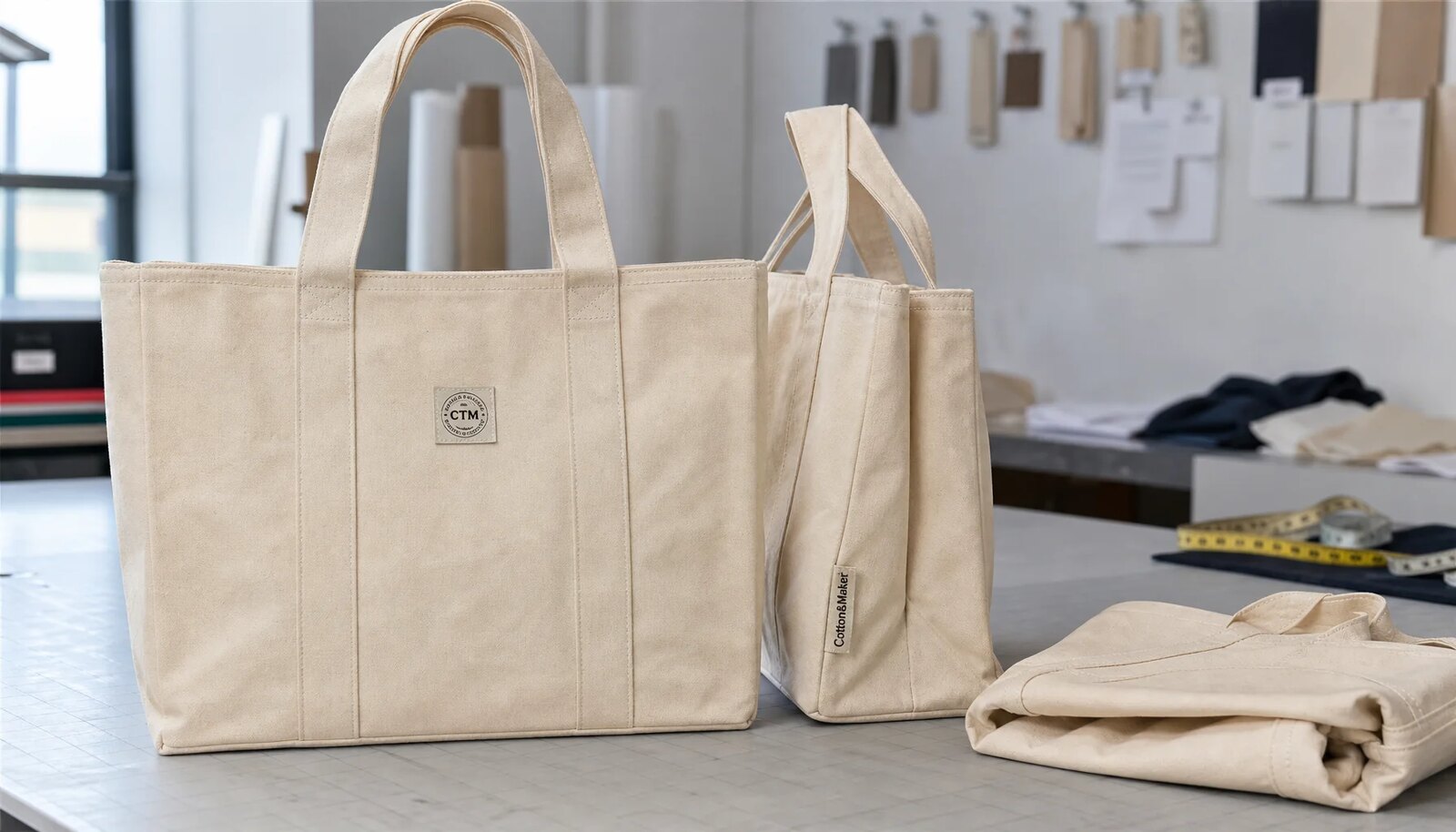
Start With The Bag’s Real Job
Coffee roasters rarely buy canvas grocery totes for one narrow use. The same order may support cafe checkout sales, farmers market carry bags, wholesale account gifts, subscription inserts, holiday bundles, loyalty rewards, and distributor kits. In photos, these bags can look almost identical. In use, they behave very differently. A tote that carries one retail coffee bag and a tasting card does not need the same structure as a grocery-style bag expected to hold several dense coffee bags, produce, bottled syrup, and small retail goods.
Begin with the job the tote must do, then work backward into fabric weight, construction, print, and packing. If an RFQ says only natural canvas tote with black logo, suppliers can quote different products while sounding aligned. One quote may be based on an 8 oz flat tote with short handles. Another may include a 10 oz bottom-gusset tote with reinforced self-fabric handles. A third may assume a heavier 12 oz construction and more protective packing. Price comparison is not meaningful until the specification is anchored.
Channel also changes the acceptable finish level. A low-cost event giveaway can be simple if that is the planned brand experience. A tote sold beside specialty coffee on a cafe shelf needs cleaner stitching, better hand feel, a tidier fold, and print quality that supports the retail price. Distributor programs add another layer: barcode labels, carton-level allocation, reliable counts, and folds that let stores receive inventory without repacking.
- Name the buying purpose: cafe resale, event giveaway, subscription insert, grocery tote, wholesale promotion, loyalty reward, or holiday gift component.
- Describe the load with real contents, such as four 12 oz coffee bags, two 1 lb bags, a carton, produce, and small retail items.
- Set the positioning before sampling: budget promotional bag, everyday reusable tote, or premium merchandise item.
- Ask all suppliers to quote the same fabric, dimensions, handle, print, packing, and inspection assumptions.
- Replace vague terms such as heavy canvas, premium quality, strong handles, and grocery size with measurable specifications.
Use Finished GSM Beside Oz
Canvas weight is often discussed in ounces, but many mills and tote factories control fabric by GSM, or grams per square meter. The two systems are connected, yet the label alone does not guarantee the same material. Yarn count, weave density, finishing, dyeing, washing, moisture content, and shrinkage all influence the final weight and hand feel. As a practical sourcing reference, 8 oz cotton canvas often finishes around 250-280 GSM, 10 oz around 300-340 GSM, and 12 oz around 380-420 GSM.
The most useful phrase for procurement is finished GSM. Greige fabric is woven but not fully finished. The tote customers receive may be natural, dyed, washed, printed, pressed, folded, and packed. If a quote only mentions greige weight, the buyer still does not know how the final bag will feel. A 10 oz greige fabric can change after dyeing or washing. The finished bag is the commercial product, so the finished range belongs on the quotation, sample tag, purchase order, and production file.
Do not treat GSM as the only quality signal. A tight 10 oz canvas can feel more stable and premium than a loose 12 oz canvas with visible gaps or distortion. Heavy slubs, weak yarn, uneven finishing, or poor opacity can make a tote look careless rather than intentionally natural. Physical swatches matter because photos cannot show stiffness, drape, fold recovery, surface texture, or how ink sits on the fabric.
- Ask whether the quoted weight is greige, finished, dyed, washed, or measured after all processing.
- State both oz and finished GSM where possible, with a finished GSM tolerance such as +/-5% unless another range is agreed.
- Label approved swatches by supplier, lot, weight, color, date, and intended tote style.
- Compare weave tightness, opacity, hand feel, stiffness, drape, and fold recovery alongside GSM.
- Require supplier notice before bulk production if the fabric lot changes from the approved swatch.
Choose 8 Oz, 10 Oz, Or 12 Oz Deliberately
An 8 oz canvas tote can be the right commercial choice when the campaign is cost-sensitive. It folds easily, keeps carton weight lower, and supports event sampling, tasting flights, trade shows, farmers market promotions, and simple launch giveaways. The risk is perception. If the bag is described as a grocery tote but feels thin, transparent, or floppy, customers may read it as disposable. That does not mean 8 oz is wrong. It means the role and messaging should match the product.
For many coffee roasters, 10 oz canvas is the strongest starting point. It has enough body for cafe retail, works well for common screen-printed artwork, and can handle everyday grocery-style use when the sewing specification is solid. It is also easier to balance across price, freight, shelf presentation, and repeat-order planning. For wholesale canvas grocery totes for coffee roasters, 10 oz often gives procurement the most room to serve multiple channels without overbuilding the bag.
A 12 oz tote sits in a more premium lane. It can feel substantial, especially with a boxed bottom, wider handles, tidy reinforcement, and a strong front-panel print. It also increases cost beyond the fabric line item. Cutting is bulkier, sewing is slower, seams are thicker, cartons get heavier, and storage uses more space. Heavy fabric can also crease more sharply if the fold and carton count are poorly controlled. Choose 12 oz because it supports the retail value, not because heavier automatically means better.
- Use 8 oz for event sampling, low-cost campaigns, and short-term promotions with modest load expectations.
- Use 10 oz for cafe retail, grocery-style carry, subscription inserts, farmers markets, and repeat merchandise programs.
- Use 12 oz for premium loyalty gifts, holiday bundles, higher retail price points, and long-life brand merchandise.
- Sample 10 oz and 12 oz in the same size before deciding; construction can change perceived strength as much as weight.
- Compare total landed cost, including cartons, freight, storage, and handling, before approving heavier canvas.
Specify Grocery Tote Construction
Fabric weight will not rescue weak construction. Many tote failures start at the handle attachment, side seam, bottom seam, or gusset rather than through the center of the fabric panel. A supplier can make a 12 oz tote perform poorly with shallow handle overlap, narrow seam allowance, low stitch density, loose thread tension, or minimal reinforcement. A well-built 10 oz tote may perform better for typical coffee retail loads than a heavier bag with weak handles.
Coffee products are dense and boxy, so the bag shape matters. A flat tote is economical and efficient to pack, but it does not help cartons, coffee bags, jars, or gift components stand upright. A bottom gusset or boxed bottom gives the bag more practical volume and a clearer grocery profile. Side gussets can add capacity, although they may change the printable panel and the way the front face sits when loaded. Compare usable capacity, not just outside width and height.
Handles need their own specification. Shoulder-friendly handle length commonly falls around 55-65 cm total length, depending on the bag height and market preference. Handle width often sits around 2.5-3.5 cm for canvas totes. Wider handles can feel better under load, but they use more material and may change the visual balance of the bag. State handle material, width, length, overlap depth, reinforcement method, and tolerances in the RFQ.
- Specify body width, height, gusset width, seam allowance, handle length, handle width, and handle overlap in the technical file.
- Use box-X stitch, bar tack, reinforced cross stitch, or dense double-row stitching for grocery-positioned handles.
- Add a bottom gusset or boxed bottom when the tote must hold multiple coffee bags, cartons, jars, or gift items upright.
- Check stitch density and thread tension on samples; loose or skipped stitches are not solved by heavier fabric.
- Inspect handle symmetry, twisted handles, bottom alignment, and gusset shape as retail-quality details.
Match Print Method To Artwork
Most coffee roaster tote graphics are well suited to screen printing. Bold logos, one to three solid colors, origin marks, roast-level icons, simple illustrations, and short cafe slogans are good candidates. Still, canvas texture changes the result. Fine serif type, thin rules, distressed details, small QR codes, and light ink on natural canvas need proofing at actual size. A digital mockup can confirm placement, but it cannot prove opacity, edge sharpness, curing, adhesion, or how the ink settles into the weave.
Heat transfer can work for gradients, complex artwork, or smaller runs. The tradeoff is surface feel. Some brands like the crisp finish; others find it too synthetic for a natural cotton grocery tote. Embroidery can look premium for small logos, patches, or badges, but it adds setup cost and may pucker lighter canvas if backing and stitch density are not controlled. Woven labels, side tabs, hangtags, and paper bands can add brand value without forcing a large print area.
Print placement should be measured, not described loosely. If the logo is centered, state the distance from the top edge, side seams, handle base, and gusset or bottom fold. If the fold line crosses the printed area, the bag may arrive with a visible crease through the artwork. For multi-location roasters, each cafe name or seasonal design needs its own proof, setup review, minimum print quantity, and carton separation plan.
- Choose screen print for solid-color logos, icons, simple illustrations, and repeat wholesale programs.
- Use heat transfer only after approving hand feel, edge appearance, rub behavior, and fit with the brand aesthetic.
- Approve a strike-off on the actual canvas weight and color, not only on paper or a showroom fabric.
- Set minimum line thickness and text size before final artwork release, especially on rough canvas.
- Measure print placement from fixed points such as top edge, side seam, handle base, and gusset fold.
Control MOQ And Price Variables
MOQ for canvas totes is not always one clean number. It can be driven by fabric stock, dyeing lot size, cutting efficiency, sewing setup, print screens, ink matching, label sourcing, barcode application, carton marking, and shipment allocation. Natural canvas in a standard weight and size usually creates fewer MOQ complications than dyed canvas, unusual GSM, custom webbing, or layered retail packaging. Ask what the MOQ applies to, not just what the MOQ is.
Multi-cafe roasters often want one tote body with different location logos. That can be efficient if the fabric, size, construction, and packing stay the same. It still changes the print workflow. Each artwork may require a separate screen, proof, ink check, carton label, and minimum print quantity. If versions are mixed in cartons without a clear allocation plan, the savings can disappear during fulfillment.
A useful quote separates the base bag cost from variable charges. Screen setup, PMS matching, woven labels, hangtags, barcode stickers, paper bands, individual bags, carton marks, inspection support, and special folding should be visible. This makes repeat-order economics easier to understand and reduces late cost changes after internal approval. Quantity breaks should reflect real demand, not only the lowest theoretical unit price.
- Clarify MOQ per fabric color, finished GSM, bag size, construction, artwork, print color count, label, packing method, carton mark, and shipment.
- Ask for realistic price breaks such as 500, 1,000, 3,000, and 5,000 pieces when those quantities match demand planning.
- Separate sample fees, screen charges, color matching, labels, hangtags, barcodes, special folding, and inspection costs from the base price.
- Confirm whether screen setup can be reused for repeat orders and how long screens or digital files are retained.
- Compare landed cost using carton size, carton weight, freight method, duties, delivery, and warehouse handling.
Write A Comparable RFQ
A strong RFQ lets procurement compare suppliers line by line. Include fabric composition, finished GSM, color, finished dimensions, gusset, handle material, handle length, handle width, reinforcement, seam construction, print method, print color count, print size, print placement, label requirements, packing method, carton data, lead time, sample process, incoterm, payment term, and quote validity. Without those details, two similar-looking prices may represent different bags.
Small omissions often become expensive later. A supplier may exclude woven labels, hangtags, barcode stickers, desiccants, paper bands, master polybags, carton marks, store-level allocation, or inspection support. If those items are added after the PO, the order may need a revised price, a new sample, or a longer schedule. Coffee programs tied to holiday launches, seasonal blends, or wholesale partner deadlines should lock these assumptions early.
Incoterms need to be consistent before prices are compared. Ex-factory, FOB, CIF, DDP, and domestic delivered prices place different responsibilities on the buyer and supplier. A low ex-factory unit price may not stay attractive after inland transport, export handling, freight, duty, and delivery are added. If final freight is not ready, request carton dimensions, gross weight, and pieces per carton so logistics can estimate landed cost.
- Issue one written RFQ template to all suppliers with the same artwork, dimensions, quantity, destination, and packing assumptions.
- Require the quote to state finished GSM, not only nominal oz weight or a general fabric name.
- Ask suppliers to list exclusions and assumptions, including setup charges, labels, barcodes, packing, inspection, and freight.
- Request sample lead time, production lead time after sample approval, and quote validity date.
- Use a quote comparison sheet that flags specification differences before comparing unit prices.
Approve Samples With Measurable Criteria
A pre-production sample is a technical control point, not just a nice-looking bag for a meeting. It should use the planned bulk fabric, final construction, actual handle reinforcement, actual print method, and intended fold whenever possible. A showroom sample is useful for early concept review, but it should not become the production reference unless it matches the bulk specification. Label approved samples clearly and keep them available for inspection comparison.
Sample feedback should be specific enough for a factory to act on. Record body width, height, gusset, handle length, handle width, handle placement, print size, print placement, total bag weight, and visible workmanship. If the logo is too low, state the revised distance from the top edge. If the handle feels short, give the new target length. If the bag feels too soft, compare it with the agreed GSM, weave, and swatch reference. Comments like make it stronger or make it more premium create room for interpretation.
Load testing should reflect coffee use, not an abstract claim. Pack the sample with several retail coffee bags, a carton, a bottle, a small gift item, or common grocery products. Carry it by hand and over the shoulder. Watch the handles, side seams, bottom shape, and print area. If the tote will be folded into a subscription shipper, test that fold and compression before mass packing is approved.
- Approve a pre-production sample made with actual bulk fabric, reinforcement, print process, and intended packing fold.
- Measure finished dimensions, handle length, handle width, print placement, gusset width, and total sample weight.
- Load the tote with real coffee and grocery items to check handle comfort, seam stress, bottom stability, and print distortion.
- Reject samples with revision notes tied to size, GSM, construction, print, or packing, not vague preferences.
- Keep the approved sample, fabric swatch, and print strike-off as controlled references for bulk inspection.
Set QC Before Cutting
QC standards should be agreed before fabric is cut. If standards are discussed only after defects appear, the buyer and supplier may disagree about what is acceptable. For canvas grocery totes, inspection should cover fabric, cutting, sewing, printing, finishing, and packing. The approved sample is the visual reference, but the PO or specification sheet should also state tolerances for finished size, GSM, handle length, print placement, and defect classification.
Fabric QC should check finished GSM, shade, stains, oil marks, mildew odor, heavy slubs, weaving defects, dye streaks, and panel distortion. Sewing QC should check seam security, stitch density, thread tension, handle alignment, reinforcement, back-tacking, loose threads, open seams, twisted handles, and gusset symmetry. Print QC should check color, opacity, registration, edge sharpness, curing, adhesion, contamination, and placement. Packing QC should check carton count, carton strength, carton mark, barcode, fold method, moisture protection, and carton condition.
Handle testing should be practical and tied to the intended load. The goal is not to create an exaggerated marketing claim; it is to prevent failures during real customer use. The buyer and factory should agree on a load or pull check appropriate to the tote’s role and record the result. For dyed canvas, dry and wet rubbing checks help reduce color transfer complaints. For cafe resale, stains, crooked logos, and poor folding should be treated seriously because they affect sell-through.
- Check finished GSM from bulk rolls before cutting and compare it against the approved tolerance and swatch.
- Inspect finished width, height, gusset, handle length, handle width, and print placement against written tolerances.
- Perform a practical handle pull or load test based on the intended coffee and grocery load.
- Classify defects as critical, major, or minor so inspection decisions are not purely subjective.
- Tie inspection records to PO number, style, fabric lot, artwork version, carton range, and approved sample.
Plan Packing And Freight Early
Fabric weight affects freight, storage, and warehouse handling. A 12 oz canvas tote is heavier and bulkier than an 8 oz or 10 oz version, especially with a gusset, reinforced handles, labels, or retail packaging. Thick seams reduce how many units fit neatly in a carton. If cartons are overfilled, bags may arrive with permanent creases, crushed corners, or distorted prints. Request carton data before final quote approval, not after production is complete.
Packing also shapes the customer-facing presentation. A cafe resale tote may need a clean fold, paper band, hangtag, barcode sticker, or individual inner packing. A subscription gift may need a fold that fits the shipper without creasing the logo. A distributor order may require carton marks by SKU, store, region, or PO. These details affect labor cost, carton count, lead time, and inspection, so they belong in the RFQ and sample review.
Moisture protection matters for cotton canvas shipped by sea or stored in humid conditions. Cartons should be dry, export grade, and not overloaded. Inner master bags, carton liners, desiccants, or plastic-reduction alternatives should be discussed early based on the buyer’s sustainability policy and route risk. The goal is simple: protect the tote without creating unnecessary packaging or changing carton dimensions late.
- Request pieces per carton, carton dimensions, net weight, gross weight, folded size, and packing method before issuing the PO.
- Approve the fold method and confirm whether it crosses the print area or creates visible front-panel creases.
- Confirm barcode stickers, hangtags, paper bands, inner packing, carton marks, SKU separation, and destination allocation before mass packing.
- Keep carton gross weight practical for warehouse handling rather than maximizing quantity per carton.
- Review pallet pattern, moisture protection, and export carton strength for the selected freight route.
Specification comparison for buyers
| Spec decision | Recommended option | When it fits | Buyer risk to check |
|---|---|---|---|
| General coffee retail tote | 10 oz cotton canvas, typically around 300-340 GSM finished weight depending on yarn, weave, washing, and finishing | Cafe resale, grocery-style carry bags, farmers markets, subscription inserts, wholesale partner promotions, and roastery merchandise programs | Confirm whether weight is finished fabric, not greige; set an acceptable finished GSM tolerance, commonly +/-5% unless the supplier proposes a tighter controlled range |
| Premium loyalty or holiday tote | 12 oz cotton canvas, often around 380-420 GSM finished weight, with wider handles and reinforced handle attachment | Premium gift sets, loyalty rewards, high-margin retail merchandise, and reusable bags positioned as durable brand items | Higher fabric consumption, bulkier seams, heavier cartons, slower sewing, and possible print cracking if curing and ink deposit are not adjusted for textured fabric |
| Budget event tote | 8 oz cotton canvas, often around 250-280 GSM finished weight, usually with flat or light gusset construction | Trade shows, tasting events, launch sampling, farmers market promotions, and short-term campaigns where the tote is not sold as premium merchandise | May feel thin for grocery positioning; verify opacity, seam strength, handle comfort, and customer perception with a physical sample |
| Natural vs dyed canvas | Natural cotton canvas for simpler sourcing; dyed canvas only when brand color, retail presentation, or seasonal design justifies the extra control work | Natural canvas fits many specialty coffee aesthetics and may reduce MOQ complexity; dyed canvas supports cafe color systems or premium capsule programs | Dyed canvas can affect shrinkage, hand feel, shade consistency, print color, crocking risk, MOQ, and lead time; require shade standard and rubbing checks |
| Grocery construction | Bottom gusset or boxed bottom with reinforced self-fabric handles, bar tack or box-X stitch, and adequate seam allowance | Useful when customers carry multiple coffee bags, cartons, produce, bottled syrups, retail goods, or gift-box contents that need usable volume | Flat totes are cheaper but carry less practical volume; compare internal capacity, bottom stability, seam stress, and packed carton efficiency |
| Handle specification | Self-fabric canvas handles, commonly 55-65 cm total length and 2.5-3.5 cm width, with box-X, bar tack, or dense double-row reinforcement | Comfortable hand and shoulder carry for grocery and cafe use, especially when the tote carries several dense coffee bags | Too-short handles reduce usability; too-long handles drag during hand carry; narrow handles feel uncomfortable under load; specify tolerances |
| Print method | Screen print for solid 1-3 color artwork; heat transfer for gradients or short runs; embroidery or woven labels for premium details | Roaster logos, origin marks, simple illustrations, roast-level icons, cafe slogans, and multi-location artwork programs | Fine text, QR codes, distressed artwork, and light ink on textured canvas require strike-off approval on actual bulk fabric |
| MOQ planning | Standardize fabric color, weight, size, and construction; split artwork only after confirming print minimums and setup charges | Roasters with several cafes, seasonal blends, subscription tiers, distributor kits, or retail partner programs | MOQ may apply per fabric color, GSM, style, print artwork, color count, packing method, carton mark, and shipment destination |
| Packing and cartons | Flat packed or controlled folded, often 50-100 pcs per export carton depending on fabric weight, gusset, and fold method | Importers, distributors, cafe groups, and fulfillment teams that need predictable storage, freight, barcode, and allocation data | Overpacked cartons crease heavy canvas and distort prints; request carton dimensions, gross weight, fold method, moisture protection, and pallet guidance before PO |
Buyer checklist before sampling
- Define the tote role before quoting: low-cost event giveaway, cafe resale item, grocery-style bag, subscription gift, loyalty reward, or distributor promotion.
- State the expected load in practical terms, such as four 12 oz coffee bags plus a carton or mixed grocery items, instead of relying only on a marketing weight claim.
- Specify finished fabric weight in oz and GSM, including whether the value applies after dyeing, washing, printing, and final finishing.
- Confirm fabric identity: conventional cotton, organic cotton, recycled cotton, cotton-poly blend, plain weave canvas, duck canvas, dyed canvas, washed canvas, or natural unbleached canvas.
- Provide finished dimensions for width, height, gusset, handle length, handle width, print size, print placement, and acceptable measurement tolerances.
- Define construction details including bottom style, side gusset, seam allowance, stitch density, handle overlap, handle reinforcement, inside binding, label, hangtag, and barcode needs.
- Send vector artwork with Pantone or brand color references, number of print colors, minimum line thickness, print method preference, and distance from seams, edges, and gussets.
- Request a pre-production sample made with actual bulk fabric, actual handle reinforcement, actual print method, intended fold, and any retail label or packing component.
- Approve the sample using measurable notes for GSM, dimensions, print placement, handle comfort, seam quality, gusset shape, fold marks, and total bag weight.
- Clarify MOQ by fabric color, fabric weight, bag size, construction, artwork, print color count, label, packing method, carton mark, and delivery destination.
Factory quote questions to send
- Is the quoted canvas weight measured as greige fabric, finished fabric, dyed fabric, washed fabric, or completed bag fabric, and what finished GSM tolerance will you control?
- What is the exact fabric composition and weave: conventional cotton canvas, organic cotton canvas, recycled cotton canvas, cotton-poly canvas, plain weave canvas, duck canvas, or another material?
- Can you provide current swatches for 8 oz, 10 oz, and 12 oz options from available stock or planned production lots rather than archive swatches?
- What finished GSM range do you recommend for our target load and retail channel, and can you state that range on the quotation and production file?
- What is the MOQ per fabric color, GSM, bag construction, print artwork, print color count, label, packing method, carton mark, and shipment destination?
- Which print method do you recommend for our artwork on this canvas texture, and what limits apply for line thickness, small text, QR codes, gradients, and color matching?
- Can the pre-production sample use actual bulk fabric, actual ink or transfer material, actual handle construction, and the intended production fold?
- What handle reinforcement will be used: bar tack, box-X stitch, cross stitch, double-row stitch, or another method, and what handle overlap depth is standard?
- What finished tolerances do you offer for body width, body height, gusset width, handle length, handle width, print placement, and carton piece count?
- What stitch density, seam allowance, thread type, needle size, and sewing method will be used for side seams, bottom seams, gussets, and handles?
Quality-control points to confirm
- Finished fabric weight should be checked from bulk fabric rolls before cutting and compared with the approved swatch and stated GSM tolerance.
- Bulk fabric should match the approved color and hand feel, with checks for shade variation, heavy slubs, oil marks, stains, mildew odor, dye streaks, weaving defects, and panel distortion.
- Finished bag dimensions should stay within agreed tolerances for width, height, side gusset, bottom gusset, handle length, handle width, and folded size.
- Handle attachment should pass the agreed practical load or pull test without seam tearing, stitch popping, fabric ripping, excessive elongation, or handle distortion.
- Stitching should be secure and consistent, with no skipped stitches, broken threads, open seams, raw seam exposure, twisted handles, or excessive loose thread tails.
- Gussets and bottom panels should be symmetrical so the tote stands, folds, stacks, and packs correctly without twisting or creating uneven front panels.
- Prints should match the approved strike-off for color, opacity, registration, edge sharpness, ink coverage, curing, adhesion, placement, and contamination control.
- Small text, QR codes, and fine artwork should be inspected at the actual printed size because rough canvas can reduce legibility.
- Dyed canvas should be checked for dry and wet rubbing risk when dark fabric or dark handles may contact light clothing or retail surfaces.
- Cartons should be clean, dry, export grade, correctly labeled, correctly counted, not overfilled, and strong enough to prevent crushed corners or permanent creasing.