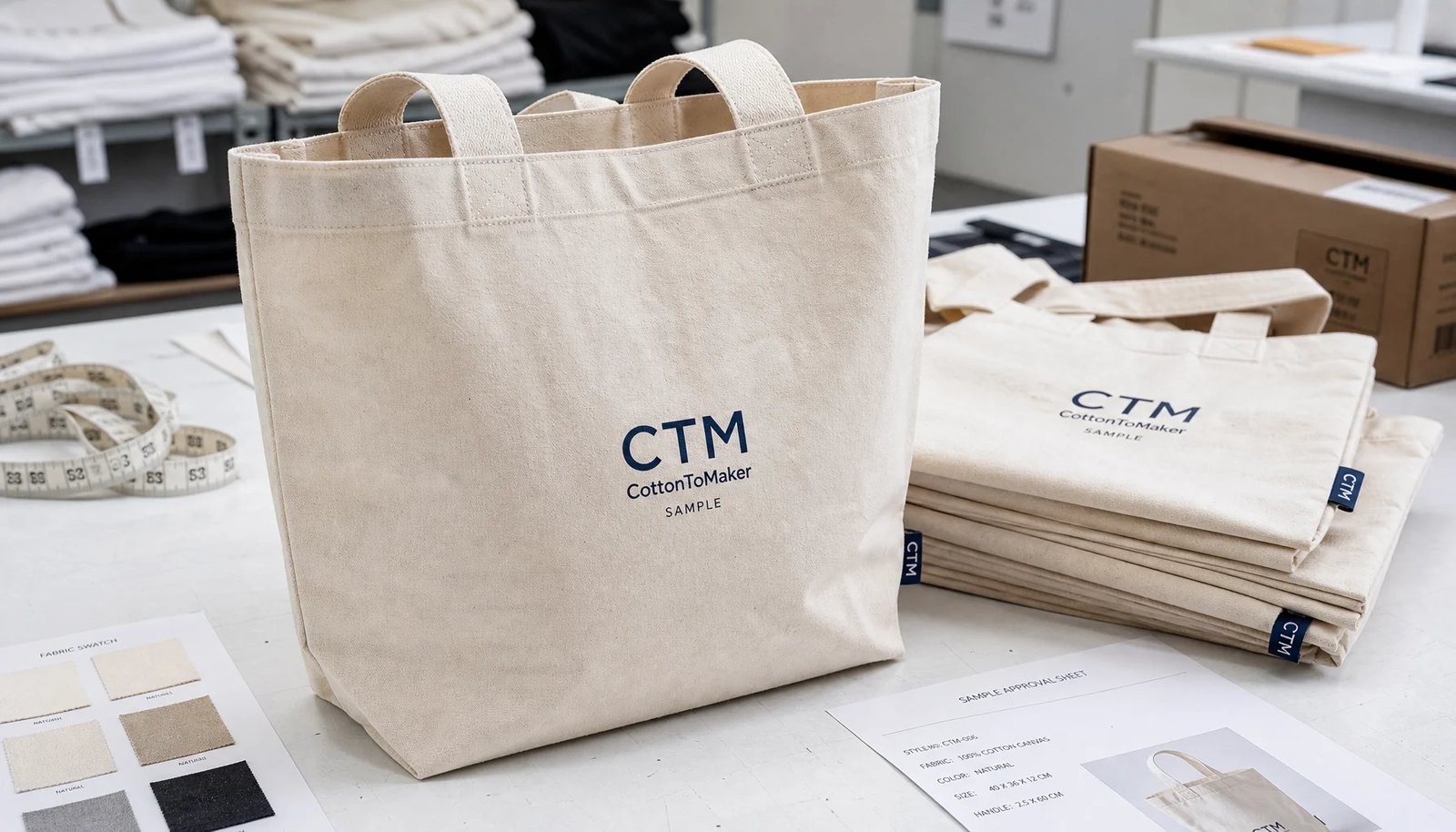
Start With the Campus Buying Brief
University bookstores buy canvas grocery totes for different jobs, so the first procurement step is not price. It is the buying brief. A tote sold as a paid retail item needs cleaner folding, better shelf appeal, barcode control, and a margin target. A checkout tote needs fast handling and a practical unit cost. An orientation or admissions tote needs delivery certainty and enough capacity for folders, books, apparel, or welcome-kit items.
The brief should tell suppliers what the tote will carry, who will approve artwork, how many logo versions are needed, where cartons will ship, and whether the order is a one-time event or a reorderable SKU. This prevents suppliers from quoting a flat promotional tote when the buyer expects a boxed-bottom grocery bag with reinforced handles.
A good brief also gives internal teams a decision rule. If retail quality matters most, a slightly higher unit cost may be justified by stronger canvas and cleaner packing. If the order is a free event bag, the buyer may prioritize a controlled 10 oz spec, bulk packing, and a safe delivery window.
- Define the use: retail sale, checkout bag, orientation kit, admissions event, alumni weekend, athletics store, department order, or replenishment SKU.
- Name the load: textbooks, folders, apparel, drinkware, snacks, gifts, tech accessories, or mixed bookstore merchandise.
- State the distribution method: folded stack, shelf bin, online fulfillment, kit insertion, direct handout, or warehouse replenishment.
- Identify approval owners: bookstore buyer, licensing team, brand office, supplier, factory contact, and QC contact.
- Set the priority: lowest landed cost, retail margin, premium feel, delivery certainty, sustainability messaging, or reorder consistency.
Specify the Tote Before Comparing Prices
Bulk tote quotes only become useful when every supplier prices the same product. Terms like “heavy canvas,” “grocery size,” and “bookstore tote” leave too much room for interpretation. One supplier may quote 8 oz canvas with a shallow gusset; another may quote 12 oz canvas with a reinforced boxed bottom. The cheaper quote may simply be a different bag.
The RFQ should state the finished tote dimensions, not only cutting size. Include finished width, finished height, bottom gusset depth, handle drop, handle width, print size, and print location. For a bookstore grocery tote, common starting ranges are about 14-16 inches wide, 13-16 inches high, and 4-6 inches deep, but the final size should match the merchandise and display plan.
Also define tolerances. Canvas is a soft textile, so minor variation is normal, but uncontrolled drift creates receiving disputes and reorder problems. Buyers often agree to body-dimension tolerances around plus or minus 1 cm and tighter print-placement tolerances where the artwork and printing process allow it. The agreed standard matters more than any generic rule.
- Body spec: finished width, height, bottom gusset, measurement method, and tolerance.
- Handle spec: self-fabric or webbing, width, finished drop, color, and reinforcement stitch.
- Fabric spec: canvas oz, GSM target, color, weave if available, finish, slub acceptance, and weight tolerance.
- Print spec: method, color count, Pantone direction, print area, placement, opacity expectation, and licensing rules.
- Commercial spec: MOQ, tiers, sample fees, setup fees, packing, carton data, lead time, trade term, and inspection access.
Use a Real Bulk Pricing Model
A useful bulk pricing plan shows how the unit price changes when fixed costs spread across more pieces. For university bookstore planning, ask for 500, 1,000, 3,000, and 5,000 pieces. These tiers help compare a single bookstore buy against a consolidated order that includes orientation, admissions, athletics, alumni, or departments.
The numbers below are not guaranteed quotes. They are a practical worksheet format using cautious indicative ranges for a natural 10 oz cotton canvas grocery tote, one-color one-side screen print, reinforced handles, boxed bottom, and bulk packing. Actual pricing depends on fabric markets, dimensions, ink coverage, location, supplier route, payment terms, and freight conditions.
Buyers should compare total program cost, not only unit price. A low unit price may exclude screens, strike-offs, barcode labels, carton marks, sample freight, inspection cooperation, export documents, local trucking, or split-destination handling. Put those costs into the same worksheet before approving a purchase order.
- 500 pcs: indicative FOB range about $2.60-$4.10; setup and sample costs carry more weight per unit.
- 1,000 pcs: indicative FOB range about $2.10-$3.50; common planning tier for controlled bookstore programs.
- 3,000 pcs: indicative FOB range about $1.85-$3.05; better setup allocation and stronger factory planning.
- 5,000 pcs: indicative FOB range about $1.70-$2.80; useful for consolidated campus demand and repeat SKUs.
- Worksheet rule: separate base unit price from screens, samples, options, packing, freight, duty if applicable, and inland delivery.
Build a Simple Landed-Cost Example
The title price is rarely the final cost a bookstore pays. A clean landed-cost model keeps the buyer from choosing a supplier based on a misleading FOB or ex-works number. Even a small difference in carton cube, packing method, or destination handling can change the final delivered cost.
For example, assume 1,000 natural 10 oz canvas grocery totes at $2.45 FOB per piece. Add a $95 screen/setup charge, a $65 print strike-off, $120 sample and sample freight, and $380 estimated freight and import/inland handling for planning. The simple landed estimate is $2,450 plus $660 in added costs, or $3,110 total. Divided by 1,000 pieces, the planning cost is $3.11 per tote before any internal receiving, storage, or retail markup.
At 3,000 pieces with the same $2.05 FOB unit price and $860 in setup, sample, freight, and handling assumptions, the planning cost becomes $6,150 plus $860, or $7,010 total. That equals about $2.34 per tote. The example shows why consolidating orders can help, but only when approvals, destinations, inventory ownership, and logo versions are controlled.
- Base unit price: the quoted product cost under a stated trade term.
- Fixed charges: screens, strike-offs, samples, color matching, and setup.
- Variable options: extra print colors, second-side print, labels, hangtags, barcode stickers, and polybags.
- Logistics inputs: carton count, CBM, gross weight, freight, customs, duty if applicable, and inland delivery.
- Internal costs: receiving labor, storage, chargebacks, markdown risk, and leftover event inventory.
Choose Canvas Weight and Construction
Canvas weight is a major price driver because it affects material cost, sewing speed, carton weight, and freight. For many university bookstore grocery totes, 10 oz to 12 oz cotton canvas is the practical range. It feels more substantial than a light event tote without becoming overly bulky for storage and shipping.
An 8 oz bag can work for light checkout use or short events, but it should not be compared directly with a structured grocery tote meant to carry books and apparel. A 12 oz tote gives stronger structure and perceived value for paid retail programs. A 14 oz or heavier tote may support a premium product, but buyers should check freight, sewing cost, and retail price before upgrading.
Construction matters as much as fabric weight. A boxed bottom gusset improves usable volume. Reinforced handles reduce failure risk. Clean seam finishing and trimmed threads improve shelf appeal. The sample should be loaded with actual bookstore merchandise because an empty tote can hide weak handle attachments or twisting gusset corners.
- 8 oz: lower-cost option for light loads, giveaways, or short-term event distribution.
- 10 oz: balanced option for many bookstore grocery totes with controlled cost and usable structure.
- 12 oz: stronger hand feel for paid retail, textbook-heavy use, and repeat merchandise programs.
- 14 oz+: premium route when higher cost, heavier cartons, and larger storage needs are acceptable.
- Construction control: specify boxed bottom, seam finish, handle reinforcement, and load test expectations.
Control Decoration and Campus Marks
Most bookstore canvas totes use screen printing because university wordmarks, mascots, and bookstore logos are often solid spot-color artwork. Screen printing is usually efficient for one to three colors across hundreds or thousands of pieces, but it still needs controlled artwork and physical approval.
Provide vector files, Pantone references, print dimensions, clear-space rules, logo restrictions, and placement instructions. Digital proofs show layout; they do not prove ink opacity, edge definition, registration, curing, or color behavior on textured canvas. A strike-off on the actual production canvas is the better approval standard.
Artwork complexity can change cost and risk. Fine reverse type, distressed textures, halftones, large ink coverage, gradients, or photographic effects may require artwork adjustment, transfer printing, or digital printing. Those methods can work, but buyers should check hand feel, cracking, adhesion, opacity, and repeatability before approving bulk production.
- Screen print: efficient for solid campus marks and repeat 1-3 color programs.
- Heat transfer: useful for detailed art, but check edge feel, adhesion, cracking, and durability.
- Digital print: flexible for complex artwork, but review opacity, color repeatability, and unit cost.
- Embroidery: better for small premium marks than large grocery tote graphics.
- Approval standard: Pantone direction plus physical strike-off on production canvas.
Compare Supplier Routes, Not Just Quotes
Direct factories, trading companies, domestic distributors, and local decorators can all be valid sourcing routes. The best route depends on order size, timing, customization depth, internal purchasing rules, and the buyer’s need for production visibility.
A direct factory is useful for custom construction, carton data, inspection access, export documentation, and repeat consistency. A trading company may coordinate multiple product categories or factories, but procurement should still require factory-level specifications and QC evidence. A domestic distributor can simplify communication, payment, and delivery, especially for smaller or rushed orders. A local decorator can help with shorter print runs, but blank tote quality must be verified.
Do not accept broad assurances such as “standard heavy canvas” or “same as photo.” Ask for swatches, measured samples, carton specs, print examples, tolerance notes, and a timeline. The supplier route should match the risk profile of the order.
- Direct factory: best for custom specs, repeat production, carton control, and inspection visibility.
- Trading company: useful for bundled merchandise, but require material detail and production accountability.
- Domestic distributor: convenient for local delivery and terms, but verify customization limits and blank quality.
- Local decorator: good for small logo runs, but confirm base tote availability and reorder consistency.
- Red flag: a supplier quotes without confirming fabric weight, finished size, gusset, handles, packing, and trade term.
Approve Samples With Measurable Tests
The sample stage turns the RFQ into the production standard. Photo approval is not enough for canvas grocery totes. Buyers need to feel the fabric, check the handle drop, test the load, inspect seams, review print texture, and confirm how the bag folds and packs.
A practical sample path may include a fabric swatch, print strike-off, prototype, and pre-production sample. Smaller orders may combine stages, but licensed artwork, paid retail programs, and repeat SKUs should not skip physical approval. The approved sample should be retained with written notes and used as the inspection reference.
Testing should reflect real bookstore use. Load the sample with textbooks, apparel, drinkware, or the actual kit contents. Carry it long enough to stress the handle attachments. Check for pulling, seam opening, gusset distortion, uncomfortable handles, print cracking, print transfer, and folding marks.
- Measure: body width, height, gusset depth, handle drop, handle width, print size, and placement.
- Inspect: shade, slubs, stains, seams, loose threads, skipped stitches, reinforcement, and trimming.
- Test: loaded carrying, seam stress, handle comfort, print rub, fold behavior, and display fit.
- Record: approval date, sample version, artwork file, Pantone target, tolerance, and accepted deviations.
- Retain: keep one buyer sample and one supplier sample as sealed production references.
Specify Packing, Cartons, and Receiving
Packing affects cost, freight, receiving accuracy, and shelf readiness. Bulk packing is usually lowest cost for checkout use, orientation kits, and event distribution. Individual polybags help with retail sale, barcode control, cleanliness, and online fulfillment, but they add material, labor, and packaging waste.
Carton data should be requested before supplier selection. Ask for pieces per carton, carton dimensions, gross weight, net weight, total CBM, and maximum carton weight. Two suppliers can quote the same unit price but create different freight and receiving costs because of carton efficiency.
Campus orders often involve multiple destinations or logo versions. Carton marks should show PO number, SKU, item name, logo version, quantity, destination, carton sequence, and any required barcode or receiving label. If mixed versions are packed under one PO, carton labeling must be clear enough for warehouse and store teams to receive without re-sorting.
- Bulk pack: best for low cost, checkout stacks, events, and reduced carton cube.
- Individual polybag: best for retail sale, barcode control, cleanliness, and unit-level handling.
- Hangtag or belly band: useful for merchandising, but test tearing, sliding, and carton creasing.
- Carton data: require pack count, dimensions, gross weight, net weight, CBM, and carton sequence.
- Receiving control: define PO, SKU, logo version, destination, quantity, pallet preference, and label format.
Protect the Campus Deadline
University bookstore demand is seasonal. Back-to-school, orientation, admissions visits, homecoming, alumni weekends, graduation, and athletics events all have fixed windows. A cheaper tote is not useful if it arrives after the event or too late for retail setup.
Break lead time into stages: artwork proofing, brand approval, sample making, sample approval, fabric purchase, cutting, printing, sewing, QC, packing, inspection, export handover, freight, customs if applicable, inland delivery, and receiving. This makes schedule risk visible before the purchase order is issued.
Many delays come from buyer-side decisions rather than sewing capacity. Revised artwork, late Pantone approval, added logo versions, barcode changes, and destination changes can all move the ship date. Assign internal approval dates and lock carton instructions before production starts.
- Artwork gate: approve logo files, color references, size, placement, and licensing rules before screens are made.
- Sample gate: approve swatch, strike-off, prototype, or pre-production sample before bulk cutting.
- Material gate: confirm whether the fabric is stock natural canvas, custom dyed canvas, or special trim.
- Production gate: schedule printing, sewing, trimming, packing, and inspection with clear responsibility.
- Delivery gate: confirm freight plan, destination labels, receiving contacts, and latest acceptable arrival date.
Specification comparison for buyers
| Sourcing or pricing choice | Indicative buyer cost impact | Best fit for university bookstores | Risk to verify before PO |
|---|---|---|---|
| Base 10 oz natural canvas tote, one-color one-side screen print, bulk packed | Typical FOB factory range may be about $1.85-$3.20 at 1,000-5,000 pcs, depending on size, fabric market, print area, and packing | Checkout bags, orientation handouts, admissions events, department programs, and budget-controlled bookstore merchandise | Confirm finished size, true GSM or oz target, handle reinforcement, screen charges, carton data, and what is excluded from the unit price |
| Upgrade from 10 oz to 12 oz canvas | Often adds about $0.20-$0.55 per piece before freight because fabric consumption, sewing effort, and carton weight can increase | Paid retail totes, textbook-heavy use, alumni programs, premium bookstore displays, and repeat SKUs | The heavier bag may improve perceived value but can raise freight, carton weight, and retail shelf bulk |
| Second-side screen print or second print color | Commonly adds about $0.12-$0.45 per piece plus possible screen or setup fees; large ink coverage can cost more | Co-branded bookstore/campus marks, sponsor logos, event graphics, and designs needing stronger retail presence | Separate logo versions, Pantone matching, registration, opacity, and curing need physical strike-off approval |
| Individual polybag, barcode sticker, or hangtag | Polybag may add about $0.04-$0.12; barcode or hangtag programs can add material, labor, and data-control costs | Retail sale, warehouse scanning, online fulfillment, giftable packaging, and cleaner receiving counts | Packaging can increase waste, carton cube, receiving complexity, and print-creasing risk if packed too tightly |
| Mixed logo versions under one PO | May add setup charges, sorting labor, carton labeling time, and separate minimums by artwork | Multi-campus systems, athletics stores, alumni offices, orientation teams, and department-funded buys | A low combined MOQ may still trigger separate screens, proof cycles, production lots, and carton-mark requirements |
| Domestic distributor or local decorator route | Unit price can be higher, but local communication, payment, delivery, and short-run decoration may be simpler | Rush orders, smaller quantities, reorder fill-ins, or buyers that require domestic invoicing | Verify blank tote quality, origin, available gusset sizes, print durability, and whether the exact item can be reordered |
| Direct factory or export route | Often stronger for custom specs and larger orders, but landed cost must include freight, duty if applicable, customs, and inland delivery | Planned seasonal buys, 1,000+ piece custom programs, repeat SKUs, and campus-wide consolidation | FOB price alone is not landed cost; check sample freight, inspection access, export documents, carton cube, and delivery schedule |
| Consolidated 3,000-5,000 pc buy | Can reduce setup allocation and improve unit economics; example FOB range may narrow to about $1.70-$2.80 for a controlled 10 oz base tote | Bookstore plus orientation, admissions, alumni, athletics, and department demand planned together | Consolidation only helps if artwork approvals, destinations, inventory ownership, and chargebacks are coordinated early |
Buyer checklist before sampling
- Define the job first: paid retail tote, reusable checkout bag, orientation kit, admissions event, alumni weekend, athletics store, department fundraiser, or replenishment SKU.
- Set one base specification for all suppliers: finished width, height, bottom gusset depth, handle drop, handle width, canvas weight, print method, packing, carton data, and trade term.
- Request pricing at 500, 1,000, 3,000, and 5,000 pieces using the same base specification, then list every option separately.
- Ask for a pricing worksheet that separates unit price, screen charges, sample fees, strike-offs, packaging, carton labels, inspection support, domestic trucking, freight assumptions, and excluded costs.
- Approve physical swatches for canvas color, hand feel, slub level, and fabric weight target before approving the full pre-production sample.
- Provide vector artwork with Pantone references, clear-space rules, print size, print location, licensing restrictions, and any logo-version requirements.
- Confirm handle construction by material, width, finished drop, attachment stitch, and load expectation rather than accepting a photo-only description.
- Require carton data before supplier selection: pieces per carton, carton dimensions, gross weight, net weight, total CBM, carton marks, and pallet preference if relevant.
- Test the approved sample with real bookstore contents and document dimensions, seam quality, handle stress, print rub, fold method, and visible defects.
- Keep one sealed approved sample with the buyer and one with the supplier for production, inspection, and reorder control.
Factory quote questions to send
- What exact canvas are you quoting: oz, GSM target, fabric-weight tolerance, weave or construction if available, color, finish, shrinkage expectation, and swatch reference?
- Is your price based on finished tote size or cutting size, and what tolerance applies to width, height, bottom gusset, handle drop, handle width, and print placement?
- What is included in the unit price, and which costs are separate: screens, films, setup, strike-off, sample, Pantone matching, carton labels, export documents, inspection cooperation, or local trucking?
- Can you quote 500, 1,000, 3,000, and 5,000 pieces using the same size, canvas, handle, print area, print color count, packing, carton plan, and trade term?
- How does pricing change for 12 oz canvas, second-side print, extra print color, larger print area, woven side label, care label, hangtag, barcode sticker, belly band, or individual polybag?
- What MOQ, setup fee, and lead-time impact apply to multiple campus logos, athletics marks, alumni versions, department versions, mixed cartons, or destination-specific carton marks?
- Which decoration method do you recommend for our artwork, and can you provide a print strike-off on the actual production canvas before bulk printing?
- What sample stages are included or recommended: fabric swatch, print strike-off, prototype, pre-production sample, and sealed production reference sample?
- What are the planned inspection points for fabric, cutting, printing, sewing, trimming, packing, carton marks, and final random inspection?
- Can you provide a stage-by-stage timeline for proofing, sampling, approval, fabric purchase, cutting, printing, sewing, QC, packing, inspection, export handover, and delivery?
Quality-control points to confirm
- Fabric weight should be checked against the approved swatch and written GSM or oz tolerance, using production-lot samples when possible rather than supplier paperwork alone.
- Visible panels should be free from stains, holes, oil marks, severe slubs, mixed shade panels, contamination, heavy creasing, and defects that would affect retail sale or campus-brand presentation.
- Finished width, height, gusset depth, handle drop, handle width, print size, and print placement should be measured across multiple cartons, not only from top-of-carton samples.
- Written tolerances should be approved before production; many soft-goods programs use around plus or minus 1 cm for body dimensions and tighter limits for print placement when the method supports it.
- Handle attachments should match the approved reinforcement method, with no skipped stitches, broken stitch lines, loose thread clusters, needle damage, weak seam ends, or uneven stress points.
- Side seams, bottom seams, gusset corners, and inside seam edges should be reviewed for puckering, twisting, open seams, poor trimming, and shape distortion when the bag is loaded.
- Print color should be reviewed against the approved Pantone direction or physical strike-off under consistent lighting, with acceptable shade variation defined before bulk production.
- Print quality should show suitable opacity, edge definition, registration, curing, and adhesion, with no obvious bleeding, pinholes, ghosting, blocking, severe fibrillation, or cracking outside the approved standard.
- Rub, tape, or adhesion checks should be performed on the same production canvas and ink system, not on a smoother substitute fabric or paper proof.
- Cartons should match the approved pack count, carton dimensions, gross weight, label format, destination mark, logo-version mark, and carton sequence before shipment release.