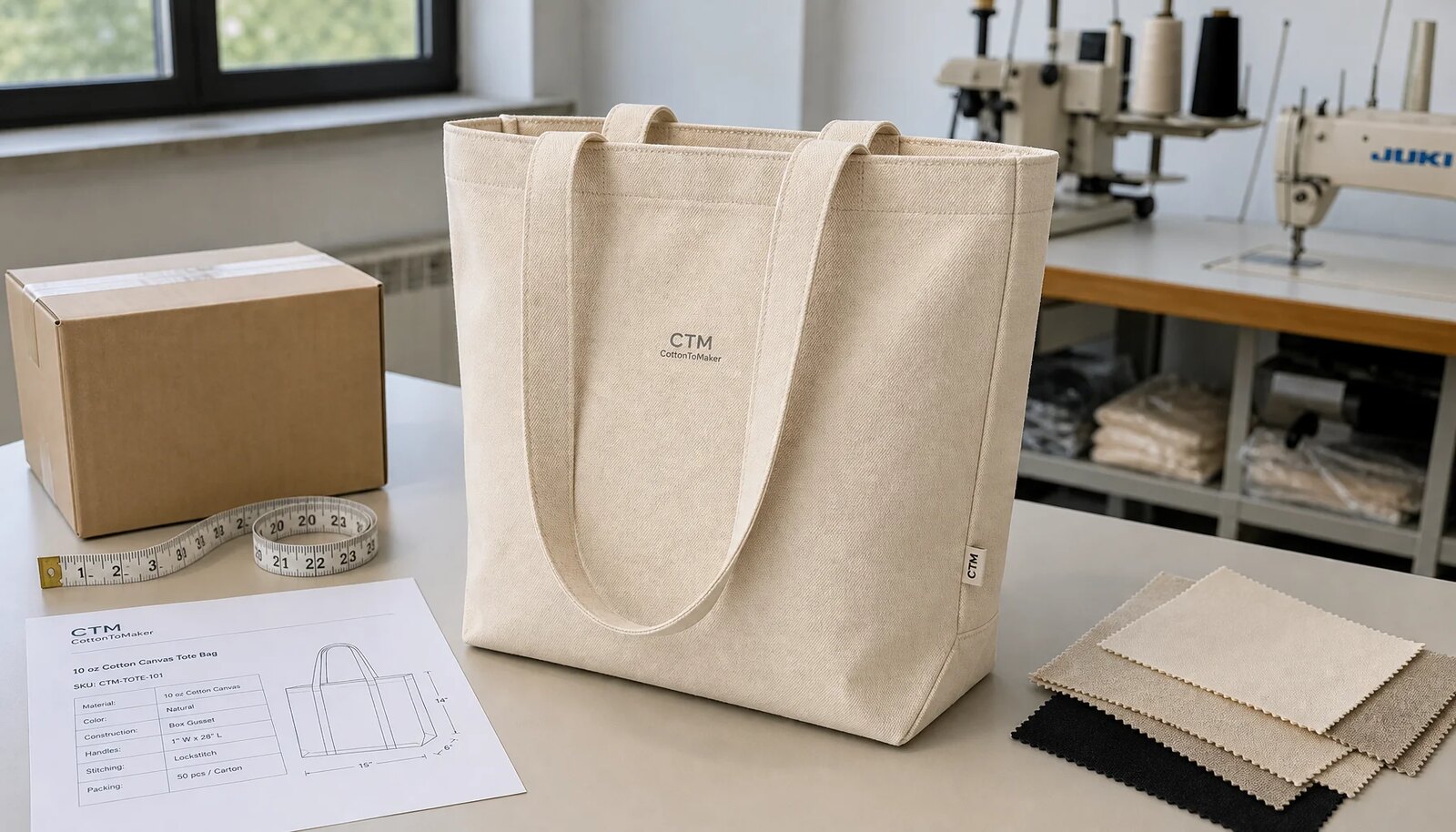
Start With the Selling Job
Wholesale canvas grocery totes for farmers market vendors are not one product. The same tote can be a giveaway, a checkout bag, a resale SKU, or a branded item that customers buy because it looks better than the generic alternative. The use case drives the spec. A giveaway can prioritize unit cost and simple packing. A resale tote needs cleaner finishing, more consistent presentation, and less visible sewing variation. A checkout bag needs structure, comfortable handling, and enough strength to carry mixed groceries, produce, jars, and bottles without twisting at the handles.
Write down the commercial job before you ask for a price. If the tote is meant to hang on a peg or sit in a retail stack, the top hem, fold quality, and label placement matter. If the tote is meant to move quickly through a checkout line, handle drop and load performance matter more than an ornate print. When the use case is vague, suppliers make their own assumptions, usually in the direction of lower cost and simpler construction. That is how buyers end up approving a sample that looks fine on a table but does not fit the actual market workflow.
- Name the commercial role of the tote before you talk about artwork.
- Use resale, giveaway, checkout, and customer purchase as separate buying scenarios.
- Decide whether presentation or durability matters more if those goals conflict.
- Check whether the bag must stand up, fold flat, or pack tightly for shipment.
Write a Spec a Factory Can Price
A useful sourcing document for this category is short and concrete. The factory needs finished width, finished height, gusset depth, handle length, handle drop, handle width, fabric weight, color, decoration method, print locations, and packing format. If those are missing, the first quote will be built on the supplier's standard tote, not yours. That is why two quotes can look similar on paper while representing different bags in practice.
Use numbers that can be reproduced. State dimensions to the nearest 0.25 in and say whether the measurement is taken after sewing and finishing. If the bag will be resold, include top hem expectation, inside trim, and whether visible raw edges are acceptable. For a market tote, you do not need a paragraph of brand language. You need a spec that controls the bag body and the finishing details that change how the tote feels in hand and looks in a display stack.
- Include finished width, height, gusset depth, handle length, handle drop, and handle width in the RFQ.
- Define whether measurements apply before or after pressing and final packing.
- State the top hem finish and inside trim level if the bag will be sold to end customers.
- Ask the supplier to confirm the tolerance window in writing before sampling starts.
Fabric Weight, Weave, and Finish
Fabric weight is important, but it only becomes meaningful when tied to the job. In this category, 8 oz canvas is a lighter starting point, 10 oz is usually the most practical balance for reusable market use, and 12 oz is the heavier retail-leaning option. The exact GSM will vary by weave and finish, so ask for both oz and GSM. That helps catch unit-conversion errors and makes quotes from different sourcing channels easier to compare. If a supplier quotes a lower price on heavier cloth, ask where the savings came from. It is usually in sewing, finishing, or inspection.
Finish changes how the tote behaves as much as the cloth weight does. Natural canvas, bleached canvas, dyed canvas, and washed canvas all present differently. Natural cloth typically shows more slub and shade movement; that can be acceptable if it is part of the approved look. Washed cloth can soften the hand but may also shift the final size and fold behavior. If the tote is expected to carry jars, bottles, and produce, ask what service load the factory built around and whether the cloth has been stabilized or pre-shrunk. A tote that changes shape after moisture or heat is not a minor issue if you plan to sell it repeatedly.
- Ask for oz and GSM together so different suppliers are speaking the same language.
- Treat shade variation, slub content, and washed finish as approval items, not surprises.
- If the tote will carry heavier groceries, ask for the intended service load and any stabilization step.
- Request a swatch or strike-off on the actual color and finish you intend to buy.
Construction That Survives Market Use
Most tote failures show up in the sewing, not the headline fabric weight. Handles twist, attachment points split, gussets buckle, and top hems wave when the construction is too light for the load path. For farmers market use, the useful questions are direct: is there a box gusset, how is the top edge finished, what reinforcement exists where the handles meet the body, and how many stitch rows or bar tacks are used in the stress zone. A well-built 10 oz tote can outperform a sloppy 12 oz tote because the construction is doing the work.
Match the structure to the channel. A flat tote is fine for a lower-cost giveaway or a simple merch item. A box gusset gives the bag real volume, improves its stance on a counter, and makes it behave more like a grocery carrier. Self-fabric handles can look cleaner on a retail tote, while webbing handles often reduce twist and hold up better when the bag is used heavily. If the supplier says reinforcement is optional, ask whether the tote still holds jars, produce, and mixed grocery shapes without strain. The photo matters less than the load path.
- Use a box gusset when the tote needs to hold grocery-shaped items, not just flat merchandise.
- Confirm handle attachment style and the reinforcement pattern at each stress point.
- Ask for the number of stitch rows or bar tacks at the handle connection.
- For resale programs, require a cleaner top hem and a consistent inside finish.
Decoration Should Be Durable, Not Just Visible
Decoration is part of the product, not a separate branding layer. For simple logos on canvas grocery totes, screen print usually gives the best balance of cost, clarity, and repeatability. It is often the right answer for one- or two-color artwork because setup is manageable and the result is easy to reproduce across replenishment orders. But the buyer still has to think about how the mark behaves when the tote is folded, stuffed, and handled every week. A print that looks sharp on a flat mockup can fail once it crosses a seam or sits on the same fold line.
Placement matters. A large front print is highly visible, but it can show crease wear sooner if the tote folds in the same place every time. A smaller mark, side label, or woven label may feel more premium and age better. Do not approve decoration from a digital mockup alone. Ask for a strike-off or decorated sample on the same canvas weight and color you intend to buy. Natural canvas, bleached canvas, and dyed canvas all affect how ink sits on the fabric. If the decoration method is more complex than screen print, require a durability check on the actual bag before bulk approval.
- Use screen print when the logo is simple and repeatability matters.
- Test decoration on the same fabric color and weight that will be used in bulk.
- Ask how the print area intersects with the fold line and the top hem.
- If you want a premium finish, consider a woven label or restrained mark instead of a large graphic.
Price the Full Program, Not the Bag Shell
The cheapest-looking tote quote is often just the cheapest shell. A useful buying decision looks at the full program: bag body, decoration setup, labels or hangtags, folding, polybagging, carton markings, freight, duty, receiving fees, and the cost of rejects or rework if the program has known risk. That may feel conservative, but it is the only way to compare suppliers who structure their quotes differently. One factory may bundle more service into the unit price; another may leave half the work outside the number you first see.
Use the same assumptions across suppliers or the comparison is meaningless. If one quote is EXW and another includes export cartons and inland freight, you are not comparing equivalent offers. If the order is a pilot, accept that setup charges will be spread over fewer pieces and will make the unit price look high. That is normal. A practical example: a 1,000-unit run at $1.22 FOB, plus 8% duty, plus $0.24 per unit freight and receiving, plus $95 of print setup amortized across the run, lands around $1.65 each before domestic margin. The exact number changes with origin and freight mode, but the math should be visible in every quote.
If the supplier will not break out the major cost lines, ask them to do it. It is much easier to compare quotes when the buyer can see where cost sits: cloth, sewing, print, packing, freight, and trade terms. Hidden cost is usually not hidden at all; it is just packed into a single number that is hard to question.
- Ask for landed cost per sellable tote, not just factory price.
- Keep freight, duty, packing, and receiving assumptions aligned across suppliers.
- Request a second quantity tier so you can see whether scale actually improves economics.
- Use the same Incoterm for every quote or the comparison will be misleading.
Compare Supplier Routes Without Mixing Categories
The source route changes the commercial shape of the order. Factory-direct cut-and-sew gives the buyer the most control over fabric, sewing, and packing, but it usually demands a tighter spec and a more disciplined MOQ. A trading company can help when the order spans multiple SKUs or when the team wants a single point of contact, but the buyer still needs to know which factory is actually making the tote. Stock blank bags with local decoration can shorten lead time, but the buyer gives up control over shade, handle length, and often gusset consistency. Those offers are not interchangeable even if the mockups look identical.
Treat route selection as a risk decision, not only a price decision. A blank tote with local print can be the fastest option if the blank inventory already matches your size and feel requirements. A factory-direct custom program is usually better when repeatability and private-label control matter. A trading company is acceptable when coordination is the real bottleneck, but do not let convenience hide where quality risk sits. If one quote is far below the others, the first question should be what is missing: cloth weight, reinforcement, print method, packing, or inspection scope.
- Do not compare stock blanks and custom cut-and-sew bags as if they were the same product.
- Ask for the actual factory name when a trading company quotes the program.
- Confirm who pays for sample rework, print fixes, and relabeling if the first version misses the brief.
- If multiple bag styles ship together, ask whether one delayed SKU can hold the full order.
Packing, Cartons, and Shipping Details
Packing is one of the easiest places to lose margin because it seems like a minor detail until the cartons hit the dock. Decide early whether the tote ships loose or polybagged, how it folds, how many pieces go in a carton, and whether the cartons need barcodes, master marks, or retail-ready labeling. A tote that is packed too tightly can crease badly and look cheap at receiving. A tote that is packed too loosely can shift around and collect dust or moisture. For resale programs, carton presentation matters more than many teams expect.
Ask for carton dimensions and gross weight before approval. That matters for freight class, pallet planning, and warehouse handling. If the program is imported, make the supplier state the trade term and whether duty, inland freight, and export cartons are included. If the bags are going to a farmers market vendor network, consider how the end user will receive them: stacked on shelves, shipped to individual stores, or kept in a backroom until the next market day. The packing format should reflect the real receiving workflow, not the supplier's default pack count.
A simple packing plan often saves more than it costs. Clear master carton marks, a fixed fold direction, and a consistent carton count help the warehouse move faster and make receiving easier to audit. If the supplier cannot tell you the carton math clearly, there is a good chance the rest of the program is equally improvised.
- Specify fold direction, pack count, carton marks, and barcode format before bulk starts.
- Ask for carton dimensions and gross weight so freight and warehouse handling can be modeled.
- Decide whether the tote ships polybagged or loose, and why.
- Make the supplier state which trade term includes cartons, inland freight, and export handling.
Samples and QC That Catch Real Defects
Sampling is where a good tote buy gets saved. A sales sample is useful if the spec is still open, but it should not be treated as bulk approval. The pre-production sample should match the final fabric, print method, size, and packing plan as closely as possible. Before sign-off, measure the tote, check handle drop, inspect symmetry, confirm that the gusset sits evenly, and load it with the kind of groceries the tote will actually carry. If the bag only works when empty, it is not ready.
Use the sample as a controlled record. Mark the approved version with dimensions, date, artwork version, fabric color, and any accepted variation such as natural slub or mild shade change. If the artwork has a border, record its position relative to the seam or top hem. Keep one sealed reference sample for later orders. That sounds obvious, but it is the difference between a reorder and a new design exercise. For QC, define the defect list in terms that match this product: wrong artwork, broken handle attachment, open seam, outside-tolerance dimensions, visible stain, seam skip in the load path, or print that cracks under the approved rub test. If the bag is sold as washable, test that claim on the approved sample instead of trusting a verbal promise.
- Approve a pre-production sample before bulk, not only a sales sample.
- Measure the tote itself, because size drift often shows up in sewing and finishing.
- Test the bag with realistic weight before release.
- Keep a sealed reference sample so later orders can be compared against the exact approved version.
Use Quote Questions as a Triage Tool
Good quote questions do more than collect information; they expose which supplier understands the product. If a supplier can answer the fabric weight, tolerance, print setup, packing, and inspection method without hand-waving, they are probably pricing the order from a real process. If the answers are vague, the risk is not only cost. It is also sample churn, delayed approvals, and a bulk run that drifts away from the approved version. The goal is not to ask more questions for the sake of it. The goal is to make the supplier prove they can build the tote you intend to buy.
When bids come back, compare them against the same decision points: fabric, construction, decoration, packing, freight term, and QC scope. A better quote is not always the cheapest one. It is the one that makes the fewest assumptions and still lands on the approved spec. For a farmers market tote, that usually means a 10 oz box-gusset bag with reinforced handles, a simple screen print, defined pack format, and a sample that already passed a realistic carry test. If the quote does not tell that story, it is not ready for purchase order release.
- Use quote questions to test process maturity, not just price.
- Compare bids against the same decision points: fabric, construction, decoration, packing, freight term, and QC scope.
- Treat vague answers as a warning sign, even if the unit price looks attractive.
- Release the PO only after the supplier can restate the tote back to you in spec language.
Specification comparison for buyers
| Spec decision | Best use case | Fabric and testing note | Illustrative landed-cost example | Supplier-risk tradeoff |
|---|---|---|---|---|
| 8 oz natural canvas, flat body | Giveaway, light promo, event bag | Lightest useful band; often around 225-250 GSM. Ask for a simple carry test and verify that the print still sits cleanly on the softer weave. | At 1,000 units: FOB $0.72-$1.05, plus about 8% duty where applicable, plus $0.18-$0.32 freight and receiving, for roughly $0.96-$1.45 landed before print setup. | Lowest material cost, but the bag can feel underspecified if the customer expects repeated grocery use. |
| 10 oz natural canvas, box gusset, reinforced handles | Core farmers market grocery tote | Usually the best balance of structure and cost, often around 280-340 GSM. Check handle attachment, top hem finish, and loaded carry performance on the approved sample. | At 1,000 units: FOB $0.98-$1.55, plus about 8% duty where applicable, plus $0.20-$0.40 freight and receiving, for roughly $1.26-$2.07 landed; add about $0.08-$0.25 per tote if print setup is amortized over the run. | Safest default for reuse, but only if the sewing is tight enough to carry the load the fabric suggests. |
| 12 oz canvas with cleaner inside finish | Retail resale tote, premium merch | Heavier cloth should be paired with a cleaner hem, more consistent trim, and a real fold test. Confirm the tote still packs cleanly after pressing. | At 1,000 units: FOB $1.35-$2.20, plus about 8% duty where applicable, plus $0.22-$0.48 freight and receiving, for roughly $1.68-$2.86 landed before sample amortization. | Better presentation, but the bag can become expensive quickly if finishing, print, or inspection standards are loose. |
| Stock blank tote plus local decoration | Short lead times, regional printing, small pilots | Useful when the blank bag already matches the size and handle spec. Verify the blank shade, weave, and gusset before local print starts. | Blank bag $0.70-$1.20, local decoration $0.45-$1.10, plus about $0.10-$0.25 inbound freight and receiving, for roughly $1.25-$2.55 landed. | Fast and flexible, but the blank inventory limits design control and can create color or size mismatch risk. |
| Factory-direct custom cut-and-sew | Repeat programs, private label, tighter spec control | Best when the size, finish, and packing are locked. Require sample approval on the final cloth, not a substitute fabric. | At 1,000 units: custom FOB $1.05-$2.40, plus about 8% duty where applicable, plus $0.20-$0.45 freight and receiving, for roughly $1.33-$3.04 landed. | Lowest hidden variance if the spec is stable, but the factory will price in setup and sewing complexity. |
| Trading company managed program | Teams that need one quote across bag, print, packing, and freight | Ask for the actual factory name, the production split, and whether any sewing or decoration is subcontracted. | At 1,000 units: managed program pricing commonly lands around $1.20-$2.70 FOB-equivalent before duty and domestic handling. | Lower admin burden, but transparency is weaker and quality accountability can get blurry if the supplier only coordinates. |
| Low-MOQ pilot run | Testing artwork, size, or sales channel before scale | Use a simplified spec and accept that setup is spread across fewer units. Do not use pilot economics as your long-term margin model. | At 100-250 units, total landed cost can easily run $2.00-$5.00 per tote because setup, print, and packing are not diluted. | Best for validation, weakest for unit economics. |
| High-volume replenishment program | Stable retail or recurring market program | Lock the approved fabric lot if possible and keep a sealed reference sample for reorder comparison. | At 5,000+ units, a locked spec can often move into roughly $0.90-$1.75 landed depending on weight, decoration, and freight. | Best repeatability and the lowest per-sellable-unit cost, but only if size, print, and packing do not drift. |
Buyer checklist before sampling
- Define the bag's job first: giveaway, checkout bag, resale SKU, or customer purchase tote.
- Set a service load target in pounds or kilograms. For many farmers market programs, 15-20 lb is a sensible baseline; heavier carry should be tested above that.
- Write finished width, height, gusset depth, handle length, handle drop, and handle width to the nearest 0.25 in.
- Set a tolerance band in writing. For critical tote dimensions, start with +/- 0.25 in unless your program explicitly allows wider variation.
- Specify fabric weight in oz and GSM, plus whether the cloth is natural, bleached, dyed, washed, or pre-shrunk.
- State what level of shade variation, slub content, and softening is acceptable on the approved sample.
- Choose handle type, handle reinforcement, and whether the tote must be hand carry or shoulder carry friendly.
- Lock decoration method, number of colors, artwork location, PMS references, and any maximum print shift you will accept.
- Ask for a line-item quote for bag body, print setup, labels or hangtags, folding, polybagging, carton marks, cartons, freight terms, duty assumption, and internal QC.
- Request pricing at at least three quantity breaks so you can see whether scale actually improves unit economics.
Factory quote questions to send
- What exact canvas weight are you quoting in oz and GSM, and what weave or base-cloth spec does that represent?
- Is your price for natural, bleached, dyed, washed, or pre-shrunk canvas, and what shade variation should we expect?
- What are the finished dimensions, handle length, handle drop, gusset depth, and tolerance you will hold in bulk production?
- What seam allowance, stitch density, and handle reinforcement pattern are included in the quoted construction?
- Which print method are you pricing, what is the setup charge per color or per side, and what file format do you want for art approval?
- What is included in the unit price: sewing, printing, labels, folding, polybagging, carton labels, export cartons, internal QC, and inland freight?
- What are the MOQ and setup minimums for the bag body, the print, the label, and the packing format separately?
- Can you quote at 500, 1,000, and 3,000 units so we can see the price curve instead of only one quantity?
- What carton pack count, carton size, and gross weight do you recommend for this tote, and what pallet pattern do you use if the order ships palletized?
- What inspection standard do you use for seams, loose threads, measurements, shade variation, and print defects, and how do you classify critical, major, and minor defects?
Quality-control points to confirm
- Use the approved pre-production sample as the controlling reference for size, hand feel, print placement, and finishing.
- Measure the sewn bag, not just the cut panel. Check width, height, gusset depth, handle drop, and handle alignment after final pressing.
- For critical dimensions, aim to hold +/- 0.25 in unless the spec allows more. If the supplier proposes a wider tolerance, make them state it before production.
- Treat a broken handle attachment, open seam, hole, wrong artwork, or size outside tolerance as a critical defect.
- Treat skipped stitching in the load path, missing bar tack, print shift beyond the approved window, or a visible stain as a major defect.
- Use a simple load test that reflects the market job. For a typical grocery tote, a 20 lb hold for 60 seconds with repeated lift-and-set cycles is a practical baseline.
- Test the decoration on the approved fabric with a dry rub or tape pull. Reject visible transfer, peeling, cracking, or tackiness.
- If washability is claimed, wash the approved sample and confirm that size, print, and seams stay within the acceptable limit.
- Check shade, slub, odor, dust, and loose-thread trim against the approved sample or swatch card.
- Inspect multiple cartons and the bottom layer, not only the top sample bags, so a mixed run does not slip through review.