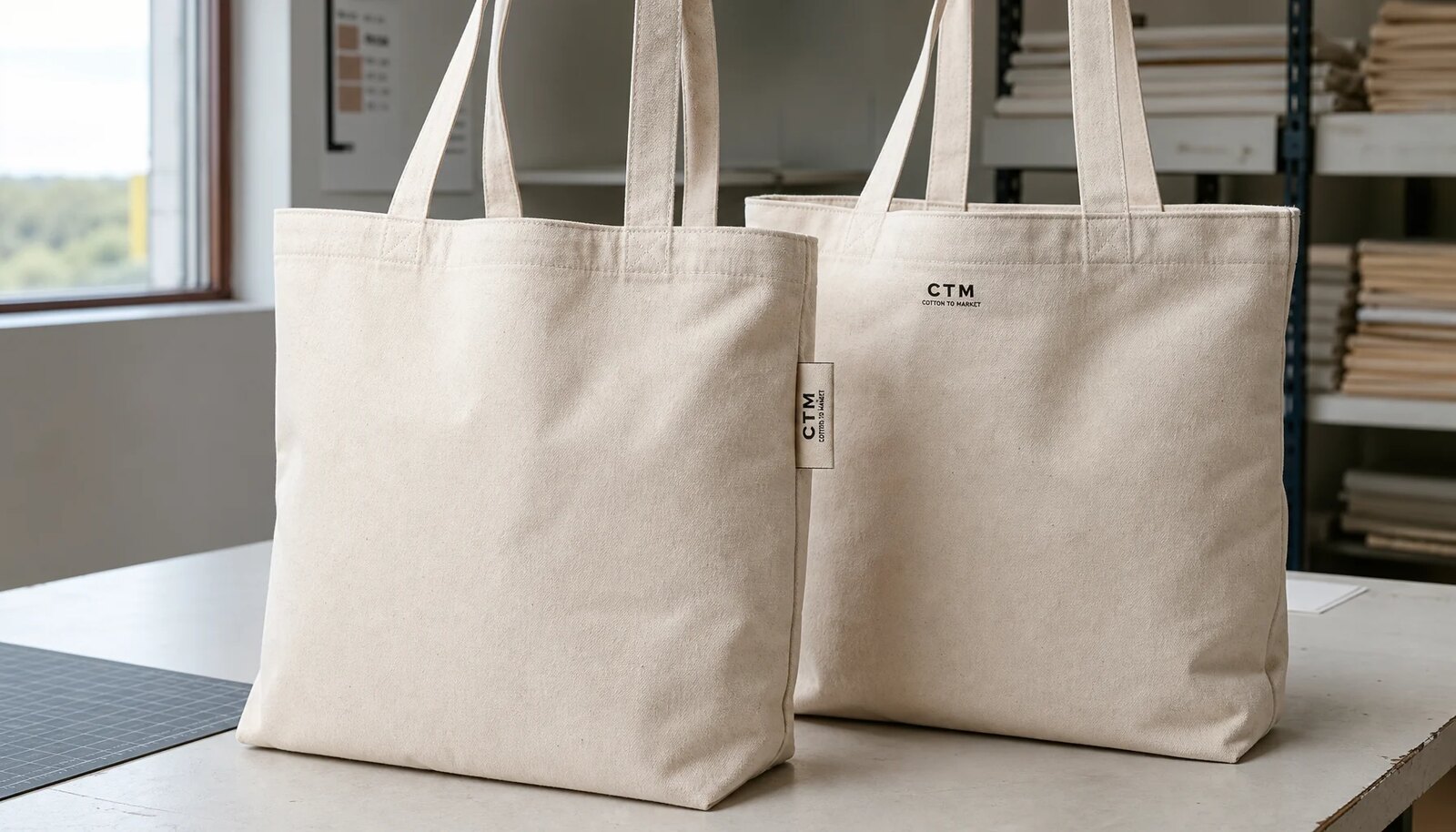
1. Define the commercial job before the tote spec
A canvas grocery tote for an eco apparel brand is not a generic cotton bag. It may be a resale accessory, a gift-with-purchase, a wholesale account giveaway, a trade show item, or a packaging replacement for folded apparel. Each use creates a different procurement target. A resale tote needs consistent finish, clean print, comfort under load, and shelf-ready presentation. A trade show tote may prioritize cost, fast production, and acceptable logo visibility. A packaging replacement may need folding consistency, barcode placement, and low bulk more than heavy structure.
Start the RFQ with a plain commercial sentence: "This tote will be sold at retail for grocery and everyday carry" or "This tote will replace poly mailer presentation for folded apparel at wholesale accounts." That sentence helps the supplier recommend fabric weight, handle drop, packing, and inspection points. Without it, suppliers tend to quote their easiest standard bag, which can make prices look attractive while missing the actual use case.
Also define the expected load and customer behavior. Grocery use often includes bottles, produce, boxed goods, and uneven weight. Apparel retail use may involve lighter loads but higher expectations for appearance. A tote used as a brand touchpoint should not arrive with oil marks, heavy lint, irregular shade, or a handle drop that feels awkward over a coat.
- State the sales channel: retail store, wholesale account, e-commerce insert, event, or market tote.
- State the expected contents and target load, such as light apparel carry or 20 lb grocery use.
- State whether the tote must fold flat, stand on shelf, fit into a carton size, or scan at receiving.
- State whether the brand will make eco claims that require supplier documentation.
2. Lock finished dimensions and handle drop early
Many quote disputes begin with size. A supplier may interpret 15 x 16 in as a flat panel before sewing, while the buyer expects finished size after seams and pressing. For procurement, the spec should define finished width, finished height, gusset depth, handle length, handle drop, handle width, and measurement tolerance. If you include only a photo and an approximate size, two factories may quote different bags while appearing to answer the same RFQ.
Common grocery tote formats include 14 x 15 in for compact retail carry, 15 x 16 in or 16 x 18 in for broader grocery capacity, and a 4 to 6 in bottom gusset when the bag must hold boxed items or stand more easily. A flat tote can be cheaper and easier to pack, but it will not carry bulky groceries as well. A gusseted tote usually improves utility but adds sewing complexity, fabric consumption, and folding decisions.
Handle drop should be approved on a loaded sample. Hand-carry drops often fall around 6 to 8 in. Shoulder-carry drops commonly sit around 10 to 12 in, with longer drops used when the target customer may carry the tote over heavier clothing. A difference of 1 or 2 in can change comfort and perceived quality. For grocery totes, handle width also matters; narrow handles can dig into the shoulder when the bag is full.
- RFQ language: "All dimensions are finished measurements after sewing and pressing."
- Example tolerance: "+/- 0.5 in for body dimensions and +/- 0.25 in for print placement unless otherwise agreed."
- Approve handle drop with weight inside the tote, not from a flat photo.
- For gusseted totes, specify whether the gusset is bottom only or side-and-bottom.
3. Choose canvas weight by function, not by habit
For wholesale canvas grocery totes, 10 oz to 12 oz cotton canvas is a practical buying range for many eco apparel brands. Ten oz can be a balanced option when the tote must look credible but stay price-sensitive. Twelve oz gives more body and confidence under load. Eight oz can work for lightweight promotional bags, but it may feel thin for retail grocery use. Fourteen oz and heavier can create a premium hand feel, but the buyer should expect higher fabric cost, higher carton weight, and sometimes slower sewing.
Ask suppliers to quote in both oz and GSM when possible, and confirm whether the number refers to greige fabric, finished fabric, washed fabric, or dyed fabric. A washed tote may feel softer and more relaxed, but washing can affect shrinkage, shade, and final measurements. Dyed canvas introduces shade-lot control and colorfastness questions. Natural undyed canvas can support a low-ink, low-finish aesthetic, but it can show slubs, seed flecks, and shade variation more visibly.
Procurement teams should compare fabric options with measurable tradeoffs, not only unit price. Heavier canvas can improve presentation and durability, but it increases shipping weight and carton cube. Softer washed canvas may suit apparel brands but can make print edges less crisp depending on artwork and method. Recycled cotton blends may have a different hand feel or shade consistency than conventional cotton. These are manageable issues when specified early.
- Ask: "Is the fabric weight measured before or after washing, dyeing, or finishing?"
- Ask for shrinkage expectations if the tote is washed or if care instructions mention washing.
- Request fabric swatches or shade bands for natural, dyed, recycled, or organic options.
- Compare carton weight and freight impact when moving from 10 oz to 12 oz or 14 oz.
4. Construction is where grocery totes succeed or fail
The center panel of a canvas tote rarely fails first. Failures usually happen at handle anchors, top hems, side seams, bottom seams, and gusset corners. That is why the construction spec deserves the same attention as artwork. A good-looking tote can still disappoint customers if the handle stitching is shallow, the seam allowance is too narrow, or the handle is anchored too close to the edge.
For grocery use, ask for reinforced handles with box-X stitching, bartacks, or a comparable reinforcement method. Stitch density around 8 to 10 stitches per inch is a common practical range, but the final target should match the fabric, thread, and machine setup. Very loose stitching can weaken the seam; overly tight stitching can pucker or cut into the canvas. Request close-up photos of the approved stitch method before bulk cutting begins.
Thread color and seam neatness also affect brand perception. Natural canvas with mismatched thread can look unfinished if the brand expects a clean retail accessory. Side seam symmetry matters when the tote is printed, because a twisted panel makes the logo appear off even if the print was placed correctly. For gusseted bags, inspect whether the bottom opens evenly and whether the tote leans when loaded.
- Specify handle material: self-fabric, cotton webbing, contrast webbing, or folded tape.
- Specify top hem width and whether seams are single-needle, double-needle, overlocked, or bound.
- Require reinforcement photos for handle anchors before production release.
- Include load-test expectation in the PO, not only in email discussion.
5. Match print method to artwork, volume, and tolerance
Screen printing is often the most economical and durable choice for simple one- to three-color logos at repeat volume. It can give strong opacity on natural canvas, but the result depends on mesh, ink, curing, and fabric surface. Digital printing or heat transfer can make sense for short runs, detailed artwork, gradients, or many artwork versions, but buyers should confirm hand feel, fold resistance, and aging behavior. Woven labels or sewn patches are useful when the brand wants low-ink branding or a more apparel-adjacent finish.
Do not ask suppliers only which print method is "best." Ask which method fits your quantity, artwork, color count, reorder plan, and acceptable defect tolerance. For example, a seasonal launch with six small artwork versions may be cheaper operationally with a method that has lower setup complexity, even if the unit price is higher. A core evergreen tote may justify screen setup because the cost is spread across larger reorders.
Print tolerance should be written. Define placement from the top edge and side edge, maximum shift, color reference, and inspection method. A practical placement tolerance might be +/- 0.25 in for a simple front logo, though tighter or looser standards depend on artwork and factory capability. For multi-color screen print, ask how registration will be controlled. For all print methods, include dry rub testing and fold testing around the logo area.
- RFQ language: "Logo print 8 x 6 in, centered on front panel, 4 in below top edge, placement tolerance +/- 0.25 in."
- Ask for Pantone, Lab, or approved physical color standard rather than a screen-viewed color only.
- Confirm whether print is applied before or after sewing, because placement control can differ.
- Check cracking, opacity, edge sharpness, curing, and rub resistance on the sample.
6. Build MOQ and pricing around real order variables
MOQ for canvas grocery totes is usually tied to more than the number of bags. Fabric availability, dye lot, print setup, label version, handle color, packing method, and carton assortment can each create a separate minimum. A supplier may say the MOQ is 1,000 pieces, but that may mean 1,000 per fabric color or per print version. For an apparel brand launching several seasonal designs, that distinction changes inventory risk immediately.
A strong RFQ asks for price breaks at the same volumes from every supplier. For example: 1,000 units, 3,000 units, and 5,000 units, with setup costs, sample costs, packing costs, and optional documentation costs listed separately. This makes the quote easier to compare and helps finance see the true cost of customization. If you are testing demand, ask for a stock natural canvas option and a custom dyed option so the premium is visible.
Landed cost matters more than the headline unit price. A heavier canvas tote may be more profitable if it sells at a higher retail price, but it may also raise freight and storage costs. Individual polybags may help retail presentation but add labor, material, and cube. A lower EXW price may lose its advantage after inland charges, packing inefficiency, inspection failure, or rework. Procurement should evaluate total cost at the expected order quantity, not the best-looking quote line.
- Ask suppliers to show unit price, setup, sample, label, packing, and documentation as separate lines.
- Compare EXW and FOB on the same incoterm before ranking suppliers.
- Do not combine variants in your forecast unless the supplier confirms they can share MOQ.
- Use reorder likelihood to decide whether to invest in custom color, labels, or heavier fabric.
7. Evaluate supplier route and accountability
Direct factories, trading companies, and sourcing partners can all be valid routes for wholesale canvas grocery totes. A direct factory may offer stronger cost control and faster technical answers when the order is repeatable and the buyer has a clear spec. A trading company may be useful when the brand needs multiple product categories consolidated, smaller mixed orders, or more support managing communication. The right route depends on quantity, internal procurement capacity, compliance needs, and how much production visibility the brand requires.
The supplier comparison should include scope of responsibility. Who sources the canvas? Who controls printing? Who performs in-line inspection? Who approves carton marks? Who pays for rework if the print is off tolerance or the handle reinforcement does not match the approved sample? A quote that answers these questions may be more valuable than a lower price with vague accountability.
Use a simple scorecard so the decision is not driven by unit price alone. Suggested criteria include spec understanding, sample accuracy, response speed, documentation quality, MOQ fit, price transparency, inspection process, packing competence, and corrective-action attitude. Weight the categories according to the order. For a first launch, sample accuracy and communication may deserve more weight. For a repeat program, price stability and production discipline may matter more.
- Score suppliers on quote completeness, not only quoted price.
- Ask who owns the print process if printing is subcontracted.
- Request a sample QC report format before placing the PO.
- Require written corrective action terms for failed inspection or wrong packing.
8. Treat eco claims as a documentation workflow
Eco apparel brands often want canvas grocery totes because they visually align with reusable, lower-plastic retail habits. That positioning can be useful, but it also creates claim risk. Natural cotton, recycled cotton, organic cotton, undyed canvas, reduced-plastic packing, and low-impact dyeing are different claims. They require different evidence. A tote should not be marketed as organic or recycled unless the supplier can provide documentation that supports that exact claim and transaction scope.
Procurement should ask what documentation is available before artwork, hangtags, and product pages are written. For organic cotton, confirm whether the certification applies to the material, the finished product, or the facility process, and whether transaction documentation is available. For recycled cotton, ask for composition, blend percentage, and certification or supplier declaration support. For undyed natural canvas, avoid implying chemical-free production unless the supplier can support the statement. For reduced polybag packing, document the packing method rather than making broad environmental claims.
Dye choices also deserve attention. Custom dyed canvas can strengthen brand color consistency, but it adds MOQ, shade-lot control, possible colorfastness testing, and lead time. Natural canvas avoids dye matching but may vary from lot to lot. Washed finishes can create a softer apparel feel but may introduce shade variation and shrinkage. The best eco route is the one the brand can document accurately and receive consistently.
- Separate material claims from packing claims and printing claims.
- Ask for composition documents before approving sustainability copy.
- Confirm whether hangtags or labels make claims that require certification support.
- Keep supplier documentation with the PO, approved sample, and inspection report.
9. Samples need approval gates, not casual sign-off
A sample should prove the tote, not only the logo. Review fabric hand feel, finished size, handle comfort, gusset behavior, seam quality, print placement, odor, lint, folding method, and carton presentation. Load the sample with realistic weight and carry it the way customers will carry it. A tote that looks acceptable flat on a desk may twist, sag, or dig into the shoulder when filled.
Use approval gates when the order has meaningful customization. A proto sample confirms size and construction. A pre-production sample confirms final fabric, trim, print, and finishing. A sealed production reference sample becomes the standard for bulk inspection. For custom color, special wash, organic or recycled material, contrast handles, or multiple artwork versions, the pre-production sample should be signed and dated by both buyer and supplier.
Do not approve a photo alone unless the risk is low and the specification is already proven. Photos can help confirm layout, but they cannot prove fabric weight, odor, handle comfort, stitch tension, or print hand feel. If timing forces photo approval for a repeat order, reference the previous sealed sample and list the exact areas that must remain unchanged. Good sample discipline reduces disputes because the buyer and supplier are comparing production to the same physical standard.
- Sample gate 1: construction and size approval.
- Sample gate 2: final material, print, trim, and packing approval.
- Sample gate 3: sealed production reference before bulk release.
- Keep one approved sample with procurement and one with the supplier production team.
10. Inspection, packing, and lead time protect the margin
Final QC should be more specific than "check quality." Define defect categories before production. Critical defects can include mold, wrong material, broken handle, unsafe contamination, or a completely wrong logo. Major defects can include open seams, wrong size outside tolerance, handle reinforcement missing, severe print misplacement, heavy stains, strong odor, or wrong carton assortment. Minor defects can include small loose threads, slight shade variation within the approved band, or small marks in non-prominent areas. The exact list should match your product and sales channel.
Sampling should also be defined. Many buyers use AQL-based inspection or an equivalent sampling plan, but the PO must state the levels and acceptance rules. Measurement checks should include finished body size, gusset, handle drop, handle width, print placement, and carton count. Print checks should include color, opacity, registration, curing, dry rub, and fold behavior. Stitching checks should focus on handle anchors, top hem, side seams, bottom seam, skipped stitches, broken thread, and loose ends. A simple load test on sampled units can reveal handle or seam weakness before shipment.
Packing and lead time deserve the same discipline. Confirm pieces per carton, carton dimensions, gross weight, fold method, barcode placement, carton marks, and whether master cartons are strong enough for export handling. Bulk packing 50 to 100 pieces per carton may work for many wholesale programs, but the final count depends on tote size, fabric weight, fold, and receiving requirements. For lead time, ask for a calendar by phase: sample, material reservation, dye or wash if any, cutting, sewing, print, finishing, inspection, and dispatch. That stage-by-stage view makes risk visible before the launch date is threatened.
- Inspection language: "Bulk must match signed sample for fabric, construction, print, label, fold, and packing."
- Packing language: "Carton marks must match PO, SKU, color, quantity, destination, and barcode requirements."
- Lead time language: "Supplier must confirm material availability before production schedule is accepted."
- Payment release should be tied to document review and agreed inspection outcome when order risk is material.
Specification comparison for buyers
| Spec decision | Recommended buying range | When it fits | Buyer risk to check |
|---|---|---|---|
| Finished tote size | Common grocery formats: 14 x 15 in, 15 x 16 in, 16 x 18 in, with 4 to 6 in bottom gusset when more volume is needed | Retail grocery tote, apparel add-on, farmers market tote, or reusable shopping bag where capacity matters | Suppliers may quote flat panel size before sewing; require finished measurements after sewing with tolerance such as +/- 0.5 in |
| Fabric weight | 10 oz to 12 oz cotton canvas for most retail grocery totes; 8 oz only for lightweight promo use; 14 oz for heavier premium positioning | Eco apparel brands needing a sturdy hand feel, better shelf presentation, and repeated use | Too-light canvas can sag, twist at seams, or feel promotional; confirm GSM/oz and whether weight is measured before or after washing |
| Handle drop | Hand-carry: 6 to 8 in drop; shoulder carry: 10 to 12 in drop; long shoulder carry may need 12 to 14 in depending on market preference | Shoulder handles for grocery use and urban retail customers; shorter handles for compact gift packaging | Short handles reduce comfort and can raise returns; approve handle drop on a loaded sample, not an empty flat sample |
| Handle reinforcement | Box stitch with X, bartack, or reinforced cross-stitch at stress points; handle width commonly 1 to 1.25 in for comfort | Any tote expected to carry groceries, books, bottles, or folded apparel repeatedly | Single row stitching, narrow handles, or anchors too close to the edge can fail early; request seam photos and load-test target |
| Stitch density | Typically 8 to 10 stitches per inch for balanced strength and appearance, adjusted by fabric and thread | Retail-facing totes where neat seams and durability both matter | Loose stitch density can weaken seams; overly tight stitching can pucker canvas or cut fabric under load |
| Print method | Screen print for 1 to 3 colors and repeat volume; digital/transfer for short runs or detailed art; woven label for minimal branding | Clear logo graphics, multiple SKU launches, gift-with-purchase programs, or premium low-ink brand presentation | Misregistration, cracking, poor opacity, or color drift; set placement tolerance, color standard, curing method, and rub-test expectations |
| Eco material route | Conventional cotton canvas, recycled cotton blend, or organic cotton when documentation supports the claim | Brands making sustainability claims on product pages, hangtags, or wholesale line sheets | Do not market unsupported claims; request composition, certification scope, transaction documents when applicable, and approved claim wording |
| MOQ structure | Separate MOQ by fabric, color, print version, trim, and packing method; compare at 1,000 / 3,000 / 5,000 units when relevant | Brands testing one hero tote or scaling multiple seasonal artwork versions | One combined MOQ can hide per-color or per-print minimums; ask suppliers to quote each variant as its own line item |
| Packing method | Bulk pack 50 to 100 pcs per carton for many wholesale programs; individual polybags only when retail or fulfillment requires them | Wholesale distribution, DC receiving, e-commerce replenishment, or retail display preparation | Carton cube, dust, folding consistency, barcode placement, and over-packing affect landed cost and warehouse claims |
Buyer checklist before sampling
- Write the end use in the RFQ: grocery resale, gift-with-purchase, trade show giveaway, apparel packaging replacement, or retail add-on.
- Specify finished dimensions after sewing: width, height, gusset depth, handle length, handle drop, handle width, and tolerance.
- State fabric composition and target weight in oz and/or GSM, including whether the weight is greige, washed, dyed, or finished.
- Define construction: seam type, top hem width, bottom gusset, handle reinforcement method, stitch density target, thread color, and seam allowance.
- Set a realistic load expectation, such as 15 lb for light retail use or 20 to 25 lb for grocery use, then ask how the supplier will verify it.
- Attach artwork with print size, placement from top edge/side edge, number of colors, Pantone or Lab reference, print method preference, and tolerance.
- Separate MOQ by SKU, body color, handle color, print version, label version, hangtag, and packing method.
- Ask for price breaks at the same quantities from every supplier, such as 1,000 / 3,000 / 5,000 units, with setup charges shown separately.
- Request sample stages: proto sample if the design is new, pre-production sample using final materials, and sealed production reference before bulk release.
- Confirm eco documentation before marketing the tote as recycled, organic, low-impact dyed, undyed, or plastic-free packed.
Factory quote questions to send
- Please quote the tote using these finished dimensions: width, height, gusset depth, handle length, handle drop, and handle width. Confirm the measurement tolerance after sewing and pressing.
- What is the fabric composition, weave, finished weight in oz/GSM, shrinkage range if washed, and whether the weight is measured before or after dyeing, washing, or finishing?
- Can you quote conventional cotton canvas, recycled cotton blend, and organic cotton options separately, including what documentation is available for each route?
- For the same design, please quote 10 oz, 12 oz, and 14 oz canvas so we can compare unit price, carton weight, and expected hand feel.
- Which handle reinforcement will you use: box-X, bartack, cross stitch, or another method? Please include stitch density target and close-up seam photos from similar production.
- What load test can you perform on a finished tote, at what weight, for how long, and how will results be documented before shipment?
- For our artwork, which print method do you recommend and why? Please list setup cost, color limit, curing method, placement tolerance, and price difference by method.
- What is your MOQ by fabric color, handle color, print version, label version, and carton assortment? Please quote price breaks at 1,000, 3,000, and 5,000 units.
- Please list all included and optional packing items: hangtag, barcode sticker, tissue, inner polybag, paper band, master carton, carton mark, and any added labor charge.
- What are the net weight, gross weight, carton dimensions, and pieces per carton for each fabric weight option? If unknown, please provide a packing estimate before sample approval.
Quality-control points to confirm
- Approved reference: keep a signed golden sample showing final fabric, finished size, handle drop, stitch method, print color, print placement, label, fold, and packing.
- Fabric: verify composition, canvas weight in oz/GSM, shade consistency, weave defects, slubs beyond agreed standard, shrinkage notes, and whether washed or dyed lots match the approved shade band.
- Measurement: measure finished width, height, gusset, handle length, handle drop, handle width, and print placement on sampled pieces; common tolerance is +/- 0.5 in for body dimensions unless the PO sets tighter rules.
- Stitching: inspect top hem, side seam, bottom seam, handle anchors, bartacks or box-X stitching, skipped stitches, broken thread, loose ends, and seam symmetry.
- Stitch density: check stitches per inch against the approved sample or PO target, especially at handle anchors and top hem where load stress concentrates.
- Load and seam strength: test a sampled finished tote with the agreed weight, such as 20 lb for grocery use, held or cycled for a defined time; record seam distortion, handle pullout, and fabric tearing.
- Print: check Pantone or approved color standard, opacity, edge sharpness, registration, curing, cracking after folding, dry rub, light wet rub when applicable, and placement tolerance such as +/- 0.25 in.
- Cleanliness and odor: reject visible oil stains, heavy dust, mold smell, chemical odor, transfer marks, dirty fold lines, and front-panel defects that affect retail presentation.
- Defect classification: define critical defects such as mold, wrong material, broken handle, unsafe sharp object; major defects such as wrong size, print misplacement, open seam, heavy stain; minor defects such as small loose thread or slight shade variation within standard.
- Sampling plan: use an agreed AQL or equivalent sampling method before shipment, commonly tighter for critical defects and practical limits for major/minor defects; document exact levels in the PO instead of relying on factory habit.