1. Start with the job the bag has to do
A wholesale canvas bag should be specified like a small production item, not like a generic promotional giveaway. The right fabric, seam build, and decoration method depend on what the bag will carry, where it will be sold, and what failure looks like. A tote used for books or apparel has a different stress pattern than one used for groceries, trade show kits, or mailer inserts. If the use case is vague, the supplier will fill in the gaps with its own assumptions, and those assumptions are usually optimized for the factory's convenience rather than your channel requirements.
The first page of the RFQ should define the use case in plain language, then translate it into measurable requirements. Tell the supplier whether the bag is for retail resale, internal distribution, e-commerce inserts, event handouts, or repeat institutional use. Then state the target load, the expected carry duration, the acceptable look level, and whether the program is one-time or recurring. A buyer who does this well gets quotes that are closer to comparable, sample approvals that are faster, and fewer post-award surprises around price or quality.
2. Specify fabric weight with enough precision to compare quotes
Fabric weight is one of the most common sources of confusion in canvas tote sourcing because suppliers do not always use the same measurement language. Some quote in ounces per square yard, others in GSM, and some simply say heavy canvas or premium canvas without a usable number. For procurement, the rule is simple: if the quote does not name a measurable fabric weight, the quote is incomplete. As a practical buying range, many programs sit around 8 oz to 14 oz, but that range is only a starting point and not a substitute for a written spec. A lighter tote can still be durable if the weave is tight and the seams are well made. A heavier tote can still disappoint if the yarn is inconsistent or the finishing creates too much stiffness.
Treat the weight number as one data point, not the entire answer. Ask whether the weight is measured before washing, after finishing, or on greige fabric. Ask whether the supplier pre-shrinks the cloth, because a bag that looks right in the sample room can change after decoration or customer washing. If you are comparing suppliers across regions, normalize the basis of measurement first, then compare the actual sample hand feel, fabric opacity, and stitch performance. Heavy canvas is not automatically better. The correct weight is the one that supports the load, print method, shelf presentation, and target landed cost without adding unnecessary cost or bulk.
3. Construction details decide whether the bag feels cheap or dependable
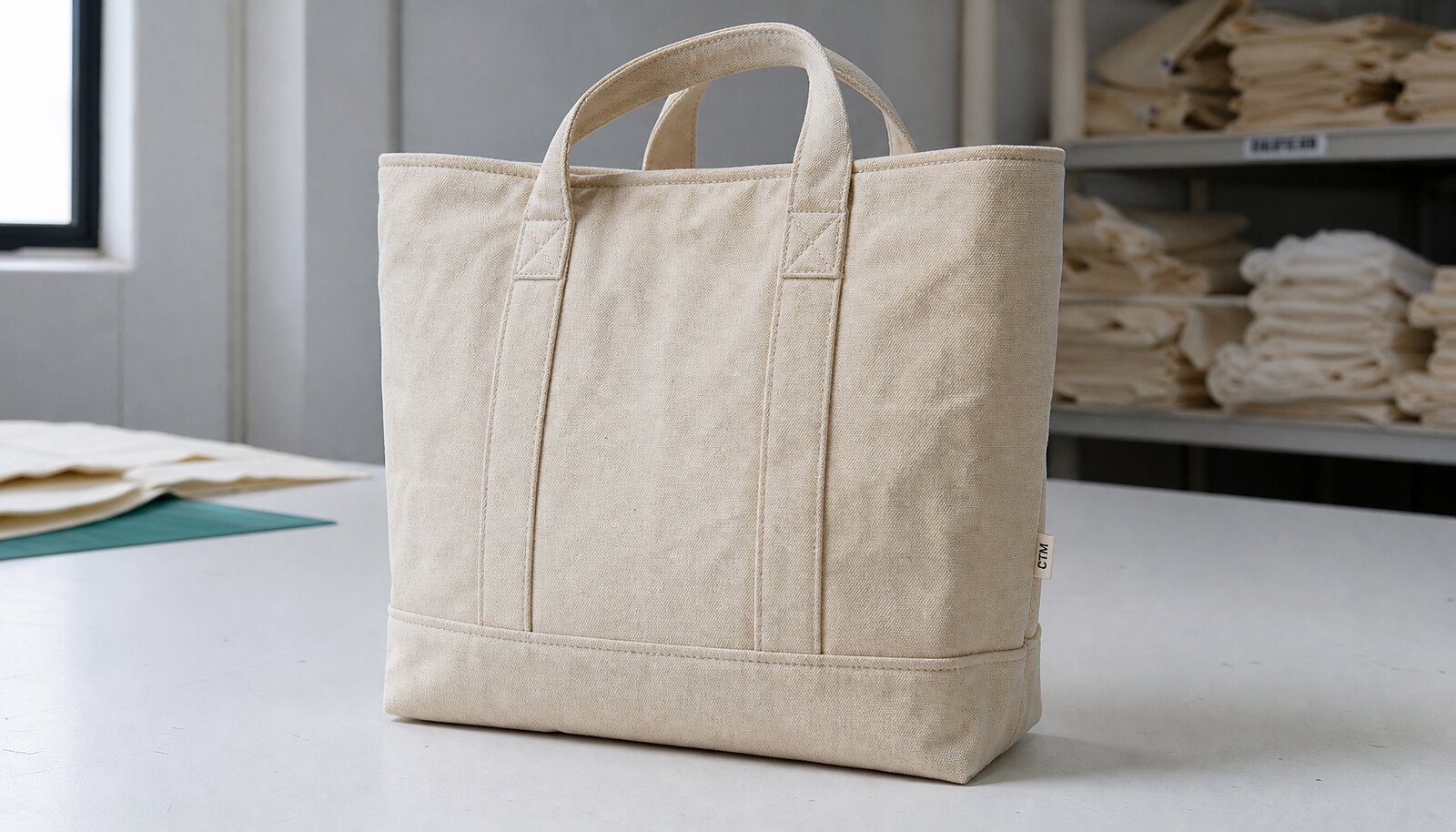
Two bags with the same fabric weight can perform very differently if the cut, stitch, and reinforcement are not equivalent. Construction details that procurement teams should insist on include handle width, handle drop, seam allowance, stitch density, bottom reinforcement, gusset depth, and whether the edges are hemmed, bound, or raw. A handle that is too narrow may feel weak even if the fabric is strong. A seam that looks neat in photos may still fail if the reinforcement at the stress points is too small. For retail programs, the visual consistency of the stitch line matters as much as the strength itself because customers notice crooked handles, puckering, or asymmetric panels very quickly.
If the bag is intended for heavier loads, the buyer should ask for explicit reinforcement at the handle anchors and bottom seam. If the bag is intended for premium retail, the buyer should also specify how the bag should sit when empty, whether it should have a structured base, and how much slouch is acceptable. Do not rely on verbal descriptions like sturdy or premium. Put the construction in a measured sketch and ask the factory to confirm each dimension in writing. That is the difference between a quote that is commercially usable and one that is only visually persuasive.
4. Choose the sourcing model that matches your control needs
Supplier type changes the commercial risk profile as much as price does. A direct cut-and-sew factory usually gives the best control over bag dimensions, stitch details, and repeatability, but only if the factory truly owns production and not just the paper trail. A trading company can be helpful when the buyer needs one contact for multiple styles or mixed packaging, but it introduces another margin layer and another handoff in the QC chain. A domestic decorator can win on turnaround, but may have fewer fabric options and less visibility into the base bag origin. A stock distributor is useful when the deadline matters more than tailoring the spec, but the buyer should expect less control over exact construction and reordering continuity.
Region and factory type also matter. In China, buyers often find deeper cut-and-sew ecosystems and more decoration options, but they need stronger diligence on factory ownership, subcontracting, and packing discipline. In India, buyers may find competitive cotton sourcing and flexible woven-bag capability, but they should verify wash behavior, color consistency, and lead-time realism. In Vietnam and Turkey, the advantage is often in shorter logistics chains to certain markets and a stronger fit for buyers who care about responsiveness and compliance visibility. In Mexico or the U.S., local conversion can help with speed and lower transit risk, but unit cost usually rises sharply. None of these regions is inherently better. The right question is which supplier model gives you the best balance of control, compliance, and landed cost for the specific program.
5. Write the RFQ so every quote is structurally comparable
A weak RFQ creates fake price differences. One supplier quotes a 10 oz bag with bulk packing, another quotes a 12 oz bag with individual polybags, and a third includes only the body bag without decoration or cartons. The unit prices are not comparable because the scope is not the same. A usable RFQ for a wholesale canvas bag should include the technical drawing, fabric weight, fiber content, decoration method, artwork placement, carton pack, destination, and Incoterm. It should also note whether sample charges are credited against bulk, because that changes the real commercial picture. Without those items, procurement ends up comparing a number that looks precise but is actually incomplete.
To make the pricing useful, ask for a line-by-line quote. Separate blank bag price, print or embroidery setup, per-color charge, label application, packaging cost, sample cost, and freight terms. Ask for exclusions in writing so the supplier cannot later say that a hangtag, carton marking, or master carton test was never included. Also ask the supplier to state whether the order can overrun or underrun and by what percentage. That detail matters when the final count affects promotion commitments, store rollout timing, or fulfillment allocations. A disciplined RFQ is not bureaucratic; it is the simplest way to avoid paying for ambiguity.
6. Decoration choice should follow the art, not the habit
Canvas bags are often decorated with screen print, digital print, embroidery, patches, woven labels, heat transfer, or a combination of methods. The right choice depends on artwork complexity, order quantity, channel, and durability expectations. Screen print is usually the commercial default for large, simple graphics because setup becomes efficient at volume. Digital print is better for multicolor art, gradients, and low-volume runs, but it can behave differently on textured canvas than on a smooth substrate. Embroidery can elevate a premium tote, but it is not the right answer for very small text, very fine detail, or large filled areas. A sewn patch or woven label may be the better choice when the buyer wants a cleaner appearance and lower risk of ink variation.
The key sourcing mistake is deciding on decoration after price comparison. That reverses the actual cost drivers. A complex logo may need more setup time, a different base fabric, or an enlarged print area. A dark bag may need a different underbase or ink system to keep the logo legible. Ask the supplier how the decoration method affects lead time, proof cycles, and rework risk. If color accuracy is commercially important, require a physical strike-off or print approval sample before bulk. If decoration is secondary and the bag itself is the hero, it may be cheaper and safer to keep branding minimal and invest in better fabric and construction instead.
7. Testing and compliance should be requested, not assumed
Procurement depth improves when testing and compliance are written into the buying process instead of being treated as a post-hoc reassurance. For a wholesale canvas bag, the useful question is not whether a supplier can say compliant, but which standard or test report they can actually provide. Depending on the market, that may include OEKO-TEX Standard 100 for textile safety, GRS or RCS for recycled content claims, REACH-related chemical restrictions for the EU market, or CPSIA and California Proposition 65 considerations for U.S. retail programs. If the bag is marketed as organic cotton, the buyer should ask for the appropriate certification chain and scope. If the supplier cannot provide the paper trail, the claim should not be built into the product brief.
Testing should also match the bag's job. Ask for colorfastness, rub resistance, dimensional stability, seam strength, and load testing when the channel or use case makes them relevant. Do not request every test under the sun just to look strict. That creates cost without clarity. Request the tests that reflect likely failure points and customer exposure. If the bag will be shipped to retailers, ask whether the supplier has an internal QC process for metal contamination, oil marks, and trim consistency. If the bag is intended for food-adjacent use, ask the buyer's compliance team whether any restricted substances or labeling issues apply. In short: build compliance into the RFQ, and ask for documentation that is specific enough to audit.
8. Sampling should prove both construction and repeatability
A sample is not only a visual approval. It is the point where the buyer can confirm whether the factory understood the spec, whether the chosen fabric behaves as expected, and whether the production method can be repeated at scale. For a wholesale canvas bag, one blank sample is usually the minimum starting point, followed by a decorated pre-production sample if the branding matters. If the bag has a special finish, lining, inner pocket, or complex label sequence, the sample stage should also confirm the assembly order. A bag can look close enough in a photo and still fail in the hand because the handles sit too high, the gusset collapses badly, or the print area is too close to a seam.
The review method should be structured. Compare the sample against the dimensioned drawing and the approved construction notes, then record any deviation before the sample is signed off. Measure the body size, handle length, handle drop, and gusset depth. Check how the bag folds and packs. If the artwork has small type, inspect it at the intended viewing distance rather than on a close-up photo only. If the buyer approves a sample with unresolved deviations, those deviations often reappear in bulk because the factory treats the approved sample as the final standard. That is why the golden sample matters more than the email thread.
9. QC needs clear defect rules and a realistic inspection plan
Quality control becomes more useful when the buyer defines what failure looks like in measurable terms. For canvas bags, the common issues are inconsistent size, crooked handles, skipped stitches, weak reinforcement, staining, shade variation, print misalignment, and packaging errors. A practical inspection plan should separate critical, major, and minor defects and should state the acceptance rule before production begins. It is better to reject a clearly defined defect than to argue after shipment about what looked acceptable in the sample room. If the bag is going into retail, the visual standard is usually tighter than for a campaign giveaway, and that difference should be reflected in the acceptance criteria.
The QC plan should include both in-process and final inspection. In-process checks catch cutting or sewing drift before a large batch is affected. Final inspection verifies the packed goods, not just the unfinished bag. For larger programs, an AQL-based plan can work well if the buyer and supplier agree on the lot size and defect definitions in advance. The buyer should also specify a practical load test. That does not have to be a laboratory exercise for every program, but it should match the use case and be reproducible. For example, a tote intended for bottles should be evaluated differently from one used for apparel or event collateral. The goal is not to over-engineer the bag. The goal is to make sure the factory knows what it has to hit.
10. Landed cost and Incoterms are where many buying decisions get distorted
A good quote is not just a unit price. The landed cost of a wholesale canvas bag can shift materially based on packing density, carton dimensions, freight mode, and the chosen Incoterm. EXW puts more logistics responsibility on the buyer and can make a low factory quote look attractive while hiding the real handling cost. FOB is often easier to compare because the supplier usually delivers to the port and clears export formalities, but the buyer still needs to model ocean or air freight, customs handling, destination charges, and domestic transport. CIF or DDP can simplify comparisons in some cases, but only if the supplier's assumptions are transparent enough to audit. If the seller will not show carton weight, carton volume, or packing count, the buyer cannot build a real landed-cost model.
Packing choices also move the number. Individually polybagged bags cost more and take more space than bulk-packed bags, but they may be necessary for retail or premium gifting. A nested bag layout can reduce carton volume, while a belly band or simple insert can support shelf presentation without full retail packaging cost. Ask the supplier to quote at least one realistic pack-out option that matches the channel, then compare the total landed cost per sellable unit rather than the invoice price alone. That is the level where procurement decisions become defensible. A slightly higher ex-factory price can still win if it reduces freight, shrinkage, and rework after receipt.
Specification comparison for buyers
| Spec decision | Recommended option | When it fits | Buyer risk to check |
|---|---|---|---|
| Direct cut-and-sew factory | Use when the bag spec is custom and repeatable: size, handle length, gusset, reinforcement, and fabric weight all matter. | Best for branded retail, uniform programs, and annual reorders where the same construction must hold over time. | Confirm the supplier actually owns cutting, sewing, printing, and packing; some factories outsource decoration or QC and only act as a pass-through. |
| Trading company / sourcing agent | Use when you need one commercial contact for multiple SKUs, mixed packaging, or broader sourcing support. | Useful for smaller runs, multi-item programs, or buyers without in-country sourcing staff. | Check margin layering, who owns the factory relationship, who approves final samples, and who is accountable if QC fails. |
| Regional decorator or local printer | Use when the bag body is standard and the main need is fast decoration or short lead time. | Fits launch tests, event programs, and lower-volume retail pilots. | Watch for limited fabric options, less control over seam construction, and weaker visibility into upstream fabric origin. |
| Stock bag distributor | Use when speed matters more than custom construction and the buyer can accept a standard shape and color. | Good for giveaways, emergency replenishment, and programs with simple logo application. | Verify stock lot consistency, available decoration area, and whether the same base bag will still be available on the next reorder. |
| Overseas OEM/ODM with decoration | Use when the supplier offers an established base pattern and can adapt details without full development from zero. | Suitable for buyers who need speed, but still want a tailored handle, label, or packaging choice. | Clarify which parts are fixed, which are negotiable, and whether the sample you approve is the exact construction that will ship. |
| Hybrid sourcing split | Source blank bags from one supplier and decoration or final pack-out from another when the program benefits from separate control. | Works when the bag spec is sensitive but decoration is better handled near the destination market. | Check shrinkage, print registration, transfer risk, and which supplier owns rework if the finished bag no longer matches spec. |
| Fabric mill plus cut-and-sew factory | Use when fabric continuity, shade continuity, or heavy annual volume justify managing the upstream textile source. | Best for large retail programs and buyers who need stable reorders across seasons. | Expect longer lead time, fabric reservation risk, and stricter minimums around weave, dye lot, or finish changes. |
| Marketplace lead generation | Use only for pricing discovery or to build a supplier longlist, not as the final sourcing decision. | Helpful at the first stage when the team needs a quick read on the market. | Do not compare marketplace quotes with factory quotes unless the GSM, construction, packing, and Incoterm are explicitly normalized. |
Buyer checklist before sampling
- Define the end use first: retail, grocery, event, gift, training kit, or mailer insert. The use case determines fabric weight, seam build, and pack-out.
- Specify fabric as GSM and, if helpful, oz, but do not use the word canvas alone.
- State whether the canvas is cotton, recycled cotton, cotton-poly blend, or another construction, and ask whether the fabric is greige, bleached, dyed, or finished.
- Lock the bag size with a dimensioned sketch that shows body width, height, gusset, handle length, and handle drop.
- Choose the decoration method before you request quotes, because screen, digital, embroidery, patch, and label options change cost and lead time.
- Ask for sample types separately: blank sample, decorated sample, pre-production sample, and production reference sample if the supplier uses one.
- Request carton dimensions, gross weight, inner pack count, and whether the bags will be polybagged, bulk packed, belly-banded, or nested.
- Compare MOQ by size, color, fabric weight, and print color count, not just total order volume.
- Set acceptance tolerances for body size, handle length, print placement, seam quality, stain rate, and shade variation.
- Confirm whether the supplier accepts an AQL plan, and define which defects are critical, major, and minor before bulk production starts.
Factory quote questions to send
- What is the exact fabric weight in GSM and oz, and is it measured before or after finishing, washing, or coating?
- Is the canvas 100% cotton, recycled cotton, cotton-poly blend, or another construction, and can you share the yarn count or weave description if available?
- What is the MOQ by bag style, fabric color, print color count, and decoration method?
- Can you provide a blank sample, a decorated sample, and a pre-production sample before bulk runs?
- Which decoration methods are available on this bag, and what changes in cost, setup, or lead time for each method?
- What are the handle width, handle length, handle drop, seam reinforcement, and stitch density included in the quote?
- How are the bags packed per inner pack and per carton, and what are the carton dimensions and gross weight?
- What is the expected shrinkage range, and is the fabric pre-shrunk or washed before cutting?
- Which Incoterms do you quote, and what is included in EXW, FOB, CIF, or DDP pricing?
- What overrun or shortage tolerance do you apply, and how do you handle rejected units after final inspection?
Quality-control points to confirm
- Verify the fabric weight against the approved spec and note whether the measurement is pre-finish or finished fabric.
- Check weave density, yarn consistency, hand feel, and visible defects such as holes, slubs, stains, oil marks, broken yarns, or shade bands.
- Measure body width, height, gusset, handle length, and handle drop against the approved drawing with a practical tolerance band.
- Inspect seam construction at the handle anchor points, side seams, and bottom seams for skipped stitches, loose thread, uneven backstitching, or weak reinforcement.
- Confirm stitch density and reinforcement method match the approved sample, especially where the handle joins the body.
- Review print registration, opacity, edge sharpness, color match, and rub resistance when the artwork or channel makes that relevant.
- Verify label position, label quality, care label content, and any barcode or retail hangtag placement.
- Check that the packed cartons match the approved pack count, inner packaging, carton markings, and gross weight.
- Run a load test that reflects the actual use case, not a generic strength claim; document the pass/fail method before production starts.
- Inspect odor, lint, dust, and surface contamination if the bags will go to retail shelves or premium gifting channels.