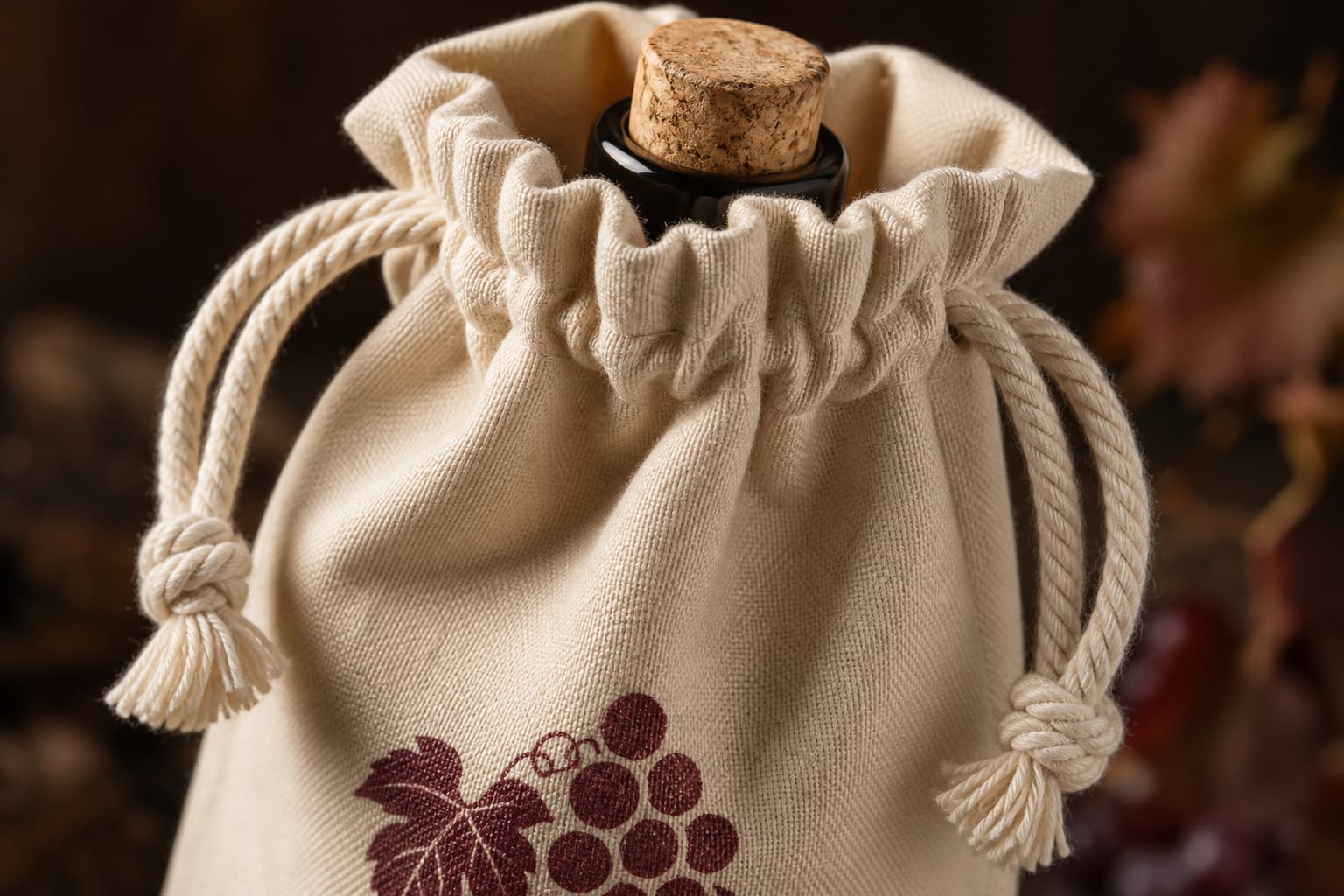
The Buying Problem: Same Logo, Very Different Bottle Bags
When buyers request wholesale bottle bags for corporate gifts, many RFQs only say cotton wine bag, jute bottle bag, or custom bottle carrier with logo. That is not enough for a reliable comparison. Two suppliers can quote the same quantity and logo but include different fabric weight, handle construction, seam reinforcement, packing, and print quality.
The main procurement risk is approving a price before the bag is defined. A bottle bag is a small product, but it carries a heavy item and is often handed directly to employees, VIP guests, distributors, or retail customers. If the bag looks thin, the logo cracks, or the bottle does not fit smoothly, the claim will be visible immediately.
- Use actual bottle dimensions rather than a general wine bottle description.
- Define fabric weight and handle type before comparing unit prices.
- Ask suppliers to separate product cost from printing, packing, and setup charges.
- Approve a real sample with the same fabric and print method planned for bulk.
Start the RFQ With the Bottle, Not the Bag
A correct bottle bag specification starts with the product going inside. Wine, champagne, spirits, olive oil, sparkling water, sauces, and premium coffee syrups all have different diameters, shoulder shapes, cap heights, and filled weights. A bag that fits a standard 750 ml wine bottle may be tight for champagne or unstable for a short wide bottle.
For corporate gifts, also confirm whether the bottle will be inserted at the factory, by a fulfillment warehouse, by a distributor, or by the buyer's own team. A tight drawstring bag may look neat, but it slows down packing if thousands of bottles must be inserted quickly.
- Provide bottle height, base diameter, widest shoulder diameter, cap or cork height, and filled weight.
- State whether the bag must stand upright when filled.
- Confirm whether tissue paper, gift card, hangtag, or retail label will be added.
- Ask the factory to test with a dummy bottle if the real bottle cannot be shipped.
Fabric Weight and Structure for Corporate Gift Positioning
Fabric choice is where many quote gaps appear. For cotton bottle bags, 180-220 GSM plain cotton works for light drawstring gift covers, while 8 oz to 10 oz cotton canvas gives a stronger reusable feel. For jute bottle bags, 260-320 GSM is common for structured corporate gifting, with laminated jute giving more body and unlaminated jute giving a softer natural handfeel.
Do not specify only eco-friendly bag or natural fabric. Those words do not tell the factory how the bag should perform. A procurement RFQ should name the fabric type, fabric weight, color, lining requirement, and whether the buyer accepts natural slubs, shade variation, and weave irregularity.
- Use 180-220 GSM cotton for economical drawstring bottle sleeves.
- Use 8 oz to 10 oz canvas when the bag needs a retail or premium reusable feel.
- Use 260-320 GSM jute when structure and natural texture are more important than fine logo detail.
- Request dyed fabric lab dips if brand color matching is required.
Logo Printing: Choose the Method Before Asking for MOQ
Corporate gift bottle bags usually carry a company logo, event mark, campaign message, or distributor branding. The print method affects MOQ, setup cost, artwork limitations, and sampling time. Screen printing is usually the most practical option for solid logos and medium to large runs. Heat transfer is better for small details, gradients, or multi-color artwork, but the handfeel and durability must be checked. Woven labels or sewn side labels are useful when the logo is small or when the bag fabric is too rough for clean printing.
For jute and coarse canvas, fine text and small icons are a common problem. The fabric surface breaks the edge of the print. If the buyer's logo has a small tagline, the RFQ should ask the factory to confirm the minimum readable letter height on the selected fabric.
- Screen print: best for solid Pantone logos and controlled cost.
- Heat transfer: useful for detailed logos but needs adhesion and handfeel approval.
- Embroidery: premium look, but not ideal for very thin cotton or tiny lettering.
- Woven label: stable for small branding and repeat programs across bag styles.
MOQ Logic: What Actually Drives the Minimum Order
MOQ for wholesale bottle bags for corporate gifts is not only about sewing quantity. It may be driven by fabric dyeing, stock fabric availability, printing setup, handle webbing color, cord color, label production, or individual packing. A supplier may accept a lower quantity for natural cotton with one-color print but require a higher MOQ for custom dyed canvas or multi-color heat transfer.
Procurement teams should ask what part of the specification controls the MOQ. This helps buyers adjust intelligently instead of only pushing for a lower number. For example, using stock natural cotton with a woven label may reduce MOQ compared with custom dyed fabric and three-color screen print.
- Stock natural fabric usually gives more flexible MOQ than custom dyed fabric.
- One-color screen print is simpler than multi-color registration on textured material.
- Custom cord, webbing, zipper, or label color can raise the minimum even if bag sewing is simple.
- Individual polybags, barcode labels, and retail-ready packing can add labor and MOQ constraints.
Sample Approval: What to Check Before Bulk Production
A digital layout is not enough for bottle bags because fabric thickness, seam allowance, drawstring channel height, and logo behavior all affect the final result. The pre-production sample should use the intended bulk fabric, actual print method, actual cord or handle, and correct packing fold if possible.
The buyer should place the real bottle inside the sample and close or carry the bag as the end user will. If the bottle neck sticks out too much, the drawstring does not close, or the handle feels narrow under weight, revise the sample before bulk production. Small corrections are cheaper before cutting fabric.
- Check internal fit with the actual bottle and any added insert or gift card.
- Measure finished width, gusset, height, handle drop, and drawstring length.
- Rub the printed logo lightly after curing to check surface stability.
- Review stitching density and reinforcement at the bottom and handle areas.
- Confirm whether the approved sample is kept by the factory as the production standard.
Packing and Export Cartons Affect Arrival Quality
Bottle bags are often judged by appearance when unpacked for gifting. Poor packing can create creases, ink transfer, moisture odor, crushed handles, or mixed SKU problems. For cotton and canvas, flat folding is usually safe if the print is fully cured. For laminated jute, over-compression can leave hard creases that do not recover well.
If bags will go to a retail buyer or distributor warehouse, include packing data in the RFQ. Carton quantity, carton size, gross weight, inner polybag or paper band, barcode placement, and carton marks should be agreed before the quote is finalized.
- Specify flat pack, folded pack, or individual pack depending on the receiving process.
- Avoid packing freshly printed bags before ink has cured.
- Use inner packing to separate colors or SKUs if the order has multiple designs.
- Request carton drop strength appropriate for export handling and warehouse stacking.
Lead Time and Quote Data Buyers Should Compare
A useful supplier quote should show more than a unit price. Buyers need to see what is included so they can compare equal specifications. The quote should list fabric, size, print method, number of print colors, packing method, MOQ, sample charge if any, sample time, bulk production time, and validity period.
Lead time should be split into steps. A supplier may say 25 days, but that may start after artwork approval, deposit, fabric confirmation, and sample approval. For seasonal corporate gifting, unclear approval timing is one of the most common reasons for late shipment.
- Ask whether lead time starts from purchase order, deposit, artwork approval, or sample approval.
- Request separate timing for sample, fabric preparation, printing, sewing, inspection, and packing.
- Confirm whether the quote includes export carton, inner packing, labels, and carton marks.
- Check whether pricing changes at different quantity breaks so the buyer can plan replenishment or distributor allocation.
Specification comparison for buyers
| Spec decision | Recommended option | When it fits | Buyer risk to check |
|---|---|---|---|
| Fabric weight for cotton bottle bags | 8 oz to 10 oz cotton canvas, or 180-220 GSM cotton for drawstring styles | Corporate wine, olive oil, coffee syrup, or premium drink gifting where the bag must feel reusable | Thin cotton may show the bottle outline too strongly and can distort after printing or washing |
| Fabric weight for jute bottle bags | 260-320 GSM laminated or unlaminated jute with cotton webbing handles | Natural eco-positioned gift programs, wine distributors, retail gifting, and seasonal hampers | Loose weave can make small printed logos look broken; confirm print size and ink coverage on sample |
| Closure type | Drawstring for dust protection; open-top with handles for faster packing and retail handover | Drawstring suits shipped gift sets; handle bags suit events, staff gifts, and distributor giveaways | Drawstrings can catch on bottle necks if the channel is too narrow or cord length is underspecified |
| Logo method | Screen print for solid logos; heat transfer for fine gradients; woven label for small repeat branding | Corporate buyers needing stable color, readable logo, and controlled unit cost | Pantone matching varies by fabric shade and texture; approve print strike-off before bulk production |
| Bottle fit | Request internal width, gusset, and height based on actual bottle diameter and cap height | Wine, champagne, spirits, water bottles, sauces, and mixed gift packs | A standard wine bag may not fit champagne or boxed bottles; supplier must test with a size dummy |
| Packing method | Flat pack in inner polybag or paper band, then export carton with carton marks | Importer warehouse receiving, retail kitting, and distributor repacking | Over-compressed cartons can crease laminated jute or transfer ink if bags are packed before curing |
Buyer checklist before sampling
- Confirm bottle type, diameter, height, filled weight, and whether the bag must carry one or two bottles.
- State fabric type and weight, such as 10 oz cotton canvas, 220 GSM cotton, or 300 GSM jute.
- Provide logo artwork in vector format and specify Pantone colors, print size, print position, and tolerance.
- Decide closure and handle structure before requesting prices because drawstring, webbing handle, and reinforced stitching change labor cost.
- Ask for one pre-production sample using bulk fabric and the intended print method, not only a digital mockup.
- Specify packing style, carton quantity, carton marks, barcode or SKU labels, and whether bags must be individually packed.
- Request lead time split into sample time, material preparation, bulk production, inspection, and packing.
- Ask the supplier to quote any mold, screen, setup, sample, document, or inland transport charges separately.
Factory quote questions to send
- What fabric weight and construction are included in your quote, and can you provide a physical swatch before sampling?
- Is the quoted size internal usable size or flat cutting size, and what tolerance do you apply to finished bags?
- Which print method are you quoting for our logo, and what is the maximum safe print area on this fabric?
- Does the MOQ depend on fabric color, printing color count, handle type, or packing requirement?
- Can you test our actual bottle size or a dummy with the same diameter and filled weight before bulk production?
- What reinforcement is included at the handle, side seam, bottom seam, and drawstring channel?
- How long must printed bags cure before packing, and how do you prevent ink transfer inside cartons?
- What inspection standard do you use for print defects, stitching defects, size tolerance, and packing quantity?
Quality-control points to confirm
- Check finished bag size against the bottle, not only against the purchase order drawing.
- Pull-test handles and drawstrings with a load above the actual filled bottle weight used in the gift program.
- Inspect print registration, logo sharpness, ink coverage, and color under consistent light before approving bulk packing.
- Review seam density, skipped stitches, loose thread ends, and reinforcement at stress points.
- Confirm fabric weight by weighing a measured fabric area or requesting mill documentation for GSM or ounce weight.
- Check odor, moisture, and color transfer risk, especially for jute, dyed cotton, and dark printed areas.
- Verify carton packing count, carton strength, carton marks, and whether inner packing matches warehouse requirements.