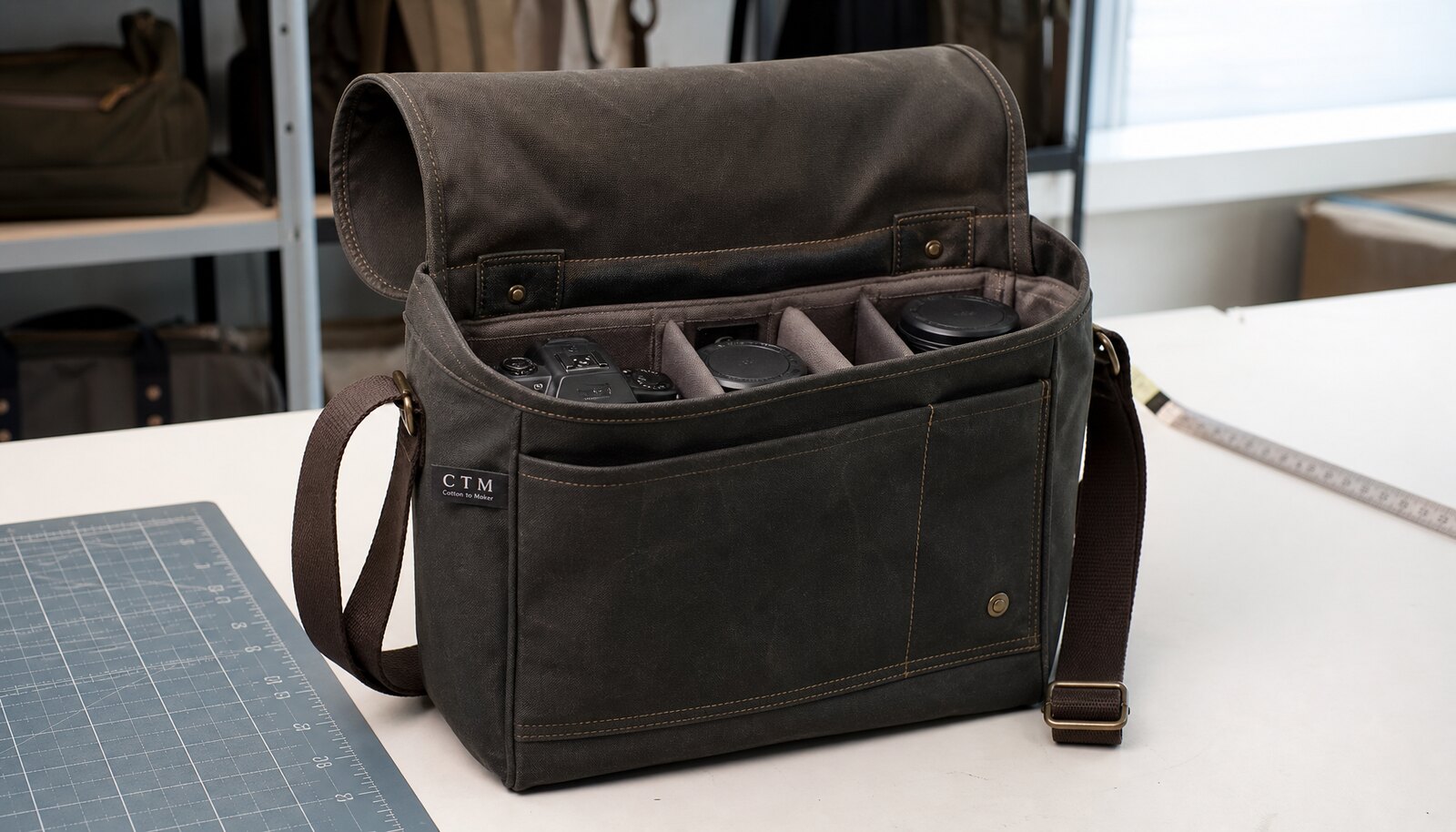
Start With the Carry Profile, Not the Fabric Sample
Waxed canvas messenger bags for camera brands need to be sourced around the actual carry job. A bag that holds a mirrorless body, two lenses, batteries, cards, a charger, and a small accessory pouch behaves very differently from a lifestyle messenger that only carries a notebook and cable kit. If the brief does not define the load, the factory will optimize for appearance and price, then quietly underbuild the strap anchors, base, or divider support where the failure starts.
The first procurement decision is whether this is a protective camera bag or a branded everyday carry bag that only occasionally moves gear. That choice changes the shell weight, the padding package, the reinforcement map, and the level of test evidence you should demand. Write down the target contents, the maximum loaded weight, whether the bag must hold shape when half full, and whether it needs to fit under an airline seat or inside a larger travel system.
- Define the maximum loaded weight in kilograms or pounds, not only the external dimensions.
- List the camera body, lenses, charger, memory cards, and any laptop or tablet that must fit in the same bag.
- State the primary failure you want to prevent: strap tear-out, base collapse, water ingress, or abrasion damage to the gear.
Use a Build-Variant Table Before You Ask for Pricing
Before you compare quotes, decide which build variant you are actually buying. A lightweight lifestyle messenger, a balanced camera-carry bag, and a high-protection spec can all look similar in photos but produce very different cost, weight, and warranty profiles. Procurement gets cleaner when the supplier is quoting against a named build rather than inventing its own interpretation of the product.
For a launch program, the balanced camera-carry build is usually the most practical starting point. It gives you enough shell weight and reinforcement to survive daily use, while keeping sewing complexity and carton volume under control. If the brand position is more rugged or the kit is heavier, move up to the reinforced build and accept the higher cost. If the product is mostly merchandise, keep the spec simpler and do not overpay for camera-grade structure that the user will not notice.
- Quote at least two build variants so you can see the cost of better structure instead of guessing.
- Keep the shell, padding, and reinforcement separate in the spec so the factory cannot blur them into one price.
- Use the same kit load when comparing variants, otherwise the price comparison is not meaningful.
Set a Shell Spec the Factory Can Repeat
For most camera-brand messenger bags, a 16-18 oz cotton canvas shell, roughly 540-610 GSM, is a sensible starting point. It is heavy enough to feel substantial, resist daily abrasion, and hold the shape of the bag, but still practical for sewing and shoulder carry. Lighter cloth can work for lifestyle goods, but it usually gives up reserve strength at corners and strap roots. Heavier cloth can also work, but only if the factory is comfortable sewing dense fabric without puckering, skipped stitches, or excessive needle damage.
Wax finish needs the same level of control as the base cloth. Ask what wax type is used, how much pickup is targeted, and how the lot is controlled from sample to bulk. A dry-wax or beeswax-style finish usually gives a better balance for commercial use than an overly greasy hand because it sheds water without making the bag uncomfortable to handle, contaminate carton liners, or leave residue on adjacent bags. Also ask for seam allowance and stitch density on structural seams so the factory cannot switch to a lighter construction after the sample is approved.
- Request the shell weight in both oz and GSM so a lighter cloth cannot be hidden behind a different unit.
- Ask for acceptable shade variation, wax bloom tolerance, and any expected handfeel change between lots.
- Confirm whether the cloth is pre-shrunk, washed, or finished to final dimensions after waxing.
Write a Durability Test Plan With Numbers
A useful durability checklist should reflect how the bag will fail in the field, not how it looks on a showroom table. For messenger bags, the first problems usually show up at the strap anchors, top handle, zipper ends, flap hinge, and the lower corners that rub against desks, vehicle seats, and the body during carry. If the bag only survives when empty, the test is not aligned with the product.
Set the test plan around the intended loaded condition and lock the thresholds before PP approval. A practical buyer-level plan is to test the full bag at 1.25x to 1.5x the rated carry load for a sustained period, then run abrasion, zipper, seam, and rub checks on the same sample after conditioning. Use lab methods where possible, but define acceptance in commercial terms so the factory knows exactly what passes and what fails.
- Static load: hold the fully loaded bag at 1.5x the rated carry weight for 30 minutes with no seam opening, no strap-anchor movement beyond the agreed tolerance, and no closure failure.
- Abrasion: set a buyer floor of 20,000 Martindale cycles on body panels and 10,000 cycles on corners and strap-contact areas, with no hole, exposed substrate, or yarn break-through.
- Zipper cycles: require at least 5,000 cycles on the main compartment zipper and 2,500 cycles on smaller pockets, with no skipped teeth, slider binding, or self-opening.
- Seam strength: define a minimum target such as 200 N for secondary seams and 300 N for primary strap anchors, or another level matched to your load requirement.
- Rub and color transfer: use dry crocking at Grade 4 or better and wet crocking at Grade 3-4 or better, unless the brand has a stricter internal standard.
Reinforce the Load Path, Not the Surface
Camera bags usually fail where the load enters the body, not where the topstitching looks neat from the outside. That means the strap root, handle anchor, and any point where webbing changes direction need hidden reinforcement, not only decorative stitching. A clean exterior can hide a weak internal path, so ask the factory to show the internal patching, webbing route, and bartack pattern on a cut sample or a clear technical drawing.
The base and lower corners deserve equal attention because they take repeated desk, floor, and vehicle contact. If the bag is intended for heavier kits, add a structured base panel or board so the shape does not collapse under load. For flap closures, check that magnets or buckles do not create stress points that distort the panel when the bag is full. Reinforcement should support the exact load path the customer will create, not just make the bag look tough in photos.
- Require bartacks at every strap turn, anchor end, and webbing termination.
- Ask for a cutaway view of the reinforcement stack so hidden patches are not left to interpretation.
- Check that the base and lower corners still hold shape after the bag is carried at full load and then set down repeatedly.
Protect the Camera Kit Inside the Bag
A waxed canvas shell is only one part of the protection system. If the interior is too soft, the shell can move around the gear and let lenses or camera bodies strike the side wall. If the interior is too rigid, the bag becomes uncomfortable and expensive to ship. The right answer is usually a structured lining with predictable padding in the side walls, base, and divider system, plus a layout that prevents the kit from shifting when the bag is half full.
For procurement, ask the factory to specify the foam or board thickness, the divider attachment method, and the place where hard edges are intentionally avoided. A good camera messenger should let the user open the flap, reach the body quickly, and still keep the lens barrels from pressing into weak points. If the bag includes a laptop sleeve, the sleeve must be structurally isolated enough that a computer does not distort the camera compartment or push the zipper out of alignment.
- Define padding thickness by zone, not as one vague overall spec; the base often needs more structure than the side walls.
- Test the fit with a real camera kit or a weight dummy placed where the user will actually store the gear.
- Check divider collapse, zipper obstruction, and sharp board corners while the bag is only partially full.
Choose Branding That Survives Wax and Wear
Waxed canvas is not a forgiving surface for every branding method. Large printed logos on the main shell can crack, scuff, or disappear unevenly as the fabric flexes and the wax surface changes with temperature and handling. For most camera-brand programs, a woven label, stitched patch, debossed panel, or restrained logo on a non-waxed area is the lower-risk route because it keeps the mark legible without fighting the finish.
Brand placement matters almost as much as the method. A logo under a strap, too close to a flap seam, or in an area that rubs against the body will age faster than the rest of the bag. Ask for a rub test on the finished logo after conditioning, folding, and packing. If the method cannot survive those steps, it is not ready for bulk. A logo that looks premium on one sample but is hard to repeat on reorder should be treated as a sourcing problem, not a creative win.
- Prefer sewn labels, patches, or debossed panels over large flooded prints on waxed cloth.
- Test branding after the bag has been folded, handled, and packed, not only when it is new.
- Keep the mark away from high-wear zones unless the method has already been proven there.
Quote the Bag as a Costed Build, Not One Unit Price
If a supplier gives only one all-in price, you cannot tell whether the bag is being engineered correctly. Ask for the shell, lining, padding, webbing, zipper, hardware, logo, packing, and carton components separately, or at least in a way that shows the major cost drivers. This is the cleanest way to compare a camera-bag specialist against a general canvas supplier, because the specialist often spends more on reinforcement and consistency while the generic factory may spend less on the parts that matter most.
Also ask for the MOQ by color, by hardware finish, and by branding method, because those are usually the points that move the order from simple to expensive. A quote that looks competitive at one colorway can become unworkable if the brand wants mixed colors, custom metal finishes, or a second logo application. For reorder planning, push for repeat-order pricing and ask what changes when the same build runs again. Repeatability is often a better indicator of supplier quality than the first quote.
- Request pricing at MOQ, repeat order, and a realistic higher volume so the breakpoints are visible.
- Separate sample charge, tooling, and bulk price so the launch cost is not hidden in the per-unit number.
- Confirm whether the quote includes inserts, tissue, polybags, desiccant, carton marks, and any retail-ready packing.
Inspect the Golden Sample and the First Lot
The most expensive error in a bag program is treating the sample as a preview instead of a contract reference. The pre-production sample should only be approved when the final shell, hardware, logo method, divider layout, and packing are all fixed. After approval, seal a golden sample with a measurement sheet and keep it as the reference for bulk inspection. If the factory later proposes a different slider, a narrower webbing width, or a changed divider, the buyer should be able to point to the sealed sample and reject the deviation cleanly.
The inspection record should capture structural and cosmetic items separately. Measure finished width, height, depth, flap alignment, strap length, pocket opening size, and divider positions. Then inspect stitch pitch, bartack placement, logo alignment, and wax appearance. A bag can look great in photos and still fail procurement if the loaded fit is wrong or if the first lot drifts from the approved sample. For launch programs, inspect the first production lot more tightly than later replenishment runs.
- Approve the bag with the intended camera kit or a calibrated weight dummy inside it.
- Record the measurement sheet, material callouts, and hardware color next to the sealed golden sample.
- Treat any change to fabric, logo, divider layout, or closure hardware as a re-sample event.
Control Packing, Lead Time, and Reorders
Packing can damage a good bag before it reaches the shelf. Waxed canvas can mark or transfer if the bags are stacked too tightly or if hardware rubs against the shell during transit. Use tissue, a low-tack inner wrap, or another approved barrier so adjacent bags do not mark each other. Make sure zipper pulls, buckles, and metal hardware cannot score the front panel when the carton is moved in warm or humid conditions.
Lead time risk usually starts with materials, not sewing. The shell cloth, wax finish, hardware finish, labels, and inserts may all sit on different supply timelines. Lock the critical-path materials before you lock the ship date. For reorders, treat the repeat run as a repeatability test: same spec, same reference sample, same packing method, and the same acceptance rules. If the reorder needs a new color or a different trim, price it and sample it as a new build instead of assuming the old line will carry over unchanged.
- Ask for carton dimensions and gross weight early so landed cost can be checked against the freight quote.
- Specify how many bags go into each carton and how they are oriented to prevent pressure marks and wax rub.
- Freeze artwork and packing before bulk starts so the factory does not need to rework approved units later.
Specification comparison for buyers
| Build variant | Recommended construction | Best fit | Buyer risk to check |
|---|---|---|---|
| Light lifestyle carry | 14-16 oz canvas, lighter foam, minimal divider system, basic reinforcement | Promo merchandise, soft-edition brand drops, lighter daily carry | Looks clean in samples but can collapse at the base and fatigue strap anchors faster |
| Balanced camera carry | 16-18 oz canvas, padded lining, structured base, reinforced corners, full divider set | Most launch programs for bodies, one to two lenses, and accessories | Needs disciplined QC because a small trim change can affect fit and load handling |
| High-protection carry | 18 oz+ canvas, denser foam, internal board or PE structure, expanded bartack map | Heavier kits, urban commute use, retail premium positioning | Higher unit cost, more sewing complexity, and more carton volume to control |
| Supplier-led generic canvas bag | Standard messenger build with limited camera-specific reinforcement | Low-risk merch where the bag is not the primary product | May quote well but miss camera-specific load paths and divider performance |
| Camera-bag specialist OEM | Purpose-built internal structure, repeatable test routines, and load-path reinforcement | Brands that need durability consistency and fewer launch surprises | Usually more disciplined on spec control, but often less flexible if the brief is vague |
| Material | 10-16 oz canvas, washed canvas, rPET canvas, lining fabric, interfacing, and hardware finish | Before price comparison | Different cloth weights, backing, or certification claims make quotes hard to compare |
| Construction | flap shape, strap webbing, buckle, D-ring, inner pocket, zipper pocket, seam allowance, and load path | Before sampling | Weak stress points create returns and failed inspections |
| Decoration | embroidery, woven patch, leather patch, metal label, or print placed away from flap folds and hardware pressure | Before artwork approval | The wrong method can crack, bleed, pucker, or fail on the chosen fabric |
Buyer checklist before sampling
- Define the exact camera kit, maximum loaded weight, and whether the bag must also fit a laptop sleeve or tablet pocket.
- Lock the shell weight, weave, wax finish, and acceptable shade variation before price negotiation starts.
- Specify the reinforcement map at strap roots, handle ends, corners, flap hinges, and any webbing turn points.
- Approve the divider layout and padding thickness with a real camera kit or weight dummy inside the sample.
- Set a measurable durability target for load, abrasion, zipper cycles, seam strength, and color transfer before PP approval.
- Choose a branding method that survives repeated flexing, rubbing, and carton contact on waxed fabric.
- Approve the packing method, carton count, gross weight, and carton dimensions before the first bulk run.
- Ask for quote splits by shell, lining, reinforcement, hardware, logo, packing, and freight-ready carton data.
- Freeze the golden sample and measurement sheet so reorders can be checked against the same reference.
- Align MOQ, color count, and reorder timing with the actual sales forecast instead of the launch wish list.
Factory quote questions to send
- What is the exact shell specification in GSM or oz, weave construction, wax type, and finishing method?
- What seam allowance, stitch density, and bartack program do you use on strap anchors and other load points?
- What foam, board, or divider materials are included, and what thickness is used in the base and side walls?
- Can you provide your test data or internal inspection records for load, seam strength, abrasion, zipper cycling, and rub resistance?
- What are the unit prices at MOQ, repeat order, and higher volume, with shell, lining, hardware, logo, and packing separated?
- Which branding methods have been validated on waxed canvas, and what is the add-on cost for each method?
- What are the sample lead time, bulk lead time, and the critical-path materials that can delay the order?
- How are the bags packed per carton, and what are the carton dimensions, gross weight, and protection materials?
- What is the approval process for the pre-production sample, the sealed golden sample, and any lot-to-lot color or wax change?
- If a trim or material changes later, what is the re-sample rule and who signs off on the deviation?
Quality-control points to confirm
- Fabric weight stays within the agreed tolerance and shows no weak weave lines, thin spots, or visible slubs in load-bearing zones.
- Wax finish is even across panels, with no sticky patches, dry streaks, excessive bloom, or transfer to adjacent surfaces unless preapproved.
- Strap anchors and handle points are bartacked cleanly with no skipped stitches, loose tails, or gaps in the load path.
- Critical seams do not open at the buyer-defined load target and show no permanent distortion that prevents normal closure.
- The main zipper runs smoothly across the full length without catching on flap seams, lining edges, or divider corners.
- Divider, padding, and base structure sit flat, with no sharp board corners, exposed foam, or shifting inserts.
- Logo placement stays within the approved tolerance and shows no cracking, scuffing, or rub-off after handling and fold tests.
- Cartons arrive without wax transfer, corner crush, moisture damage, or loose packing that lets the bags rub in transit.