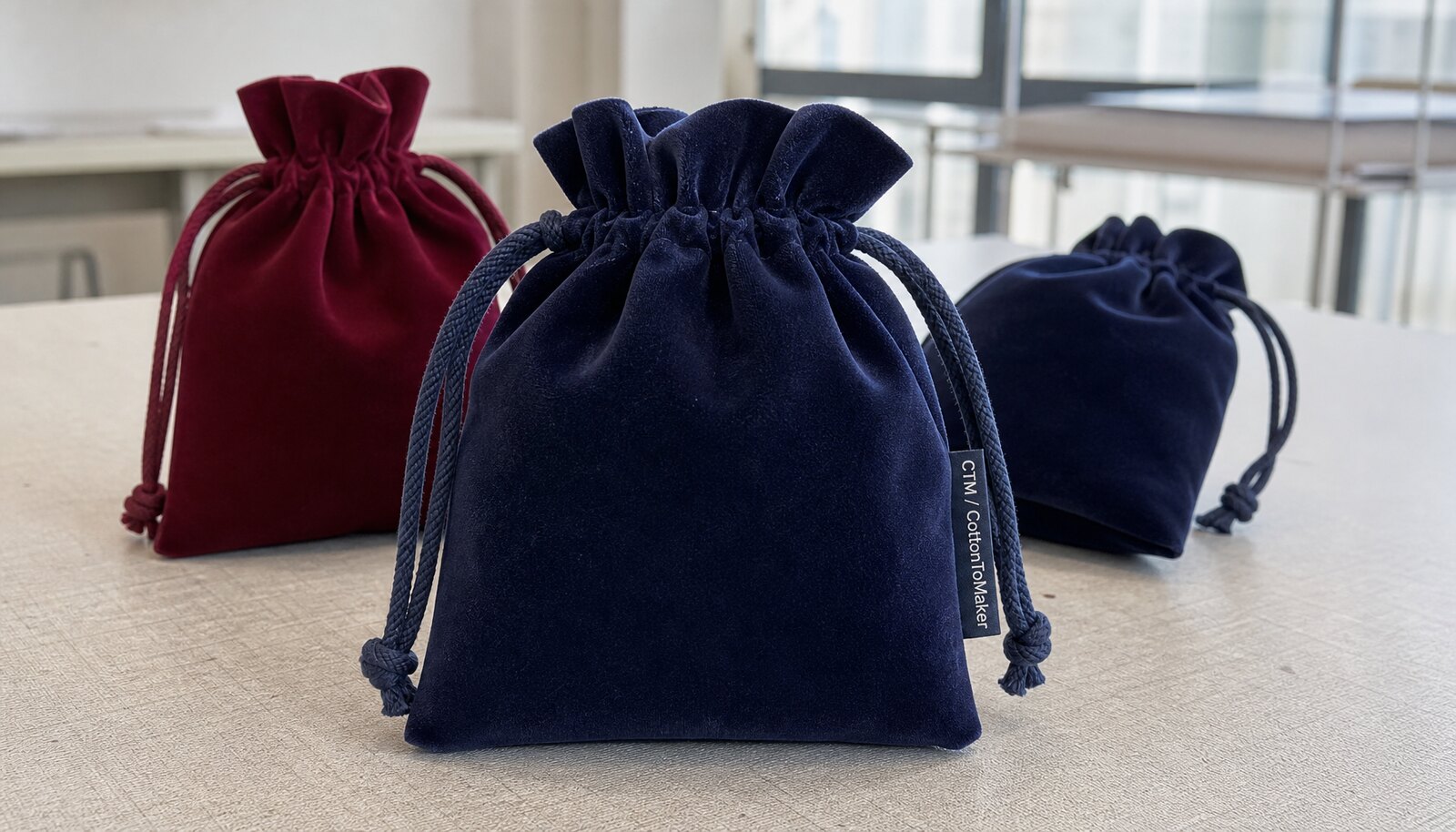
What Watch Retailers Need the Pouch to Do
A velvet drawstring pouch for watch retail is not just a soft bag. It is usually a presentation item, a scratch barrier, and a brand cue at the same time. That means the spec has to balance appearance, protection, and unit cost. If the pouch sits inside a watch box, the priority is clean fit and surface protection. If it is handed over at point of sale or used in e-commerce fulfillment, the pouch also has to survive handling, stacking, and repeated opening without looking tired after one use.
Start the RFQ with the use case, not the fabric color. State whether the pouch holds one watch, a watch plus strap, or a watch box insert. Then lock the basic build: velvet face, lining, drawcord, and logo method. For most retail programs, a polyester velvet in the 200 to 240 GSM range with a smooth lining around 120 to 140 GSM is a practical starting point. It gives enough body to feel premium without becoming bulky or too expensive to ship.
- Write the pouch spec around the watch size range, not a generic bag dimension.
- Decide if the pouch is for display, gifting, or transit before you negotiate MOQ.
- Keep the first-order construction simple enough to repeat without retooling.
Set the Base Spec Before You Negotiate MOQ
MOQ is rarely a fixed factory rule. It is the result of how much setup the supplier has to absorb for your order. Velvet color choice, lining choice, logo method, and packing format all push the minimum in different directions. A supplier can often do a lower MOQ when you stay inside its standard fabric stock, standard cord, and standard label format. The moment you ask for a custom dye match, a special woven label, and retail-ready packing, the factory has more moving parts to control and will usually raise the minimum.
The cleanest negotiation path is to separate the build into fixed and variable elements. Keep the pouch body, lining, and cord common across the line, then vary only the logo or side label if possible. For a first order, stock velvet colors such as black, navy, or deep burgundy are usually easier to source than a custom shade. If the brand requires a precise color, ask the factory to quote both a stock-fabric route and a custom-dyed route so you can see what the color requirement really costs in MOQ and lead time.
- Ask for a base MOQ and a delta MOQ for each extra color or logo version.
- Keep the same pouch body across the range if you want a lower total commitment.
- Treat custom dye and custom packaging as separate cost drivers, not one combined request.
Where Velvet Pouch MOQ Actually Comes From
The fastest way to misunderstand a quote is to treat MOQ as a single number. In practice, the minimum is shaped by three things: material allocation, decoration setup, and packing labor. If the supplier has stock velvet on hand, it can cut and sew small lots more easily. If the order needs a special pile direction, a woven brand label, or a printed logo that needs a dedicated screen or transfer setup, the factory wants more units to cover that preparation. Watch retailers often see this when they add multiple colors or multiple logo placements to one order and the supplier suddenly moves from a small test run to a much larger minimum.
Use a negotiation model that rewards simplicity. One body spec, one lining spec, one cord spec, and one packaging spec usually gives you the best chance of holding the MOQ down. If the supplier quotes 500 pieces for a standard black velvet pouch but 2,000 pieces for custom navy dye plus embroidery, that is not a random number. It means the factory is spreading setup, material booking, and production risk across a shorter run. Ask for the quote split so you can see whether the real issue is dye, decoration, or packing. That detail matters more than the headline MOQ.
- Separate the base pouch minimum from the minimum per color and per logo version.
- If you need multiple SKUs, use one common construction and change only the branding layer.
- Have the supplier quote both stock-material and custom-material options for comparison.
Compare Sourcing Routes Before Comparing Unit Prices
The best supplier is not always the lowest unit price. For velvet drawstring pouches, you need to compare sourcing routes as well as factories. A direct cut-and-sew factory gives you the best control over seam quality, lining consistency, and logo placement, but it may want a cleaner spec and a more disciplined MOQ. A trading company can help if you are sourcing pouches alongside other packaging items, but you should expect less transparency on which factory is actually making the goods. A print specialist can be useful for short-turn logo work, but it is often weaker on sewing tolerances and repeatability.
Look at the full landed cost, not just the ex-works quote. Small pouches are light, but velvet packaging can be bulky, so carton size and packing density affect freight more than buyers expect. A supplier that quotes a slightly higher unit price but packs efficiently and shares accurate carton data can end up cheaper than a lower-priced source with oversized cartons and no pre-shipment packing discipline. For watch retail programs, the cheapest quote is often the one that later creates rework, packing disputes, or a second round of samples.
- Compare quotes on the same carton count, carton size, and inner packing method.
- Ask which cost items are included in the unit price and which are charged separately.
- Treat sample quality, lead time reliability, and packing accuracy as part of the price.
What a Clean Sample Must Prove
The first sample should do more than show color. It should prove that the pouch can be produced with the final fabric, lining, drawcord, and logo method without unwanted distortion. For velvet, that means checking pile direction, crush resistance, and surface clarity under both daylight and indoor light. A sample that looks fine on a bench but shows streaking or pressure marks after a few folds is not ready for retail. If the pouch has a side label or woven tag, the label should sit flat and the stitch line should not pull the body fabric into a wave.
Use a real watch or a dummy of the same size when you approve the sample. A watch pouch that only looks right when empty is a bad reference. The opening should feel easy but secure, the drawcord should close evenly, and the item should not slide out when the pouch is tilted. Check the sample against the exact watch dimensions, clasp shape, and strap thickness you plan to ship. A good factory sample should also include the proposed packing method, because compression and folding can change the way velvet looks after transit.
- Test the sample with the actual watch size or a same-size dummy.
- Inspect the front panel for pile crush, streaking, and lint transfer.
- Approves only after the pouch is checked in the planned packing format, not only on the table.
Print and Branding Options That Hold Up on Velvet
Velvet is less forgiving than flat cotton or canvas, so branding needs to be chosen with care. Full-panel print can work, but only if the artwork is simple and the supplier understands how the ink or transfer interacts with the pile. A heavy print layer can flatten the velvet or feel sticky after packing. For most watch retail programs, a woven side label, a low-profile patch, or a small embroidered mark is more stable than a large printed logo on the face of the pouch. The best choice depends on whether you want the brand to be subtle or prominent.
Embroidery looks premium, but it can also add stiffness and create pressure points if the logo sits where the watch touches the pouch. Woven labels are often the safest option because they keep the face of the pouch soft and they are easier to repeat consistently across reorders. Screen print can be economical for one or two colors, but it needs a proper adhesion test on the velvet surface. If the supplier suggests a heat transfer, ask how it behaves after folding, rubbing, and warehouse handling. A logo that cracks after the first shipment is not a good value even if the unit price looks attractive.
- Woven label: best for repeat orders and low surface risk.
- Embroidery: premium look, but verify stiffness and pile distortion.
- Screen print: workable for simple art, but only after adhesion and rub testing.
- Patch or debossed panel: useful when the brand wants a cleaner luxury look.
QC Limits That Belong in the PO
A factory will usually default to its own inspection habits unless you define your own acceptance criteria. That is a problem with velvet, because small defects can be visible immediately in retail lighting. The purchase order should set measurable limits for size tolerance, seam quality, logo placement, and pile condition. If the pouch is going into a premium watch program, tighten the defect standard around the face panel and logo area. A loose thread at the side seam may be acceptable on a low-cost promotion, but it is not acceptable when the pouch is sitting next to a luxury watch box.
You also need a clear rule for color consistency. Velvet can look different under warehouse light, daylight, and store lighting, so the approval sample should be treated as the reference for the lot. If the run includes multiple cartons from different dye lots, make sure the supplier does not mix shades in the same carton. That is where many retail buyers get hurt: the first units look fine, but the next carton has enough shade movement that the whole shelf display looks uneven.
- Set a clear tolerance for pouch dimensions, logo position, and cord length.
- Reject visible pile crush, stained areas, exposed raw edges, and rough seam ends.
- Use a stricter standard for the front panel than for hidden seams.
- Require lot separation if the order uses more than one dye run.
Packing That Protects Velvet and Supports Retail Use
Packing is part of the product on a velvet pouch order. Velvet can pick up lint, mark under pressure, and show crush lines if it is packed too tightly. Decide early whether the pouch ships in a polybag, tissue wrap, or plain bulk bundle. For retail display, an individual polybag with a barcode sticker is common, but the pouch should not be over-sealed to the point that moisture is trapped. If the route is long or humid, add a simple protective insert such as a desiccant packet or a carton liner if the factory can do it consistently.
Carton planning matters more than many buyers expect because velvet pouches are light but voluminous. Ask for the exact carton dimensions, gross weight, net weight, and count per carton. A carton that is too full can crush the pile, while a carton that is too empty increases freight cost for no benefit. If the pouches will be inserted into watch boxes later, specify the packing sequence so the factory knows whether to bundle by SKU, by color, or by store allocation. That avoids mixed cartons that slow down distribution.
- Use a packing format that protects the pile without trapping moisture.
- Get carton dimensions before you finalize freight planning.
- Specify whether cartons should be packed by SKU, color, or store allocation.
Lead Time Risk and Reorder Planning
Watch buyers often underestimate how much lead time is consumed by artwork approval and material booking. A clean sample can still turn into a delayed production order if the velvet is not in stock or the supplier is waiting on a custom label. A practical timeline is usually one to two weeks for sampling when stock materials are available, then roughly three to five weeks for bulk production after sample sign-off, depending on decoration and packing complexity. Custom dye, embroidery digitizing, or new packaging inserts can add more time, especially during peak season.
Reorder planning is the best way to hold cost and MOQ under control. Once the first run is approved, keep the base construction stable and vary only what truly needs changing, such as logo artwork or carton labeling. If the watch line will move seasonally, build a small safety stock into the plan so you are not forced into an urgent, low-visibility reorder. The fastest way to lose margin on a pouch program is to rush a second run without the original materials and reference sample in front of the factory.
- Freeze the artwork and material list before bulk production starts.
- Expect custom dye and decoration steps to lengthen the schedule.
- Use the first approved run as the control sample for future reorders.
Build the RFQ So Quotes Can Be Compared
The best RFQ is the one that makes suppliers quote the same thing. Include a dimensioned drawing, target watch sizes, fabric direction if it matters, logo file, color count, lining spec, closure type, packing method, and destination port or warehouse. Also state the first-order quantity, expected reorder volume, and whether you want the factory to price stock material and custom material separately. If you do not define those items, the supplier will fill in the blanks with its own assumptions and the quotes will look cheaper or more expensive for reasons that have nothing to do with the real product.
For negotiation, ask the factory to quote three versions if possible: a stock-fabric version, a custom-dyed version, and a version with the simplest acceptable branding. That gives you a clean view of the tradeoff between image and minimum. You are not trying to buy the cheapest pouch on paper. You are trying to buy the pouch that protects the watch, matches the brand, and can be reordered without a second sourcing project.
- Send the same tech pack to every supplier so setup assumptions stay consistent.
- Request separate pricing for material, decoration, packing, and freight-related carton changes.
- Use one approved sample as the reference for all future reorder discussions.
Specification comparison for buyers
| Spec decision | Recommended option | When it fits | Buyer risk to check |
|---|---|---|---|
| Direct cut-and-sew velvet pouch factory | Best control over pile, seam quality, and logo placement | Repeat programs and private label watch packaging | MOQ can still climb if you request custom dye, multiple colors, or special lining |
| Trading company with vetted pouch factories | Useful when you need one contact for pouches and related packaging | Small teams that want sourcing support across accessories | Factory identity and process control can be opaque; request live production photos and a named factory |
| Print specialist that subcontracts sewing | Good for simple logo-first pouches with fast art turnaround | Promotional watch sets and basic retail launches | Stitch quality and size tolerance can vary between subcontract lots |
| Stock-fabric supplier with standard colors | Lowest MOQ and fastest launch path | Testing a new watch line or seasonal assortment | Color range is limited and velvet shade can vary between rolls |
| Custom-dyed velvet route | Best when brand color must match a packaging system | Core retail SKUs that will reorder | Longer lead time and higher minimum by color; require lab dip approval |
| Woven-label-only branding | Premium look with low decoration risk | Luxury positioning and dark velvet bodies | Logo visibility may be too subtle if shelf impact matters |
| Embroidery or patch branding | Strong tactile brand presence | Mid-tier to premium watch sets with larger face panels | Can distort velvet pile or create stiffness if placement is wrong |
| Local assembler or nearshore supplier | Useful for urgent launches and short transit | Trial orders and fast replenishment | Higher labor cost and fewer fabric options; verify repeatability across lots |
Buyer checklist before sampling
- Define the watch size range the pouch must fit, including whether it holds one watch, a watch plus strap, or a watch box insert.
- Lock the fabric choice before negotiating MOQ: stock velvet, custom-dyed velvet, or a supplier standard color bank.
- Choose one branding method for the first order so setup cost is not spread across too many variants.
- State whether the pouch is for in-store display, e-commerce shipment, or inside-box presentation, since that changes lining and packing.
- Request a pre-production sample with the final fabric, cord, lining, label, and carton spec, not just a color swatch.
- Compare quotes on the same basis: ex-works price, setup charges, packing method, carton count, and lead time.
- Set visible quality limits for pile crush, loose threads, logo position, and seam appearance before bulk production starts.
- Ask for production photos and carton data before balance payment or shipment release.
- Keep one repeatable base spec if you want to lower MOQ on future reorders.
- Confirm the final export carton size and pack count so freight is not distorted by oversized packaging.
Factory quote questions to send
- What is your MOQ by color, by logo method, and by packaging format?
- Which parts are stock items and which parts require custom sourcing or setup?
- Can you quote the same pouch with stock velvet and with custom-dyed velvet separately?
- What exact velvet construction do you use, including face weight, backing, and pile finish?
- What is the lining spec, and can it be changed without raising MOQ too much?
- Which branding methods do you recommend for velvet, and what setup cost applies to each one?
- What is the sample fee, what sample stage will you supply, and how long does sample approval take?
- What is the production lead time after sample sign-off, and what usually causes delay?
- What are the packing details: inner bag type, carton count, carton size, and master carton label format?
- What defect standard do you use for stitching, logo position, shade variation, and surface damage?
Quality-control points to confirm
- Velvet pile is even across the front panel, with no bald patches, streaks, or crushed marks that remain visible after light handling.
- Finished size matches the approved spec within plus or minus 5 mm on length and width.
- Drawcord slides smoothly, with both cord ends equal in length within 5 mm and no fraying at the cut edge.
- Stitching is straight, tight, and consistent, with no skipped stitches, open seams, or loose seam tails.
- Logo placement is centered within the approved tolerance and shows no cracking, bleeding, puckering, or thread breakout.
- Interior lining is clean and smooth, with no scratch points, hard knots, or exposed raw seam allowances.
- Dry rub test leaves no visible dye transfer on a white cloth after 10 firm rubs on the finished pouch surface.
- Carton count, item label, and outer carton marking match the purchase order and the approved packing list.