Start with the campus use case
A canvas grocery tote sold through a university bookstore is not the same product as a basic event tote. It may carry two hardcover textbooks, a lab notebook, a sweatshirt, a water bottle, art supplies, snacks, or small grocery items from a campus market. It may also sit on a retail shelf beside branded apparel, alumni gifts, and higher-margin merchandise. That mix makes the tote both a utility item and a visible school-spirit product.
The first decision is not fabric weight. It is the job the tote must do. A giveaway bag can be lighter, simpler, and packed in bulk. A checkout tote needs to feel credible in the customer's hand and handle mixed purchases without looking disposable. A grocery-style bookstore tote needs a real bottom gusset and strong handle attachment. A premium merchandise tote may justify heavier fabric, cleaner internal finishing, a woven label, hangtag, barcode, or controlled fold.
This distinction prevents weak price comparisons. The phrase "canvas grocery tote with university logo" can produce quotes for an 8 oz flat promo tote, a 10 oz gusseted shopping tote, a 12 oz reinforced carrier, or a 14 oz premium bag. All may be valid in the right context, but they are not comparable products. Define the role first, then compare suppliers on the same build.
- Giveaway tote: light load, low cost, simple print, short campaign window.
- Core bookstore tote: mixed purchases, midweight canvas, reinforced handles, clean shelf appearance.
- Grocery-style tote: deeper gusset, stronger handle attachment, practical load test.
- Premium merchandise tote: heavier fabric, better finishing, trims, barcode or hangtag, controlled retail fold.
- Multi-campus program: one base construction with approved artwork changes by school or store.
Understand canvas weight the useful way
Canvas is usually quoted in ounces per square yard in the U.S. market and GSM, or grams per square meter, in international sourcing. A practical conversion is 8 oz at about 271 GSM, 10 oz at about 339 GSM, 12 oz at about 407 GSM, and 14 oz at about 475 GSM. These numbers are guideposts. They do not replace a written fabric basis, because finishing, dyeing, washing, shrinkage control, and weave can change the final hand feel.
For bookstore programs, the phrase that matters is "finished fabric weight." Some suppliers quote greige fabric before dyeing or finishing. Others quote cloth after finishing. Those two bases can feel different even when both quotes say 10 oz canvas. Ask the supplier to identify whether the weight is greige, dyed, washed, bleached, pigment dyed, natural unbleached, or finished. Also ask for the tolerance, because fabric weight is not perfectly identical from roll to roll.
A good working range for many university bookstore totes is 10 oz to 12 oz finished canvas. An 8 oz tote can be suitable for orientation, sponsor events, and light retail use, but it should not be described internally as a book-and-grocery carrier unless testing confirms it. A 10 oz tote often gives the best balance of cost, printability, feel, and freight. A 12 oz tote adds structure and perceived durability for heavier loads. A 14 oz tote belongs in premium or high-duty programs where the retail price and freight budget support it.
- 8 oz, about 271 GSM: light-duty events, handouts, simple checkout bags.
- 10 oz, about 339 GSM: common everyday bookstore retail weight when construction is sound.
- 12 oz, about 407 GSM: stronger hand feel for books, groceries, and repeat campus use.
- 14 oz, about 475 GSM: premium or heavy-duty merchandise with higher landed cost.
- Best wording: "Quote finished canvas weight in oz/yd2 and GSM, with fabric finish and tolerance stated."
Pair fabric weight with size and gusset
Fabric weight cannot be judged alone. A compact 10 oz flat tote can feel sturdy, while a large 10 oz grocery tote may sag if the bottom and handles are underbuilt. Before choosing the weight, define the finished body dimensions, bottom gusset depth, top opening, and expected carry style. The same fabric can perform very differently depending on pattern and construction.
The bottom gusset is especially important for bookstore use. Flat totes are economical, stack well, and work for events or simple checkout purchases. They are less friendly to textbooks, binders, boxed items, bottles, and groceries because the contents push into the bottom corners. A 4-5 inch gusset is often practical for notebooks, apparel, stationery, and small campus essentials. A 6 inch or deeper gusset improves grocery-style capacity but adds fabric consumption, sewing time, folded bulk, and carton volume.
Measurement rules should be agreed before the sample is approved. Gusseted totes can produce different numbers depending on whether the bag is measured flat, shaped open, or along the seam. Many cut-and-sew fabric goods use tolerances around plus or minus 1 cm for handle drop and smaller details, and plus or minus 1-1.5 cm for larger body measurements, depending on the factory and tote size. The exact standard should live with the purchase file and approved sample.
- Flat tote: lowest cost and easiest packing for light use.
- 4-5 inch gusset: practical for bookstore merchandise, notebooks, apparel, and small essentials.
- 6 inch or deeper gusset: better grocery capacity with higher fabric use and freight cube.
- Large body plus light fabric: higher risk of sagging, weak shelf presence, and stress at corners.
- Balanced retail spec: mid-size body, 10-12 oz finished canvas, reinforced shoulder handles, documented bottom seam.
Treat handles as the strength system
Most tote failures begin at the handles, not in the middle of the fabric panel. A heavier canvas body does little good if the handles are narrow, short, loosely attached, or sewn with minimal reinforcement. For university bookstore totes, handle length, handle drop, handle width, attachment method, reinforcement stitch, thread quality, and top hem construction should be specified as part of the product, not left to factory habit.
Shoulder handles are usually more useful for students walking across campus with books or groceries. They use more material and create more leverage at the attachment points, so reinforcement matters. Hand-carry handles can work for lower-load checkout bags, gift packaging, or event totes, but they become less comfortable as the bag gets heavy. Width also changes the experience: a narrow handle may be acceptable on a light tote, while wider webbing or self-fabric handles can distribute weight better for book-heavy use.
Common reinforcement options include bar tacks, box stitching, cross stitching, handles inserted into a folded top hem, side-seam capture, and reinforcement patches. A core 10 oz bookstore tote may only need a clean bar tack or box stitch if the size and load are moderate. A larger 12 oz grocery-style tote may need wider handles, a stronger top hem, and reinforced stress points. During sampling, inspect the inside as closely as the logo side. Look for enough fabric caught in the stitch, even tension, no skipped stitches, and no tearing around the needle holes after loading.
- State handle drop in inches or centimeters rather than using terms like long or shoulder length.
- Specify handle width, handle material, and whether handles are self-fabric or separate webbing.
- Use named reinforcement for book-heavy totes: bar tack, box stitch, cross stitch, or patch reinforcement.
- Define top hem width and seam allowance so handle stress points are not underbuilt.
- Check early production for loose threads, uneven tension, crooked handles, and weak attachment points.
Choose decoration for real canvas texture
University marks, bookstore graphics, mascots, and sponsor logos do not print on canvas the way they print on paper or smooth synthetic fabric. Canvas has texture. Fine lines can break, small type can lose sharpness, large solid areas may require heavier ink coverage, and textured weave can soften edges. Decoration should be chosen around the artwork, fabric color, fabric weight, order quantity, color count, durability expectation, and acceptable hand feel.
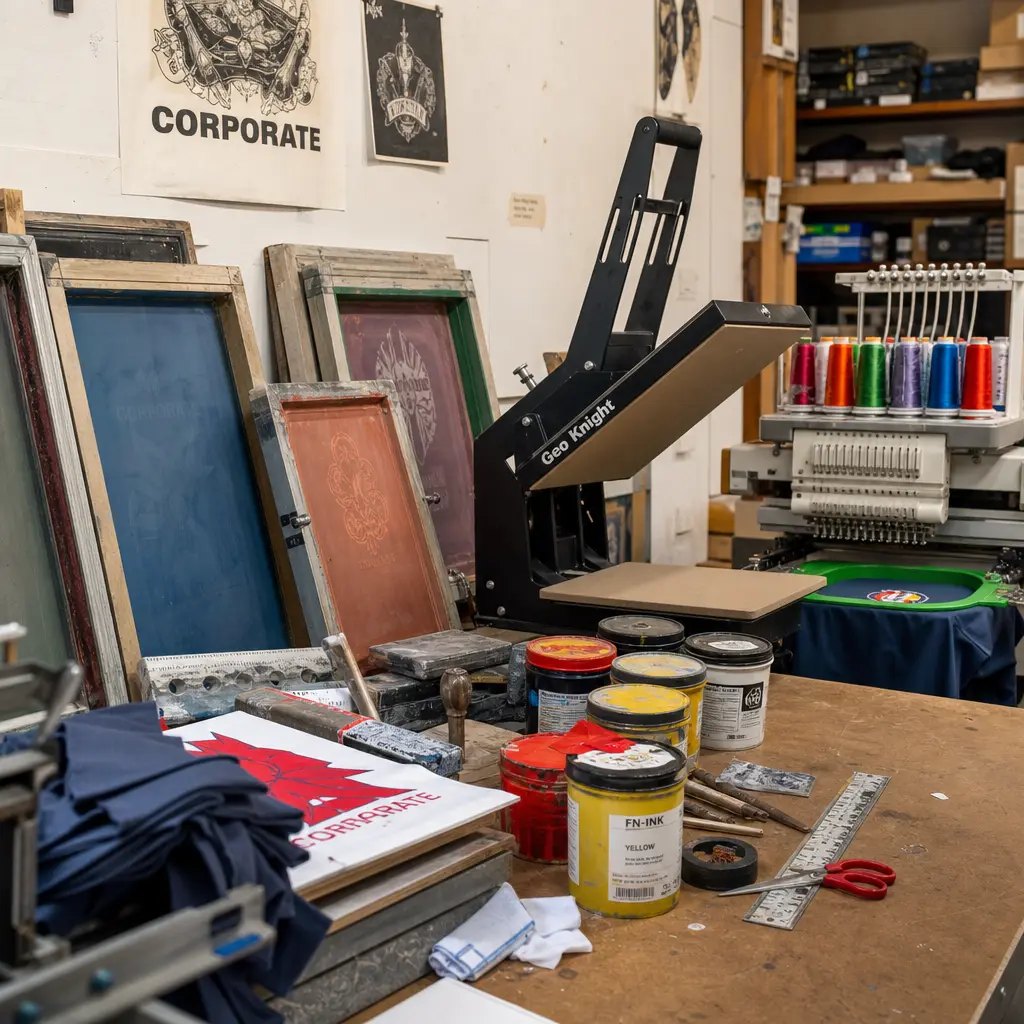
Screen printing is often the most predictable method for simple one-color or two-color university logos, bookstore names, athletic slogans, and bold graphics. It can give strong coverage at volume when screens, inks, curing, and placement are controlled. The quote should state print size, color count, ink type if relevant, approved color reference, curing method, and placement tolerance. For many tote programs, placement tolerance may land around plus or minus 0.5 cm to 1 cm, depending on artwork size and construction, but it should be agreed in writing.
Transfer printing can help with detailed art, smaller runs, or multi-campus programs with many design versions. The risk is hand feel and adhesion. A large transfer on canvas may feel stiff, and edges can lift if temperature, pressure, or curing are not controlled. Embroidery, woven patches, printed patches, leather-look patches, and sewn labels create a more merchandise-driven look, but they add digitizing, thread selection, backing, patch attachment, placement control, and lead time.
The approval sample should show the actual decoration on the actual canvas. A digital mockup is useful for layout, but it cannot prove opacity, edge definition, ink feel, transfer stiffness, embroidery distortion, or patch alignment. For bookstore retail, decoration quality is not cosmetic detail. It affects perceived value at the shelf.
- Screen print: reliable for bold logos, simple graphics, repeat orders, and larger quantities.
- Transfer print: useful for detailed art or many versions; test stiffness, edge adhesion, and flexing.
- Embroidery: premium for small marks, but dense stitches can distort canvas or require backing.
- Patch or sewn label: strong merchandise look with extra trim cost and placement control.
- Approval standard: actual artwork, actual canvas, actual decoration process, agreed color target, and placement tolerance.
Make cost comparisons less misleading
MOQ and price breaks reflect more than sewing capacity. They include fabric purchasing, cutting efficiency, print setup, trim sourcing, line changeover, packing labor, inspection, export handling, and shipment release. A stock natural 10 oz tote with one print color can often be produced efficiently at a lower quantity. A program with five body colors, eight campus logos, two handle colors, hangtags, barcodes, retail folds, and split shipments may create separate minimums and setup costs for each variation.
The easiest way to reduce cost without weakening the tote is to standardize what customers do not need to see. In a multi-campus program, artwork may change by school, but the base construction can often stay fixed: one finished fabric weight, one size, one gusset, one handle system, one print method, one packing method, and one tolerance sheet. That gives the production line a repeatable item and gives the buyer cleaner quality comparisons across campuses.
Ask for realistic price bands, such as 500, 1,000, 2,500, and 5,000 pieces if those reflect plausible demand. Separate recurring unit price from one-time setup charges. Screens, plates, transfer setup, embroidery digitizing, woven label setup, hangtag printing, barcode stickers, testing, and special cartons may sit outside the base cost. Also request carton dimensions, pieces per carton, and gross weight. A low ex-factory price can disappear once freight cube, heavy cartons, rework, or unsellable defects are included.
- Ask MOQ by fabric weight, body color, artwork version, print color count, packing format, and destination.
- Standardize the base tote when campus-specific art must vary.
- Separate one-time setup charges from recurring unit cost.
- Request price bands that match actual demand, not only the supplier's preferred high-volume tier.
- Compare landed cost and sellable quality, not the lowest bag price alone.
Pick the right sourcing route
The best sourcing route depends on deadline, quantity, customization, and the buyer's internal bandwidth. A domestic decorator or regional supplier may be the right choice for short timelines, small runs, late artwork approvals, or events that cannot wait for overseas production and transit. The tradeoff is reduced control over the blank tote. Buyers should still inspect blank dimensions, shade, fabric feel, handle strength, and sewing quality before decoration begins.
Direct factory OEM production is stronger for repeat programs where the bookstore or licensing team wants to lock fabric weight, GSM basis, construction, decoration method, labels, packing, carton data, and inspection points. It can improve control and reorder consistency, but it depends on disciplined sample approval and clear written tolerances. A development sample can help refine a new tote. The pre-production sample should then represent the final fabric, build, artwork, trims, fold, and packing.
A trading company or sourcing agent can be useful when the program includes multiple SKUs, several decoration methods, split shipments, or consolidated export handling. The key is accountability. Ask who cuts the fabric, who sews the bags, who prints or decorates them, who packs them, and who performs inspection. Subcontracting is common in soft goods, but hidden subcontracting without clear quality ownership creates avoidable risk.
Shipment terms also need normalization. A domestic decorated blank delivered to campus is not directly comparable to an overseas factory quote under EXW, FOB, CIF, DDP, or another Incoterm. Every quote should name the delivery term, delivery point, sample process, production lead time, carton data, payment terms, inspection point, and excluded charges.
- Use domestic decoration for urgent deadlines, small runs, and late artwork changes.
- Use direct OEM production for repeat volume, locked specs, and stronger construction control.
- Use a sourcing agent for multi-SKU coordination, export handling, and consolidated communication.
- Compare suppliers only after Incoterm, carton data, sample process, and inspection point are clear.
- Document who owns corrective action if sewing, printing, labeling, or packing fails inspection.
Use samples to lock the product
A tote sample should prove more than logo placement. For university bookstore use, it should confirm fabric weight, hand feel, shade, finished size, handle comfort, gusset capacity, decoration quality, trim placement, fold style, barcode location, and packing concept. A showroom sample can start the conversation, but it should not become the approval standard unless it uses the same materials and construction planned for production.
The pre-production sample is the important checkpoint. It should be made with the approved finished canvas weight, same fiber content and color, same handle tape or self-fabric handle, same reinforcement method, same decoration process, same labels or hangtags, and same fold and packing method. If substitute fabric, temporary ink, generic handles, missing labels, or placeholder packing are used, those exceptions should be documented and closed before bulk production.
Keep signed reference samples. One can remain with the buyer for incoming inspection, and one can stay sealed with the supplier or sourcing partner. Photos help with artwork placement and defect records, but they cannot fully capture hand feel, stiffness, shade, fabric thickness, or stitch quality. The written approval should list measurable items: body size, gusset depth, handle drop, handle width, print size, print location, fabric weight basis, label position, fold, carton quantity, and accepted tolerances.
Reorders deserve the same discipline. Natural canvas can vary in shade. Black and navy canvas can vary in depth. Handle tape, ink, thread, and trims can shift between lots. Use the previous approval file and reference sample to check whether the new production remains within the accepted range.
- Approve fabric, construction, artwork, trims, fold, and packing as one complete product.
- Avoid approving bulk from substitute materials unless the substitution is intentional and documented.
- Measure the sample and record dimensions, gusset, handle drop, fabric basis, and decoration placement.
- Keep sealed reference samples for reorders and dispute resolution.
- Require written confirmation that production will follow the approved sample and tolerance sheet.
Control quality before cartons close
Quality control works best when the standard is known before fabric is cut. Words like "good quality" and "retail grade" are too loose for a canvas grocery tote program. The file should define tolerances for finished size, gusset depth, handle drop, handle placement, print position, shade, stains, stitching, carton count, fold direction, barcode location, and mixed-artwork separation.
Dimension tolerances should reflect cut-and-sew reality. Many fabric goods programs use plus or minus 1 cm for handle drop and smaller details, and plus or minus 1-1.5 cm for larger body measurements, depending on tote size and factory capability. Print placement often needs its own tolerance, commonly around plus or minus 0.5 cm to 1 cm for many tote layouts. Shade should be checked against the approved swatch or sample under consistent lighting. Stitching checks should name unacceptable defects: broken stitches, skipped stitches, thread nests, open seams, needle cuts, insecure bar tacks, and visibly misaligned handles.
A practical load test should match the tote's campus promise. For example, load the bag with textbooks, notebooks, a bottle, and grocery-style items, then lift and carry it through a defined handling cycle. The pass criteria should be simple and visible: no handle detachment, no open bottom seam, no major stitch failure, no severe tearing, and no obvious deformation beyond normal use. If the tote is marketed for heavier daily use, align on the test load during sampling rather than after defects appear.
First-batch inspection is valuable because it catches problems while correction is still possible. Crooked handles, wrong stitch settings, shade drift, and print placement errors are much easier to fix before most cartons are packed. Final inspection should then confirm that packed goods match the approved sample, tolerance sheet, purchase order, and packing standard.
- Set dimension, handle, gusset, print, shade, stitch, stain, and packing tolerances in writing.
- Inspect early production before most goods are sealed in cartons.
- Use a practical load test tied to bookstore use rather than an undefined durability claim.
- Classify defects as critical, major, or minor so accept/reject decisions are consistent.
- Record defect type, quantity, location, photos, carton number, and corrective action before shipment.
Plan packing and receiving
Packing can change both landed cost and store labor. A 12 oz tote may be efficient if it folds cleanly and ships in sensible carton counts. A lighter tote can become expensive if it is individually polybagged, packed loosely, or shipped in oversized cartons. Before awarding an order, request folded size, pieces per carton, carton dimensions, net weight, gross weight, and carton marks.
Campus receiving teams notice details that product photos do not show. Can one person safely lift the carton? Are carton counts consistent? Is the campus name, artwork version, SKU, or purchase order visible on the carton mark? Are barcodes on the tote, hangtag, label, or polybag? Does the retail fold show the front artwork, or will bookstore staff need to refold every unit before merchandising? Are individual bags required for e-commerce cleanliness, or is bulk folded packing better for cost and material reduction?
Retail-ready packing adds labor and should be priced intentionally. Hangtags, barcode stickers, size labels, color labels, inner packs, controlled folds, and special cartons may be worthwhile for premium merchandise or multi-location distribution. For bulk checkout bags, a clean folded pack with a carton liner may be enough. For online bookstore fulfillment, individual protection and scan-ready labeling may be required. The best packing method depends on how the tote moves from factory carton to warehouse, store shelf, online order, or event table.
Freight comparisons require the same delivery basis. FOB factory, FOB port, CIF, DDP, and domestic delivered pricing can make unit costs look deceptively different. Ask each supplier for carton data and Incoterm so the landed-cost calculation includes freight, duties if applicable, brokerage, inland delivery, and receiving labor assumptions.
- Request folded size, pieces per carton, carton dimensions, net weight, gross weight, and carton marks.
- Confirm barcode location, hangtag attachment, fold direction, artwork visibility, and inner-pack method.
- Decide whether individual polybags are needed for protection, e-commerce, or distribution.
- Set a maximum carton weight if campus receiving has handling limits.
- Keep packing photos or a packing diagram in the approval file for reorders.
Specification comparison for buyers
| Buying scenario | Best starting spec | Why it works | Watch before ordering |
|---|---|---|---|
| Orientation or event giveaway | 8 oz finished canvas, open top, flat body or shallow gusset, one-color print, bulk folded packing | Keeps cost and lead time controlled for light-use programs, sponsor tables, admissions events, and welcome-week handouts | Do not position it as textbook-duty unless a load test supports the claim; confirm opacity, shrinkage, handle stitching, and print coverage |
| Everyday bookstore retail tote | 10 oz finished canvas, 5-6 inch bottom gusset, shoulder handles, reinforced stress points | Balances fabric cost, shelf appearance, printability, carry comfort, and carton weight for common bookstore purchases | Quote finished size, gusset, handle drop, reinforcement, print area, carton count, carton weight, and delivery term |
| Book-and-grocery campus carrier | 12 oz finished canvas, wider handles, stronger reinforcement, boxed or folded bottom gusset, practical load test | Adds structure for textbooks, groceries, drink bottles, binders, apparel, and repeated campus use | Check folding bulk, freight cube, print curing, needle size, stitch tension, and bottom-corner strength |
| Premium bookstore merchandise | 12-14 oz canvas, clean seam finishing, branded trim, hangtag or barcode, controlled retail fold | Supports higher retail pricing for alumni shops, gift departments, school-spirit collections, and reusable bag programs | Labels, hangtags, barcode labor, inner packs, special cartons, and premium trims are often priced separately |
| Low-MOQ test order | Stock natural, black, or navy 10 oz canvas with one artwork placement and standard packing | Useful for demand testing, seasonal art, small campus stores, or first orders before a larger reorder | Ask whether reorder fabric shade, handle tape, ink color, screen files, and fold method can be matched |
| Multi-campus bookstore program | One locked base tote spec with campus-specific artwork files and shared tolerance sheet | Controls quality drift while allowing local branding, separate SKUs, and destination-specific receiving records | Clarify MOQ and setup charges by body color, artwork, print color count, barcode version, destination, and shipment release |
| Domestic blank plus local decoration | Stock blank totes decorated regionally by screen print, transfer, embroidery, patch, or label | Fits urgent deadlines, smaller quantities, late artwork approvals, and programs where speed matters more than lowest unit price | Inspect blank tote dimensions, fabric shade, handle strength, and seam quality before decoration starts |
| Direct factory OEM production | Cut-and-sew order with locked fabric weight, construction, decoration, labels, packing, carton data, inspection plan, and Incoterm | Best for repeat semester programs, larger volumes, and buyers who need stronger control over build and reorder consistency | Sampling and written tolerances must be disciplined before bulk cutting begins |
| Trading company or sourcing agent | One accountable coordinator for fabric, sewing, decoration, trims, inspection, documents, and shipment consolidation | Useful for mixed-SKU tote programs, split shipments, several decoration methods, or lean internal sourcing teams | Ask which facility cuts, sews, prints, packs, and inspects the goods; document who owns corrective action |
Buyer checklist before sampling
- Define the tote's role: giveaway, checkout bag, grocery-style reusable tote, premium merchandise, alumni gift, e-commerce item, or multi-campus program.
- Describe the load in practical terms, such as two hardcover textbooks and a notebook, groceries plus a bottle, or apparel plus stationery.
- Specify fabric weight in ounces per square yard and GSM, and require the supplier to state whether the number is greige, washed, dyed, or finished fabric.
- Set a fabric-weight tolerance and require the production lot to match the signed fabric swatch or approved pre-production sample.
- Define finished body width and height, bottom gusset depth, handle length, handle drop, handle width, top hem width, seam allowance, and closure style if any.
- Name the handle attachment and reinforcement method: bar tack, box stitch, cross stitch, top-hem insertion, side-seam insertion, patch reinforcement, or another approved construction.
- Specify thread color, stitch density target, seam finish, top hem finish, and loose-thread limits for retail presentation.
- Provide artwork files with print size, location, color count, Pantone or approved color target, placement tolerance, and front, back, or two-sided decoration requirements.
- Identify which costs are included or excluded: screens, plates, transfer setup, embroidery digitizing, woven labels, care labels, hangtags, barcode stickers, polybags, testing, inspection, and export cartons.
- Require a pre-production sample made with the same fabric, handle construction, decoration method, trims, fold, and packing plan intended for bulk production.
Factory quote questions to send
- What exact canvas are you quoting: fiber content, weave, finished ounces per square yard, finished GSM, fabric finish, and stated tolerance?
- Is the fabric stock, custom dyed, pigment dyed, washed, bleached, natural unbleached, organic cotton, recycled blend, or another base cloth?
- Is the quoted weight measured before or after finishing, and can production fabric be checked against an approved swatch or signed sample?
- What finished body dimensions, gusset depth, top hem width, handle length, handle drop, handle width, and seam allowance are included?
- How are the handles attached and reinforced: top-hem insertion, outside-body stitching, side-seam capture, box stitch, cross stitch, bar tack, or patch reinforcement?
- What thread type, stitch density range, needle approach, and seam finishing method will be used for the top hem, side seams, bottom seam, gusset, and handle stress points?
- Which decoration process is quoted, and what color count, artwork size, placement tolerance, curing method, and color standard are included?
- Can the pre-production sample be made with the same fabric specification, ink, transfer film, embroidery thread, label, patch, fold, and packing method planned for bulk?
- What are the MOQ and price breaks by fabric weight, body color, size, artwork, print color count, packing method, and shipment destination?
- Which costs are excluded from the unit price, including screens, plates, digitizing, labels, barcode stickers, hangtags, inner cartons, polybags, testing, inspection, export documents, or special packing?
Quality-control points to confirm
- Verify fabric weight on the agreed basis, preferably finished fabric, and compare production fabric with the signed swatch and approved pre-production sample.
- Check finished body dimensions, gusset depth, handle drop, handle width, top opening shape, and left-right symmetry before most cartons are sealed.
- Inspect handle attachment under realistic load, including bar tacks, box stitching, cross stitching, patch reinforcement, side-seam insertion, thread tension, and fabric tearing around stress points.
- Review side seams, bottom seams, top hem, gusset corners, and handle joins for skipped stitches, loose threads, puckering, needle cuts, weak seam allowance, and uneven folding.
- Verify print registration, placement, edge definition, ink coverage, curing, color match, opacity, and resistance to cracking, peeling, smearing, or excessive stiffness on textured canvas.
- Check shade consistency across body fabric, handles, labels, and printed panels, especially when production uses more than one fabric lot, dye lot, or trim lot.
- Look for stains, oil marks, dust, mildew odor, fabric slubs beyond the approved standard, needle damage, dirty packing, and defects that would hurt retail presentation.
- Open random cartons to confirm fold direction, barcode placement, hangtag attachment, polybag fit if used, pieces per carton, carton markings, and mixed-artwork separation.
- Run a practical load test that reflects bookstore use, then inspect handle stitches, bottom seams, and gusset corners after lifting and carrying.
- Record defects by type, severity, location, carton number, and count so the supplier can sort, repair, replace, or credit goods before shipment.