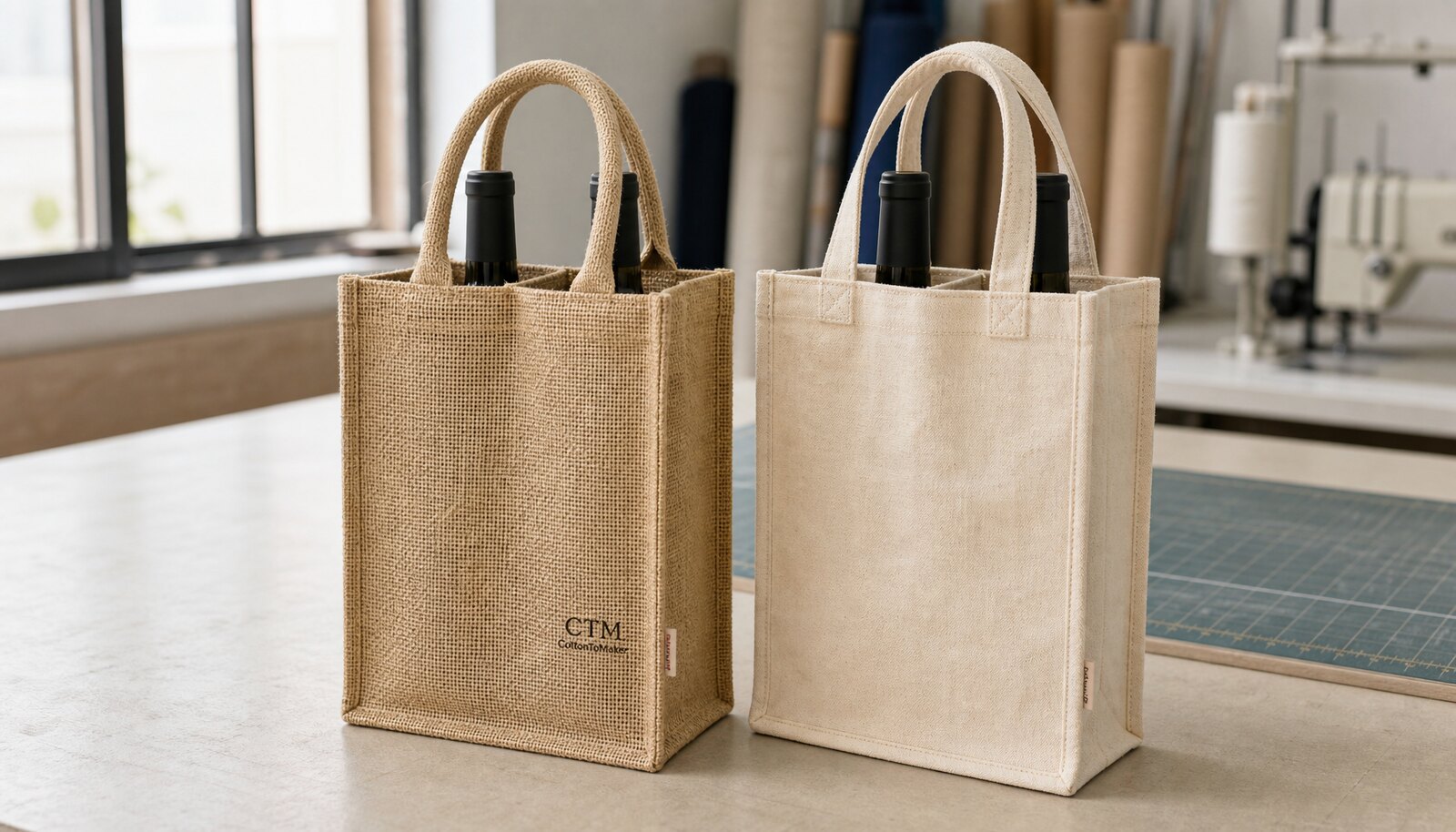
Why two-bottle wine bags sell, and where buyers get the spec wrong
Two bottle wine bags for retail sit in a very specific buying zone: they are not just gift bags, and they are not full wine carriers with hard inserts. Retail buyers usually need a product that looks polished on shelf, carries two 750 ml bottles without sagging, and lands at a cost that still leaves margin after freight, packaging, and retail markup. That means the real spec is not the artwork alone. It is the fabric weight, seam structure, handle strength, and how the bottles are separated inside the bag.
The common mistake is to treat every two-bottle bag like a simple tote. Once two glass bottles are inside, the load point changes. The base has to resist point pressure, the handles have to survive a vertical lift, and the center wall or divider has to prevent bottle-to-bottle contact. For retail programs, the buyer needs a construction that is repeatable across a full production run, not a hand-finished sample that looks good only once.
- Retail use cases: wine shops, gourmet stores, club promotions, corporate gifting, and seasonal shelf displays.
- Typical bottle formats: standard 750 ml Bordeaux, Burgundy, or one standard plus one slightly wider bottle.
- Main buying objective: keep the product presentable while controlling packed weight and landed cost.
Material choices that actually change the quote
The cheapest-looking quote is usually the one with the weakest material spec. For cotton, buyers should quote by fabric weight, such as 8 oz, 10 oz, or 12 oz canvas, rather than only saying cotton bag. For jute, the useful range is usually around 250 to 350 GSM, depending on whether the bag needs to stand upright and hold shape. If the supplier only writes “jute” or “canvas,” the same product can arrive in a very different weight class than expected.
For retail, 8 oz canvas can work if the bag is only for light gift presentation and the divider is well supported. If the bag will be reused by shoppers or will sit on shelf with bottles already inserted, 10 oz is a safer midpoint. Jute gives a more natural retail look and often performs well in premium grocery and wine programs, but buyers need to watch fraying, loose weave, and print clarity. Mixed-material builds, such as cotton with jute face panels, can be effective, but they often add sewing steps and raise labor cost.
- Cotton canvas: better print clarity, softer handfeel, easier branding, but can wrinkle more in packing.
- Jute: stronger visual shelf impact, lower perceived eco-style positioning, but more texture variation and rougher print surface.
- Laminated liners or inserts: improve stiffness and bottle protection, but increase cost and may reduce recyclability.
The construction detail that protects bottles in transit
A two-bottle wine bag is only as good as the internal structure. The divider is the most important functional feature because it controls how the bottles move during carrying and carton transport. A stitched center wall is the most common low- to mid-cost solution. For better protection, some suppliers add a full-height divider from bottom to top, while others use a partial divider tied at the top. The right choice depends on bottle type and whether the bag will be sold empty or pre-filled.
The bottom also matters more than many buyers expect. A single-layer bottom may be enough for a light promotional bag, but retail buyers usually get better results with a reinforced base, folded seam, or a small inserted board. This helps the bag stand upright on shelf and reduces the chance that the bottles push through the bottom seam in shipping. If the bag has an open top, a reinforced neck area or short top fold helps stop handle stress from concentrating at the top edge.
- For standard retail wine sets, request divider alignment within a small tolerance so the bottle necks stay parallel.
- Use reinforced bottom stitching if the program includes export shipping or warehouse repacking.
- If the bag is sold empty, make sure the structure still looks full and upright without bottles inside.
Print method, branding area, and what works on textured fabric
Two bottle wine bags for retail often carry simple branding, not complex graphics. That is a good thing, because the most reliable print methods for canvas and jute are usually the ones that hold up in production: screen print, woven label, embossed patch, or a sewn side label. Screen printing is the most economical for one- or two-color logos at scale and gives clean coverage on flat cotton canvas. On jute, the weave texture can break up fine details, so a bold logo with thicker lines usually prints better than a delicate illustration.
If the brand wants a premium retail look, a woven label or stitched patch can be more stable than trying to print a detailed image on rough fabric. For a low-cost private label run, a single-color print centered on the front panel is often the best cost-to-impact balance. Buyers should define the maximum print area, the exact logo location, and the acceptable color range early, because moving the logo after sampling can affect sewing marks, seam allowance, and carton packing alignment.
- Screen print: best for 1 to 2 colors and repeat retail orders.
- Woven label: good for premium branding and low-ink failure risk.
- Embossed patch or sewn badge: useful when the fabric texture makes printing less sharp.
MOQ logic: what drives minimums and where buyers can save
MOQ for two bottle wine bags for retail is rarely about the bag shape alone. It is usually driven by fabric sourcing, print setup, divider cutting, and whether the factory needs to reserve a special trim or label. A simple plain bag in standard fabric may start at a few hundred pieces, but once the buyer adds custom print, divider inserts, or branded packaging, the MOQ often moves into the 500 to 3,000 piece range. If the supplier quotes a very low MOQ, the unit price is often higher because labor and setup costs are spread across fewer pieces.
The most practical buying method is to match MOQ to channel risk. For a new retail program, a buyer might use a lower MOQ for first sell-in, then convert to a larger repeat order after one sales cycle. That only works if the sample is designed to be mass-producible. A sample that uses special handwork or nonstandard trim can mislead the buyer into approving a version that cannot be repeated economically.
- Lower MOQ usually means: fewer color options, simpler print, stock fabric, and standard packing.
- Higher MOQ usually unlocks: better fabric choice, more custom branding, and stronger carton economics.
- Request tiered pricing at 500, 1,000, 3,000, and 5,000 pcs so the buyer can judge the scale curve.
Quote comparison: how to read supplier pricing without getting trapped
A useful quote for two bottle wine bags should separate the base bag, print, packing, and any added inserts. If the supplier gives one lump price, the buyer cannot tell whether a lower quote is coming from a thinner fabric, less stitching, or simpler packaging. For retail programs, the lowest quote can be the least useful if it excludes barcode stickers, folding standards, or carton markings needed by the distribution center.
The most practical quote comparison is landed-cost oriented. A bag with a slightly higher factory price can still be cheaper overall if it ships more efficiently, packs flatter, or needs fewer damage claims. Buyers should compare not only unit price but also carton count, carton volume, gross weight, and whether the product arrives ready for retail or needs repacking at destination.
- Line-item quote should show: fabric spec, print method, divider construction, packing method, and carton quantity.
- Ask for price breaks by order volume, not only a single MOQ number.
- Include destination pack requirements so freight estimates are based on realistic carton size.
Supplier routes compared: factory-direct, trader, and stock-hybrid sourcing
For retail buyers, the sourcing route matters as much as the product specification. A factory-direct supplier usually gives the clearest control over fabric weight, stitching, divider alignment, and print repeatability. A trading company can sometimes move faster on mixed items or small programs, but the buyer may lose visibility on the actual sewing line, which matters when the bag has a divider or special reinforcement. A stock-hybrid route can work for urgent promotions, but it usually limits brand control and may introduce consistency issues across replenishment orders.
The right route depends on how much risk the retail buyer can tolerate. If the bag is a core SKU, factory-direct is usually worth the extra effort because changes can be locked into a clear spec sheet. If the bag is a short-season promotion, a trader may be acceptable if they can still provide real production photos, sample swatches, and a clear packing list. Stock options should be treated as an exception, not a long-term retail strategy, because the available materials and trims often change without notice.
- Factory-direct: best for controlled QC, repeat orders, and custom divider builds.
- Trader: useful for small mixed orders or when you need coordination across multiple items.
- Stock-hybrid: fastest path, but limited on exact color, print, and packing consistency.
QC thresholds that prevent expensive retail returns
For a two-bottle wine bag, quality control should focus on load-bearing features, not just appearance. Stitch spacing should stay consistent and secure at handle attachment points. The divider must sit square in the center line. The bag should hold two filled bottles without the handles stretching out of shape or the side panels bowing too much. If the product is meant for shelf display, it should stand upright long enough to merchandise cleanly before purchase.
Print quality also needs a practical standard. On textured jute, slight ink irregularity is normal, but the logo must still be readable from retail viewing distance. On cotton canvas, the print should not show major bleeding, flaking, or color shift between panels. Buyers should agree in advance what is acceptable before mass production, especially if the artwork has fine type or a logo that must sit close to a seam.
- Check handle seam strength with a real bottle load, not only an empty-bag pull test.
- Confirm that the divider does not twist when the bag is lifted.
- Reject samples with obvious panel distortion, crooked top lines, or loose threads at stress points.
Sample approval: what to inspect before releasing production
A sample for retail approval should be treated as the production reference, not just a visual preview. The buyer should inspect actual bottle fit using the intended bottle shapes, because a standard Bordeaux bottle can behave very differently from a wider Burgundy bottle. If the sample uses substitute bottles or empty shells only, the buyer may approve a bag that fits poorly in real use. Sample approval should also include the actual print method, because screen print on sample fabric may look different from a digital proof or a hand-applied mark.
The most useful sample review includes fit, function, and finish. Fit means the bottles sit correctly and the top line remains balanced. Function means the bag can be carried comfortably without strain. Finish means the seam lines, print placement, and edge trimming are clean enough for retail display. If the final order includes barcode stickers or hangtags, those should be present in the approval sample too so the supplier does not treat them as an afterthought later.
- Test with real bottles of the exact height and diameter range intended for the SKU.
- Approve the print color and placement on the same fabric weight that will be used in production.
- Keep a signed sample, spec sheet, and photo record so both sides reference the same standard.
Packing, carton layout, and schedule risks buyers should build in
Packing is one of the easiest ways to destroy margin on a retail wine bag. Two bottle bags are often sold flat, but if the fabric is thick or the divider is bulky, folding marks can become permanent and the bag may arrive with creases. Buyers should define whether the supplier should polybag each piece, bundle by count, or pack directly into a master carton. The best choice depends on the retail channel, warehouse handling, and whether the item is sold as a gift-ready product or as a shelf stock accessory.
Lead time is usually reasonable on standard builds, but custom labels, special fabric dye lots, or complex divider constructions add time. A practical production cycle often includes artwork confirmation, pre-production sample approval, mass sewing, inspection, and carton loading. For seasonal retail, the real risk is not sewing speed alone; it is late artwork changes, incomplete packing instructions, and sample revisions that push the order past the sell-in window.
- Plain or simple printed bags generally move faster than fully packaged retail sets.
- Request carton cube and gross weight early so freight and warehouse plans can be calculated.
- Leave time for one correction round after sample approval, especially for new artwork or divider specs.
Specification comparison for buyers
| Spec decision | Recommended option | When it fits | Buyer risk to check |
|---|---|---|---|
| Fabric route | 8 oz to 10 oz cotton canvas or 250 to 350 GSM jute | Mid-market retail programs where bag feel and shelf appearance matter | Too light and the bag collapses; too heavy can raise unit cost and reduce foldability |
| Bottle separation | Internal divider panel with top tie or stitched center wall | Wine retail sets, gift shops, club stores, and premium promotions | Without a divider bottles knock together and the bag may fail in transit |
| Handle construction | Self-fabric handles with bar-tack reinforcement or cotton webbing handles | Reusable retail bags carrying 2 standard 750 ml bottles | Short handle drop or weak reinforcement causes seam tearing after loading |
| Closure style | Open top for low-cost retail, top flap or drawstring tie for premium sets | Open top for display-driven shelf selling; closure for gift and e-commerce shipping | Loose tops allow bottle movement; closures can add labor and longer sewing time |
| Print method | 1 to 2 color screen print for volume, woven label or embossed patch for premium | Mass retail and brand programs with repeat orders | Complex artwork or fine gradients may not print cleanly on textured jute or canvas |
| MOQ route | 500 to 3,000 pcs by material and print method | Trial orders, seasonal retail, and private label launches | Very low MOQ often means higher unit cost, limited color choice, or shared materials |
| Retail packing | Flat pack with bulk carton dividers or 12 to 50 pcs per outer carton | Distribution centers and importers optimizing cube and warehouse handling | Poor carton packing creates creases, scuffs, and crushed corners at arrival |
| Supplier type | Factory-direct bag maker with wine bag experience | Buyers needing control over stitching, inserts, and print placement | Trading routes may hide the real construction method and complicate QC claims |
| Lead time route | 30 to 45 days after sample approval for standard builds | Regular retail replenishment and planned promotions | Artwork changes, divider inserts, and custom packaging can extend the schedule |
Buyer checklist before sampling
- Confirm final bag size, gusset, handle drop, and usable loading weight.
- Specify fabric type, GSM/oz weight, color tolerance, and shrinkage expectations.
- Send vector artwork and define logo size, print position, and Pantone references.
- Ask for sample photos plus one physical pre-production sample before bulk approval.
- Agree carton packing, barcode or hangtag needs, and shipment marks before production.
- Record inspection checkpoints for stitching, print adhesion, stains, and quantity count.
Factory quote questions to send
- What fabric weight, handle structure, and divider construction are included in this quote?
- Is the price based on plain bag, one-color print, or fully finished retail packing with barcode labeling?
- What is the MOQ for the quoted material and print method, and how does the price change at 1,000, 3,000, and 5,000 pcs?
- Can you confirm sample lead time, mass production lead time after approval, and whether stock material is available for faster delivery?
- What carton packing quantity, carton size, and gross weight do you recommend for export and retail distribution?
- Which QC points are inspected before shipment: stitch strength, print registration, size tolerance, and divider alignment?
Quality-control points to confirm
- Measure finished size against the approved spec with tolerance typically held within +/- 0.5 to 1 cm depending on material stretch.
- Pull-test handle seams and bar-tacks so the bag does not open when loaded with two full bottles.
- Verify divider height and center placement so bottle necks do not collide during carrying.
- Check print placement, density, and cure so the logo does not crack, rub off, or bleed onto the fabric.
- Inspect bottom construction for flatness and stability; a soft bottom can make the bag tip in retail display and during packing.
- Review carton packing for crease control, count accuracy, and moisture protection, especially on jute and cotton goods shipped in humid routes.