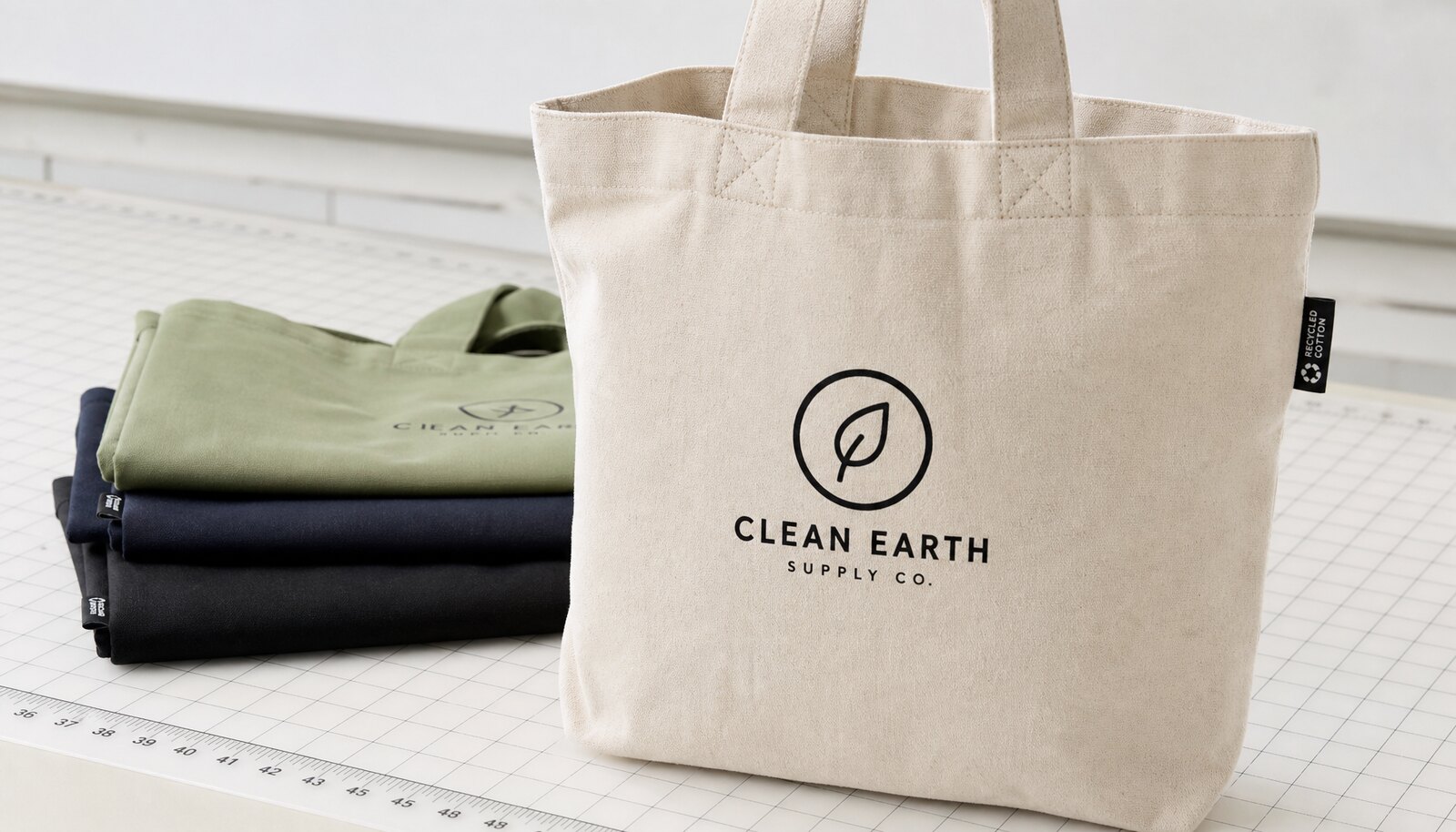
Why recycled canvas totes still make sense for trade show programs
Recycled canvas is useful because it solves more than one problem at once. It gives exhibitors a bag that can carry brochures, samples, and a laptop-sized handout kit without collapsing on the floor. It also gives the brand a more durable surface than a thin nonwoven or paper giveaway, which matters when the bag keeps moving through the hall after the first handoff. For buyers planning recycled canvas totes for trade shows, the value is not the sustainability label by itself. It is the combination of structure, printability, and reuse potential.
The tote should be treated as event equipment, not a generic promo item. It affects booth flow, storage volume, venue receiving, and the total cost of the program. A bag that is too light can look cheap and fail under a real load. A bag that is too heavy can drive freight, raise pack volume, and reduce the number of pieces you can move in a pallet or carton. The best spec is the one that fits the content, the audience, and the distribution model.
- Best fit: conference handouts, expo welcome kits, distributor roadshows, and sponsor giveaways.
- Less suitable: ultra-low-cost handouts expected to be discarded immediately.
- Buying rule: define the tote as a carry system first, then as a printed item.
Start with the contents, not the tote quote
The bag size should follow the actual contents. If the tote is carrying brochures and a pen, a modest open-top bag may be enough. If it must hold samples, bottles, or a boxed set, the gusset and handle build matter much more. For most trade show handouts, sizes around 38 x 42 cm or 40 x 35 cm with an 8 to 12 cm gusset cover the usual need. That is not a rule; it is a starting point. The right dimensions depend on whether the bag needs to stand upright, lie flat in cartons, or sit comfortably over a shoulder during a full day on the floor.
Handle style follows use case. Short handles are fine if attendees carry the bag only from the booth to the next aisle. Longer handles are better if the tote needs shoulder carry while people move between sessions. For premium event kits, buyers should also care about how the handle is attached. A clean top hem, symmetric handle placement, and a reinforced stress point reduce the chance that the bag twists when loaded. If the supplier cannot explain the carry behavior, the quote is probably too generic to be useful.
- Brochure kit: lighter canvas, open top, compact gusset, and fast distribution.
- Sample kit: stronger canvas, deeper gusset, and reinforced handle attachment.
- VIP or sponsor bag: cleaner finish, more controlled print placement, and tighter dimensional tolerance.
Fabric weight and recycled-content proof are separate decisions
Fabric weight controls the hand feel, structure, and freight profile of the tote. For most event programs, 12 oz to 14 oz recycled canvas is a practical middle ground. It has enough body to feel substantial without turning the bag into a freight problem. Ten-ounce cloth can work for lightweight collateral, but it usually feels softer and less durable, especially when the tote is reused. Heavier cloth can make sense for premium programs, but buyers should expect higher material cost and more packing volume. The right answer depends on how the tote will be used after the show, not only on the first handout.
Recycled-content proof is a different question. Ask what the claim actually covers. Does it refer to recycled fiber, recycled yarn, or finished cloth made from recycled input? If your internal team needs the claim for reporting, procurement, or customer-facing material, the supplier should be able to show a lot-level document or certificate that maps to the production run. Useful evidence can include a GRS or RCS certificate where applicable, a mill declaration, a lot number, and a sample label tied to that batch. Do not let 'eco canvas' stand in for documentation.
- 10 oz: workable for light handouts, but less robust and less premium.
- 12 oz: the default starting point for many trade show tote programs.
- 14 oz+: better for repeat use, heavier samples, and a more structured shape.
- Ask for finished weight, not just nominal cloth weight.
- Confirm whether the recycled claim is supported at fiber, yarn, or finished-cloth level.
Construction details decide whether the tote survives the event
Canvas totes fail at the seams, not in the marketing copy. That is why the construction spec matters. Buyers should write down seam allowance, stitch density, handle reinforcement, and top finishing rather than leaving those choices to the factory. A reasonable starting point for this category is a seam allowance in the 8 to 10 mm range and stitch density around 7 to 10 stitches per inch on the load-bearing areas. That is not a universal standard. It is a procurement baseline that gives the factory a measurable target and makes the sample easier to evaluate.
The handle attachment deserves special attention because it takes the load every time the bag is picked up. Box-stitch or bar-tack reinforcement at the stress point is usually the right call for a trade show tote, especially if the bag will carry samples or repeated daily use. A hemmed top edge and clean internal finishing also matter because raw edges fray quickly once the bag is folded, opened, and re-packed. If a tote is meant to be reused, these small details determine how long the item stays in circulation and how it reflects on the brand.
- Write the handle length into the spec for hand carry or shoulder carry.
- Require symmetric handle placement so the bag hangs straight when loaded.
- Ask for close-up photos of seam construction, not only a front view of the tote.
- Treat loose thread tails, skipped stitches, and twisted handles as avoidable defects.
Print method should match the artwork and the event timeline
For simple logos and large runs, screen print remains the most practical option on recycled canvas. It offers strong opacity, predictable repeatability, and usually the cleanest unit economics when the artwork is limited to one or two colors. It is also easier to compare from sample to bulk because the print process is familiar and controlled. If the bag needs a full-color image, fine gradients, or a very low MOQ, the supplier may propose a digital transfer or another decorated method. That can be acceptable, but the buyer should check how the print behaves after folding, stacking, and normal handling. A sample that looks fine on a table is not enough.
Print control should include placement tolerance, edge quality, and cure performance. On a tote, a logo that drifts a few millimeters can look crooked from across a booth, especially if it is large or centered. Ask for a strike-off or a decorated sample before bulk approval, and check how the print looks after a rub test and a few folds. If the artwork is complicated, ask the supplier to explain where they expect the process risk to sit: opacity, registration, hand feel, or turnaround time. That answer tells you whether the process fits the deadline.
- Screen print: best for simple logos, strong visibility, and larger quantities.
- Transfer or digital print: useful for small runs or complex art, but test durability carefully.
- Ask for placement tolerance in writing so the approval is not subjective.
- Check print after fold and rub, not only on a flat sample.
Supplier verification should be document-driven, not conversational
A good tote supplier can show more than a price sheet. If the recycled-content claim matters, ask for the actual document chain behind it. That may include a GRS or RCS certificate if the supply chain qualifies, a mill declaration, a transaction certificate, a lot identifier, or a recycled-content statement tied to the specific fabric used in your tote. If the factory uses subcontractors, ask who buys the cloth, who prints the bag, and who signs off on the finished product. The point is traceability. You want to know which document applies to the exact material you are buying, not to a different line or a different month.
Audit evidence matters too. If the order is large or the brand risk is high, ask for a recent SMETA, BSCI, SEDEX, ISO 9001, or equivalent audit summary, plus any corrective action closure notes that are relevant to production control. You do not need every certification under the sun. You do need enough evidence to know the factory can control labor, process, and repeat orders. A supplier that refuses to share even a summary document is giving you too little to judge whether the tote spec can be held in production.
- Ask for the certificate number, scope, and expiration date if a certification is used.
- Request the mill name and lot ID for the fabric used in the sample.
- Check whether the sample and the bulk order are tied to the same material source.
- Ask who owns final inspection: the factory, a third party, or the trader.
Make sample approval traceable before you approve bulk
Samples are only useful if they can be tied to the production run. A golden sample should be labeled with the product version, fabric weight, print method, color reference, and date of approval. If the tote has multiple versions, each one needs its own control point. Buyers should also ask whether the sample was made on the same line or with the same material source as the planned bulk order. Otherwise, the sample can be visually correct and still fail to represent the real shipment.
The sample review should cover structure, print, finish, and load. Measure the finished dimensions after the bag has been pressed or folded the same way it will be packed. Check the handle length against the approved spec. Rub the print with a white cloth to see whether transfer is obvious. Load the sample with the real event contents or a realistic equivalent weight. If the tote is for a premium sponsor kit, ask for two samples: one to approve, and one to keep sealed as the reference sample that the factory must match. That reduces the chance of drift between approval and shipment.
- Ask for a labeled pre-production sample, not only a generic mockup.
- Keep one sealed approved sample whenever the order is large or brand-sensitive.
- Record the approved art file version so the factory cannot swap files later.
- Require the sample to reflect the planned packing method, not just the bag shape.
MOQ, lead time, and sample cost need to be spelled out early
The quote is more useful when it separates the parts of the cost. Ask for the bag price, print setup, sample cost, packaging cost, and freight basis separately. This matters because a low-looking unit price can hide a high setup fee, or a cheap sample can be offset by a slow bulk lead time. For event programs, the timing is often more important than the raw factory price. A tote that lands after the show is not a bargain. Buyers should ask for the expected sample lead time, the bulk lead time after sample approval, and any conditions that could extend both, such as fabric sourcing, dyeing, or peak season congestion.
MOQ should be broken out by size, fabric color, and print version. That is especially important if the event team wants multiple languages, regional sponsor logos, or separate attendee and VIP bags. Some suppliers can combine multiple artworks into one fabric run, but not every line can do that efficiently. Ask whether setup can be shared across versions and whether the sample cost is credited back if the bulk order proceeds. A quote that answers those questions clearly is much easier to compare than one that just gives a unit price and a promise.
- Ask for separate lines on unit price, setup, sample, packing, and freight.
- Confirm whether sample charges are refundable or credited on bulk.
- Get MOQ by size, color, and print version, not one blended number.
- Ask what conditions trigger lead-time slips during show season.
QC should use measurable acceptance criteria, not broad language
Quality control is where many tote programs get too vague. A buyer can inspect a sample visually and still miss the defects that matter in volume. A practical QC plan should include a visual check, a seam check, a print adhesion check, a load test, and a carton-count verification. Use a standard that the factory can repeat. A common procurement baseline is AQL 2.5 for major defects, 4.0 for minor defects, and zero tolerance for critical defects. If your brand is more sensitive, tighten those thresholds. The key is to define them before production starts, not after the first complaint.
The acceptance criteria should be written in plain terms. Major defects include wrong artwork, open seams, missing handles, severe stains, or a bag that fails the load test. Minor defects can include loose threads, slight print wobble, or a small cosmetic inconsistency that does not affect use. For construction checks, look for a seam allowance within the approved range, stitch density near the written spec, and handle reinforcement that does not pull apart when loaded. For print checks, use a dry-rub test of 50 double rubs on a white cloth and reject obvious smear or heavy transfer. If a tote is going to a trade show, the bag should survive simple handling without looking tired before it reaches the venue.
- Use the real event load or a realistic equivalent for the load test.
- Check dimensions on a finished, packed sample, not only on a cut piece.
- Reject open seams, missing handles, and wrong artwork as critical defects.
- Verify carton count and outer marks before shipment leaves the factory.
Packing, freight, and reuse economics should be part of the buying decision
Recycled canvas is bulky, so packing format changes the landed cost more than many buyers expect. Bulk packing is usually the best choice when the bags are moving to a warehouse or a venue and presentation is secondary to efficiency. Retail-style packing or polybags may be justified if the tote will be stored for a long period, sold at retail, or inserted into a polished VIP kit. Ask for carton dimensions, gross weight, and estimated CBM with the quote so you can compare shipping modes before the order is placed. If one supplier uses tighter packing and another does not, the delivered cost can differ even when the FOB price looks close.
The reuse tradeoff matters as well. A lighter bag may be fine if the tote only needs to survive one event. A heavier, better-constructed tote usually makes more sense if the bag will move from the show floor into a second or third use. That does not mean every program needs the thickest cloth available. It means the team should choose the weight and construction that fit the actual lifecycle. If the goal is a one-day handout, do not overbuild. If the goal is a reusable branded bag that attendees will keep, the cost per use usually favors the better spec.
- Bulk pack for freight efficiency and warehouse speed.
- Use retail-style packing only when presentation or storage requires it.
- Compare landed cost, not just the factory quote.
- Match the fabric weight to the expected reuse cycle.
Specification comparison for buyers
| Verification item | Strong supplier evidence | Buyer follow-up | Risk if weak |
|---|---|---|---|
| Recycled-content claim | GRS, RCS, or a mill declaration tied to the exact lot | Ask what the claim covers and which production batch it applies to | Vague 'eco canvas' language with no traceable support |
| Fabric source and finish | Mill name, finished GSM or oz, and any wash or dye finish noted on the spec | Request a mill sheet or spec sheet plus a labeled swatch | Only a nominal cloth weight with no finished-spec detail |
| Social and factory audit | Recent SMETA, BSCI, SEDEX, ISO 9001, or equivalent internal audit summary | Ask when the audit was done and whether corrective actions were closed | No evidence of factory control or labor compliance |
| Sample traceability | Pre-production sample labeled with lot ID, version, date, and approver | Ask for a golden sample photo and a sample control record | A sample that cannot be tied back to the bulk run |
| Print control | Defined print method, art version, placement spec, and cure method | Request a strike-off or decorated sample before bulk | Promises to 'match artwork' with no tolerances |
| Quality inspection | AQL-based report or a defined defect grid with major/minor categories | Ask for the inspection template and the last report format | No written inspection standard |
| MOQ and lead time | MOQ by size, color, and print version, plus sample and bulk lead times | Ask whether mixed artworks can share one fabric run | A quote that omits timing until after order placement |
| Packing and carton marks | Pack count, carton dimensions, gross weight, and clear SKU labels | Request a carton photo and a packing list sample | Freight surprises from oversized or mixed cartons |
| Commercial terms | Unit price plus setup, sample cost, shipping basis, and rework policy | Ask for FOB and delivered-cost lines separately | A single all-in price that hides cost drivers |
Buyer checklist before sampling
- Define the event job first: handout bag, VIP kit bag, retail-style reusable bag, or sponsor giveaway.
- List the actual contents the tote must hold, including brochures, samples, bottles, or boxed inserts.
- Lock the bag size, gusset depth, and handle length before asking for pricing.
- Specify the fabric weight in GSM or oz and ask for the finished weight after processing.
- Ask whether the recycled-content claim is supported by GRS, RCS, a mill declaration, or another traceable document.
- Confirm whether the tote needs an open top, hemmed top, binding, lining, or reinforcement at the handle base.
- State the print method, number of colors, and whether placement must be centered, offset, or repeated on both sides.
- Provide vector artwork and note any brand rules for Pantone matching, edge spacing, or clear zone.
- Ask for a pre-production sample or golden sample and define exactly how it will be approved.
- Request carton dimensions, gross weight, pack count, and estimated CBM so freight can be compared accurately.
Factory quote questions to send
- What recycled-content document can you provide for this tote, and does it apply to the fiber, yarn, or finished cloth?
- What is the exact finished fabric weight in GSM or oz after processing, not just the nominal cloth description?
- Can you share the mill name, fabric origin, and any certification scope that supports the recycled-content claim?
- What seam allowance, stitch density, and handle reinforcement do you use on this bag?
- What print method are you quoting, how many colors are included, and what is the setup charge for each side?
- Can you provide a decorated sample or strike-off before bulk approval, and what does it cost?
- What is the MOQ per size, fabric color, and print version, and can multiple event artworks share one production run?
- What are the sample lead time, bulk lead time, and the usual causes of delay during peak trade show season?
- What inspection standard do you use, and can you share a recent report format or AQL summary?
- How are the bags packed, labeled, and cartonized, and what are the carton dimensions and gross weight?
Quality-control points to confirm
- Set a common baseline of AQL 2.5 for major defects, 4.0 for minor defects, and 0 for critical defects unless your internal standard is stricter.
- Use a finished-size tolerance that is written into the PO, such as +/- 0.5 cm for key dimensions on a standard tote.
- Require seam allowance to stay within the approved range, commonly 8 to 10 mm for load-bearing seams on this type of bag.
- Check stitch density on a representative sample, with a practical baseline around 7 to 10 stitches per inch on the main seams.
- Define handle reinforcement clearly, such as box-stitch or bar-tack reinforcement at the stress point, with no skipped stitches or loose thread bundles.
- Run a static load test with a realistic event fill, such as 5 kg for 30 minutes on a standard giveaway tote, or a higher approved threshold for premium kits.
- Inspect print adhesion with a dry-rub check of 50 double rubs on a white cloth, with no visible smear or heavy transfer.
- Inspect print placement against the approved sample, with no obvious off-center logo, misregistration, or edge breakout.
- Treat open seams, missing handles, wrong artwork, severe stains, and broken packaging as critical defects.
- Verify carton counts, outer marks, and pack counts against the packing list before the goods leave the factory.