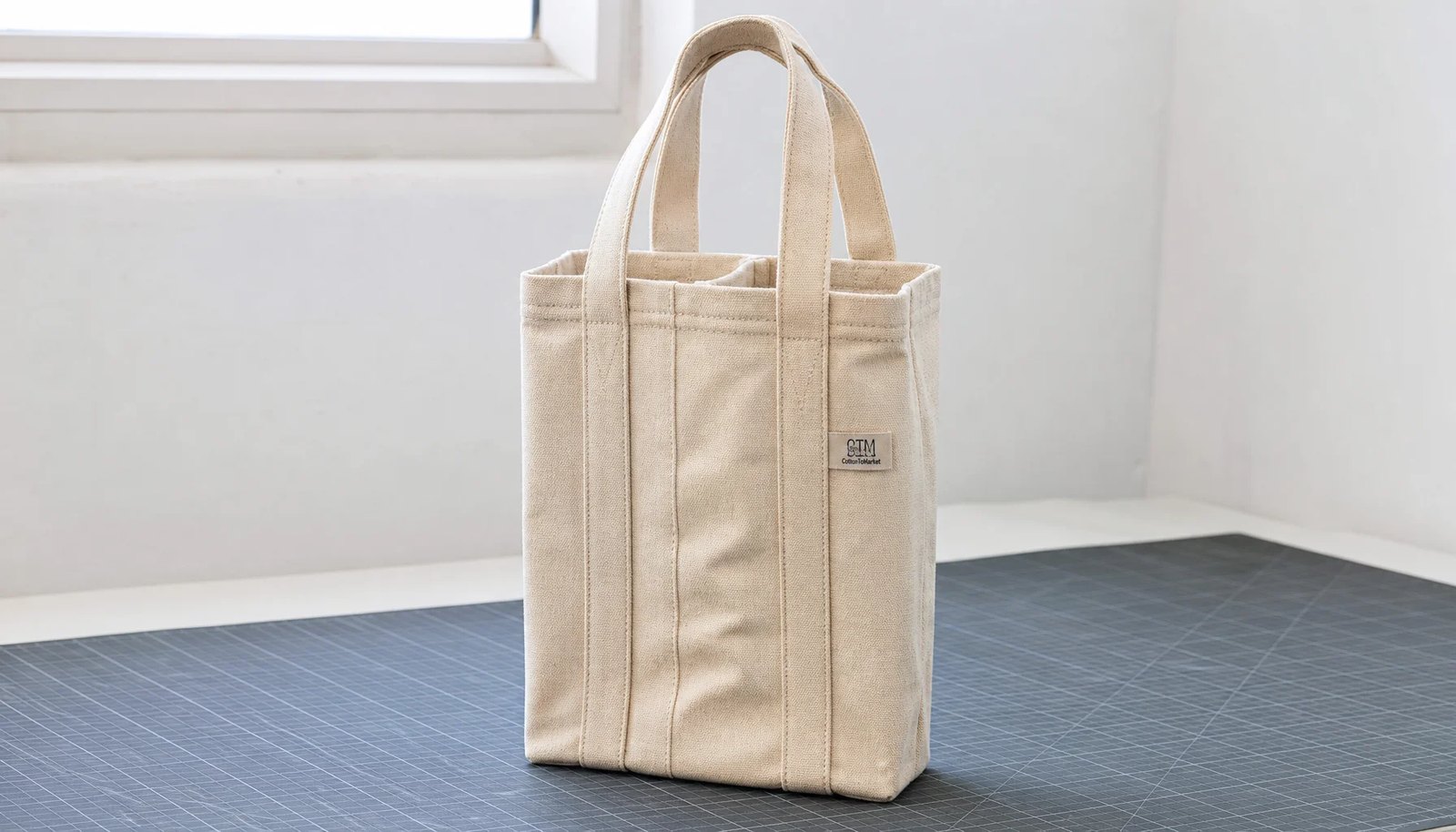
1. Trade Show Handling Exposes Construction Gaps Fast
Wholesale canvas wine carriers for trade show exhibitors are usually judged too early by appearance and too late by damage. On a booth floor, the bag is lifted with one hand, set down hard, opened quickly, stacked with other materials, and moved again. That handling pattern is harder on seams, handles, and decoration than a controlled retail display ever is. If the spec only describes color and logo placement, the first real quality test happens after the shipment is already on the way to the event.
Procurement teams need to think in terms of failure modes, not just product style. The common weak points are handle anchors, top hems, bottle dividers, and any decoration that crosses a fold line or sits close to a seam. If the carrier is reused across shows, the durability target changes again because the bag must survive repeated loading, not just one gifting cycle. The right commercial question is not whether the sample looks premium. It is whether the build matches the handling environment the bag will actually face.
- Trade show use stresses seams, handles, and print zones more than shelf display does.
- Reusable programs need construction that survives multiple loading cycles, not one handoff.
- The earliest failures usually show up at handle anchors, top hems, and fold lines.
2. Start With Bottle Geometry And Use Case
Do not start the spec with fabric. Start with the bottle. A 750 ml bottle is not one shape, and the difference between a narrow Bordeaux profile and a wider Burgundy profile changes the gusset, divider, and usable height. Closure type matters too. Cork, screw cap, and synthetic closure can each change the effective height you need inside the bag. If the carrier is for two bottles, decide whether the bottles share a cavity, sit side by side with a divider, or use a fixed insert to keep them stable during movement.
This is also where many quote comparisons go wrong. Finished dimensions should be based on the loaded bag, not the flat cut size. Define inside width, gusset depth, usable height, and top opening after closures or inserts are installed. If the bag has a zipper, snap, tie, or board insert, those items are part of the size logic. A bag that fits a flat drawing can still fail when a real bottle label, neck, or closure adds a few millimeters of obstruction. Your spec should tell the factory exactly what the bottle stack looks like and how much clearance is acceptable.
- Confirm bottle diameter, bottle height, and closure type before fixing the size.
- Write the spec around loaded dimensions, not only flat pattern dimensions.
- If the carrier uses a divider or insert, define thickness, attachment, and edge finish.
3. Fabric Weight Only Works When The Build Matches It
A common starting point for a two-bottle canvas carrier is a midweight woven canvas that has enough body to stand up, enough surface stability for decoration, and enough strength for normal event handling. Lighter builds can be appropriate for short-use or single-event programs. Heavier builds make sense when the carrier will be reused, when the bottles are heavier, or when the brand wants a more premium hand feel. The better question is not which fabric is strongest, but which fabric supports the actual program without creating unnecessary stiffness or cost.
Fabric alone does not make the product durable. Ask for seam allowance, stitch density, reinforcement method, and thread type. Handle anchors should use a reinforcement pattern that is visible and repeatable, not a decorative stitch that only looks strong. If the bag includes an insert, divider, or lining, inspect the interface between those parts and the outer shell. Abrasion at internal edges is a common hidden failure point. Buyers should also confirm whether the factory controls cutting and sewing in the same facility or whether the order moves between multiple subcontracted steps, because that affects consistency and accountability.
- Match fabric weight to reuse frequency, bottle mass, and brand position.
- Treat seam allowance, reinforcement, and thread as part of the strength spec.
- Check for internal abrasion points where dividers, inserts, or linings meet the shell.
4. Choose Decoration For Wear, Not Just Graphics
Decoration choice affects durability, cost, and lead time, so it should be selected for the handling profile rather than for the artwork file alone. Screen print is often the best fit for simple logos and repeat orders because it is repeatable and usually more stable on canvas. Transfer methods can work when artwork changes often or the run is short, but they should be evaluated for edge lift, cracking at fold lines, and wear after handling. A sample that looks sharp on day one is not enough if the logo starts breaking down after a few booth moves.
Placement matters as much as method. A logo centered across a handle anchor or a sharp fold will wear faster than the same logo on a flat panel. If the canvas is dark, the supplier may need an underbase or a different print approach to maintain color strength. Woven labels, side labels, and hang tags should be line-itemed separately so the buyer can see what is included and what is a later add-on. That separation helps prevent surprise charges and makes it easier to compare factories that are quoting different build levels under similar-looking sample photos.
- Use screen print when the art is stable and repeated handling matters.
- Use transfers only when artwork complexity or timing justifies the tradeoff.
- Keep decoration away from fold lines, handle anchors, and other wear points where possible.
5. Build A Durability Testing Checklist That Reflects Reality
A useful durability testing checklist should mirror how the carrier is actually used, not how a generic lab test happens to be written. Start with load-bearing checks on the handles, then move to drop or impact checks that reflect the real handoff from cart to booth or dock to shelf. If the product has a closure, test it in both lightly loaded and fully loaded conditions. If there is a divider or insert, make sure it stays seated under movement. The goal is not to prove the carrier is indestructible. The goal is to uncover the weak point before the order is approved for bulk.
That checklist should be tied to the production sample, not to a hand-made sales sample that never reflects the true process. If the factory sends a polished hand sample and then changes sewing method in bulk, the approval is meaningless. For procurement, the smarter approach is to define the test route in advance: how the bag is loaded, how it is lifted, what surface it is dropped onto, how many cycles are needed, and what level of print wear is acceptable. Keep the wording specific enough that the supplier knows exactly what passed or failed, but avoid pretending that one universal number fits every program.
- Test the sample in the same construction and packing method that bulk production will use.
- Define load, drop, and rub targets from actual field handling rather than a generic standard.
- Include closure retention, divider stability, and handle distortion in the test scope if they matter to use.
6. Read Quotes As A Landed-Cost Document
A quote is only useful if it can be compared on the same basis. At minimum, separate the base bag price, print or decoration charges, sample cost, trim or label cost, carton cost, and freight terms. If the supplier gives one bundled number, you cannot see whether the low price depends on a thinner canvas, fewer reinforcements, or optimistic packing assumptions. Hidden cost usually shows up later as a change order, a rushed remanufacture, or a delay that did not appear in the headline number.
Incoterms matter here because they determine who controls the shipment and which costs are included. EXW shifts more responsibility to the buyer, while FOB and FCA often give more control at the export handoff. DAP and DDP can simplify budget planning, but only if the quote clearly states what is excluded, especially duties, remote-area surcharges, storage, and re-delivery fees. Region also matters. Lead times and freight risk are different if the supplier ships from a port with congestion, from an inland manufacturing cluster, or from a region that has seasonal holiday closures. Compare the same route, the same destination, and the same delivery window before treating two quotes as equivalent.
- Separate base bag, decoration, trim, packaging, and freight so the quote is auditable.
- Use the same Incoterm and destination for every supplier comparison.
- Ask about holiday closures, port congestion, inland trucking, and other region-specific lead-time risks.
7. Audit The Supplier, Not Just The Sample
Supplier evaluation should go beyond a pretty sample. Ask for a factory profile that shows who cuts, who sews, who decorates, who inspects, and who packs. If those steps happen in different facilities, ask how traceability is maintained and who owns the defect if something fails. A credible supplier should be able to show production capacity, active product lines, inspection flow, and a clean escalation path for defects or late approvals. For business-critical orders, the most useful document is not a brochure. It is the operating picture of how the supplier actually runs the line.
Audit criteria should also fit the order risk. For a low-stakes, one-time event, a lighter review may be enough. For repeated annual spend or a customer-facing premium program, request the quality manual, recent inspection records, and social compliance or ethical sourcing documentation that your purchasing policy requires. Ask whether the supplier can maintain color and lot traceability across reorder cycles. If the bag is part of a brand program, that traceability matters because a slightly different canvas lot, print screen, or trim source can change the look and wear of the finished product even when the order description appears identical.
- Request a factory profile that maps cutting, sewing, decoration, inspection, and packing.
- Check traceability across fabric, thread, trim, and decoration consumables.
- Match the audit depth to the spend risk and the business impact of a failure.
8. Make Sampling A Production Control Step
Sampling should control production, not just approve artwork. A sales sample can help the buyer judge the overall concept, but it is not enough if the bulk product will use a different sewing flow, a different print method, or a different packing method. The sample that matters is the pre-production sample made from the intended fabric, trim, and final decoration setup. That sample should be measured, loaded, rubbed, and checked under the same assumptions that apply to the bulk run. If the supplier cannot reproduce that sample consistently, the order is not ready.
Treat the approved sample as the reference for the PO and for any later dispute. Mark it clearly, record the dimensions, note the fabric lot if possible, and capture the accepted decoration placement. Then check the first production output against that sample before the factory runs the whole lot. This is where many programs save time. It is cheaper to stop a bad run after the first cartons than to negotiate a correction after the order has already shipped to a receiving warehouse. A disciplined sample process is especially important when the event date leaves little room for replacement stock.
- Use the pre-production sample as the production reference, not the sales sample unless they are identical.
- Record fabric lot, trim lot, decoration placement, and packed configuration against the approved sample.
- Inspect the first output before the full run continues if the order has tight timing.
9. Control Packing For Booth Life, Not Warehouse Life
Packing is part of the product. A carrier can pass construction checks and still arrive looking tired if the carton is too tight, the handles are bent, or the decoration is rubbing inside the pack. For trade show programs, ask the supplier to protect the print face, keep handles flat, and avoid compression that creates a permanent crease. If the product is retail-ready, polybagging or a simple protective wrap may help, but only if it does not deform the bag. The question is how the carrier should look when it is first handed over at the event, not whether it can survive indefinite warehouse storage.
Carton count and pallet pattern matter because damage gets expensive once the bags are dispersed across show sites or distributor locations. Specify master carton size, unit count per carton, orientation, and pallet build before the order starts. If multiple destinations are involved, label cartons clearly so the receiving team does not have to open mixed packs to sort them. This is a practical procurement issue, not a packaging preference. Poor pack planning creates rework, delays, and avoidable damage, especially when the bags are being delivered alongside other event materials that already compete for attention and space.
- Specify carton count, carton size, orientation, and pallet pattern before bulk starts.
- Protect print faces and handles from compression and rubbing during transit.
- Use clear carton marks if the order will be split across multiple show locations.
10. Award The Order With Buffer For Freight And Reorder Risk
MOQ and lead time are not just supplier terms. They are risk signals. MOQ usually rises when the order adds custom fabric, multiple print colors, dividers, inserts, or special closures because each change adds setup and material complexity. Lead time changes with fabric availability, peak seasons, port congestion, and regional holiday calendars. The useful question is not what the factory prefers in theory. It is what it can produce consistently without quietly changing the build or stretching the schedule past your event date.
For procurement planning, compare first-order MOQ and repeat-order MOQ separately. Reorders are often easier because the factory already has the pattern, screens, and sewing method in place. Landed-cost planning should also include a buffer for customs clearance, inland transfer, and delivery to the final receiving point. If the bag must arrive before a show, ask the supplier for two milestones: when the goods leave the factory and when they are actually expected at the venue or the receiving warehouse. That distinction matters more than a low ex-works price if the shipment is likely to be late.
- Expect MOQ to change with custom color, more decoration, inserts, and special closures.
- Compare first-order and repeat-order MOQ separately because they are often different.
- Plan for factory lead time, export transit, customs, inland delivery, and event-side receiving as separate steps.
Specification comparison for buyers
| Spec decision | Recommended option | When it fits | Buyer risk to check |
|---|---|---|---|
| Direct factory with sewing and decoration in-house | Use one supplier that controls cutting, sewing, decoration, inspection, and final pack-out | Repeat orders, fixed artwork, and programs where consistency matters more than switching suppliers | Confirm the approved sample came from the same production line and not a hand-finished sample room |
| Factory with third-party test evidence | Ask for documented load, rub, and colorfastness results tied to the exact build you are buying | Retail buyers or brand teams that need internal review files or a compliance trail | Check that the report matches the same fabric weight, handle build, print method, and carton pack |
| Trading company with factory disclosure | Use when you need multiple sourcing options or a broader material range | Multi-SKU programs or buying teams that want backup sourcing | Verify which factory owns the pattern, who controls QC, and who pays for remake or delay costs |
| Stock blank carrier with local decoration | Use for rush events, short runs, or first-time market tests | Show deadlines where speed matters more than full customization | Inspect seam quality, handle reinforcement, and base stability before adding artwork |
| Heavier canvas build, typically used for reusable programs | Choose when the carrier will be reused across events or carry heavier bottles | Premium gifting, repeat booth use, or retail resale | Confirm the thicker fabric does not create cracking at fold lines or overly stiff handles |
| Nearshore or regionally closer supplier | Choose when delivery reliability matters more than the lowest ex-works price | Frequent replenishment, tight trade show calendars, or unstable freight lanes | Validate fabric availability, trim sourcing, and repeat lead time, not just sewing capacity |
| Split source: base bag factory and local decorator | Use when artwork changes often but the bag construction stays fixed | Regional event programs with multiple markets or fast marketing updates | Watch for color drift, transit damage, and split accountability if the lot fails |
| EXW, FOB, FCA, DAP, or DDP quote structure | Use the term that matches your freight control and customs capability | Teams that need either maximum control or one landed number | Check what is excluded: duties, remote-area charges, storage, drayage, and re-delivery fees |
| Supplier with a documented audit packet | Choose when the order is business-critical or involves repeat annual spend | Procurement teams that need structured supplier approval | Request factory profile, capacity snapshot, QC flow, traceability, and social compliance documentation |
Buyer checklist before sampling
- Define bottle count, bottle diameter, bottle height, closure style, and whether the carrier will be used for side-by-side or divided loading.
- Lock the intended use case: single event giveaway, repeated booth transport, retail resale, or premium gifting. The use case should drive fabric weight and reinforcement.
- Specify finished dimensions around the loaded bottle, not only the flat pattern size.
- Write the acceptable fabric weight range, color tolerance, and trim consistency into the spec before sampling.
- Ask for seam construction details: seam allowance, stitch density, reinforcement at handle anchors, and whether the factory uses bar tacks or a box-X pattern.
- Choose decoration based on wear, not appearance only. Map the print to the flat panel and keep it away from fold lines and anchors where possible.
- Set buyer-specific durability targets for load, drop, rub, and closure retention, and tie them to the actual route and handling conditions.
- Request a pre-production sample made from the same intended fabric, decoration method, and packing method as bulk production.
- Confirm carton count, carton size, pallet pattern, and outer label text before production starts.
- Compare landed cost using the same Incoterm, same destination, and same delivery window so the quote is actually comparable.
Factory quote questions to send
- What exact fabric weight, weave, and finish are you quoting, and what tolerance do you hold on the bulk lot?
- What finished dimensions are you pricing, and what bottle diameter and closure height did you assume for fit?
- Is this a one-bottle or two-bottle carrier, and is the internal structure a shared cavity, divider, or insert-based design?
- Which seams are reinforced, and do you use bar tacks, box-X reinforcement, or both at the handle anchors?
- What stitch density do you run on the load-bearing seams, and how do you control seam allowance during production?
- What decoration method is included, how many colors are covered, and what setup or screen charges apply by color?
- What is the MOQ for the first order, and does it change on repeat orders using the same fabric and artwork?
- Which Incoterms do you quote by default, and what charges are excluded from the price?
- What lead time do you commit to after sample approval, and what changes it during peak season, holidays, or port congestion?
- Can you share recent factory audit material, QC workflow, and defect escalation process for this product line?
Quality-control points to confirm
- Set the load target from actual use, then add a safety margin that matches the program. For a reusable trade show carrier, many buyers build their internal target around more than the intended field load, but the exact number should come from the bottle weight, carry distance, and reuse expectation rather than a fixed universal standard.
- Choose a drop target that reflects real handling, such as transfer from cart to booth, not an arbitrary benchmark. The spec should describe the surface, orientation, and number of drops so the factory knows what failure mode matters.
- Use a rub or abrasion method your team already recognizes, or specify the method by name in the commercial file. Avoid inserting a grade value unless your procurement policy already uses that reference and the supplier can test to it reliably.
- Require the approved sample to match the production fabric, print method, lining or insert, and pack-out method. A hand-finished sample is not enough if bulk sewing will be machine-run.
- Check that handle anchors, side seams, and top hem reinforcement are consistent across the lot. Small variations here are usually the first sign of a weak run.
- Measure finished width, gusset depth, and usable height against the loaded sample, not the flat blank. The bag should load without forcing the side panels or twisting the handles.
- Inspect decoration at stress points, especially where the print crosses a fold or sits close to a stitched edge. Those zones usually fail first under repeated handling.
- Verify carton count, carton marking, and pack configuration against the PO and packing list before shipment release. Packing mistakes become expensive once the goods are split across multiple show locations.
- Ask for lot traceability on fabric, thread, trims, and decoration consumables so any defect can be isolated quickly if a corrective action is needed.
- Write major and minor defect rules before production starts. Major defects should include seam failure, broken handles, fit failure, and print damage that affects brand presentation or reuse.