Tote Bag OEM Customization Options for United States Manufacturing RFQs
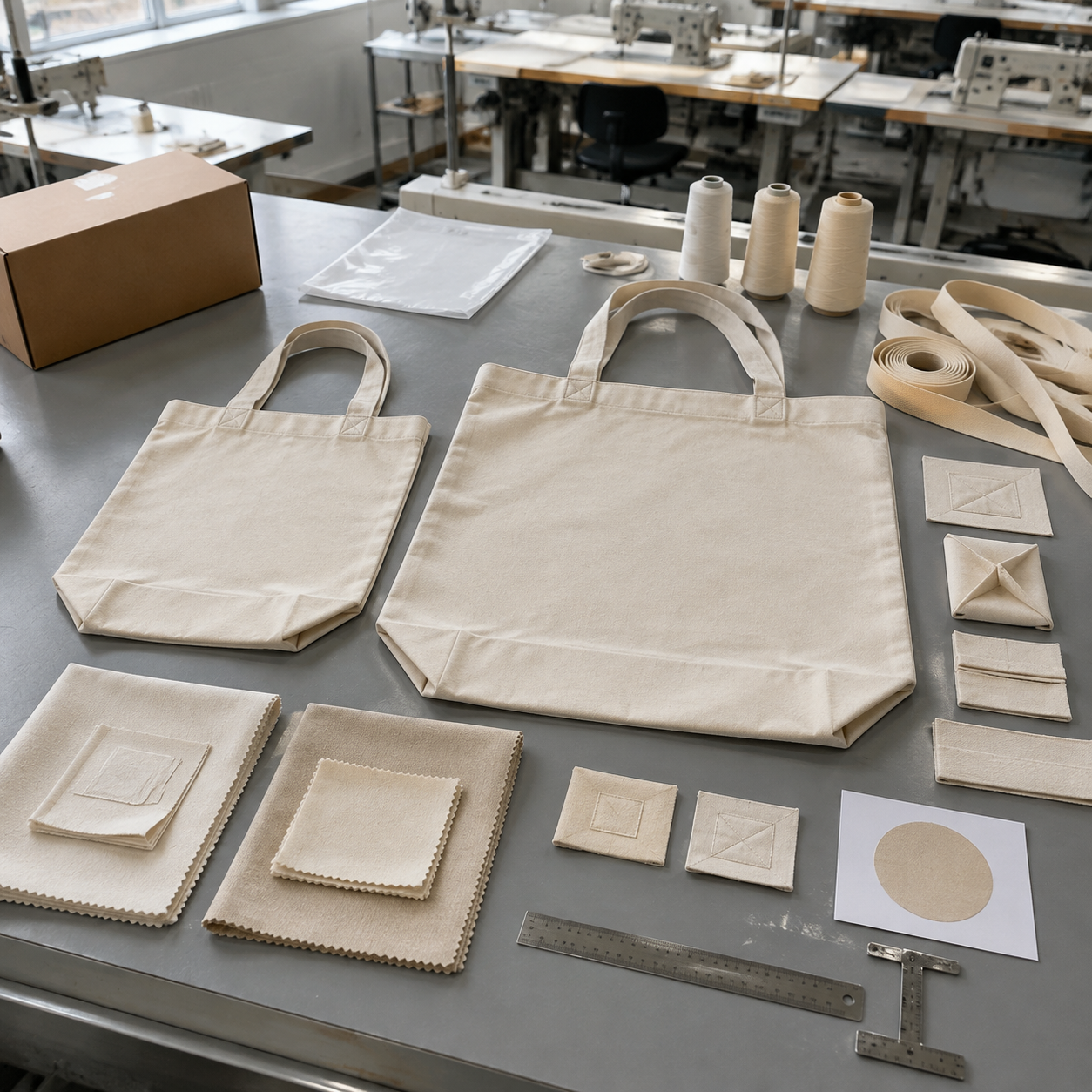
By Vincent Xi, Editorial Author
For United States B2B buyers, tote bag OEM customization options become comparable only after every supplier receives the same baseline specification and returns the same cost breakdown. The buying decision is not simply which features are available. It is which combination of material, construction, decoration, labels, packing, landed cost, and delivery can be documented in the quote and approved before bulk production.
Start with a baseline SKU, then ask suppliers to price each alternative as a separate addition or deduction. Require the offered specification, tolerance, setup cost, sample route, production assumption, schedule effect, and exception for every quote line. This prevents a lower headline price from hiding differences in fabric basis, construction, packing, inspection, or commercial terms.
The controls below are an editorial RFQ method. Published values are identified as planning references rather than supplier commitments, market prices, product test results, certifications, or legal determinations.
United States Customization Options: Fix the Baseline Tote Bag
A supplier cannot quote meaningful customization deltas until the baseline tote bag is defined.
| Decision area | Buyer-controlled RFQ field | Required supplier return | Release evidence |
|---|---|---|---|
| Intended use | Expected contents, carry method, service conditions, sales channel, and buyer-defined performance targets | Recommended material and construction, with assumptions and deviations identified | Approved use statement and defined sample checks |
| Finished body | Length, width, depth, measurement points, measurement condition, and tolerance | Offered dimensions, tolerance, pattern changes, and price effect | Dimensioned pre-production sample and measurement record |
| Fabric | Fiber composition, weave, nominal ounce designation, gsm value, weight basis, finish, color route, and tolerance | Offered composition and mass per unit area, whether stated before or after finishing, and requested supporting documents | Approved bulk swatch and material document set |
| Handles and base | Handle material, width, drop, placement, attachment, reinforcement, seams, gusset, and base construction | Construction description, separately priced alternatives, and proposed performance check | Construction sample and buyer-approved check record |
| Decoration | Artwork revision, process, color reference, size, placement, substrate, and locations | Process limits, setup costs, subcontracting disclosure, sample route, and schedule effect | Production-fabric strike-off or decorated pre-production sample |
| Labels and trim | Legally reviewed copy, dimensions, material, placement, attachment, and hardware finish | Dielines, physical samples, available current documents, and deviations | Approved dieline and physical sample |
| Packing | Fold method, unit protection, inserts, tickets, carton count, carton specification, and shipping marks | Pack count, carton dimensions, net and gross weights, packing cost, and pallet assumptions where applicable | Packed sample and approved carton specification |
| Commercial and delivery | Quantity by variant, currency, quoted trade term, named place, approval dates, and United States receiving point | Itemized prices, validity period, payment terms, milestone dates, freight assumptions, and exclusions | Signed specification, purchase order, and approval calendar |
Treat a blank or unresolved field as a supplier proposal, not buyer acceptance. The response should show the proposed value, price effect, schedule effect, and evidence needed for approval. The RFQ should also state which signed document controls if the specification, drawing, artwork, sample, and purchase order conflict.
Price Customization Options as Quote Deltas
Ask each supplier to preserve the baseline price and return an additive or deductive amount for every alternative. This keeps a design change from reopening unrelated quote lines.
| Customization decision | Hold constant in the baseline | Price separately | Approval control |
|---|---|---|---|
| Body profile | Finished dimensions, panel layout, measurement method, and tolerance | Alternate dimensions, gusset, boxed base, or changed panel layout | Recorded measurements against the approved drawing |
| Fabric and color | Composition, weave, mass basis, finish, and color route | Lighter or heavier fabric, lining, coating, stock dye, or custom dye | Swatch, mass-verification method, color approval, and required documents |
| Handles and reinforcement | Material, width, drop, placement, attachment, and stitch construction | Alternate drop, webbing, self-fabric handle, rope, or added reinforcement | Construction sample and buyer-defined performance check |
| Interior and closure | Open top and unlined body, if that is the baseline | Pocket, lining, zipper, snap, magnet, or divider | Functional sample and agreed defect criteria |
| Decoration | Process, artwork revision, color reference, size, placement, and location count | Alternate process, added color, larger area, or additional location | Production-fabric sample and recorded artwork approval |
| Labels and trim | Approved copy, material, dimensions, placement, and attachment | Woven label, printed label, hangtag, ticket, patch, or hardware | Approved dieline, physical sample, and document review |
| Packing | Fold, unit protection, master-carton pack, and shipping marks | Individual pack, insert, retail-ready pack, or pallet requirement | Packed sample, carton data, weights, and pack count |
Published Values: Planning Inputs, Not Specifications
The date labels below are the publishers' framing, not independent verification dates. The figures are useful for supplier questions but should not be copied into a purchase order without quote-specific confirmation.
- Finished-size examples: In the Kenwys page's 2025/2026 buyer-guide period, 35 x 40 cm is presented as a small-tote example and 45 x 50 cm as a large-market-tote example. The unit is centimeters, the scope is example finished body dimensions, and the source is How to Source Custom Canvas Tote Bags. The page does not establish measurement points or tolerances for the buyer's pattern.
- Fabric-positioning examples: The Homevolution page presented as a 2026 sourcing guide pairs a nominal 5 oz description with approximately 150 gsm and a nominal 12 oz description with approximately 340 gsm. The units are the publisher's commercial ounce descriptions and grams per square meter; the scope is its lightweight promotional and heavier retail positioning. The source is the 2026 Tote Bag Sourcing Guide. The page does not establish a universal conversion basis or allowable mass tolerance.
- Custom-color planning range: In the Kenwys page's 2025/2026 buyer-guide context, 5% to 15% of unit cost is presented as a custom-color planning range. The unit is percent of unit cost, the scope is the publisher's commercial estimate, and the source is Kenwys. Replace that range with the supplier's quoted surcharge, dye-lot conditions, approval timing, and rejected-lot responsibility.
Because the cited pages do not define a common ounce basis, the RFQ should request the nominal ounce designation and gsm value separately. It should also state whether mass applies before or after finishing, the permitted tolerance, sample conditioning, and verification method.
Convert Each Customization Option into Approval Evidence
A material name, sample photograph, or premium descriptor is not a measurable specification. Connect each choice to a supplier response and a release record.
| Choice | Quote response required | Approval evidence |
|---|---|---|
| Fabric composition and mass | Fiber content, weave, nominal ounce designation, gsm value, weight basis, finish, and tolerance | Approved bulk swatch, stated measurement method, and required current documents |
| Color and finish | Natural, stock-dyed, or custom-dyed route; color reference; finish; and change restrictions | Lab dip or swatch approval under the buyer-defined review method |
| Body dimensions | Finished dimensions, measurement points, measurement condition, and tolerance | Signed drawing and pre-production measurement record |
| Handles and seams | Width, finished drop, attachment location, reinforcement, seam construction, and positional tolerance | Approved construction sample and defined defect criteria |
| Base and interior | Gusset, corners, base panel, lining, pocket, closure, binding, or piping | Functional sample and opened construction reference where required |
| Decoration | Exact process, artwork revision, substrate, color reference, size, placement, setup cost, and subcontracting status | Production-fabric strike-off or decorated sample with retained reference |
| Labels and trim | Copy, material, dimensions, placement, attachment, finish, and required supporting documents | Approved dieline, physical sample, and document review |
| Packing | Fold, unit protection, inserts, tickets, carton specification, weights, and marks | Packed sample and confirmed carton record |
For a buyer-created handle or seam check, specify the load unit, hold or lift sequence, cycle count, sample condition, pass criteria, and recording party. That check is a purchase-order control unless a recognized test method is expressly incorporated. Passing it does not establish certification.
The Gorfia manufacturing-details article is used only to identify base reinforcement as a customization decision that should be priced and checked on the buyer's sample. Its project narrative is not evidence of performance for another order.
Decoration Sample Gates
The Homevolution page presented as a 2026 sourcing guide and the Kenwys page presented for the 2025/2026 buyer-guide period discuss screen printing, embroidery, and transfer-based decoration as sourcing options. They do not establish compatibility, durability, cost, or production capability for a buyer's selected fabric and artwork. Treat each process as a candidate to quote and sample. (Homevolution; Kenwys)
| Decoration route | RFQ fields | Sample checks |
|---|---|---|
| Screen print | Artwork revision, ink system, color reference, print area, location, curing route, setup cost, and substrate | Registration, coverage, strike-through, edge quality, adhesion, position, and approved color |
| Embroidery | Artwork revision, thread specification, backing, placement, stitch basis, setup cost, and substrate | Puckering, thread breaks, backing visibility, edge definition, position, and reverse-side finish |
| Transfer or digital process | Artwork revision, exact process, substrate requirement, placement, setup cost, and application conditions | Edge adhesion, cracking, hand feel, position, color, and claimed rub or wash performance |
| Label, patch, or hardware | Material, finish, dimensions, attachment method, placement drawing, and contract documents | Alignment, attachment security, sharp edges, surface damage, and consistency |
A digital rendering can approve layout intent, but it does not show production-fabric interaction. Before bulk release, record the approved artwork revision, approve the relevant physical sample, and identify retained reference samples held by the buyer and supplier.
United States Labeling Controls for Customized Tote Bags
Label artwork should remain a release gate until the actual construction, intended use, claims, transaction, and sales channel have been reviewed. A generic label template cannot determine legal coverage.
Textile-labeling review. Determine whether the customized tote is covered by the federal textile-labeling rules or an applicable exclusion. For a covered product, route the proposed fiber content, country-of-origin disclosure, and responsible-business information through qualified review against the current FTC textile-labeling guidance. Requirements for another textile product should not be assumed to apply automatically to the tote.
Country-of-origin marking. Confirm the required marking, placement, permanence, and any transaction-specific exception for the actual imported article and packaging under the current federal country-of-origin marking regulation. This source identifies the linked regulatory scope; it is not a supplier certification. The buyer's customs broker or trade counsel should review the proposed result.
Channel-specific review. If the tote is designed or marketed as a children's product, determine whether testing, certification, or tracking-label obligations apply to that product using the current CPSC tracking-label resource. For California distribution, review the actual inks, coatings, hardware, and intended exposure against current California business guidance before deciding whether a warning is required.
Claim documentation. For a recycled, organic, water-resistance, wash, chemical, or other product claim, the RFQ should identify the required document or test report, covered material or production lot, issuing party, validity period, applicable method, and responsibility for testing. A website badge, undated document, or general supplier declaration does not by itself establish that the ordered product satisfies the claim. Do not describe the product, material, or supplier as certified without a current document covering the exact claim.
The linked official resources identify external questions for legal, customs, children's-product, and chemical-warning review. Supplier inspection plans, label templates, restricted-substance lists, and internal tests are company procedures; they must not be represented as United States legal determinations or independent certifications.
Landed-Cost Controls for United States Manufacturing RFQs
Use the same currency, quoted trade term, named place, quantity split, validity period, and destination in every comparison. Keep customization costs separate from logistics and import assumptions so a product change does not silently alter the landed-cost model.
| Cost line | Required input and control |
|---|---|
| Goods | Unit price by quantity, fabric, colorway, construction, decoration revision, and packing version |
| Development | Samples, artwork conversion, screens, digitizing, molds, tooling, lab dips, and sample courier charges |
| Customization deltas | Custom dye, decoration locations, pockets, lining, closure, reinforcement, labels, trim, and retail packing |
| Packing | Unit packaging, inserts, tickets, master cartons, required carton checks, and palletization |
| Origin charges | Inland movement, export handling, and documents, with each inclusion and exclusion stated |
| International movement | Freight basis, equipment assumption, booking period, insurance, and included or excluded surcharges |
| United States import | Transaction-specific classification reviewed by the buyer's broker or counsel, customs value, duty, fees, and applicable trade measures |
| United States delivery | Terminal charges, examination exposure where applicable, drayage, transload, storage exposure, and delivery to the named receiving point |
| Quality and compliance | Inspection, laboratory work, document review, sorting, rework, retesting, and replacement responsibility |
Treat a supplier-proposed tariff classification as an input for review, not a final landed-cost fact. Provide the buyer's broker or counsel with the actual sample, composition, construction, intended use, value, and transaction details before releasing the import-cost worksheet.
Example Calculation: Assumptions to Verify
The following figures are an editorial example, not sourced price evidence, a market price, or a supplier offer. The scope is a hypothetical United States RFQ. Replace every input with a dated supplier, carton, freight, and broker record before making a sourcing decision.
| Example worksheet line | Assumed or derived value | Status and verification control |
|---|---|---|
| Order quantity | 5,000 units | Example assumption; replace with the purchase-order quantity |
| Goods price | USD 2.40 per unit | Example supplier-price assumption; verify in the supplier's dated quote |
| Allocated international freight | USD 0.35 per unit | Example freight assumption; verify against current freight and confirmed carton data |
| Goods subtotal | USD 12,000 for 5,000 units | Derived example from the assumed quantity and goods price |
| Freight subtotal | USD 1,750 for 5,000 units | Derived example from the assumed quantity and allocated freight |
| Partial total | USD 13,750 for 5,000 units, equal to USD 2.75 per unit | Derived example containing only the assumed goods and freight lines |
The partial total excludes development, customization deltas not included in the assumed goods price, inspection, insurance, duty, import fees, brokerage, terminal charges, and United States inland delivery.
Delivery Controls for United States Purchase Orders
In its 2025/2026 buyer-guide context, the Kenwys page cites 7 to 35 days plus shipping as a production planning range. The unit is days, the scope is the publisher's general production estimate before destination shipping, and the source is How to Source Custom Canvas Tote Bags. The source does not make that range a commitment for the selected fabric, decoration, quantity, season, or United States receiving date, and it does not define whether the days are working or calendar days.
Build the purchase-order calendar from dated, owner-assigned milestones:
- Specification, drawing, and artwork release.
- Material availability confirmation.
- Lab dip, swatch, or decoration strike-off submission and approval.
- Pre-production sample submission, correction, and approval.
- Bulk material availability.
- Cutting, decoration, sewing, finishing, and packing windows.
- Buyer or third-party inspection window and release authority.
- Ex-factory readiness and freight-booking confirmation.
- Departure estimate, United States arrival estimate, customs allowance, and delivery to the named receiving point.
Require the supplier to distinguish estimates from commitments and identify milestones dependent on buyer approval, material availability, subcontracted decoration, or freight booking. An ex-factory date does not answer a buyer's required United States receiving date.
RFQ Matrix for Tote Bag Customization Options
The matrix below is adapted from the Lucky Star Creation page presented as a 2026 manufacturer-selection checklist. The scope of that source is defining end use, dimensions, material, construction, branding, packing, and quality before supplier comparison. It does not validate a supplier, product, price, capacity, or delivery claim. (How to Choose a Custom Bag Manufacturer)
| RFQ section | Fields the supplier must complete |
|---|---|
| Document control | Buyer SKU, RFQ revision, drawing revision, artwork revision, issue date, response deadline, and authorized contacts |
| Product scope | Tote silhouette, intended use, expected contents, carry pattern, service expectation, and reference-sample hierarchy |
| Quantity | Total quantity, split by colorway and artwork, permitted overrun or underrun, and supplier minimums |
| Measurements | Finished body dimensions, depth, handle length and drop, placement, tolerances, measurement points, and measurement condition |
| Fabric | Composition, weave, nominal ounce designation, gsm value, weight basis, tolerance, color route, color reference, finish, and claim documents |
| Construction | Pattern panels, seams, stitch construction, top edge, base, gusset, corners, handle attachment, reinforcement, lining, pockets, and closure |
| Decoration | Exact process, artwork revision, color reference, area, locations, ink or thread requirement, setup cost, and subcontracting disclosure |
| Labels and trim | Legally reviewed copy, dielines, materials, placement, attachment, hardware finish, hangtags, tickets, and supporting documents |
| Packing | Fold method, unit protection, inserts, units per carton, carton material, dimensions, net and gross weights, shipping marks, and pallet plan |
| Sample gates | Material swatch, color approval, strike-off, construction prototype, packed pre-production sample, approval owner, and retained references |
| Inspection and testing | Defect categories, measurement checks, sampling plan, acceptance criteria, methods, units, pass criteria, report format, and release authority |
| United States review | Proposed label data, origin marking, composition declaration, channel requirements, current reports, and broker or counsel hold points |
| Commercial response | Price breakdown, customization deltas, setup and sample charges, currency, quoted trade term, named place, payment terms, validity, and exclusions |
| Logistics and delivery | Carton count, cube, weights, origin readiness, freight assumptions, destination, approval dates, inspection window, and receiving requirement |
| Change control | Written approval before changing fabric source, composition, weight, color, construction, decoration process, trim, labels, or packing |
| Exceptions | Every deviation, reason, price effect, schedule effect, and proposed approval evidence |
| Nonconformance | Sorting, rework, replacement, retesting, freight, and payment-hold responsibilities |
Evidence Method and Limitations
Author basis. Vincent Xi is identified as the Editorial Author. No personal factory visit, product test, customer outcome, or first-person sourcing experience is claimed.
Source context: RFQ structure. The Lucky Star Creation page presented as a 2026 checklist supports the categories to define before supplier comparison. It is not evidence of manufacturing capability or performance. (Lucky Star Creation)
Source context: numerical planning references. The Homevolution page presented as a 2026 sourcing guide and the Kenwys page presented for the 2025/2026 buyer-guide period support only the attributed size examples, fabric-positioning descriptions, custom-color planning range, and production planning range. They are commercial sourcing pages, not independent laboratory reports, live quotations, purchase orders, or delivery commitments. (Homevolution; Kenwys)
Source context: construction. The Gorfia article is used only to identify base reinforcement as a customization decision to price and inspect. Its project narrative is not treated as evidence for another order. (Gorfia)
Source context: United States controls. The linked FTC guidance, federal country-of-origin marking regulation, CPSC resource, and California business guidance identify questions for legal, customs, children's-product, and chemical-warning review. Applicability must be determined for the actual tote, claims, transaction, and sales channel.
Methodology. The cited commercial pages were compared for overlapping customization fields and numerical planning references. Each retained value is paired with its unit, publisher period, scope, source, and a statement of what it does not prove. Those fields were then translated into buyer inputs, supplier-return fields, approval evidence, commercial deltas, and change controls. The landed-cost arithmetic is separately labeled as a hypothetical example whose inputs must be replaced with current quote data.
Limitations and verification. The cited commercial pages do not establish current prices, capacity, legal compliance, certification, laboratory performance, cartonization, or committed delivery. Verify finished dimensions, measurement tolerances, composition, fabric mass, color route, dye surcharge, decoration, labels, packing, test methods, carton dimensions, weights, quote validity, and milestone dates in the supplier's written quote and approved pre-production sample. Verify United States labeling, country-of-origin marking, classification, duty treatment, children's-product scope, and California obligations with qualified counsel or the buyer's customs broker using current official requirements. Obtain current documents before making any material, environmental, compliance, or certification claim.
Discuss Your Requirements
Review our manufacturing capabilities, then share your specifications for a supplier-fit review.