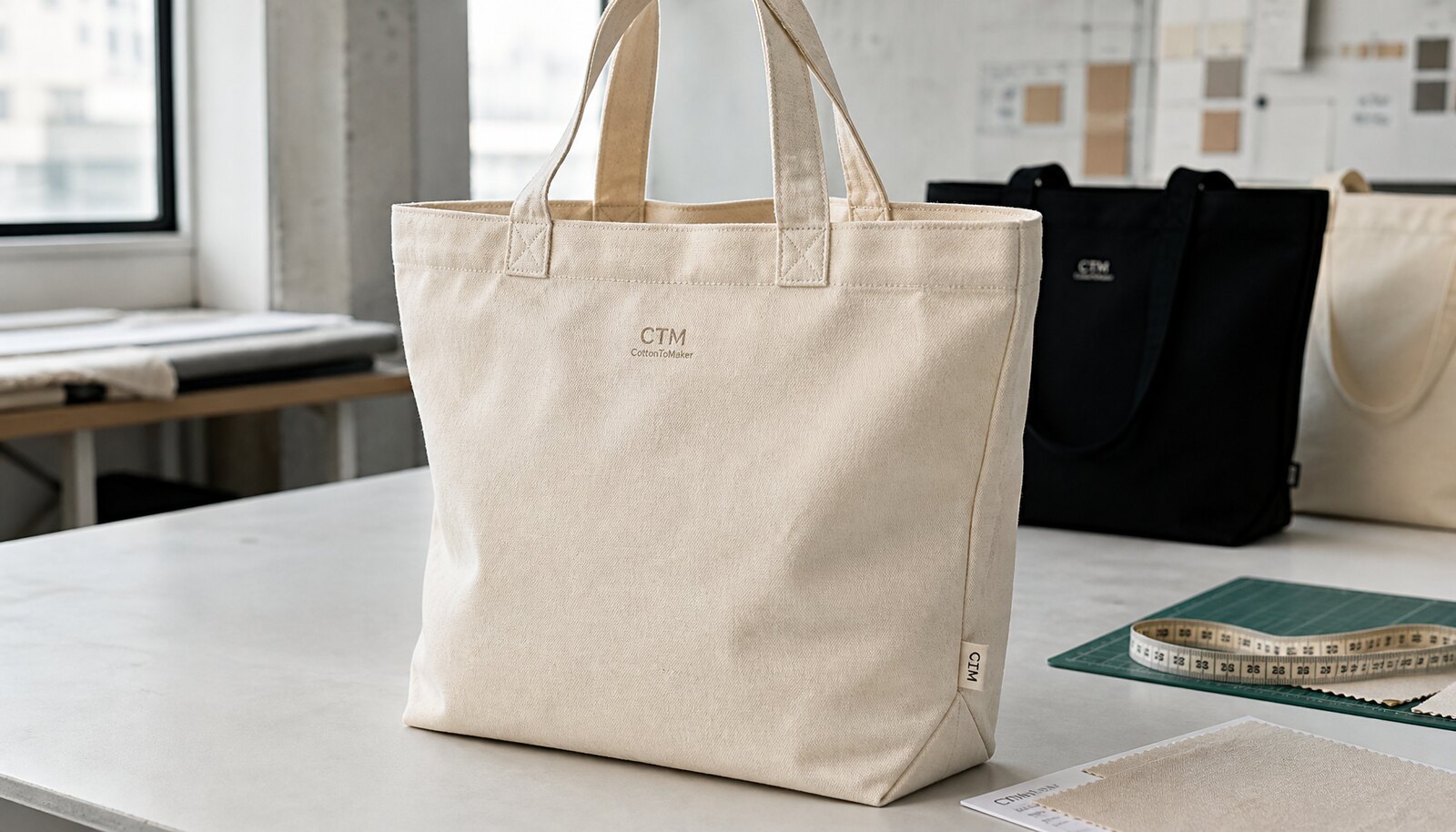
What buyers actually mean by tote bag canvas custom
When procurement teams search for tote bag canvas custom, the real need is usually not a generic tote. It is a repeatable finished product that can be quoted consistently, produced in volume, and received without a rework backlog. That means the buyer needs a spec that a factory can build from, not just a logo file and a target price.
Canvas totes look simple, which is why they often get under-specified. The cost driver is rarely only the bag itself; it is the combination of fabric weight, body construction, handle reinforcement, print process, and packing format. If those choices are not fixed before you request pricing, suppliers will fill in the blanks differently and the quotes will not be comparable.
The most useful question is not 'how much for a custom tote?' It is 'what exact bag are we buying, how will it be measured, and what constitutes an acceptable unit?' Once that is clear, sourcing decisions become more disciplined and the risk of surprise charges drops sharply.
- Define the use case before you ask for price.
- Quote the finished bag, not just the fabric and print.
- Keep the approved sample tied to one written spec version.
Start with the bag structure before you price the decoration
The body of the bag sets the cost floor. A flat tote is faster to sew and uses less cloth, so it usually wins on price. A bottom gusset or side gusset adds usable capacity and makes the tote feel more substantial, but it also increases sewing time, trim consumption, and the chance of dimensional variation.
For most retail and promotional programs, 10 oz to 12 oz canvas is the practical middle ground. It usually gives enough body for print readability and carry strength without pushing the bag into a heavy, expensive build. If the tote will hold books, groceries, or sample kits, move up in weight and tighten the handle reinforcement rather than trying to save cost on the cloth.
Handle design is often underpriced in RFQs. A long webbing handle, folded self-fabric handle, or reinforced sewn-on handle will all change the quote. The same is true for top hems, interior binding, and whether the raw edges are fully enclosed. Those details are visible to the buyer and to the end customer, so they should be part of the quote request from the start.
- Flat body: lowest cost and simplest production.
- Bottom gusset: more usable volume and better shelf shape.
- Reinforced handles: worth paying for when the bag will carry real weight.
- Fully enclosed edges: cleaner interior and lower fray risk.
Fabric weight, weave, and finish are not interchangeable
Two suppliers can both say 12 oz canvas and still deliver different results. One may be quoting a looser weave with a softer hand feel; another may be quoting a tighter, denser fabric that prints better and holds shape longer. That is why a pure GSM or oz number is not enough. You need the fabric description, finish, and whether the cloth is pre-shrunk, washed, or calendared.
For tote bag canvas custom programs, natural or bleached canvas is the fastest route when you want a clean production start and fewer dye variables. Dyed canvas can look premium, but it adds shade control and may extend lead time if the color is not stocked. If color is critical, ask for a lab dip or a small strike-off and approve it against a daylight standard before the factory books bulk cloth.
Buyers should also ask how the fabric is measured. Some mills quote the greige cloth weight, then the finished weight changes after finishing or printing. Others quote the post-finish weight. If you do not specify the measurement point, you can end up comparing unlike numbers and making a bad commercial decision on paper.
- 10 oz to 12 oz is the usual commercial sweet spot.
- Pre-shrunk cloth reduces surprise size drift, but can add cost.
- Natural canvas lowers dye risk and usually speeds sampling.
- Ask whether the weight is measured before or after finish.
Print method should follow the artwork, not habit
For simple logos and repeat orders, screen print is often the strongest commercial option. It gives good opacity on canvas, scales well once setup is paid, and usually survives handling better than thin transfer layers. The tradeoff is that screen print is less flexible when the artwork changes often, because each color or revision adds setup time and cost.
Digital print or heat transfer makes more sense when the design has gradients, fine detail, or too many colors for economical screen setup. That said, the buyer should not assume that a sharper digital proof automatically means a better tote. Canvas texture can break up fine detail, and some transfer films age poorly if the bag is folded, rubbed, or packed tightly.
A practical rule is simple: if the design is a logo or a small set of spot colors, screen print usually wins on total cost. If the artwork is image-heavy, limited quantity, or still evolving, a digital or transfer route can reduce setup friction. What matters is confirming the ink system, curing method, and post-print durability on the actual fabric, not on a smooth proof sheet.
- Screen print: best for simple logos and repeat volume.
- Digital or transfer: better for small runs and complex art.
- Always verify rub resistance on the actual canvas.
- Ask for the print method that matches the artwork, not the supplier's default.
How to compare factory quotes without comparing the wrong number
A useful quote breaks the product into the parts that actually move cost: fabric, cutting, sewing, printing, trim, packing, and export carton. If a supplier gives you a single all-in price with no detail, you cannot see what changes when you adjust size, fabric, or print complexity. That makes negotiation weak and makes later change orders almost inevitable.
The biggest commercial differences usually come from five items: fabric weight, bag size, reinforcement at the handles, number of print colors, and packing format. A quote that looks cheap can become expensive after you add polybags, barcode labels, carton marks, or an additional print version. Procurement should normalize all quotes to the same spec before comparing them side by side.
Do not stop at the unit price. Ask for setup fees, sample fees, carton dimensions, gross weight, and whether the quoted quantity includes yield loss or overage. If you are buying a first run, it is often better to see the total landed production cost for the pilot quantity and the replenishment quantity rather than pretending one price applies to both.
- Separate one-time setup from recurring unit cost.
- Normalize all quotes to the same finished size and packing method.
- Check whether cartons, labels, and polybags are included or extra.
- Treat unusually low prices as a prompt for a deeper spec check.
Supplier route selection: direct factory, trading company, or hybrid model
The right sourcing route depends on how much control the buyer wants over fabric, print, and schedule. A direct factory is usually the best route when the order is specification-heavy, repeatable, or sensitive to QC. It gives you a clearer line of sight on the actual production steps and usually less markup between your spec and the floor.
A trading company can still be the right answer when the purchase is bundled with other products, when the buyer wants one contact point across multiple suppliers, or when internal procurement capacity is limited. The commercial tradeoff is visibility. If the trade partner is too thin on production detail, you can lose control over the fabric source, the print subcontractor, or the final inspection point.
A hybrid route can work when one specialist controls the print or trim and a factory handles sewing. That is useful only if somebody clearly owns the spec and the final approval sample. If no one owns the chain end to end, the buyer becomes the integrator by default, which usually costs more time than it saves.
- Direct factory: best for control, repeat orders, and cleaner defect ownership.
- Trading company: useful for consolidation, but require named production sites.
- Hybrid sourcing: workable only when one party owns final QC accountability.
- If the quote is unusually low, ask who is actually sewing and printing the bags.
Comparison table: which route or spec choice wins in practice
The most useful sourcing decision is the one that balances price, lead time, and control. Use the table below to decide where your order belongs before you build the RFQ package. A buyer who knows the right route early can avoid a lot of quote noise later.
Packing also belongs in the buying decision, not just the warehouse checklist. Bulk packing reduces cost and carton volume, while individual polybagging or retail inserts increase labor, material use, and carton count. The right choice depends on who is receiving the goods and how much rework happens after delivery.
- Anchor decisions to measurable requirements, not vague preferences.
- Ask the supplier to quote the same spec in each route you are considering.
- Do not mix packing assumptions across suppliers when comparing price.
Sample approval is where most programs either tighten up or drift
A sample is only useful if it proves the actual production variables. A rough mock-up, a digital proof, or a prototype made from substitute cloth is not enough to approve bulk. It can help with layout and general appearance, but it cannot confirm the hand feel, drape, print behavior, or seam strength of the real bag.
For tote bag canvas custom programs, the cleanest approval path is usually a reference sample, then a pre-production sample made with final fabric and final trim, then a first-off or bulk seal sample from the actual line. Each stage should answer a different question. The reference sample checks look and fit. The pre-production sample checks process reality. The first-off sample confirms the line can reproduce the agreed standard before the rest of the order is released.
The approval record should include the exact bag dimensions, print position, handle length, fold method, packing style, and any defects that were noted and accepted. If a change is made after approval, it should be treated as a spec revision with a new sign-off rather than a casual email thread.
- Approve final fabric, not substitute fabric.
- Approve final print method, not a digital proof alone.
- Approve the final packing method, because it affects handling and carton count.
- Record every accepted exception so bulk inspection has a clear baseline.
QC limits that are specific enough to act on
QC becomes useful only when it is measurable. For fabric weight, size, stitching, print placement, and carton pack-out, the buyer should set a tolerance before bulk begins. Without that, an inspector can only say a bag looks fine or does not look fine, which is not enough for a commercial purchase order.
A good starting point for standard canvas totes is plus or minus 5 percent on fabric weight, plus or minus 0.5 cm on small finished dimensions, and plus or minus 1.0 cm on larger dimensions. Handle length should also be checked against the approved sample so both straps hang evenly and the bag does not look twisted when packed flat. For print, a half-centimeter placement tolerance is usually enough for logo work, but the buyer should tighten it if the design must align with seams or panels.
Print durability needs a practical test, not just a visual check. A dry rub test and a light wet rub test on the actual canvas will catch the common problems early: under-cured ink, weak film adhesion, and powdery surface transfer. If the bag is dyed, inspect for shade variation across panels and between cartons. If the bag is washed or pre-shrunk, verify post-finish dimensions before the order is released.
- Use measurable tolerances for fabric weight, size, stitch quality, and print position.
- Require a rub test on the finished print, not just a visual approval.
- Open random cartons from across the shipment, not only the top layer.
- Reject mixed-SKU cartons unless they were explicitly approved.
Packing and carton strategy affects both freight cost and warehouse work
Packing is not just a logistics detail. It changes freight density, carton damage risk, and how much labor your receiving team spends unpacking and counting. A tightly folded tote can save carton volume, but it can also crease the print or set a permanent fold line. A looser pack protects the appearance better, but it may increase carton size and shipping cost.
For bulk and wholesale channels, the cleanest route is usually a standard fold, one SKU per carton, and carton marks that match the purchase order exactly. That makes receiving faster and reduces the chance of count errors. If the bags need individual polybags or insert cards, make sure the supplier includes the added labor and material in the quote. Those items are easy to omit accidentally and they are expensive to add late.
Carton weight matters too. A carton that is technically efficient but too heavy to handle safely will slow down warehouse flow and can create receiving complaints. Ask the supplier to quote carton dimensions, carton gross weight, and pieces per carton before the order is placed. That is basic procurement discipline, but it prevents a lot of avoidable friction at destination.
- Bulk pack is usually cheapest and easiest to receive.
- Retail-ready packing costs more, but it may save downstream labor.
- Keep carton weight and carton size aligned with your warehouse limits.
- Use carton marks that identify style, color, quantity, and PO number.
Specification comparison for buyers
| Decision | Recommended range or route | Price impact | Lead-time impact | When it wins |
|---|---|---|---|---|
| Fabric weight | 10 oz to 12 oz canvas, about 340 to 410 GSM | Low to medium; usually the best balance of hand feel and cost | Low; stock cloth is easier to book | Retail programs, promos, and general-purpose shopping totes |
| Fabric weight | 13 oz to 16 oz canvas, about 440 to 540 GSM | Medium to high; more cloth and more sewing time | Medium; heavier goods can slow cutting and stitching | Premium retail, books, and carry-heavy use |
| Sourcing route | Direct factory | Usually lowest at scale because there is less markup | Medium; you still need sample and approval time | You need tighter control over fabric, print, and sewing quality |
| Sourcing route | Trading company or agent | Medium to high; markup buys coordination and bundle service | Medium to high; more handoff points can add delay | You are consolidating several items or do not have internal sourcing bandwidth |
| Print method | Screen print for 1 to 4 spot colors | Lowest at repeat volume after setup is amortized | Medium; screen prep adds setup time | Simple logo programs, repeat orders, and strong opacity on canvas |
| Print method | Digital print or heat transfer for complex art | Medium to high; better for short runs or many colors | Low to medium; faster setup, but more process sensitivity | Gradients, detailed graphics, or pilot runs |
| Packing | Bulk pack by SKU, then carton label by PO and color | Lowest labor and carton cost | Lowest; simplest for the factory to execute | Wholesale, distribution, and warehouse rework at destination |
| Packing | Individual polybag with insert card or barcode sticker | Higher labor, materials, and carton volume | Medium; extra handling and QC time | Retail-ready presentation or high-touch channels |
Buyer checklist before sampling
- Define the end use first: retail shelf, trade show, shopping carry, or mailer-style distribution, because that decision changes the right fabric weight, handle length, and packing method.
- Lock the finished size in writing, including body width, body height, gusset depth if any, and handle drop, so the factory does not quote against its own assumptions.
- State the fabric spec in measurable terms: target GSM or oz, natural or bleached canvas, and whether the cloth is pre-shrunk, washed, or calendared.
- Provide artwork as vector files, then name the print location, number of colors, Pantone references, and any front/back or repeat-placement requirement.
- Decide the acceptable version count up front: one SKU, multiple colors, or multiple print variants, because each version changes MOQ and sorting cost.
- Set a sample approval path with one owner, one approved sample, and one change-control rule so the bulk order is not approved by email fragments.
- Write the packing instruction clearly: fold direction, polybag yes/no, insert card yes/no, carton count, carton weight limit, and carton mark language.
- Specify the receiving requirement: palletized or not, mixed SKUs or not, and whether cartons must be easy to count and scan in the warehouse.
- Ask for the inspection method before bulk starts, including how many random cartons will be opened, what gets measured, and what defects trigger rework.
- Require a documented tolerance sheet for size, fabric weight, stitch quality, print placement, and pack-out so the quote and the QC standard match the same version.
Factory quote questions to send
- What is the finished fabric weight of the actual production cloth, and what tolerance do you accept on incoming rolls?
- Is the quoted GSM or oz measured on greige fabric, finished fabric, or after any wash or pre-shrink process?
- Which print method are you pricing for this artwork, and what are the setup charges, screen charges, plate charges, or curing costs?
- What is your MOQ by color, by artwork version, and by packing style, and which of those thresholds changes the unit price most?
- Can you break the quote into fabric, cutting, sewing, printing, packing, export carton, and any one-time setup fee?
- Do you own the fabric, cutting, printing, and sewing steps in-house, or are any of them subcontracted to another site?
- What is your standard seam specification on the body and handle attachment, including stitch density and reinforcement style?
- How do you approve the first-off sample before bulk, and what exactly is frozen after that approval?
- What packing format is included in the quote: bulk pack, polybag, barcode sticker, insert card, or palletization?
- What carton count, gross weight, and carton dimensions are you planning for this style, and can you share the carton pack-out sheet?
Quality-control points to confirm
- Fabric weight should stay within plus or minus 5 percent of the agreed target for standard programs; for premium retail programs, tighten the tolerance to plus or minus 3 percent.
- Finished size should be checked flat after pressing, with a practical tolerance of plus or minus 0.5 cm on smaller bags and plus or minus 1.0 cm on larger bodies.
- Handle length and handle drop should be consistent bag to bag, with a target tolerance of plus or minus 1.0 cm unless the design is intentionally variable.
- Main seams should be sewn at a consistent density, with no skipped stitches, open seams, or visible seam waviness; stress points at the handle join should use reinforcement that matches the approved sample.
- Print placement should align to the approved artwork location within plus or minus 0.5 cm on both axes for standard logo work.
- Ink adhesion should pass a dry rub test and a light wet rub test on the actual canvas, with no visible smearing, flaking, or edge cracking under normal viewing distance.
- If the design uses dyed canvas, require a lot-to-lot shade check against an approved master under daylight conditions, and reject obvious panel-to-panel shade jumps within the same bag.
- Loose threads should be trimmed cleanly, with no long thread tails at handles, side seams, or internal seam turns.
- Carton pack-out must match the packing list exactly, with no mixed-SKU cartons unless the PO explicitly allows it.
- Carton gross weight should stay within the receiving limit agreed with the buyer's warehouse, and carton marks should include style, color, quantity, PO number, and country-of-origin labeling if required.